The young men become increasingly impatient with the slow pace of O’Connell’s repeal campaign and soon begin to contemplate armed insurrection. Davis, along with John Dillon and Charles Duffy, found The Nation, the newspaper of the movement in 1842. In its pages the idea of total separation from England is soon openly suggested, and Lane becomes one of the paper’s contributors. He contributes articles and later poems to the paper, his best known poems being Carrig Dhoun and Kate of Araglen which are written under the pen name “Domhnall na Glanna” or “Domhnall Gleannach.”
Finally, in 1846, the issue of physical force split the Young Irelanders from O’Connell’s Repeal Association. Lane supports the split. Davis, Lane, and small group of their friends soon become known by the name which has survived to this day: the Young Ireland Party.
Lane and his college classmate Michael Joseph Barry are the most prominent Young Irelanders in Cork, and are interned in Cork City Gaol after the Young Ireland Rebellion of 1848. Lane spends four months in prison. After his release, he returns to Cork and does not appear to have much political involvement thereafter.
Sinn Féin, a left-wingIrish republican political party active in both the Republic of Ireland and Northern Ireland, is founded on November 28, 1905, when, at the first annual Convention of the National Council, Arthur Griffith outlines the Sinn Féin policy, “to establish in Ireland’s capital a national legislature endowed with the moral authority of the Irish nation.”
The phrase “Sinn Féin” is Irish for “ourselves” or “we ourselves,” although it is frequently mistranslated as “ourselves alone.” The meaning of the name itself is an assertion of Irish national sovereignty and self-determination, i.e., the Irish people governing themselves, rather than being part of a political union with Great Britain under the Westminster Parliament.
Around the time of 1969–1970, owing to the split in the republican movement, there are two groups calling themselves Sinn Féin, one under Tomás Mac Giolla, the other under Ruairí Ó Brádaigh. The latter becomes known as Sinn Féin (Kevin Street) or Provisional Sinn Féin, and the former becomes known as Sinn Féin (Gardiner Place) or Official Sinn Féin. The “Officials” drop all mention of Sinn Féin from their name in 1982, instead calling itself the Workers’ Party of Ireland. The Provisionals are now generally known as Sinn Féin. Supporters of Republican Sinn Féin, which comes from a 1986 split, still use the term “Provisional Sinn Féin” to refer to the party led by Gerry Adams.
Sinn Féin is a major party in both Northern Ireland and the Republic of Ireland. It is the largest nationalist party in the Northern Ireland Assembly, and the second-largest overall. It has four ministerial posts in the most recent power sharingNorthern Ireland Executive. It holds seven of Northern Ireland’s eighteen seats, the second largest bloc after the Democratic Unionist Party (DUP), at Westminster, where it follows a policy of abstentionism, refusing to attend parliament or vote on bills. It is the third-largest party in the Oireachtas, the parliament of the Republic of Ireland. As Ireland’s dominant parties of Fine Gael and Fianna Fáil are both centre-right, Sinn Féin is the largest left-wing party in Ireland.
Sinn Féin members have also been referred to as Shinners, a term intended as a pejorative.
The Gaiety is extended by theatre architect Frank Matcham in 1883, and, despite several improvements to public spaces and stage changes, it retains several Victorian era features and remains Dublin’s longest-established, continuously producing theatre.
Patrick Wall and Louis Elliman purchase the theatre in 1936 and run it for several decades with local actors and actresses. They sell it in 1965, and in the 1960s and the 1970s the theatre is run by Fred O’Donovan and the Eamonn Andrews Studios, until Joe Dowling, former artistic director of the Abbey Theatre, becomes director of the Gaiety in the 1980s. In the 1990s Groundwork Productions take on the lease and the theatre is eventually bought by the Break for the Border Group. The Gaiety is purchased by music promoter Denis Desmond and his wife Caroline in the late 1990s, who undertake a refit of the theatre. The Department of Arts, Sport and Tourism also contributes to this restoration fund.
The theatre plays host to the 1971 Eurovision Song Contest, the first to be staged in Ireland, during the Gaiety’s centenary year. Clodagh Rodgers, a contestant in that particular contest, later presents her RTÉ television series The Clodagh Rodgers Show from the theatre in the late 1970s.
Aeneas Coffey, Irish inventor and distiller, dies in England on November 26, 1852. He is born in Calais, France, to Irish parents in 1780. He is educated at Trinity College, Dublin, and enters the excise service around 1799–1800 as a gauger. He marries Susanna Logie in 1808, and they have a son, also named Aeneas, who may have been their only child.
According to British customs and excise records, Coffey is a remarkable man with widespread interests and multiple talents who rises quickly through the excise service ranks. He is appointed sub-commissioner of Inland Excise and Taxes for the district of Drogheda in 1813. He is appointed Surveyor of Excise for Clonmel and Wicklow in 1815. In 1816 he is promoted to the same post at Cork. By 1818 he is Acting Inspector General of Excise for the whole of Ireland and within two years is promoted to Inspector General of Excise in Dublin.
Coffey is a strong, determined upholder of the law, but aware of its shortcomings. He survives many nasty skirmishes with illegal distillers and smugglers, particularly in County Donegal in Ulster and in the west of Ireland, where moonshining is most rife. On several occasions he proposes to the government simple, pragmatic solutions to rules and regulations which have hampered legal distillers. Not all of his ideas are accepted. Between 1820 and 1824 he submits reports and gives evidence to Parliamentary Commissions of Inquiry on many aspects of distilling, including formalising the different spellings of Irish whiskey and Scotch whisky. His 1822 report is solidly backed by the Irish distillers. He believes in making it viable to distill legally, and illegal distilling might largely disappear.
He assists the government in the drafting of the 1823 Excise Act which makes it easier to distill legally. It sanctions the distilling of whiskey in return for a licence fee of £10, and a set payment per gallon of proof spirit. It also provides for the appointment of a single Board of Excise, under Treasury control, for the whole of the United Kingdom, replacing the separate excise boards for England, Scotland and Ireland. The 1823 Excise Act also provides for not more than four assistant commissioners of excise to transact current business in Scotland and Ireland, under the control of the board in London. Coffey resigns from government excise service at his own request in 1824.
Between his Dublin education and his work as an excise officer, Coffey has ample opportunity to observe the design and workings of whiskey stills, as Ireland is the world’s leading producer of whiskey in the 19th century, and Dublin is at the center of that global industry. This is how Coffey becomes familiar with a design differing from the traditional copper pot alembic still commonly used in Ireland, the continuous, or column, still. First patented by a Cork County distillery in 1822, the column still remains a relatively inefficient piece of equipment, although it points the way towards a cheaper and more productive way to distill alcohol. It is that last point that captures Coffey’s imagination. He makes his own modifications to existing column still designs, so as to allow a greater portion of the vapors to re-circulate into the still instead of moving into the receiver with the spirit. The result is more efficient, producing a lighter spirit at higher alcohol content. Coffey patents his design in 1830, and it becomes the basis for every column still used ever since.
On his retirement from service, Coffey goes into the Irish distilling business. For a short time he runs the Dodder Bank Distillery, Dublin and Dock Distillery in Grand Canal Street, Dublin, before setting up on his own as Aeneas Coffey Whiskey Company in 1830. The development of the Coffey still makes distillation of his own whiskey much more economical.
Nothing is known of the final years and last resting place of Aeneas Coffey. His only son, also called Aeneas Coffey, emigrates to South Africa and manages a distillery. He marries but his wife dies childless. He returns to England and spends his final years near London.
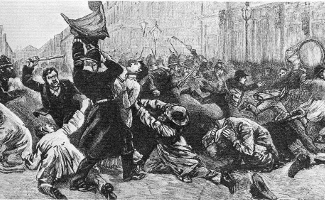
Bloody Sunday takes place in London on November 13, 1887, when a march against unemployment and coercion in Ireland, as well as demanding the release of Member of Parliament (MP) William O’Brien, is attacked by the Metropolitan Police Service and the British Army. The demonstration is organised by the Social Democratic Federation (SDF) and the Irish National League. Violent clashes take place between the police and demonstrators, many “armed with iron bars, knives, pokers and gas pipes.” A contemporary report notes that 400 are arrested and 75 persons are badly injured, including many police, two policemen being stabbed, and one protester bayonetted.
The Long Depression, starting in 1873 and lasting almost to the end of the century, creates difficult social conditions in Britain, similar to the economic problems that drive rural agitation in Ireland. Falling food prices create rural unemployment, which results in both emigration and internal migration. Workers move to the towns and cities in thousands, eroding employment, wages and working conditions. By November 1887, unemployed workers’ demonstrations from the East End of London have been building up for more than two years. There have already been clashes with the police and with the members of upper-class clubs. Trafalgar Square is seen symbolically as the point at which the working-class East End meets the upper-class West End of London, a focus of class conflict and an obvious flashpoint.
This attracts the attention of the small but growing socialist movement – the Marxists of both the Social Democratic Federation and Socialist League, and the reformist socialists of the Fabian Society. Police and government attempt to suppress or divert the demonstrations also bring in the radical wing of the Liberal Party and free speech activists from the National Secular Society.
Some 30,000 persons encircle Trafalgar Square as at least 10,000 protesters march in from several different directions, led by Elizabeth Reynolds, John Burns, William Morris, Annie Besant and Robert Bontine Cunninghame Graham, who are primarily leaders of the Social Democratic Federation. Also marching are the Fabian playwright George Bernard Shaw and Charlotte Wilson. Two thousand police and 400 troops are deployed to halt the demonstration. Burns and Cunninghame Graham are arrested and imprisoned for six weeks. Annie Besant, who is a Marxist, Fabian and secularist, speaks at the rally and offers herself for arrest, but the police decline to do so. Of the 400 arrested, 50 are detained in custody.
In the fighting, many rioters are injured by police truncheons and under the hooves of police horses. There are both infantry and cavalry present. Although the infantry is marched into position with bayonets fixed, they are not ordered to open fire and the cavalry are not ordered to draw their swords.
The following Sunday, November 20, sees another demonstration and more casualties. According to a report in the partisan Socialist Review, among them is a young clerk named Alfred Linnell, who is run down by a police horse, dying in hospital a fortnight later from complications of a shattered thigh.
The funeral of Linnell on December 18 provides another focus for the unemployed and Irish movements. William Morris, leader of the Socialist League, gives the main speech and advocates a holy war to prevent London from being turned into a huge prison. A smaller but similar event marks the burial of another of those killed, W. B. Curner, which takes place in January. The release of those imprisoned is celebrated on February 20, 1888, with a large public meeting. Henry Hyndman, leader of the SDF, violently denounces the Liberal Party and the Radicals who are present.
(Pictured: Bloody Sunday, 1887. This engraving from The Illustrated London News depicts a policeman being clubbed by a demonstrator as he wrests a banner from a female protester.)
In 1910, at the age of 17, he starts an apprenticeship in O’Neill’s hardware trade in Mitchelstown, where he joins the Gaelic League and the Ancient Order of Hibernians. Later he works at Barry’s Timber Merchants in Fermoy. In the aftermath of the 1916 Easter Rising, he witnesses the shooting and arrest of David, Thomas and Richard Kent of Bawnard House by the Royal Irish Constabulary. After this, he determines to dedicate his life to Irish republicanism. In 1917 he is elected First Lieutenant of the Irish Volunteer Company, which resides in Fermoy.
In Cork in 1919, Lynch re-organises the Irish Volunteers, the paramilitary organisation that becomes the Irish Republican Army (IRA), becoming commandant of the Cork No. 2 Brigade of the IRA during the guerrilla Irish War of Independence. He is captured, along with the other officers of the Cork No. 2 Brigade, in a British raid on Cork City Hall in August 1920. He provides a false name and is released three days later. In September 1920, he and Ernie O’Malley command a force that takes the British Army barracks at Mallow. The arms in the barracks are seized and the building is partially burned. In April 1921, the IRA is re-organised into divisions based on regions. Lynch’s reputation is such that he is made commander of the 1st Southern Division.
The war formally ends with the signing of the Anglo-Irish Treaty between the Irish negotiating team and the British government in December 1921. Lynch is opposed to the Treaty, on the ground that it disestablishes the Irish Republic proclaimed in 1916 in favour of Dominion status for Ireland within the British Empire. He becomes Chief of Staff of the IRA in March 1922, much of which is also against the Treaty.
Although Lynch opposes the seizure of the Four Courts in Dublin by a group of hardline republicans, he joins its garrison in June 1922 when it is attacked by the newly formed National Army. This marks the beginning of the Irish Civil War. The ‘Munster Republic’ falls in August 1922, when Free State troops land by sea in Cork and Kerry. The Anti-Treaty forces then disperse and pursue guerrilla tactics.
Lynch contributes to the growing bitterness of the war by issuing what are known as the “orders of frightfulness” against the Provisional government on November 30, 1922. This General Order sanctions the killing of Free State Teachta Dála (TDs) and Senators, as well as certain judges and newspaper editors in reprisal for the Free State’s killing of captured republicans. Lynch is heavily criticised by some republicans for his failure to co-ordinate their war effort and for letting the conflict peter out into inconclusive guerrilla warfare. Lynch makes unsuccessful efforts to import mountain artillery from Germany to turn the tide of the war.
In March 1923, the Anti-Treaty IRA Army Executive meets in a remote location in the Nire Valley. Several members of the executive propose ending the civil war. However, Lynch opposes them and narrowly carries a vote to continue the war.
On April 10, 1923, a National Army unit is seen approaching Lynch’s secret headquarters in the Knockmealdown Mountains. Lynch is carrying important papers that could not fall into enemy hands, so he and his six comrades begin a strategic retreat. To their surprise, they run into another unit of 50 soldiers approaching from the opposite side. Lynch is hit by rifle fire from the road at the foot of the hill. Knowing the value of the papers they carry, he orders his men to leave him behind.
When the soldiers finally reach Lynch, they initially believe him to be Éamon de Valera, but he informs them, “I am Liam Lynch, Chief-of-Staff of the Irish Republican Army. Get me a priest and doctor, I’m dying.” He is carried on an improvised stretcher manufactured from guns to “Nugents” pub in Newcastle, at the foot of the mountains. He is later brought to the hospital in Clonmel and dies that evening. He is laid to rest two days later at Kilcrumper Cemetery, near Fermoy, County Cork.
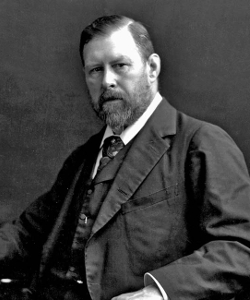
Stoker’s father, Abraham Stoker, is a civil servant and his mother, Charlotte Mathilda Blake Thornley, is a charity worker and writer. Stoker is a sickly child and is bedridden with an unknown illness until he starts school at the age of seven, when he makes a complete recovery. Growing up his mother tells him a lot of horror stories which may have influence on his later writings.
In 1864 Stoker enters Trinity College, Dublin. While attending college he begins working as an Irish civil servant. He also works part time as a free lance journalist and drama critic. In 1876 he meets Henry Irving, a famous actor, and they soon become friends. Not long after that, Stoker meets and falls in love with an aspiring actress named Florence Balcombe whom he marries on December 4, 1878 at St. Anne’s Parish Church, Dublin. In 1878 he accepts a job working in London as Irving’s personal secretary.
On December 9, Stoker and his new wife move to England to join Irving. His first book The Duties of Clerks of Petty Sessions in Ireland though written while he is still in Dublin, is published in 1879. On December 30, 1879 Stoker and his wife have their only child, a son Noel. While in England Stoker also writes several novels and short stories. His first book of fiction, Under the Sunset, is published in 1881.
Stoker visits the English coastal town of Whitby in 1890, a visit that is said to be part of the inspiration for Dracula. Before writing Dracula, he meets Ármin Vámbéry, a Hungarian writer and traveller. Dracula likely emerges from Vámbéry’s dark stories of the Carpathian Mountains. Stoker then spends several years researching European folklore and mythological stories of vampires.
Dracula is an epistolary novel, written as a collection of realistic but completely fictional diary entries, telegrams, letters, ship’s logs, and newspaper clippings, all of which add a level of detailed realism to the story, a skill which Stoker develops as a newspaper writer. At the time of its publication, Dracula is considered a “straightforward horror novel” based on imaginary creations of supernatural life.
The original 541-page typescript of Dracula is believed to have been lost until it is found in a barn in northwestern Pennsylvania in the early 1980s. It consists of typed sheets with many emendations, plus handwritten on the title page is “THE UN-DEAD.” The author’s name is shown at the bottom as Bram Stoker. The typescript is purchased by Microsoft co-founder Paul Allen.
After suffering a number of strokes, Abraham “Bram” Stoker dies at No. 26 St. George’s Square, London on April 20, 1912. Some biographers attribute the cause of death to tertiary syphilis, others to overwork. He is cremated and his ashes are placed in a display urn at Golders Green Crematorium in north London.
Finegan is born November 17, 1814, at Clones, County Monaghan. He comes to Florida in the 1830s, first establishing a sawmill at Jacksonville and later a law practice at Fernandina Beach. At the latter place, he becomes the business partner of David Levy Yulee and begins construction of the Florida Railroad to speed transportation of goods and people from the new state’s east coast to the Gulf of Mexico.
By the outbreak of the American Civil War, Finegan has built his family a forty-room mansion in Fernandina Beach at the site of the modern Atlantic Elementary School. At Florida’s secession convention, Finegan represents Nassau County alongside James Graham Cooper.
In April 1862, Finegan assumes command of Middle and East Florida from Brigadier General James H. Trapier. Soon thereafter, he suffers some embarrassment surrounding the wreck of the blockade runnerKate at Mosquito Inlet. Her cargo of rifles, ammunition, medical supplies, blankets, and shoes is plundered by civilians. Eventually, most of the rifles are found, but the other supplies are never recovered.
In 1863, Finegan complains of the large quantity of rum making its way from the West Indies into Florida. Smugglers are buying it in Cuba for a mere seventeen cents per gallon, only to sell it in the blockaded state for twenty-five dollars per gallon. He urges Governor John Milton to confiscate the “vile article” and destroy it before it can impact army and civilian morals.
In February 1864, General P.G.T. Beauregard begins rushing reinforcements to Finegan after Confederate officials become aware of a build-up of Federal troops in the occupied city of Jacksonville. As Florida is a vital supply route and source of beef to the other southern states, they cannot allow it to fall completely into Union hands.
On February 20, 1864, Finegan stops a Federal advance from Jacksonville under General Truman Seymour that is intent upon capturing the state capitol at Tallahassee. Their two armies clash at the Battle of Olustee, where Finegan’s men defeat the Union Army and force them to flee back beyond the St. Johns River. Critics have faulted Finegan for failing to exploit his victory by pursuing his retreating enemy, contenting himself by salvaging their arms and ammunition from the battlefield. However, his victory is one rare bright spot in an otherwise gloomy year for the dying Confederacy.
Finegan is relieved of his command over the state troops and replaced by Major General James Patton Anderson. This change in command is necessary as Finegan is ordered to lead the “Florida Brigade” in the Army of Northern Virginia, where he serves effectively until near the end of the war.
Finegan returns to Fernandina Beach after the war to discover his mansion has been seized by the Freedmen’s Bureau for use as an orphanage and school for black children. It took some legal wrangling, but he is eventually able to recover the property. The untimely death of his son Rutledge on April 4, 1871, precipitates a move to Savannah, Georgia. There, Finegan feels at home with the large Irish population and works as a cotton broker.
It is while living in Savannah that Finegan marries his second wife, the widow Lucy C. Alexander, a Tennessee belle. They eventually settle on a large orange grove in Orange County, Florida. Finegan dies on October 29, 1885, at Rutledge, Florida. According to The Florida Times-Union, his death is the result of “severe cold, inducing chills, to which he succumbed after brief illness.” He is buried at the Old City Cemetery in Jacksonville.
Fenians propose a “New Departure,” an alliance with the Parnellites, on October 27, 1878. The term New Departure is used to describe several initiatives in the late 19th century by which Irish republicans, who are committed to independence from Britain by physical force, attempt to find a common ground for co-operation with groups committed to Irish Home Rule by constitutional means. The term refers to the fact that Fenians are to some extent departing from their orthodox doctrine of noninvolvement with constitutional politics, especially the British parliament.
John O’Connor and Dr. Mark Ryan, both members of the IRB’s Supreme Council, believe O’Connor Power has some hand in the new departure. John O’Connor suspects that Michael Davitt of the IRB has been influenced by O’Connor Power, and that the new departure proposals conceal some sinister scheme of Power’s devising, assumptions that Davitt hotly rejects. The precedent for constitutional agitation set by Power is not lost on orthodox Fenians such as Dr. Ryan, who sees behind the new departure the nefarious influence of the member for Mayo.
In late 1878 Michael Davitt makes a fund-raising political lecture tour of the United States, promoted by William Carroll and John Devoy of Clan na Gael. On October 13 in Brooklyn, New York, Davitt first presents, in a lecture titled “Ireland in parliament from a nationalist’s point of view,” a doctrine that Irish republicans cannot prevent Irishmen voting or being elected to the British parliament, but they can influence who is sent to that parliament. He states that the Home Rule League, especially Isaac Butt and John O’Connor Power, are failing to prevent Ireland from being “imperialised” or “West Britainised.” Davitt however believes that Parnell and Joseph Biggar are acceptable Irish MPs, and Irish republicans should ensure that more such strong nationalists are voted in. John Devoy follows and points out that if Irish republicans are to gain the support of Britain’s potential enemies, such as Russia, they need to provide far stronger opposition to Britain both inside and outside parliament. He points out that Russia has not yet seen the Irish as providing any such meaningful opposition, in fact to Russia they appear loyal to Britain. Hence it is necessary to replace representatives in all Irish public bodies with suitable committed nationalists. Both Davitt and Devoy at this meeting stress that resolution of the Irish land question by transfer of ownership to the farmers themselves is integral to Irish demands on Britain.
On October 27, 1878, Devoy, without first consulting Davitt, summarises these ideas in what he terms a “new departure” in the New York Herald, and it is reported in Ireland on November 11. He also states that Irish participation in the British parliament is to be temporary, and that at a suitable time Irish nationalist MPs will withdraw to Dublin and form an independent Irish legislature. Davitt is at first worried that perceived connections to the Fenians will threaten Parnell in parliament, but Devoy convinces him that Parnell will not be affected. IRB leaders John O’Leary and Charles Kickham reject the overture to constitutionalists and Parnell gives no comment. He does however adopt the militant rhetoric of land ownership to be transferred to the Irish farmers themselves in various public speeches in Ireland. Hence the stage is set for the successful collaboration in 1879 over the Land War.
After the Battle of Pea Ridge, Kiernan insists on joining the fighting ranks, and in that capacity is seemingly appointed a Major in the 6th Missouri Volunteer Infantry. In May 1863 at Port Gibson, Mississippi, he is wounded in the left lung and left on the battlefield for dead. Recovered and imprisoned, he effects an escape back to Union forces and resigns his commission. On August 1, 1863, he is commissioned a Brigadier General of the United States Volunteers by President Abraham Lincoln, commanding a post at Miliken’s Bend on the Mississippi River. However, ill-health as a result of his battlefield wounds forces him to resign on February 3, 1864.
In May 1865 Kiernan gains a U.S. consular post at Chinkiang, China. He manages to make the trip there, but his health does not allow him to perform the duties. He returns to New York where he becomes an examining physician for the Bureau of Pensions, a position he holds until his death.
James Lawlor Kiernan dies on November 26, 1869. The official cause of death is “congestion of the lungs.” Perhaps he is killed by that Confederate ball that wounded him six years earlier. He is buried in Green-Wood Cemetery in Brooklyn, New York.







 seamus dubhghaill