seamus dubhghaill

Promoting Irish Culture and History from Little Rock, Arkansas, USA


Leave a comment

Founding of the Gaelic League

conradh-na-gaeilge-logo

The Gaelic League (Irish: Conradh na Gaeilge), a social and cultural organisation which promotes the Irish language in Ireland and worldwide is founded in Dublin on July 31, 1893.

Conradh na Gaeilge is founded by Douglas Hyde, the son of a Church of Ireland rector from Frenchpark, County Roscommon, with the aid of Eugene O’Growney, Eoin MacNeill, Thomas O’Neill Russell, and others. The organisation develops from Ulick Bourke‘s earlier Gaelic Union and becomes the leading institution promoting the Gaelic Revival, carrying on efforts like the publishing of the Gaelic Journal. The League’s first newspaper is An Claidheamh Soluis (The Sword of Light) and its most noted editor is Patrick Pearse. The motto of the League is Sinn Féin, Sinn Féin amháin (Ourselves, Ourselves alone).

The League encourages female participation from the start and a number of women play a prominent role. They are not restricted to subordinate roles, but play an active part in leadership, although males are in the overwhelming majority. Local notables, such as Lady Gregory in Galway, Lady Esmonde in County Wexford, and Mary Spring Rice in County Limerick, and others such as Norma Borthwick, found and lead branches in their communities. At the annual national convention in 1906 women are elected to seven of the forty-five positions on the Gaelic League executive. Executive members include Máire Ní Chinnéide, Úna Ní Fhaircheallaigh (who writes pamphlets on behalf of the League), Bean an Doc Uí Choisdealbha, Máire Ní hAodáin, Máire de Buitléir, Nellie O’Brien, Eibhlín Ní Dhonnabháin, and Eibhlín Nic Néill.

Though apolitical, the organisation attracts many Irish nationalists of different persuasions, much like the Gaelic Athletic Association. It is through the League that many future political leaders and rebels first meet, laying the foundation for groups such as the Irish Volunteers. However, Conradh na Gaeilge does not commit itself entirely to the national movement until 1915, causing the resignation of Douglas Hyde, who feels that the culture of language should be above politics. Most of the signatories of the 1916 Proclamation are members. It still continues to attract many Irish Republicans. Seán Mac Stíofáin, the first chief of staff of the Provisional IRA was a prominent member in his later life.

After the foundation of the Irish Free State in 1922, the organisation has a less prominent role in public life as Irish is made a compulsory subject in state-funded schools. It does unexpectedly bad in the Irish Seanad election of 1925, when all the candidates it endorses are defeated, including Hyde.

1 Comment

Fenian James Carey Killed by Patrick O’Donnell

james-carey

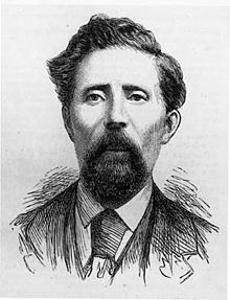
James Carey, a Fenian and informer most notable for his involvement in the Phoenix Park Murders, is shot and killed by Patrick O’Donnell aboard the Melrose on July 29, 1883.

Carey is born in James Street, Dublin, in 1845. He becomes a bricklayer and builder as well as the leading spokesman of his trade and obtains several large building contracts. During this period Carey is engaged in an Irish nationalist conspiracy, but to outward appearance he is one of the rising men of Dublin. He is involved in religious and other societies, and at one time is spoken of as a possible lord mayor. In 1882 he is elected a town councillor.

About 1861 Carey joins the Irish Republican Brotherhood, soon becoming treasurer. In 1881 he breaks with the IRB and forms a new group which assumes the title of the Irish National Invincibles and establishes their headquarters in Dublin. Carey takes an oath as one of the leaders. The object of the Invincibles is to remove all “tyrants” from the country.

The secret head of the Invincibles, known as No. 1, gives orders to kill Thomas Henry Burke, the under-secretary to the lord-lieutenant. On May 6, 1882, nine of the conspirators proceed to the Phoenix Park where Carey, while sitting on a jaunting-car, points out Burke to the others. At once they attack and kill him with knives and, at the same time, also kill Lord Frederick Cavendish, the newly appointed chief secretary, who happens to be walking with Burke.

For a long time no clue can be found to identify the perpetrators of the act. However, on January 13, 1883, Carey is arrested and, along with sixteen other people, charged with a conspiracy to murder public officials. On February 13, Carey turns queen’s evidence, betraying the complete details of the Invincibles and of the murders in the Phoenix Park. His evidence, along with that of getaway driver Michael Kavanagh, results in the execution of five of his associates by hanging.

His life being in great danger, he is secretly put onboard the Kinfauns Castle with his wife and family, which sails for the Cape on July 6. Carey travels under the name of Power. Aboard the same ship is Patrick O’Donnell, a bricklayer. Not knowing his true identity, O’Donnell becomes friendly with Carey. After stopping off in Cape Town, he is informed by chance of Carey’s real identity. He continues with Carey on board the Melrose for the voyage from Cape Town to Natal. On July 29, 1883, when the vessel is twelve miles off Cape Vaccas, O’Donnell uses a pistol he has in his luggage to shoot Carey dead.

O’Donnell is brought to England and is tried for murder. After being found guilty, he is executed on December 17 at Newgate.


Leave a comment

The Peace Preservation Force is Established

robert-peel

Robert Peel (pictured), chief secretary of Ireland (1812-18), establishes the Peace Preservation Force to counter rural unrest on July 25, 1814. This rudimentary paramilitary police force is designed to provide policing in rural Ireland, replacing the 18th century system of watchmen, baronial constables, revenue officers, and British military forces.

Peel masterminds Act 54, George III, c.131, which is passed on July 25, 1814, to “provide for the better execution of the Laws in Ireland, by appointing Superintending Magistrates and additional Constables in Counties in certain cases.” On foot of this Act, Peel forms the Peace Preservation Force.

The Peace Preservation Force is at the disposal of the Lord Lieutenant of Ireland for use in any district that has been “proclaimed” in a disturbed area. The first resident magistrates are appointed under the 1814 Act.

Sir Richard Willcocks, a former Dublin Magistrate and Special Government Magistrate, is the first appointed Chief Magistrate of the Peace Preservation Force and is allocated to the Barony of Middlethird, County Tipperary, with twenty constables who are ex-cavalry sergeants operating from a base at Cashel. He is appointed Inspector General of Munster and Stipendiary Magistrate. He dies in Dublin and is buried in Chapelizod Church of Ireland Cemetery.

The cost of the Peace Preservation Force operation has to be paid for by the area “proclaimed,” and when tranquility is restored the force will be either withdrawn or disbanded. Between 1814 and 1922 a total of four members of the Peace Preservation Force are killed on duty, namely, Sub Constable Thomas Manning is shot dead on August 16, 1821 when his patrol challenges a gang of insurgents; Chief Police Magistrate Richard Going, is shot dead on October 14, 1821 by a gang of four men while out riding; Sub Constable Hugh Colligan is killed on January 31, 1822 when his barracks are attacked; Sub Constable Thomas Knox is killed on March 10, 1822 while on sick leave and is identified as a policeman.


Leave a comment

Death of John Moore Neligan, Physician & Medical Teacher

atlas-of-cutaneous-diseases

John Moore Neligan, one of the foremost physicians and medical teachers of his day, dies on July 24, 1863. Neligan, son of a medical practitioner, is born at Clonmel, County Tipperary, in 1815. He graduates M.D. at Edinburgh in 1836, and begins practice in his birthplace. He later moves to Cork, where he lectures on materia medica and medical botany in a private school of anatomy, medicine, and surgery in Warren’s Place.

In 1840 he takes a house in Dublin, and in 1841 is appointed physician to the Jervis Street Hospital. He also gives lectures on materia medica from 1841 to 1846, and on medicine from 1846 to 1857, in the Dublin school of Peter Street. He publishes in 1844 Medicines, their Uses and Mode of Administration, which gives an account of all the drugs mentioned in the London, Scottish, and Irish pharmacopœias, and of some others. Their sources, medicinal actions, doses, and most useful compounds are clearly stated. The compilation, though containing no original matter, is useful to medical practitioners, and goes through many editions.

Neligan enjoys the friendship of Robert James Graves, the famous lecturer on medicine, and in 1848 edits the second edition of his Clinical Lectures on the Practice of Medicine. In the same year he publishes The Diagnosis and Treatment of Eruptive Diseases of the Scalp, which is printed at the Dublin University Press. He describes as inflammatory diseases herpes, eczema, impetigo, and pityriasis, and as non-inflammatory porrigo, and gives a lucid statement of their characteristics in tabular form. He is unaware, however, of the parasitic nature of herpes capitis, as he calls ringworm, and seems not to have noticed the frequent relation between eczema of the occiput and animal parasites.

From 1849 to 1861 he edits the Dublin Quarterly Journal of Medical Science, and publishes many medical papers of his own in it. In 1852 he publishes A Practical Treatise on Diseases of the Skin, and, like most men who attain notoriety as dermatologists, issues in 1855 a coloured Atlas of Skin Diseases. His treatise is a compilation from standard authors, with a very small addition from his own experience. The subject is well arranged, and so set forth as to be useful to practitioners. It is much read, and leads to his treating many patients with cutaneous affections.

Neligan suffers from kidney disease in his final years. On July 17, he begins to feel unwell and returns to his country residence, Clonmel House, and goes to bed, from which he never rises again. Over the next few days his kidneys ceased to function altogether and he slips into a coma. John Moore Neligan dies on July 24, 1863.


Leave a comment

St. Vincent’s Hospital Opens on St. Stephen’s Green, Dublin

st-vincents-hospital-dublin

St. Vincent’s Hospital, a teaching hospital currently located at Elm Park, south of the city of Dublin, opens on July 23, 1834, at its original location on St. Stephen’s Green, Dublin. The hospital is founded by Mother Mary Aikenhead, foundress of the Roman Catholic order Religious Sisters of Charity. It is open to all who can afford its services, irrespective of their religious persuasion.

The hospital subsequently moves to its current site in Elm Park in 1970, and in 1999 is renamed St. Vincent’s University Hospital (SVUH), to highlight its position as a principal teaching hospital of University College Dublin (UCD).

Today St. Vincent’s University Hospital serves as a regional centre for emergency medicine and medical care at an inpatient and outpatient level. Many patients from regional and tertiary hospitals are referred to SVUH for specialist care, and it is the national referral centre for liver transplantation and adult cystic fibrosis. Tied closely to the University, it serves as a training ground for doctors, nurses, radiographers and physiotherapists, teaching students from UCD’s undergraduate degree courses.

The hospital provides in excess of forty medical, surgical, and allied specialities, and has 479 in-patient suites, incorporating 7-day, 5-day, and day care. A major multimillion-euro extension building is completed in 2005 and officially opens in 2006. This development contains a new emergency department, endoscopy department, outpatient clinics, intensive care unit, diagnostic laboratories and operating theatres, as well as a state-of-the-art radiology department (incorporating Multislice CT-Scanners, Nuclear Medicine and MRI).

The on-campus Education & Research Centre serves as home to a number of research groups allied to clinical departments within the hospital including the Centre for Colorectal Disease, the National Liver Transplant Unit, and the Department of Rheumatology, and maintains close academic links to nearby UCD.


Leave a comment

The Last Official Bare-Knuckle Title Fight

sullivan-kilrain-fight

Heavyweight boxer John L. Sullivan defeats fellow Irish American Jake Kilrain in a world championship bout which lasts 75 rounds on July 8, 1889, the last official bare-knuckle title fight ever held.

Bare-knuckle boxing is the original form of boxing, closely related to ancient combat sports. It involves two individuals fighting without boxing gloves or other padding on their hands. The difference between a street fight and a bare-knuckle boxing match is an accepted set of rules, such as not striking a downed opponent.

The Sullivan-Kilrain fight is considered to be a turning point in boxing history because it is the last world title bout fought under the London Prize Ring Rules, and therefore the last bare-knuckle heavyweight title bout. It is one of the first sporting events in the United States to receive national press coverage.

For the first time, newspapers carry extensive pre-fight coverage, reporting on the fighters’ training and speculating on where the bout will take place. The traditional center of bare-knuckle fighting is New Orleans, but the governor of Louisiana has forbidden the fight in that state. Sullivan has trained for months in Belfast, New York under trainer William Muldoon, whose biggest problem has been keeping Sullivan from liquor. A report on Sullivan’s training regimen in Belfast is written by famed reporter Nellie Bly and published in the New York World.

Rochester reporter Arch Merrill comments that occasionally Sullivan would “escape” from his guard. In Belfast village, the cry is heard, “John L. is loose again. Send for Muldoon!” Muldoon would snatch the champ away from the bar and take him back to their training camp.

On July 8, 1889, an estimated 3,000 spectators board special trains for the secret location, which turns out to be Richburg, a town just south of Hattiesburg, Mississippi. The fight begins at 10:30, and it looks as if Sullivan is going to lose, especially after he vomits during the 44th round. But the champion gets his second wind after that, and Kilrain’s manager, Mike Donovan, finally throws in the towel after the 75th round. Kilrain does not want to give up thinking he can outlast Sullivan, but Donovan defends his actions insisting that Kilrain would die if the fight continued. In any case, the Kilrain-Sullivan fight can rightly be listed among the greatest fights of the pre-modern era.


Leave a comment

Birth of Francis Fowke, Engineer & Architect

francis-fowke

Francis Fowke, engineer, architect, and a Captain in the Corps of Royal Engineers, is born in Ballysillan, Belfast, on July 7, 1823. Most of his architectural work is executed in the Renaissance style, although he makes use of relatively new technologies to create iron framed buildings, with large open galleries and spaces.

Fowke studies at The Royal School Dungannon, County Tyrone, and the Royal Military Academy, Woolwich. He obtains a commission in the Royal Engineers and serves with distinction in Bermuda and Paris. On his return to England, he is appointed architect and engineer in charge of the construction of several government buildings.

Among his projects are the Prince Consort’s Library in Aldershot, the Royal Albert Hall and parts of the Victoria and Albert Museum in London, the Royal Museum in Edinburgh, and the National Gallery of Ireland in Dublin. He is also responsible for planning the 1862 International Exhibition in London. The Crystal Palace at the Great Exhibition of 1851 being a hard act to follow, the International Exhibition building is described as “a wretched shed” by The Art Journal. Parliament declines the Government’s proposal to purchase the building. The materials are sold and used for the construction of Alexandra Palace.

Before his sudden death from a burst blood vessel on December 4, 1865, Fowke wins the competition for the design of the Natural History Museum, although he does not live to see it executed. His renaissance designs for the museum are altered and realised in the 1870s by Alfred Waterhouse, on the site of Fowke’s Exhibition building.

Francis Fowke is buried in Brompton Cemetery, London.

A medal is issued by the Royal Engineers in 1865, as a memorial prize for architectural works carried out by members of the corps. With the demise of great architectural works, the prize has transformed into the prize awarded to the top student on the Royal Engineers Clerks of Works course.


Leave a comment

The Theft of the Irish Crown Jewels

irish-crown-jewels-reward

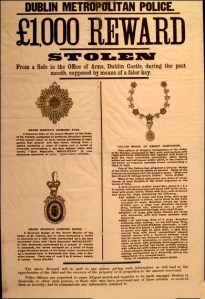
The theft from Dublin Castle of the Irish Crown Jewels, the heavily jeweled star and badge regalia of the Sovereign and Grand Master of the Order of St. Patrick, as well as the collars of five knights of the Order is discovered on July 6, 1907. The theft has never been solved and the jewels have never been recovered.

Prior to 1903, the insignia of the Sovereign and those of deceased Knights are in the custody of the Ulster King of Arms, the senior Irish officer of arms, and are kept in a bank vault. In 1903, the jewels are transferred to a safe, which is to be placed in the newly constructed strongroom in Dublin Castle beside the Ulster King of Arms’ office. The new safe is too large for the doorway to the strongroom and Arthur Vicars, the Ulster King of Arms, instead stores it in his office. Seven latch keys to the door of the Office of Arms are held by Vicars and his staff, and two keys to the safe containing the insignia are both in the custody of Vicars. Vicars is known to regularly get drunk on overnight duty and he once awoke to find the jewels around his neck. It is not known whether or not this is a prank or a practice for the actual theft.

The insignia are last worn by the Lord Lieutenant, Lord Aberdeen, on March 15, 1907, at a function to mark Saint Patrick’s Day on March 17. They are last known to be in the safe on June 11, when Vicars shows them to a visitor to his office. The jewels are discovered to be missing on July 6, four days before the start of a visit by King Edward VII and Queen Alexandra to the Irish International Exhibition, at which it is planned to invest Bernard FitzPatrick, 2nd Baron Castletown, into the Order. The theft reportedly angers the King, but the visit goes on as scheduled, however, the investiture ceremony is cancelled.

A police investigation is conducted by the Dublin Metropolitan Police (DMP). Posters issued by the DMP depict and describe the missing jewels. Detective Chief Inspector John Kane of Scotland Yard arrives on July 12 to assist. His report, which is never released, is said to name the culprit but is suppressed by the Royal Irish Constabulary (RIC).

Vicars refuses to resign his position, and similarly refuses to appear at a Viceregal Commission into the theft. Vicars argues for a public Royal Commission instead, which has the power to subpoena witnesses. He publicly accuses his second in command, Francis Shackleton, of the theft. Kane explicitly denies to the Commission that Shackleton, brother of the explorer Ernest Shackleton, is involved. Shackleton is exonerated in the Commission’s report, and Vicars is found to have “not exercise[d] due vigilance or proper care as the custodian of the regalia.” Vicars is compelled to resign, as are all the staff in his personal employ.


Leave a comment

Archbishop Paul Cullen Elevated to First Irish Cardinal

cardinal-paul-cullen

Archbishop Paul Cullen, Roman Catholic Archbishop of Dublin and previously of Armagh, is elevated to the cardinalate as Cardinal-Priest of San Pietro in Montorio on June 22, 1866, becoming the first Irish cardinal.

Cullen is born at Prospect, Narraghmore, Athy, County Kildare. He enters St. Patrick’s, Carlow College, in 1816, and proceeds to the Pontifical Urban College in Rome in 1820.

Cullen is ordained in 1829 and is appointed Rector of the Pontifical Irish College in Rome in late 1831. He successfully secured the future of the college by increasing the student population and thereby strengthening the finances of the college.

Cullen is promoted to the primatial See of Armagh on December 19, 1849, and is consecrated by the Cardinal Prefect of Propaganda at the Irish College in Rome on February 24, 1850. He is also named Apostolic Delegate. Cullen is transferred to the See of Dublin on May 1, 1852.

Cullen is sent to Ireland to bring the Irish church into conformity with Roman canon law and usage. His first major act as Archbishop of Armagh is to convene the Synod of Thurles, the first national synod held in Ireland since the Reformation. This occurs during the period of the debilitating Irish Famine which reduces the population of the country by over 2 million people through starvation, disease, and emigration. After a series of disastrous harvests in the 1860s, he founds, along with the Lord Mayor of Dublin, the Mansion House Relief Committee in 1862. Cullen also starts the practice of Irish priests wearing Roman clerical collars and being called “Father” rather than “Mister” by their parishioners.

Cullen pays frequent visits to Rome. He takes part in the definition of the dogma of the Immaculate Conception of the Blessed Virgin Mary in 1854, and with the eighteenth centenary of the martyrdom of Saints Peter and Paul in 1867.

After his elevation to cardinal, Cardinal Cullen takes an active part in deliberations during the Vatican Council. Towards the close of the council at the express wish of the Central Commission, Cardinal Cullen proposes a formula for the definition of Papal Infallibility. It is a matter of great delicacy, as promoters of the definition are split up into various factions, some anxious to assign a wide range to the pope’s decisions, while others wish to set forth in a somewhat indefinite way the papal prerogative.

Cullen is the most important Irish political figure in the thirty years between Daniel O’Connell and Charles Stewart Parnell. In political matters Cullen makes it a rule to support every measure, whatever its provenance, conducive to the interests of his vision for the Roman Catholic Church in Ireland. Cullen is also a frequent visitor at the vice-regal lodge to lobby the government.

Cardinal Paul Cullen dies in Dublin on October 24, 1878, at the age of 75. He is buried at Holy Cross College in Drumcondra.


Leave a comment

John Joseph “Jack” Doyle Becomes First Major League Pinch Hitter

jack-doyle

John Joseph “Jack” Doyle, Irish-American first baseman of the Cleveland Spiders in Major League Baseball, becomes the first to pinch hitter in a baseball game on June 7, 1892. He comes through with a game-winning single against the Brooklyn Dodgers.

Doyle is born in Killorglin, County Kerry, on October 25, 1869, and emigrates with his family to the United States when he is a child, settling in Holyoke, Massachusetts. After attending Fordham University, Doyle embarks on a baseball career that lasts 70 years. He makes his first appearance at the major league level by signing and playing two years for the Columbus Solons of the American Association. Doyle plays for ten clubs between 1889 and 1905, batting .299 in 1,564 games with 516 stolen bases. He begins as a catcher–outfielder and becomes a first baseman in 1894. His best years are in 1894, when he bats .367 for the New York Giants, and in 1897, when he hits .354 with 62 stolen bases for the Baltimore Orioles.

Because of his aggressive playing style, Doyle is known as “Dirty Jack”, often feuding with umpires, fans, opposing players, and even at times, his own teammates. He carries on a lengthy feud with John McGraw that starts when they are teammates in Baltimore. McGraw, of course, has to have the last word. In 1902, McGraw is appointed manager of the Giants and his first act is to release Doyle, even though he is batting .301 and fielding .991 at the time. Even with these seemingly out-of-control traits, Doyle is deemed a natural leader and is selected as team captain in New York, Brooklyn and Chicago, and serves as an interim manager for the Giants in 1895 and Washington Senators in 1898.

In 1905, after playing one game with the New York Highlanders, Doyle becomes manager of Toledo of the Western Association. One year later, he is named the manager of the Des Moines Champions, so named because they won the league championship the previous year, and they win it again under Doyle’s helm. Following his championship season at Des Moines, he manages Milwaukee in 1907.

In 1908–1909, the only years of his adult life spent outside of baseball, Doyle serves as police commissioner of his hometown of Holyoke. He returns to baseball as an umpire and works in the National League for 42 games in 1911. He later joins the Chicago Cubs as a scout in 1920. He remains in that capacity until his death at age 89 on New Year’s Eve 1958. Doyle is buried at St. Jerome Cemetery in Holyoke.