The third Irish Race Convention is held in New York City on March 4, 1916, and serves as an immediate call for the Easter Rebellion in Dublin. Previous conventions were held in Chicago (1881) and Dublin (1896). The Irish Race Conventions are a disconnected series of conventions held in Europe and the Americas between 1881 and 1994. The main participants and financial supporters of the conventions are usually Irish Americans.
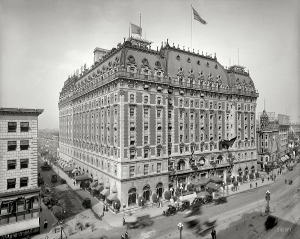
The 1916 convention, comprising 2,300 delegates at the Hotel Astor, is held six weeks before the Easter Rising, and considers the division between the home Rule parties and the more militant nationalists. The Rising would be supported by Clan na Gael, but other members remain hopeful that the 1914 Home Rule Act, which had been passed but suspended during World War I, might work.
A majority at the convention support the American policy of neutrality during the war and are opposed to any alliance with Britain. Woodrow Wilson wins the United States presidential election in 1916 with help from Irish Americans and his campaign slogan of “He kept us out of War.”
An important result is the formation of the “Friends of Irish Freedom” that work as a coordinating body to support “the independence of Ireland, the industrial development of Ireland, the use and sale of Irish products, and to revive Irish culture.”
(Pictured: Hotel Astor, located in the Times Square area of Manhattan, New York City. The hotel was demolished in 1967 and replaced with the 54-story high-rise office tower One Astor Plaza.)
Land disputes in Ireland had been a contentious issue for much of the 19th century, with tenants of landlords insisting on fixity of tenure, which later grows into a demand to own their own land. In addition, The Wyndham Land Act of 1903 enables the transfer of about 9 million acres, up to 1914, from landlords to tenants. However, tenure and ownership of land is still a live issue on the eve of the Irish War of Independence.
Shawe-Taylor is a land agent to a local landlord and is himself a tenant. Early in January 1920, a group of local IRA soldiers, including Mick Kelly, Bill Freaney and Larry Lardner, approach Shawe-Taylor on behalf of some local people who are requesting a road to travel to Mass. While Shawe-Taylor himself is amenable to their demands, his landlord refuses them outright and makes this known via Shawe-Taylor.
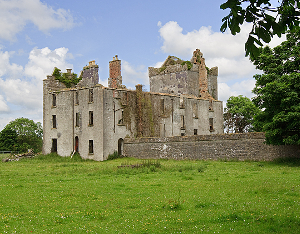
On March 3, 1920, Shawe-Taylor and his driver, Barrett, are making their way to Galway to attend the fair. At 6:00 AM the coach reaches Egan’s Pub, Coshla, where they find the road blocked. The donkey cart of a local, Johnny Kelly, has been stolen and placed across the road. From behind the wall, at least two shooters fire at Barrett and Shawe-Taylor, wounding Barrett and killing Shawe-Taylor. This results in a huge security presence in the area, which in turn leads to more unrest with the locals. This increases with the arrival of the Black and Tans, whose irregular methods result in shootings, assaults, rapes and deaths. Moorpark House is placed under Royal Irish Constabulary protection out of fear of further killings.
Other people who subsequently die as a result of the unrest in Galway include Ellen Quinn, a pregnant mother of six and a tenant of Lady Gregory, Fr. Michael Griffin, Tom Egan and brothers Patrick and Harry Loughnane. In addition, there are numerous incidents of violence, many of which are recorded with horror by Lady Gregory in her journal, who remarks that “the country has gone wild since the killing of Frank Shawe-Taylor.”
No one is ever tried for Frank Shawe-Taylor’s killing, though the identities of those involved are known to some locals at the time. His widow eventually sells their property and, with her young children, moves to England.
Whelan is best known for composing a piece for the interval of the 1994 Eurovision Song Contest. The result, Riverdance, is a seven-minute display of traditional Irish dancing that becomes a full-length stage production and spawns a worldwide craze for Irish dancing and Celtic music and also wins him a Grammy Award. It is released as a single in the United Kingdom in 1994, credited to “Bill Whelan and Anúna featuring the RTÉ Concert Orchestra.” It reaches number 9 and stays in the charts for 16 weeks. The album of the same title reaches number 31 in the album charts in 1995. He also composes a symphonic suite version of Riverdance, with its premiere performed by the Ulster Orchestra on BBC Radio 3 in August 2014.
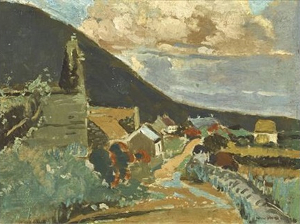
Nano Reid, Irish landscape artist, figure painter and portraitist, is born in Drogheda, County Louth on March 1, 1900. An individual, expressionistic artist, Reid is acknowledged to be one of the finest Irish woman painters of twentieth-century visual art in Ireland. Her works are represented in many public collections throughout Ireland.
In 1920, Reid wins a scholarship to study fine art painting and drawing at the Dublin Metropolitan School of Art, now the National College of Art and Design, under Harry Clarke. At the time, she is, in the words of fellow student Hilda van Stockum, “a fierce redhead…uncompromising and looking for truth.” In 1925 she starts showing at the Royal Hibernian Academy (RHA), submitting a total of 42 canvases until the late 1960s.
In 1950, with Norah McGuinness, Reid represents Ireland at the Venice Biennale. This is followed by the Exhibition of Contemporary Irish Art in Aberystwyth, Wales (1953), and the Mostra Internazionale di Bianco e Nero in Lugano, Switzerland (1956), the Guggenheim International Award Exhibition in New York City (1960) and the Twelve Irish Painters show in New York City (1963). In 1974, the Arts Council and the Arts Council of Northern Ireland stage a major retrospective of Reid’s artworks.
Nano Reid dies in Drogheda in 1981. Retrospectives are held at Taylor Galleries in Dublin (1984), Droichead Arts Centre in Drogheda (1991), and at Linenhall Arts Centre in Castlebar, County Mayo (1999).
Life in New York is difficult during the Great Depression, so John and his two brothers are shipped back to Ireland in 1933. The two eldest are sent to their maternal grandmother’s house in Fintona, County Tyrone, but John is sent to his father’s ancestral home at Garvaghey, then maintained by two spinster aunts.
A year of graduate school at University of California, Berkeley convinces Montague that he should return to Ireland. He settles in Dublin working at the Irish Tourist Office. In 1961 he moves to Bray, County Wicklow. A regular rhythm of publication sees his first book of stories, Death of a Chieftain (1964) after which the musical group The Chieftains is named, his second book of poems, A Chosen Light (1967), Tides (1970).
All during the 1960s, Montague continues to work on his long poem, The Rough Field, a task that coincides with the outbreak of the Northern Ireland civil rights movement. A Patriotic Suite appears in 1966, Hymn to the New Omagh Road and The Bread God in 1968, and A New Siege, dedicated to Bernadette Devlin which he reads outside Armagh Jail in 1970.
Montague settles in Cork in 1974 and publishes an anthology, theFaber Book of Irish Verse (1974) with a book of lyrics, A Slow Dance (1975). Recognition is now beginning to come, with the award of the Irish American Cultural Institute in 1976, the first Marten Toonder Award in 1977, and the Alice Hunt Bartlett Award for The Great Cloak in 1978.
In 1987, Montague is awarded an honorary doctor of letters by the State University of New York at Buffalo. He serves as distinguished writer-in-residence for the New York State Writers Institute during each spring semester, teaching workshops in fiction and poetry and a class in the English Department of the University at Albany. In 1998, he is named the first Irish professor of poetry, a three-year appointment to be divided among Queen’s University Belfast, Trinity College Dublin, and University College Dublin. In 2008, he publishes A Ball of Fire, a collection of all his fiction including the short novella The Lost Notebook.
John Montague dies at the age of 87 in Nice, France on December 10, 2016, after complications from a recent surgery.
The protesters chant and wave banners bearing the slogan “The Milosevic of Manhattan” prior to the arrival of the 56th U.S. Secretary of State, who was in office during the controversial administration of Richard Nixon. Kissinger says he is pleased to discover that even in Ireland people are not indifferent to him. However, he denies being a war criminal claiming it is an insult to human intelligence for protesters in Cork to compare him with Slobodan Milošević.
“These people are throwing around allegedly criminal charges without a shred of real evidence. I don’t know who they represent but I wish their knowledge equalled their passion.”
Kissinger, who is visiting the university to deliver a speech at an MBA Association of Ireland business conference, says he has never replied to derogatory remarks in the media. He adds, “I consider them (the accusations) fundamentally beneath contempt. They are based on distortions and misrepresentations.”
Kissinger says the international scene is experiencing an extraordinary period of change for which there is no historical precedent. One of the biggest challenges facing the U.S. administration, he says, is to bring countries together to prevent the spread of biological and chemical weapons.
Kissinger’s visit is condemned by human rights organisations who claim he flouted international law in his dealings with Bangladesh, Chile and East Timor. Cork Sinn FéincouncillorJonathan O’Brien tells an earlier council meeting that Kissinger is not welcome in the city, and calls on UCC to cancel his invitation.
The Bank of Ireland suspends gold payments on February 26, 1797. In the late 18th century, cash is king, whether it be gold or silver. If one has no gold or silver, one has no goods, unless one is a member of the 10,000 or so landed aristocratic families who are allowed to run up debts.
At the end of the 18th century Britain is at war with France. The British government requires gold above all to conduct its war with Napoleon. There is not enough to go around. There is not enough gold in the vaults of the Bank of England to adequately fund the war, much less for sending any of it to Ireland. Therefore, in 1797 the Bank of Ireland is obliged to stop issuing gold that it does not have and rather rely on well established banknotes to keep money in circulation. A few weeks later the stance taken by the Bank is approved of by Irish legislators in the Irish Parliament.
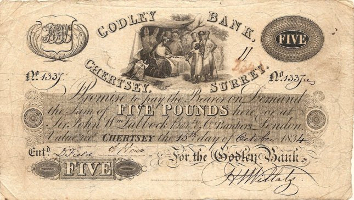
The withdrawal of gold and the increased issuing of notes leads to the establishment of a number of private banks in Ireland who are allowed to issue their own notes. In 1799 there are eleven private banks. By 1803, this number has increased to forty-one. Many of these banks subsequently fail and destroy the lives of their customers. The partners who run these financial institutions are identified on the banknotes they issue. Therefore their clients can see the names, but not the addresses, of the men who have financially destroyed them when they fall into liquidation.
The worst blizzard in living memory hits Ireland on February 25, 1947. The penetrating Arctic winds had been blowing for several weeks. Munster and Leinster had been battling the snows since the middle of January.
On the evening of February 24, a major Arctic depression approaches the coast of Cork and Kerry and advances northeast across Ireland. By morning, Ireland is being pounded by the most powerful blizzard of the 20th century. The winter of 1946-1947 is the coldest and harshest winter in living memory. Temperatures rarely rise above freezing and the snows that have fallen across Ireland in January remain until the middle of March.
Worse still, all subsequent snowfall in February and March simply piles on top of all that has previously fallen. There is no shortage of snow that bitter winter. Of the fifty days between January 24 and March 17, it snows on thirty of them.
“The Blizzard” of February 25th is the greatest single snowfall on record and lasts for almost fifty consecutive hours. It smothers the entire island in a blanket of snow. Driven by persistent easterly gales, the snow drifts until every hollow, depression, arch and alleyway is filled and the Irish countryside becomes a vast ashen wasteland.
Everything on the frozen landscape is a sea of white. The freezing temperatures solidify the surface and it is to be an astonishing three weeks before the snows begins to melt.
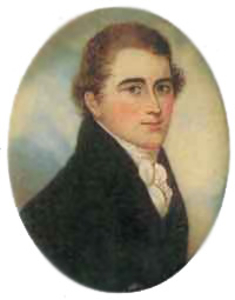
O’Leary is born around 1800 in Cork, County Cork. His father is Jeremiah O’Leary, a butter merchant. Little is known of his early life.
In 1817, O’Leary travels to London to enlist in a regiment being formed by Henry Wilson. Wilson is recruiting officers and NCOs to go to South America and form a Hussar regiment in service to Simón Bolívar, who goes on to liberate much of South America from Spanish rule.
O’Leary sails for Venezuela with Wilson near the end of 1817, arriving in March 1818. Unlike many of the Irish who fight for Simón Bolívar in his many campaigns to win South American independence, he has not served in the Napoleonic Wars. He first meets Bolívar away from the front shortly his arrival and Bolívar is apparently impressed with the young Irish officer.
In March 1819, O’Leary sees his first action and is promoted to captain. In July, after Bolívar’s famous crossing through the Casanare Swamps and over the Andes, he receives a saber wound in the battle of Pantano de Vargas but he quickly recovers and takes part in the Battle of Boyacá on August 9. Shortly after this, he becomes aide-de-camp to Bolívar. Two years later, after much more fighting, Venezuela is freed.
During the next few years, as the fight continues to free the rest of South American from Spanish domination, O’Leary performs many dangerous missions for “The Liberator,” rising ever higher in his esteem. He continues to serve Bolívar well through the political and military intrigues that follow the freeing of South America from the Spanish.
After Bolívar’s death in December 1830, O’Leary disobeys orders to burn the general’s personal documents and is exiled to Jamaica by the new Venezuelan government. There he writes extensive memoirs that are later edited by his son, Simon Bolivar O’Leary, and published in the 1870s and 1880s. Simon is the eldest of six children O’Leary has with his South American wife. He also writes his own very extensive memoirs, spanning thirty-four volumes, of his time fighting in the revolutionary wars with Bolívar.
In 1833, O’Leary is able to return to Venezuela. He holds a number of diplomatic posts for the Venezuelan government for the next 20 years, and on at least two occasions is able to visit his boyhood home of Cork.
Daniel O’Leary dies in Bogotá on February 24, 1854. The Venezuelans name a plaza after him in Caracas. In 1882, they obtain permission to take O’Leary’s body from Bogotá to Caracas, where it is laid to rest in the National Pantheon of Venezuela to lie forever in death next to the man he had served so faithfully in life, Don Simón Bolívar. A bust and plaque honouring O’Leary are presented by the Venezuelan Government to the people of Cork and unveiled on May 12, 2010 by the Venezuelan Ambassador to Ireland, Dr. Samuel Moncada.
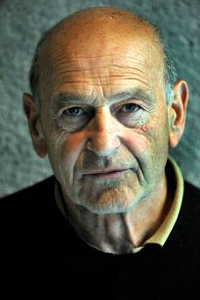
Murphy attends the local Archbishop McHale College and later becomes a metalwork teacher. He begins writing in the late 1950s, saying, “In 1958, my best friend said to me, why don’t we write a play? I didn’t think it was an unusual question, because in 1958 everyone in Ireland was writing a play.” His second play, A Whistle in the Dark, is written in his Tuam kitchen on his free Friday and Saturday nights. It is entered into a competition for amateur plays, which it wins, and is eventually performed at the Theatre Royal Stratford East in London in 1961. It causes considerable controversy both there and in Dublin when it is later given its Irish premiere at the Abbey having initially been rejected by its artistic director.
Though Murphy is religious as a boy, education by the Christian Brothers leaves him largely irreligious. His 1975 play The Sanctuary Lamp is produced in the Abbey Theatre and receives a hostile reception due to its anti-Catholic nature, with theatregoers walking out and much negative criticism in the media.
Considered by many to be Ireland’s greatest living playwright, a title also often given to Brian Friel prior to his death in 2015, Murphy is honoured by the Abbey Theatre in 2001 by a retrospective season of six of his plays. His plays include the historical epic Famine (1968) which deals with the Irish Potato Famine between 1846 and spring 1847, the anti-clerical The Sanctuary Lamp (1975), The Gigli Concert (1983) and for many his masterpiece, the lyrical Bailegangaire and the bar-room comedy Conversations on a Homecoming (both 1985).
Murphy’s work is characterised by a constant experimentation in form and content from the apparently naturalistic A Whistle in the Dark to the surreal The Morning After Optimism and the spectacularly verbal The Gigli Concert. Recurring themes include the search for redemption and hope in a world apparently deserted by God and filled with suffering. Although steeped in the culture and mythology of Ireland, Murphy’s work does not trade on familiar clichés of Irish identity, dealing instead with Dostoyevskian themes of violence, nihilism and despair while never losing sight of the presence of laughter, humour and the possibilities of love and transcendence.




 The
The 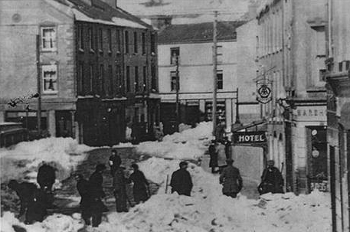
 seamus dubhghaill