seamus dubhghaill

Promoting Irish Culture and History from Little Rock, Arkansas, USA


Leave a comment

Martial Law Declared in Ireland

martial-law-april-1916

The United Kingdom declares martial law in Ireland for one month on April 25, 1916, the day after the commencement of the Easter Rising. A curfew is imposed from 8:30 PM until 5:00 AM. Anyone spotted on the streets during the hours of darkness are to be shot on sight. The trams stop running at 7:00 PM and the theatres and cinemas close by 8:00 PM. Those rushing for trams leaving the city centre have to pass through a stop-and-search military cordon.

The Easter Rising, also known as the Easter Rebellion, is an armed insurrection in Ireland during Easter Week, 1916. The Rising is mounted by Irish republicans in an attempt to end British rule in Ireland, secede from the United Kingdom of Great Britain and Ireland and establish an independent Irish Republic. This takes place while the United Kingdom is heavily engaged in World War I. It is the most significant uprising in Ireland since the Irish Rebellion of 1798.

Organized by seven members of the Military Council of the Irish Republican Brotherhood (IRB), the Rising begins on Easter Monday, April 24, 1916, and lasts for six days. The following day the British Government immediately declares martial law in Ireland. Members of the Irish Volunteers, led by schoolmaster and Irish language activist Patrick Pearse and joined by the smaller Irish Citizen Army of James Connolly and 200 members of Cumann na mBan, seize key locations in Dublin and proclaim the Irish Republic independent of the United Kingdom. There are actions in other parts of Ireland, however, except for the attack on the Royal Irish Constabulary barracks at Ashbourne in County Meath, they are minor.

With vastly superior numbers and artillery, the British army quickly suppresses the Rising and Pearse agrees to an unconditional surrender on Saturday, April 29, 1916. Most of the leaders are executed following courts-martial, but the Rising succeeds in bringing physical force republicanism back to the forefront of Irish politics. Support for republicanism continues to rise in Ireland in the context of the ongoing war in Europe and the Middle East and revolutions in other countries, and especially as a result of the Conscription Crisis of 1918 and the failure of the British-sponsored Irish Convention.

In the 1918 Irish general election, republicans, by then represented by Sinn Féin, secure an overwhelming victory, winning 73 Irish seats out of 105 to the British Parliament, on a policy of abstentionism and Irish independence. The following year Éamon de Valera escapes from Lincoln Gaol to become party leader. On January 21, 1919, they convene the First Dáil and declare the independence of the Irish Republic. Later that same day the Irish Republican Army, organised by Minister for Finance and IRB president Michael Collins, begins the Irish War of Independence with the Soloheadbeg ambush.

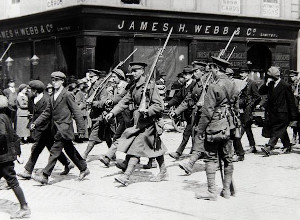
(Pictured: Rebel prisoners are marched out of Dublin by the British Army)


Leave a comment

The 32CSM Condemns the Good Friday Agreement

32-county-sovereignty-movement

Key members of the 32 County Sovereignty Movement (32CSM), led by the sister of H-Block hunger striker Bobby Sands, meet on April 19, 1998, to draft an outright condemnation of the Good Friday peace deal.

The 32CSM is an Irish republican group that is founded by Bernadette Sands McKevitt. It does not contest elections but acts as a pressure group, with branches or cumainn organised throughout the traditional counties of Ireland. The organisation has been described as the “political wing” of the Real Irish Republican Army, but this is denied by both organisations. The group originates in a split from Sinn Féin over the Mitchell Principles.

The 32CSM is founded as the 32 County Sovereignty Committee on December 7, 1997, at a meeting of like-minded Irish republicans in Finglas in Dublin. Those present are opposed to the direction taken by Sinn Féin and other mainstream republican groups in the Northern Ireland peace process, which leads to the Belfast Agreement (also known as the Good Friday Agreement) the following year. The same division in the republican movement leads to the paramilitary group now known as the Real IRA breaking away from the Provisional Irish Republican Army at around the same time.

Most of the 32CSM’s founders have been members of Sinn Féin. Some had been expelled from the party for challenging the leadership’s direction, while others felt they had not been properly able to air their concerns within Sinn Féin at the direction its leadership had taken. Bernadette Sands McKevitt, wife of Michael McKevitt and a sister of hunger striker Bobby Sands, is a prominent member of the group until a split in the organisation.

The name refers to the 32 counties of Ireland which were created during the Lordship of Ireland and Kingdom of Ireland. With the partition of Ireland in 1920–1922, twenty-six of these counties form the Irish Free State which becomes the Republic of Ireland. The remaining six counties of Northern Ireland remain part of the United Kingdom. Founder Bernadette Sands McKevitt says in a 1998 interview with the Daily Mirror that people did not fight for “peace” – “they fought for independence” – and that the organisation reaffirms to the republican position in the 1919 Irish Declaration of Independence.

Before the referendums on the 1998 Good Friday Agreement, the organisation lodges a legal submission with the United Nations challenging British sovereignty in Ireland. The referendums are opposed by the organisation, but are supported by 71% of voters in Northern Ireland and by 94% in the Republic of Ireland.

The 32CSM has protested against what it calls “internment by remand” in both jurisdictions in Ireland. Other protests include ones against former Democratic Unionist Party (DUP) leader Ian Paisley in Cobh, County Cork, against former British Prime Minister John Major being given the Keys to Cork city, against a visit to the Republic of Ireland by Police Service of Northern Ireland head Sir Hugh Orde, and against the Israeli occupation of Palestine and Anglo-American occupation of Iraq.

In 2015, the 32CSM organises a demonstration in Dundee, Scotland, in solidarity with the men convicted of shooting Constable Stephen Carroll, the first police officer to be killed in Northern Ireland since the formation of the PSNI. The organisation says the “Craigavon Two” are innocent and are victims of a miscarriage of justice.

The 32CSM once criticised the Real IRA’s military actions, with respect to the Omagh bombing. However, the group is currently considered a foreign terrorist organization (FTO) in the United States, because the group is considered to be inseparable from the Real IRA, which is designated as an FTO. At a briefing in 2001, a spokesman for the U.S. Department of State states that “evidence provided by both the British and Irish governments and open-source materials demonstrate clearly that the individuals who created the Real IRA also established these two entities to serve as the public face of the Real IRA. These alias organizations engage in propaganda and fundraising on behalf of and in collaboration with the Real IRA.” The U.S. Department of State’s designation makes it illegal for Americans to provide material support to the Real IRA, requires U.S. financial institutions to block the group’s assets and denies alleged Real IRA members visas into the United States.


Leave a comment

Formation of the Northern Ireland Civil Rights Association

northern-ireland-civil-rights-association

The Northern Ireland Civil Rights Association (NICRA), an organisation that campaigns for civil rights in Northern Ireland during the late 1960s and early 1970s, is formed in Belfast on April 9, 1967. The civil rights campaign attempts to achieve reform by publicising, documenting, and lobbying for an end to discrimination in areas such as elections (which are subject to gerrymandering and property requirements), discrimination in employment, in public housing and alleged abuses of the Special Powers Act.

Since Northern Ireland’s creation in 1922, the Catholic minority suffers from varying degrees of discrimination from the Protestant and Unionist majority. Many nationalist historians regard the ethos of Northern Ireland as unambiguously sectarian, however, academic and author Senia Paseta posits that discrimination was never as calculated as republicans maintained nor as fictional as unionists claimed. In fact, laws against religious discrimination are enshrined in the Government of Ireland Act 1920, Northern Ireland’s constitution. No government of Northern Ireland, even if they want to, can create laws which overtly discriminated against any religious body of peoples.

The genesis of NICRA lay in a meeting in Maghera in August 1966 between the Wolfe Tone Societies which is attended by Cathal Goulding, then chief of staff of the Irish Republican Army (IRA). During its formation, NICRA’s membership extends to trade unionists, communists, liberals, socialists, with republicans eventually constituting five of the thirteen members of its executive council. The organisation initially also has some unionists, with Young Unionist Robin Cole taking a position on its executive council. Official Sinn Féin and Official Irish Republican Army influence over NICRA grows in later years, but only as the latter’s importance declines, when violence escalated between late 1969 until 1972, when NICRA ceased its work.

Events escalate in Northern Ireland until August 1969, when the annual Apprentice Boys of Derry march is attacked as it marches through the city’s walls and past a perimeter with the nationalist Bogside. Initially some loyalist supporters throw pennies down from the walls onto Catholics in the Bogside. Catholics then throw nails and stones at loyalists leading to an intense confrontation. The Royal Ulster Constabulary (RUC) intervenes, and a three-day riot known as the Battle of the Bogside ensues. Rioting quickly spreads throughout nationalist areas in Northern Ireland, where at least seven are killed and hundreds wounded. Thousands of Catholics are driven from their homes by loyalists. These events are often seen as the start of the Troubles.

In a subsequent official inquiry, Lord Leslie Scarman concludes, “We are satisfied that the spread of the disturbances [in Derry in August 1969] owed much to a deliberate decision of some minority groups to relieve police pressure on the rioters in Londonderry. Amongst these groups must be included NICRA, whose executive decided to organise demonstrators in the province so as to prevent reinforcement of the police in Londonderry.” In December 1969 and January 1970, both Sinn Féin and the IRA split into “Official” and “Provisional” wings, with the “Official” wings retaining influence in NICRA.

The British government introduces internment on August 9, 1971, at the request of Northern Ireland Prime Minister Brian Faulkner. The British Army, in co-operation with the RUC, intern 342 people. One hundred sixteen of those interned are innocent of involvement with the IRA and are quickly released.

The introduction of internment is not a closely guarded secret, with newspaper editorials appearing and discussion on television. The IRA goes underground or flees across the border. As a result, fewer than 100 arrests are from the IRA. By this stage, support for NICRA begins to wane, however NICRA continues to organise anti-internment marches. In Derry on January 30, 1972, NICRA takes part in a mass anti-internment march which had also been banned. Fourteen unarmed demonstrators are shot and killed by British troops during the march which becomes known as Bloody Sunday.


2 Comments

The Battle of Brunswick Street

*

The Battle of Brunswick Street occurs in Dublin on March 14, 1921, during the Irish War of Independence.

British authorities hang six Irish Republican Army (IRA) Volunteers in Mountjoy Gaol for crimes of high treason and murder on the morning of March 14, 1921. The Volunteers, including Francis Xavier Flood, Thomas Bryan, Patrick Doyle, Bernard Ryan and Dermot O’Sullivan, had been captured in an ambush at Drumcondra two months earlier.

The gates of Mountjoy Gaol are opened at 8:25 AM and news of the executions is read out to the distraught relatives of the dead. As many as 40,000 people gather outside the prison and many mournfully say the Rosary for the executed men.

By evening, the streets clear rapidly as the British-imposed curfew comes into effect at 9:00 PM each night. During this period, the city is a fearful place, patrolled by regular British troops and the much-feared paramilitary police, the Auxiliary Division, as people scurry home and await IRA retaliation for the hangings, which is not long in coming.

That very evening, IRA captain Peadar O’Meara sends as many as thirty-four IRA men out to attack police or military targets. They are armed with the standard urban guerrilla arms of easily hidden handguns and grenades. One young Volunteer, Sean Dolan, throws a grenade at a police station on nearby Merrion Square, which bounces back before it explodes, blowing off his own leg.

At around 8:00 PM, with the curfew fast approaching, a company of Auxiliaries based in Dublin Castle is sent to the area to investigate the explosion. It consists of one Rolls Royce armoured car and two trucks holding about sixteen men. Apparently, the Auxiliaries have some inside information as they head straight for the local IRA headquarters at 144 Great Brunswick Street, now Pearse Street. One later testifies in court that “I had been notified there were a certain number of gunmen there.”

The IRA is expecting the Auxiliaries. As soon as the Auxiliaries approach the building, fire is opened on them from three sides. What is described in newspapers as a “hail of fire” tears into the Auxiliaries’ vehicles. Five of the eight Auxiliaries in the first truck are hit in the opening fusillade, two of them fatally injured. The IRA fighters, however, are seriously outgunned. The Rolls Royce armoured car is impervious to small arms fire (except its tires, which are shot out) but mounts a Vickers heavy machine gun which sprays the surrounding houses with bullets. The uninjured Auxiliaries also clamber out of their trucks and return fire at the gun flashes from street corners and rooftops.

Civilian passersby fling themselves to the ground to avoid the bullets but four are hit, by which side it is impossible to tell. The British military court of inquiry into the incident finds that the civilians had been killed by persons unknown, if by the IRA then they were “murdered,” if hit by Auxiliaries the shootings were “accidental.”

The gunfire lasts only five minutes but in that time seven people, including the two Auxiliaries, are killed or fatally wounded and at least six more wounded. Three civilians lay dead on the street – Thomas Asquith is a 68-year-old caretaker, David Kelly is a prominent Sinn Féin member and head of the Sinn Féin bank, and Stephen Clarke, aged 22, is an ex-soldier and may have been the individual who tipped off the Auxiliaries about the whereabouts of the IRA meeting house. An internal IRA report notes that he is “under observation, as he was a tout for the enemy.” The wounded are spirited away by sympathetic fire brigade members and members of Cumann na mBan and treated at nearby Mercer’s Hospital.

Two IRA men are captured as they flee the scene. Thomas Traynor, a 40-year-old veteran of the Easter Rising, is carrying an automatic pistol, but claims to have had no part in the ambush itself. He had, he maintains, simply been asked to bring in the weapon to 144 Great Brunswick Street. The other is Joseph Donnelly a youth of just 17 years of age.

As most of the IRA fighters get away through houses, over walls and into backstreets, the Auxiliaries ransack St. Andrew’s Catholic Hall at 144 Great Brunswick Street but find little of value. Regular British Army troops quickly arrive from nearby Beggars Bush Barracks and cordon off the area, but no further arrests are made. Desultory sniping carries on in the city for several hours into the night.

(From: “The Pearse Street Ambush, Dublin, March 14, 1921” by John Dorney, The Irish Story (theirishstory.com), January 26, 2015)


Leave a comment

Birth of Irish Nationalist Bobby Sands

Robert Gerard Sands, commonly known as Bobby Sands, Irish nationalist and member of the Provisional Irish Republican Army, is born on March 9, 1954, at Abbots Cross, NewtownabbeyCounty Antrim, outside Belfast.

Sands is the oldest of four children born to John and Rosaleen Sands, and the couple’s first son. Sands grows up in Belfast under the cloud of nationalist and loyalist divisions. At an early age, Sands’s life is affected by the sharp divisions that shape Northern Ireland. At the age of ten, he is forced to move with his family out of their neighborhood due to repeated intimidation by loyalists.

“I was only a working-class boy from a Nationalist ghetto,” Sands later writes about his childhood. “But it is repression that creates the revolutionary spirit of freedom.” Loyalist intimidation proves to be a theme throughout Sands’ life. At the age of 18, he is forced out of his job as an apprentice car builder. Not long afterwards, he and his family have to move again, as a result of political trouble.

The steady number of conflicts pushes Sands to join the republican movement in 1972. His ties to the movement soon capture the attention of the authorities, and later that year, he is arrested and charged with possessing firearms in his house. He spends the next three years of his life in prison. Upon his release, Sands immediately returns to the Republican Movement. He signs on as a community activist in Belfast’s rough Twinbrook area, quickly becoming a popular go-to person for a range of issues affecting the neighborhood.

In late 1976, authorities arrest Sands again, this time in connection with the bombing of Balmoral Furniture Company and an ensuing gun battle. After weathering a brutal interrogation and then a court proceeding that offers up questionable evidence connecting Sands and three others to the attack, a judge sentences Sands to 14 years in prison at the Long Kesh Detention Centre, a facility used to house Republican prisoners from 1971 until 2000, located just outside of Belfast.

As a prisoner, Sands’s stature only grows. He pushes hard for prison reforms, confronting authorities, and for his outspoken ways he is frequently given solitary confinement sentences. Sands contention is that he and others like him, who are serving prison sentences, are actually prisoners of war, not criminals as the British government insists.

Beginning on March 1, 1981, Sands leads nine other Republican prisoners in the H-Block section of the Maze prison on a hunger strike that lasts until death. Their demands range from allowing prisoners to wear their own clothes to permitting visits and mail, all of which are central in improving the inmates’ way of life.

Unable to move authorities to give in to his requests, and unwilling himself to end his hunger strike, Sands’s health begins to deteriorate. During the first seventeen days of the strike alone, he loses 16 pounds. A hero among his fellow nationalists, Sands is elected as a Member of Parliament (MP) for Fermanagh and South Tyrone while in prison. Sands becomes the youngest MP at the time. However, he dies less than one month later without ever having taken his seat in the House of Commons.

Only days after slipping into a coma, on the morning of May 5, 1981, Sands dies from malnutrition due to starvation. He is 27 years old and has refused to eat for 66 days. He becomes so fragile over his final weeks that he spends his final days on a waterbed to protect his deteriorating and fragile body. At time of his death, Sands is married to Geraldine Noade, with whom he has one son, Gerard.

The announcement of Sands’s death prompts several days of rioting in nationalist areas of Northern Ireland. Over 100,000 people line the route of Sands’s funeral. He is buried in the ‘New Republican Plot’ alongside 76 others. Their graves are maintained by the National Graves Association, Belfast.

While loyalists dismiss Sands’s death, others are quick to recognize its significance. Over the next seven months, nine other IRA supporters die on hunger strike. Eventually, the British government gives proper political recognition to the prisoners, many of them earning their release under the 1998 Good Friday Agreement.

Bobby Sands’ final days are depicted in the 2008 Steve McQueen film Hunger, with actor Michael Fassbender portraying Sands.


Leave a comment

Birth of Mairéad Farrell, Provisional IRA Member

mairead-farrell

Mairéad Farrell, member of the Provisional Irish Republican Army (IRA), is born in Belfast on March 3, 1957. She is shot dead by the British Army in Gibraltar on March 6, 1988.

Farrell is born into a middle-class family with no link to militant Irish republicanism other than a grandfather who had been interned during the Irish War for Independence. She is educated at Rathmore Grammar School, Belfast. At the age of 14 she is recruited into the Provisional IRA by Bobby Storey. After leaving school at the age of 18, she is hired as a clerical worker for an insurance broker’s office.

On March 1, 1976, the British government revokes Special Category Status for prisoners convicted from this date under anti-terrorism legislation. In response, the IRA instigates a wave of bombings and shootings across Northern Ireland and younger members such as Farrell are asked to participate. On April 5, 1976, along with Kieran Doherty and Sean McDermott, she attempts to plant a bomb at the Conway Hotel in Dunmurry, as that hotel had often been used by British soldiers on temporary duty in Northern Ireland. She is arrested by Royal Ulster Constabulary (RUC) officers within an hour of planting the bomb. McDermott, her boyfriend, is shot dead by a RUC reservist at a nearby housing estate.

At her trial, Farrell refuses to recognise the court as it is an institution of the British state. She is sentenced to fourteen years in prison for explosives offences, firearms offences, and belonging to an illegal organisation.

When Farrell arrives at Armagh Prison, she refuses to wear a prison uniform in protest at the designation of republican prisoners as criminals and becomes the official Officer Commanding of the female IRA prisoners. After 13 months, she, along with Mary Doyle and Mairead Nugent, begin a hunger strike to coincide with the one already taking place in Long Kesh Prison. It ends on December 19, a day after the men’s strike. In March 1981 the prisoners’ rights campaign is focused on the hunger strike being undertaken by Bobby Sands, leader of IRA prisoners in the H-Blocks. She was one of the H-Block/Armagh prisoners to stand for election in the Republic of Ireland in the 1981 Irish general election, standing in Cork North-Central and polling 2,751 votes (6.05%).[17]

Upon her release from prison in October 1986, Farrell enrolls at Queen’s University, Belfast for a course in Political Science and Economics. However, she drops out to re-engage in IRA activity. The IRA sends her with Seán Savage and Daniel McCann to the British overseas territory of Gibraltar to plant a car bomb in a heavily populated town area. The target is the band and guard of the 1st Battalion of the Royal Anglian Regiment during a weekly ceremonial changing of the guard in front of Governors’ residence, on March 8, 1988. According to interrogated IRA members, Gibraltar is selected as a target because it is a British possession that is in dispute, and that it is an area with lighter security measures than had become endemic at British military installations elsewhere due to the IRA’s campaign.

The British Government’s domestic intelligence service MI5 becomes aware of their plan and a detachment from the British Army is specifically deployed to Gibraltar to intercept the IRA team and prevent the attack. Farrell, Savage and McCann are confronted by plainclothes soldiers from the Special Air Service regiment while they are engaged in a reconnaissance in Gibraltar pending the delivery of the car bomb. Farrell is shot three times in the back and once in the face. Her two accomplices are also killed in an operation code-named Operation Flavius by the British Government. Some witnesses to the shooting state that Farrell and McCann were shot while attempting to surrender, and while lying wounded on the ground. The three IRA members are all found afterwards to be unarmed.

Keys to a hire car found in Farrell’s handbag lead the Spanish Police to the discovery across the border in Spain of five packages totaling 84 kg of Semtex explosive in a car which the IRA team intended to subsequently drive into Gibraltar for the attack. These packages have four separate detonators attached. Around this is packed 200 rounds of ammunition as shrapnel. There are two timers but they were not primed or connected.

At the funeral of the ‘Gibraltar Three’ on March 16, three mourners are killed in a gun and grenade attack by loyalist paramilitary Michael Stone in the Milltown Cemetery attack.


Leave a comment

The Clive Barracks Bombing

clive-barracks-bombing

The Clive Barracks bombing, a bomb attack carried out by the Provisional Irish Republican Army on a British Army barracks at Ternhill, Shropshire, takes place on February 20, 1989. The attack injures two soldiers from the Parachute Regiment and destroys a large part of the barracks.

The IRA intensifies their campaign outside of Northern Ireland in 1988. In May 1988 the IRA enjoys one of their most successful ambushes on British Military figures in mainland Europe with attacks in the Netherlands where they kill three and injured three Royal Air Force soldiers. Four months later in August 1988, the Provisional IRA carries out the Inglis Barracks bombing, which kills one British soldier and injures ten others. It is the first IRA attack in England since the infamous Brighton hotel bombing in October 1984.

On Monday, February 20, 1989, the Provisional IRA explodes two bombs at Clive Barracks at Ternhill. Only two of the planned three bombs are primed and ready to explode when the two IRA members, both of whom are wearing combat jackets, are spotted and approached by a sentry, Lance-Corporal Alan Norris, who raises the alarm. They throw the third bomb, which was inside a backpack, at him and run to a car they had stolen earlier and drive away. Soldiers fire three rounds at the IRA members as they are fleeing but no shots hit their target.

The bombs explode about ten minutes after the IRA men escape. Even though nobody is killed in the attack, the explosions cause large damage to the barracks. The alarm sounded by Norris gives about fifty British soldiers a chance to escape almost certain death. Only two soldiers are injured, one being hit by flying glass the other with only minor injuries.

The IRA claims responsibility for the bombings and British police believe IRA fugitive Patrick Sheehy is the main operator in the attack. The IRA issues a statement saying, “While Britain maintains its colonial grip on the north of Ireland, the IRA will continue to strike at those who oversee and implement British Government policy in our country.”

Five months later, in July 1989, the IRA kills a British soldier in Hanover, West Germany when they place a booby trap IED under his car. On September 7 the IRA mistakenly shoots dead Heidi Hazell, the German wife of a British soldier, in a hail of bullets in Dortmund. In the climax of the England and European campaign by the IRA is the Deal barracks bombing in which the IRA kills eleven Royal Marines and seriously injures 22 others. It is the highest death toll from an operation in England in seven years since the Hyde Park and Regent’s Park bombings on September 22, 1982, which kill 11 soldiers and injured more than fifty.


Leave a comment

Birth of Seán Mac Stíofáin, Irish Republican Army Commander

sean-mac-stiofain

Seán Mac Stíofáin, Irish Republican Army (IRA) commander and a founding member of the Provisional IRA and its first chief of staff, is born in Leytonstone, London on February 17, 1928.

Mac Stíofáin is born John Stephenson, the son of Protestant parents. He claims Irish ancestry on his mother’s side although the validity of this is uncertain. He leaves school at sixteen, working as a labourer and converting to Catholicism. He also serves in the Royal Air Force during World War II, working as a storeman. After the war, he becomes involved and obsessed with Irish republicanism. He joins the Irish Republican Army in 1949 and helps organise an IRA unit in London.

In 1953, Stephenson leads a raid that steals rifles and mortars from a cadet school armoury in Essex. He is stopped randomly by police, arrested and sentenced to eight years in prison. He serves more than three years behind bars, using this time to learn Irish Gaelic. Released in 1956, he marries an Irish woman, moves to Dublin and changes his name to Seán Mac Stíofáin, the Gaelic form of his birth name.

Mac Stíofáin gradually ascends through the ranks of the IRA, becoming its director of intelligence. The outbreak of the Troubles in 1969 opens up divisions in the IRA over strategy and tactics. While Cathal Goulding and other leaders want to use violence carefully, Mac Stíofáin and his supporters urge open warfare with the Royal Ulster Constabulary (RUC).

In August 1969, Mac Stíofáin leads a raid on the RUC station at Crossmaglen, in defiance of IRA orders. In December, he and four others form a Provisional Army Council. This splinter group becomes the nucleus of the Provisional IRA.

Mac Stíofáin becomes the Provisional IRA’s first chief of staff. He also oversees its rearming and the escalation of its military campaign in Northern Ireland. In July 1972, he represents the Provisional IRA in secret talks with the British government in London. When these talks collapse, he orders an increase in Provisional IRA operations, beginning with the mass bombing of Belfast on July 21, 1972.

Mac Stíofáin remains in charge until November 1972, when a controversial television interview leads to his arrest, imprisonment and removal from the Provisional IRA leadership. He is released the following year but is no longer prominent in the Provisional IRA. He spends the rest of the 1970s working for a Sinn Féin newspaper.

Mac Stíofáin died on May 18, 2001, in Our Lady’s Hospital in Navan, County Meath, after a long illness. He is buried in St. Mary’s Cemetery, Navan. His funeral is attended by Gerry Adams and Martin McGuinness.


2 Comments

Death of Republican Activist James Murphy

black-and-tans-and-auxies-dublin-ireland-1921

Republican activist James Murphy dies in Mater Hospital, Dublin on February 11, 1921. Before he dies, he declares that he and Patrick Kennedy had been shot by their Auxiliary captors. A court of inquiry is held, and Captain W. L. King, commanding officer of F Company Auxiliary Division of the Royal Irish Constabulary (ADRIC), is arrested for the killings.

James Murphy and Patrick Kennedy are arrested by Auxiliaries in Dublin on February 9 and are taken into the custody of ‘F’ company. Two hours later, constables of the Dublin Metropolitan Police find the two men lying shot, with pails on their heads, in Clonturk Park, Drumcondra. Kennedy is dead and Murphy is fatally wounded. He dies in Mater Hospital, Dublin two days later.

Just before dying Murphy testifies that King had taken them and stated that they were “just going for a drive.” King is arrested for the killings. King and two of his men, Hinchcliffe and Welsh, are court-martialed on February 13-15, but are acquitted after Murphy’s dying declaration is ruled inadmissible and two officers from ‘F’ Company provide perjured alibis for King at the time of the shootings.

King is implicated and court-martialed for the deaths of Conor Clune, Peadar Clancy, and Dick McKee, the latter two leading lights in the Dublin Irish Republican Army, the former a luckless Gaelic League member, who are all captured in Dublin on November 20, 1920, the day before Bloody Sunday. Clune is caught at Vaughn’s Hotel in Parnell Square, Dublin and the two IRA leaders at Lower Gloucester Street, complete with British Army officer uniforms and detonators.

Sometime between then and the next day, in the Dublin Castle guardroom, as news filters in of the deaths of several British intelligence officers, the prisoners are killed in questionable circumstances. According to an official report from Dublin Castle, they attempted to grab rifles and hurl unfused grenades and are killed in that action. The guards of ‘F’ Company in the room at the time are cleared of wrongdoing by a court inquiry. A Major Reynolds of ‘F’ Company is said to have passed details of the killers to Michael Collins. The Times notes that it seems as if the prisoners had been lined up and shot. In a later novel, a Captain Hardy more or less confesses to the killing of one of the prisoners.

Ironically, Captain King is on Michael Collins’s list of British Intelligence officers to be executed on the morning of November 20, 1920, he is not in his room when the assassins arrive but rather, he is interrogating the prisoners in Dublin Castle.

(Pictured: Mixed gunmen of the Royal Irish Constabulary’s Auxiliary Division and Black and Tans contingents, Stair na hÉireann | History of Ireland)


Leave a comment

Hanging of Peter Barnes & James Richards

peter-barnes-and-james-mccormack

Irish Republican Army (IRA) volunteers Peter Barnes and James Richards are hanged in Winston Green Prison in Birmingham, England on February 7, 1940 for their involvement in a bombing in Coventry the previous year which killed five people.

Barnes and Richards (also known as James McCormack) are members of the Irish Republican Army (IRA) and participate in the August 25, 1939 Coventry bombing which kills five people. Although they both admit to constructing the bomb, which is intended to be used to destroy a power station, they claim not to be involved in planting the bomb.

Seán MacBride, a former Chief of Staff of the IRA and Irish barrister, attempts to secure their release claiming they are being illegally held without a writ of habeas corpus. However, both are charged with murder on December 12 along with Brigid O’Hara and Joseph and Mary Hewitt. All five plead not guilty before the court at Birmingham Assizes.

Brigid O’Hara issues statements between August 28 and September 4 to Scotland Yard and Birmingham City Police denying any knowledge of the bombings and later provides evidence for the prosecution. Found guilty of murder on December 15, Barnes and Richards are hanged at Winston Green Prison in Birmingham on February 7, 1940. Their remains are returned to Dublin in 1969.

The reinterment in Mullingar, County Westmeath is attended by an estimated 15,000 people. Mass is said in Irish in the Cathedral before the funeral to Ballyglass Cemetery. Among those attending are three brothers of Peter Barnes and a sister and brother of McCormack.

The trial and execution results in a public outcry in Ireland against Neville Chamberlain and the British Government as Peadar O’Donnell and other prominent Irish writers sign a petition campaigning for leniency towards the condemned men.