FitzMaurice is born in Wales in about 1150, the second-eldest son of Maurice FitzGerald, Lord of Llanstephan, by his wife, Alice (daughter of Arnulf de Montgomery). He has one sister, Nesta, who is named after their celebrated grandmother, Princess Nest ferch Rhys, and five brothers, including the eldest, William FitzMaurice, 1st Baron of Naas.
FitzMaurice’s father is the leader of the first landing of Normans who arrive in Ireland in 1169 to assist the exiled Irish king of Leinster Diarmait Mac Murchada regain his kingdom. Accompanying his father from Wales to Ireland, he and his brother Alexander show great valour in the battle against Ruaidrí Ua Conchobair outside the walls of Dublin in 1171. Upon the death of their father on September 1, 1176, his elder brother William grants him half the cantred of Ophelan with centres at Maynooth and Rathmore. He is confirmed in them by Prince John in 1185.
William FitzAldelm deprives FitzMaurice and his brothers of their stronghold of Wicklow, though, after a time, is compelled to give them Ferns in exchange. FitzMaurice has already received, from Strongbow, Naas and other districts in what becomes County Kildare, and has erected Maynooth Castle.
In 1199, though receiving King John’s letters of protection, FitzMaurice is ordered to “do right” to Maurice Fitzphilip for the lands of “Gessil and Lega,” that he had taken from Fitzphilip. Between 1185 and 1204, FitzGerald has established a settlement at Geashill. Originally of motte-and-bailey design, it is a timber castle on an earthen mound, nearby are located the church and tenant dwellings. On his death, FitzMaurice is still in possession of those estates. In the 15th century the wooded fortress at Geashill is replaced by a stone tower house. Today, only the west wall of the castle remains.
FitzMaurice is often described as “Baron Offaly,” the middle cantred of which had been among his father’s possessions. He dies on January 15, 1204.
FitzMaurice is described by his cousin, Gerald of Wales, as small in stature, but distinguished for prudence and honesty. He is the patrilineal ancestor of the earls of Kildare.
Sometime around 1193, FitzMaurice marries as her first husband, Eve de Bermingham, daughter of Sir Robert de Bermingham. In marriage, he receives the barony of Offaly, becoming the first FitzGerald Lord of Offaly. Together he and Eve have one son:
Following FitMaurice’s death in 1204, Eve goes on to marry two more times. Her second husband is Geoffrey FitzRobert, and her third, whom she marries sometime after 1211, is Geoffrey de Marisco, Justiciar of Ireland. She dies between June 1223 and December 1226.
During the Irish Confederate Wars, like most Irish Catholics, O’Brien sides with Confederate Ireland. His services to the Catholic Confederation are highly valued by the Supreme Council. He treats the wounded and supports Confederate soldiers throughout the conflict. He is against a peace treaty that does not guarantee Catholic freedom of worship in Ireland and in 1648 signs the declaration against the Confederate’s truce with Murrough O’Brien, 1st Earl of Inchiquin, who has committed atrocities such as the Sack of Cashel against Catholic clergy and civilians, and the declaration against the Protestant royalist leader, James Butler, 1st Duke of Ormond, in 1650 who, due to his failure to resist the Cromwellian conquest of Ireland is not deemed fit to command Catholic troops. He is one of the prelates, who, in August 1650 offers the Protectorate of Ireland to Charles IV, Duke of Lorraine.
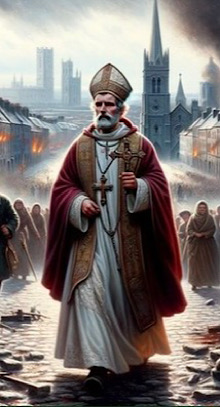
In 1651, Limerick is besieged and O’Brien urges a resistance that infuriates the Ormondists and Parliamentarians. Following surrender, he is found ministering to the wounded and ill inside a temporary plague hospital. As previously decided by the besieging army, O’Brien is denied quarter and protection. Along with Alderman Thomas Stritch and English Royalist officer Colonel Fennell, he is tried by a drumhead court-martial and sentenced to death by New Model Army General Henry Ireton. On October 30, 1651, O’Brien is first hanged at Gallows Green and then posthumously beheaded. His severed head is afterward displayed spiked upon the river gate of the city.
After the successful fight that is eventually spearheaded by Daniel O’Connell for Catholic emancipation between 1780 and 1829, interest revives as the Catholic Church in Ireland is rebuilding after three hundred years of being strictly illegal and underground. As a result, a series of re-publications of primary sources relating to the period of the persecutions and meticulous comparisons against archival Government documents in London and Dublin from the same period are made by Daniel F. Moran and other historians.
The first Apostolic Process under Canon Law begins in Dublin in 1904, after which a positio is submitted to the Holy See.
In the February 12, 1915 Apostolic decree, In Hibernia, heroum nutrice, Pope Benedict XV formally authorizes the formal introduction of additional Causes for Roman Catholic Sainthood.
During a further Apostolic Process held in Dublin between 1917 and 1930 and against the backdrop of the Irish War of Independence and the Irish Civil War, the evidence surrounding 260 alleged cases of Roman Catholic martyrdom are further investigated, after which the findings are again submitted to the Holy See.
On September 27, 1992, O’Brien and sixteen other Irish Catholic Martyrs are beatified by Pope John Paul II. June 20th, the anniversary of the 1584 execution of Elizabethan era martyr Dermot O’Hurley, is assigned as the feast day of all seventeen. A large backlighted portrait of him is on display in St. Michael’s Church, Cappamore, County Limerick, which depicts him during The Siege of Limerick.
In January and February 1689, Butler votes against the motion to put William of Orange and Mary on the throne and against the motion to declare that James II has abdicated it. Nevertheless, he subsequently joins the forces of William of Orange, by whom he is made colonel of the 2nd Troop of Horse Guards on April 20, 1689. He accompanies William in his Irish campaign, debarking with him in Carrickfergus on June 14, 1690, and commands this troop at the Battle of the Boyne in July 1690. In February 1691 he becomes Lord Lieutenant of Somerset.
Butler serves on the continent under William of Orange during the Nine Years’ War and, having been promoted to major general, he fights at the Battle of Steenkerque in August 1692 and the Battle of Landen in July 1693, where he is taken prisoner by the French and then exchanged for the Duke of Berwick, James II’s illegitimate son. He is promoted to lieutenant general in 1694.
Butler plays a dramatic role at the notorious meeting of the Privy Council on March 8, 1711, when Antoine de Guiscard, a French double agent who is being questioned about his treasonable activities, attempts to assassinate Robert Harley, 1st Earl of Oxford, against whom he has a personal grudge for drastically cutting his allowance, by stabbing him with a penknife. Harley is wounded, but not seriously, due largely to the fact that he is wearing a heavy gold brocade waistcoat in which the knife gets stuck. Several Councillors, including Butler, stab Guiscard in return. Guiscard implores Butler to finish the deed, but he replies that it is not for him to play the hangman. In any case, he has the sense to see that Guiscard must be kept alive at least long enough to be questioned, although as it turns out Guiscard’s wounds are fatal, and he dies a week later.
On April 23, 1712, Butler leaves Harwich for Rotterdam to lead the British troops taking part in the war. Once there he allows himself to be made the tool of the Tory ministry, whose policy is to carry on the war in the Netherlands while giving secret orders to him to take no active part in supporting their allies under Prince Eugene. In July 1712, he advises Prince Eugene that he can no longer support the siege of Le Quesnoy and that he is withdrawing the British troops from the action and instead intends to take possession of Dunkirk. The Dutch are so exasperated at the withdrawal of the British troops that they close the towns of Bouchain on Douai to British access, despite the fact that they have plenty of stores and medical facilities available. Butler takes possession of Ghent and Bruges as well as Dunkirk, in order to ensure his troops are adequately provided for. On April 15, 1713, he becomes Lord Lieutenant of Norfolk.
Ormonde’s position as Captain-General makes him a personage of much importance in the crisis brought about by the death of Queen Anne and, during the last years of Queen Anne, he almost certainly has Jacobite leanings and corresponds with the Jacobite Court including his cousin, Piers Butler, 3rd Viscount Galmoye, who keeps barrels of gunpowder at Kilkenny Castle. King George I, on his accession to the throne in August 1714, institutes extensive changes and excludes the Tories from royal favour. Butler is stripped of his posts as Captain-General, as colonel of the 1st Regiment of Foot Guards and as Commander in Chief of the Forces with the first two posts going to the Duke of Marlborough and the role of Commander-in-Chief going to John Dalrymple, 2nd Earl of Stair. On November 19, 1714, Butler is instead made a member of the reconstituted Privy Council of Ireland.
Accused of supporting the Jacobite rising of 1715, Butler is impeached for high treason by Lord Stanhope on June 21, 1715. He might avoid the impending storm of Parliamentary prosecution, if he remains in England and stands trial but instead, he chooses to flee to France in August 1715 and initially stays in Paris with Henry St. John, 1st Viscount Bolingbroke. On August 20, 1715, he is attainted, his estate forfeited, and honours extinguished. The Earl Marshal is instructed to remove the names and armorial bearings of Butler and Bolingbroke from the list of peers and his banner as Knight of the Garter is taken down in St. George’s Chapel.
On June 20, 1716, the Parliament of Ireland passes an act extinguishing the regalities and liberties of the county palatine of Tipperary; for vesting Butler’s estate in the crown and for giving a reward of £10,000 for his apprehension, should he attempt to land in Ireland. But the same parliament passes an act on June 24, 1721, to enable his brother, Charles Butler, 1st Earl of Arran, to purchase his estate, which he does accordingly.
Butler subsequently moves to Spain where he holds discussions with Cardinal Giulio Alberoni. He later takes part in a Spanish and Jacobite plan to invade England and puts James Francis Edward Stuart on the British throne in 1719, but his fleet is disbanded by a storm in the Bay of Biscay. In 1732, he moves to Avignon, where he is seen in 1733 by the writer Lady Mary Wortley Montagu. He dies at Avignon in exile on November 16, 1745, but his body is returned to London and buried in Westminster Abbey on May 22, 1746.
On July 20, 1682, Butler, then called Lord Ossory, marries Lady Anne Hyde, daughter of Laurence Hyde, who is then Viscount Hyde of Kenilworth but becomes Earl of Rochester in November. The couple has a daughter, Mary, who dies young in 1688.
Following the death of his first wife in 1685, Butler plans to marry again in order to secure a male heir. He gains permission from the House of Lords for the arranging of a jointure for another marriage in May 1685, and in August of that year, he marries Lady Mary Somerset, daughter of the Duke of Beaufort and Mary Capel. The couple has a son, Thomas (1686–1689), and two daughters, Elizabeth (1689–1750) and Mary (1690–1713). His second wife is a Lady of the Bedchamber to Queen Anne. Their younger daughter, Mary, marries John Ashburnham, 1st Earl of Ashburnham.
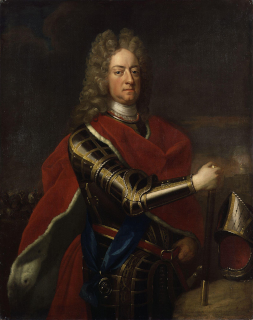
(Pictured: Portrait of James Butler, 2nd Duke of Ormonde, by Michael Dahl, National Portrait Gallery)
Barry seems to be an extreme example of an eighteenth-century rake, a man of quarrelsome and violent nature, and a heavy drinker. He is a member of the notorious Dublin Hellfire Club. The club’s reputation never fully recovers from the sensational publicity surrounding his trial for murder, although there is no reason to think that any of his fellow members knew of or condoned the crime. There are widespread rumours that he had committed at least one previous murder which was successfully hushed up, although there seems to be no firm evidence for this.
On August 9, 1738, Barry is drinking with some friends at a tavern in Palmerstown, then a small village near Dublin. Drinking more heavily than usual, he attacks a drinking companion but is unable to draw his sword. Enraged, he runs to the kitchen, where he chances to meet Laughlin Murphy, the tavern porter, and for no known reason runs him through with his sword. He then bribes the innkeeper to let him escape. Murphy is taken to Dublin where he lingers for several weeks, dying on September 25, 1738.
Although Barry is not immediately apprehended, there is no reason to believe that the Crown intends that he should escape justice. The authorities clearly aim not only to prosecute him but to secure a conviction. Even in an age when the aristocracy enjoys special privileges, the murder of Murphy, who by all accounts was an honest and hardworking man with a wife and young family to support, shocks public opinion, whereas Barry is regarded, even among members of his own class, as a public nuisance. In due course, he is arrested and indicted for murder. He demands, as the privilege of peerage, a trial by his peers. The trial, which takes place in the Irish Houses of Parliament on April 27, 1739, arouses immense public interest.
Bowes dominates the proceedings, and his speeches make his reputation as an orator. Thomas Rundle, Bishop of Derry, who as a spiritual peer is only an observer at the trial, says, “I never heard, never read, so perfect a piece of eloquence…the strength and light of his reason, the fairness and candour.” The Bishop is scathing about the quality of counsel for the defence, describing the performance of Barry’s counsel as “detestable.” The defence case is that Murphy had died not from his wound but from a long-standing illness (or alternatively a rat bite), but in view of the medical evidence produced by the prosecution this is a hopeless argument. According to Bishop Rundle, Barry’s counsel fails even to mention the possibility that Murphy, who lingered for six weeks after being stabbed, might have died through inadequate medical care. Given the overwhelming evidence of Barry’s guilt, however, any defence would probably have been useless, and despite what is described as their “looks of horror,” his peers have little difficulty in finding him guilty. Wyndham, who had conducted the trial with exemplary fairness, pronounces the death sentence. His retirement soon afterward is generally thought to be due to the strain of the trial.
King George II, like all British monarchs, has the prerogative of mercy, and a campaign is launched by Barry’s friends and relatives to persuade the King to grant a pardon. Their plea concentrates on the victim’s low social standing, the implication being that the life of a peer is worth more than that of a tavern worker, despite the victim’s blameless character and the savage and wanton nature of the murder. The King proves reluctant to grant a pardon, and for a time it seems that Barry will be executed, but in due course, a reprieve is issued. Popular legend has it that his uncle, Sir Compton Domvile, through whose estate at Templeogue the River Dodder flows, secured a royal pardon for his nephew by threatening to divert the course of the river, thus depriving the citizens of Dublin of what is then, and remains long after, their main supply of drinking water.
On June 17, 1740, Barry receives a full royal pardon and the restoration of his title and estates. Soon afterward he leaves Ireland for good and settles in England. He is said to have had a personal audience with the King and thanked him in person for his clemency.
Barry’s last years are wretched. Although he has a second marriage shortly before his death, he is abandoned by all his former friends, is in great pain from gout, and is prone to depression. He dies in Nottingham on March 22, 1751, and is buried at St. Nicholas Church, Nottingham. On his death the title becomes extinct. His estates pass to his cousin, Sir Compton Domvile, 2nd Baronet, who makes unsuccessful efforts to have the barony revived. His widow Elizabeth outlives him by many years, dying in December 1816.
Butler succeeds to the title at the age of fifteen and was educated at the University of Oxford, taking the degree of LL.D. in 1677. In 1678, he is commissioned as a captain in Colonel Thomas Dongan‘s regiment, which is disbanded before he takes up his post.
In 1692, Butler is created Earl of Newcastle in County Limerick in the Jacobite peerage of Ireland. In France he is named Colonel of the 2nd Queen’s Regiment of Irish Horse in the service of that country and serves with distinction in various battles of the War of the Spanish Succession, also becoming a Lieutenant-General in the Spanish army. He is at the Siege of Roses in 1693, and in 1694 is a Brigadier attached to the army of Germany. He serves in Italy and other parts of Continental Europe from 1701 to 1703, sharing all the fortunes of the Irish Brigade. He later serves in the French army as a Lieutenant-General. He is created Brigadier of Cavalry in 1694.
Butler dies at the age of eighty-eight in Paris on June 18, 1740, and is buried at St. Paul’s there. John C. O’Callaghan writes in Irish Brigades in the Service of France (Glasgow, 1870): “The successive claimants of the title of Galmoy were officers in France down to the Revolution; in whose armies, as well as in others, various gentlemen have honourably represented a name, of which the illustrious General Lafayette is related to have said, in the war for the independence of the United States of America, that ‘whenever he wanted anything well done, he got a Butler to do it.'”
Notwithstanding the attainder, the viscountcy is assumed by his nephew, James Butler of the Irish Brigade in France, the son of the Viscount’s brother, Richard Butler of Galmoye.
Soon after Edward IV becomes king in March 1461, Plantagenet is made Duke of Clarence, and in 1462 he is appointed Lord Lieutenant of Ireland. However, around 1468, he falls under the influence of Richard Neville, 16th Earl of Warwick, who is losing the control that he had formerly exercised over the King. In defiance of Edward IV, he marries Neville’s daughter Isabel in Église Notre-Dame de Calais in July 1469. Then, in March 1470, he and Neville secretly support an armed uprising in northern England. When Edward IV discovers their treachery, they flee to France but return in September.
After Edward IV goes into exile, Plantagenet and Neville put the ineffectual Lancastrian monarch Henry VI, deposed in 1461, back on the throne. But Plantagenet soon becomes disenchanted with Neville’s management of the government. When Edward IV returns from exile in March 1471, the brothers become reconciled, and Plantagenet, who fights in the battles that lead to Edward’s restoration, is created, by right of his wife, first Earl of Warwick on March 25, 1472, and first Earl of Salisbury in a new creation.
After his wife dies on December 22, 1476, Plantagenet seeks to wed Mary, Duchess of Burgundy. But when Edward IV objects to that match also, the embittered Plantagenet once more begins scheming against his brother. Edward IV becomes convinced that his brother is aiming at his throne. Plantagenet is thrown into prison, and in January 1478 the King unfolds the charges against his brother to Parliament. He had slandered the King, had received oaths of allegiance to himself and his heirs, and had prepared for a new rebellion. Both houses of Parliament pass the bill of attainder, he is “privately executed” at the Tower of London on February 18, 1478, by tradition in the Bowyer Tower, and soon after the event, a rumour spreads that he had been drowned in a butt of malmsey wine.
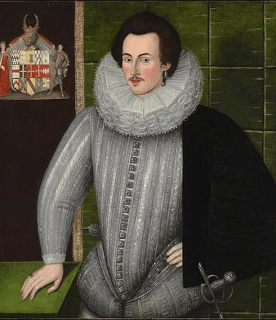
Blount is born in 1563, the second son of James, 6th Baron Mountjoy, and Catherine, only daughter of Sir Thomas Legh. He is among the most distinguished of the family, succeeding as 8th Baron Mountjoy on the death in 1594 of his unmarried elder brother William, 7th Baron Mountjoy. The good fortune of his youthful and handsome looks find favour with Queen Elizabeth I which arouses the jealousy of Robert Devereux, 2nd Earl of Essex, leading to a duel between the two courtiers, who later become close friends.
The downfall of Lord Essex does not damage Blount’s career. After the failure of his rebellion, Essex shocks many by denouncing his sister Penelope, who is Blount’s mistress, as a traitor, which inevitably raises the question of his own possible involvement. But the Crown, anxious to retain Blount’s services, and also to show as much leniency as possible to the defeated rebels, simply ignore the accusation.
On February 24, 1600, Blount lands in Ireland as Lord Deputy following Lord Essex and in the ensuing years brings the Nine Years’ War to an end. The leader of the rebellion, Hugh O’Neill, Earl of Tyrone, writes about Blount’s “refined manners” that he would lose a whole season of campaigning “while waiting until breakfast is prepared to his mind!” Despite this, Blount proves that he is quite qualified to pursue the war.
In early 1600, Blount dispatches Sir Henry Docwra with an army of 4,200 troops to land at Culmore to erect a fortress commanding the shores of Lough Foyle in the northwest of Ulster. To prevent Hugh O’Neill from sending a strong force to repulse Dowcra’s forces, Blount advances in force from Dublin to Newry causing O’Neill to fear a southern advance into Tyrone.
Blount aims to avoid the mistakes of previous Lords-Deputy. After the Battle of Moyry Pass, he has it cleared, and a garrison is established there. It had long been a problem for English forces advancing into Ulster from the south. He also establishes posts with garrisons at Mountnorris and Armagh.
On July 13, 1601, Blount and his army along with Turlough McHenry O’Neill of the Fews who had recently switched to the English side in the war, have a stand-off with Hugh O’Neill’s forces at the River Blackwater. After a few shots in vain from either side, O’Neill’s forces withdraw, and Blount sends his forces to occupy the ruined Blackwater fort destroyed by O’Neill in 1595. Later O’Neill’s forces attack Blount’s camp before withdrawing. In response, the Lord-Deputy sends his forces across the river where they find strong artificially fortified fords, which would have held out against the English.
By July 15, 1601, the Lord-Deputy has secured the surrender of O’Neill’s ally Hugh Magennis. That month, he has a new fort near the old Blackwater fort erected.
Blount reports to the council in England that O’Neill is determined to prevent his forces from advancing into Tyrone and toward Dungannon. As such, he initiates a policy of burning large quantities of corn to induce a famine to drive the rebels out of their strongholds.
Blount sets about trying to entice Hugh’s forces to come out and attack by fetching some materials for the new fort from the Tyrone side of the river as well as burning more corn. Further skirmishes between Blount and O’Neill’s forces ensue during the summer of 1601.
Spanish forces land in Munster in August 1601, forcing Blount to send his forces southward leaving O’Neill remaining in his unbroken heartland of Tyrone. The Spanish arrival culminates in the Siege of Kinsale that December, which sees a major defeat of the rebels and their allies.
O’Neill during this time has also moved south to assist some of his allies, however, after some serious defeats at the hands of the forces of Richard Burke, 4th Earl of Clanricarde of Connacht, he is in no place to offer any effective resistance once Blount marches once more to Tyrone in the summer of 1602.
Blount advances to the location he found the previous summer at the River Blackwater, which commands safe and secure passage into Tyrone, previously inaccessible, and sets about erecting a new fort. Having observed this, O’Neill burns his capital at Dungannon and flees to his last refuge in Glenconkeyne.
Advancing northward through Tyrone, Blount erects a fort in the townland of Magheralamfield, afterward known as Mountjoy Castle. He also christens the new fort at the Blackwater Charlemont Fort after himself.
Once in Tyrone, Blount carries out a campaign of devastation throughout it resulting in the mass hunting of rebels, spoiling of corn, the burning of houses and the killing of churls so as to force the submission of O’Neill and his remaining allies. Most symbolically, Blount has the inauguration site of the O’Neill’s at Tullyhogue Fort destroyed.
On March 30, 1603, six days after the death of Elizabeth and the accession of James I, O’Neill makes peace with Blount, signing the Treaty of Mellifont. Blount continues in office with the more distinguished title of Lord-Lieutenant. He declares amnesty for the rebels and grants them honourable terms, which causes some severe criticism from England. He shows similar moderation in putting down the abortive risings in Cork, Waterford and Wexford, where the aldermen, apparently with some vague idea of gaining greater toleration for Roman Catholics, refuse to proclaim the new King. In Cork, three insurgents are hanged after a summary trial, but the rest are acquitted or pardoned.
As part of the Plantation of Ulster, the majority of the barony of Loughinsholin is detached from County Tyrone and made part of the newly created County Londonderry. The rest of Loughinsholin along with the northern parts of Dungannon barony are merged to create the short-lived barony of Mountjoy. It is later amalgamated with the barony of Dungannon.
On his return to England, Blount serves as one of Sir Walter Raleigh’s judges in 1603, and in the same year King James I appoints him Master-General of the Ordnance as well as creating him Earl of Devonshire, granting him extensive estates. He is one of the founder members of the Spanish Company re-founded by royal charter in 1605.
Toward the end of Blount’s life, on December 26, 1605, at Wanstead House near London, in a ceremony conducted by his chaplain William Laud, afterward Archbishop of Canterbury, he marries his long-time mistress Lady Penelope, formerly wife of Robert Rich, 3rd Baron Rich (later 1st Earl of Warwick) and sister of Robert Devereux, 2nd Earl of Essex.
Blount leaves no legitimate children, and so his hereditary titles become extinct at his death on April 3, 1606, at Savoy House, London.
Pery is the son of William Cecil Pery, 1st Baron Glentworth, and his first wife, Jane Walcott, daughter of John Minchin Walcott. He is educated at Trinity College Dublin (TCD). He marries Alice Mary Ormsby, the daughter of Henry Ormsby of County Mayo, by his wife Mary Hartstonge, in 1783, and they have at least eight children. Alice Mary is the heiress of her uncle, Sir Henry Hartstonge, 3rd Baronet, who leaves her substantial property in the south of Ireland.
Pery is elected to the Parliament of Ireland as the Member of Parliament for Limerick City in 1786 and holds the seat until 1794, when he inherits his father’s barony and takes his seat in the Irish House of Lords. As a politician, he is a vocal Unionist. He holds the office of Keeper of the Signet and Privy Seal of Ireland between 1795 and 1797. In 1797, he is invested as a Privy Counsellor. He subsequently holds the office of Clerk of the Crown and Hanaper of Ireland between 1797 and 1806. In 1800, he is created Viscount Limerick of the City of Limerick.
Pery’s eldest son and heir, Henry Hartstonge Pery, Viscount Glentworth, predeceases him on August 7, 1834, and thus Pery is succeeded in his titles by Henry’s eldest son, William Henry Tenison Pery. One of Pery’s daughters, Theodosia, marries the Whig politician and Chancellor of the Exchequer, Thomas Spring Rice, 1st Baron Monteagle of Brandon.
Plunkett’s only grown sibling, a younger brother, from whom he is estranged from about 1916, for reasons not fully clear but connected to his mother’s will, is the noted British naval officer Sir Reginald Drax. Another younger brother dies in infancy.
The title passes to Plunkett at his father’s death in 1899 at a fairly young age. The young Lord Dunsany returns to Dunsany Castle in 1901 after war duty. In that year he is also confirmed as an elector for the Representative Peers for Ireland in the House of Lords.
In 1903, Plunkett meets Lady Beatrice Child Villiers (1880–1970), youngest daughter of Victor Child Villiers, 7th Earl of Jersey, who is then living at Osterley Park. They marry in 1904. Their one child, Randal, is born in 1906. Lady Beatrice is supportive of her husband’s interests and helps him by typing his manuscripts, selecting work for his collections, including the 1954 retrospective short story collection, and overseeing his literary heritage after his death.
The Plunketts are socially active in Dublin and London and travel between homes in Meath, London and Kent, other than during the First and Second World Wars and the Irish War of Independence. He circulates with many literary figures of the time. To many of these in Ireland he is first introduced by his uncle, the co-operative pioneer Sir Horace Plunkett, who also helps to manage his estate and investments for a time. He is friendly, for example, with George William Russell, Oliver St. John Gogarty, and for a time, W. B. Yeats. He also socialises at times with George Bernard Shaw and H. G. Wells and is a friend of Rudyard Kipling.
In 1910 Plunkett commissions a two-story extension to Dunsany Castle, with a billiard room, bedrooms and other facilities. The billiard room includes the crests of all the Lords Dunsany up to the 18th.
Plunkett serves as a second lieutenant in the Coldstream Guards in the Second Boer War. Volunteering in World War I and appointed Captain in the Royal Inniskilling Fusiliers, he is stationed for a time at Ebrington Barracks in Derry, Northern Ireland. Hearing while on leave of disturbances in Dublin during the Easter Rising of 1916, he drives in to offer help and is wounded by a bullet lodged in his skull. After recovery at Jervis Street Hospital and what is then the King George V Hospital (now St. Bricin’s Military Hospital), he returns to duty. His military belt is lost in the episode and later used at the burial of Michael Collins. Having been refused forward positioning in 1916 and listed as valuable as a trainer, he serves in the later war stages in the trenches and in the final period writing propaganda material for the War Office with MI7b. There is a book at Dunsany Castle with wartime photographs, on which lost members of his command are marked.
During the Irish War of Independence, Plunkett is charged with violating the Restoration of Order in Ireland Act 1920, tried by court-martial on February 4, 1921, convicted, and sentenced to pay a fine of 25 pounds or serve three months in prison without labour. The Crown Forces had searched Dunsany Castle and had found two double-barreled shotguns, two rook rifles, four Very pistols, an automatic pistol and a large quantity of pistol ammunition, along with shotgun and rifle ammunition.
During World War II, Plunkett signs up for the Irish Army Reserve and the British Home Guard, the two countries’ local defence forces, and is especially active in Shoreham, Kent, the English village bombed most during the Battle of Britain.
Plunkett’s fame arises chiefly from his prolific writings. He is involved in the Irish Literary Revival. Supporting the Revival, he is a major donor to the Abbey Theatre, and he moves in Irish literary circles. He is well acquainted with W. B. Yeats, Lady Gregory, Percy French, George “AE” Russell, Oliver St. John Gogarty, Padraic Colum and others. He befriends and supports Francis Ledwidge, to whom he gives the use of his library, and Mary Lavin.
Plunkett makes his first literary tour to the United States in 1919 and further such visits up to the 1950s, in the early years mostly to the eastern seaboard and later, notably, to California. His own work and contribution to the Irish literary heritage are recognised with an honorary degree from Trinity College Dublin.
In 1940, Plunkett is appointed Byron Professor of English in the University of Athens in Greece. Having reached Athens by a circuitous route, he is so successful that he is offered a post as Professor of English in Istanbul. However, he has to be evacuated due to the German invasion of Greece in April 1941, returning home by an even more complex route, his travels forming a basis for a long poem published in book form (A Journey, in 5 cantos: The Battle of Britain, The Battle of Greece, The Battle of the Mediterranean, Battles Long Ago, The Battle of the Atlantic, special edition January 1944). Olivia Manning‘s character Lord Pinkrose in her novel sequence the Fortunes of War is a mocking portrait of Dunsany in that period.
In 1947, Plunkett transfers his Meath estate in trust to his son and heir and settles in Kent at his Shoreham house, Dunstall Priory, not far from the home of Rudyard Kipling. He visits Ireland only occasionally thereafter and engages actively in life in Shoreham and London. He also begins a new series of visits to the United States, notably California, as recounted in Hazel Littlefield-Smith’s biographical Dunsany, King of Dreams.
In 1957, Plunkett becomes ill while dining with the Earl and Countess of Fingall at Dunsany, in what proves to be an attack of appendicitis. He dies in hospital in Dublin, at the age of 79, on October 25, 1957. He is buried in the churchyard of the ancient church of St. Peter and St. Paul, Shoreham, Kent. His funeral is attended by many family members, representatives of his old regiment and various bodies in which he had taken an interest, and figures from Shoreham. A memorial service is held at Kilmessan in County Meath, with a reading of “Crossing the Bar,” which coincides with the passing of a flock of geese.
Beatrice survives Plunkett, living mainly at Shoreham and overseeing his literary legacy until her death in 1970. Their son Randal succeeds to the barony and is in turn succeeded by his grandson, the artist Edward Plunkett. Plunkett’s literary rights pass from Beatrice to Edward.
As Governor-General of India, Wellesley uses military force and diplomacy to strengthen and expand British authority. East India Company forces defeat and kill Tipu Sultan, Indian Muslim ruler of the Kingdom of Mysore (present-day Mysuru) and sympathizer for Revolutionary France, in the Fourth Anglo-Mysore War (1799), and he then restores the Hindu dynasty there that had been deposed by Tipu’s father, Hyder Ali. He annexes much territory after his brother Arthur and General Gerard Lake defeat the Maratha Confederacy of states in the Deccan Plateau (peninsular India). In addition, he forces the Oudh State to surrender numerous important cities to the British, and he contracts with other states a series of “subsidiary alliances” by which all parties recognize British preponderance. He receives a barony in the British peerage in 1797 at the time of his appointment as governor-general, and in 1799 he is awarded a marquessate in the Irish peerage for his victory in the Mysore War.
When Wellesley is faced with an invasion by Zaman Shah Durrani, ruler (1793–1800) of Kabul (Afghanistan), he utilizes his envoy, Captain John Malcolm, to induce Fatḥ-Alī Shah Qajar of Qajar Iran to restrain Zaman Shah Durrani and to give British political and commercial interests preference over the French. On receiving a British government order to restore to France its former possessions in India, he refuses to comply. His policy is vindicated when the Treaty of Amiens (1802) is violated, and Great Britain resumes war against Napoleonic France.
Wellesley’s annexations and the vast military expenditure that he had authorized alarms the court of directors of the East India Company. In 1805, he is recalled, and soon afterward he is threatened with impeachment, although two years later he refuses an offer of the foreign secretaryship. In 1809, he goes to Spain to make diplomatic arrangements for the Peninsular War against France and later that year becomes foreign secretary under Prime MinisterSpencer Perceval. In that office he antagonizes his colleagues, who consider him an indolent megalomaniac and welcome his resignation in February 1812. Unlike most of them, however, he had urged a stronger war effort in Spain and had advocated political rights for British Roman Catholics. After Perceval’s assassination on May 11, 1812, he attempts unsuccessfully to form a government at the request of the prince regent (the future King George IV).
As Lord Lieutenant of Ireland, Wellesley disappoints the anti-Catholic George IV, and he is about to be removed when his brother, Arthur, is appointed prime minister in January 1828. He then resigns because his brother is opposed to Roman Catholic emancipation, although the duke is constrained to accept that policy as a political necessity in 1829. His second term as Lord Lieutenant of Ireland (1833–34) ends with the fall of Charles Grey, 2nd Earl Grey’s reform government. When the Whig Party returns to power in April 1835, he is not sent back to Ireland, and in his rage, he threatens to shoot the prime minister, William Lamb, 2nd Viscount Melbourne. He wants to be created Duke of Hindustan so that his rank will equal that of his brother.
Wellesley dies at the age of 82 on September 26, 1842, at Knightsbridge, London. He is buried in Eton College Chapel, at his old school. He and Arthur, after a long estrangement, had been once more on friendly terms for some years. Arthur weeps at the funeral and says that he knows of no honour greater than being Lord Wellesley’s brother.
Wellesley’s library is sold at auction in London by R. H. Evans on January 17, 1843 (and three following days); a copy of the catalogue, annotated with prices and buyers’ names, is held at Cambridge University Library.
Wellesley has several children, including three sons, but none are legitimate. The marquessate thus becomes extinct upon his death. The earldom of Mornington goes to his next surviving brother, William Wellesley-Pole.
(From: “Richard Colley Wellesley, Marquess Wellesley, British statesman,” written and fact-checked by the Editors of Encyclopaedia Britannica, http://www.britannica.com, April 2024 | Pictured: “Richard Colley Wellesley, Marquess of Wellesley (1760-1842),” oil on canvas portrait by Thomas Lawrence, 1812-13)





 seamus dubhghaill