seamus dubhghaill

Promoting Irish Culture and History from Little Rock, Arkansas, USA


Leave a comment

RMS Queen Mary Collides with HMS Curacoa

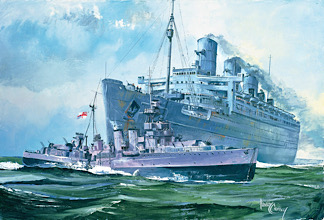
Twenty miles off the coast of County Donegal on October 2, 1942, the luxury Cunard liner RMS Queen Mary, converted into a troop carrier for World War II, smashes into her escort ship, the British Royal Navy cruiser HMS Curaçoa (D41). The HMS Curacoa, which had connected with the RMS Queen Mary to escort her for the final two hundred miles to the port of Greenock, Scotland, sinks with the loss of 338 men. As are his orders, Captain Cyril Illingworth of the RMS Queen Mary, which is carrying an estimated 15,000 U.S. troops, does not stop to mount a rescue operation.

On a near perfect afternoon, the RMS Queen Mary is off the Irish coast. The vessel is setting a zigzag course to help evade U-boats and long-range German bombers. The RMS Queen Mary has caught up with her 4,290 tonne escort vessel, the HMS Curacoa, and is set to overtake her.

Aboard the HMS Curacoa, seaman Ernest Watson is admiring the RMS Queen Mary’s majestic lines when he notices the bow is swinging toward the cruiser. To his horror, she continues to swing and is soon on a collision course. The gap narrows inexorably as the stunned Watson finally finds his vocal cords and screams, “She’s going to ram us.” Later Watson describes how many of his mates are so shocked they cannot move.

Within seconds, there is a screech of twisted metal followed by the hiss of steam and the screams of those injured or trapped below. The RMS Queen Mary, twenty times larger than the cruiser, has been traveling at top revs giving her a speed of 28.5 knots. The impact swings the HMS Curacoa broadside on and the troopship slices through her 10 cm armour plating. It is all over in seconds, and the troopship continues on her zigzag course leaving the HMS Curacoa cut in two with the forward and aft sections separated by 100 metres of ocean.

At the moment of impact, as the HMS Curacoa reels in the water, Watson and many other seaman on deck are thrown into the freezing water. Even as they surface they watch in horror as the stern quickly sinks, taking with it the men trapped behind the water-tight doors. The forward section follows soon after, leaving the men in the murky water surrounded by debris, oil and drowned or mutilated bodies. It is every man for himself as survivors cling to floating wreckage. They are about 20 nautical miles off the Irish coast which, had boats or rafts been launched, would put them within easy reach of safety.

The survivors believe the RMS Queen Mary will turn back to pick them up, however, it is with obvious despair that they watch her disappear over the horizon. To sail on is probably the toughest decision Captain Illingworth ever has to make. The World War I veteran has many years of experience by the time he has risen to become Cunard-White Star Line’s senior commander and master of the RMS Queen Mary. He is obeying orders that under no circumstances is he to stop until the RMS Queen Mary has safely delivered the troops to Britain. His only option is to signal nearby British destroyers to rescue survivors.

Two destroyers react to Captain Illingworth’s message and steam toward the wreckage where two hours after the collision, they find many bodies of sailors who have died of hypothermia. Only the hardiest live long enough to land in Londonderry, County Londonderry, Northern Ireland, the next day. Of the HMS Curacoa’s 430 personnel, only 99 seamen and two officers survive. Because of war-time security the official inquiry is delayed until the war in Europe is over. Then, in June 1945, only a few weeks after VE Day, the Admiralty Commissioners sued Cunard-White Star Line claiming the RMS Queen Mary had been responsible.

It appears to be a clear-cut case. The HMS Curacoa’s captain, John Boutwood, gives evidence to a Royal Navy inquiry and is acquitted without a reprimand. Later he gains the Distinguished Service Order (DSO). Boutwood says the HMS Curacoa steamed at some 3 knots slower than the larger vessel which had been in the process of overtaking at the time of the collision. He says he had been amazed when the troopship continued turning to starboard and closed the gap between the vessels. When the collision occurred he, and all others on the bridge, had clung to whatever was nearest.

At first, Boutwood vainly hopes the damaged ship will stay afloat. He also says it was impossible to give orders because of the noise of escaping steam from the boiler room. The RMS Queen Mary’s first officer gives evidence that he had taken over the helm less than two minutes before she rams the cruiser. She is about 500m away and on the starboard bow. He is unconcerned at the narrow gap because he expects HMS Curacoa to take evasive action. He believes the cruiser, a more manoeuvrable vessel, would change course.

The first officer had also been reassured by Captain Illingworth, that the cruiser was “experienced in escorting and would keep out of the way.” At a later hearing some months after the opening, Illingworth says he had felt a bump at the time of the collision and had asked the quartermaster if they had been hit by a bomb. The answer was: “No sir, we have hit the cruiser.”

The judge holds the cruiser responsible saying the normal rules of an overtaking vessel keeping clear of the other does not apply in this case. He says the cruiser could have avoided the collision up to seconds before it occurred. The Admiralty, faced with huge compensation to the families of the dead sailors, appeals. In appeal the ruling is that the cruiser was responsible for two-thirds of the damage and the RMS Queen Mary for one-third. Still not satisfied, the case goes to the House of Lords where the verdict of the Appeal Court is upheld in February 1949. No survivor comes out unscathed but above all others, Illingworth has to live with the memory of leaving British sailors to fight for their lives in the ocean.

However, when asked at the first hearing if he felt Illingworth had made the right decision, the captain of the HMS Curacoa says, “I would say, yes.” The RMS Queen Mary continues as a troopship until August 11, 1945. The vessel is now a floating attraction at Long Beach, California.

(From: “SS Queen Mary & the loss of HMS Curacoa 1942” by A. N. Other and NHSA Webmaster, Naval Historical Society of Australia, https://navyhistory.au)
Leave a comment

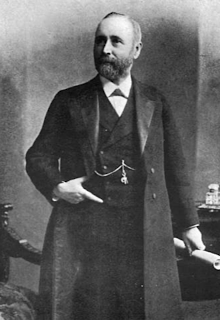
Birth of William Pirrie, 1st Viscount Pirrie

William James Pirrie, 1st Viscount PirrieKPPCPC (Ire), a leading British shipbuilder and businessman, is born on May 31, 1847, in Quebec City, Canada East, Province of Canada. He is chairman of Harland & Wolff, shipbuilders, between 1895 and 1924, and also serves as Lord Mayor of Belfast between 1896 and 1898.

Pirrie is taken back to Ireland when he is two years old and spends his childhood at Conlig House, also known as Little Clandeboye ConligCounty Down. Belonging to a prominent family, his nephews included J. M. Andrews, who later becomes Prime Minister of Northern IrelandThomas Andrews, builder of RMS Titanic, and Sir James Andrews, 1st Baronet, the Lord Chief Justice of Northern Ireland.

Pirrie is educated at the Royal Belfast Academical Institution before entering Harland & Wolff shipyard as a gentleman apprentice in 1862. Twelve years later he is made a partner in the firm, and on the death of Sir Edward Harland in 1895, he becomes its chairman, a position he holds until his death. As well as overseeing the world’s largest shipyard, he is elected Lord Mayor of Belfast in 1896, and is re-elected to the office as well as made an Irish Privy Counsellor the following year. He becomes Belfast’s first honorary freeman in 1898, and serves in the same year as High Sheriff of Antrim and subsequently of County Down. In February 1900, he is elected President of the UK Chamber of Shipping, where he had been vice-president the previous year. He helps finance the Liberals in Ulster in the 1906 United Kingdom general election, and that same year, at the height of Harland & Wolff’s success, he is raised to the peerage as Baron Pirrie, of the City of Belfast.

In 1907, Pirrie is appointed Comptroller of the Household to the Lord Lieutenant of Ireland, and in 1908 is appointed Knight of St Patrick (KP). Pro-Chancellor of Queen’s University of Belfast (QUB) from 1908 to 1914, he is also in the years before World War I a member of the Committee on Irish Finance as well as Lord Lieutenant of Belfast.

In February 1912, after chairing a famous meeting of the Ulster Liberal Association at which Winston Churchill defends the government’s policy of Home Rule for Ireland, Pirrie is jeered on the streets of Belfast, and assaulted as he boards a steamer in Larne: pelted with rotten eggs, herrings, and bags of flour. In 1910, the Ulster Liberal Association, an overwhelmingly Protestant body, with a weekly newspaper, and branch network throughout Ulster, adopts (in opposition to the Ulster Liberal Unionist Association) an explicitly pro-home rule position.

In the months leading up to the 1912 sinking of the RMS Titanic, Pirrie is questioned about the number of life boats aboard the Olympic-class ocean liners. He responds that the great ships are unsinkable and the rafts are to save others. This haunts him for the rest of his life. In April 1912, Pirrie is to travel aboard RMS Titanic, but illness prevents him.

During the war Pirrie is a member of the War Office Supply Board, and in 1918 becomes Comptroller-General of Merchant Shipbuilding, organising British production of merchant ships.

In 1921, Pirrie is elected to the Senate of Northern Ireland, and that same year is created Viscount Pirrie of the City of Belfast, in the honours for the opening of the Parliament of Northern Ireland in July 1921, for his war work and charity work. In Belfast he is, on other grounds, already a controversial figure: a Protestant employer associated as a leading Liberal with a policy of Home Rule for Ireland.

In March 1924, Pirrie, his wife, and her sister sail on a Royal Mail Steam Packet Company liner from Southampton on a business trip to South America. They travel overland from Buenos Aires to Chile, where they embark aboard the Pacific Steam Navigation Company‘s Ebro. Pirrie comes down with pneumonia in Antofagasta, and his condition worsens when the ship reaches Iquique. At Panama City two nurses embark to care for him. By then he is very weak, but insists on being brought on deck to see the canal. He admires how Ebro is handled through the locks.

Pirrie dies at sea off Cuba on June 7, 1924. His body is embalmed. On June 13, Ebro reaches Pier 42 on the North River in New York City, where Pirrie’s friend Andrew Weir, 1st Baron Inverforth and his wife meet Viscountess Pirrie and her sister. UK ships in the port of New York lower their flags to half-mast, and Pirrie’s body is transferred to Pier 59, where it is embarked on White Star Line‘s RMS Olympic, one of the largest ships Pirrie ever built, to be repatriated to the UK. He is buried in Belfast City Cemetery. The barony and viscountcy die with him. Lady Pirrie dies on June 19, 1935. A memorial to Pirrie in the grounds of Belfast City Hall is unveiled in 2006.


Leave a comment

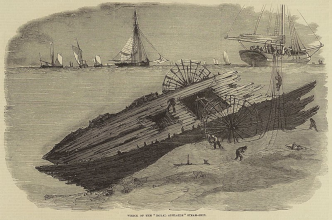
The Wreck of the RMS Royal Adelaide

The RMS Royal Adelaide, a paddle steamship owned and operated by the City of Dublin Steam Packet Company, sinks in a storm on March 30, 1850, with the loss of two hundred lives. Its principal route runs between London and Cork, County Cork.

The RMS Royal Adelaide, captained by John Batty, leaves Cork fully laden with cargo and about 250 passengers on Wednesday, March 27,1850, touching off at Plymouth, Devon, England, on Thursday evening. By the time the ship leaves Plymouth for London at 3:00 a.m. on Friday, March 29, there are almost three hundred deck passengers.

The ship is totally lost at about 11:00 p.m. on Saturday, March 30 on Tongue Sands north of Margate, Kent, England, with the loss of all on board. News only reaches London late on Sunday as the river pilot waiting for the ship happens to meet a Deal, Kent, pilot, Charles Gillham, who reports seeing a ship of a similar description in distress the previous evening (The Illustrated London News, April 6 and 13, 1850).

The dead include more than one hundred fifty deck passengers from Ireland, during a time when the Great Famine is at its height.

(Pictured: “The Wreck of the Royal Adelaide,” illustration for The Illustrated London News, April 13, 1850)


Leave a comment

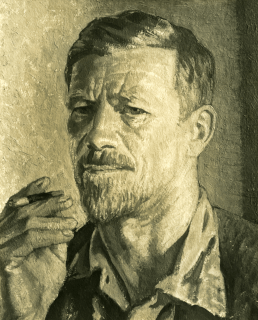
Birth of Edward Conor Marshall O’Brien, Ship Builder & Designer

Edward Conor Marshall O’Brien, Irish aristocrat and intellectual, is born in Cahirmoyle, County Limerick, on November 3, 1880. His views are republican and nationalist. He is also owner and captain of one of the first boats to sail under the tri-colour of the Irish Free State. He is the first amateur Irish sailor to sail around the world.

O’Brien is a ship builder and designer, and his notable boats include the Kelpie (used for gun running in 1914), the Saoirse (in which he circumnavigates the globe) and the Ilen (a Falkland Islands service ship).

O’Brien’s grandfather is William O’Brien who is a member of Young Ireland. His grandfather and his aunt Charlotte Grace O’Brien both play roles in social reform. Robert Donough, his uncle, is an architect, and the painter Dermod O’Brien is his brother. He is educated in England at Winchester College and the University of Oxford, and in Ireland at Trinity College Dublin (TCD). After his education he comes back to Ireland and starts practicing as an architect in 1903. According to the 1911 census he lives at 58 Mount Street, south County Dublin.

O’Brien is credited with two buildings in his lifetime: the Co-operative Hall in County Donegal and the People’s Hall in County Limerick. He is also known as a naval architect, having designed two ships, the Saoirse and the llen. He later captains both of these ships himself.

In Saoirse, a 20-ton, 42-foot ketch designed and built in 1922 in Baltimore, County Cork, he and three crew members circumnavigate the globe between 1923 and 1925 – the first recorded by an amateur skipper from west to east, the first yacht circumnavigation by way of the three great capes: Cape Horn, Cape of Good Hope and Cape Leeuwin, and the first boat flying the Irish tri-colour to enter many of the world’s ports and harbours. His voyage begins and ends at the Port of Foynes, County Limerick, where he lives. His account of the voyage, Across Three Oceans, (1927) becomes one of the classics of maritime literature.

Up until O’Brien’s circumnavigation, this route is the preserve of square-rigged grain ships taking part in the grain race from Australia to England via Cape Horn (also known as the clipper route).

O’Brien’s seagoing experiences are put to use in his design of the Ilen, which is built for the Falkland Islands as a service boat and launched in the spring of 1926. In 1998, Ilen returns to the site where she was first built, on the River Ilen near Baltimore, County Cork, where she undergoes a full restoration and is re-launched in May 2018. This task provides work-based learning for the students of the Ilen School.

O’Brien has some involvement with gun running in 1914 on behalf of the Irish Volunteers, for political reasons and because he has experience in sailing. On July 26, 1914, nine hundred guns are brought to Howth harbour aboard Erskine Childers‘ yacht Asgard. As part of the same operation, O’Brien transports arms on his yacht, Kelpie. The guns on Kelpie are transshipped to another yacht, Chotah, owned by Sir Thomas Myles, before being landed at Kilcoole in County Wicklow on August 1, 1914. After the gun running incidents, he serves in the Royal Naval Volunteer Reserve.

O’Brien is a keen mountaineer as well as a sailor, known for climbing in bare feet. He climbs Mount Brandon in southwest Ireland and Snowdon in North Wales with George Mallory and Geoffrey Winthrop Young among others. Later, during his circumnavigation (1923–1925) he plans to climb Aoraki / Mount Cook in the Southern Alps in New Zealand‘s South Island. However, because of delays during his circumnavigation, he arrives in New Zealand too late.

In 1928, O’Brien marries a well-known artist, Kathleen Francis, the youngest daughter of Sir George Clausen, RA. The couple thereafter moves to Ibiza, where they live on the Saoirse until Kathleen’s death in 1936. They have no children. Relocating to Cornwall, where he lives with his sister, he writes books on sailing and works of fiction for children. Although too old for active service when war with Germany breaks out in 1939, he assists the British war effort by serving in the Small Ships Pool, which delivers support vessels across the Atlantic and brings food supplies from the United States in private yachts.

In 1940 O’Brien sells Saoirse to the Royal Cornwall Yacht Club. The boat remains in use until 1980, when it is lost off the Jamaican coast. After the war he retires to another sister’s home in Foynes, County Limerick, where he lives and continues to write books for children until his death on April 18, 1952.


Leave a comment

USS Nathanael Greene Runs Aground in the Irish Sea

USS Nathanael Greene (SSBN-636), a James Madison-class fleet ballistic missile submarine, runs aground in the Irish Sea on March 13, 1986, suffering severe damage to her rudder and ballast tanks. She is the third ship of the United States Navy to be named for Major General Nathanael Greene (1746–1786), who served in the Continental Army during the American Revolutionary War.

Nathanael Greene‘s keel is laid down on May 21, 1962, at the Portsmouth Naval Shipyard in Kittery, Maine. The construction of the ship is supervised by Commander Lawrence Dennis Ballou. She is launched on May 12, 1964, sponsored by Mrs. Neander W. Wade, a descendant of Nathanael Greene, and commissioned on December 19, 1964, with Commander Robert E. Crispin in command of the Blue Crew and Commander William M. Cossaboom in command of the Gold Crew.

Nathanael Greene departs Portsmouth for shakedown on December 30, 1964, with her Gold Crew embarked. It is relieved on February 1, 1965, by the Blue Crew. Her shakedown period is followed by repairs and alterations at Portsmouth Naval Shipyard, after which the submarine, with her Blue Crew embarked, departs the shipyard for ballistic missile loading and her initial Polaris missile deterrent patrol.

In 1970-71 Nathanael Greene is refueled and receives its conversion to launch Poseidon missiles at Newport News Shipbuilding. Following Yard period and shakedown, she proceeds to Cape Canaveral for a test missile launch. In March 1972, she departs for her first deterrent patrol following conversion ending up in Holy Loch, Scotland.

On January 29, 1970, while making a surface run into port in thick fog, Nathanael Greene runs aground in about sixteen feet of water. She is refloated after about seven hours.

On August 11, 1984, Nathanael Greene loses her propeller in the Irish Sea. While proceeding back to Holy Loch at about 3 knots using her secondary propulsion motor, a transit of about 5 or 6 days, she is redirected to Her Majesty’s Naval Base, Clyde at Faslane as the U.S. dry dock in Holy Loch is fully committed and unavailable, while Admiralty Floating Dock No. 60 at Faslane is available. While in the Faslane dry dock, a fire occurs in one of the dock’s enclosed machinery spaces on August 18, 1984. The fire is quickly extinguished and does not affect the Nathanael Greene. While in dry dock, it is established that the main shaft had broken with the loss of about a third of its length along with the propeller. Repairs are completed in about twelve days and the Nathanael Green is undocked on September 3, 1984.

On March 13, 1986, Nathanael Greene runs aground in the Irish Sea, suffering severe damage to her rudder and ballast tanks. Her grounding is a serious accident involving a U.S. Navy nuclear-powered ballistic missile submarine. She is deactivated while still in commission in May 1987. Her early deactivation is decided both as a result of the damage sustained in the accident as well as in accordance with the limitations set by the SALT II Treaty.

Nathanael Greene is decommissioned on December 15, 1986, and stricken from the Naval Vessel Register (NVR) on January 31, 1987. Her removal from service allows the United States to comply easily with the ballistic missile limits of the SALT II strategic arms limitation treaty.

Nathanael Greene enters the Ship-Submarine Recycling Program (SRP), the process that the United States Navy uses to dispose of decommissioned nuclear vessels, at Bremerton, Washington, on September 1, 1998. Her scrapping is completed on October 20, 2000.

Nathanael Greene‘s sail has been restored and is now on display in Port Canaveral, Florida, as a memorial to the original 41 for Freedom fleet ballistic missile submarines.

(Pictured: USS Nathanael Greene (SSBN-636), probably during her sea trials off New England in the mid-1960s.)


Leave a comment

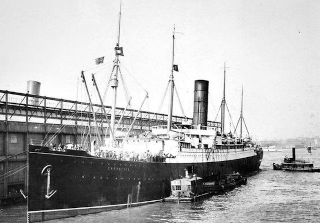
RMS Carpathia Arrives in New York City with RMS Titanic Survivors

The RMS Carpathia, a Cunard Line transatlantic passenger steamship, arrives in New York City on April 18, 1912, with 705 survivors from the RMS Titanic, which sank in the North Atlantic three days earlier.

As she is making her way from New York to Fiume, Austria-Hungary (now Rijeka, Croatia), RMS Carpathia receives a distress call from the “unsinkable” RMS Titanic. RMS Carpathia’s captain, Arthur Rostron, later testifies that the distance to RMS Titanic was 58 nautical miles (67 miles) and was expected to take three and a half hours to reach the doomed liner as its top speed, which was about 14.5 knots.

However, braving dangerous ice fields of its own, Rostron orders extra stokers to feed coal and cut off heating and hot water elsewhere in order to supply the ship’s engines with as much steam as possible. These decisions help accelerate the ship to more than 17 knots and the RMS Carpathia arrives on the scene approximately one hour and 40 minutes after RMS Titanic went down. For the next four and a half hours, the ship rescues 705 survivors from RMS Titanic‘s lifeboats.

Slowed by storms and fog since early Tuesday, April 16, RMS Carpathia arrives in New York City on the cold and rainy evening of Thursday, April 18, escorted by the scout cruiser USS Chester. RMS Carpathia first bypasses Pier 54, its Cunard Line pier, and sails up the Hudson River to Pier 59, the berth for White Star Line and where RMS Titanic was supposed to have arrived. Having dropped off the empty lifeboats, RMS Carpathia then sails back toward Pier 54.

A tugboat filled with photographers follows the ship to the pier, and the flashlight of cameras lights up the ship in the night sky to reveal that the decks are crammed with passengers.

Tens of thousands of people gather around Pier 54 to meet them and receive the first physical confirmation of the maritime disaster. On the orders of Rostron, RMS Carpathia‘s passengers disembark first, believing the scene will become tumultuous as soon as RMS Titanic survivors first appear. That moment comes when a teary-eyed woman with makeshift clothes descends a gangway and stumbles away from the boat into the arms of an officer.

The RMS Carpathia is initially a transatlantic passenger ship that makes its maiden voyage in 1903. During World War I, she is used to transfer Canadian and American Expeditionary Forces to Europe.

On July 15, 1918, under the command of Captain William Prothero, RMS Carpathia is a part of a large convoy that is making its way from Liverpool to Boston. Two days later, carrying 57 passengers and 166 crew, she is torpedoed on the port side by a German U-boat off the southwest coast of Ireland.

A second strike follows, which penetrates the engine room, killing three firemen and two trimmers. Prothero gives the order to abandon ship and all passengers and the surviving crew members board the lifeboats.

A third torpedo strike hits the gunner’s rooms, resulting in a large explosion that dooms the ship. The U-boat starts approaching the lifeboats when the HMS Snowdrop arrives on the scene and drives away the submarine with gunfire before picking up survivors.

The wreck of the RMS Carpathia is only discovered in 2000 after an 80 year-long search for the missing ship.

(From: “On This Day: Carpathia arrives in New York with Titanic survivors” by Michael Dorgan, IrishCentral, http://www.irishcentral.com, April 15, 2022)


Leave a comment

Commissioning of the USS Juneau

USS Juneau (CL-52), a United States Navy Atlanta-class light cruiser, is commissioned on February 14, 1942, with Captain Lyman Knute Swenson in command. The ship becomes horribly famous as the vessel which carries the five Irish American Sullivan brothers to their death on November 13, 1942, after it is hit by a Japanese torpedo at the Battle of Guadalcanal.

The USS Juneau is laid down by Federal Shipbuilding and Drydock Company, Kearny, New Jersey, on May 27, 1940, and launched on October 25, 1941, sponsored by Mrs. Harry I. Lucas, wife of the mayor of the city of Juneau, Alaska.

After a hurried shakedown cruise along the Atlantic Coast in the spring of 1942, USS Juneau assumes blockade patrol in early May off Martinique and the Guadeloupe archipelago to prevent the escape of Vichy French naval units. She returns to New York to complete alterations and operates in the North Atlantic and Caribbean from June 1 to August 12 on patrol and escort duties. The cruiser departs for the Pacific Theater on August 22.

On 8 November, USS Juneau departs Nouméa, New Caledonia, as a unit of Task Force 67 under the command of Rear Admiral Richmond K. Turner to escort reinforcements to Guadalcanal. The force arrives there on the morning of November 12, and USS Juneau takes up her station in the protective screen around the transports and cargo vessels. Unloading proceeds unmolested until 14:05, when 30 Japanese planes attack the alerted United States group. The anti-aircraft fire is effective, and the USS Juneau alone accounts for six enemy torpedo bombers shot down. The few remaining Japanese planes are, in turn, attacked by American fighters with only one bomber escaping. Later in the day, an American attack group of cruisers and destroyers clears Guadalcanal on reports that a large enemy surface force is headed for the island. At 01:48 on November 13, Rear Admiral Daniel J. Callaghan‘s relatively small landing support group engages the enemy. The Japanese force consists of two battleships, one light cruiser, and nine destroyers.

Because of bad weather and confused communications, the battle occurs in near-pitch darkness and at almost point-blank range, as the ships of the two sides become intermingled. During the melee, the USS Juneau is struck on the port side by a torpedo launched by Japanese destroyer Amatsukaze, causing a severe list, and necessitating withdrawal. Before noon on November 13, USS Juneau, along with two other cruisers damaged in the battle, USS Helena (CL-50) and USS San Francisco (CA-38), head toward Espiritu Santo for repairs. USS Juneau is steaming on one screw, keeping station 800 yards off the starboard quarter of the likewise severely damaged USS San Francisco. She is down 12 feet by the bow, but able to maintain 13 knots.

A few minutes after 11:00, two torpedoes are launched from Japanese submarine I-26. These are intended for USS San Francisco, but both pass ahead of her. One strikes USS Juneau in the same place that had been hit during the battle. There is a great explosion, and USS Juneau breaks in two and disappears in just 20 seconds. Fearing more attacks from I-26, and wrongly assuming from the massive explosion that there are no survivors, USS Helena and USS San Francisco depart without attempting to rescue any survivors. In fact, more than 100 sailors survive the sinking of USS Juneau. They are left to fend for themselves in the open ocean for eight days before rescue aircraft belatedly arrive. While awaiting rescue, all but ten die from the elements and shark attacks. Among those lost are the five Sullivan brothers. Two of the brothers apparently survive the sinking, only to die in the water. Two presumably go down with the ship. Some reports indicate the fifth brother also survives the sinking but disappears during the first night when he leaves a raft and gets into the water. On November 20, 1942, USS Ballard (DD-267) recovers two of the ten survivors. Five more in a raft are rescued by a PBY Seaplane five miles away. Three others, including a badly wounded officer, make it to San Cristobal (now Makira) Island, about 55 miles away from the sinking. One of the survivors recovered by USS Ballard says he had been with one of the Sullivan brothers for several days after the sinking.

As a direct result of the Sullivans’ deaths (and the deaths of four of the Borgstrom brothers within a few months of each other two years later), the United States Department of War adopts the Sole Survivor Policy, a set of regulations, partially stipulated by law, that are designed to protect members of a family from the draft during peacetime, or from hazardous duty or other circumstances, if they have already lost family members to military service.

To honor the five Sullivan brothers, who all died in the sinking, and the USS Juneau, the United States Navy later commissions two ships named USS The Sullivans, and two ships named USS Juneau. On March 17, 2018, the wreck of USS Juneau is located by Paul Allen‘s research crew on board RV Petrel at a depth of about 13,800 feet off the coast of the Solomon Islands in several large pieces.


Leave a comment

The Wreck of the “Stephen Whitney”

The passenger-carrying sailing ship Stephen Whitney is wrecked on West Calf Island off the southern coast of Ireland on November 10, 1847 with the loss of 92 of the 110 passengers and crew aboard.

The Stephen Whitney is a packet ship in Robert Kermit‘s Red Star Line. The ship is named after a Kermit investor, New York City merchant Stephen Whitney.

The 1,034-ton ship leaves New York City on October 18 for Liverpool, England, carrying passengers and a cargo which includes corn, raw cotton, cheese, resin, and twenty boxes of clocks. On November 10 in thick fog, the captain, C.W. Popham, mistakes the Crookhaven lighthouse for the one at the Old Head of Kinsale and the lighthouse on Cape Clear Island is obscured by fog compounding the error in navigation. At around 10:00 p.m., the ship strikes the western tip of West Calf Island, completely breaking up within about ten minutes. Conditions in the area are distressing as it is the height of the Great Famine.

The loss of the ship triggers the decision to replace the Cape Clear Island lighthouse with one on Fastnet Rock. This decision is also because the lighthouse on Cape Clear is often shrouded in fog or low level clouds, which make it hard or at times impossible to see.

(Pictured: West Calf Island, the most westerly of the three Calf Islands that lie at the heart of Roaring Water Bay, West Cork)


6 Comments

The Shipwrecks of the Trevor and Nonpareil

Two hundred passengers are lost in the shipwrecks of the brigs Trevor and Nonpareil on October 20, 1775. Among the casualties are The Hononorable Major Francis Caulfield, Member of Parliament (MP) for Charlemont, his wife, and daughters. Also lost is John French, Member for Roscommon County.

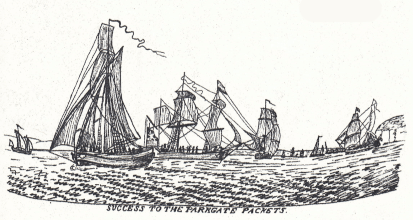
On Thursday, October 19, 1775, the brig Trevor, with Captain William Totty at the helm, and the brig Nonpareil, with Capatin Samuel Davies, sail from Parkgate for Dublin. That evening, as the vessels are near Holyhead, the wind shifts about from the south southwest to the west, and so violent a hurricane arises that they cannot carry any sail, but are obliged to lie to, and drive before the wind. In this situation, the Trevor drives upon the banks near the Lancashire shore and is totally lost.

Everyone on board perishes, except Samuel Fairclough, a mariner, who miraculously saves his life by leaping aboard another vessel named the Charming Molly, under Captain Joseph Holloway, which is transporting coal from Chester to Newry. The Charming Molly accidentally runs afoul of the Trevor and carries away the Trevor‘s foretopmast and, at the instant the two vessels come together, Fairclough makes his leap. He was the only survivor of the 30 to 40 passengers and crew aboard the Trevor.

Captain Holloway states that his vessel and the Trevor came together at some distance from the coast. They parted at the time Fairclough jumped across, and the Trevor subsequently went to pieces. A great many chests, boxes, some of which are broken, and quantities of East India goods are strewn along the shore, all wet with salt water. These items are in the custody of Mrs. Hesketh, Lady of the Manor of this coast, secured by Mr. Standen of Rossall Hall. The East India goods had arrived by land from London. The cargo and coins aboard the Trevor are estimated to be worth £15,000.

The Charming Mary runs ashore at Blackpool with most of her sails carried away, but otherwise with little damage.

The Nonpareil is lost in the storm between Parkgate and Dublin, driven on shore near Hoyle-sands and lost. There are no survivors. The wife of Captain Davies states that her husband sailed from Parkgate with very low spirits as he did not like the appearance of the weather. He is pressured to put to sea, which he does, and is turned back twice, but gets off on the third attempt, and is never seen again.

Between them, the Trevor and the Nonpareil reportedly carry nearly 200 passengers, the majority being on the Nonpareil. They carry cargo valued at £15,000.

On Tuesday evening, October 24, the Collector of the port of Chester receives the melancholy account of the loss of the Trevor by a letter from the Collector of Poulton, in Lancashire. This is immediately communicated to the Merchants, who are concerned in shipping the cargo, and they set out as soon as possible to give assistance and to secure each part of the cargo as might come ashore.

The merchants from Chester reach Poulton late on Wednesday night, October 25. The following morning, they set out along the shore from Blackpool, where the Charming Mary is stranded. The greatest part of the hull of the Trevor lay scattered along the shore at a great distance. On their arrival at Rossall Hall, about six miles from Blackpool, they have the satisfaction to find that Mr. Standen, who is Steward of the Manor of Bold Fleetwood Hesketh, now a minor and son to the deceased Fleetwood Hesketh, on whose estate the wreck is taken up, has taken all possible care of everything that can be saved from plunderers.


Leave a comment

Commissioning of the LÉ Deirdre (P20)

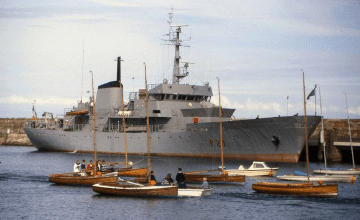
The Deirdre (P20), an offshore patrol vessel in the Irish Naval Service, is commissioned by Lt. Cdr. Liam Brett on June 19, 1972. The building of LÉ Deirdre marks a milestone in the development of the Naval Service, being the first ship purpose-built in Ireland to patrol in Irish waters. She is named after Deirdre, a tragic heroine from Irish mythology who committed suicide after her lover’s murder.

In 1971, a contract is signed with Verlome Cork Dockyard (VCD) to build an offshore patrol vessel for the Naval Service. Built in 1972, LÉ Deirdre is built as a replacement for the Ton-class minesweepers, and one of the first vessels custom-built for the Irish Naval Service. She has a longer range and is a more seaworthy ship for work in the Atlantic. LÉ Deirdre becomes the prototype for the later Emer-type vessels.

Deirdre undertakes a number of search and rescue operations throughout her career. For example, LÉ Deirdre is one of the vessels involved in the 1979 Fastnet race rescue operations, assisting the crews of two yachts. In 1990, during the rescue of a Spanish trawler crew in Bantry Bay, a member of LÉ Deirdre‘s crew dies and is posthumously awarded the Distinguished Service Medal and Spanish Cross of Naval Merit.

By the time of the vessel’s naval decommissioning in early 2001, LÉ Deirdre has travelled approximately 450,000 nautical miles. She is replaced by a Róisín-class patrol vessel.

Deirdre is sold at public auction for IR£190,000 to the English yacht chartering company Seastream International for conversion into the luxury charter yacht Tosca IV for the company’s owner, businessman Christopher Matthews. Speaking on the radio, a Seastream spokesman appears pleased with their bargain as they had been prepared to bid up to IR£500,000. The auction starting price had been IR£60,000.

The conversion in a Polish shipyard is not completed as the English owner is killed while piloting a Eurocopter EC130 helicopter which crashes at Sauk Prairie, Wisconsin after hitting power lines over Lake Wisconsin on August 6, 2004. In 2007 LÉ Deirdre is towed to Brazil for further refit and completion. Substantially complete, she arrives at Jacksonville, Florida in September 2012 for final outfitting as Santa Rita I. However, in August 2014, Santa Rita I is towed to Green Cove Springs, Florida, for breaking.