seamus dubhghaill

Promoting Irish Culture and History from Little Rock, Arkansas, USA


6 Comments

Death of Colonel Dennis O’Kane

dennis-o-kane

Colonel Dennis O’Kane, officer in the Union Army during the American Civil War, dies on July 4, 1863, of wounds sustained the previous day when fighting with the 69th Pennsylvania Irish Brigade at the Battle of Gettysburg.

Born in Coleraine, County Londonderry, O’Kane is a tavern owner in Philadelphia, Pennsylvania and a member of the 2nd Pennsylvania Militia regiment prior to the Civil War. When the conflict starts, he helps recruit the 24th Pennsylvania Volunteer Infantry, a unit that has the 2nd Pennsylvania Militia as its nucleus. Commissioned Major, Field and Staff, on May 1, 1861, he is with his regiment as it serves first in Maryland and then Virginia before their enlistment expires in July 1861.

In August 1861 O’Kane joins with many of the men from the 24th Pennsylvania in re-enlisting to continue the war effort, and they form the basis of what becomes the 69th Pennsylvania Infantry Regiment. Commissioned Lieutenant Colonel, Field and Staff on August 19, 1861, his new regiment is composed largely of Irish immigrants like himself, and they emblazon the Irish harp on their flag. The unit eventually is joined with the 71st, 72nd and 106th Pennsylvania Infantry Regiments to form the famous Philadelphia Brigade.

O’ Kane serves as second-in-command through 1862, participating in the Peninsular Campaign of May and June, the Second Battle of Bull Run in August, and the September 1862 Battle of Antietam, where his brigade is caught in the West Woods area and takes heavy losses. In November 1862, the 69th Pennsylvania’s commander, Colonel Joshua T. Owen, is promoted to Brigadier General, US Volunteers. O’Kane is advanced to Colonel on December 1, 1862, to fill the vacancy.

At the Battle of Fredericksburg on December 14, 1862, O’Kane leads his men in the third of four waves of futile Union charges on strong Confederate positions at Marye’s Heights south of the town, and sees his regiment sustain fifty-one casualties. In May 1863 during the Battle of Chancellorsville, his brigade is held in reserve and sees limited action.

During the Battle of Gettysburg in July 1863, O’Kane finds the 69th Pennsylvania positioned along a rock fencing in the middle of the Union lines that becomes famous as “The Angle.” That position becomes the epicenter of Pickett’s Charge on July 3, the third day of the battle, as the remnants of the Confederate forces, having been much devastated from Union artillery fire, crash over the rock walls and engage the Philadelphia Brigade in brutal hand-to-hand fighting.

O’Kane is shot in the head at the wall and dies the following day. His regiment again takes high casualties but succeeds in helping to repulse the rebels and defeat the charge. The monument for the 69th Pennsylvania Infantry in Gettysburg National Military Park stands on the spot where O’Kane was mortally wounded.


Leave a comment

The Battle of Malvern Hill

battle-of-malvern-hill

Irish take up arms against each other in the American Civil War as the Irish Brigade of the Union Army and the Confederate 6th Regiment, Louisiana Infantry take part in the Battle of Malvern Hill on July 1, 1862.

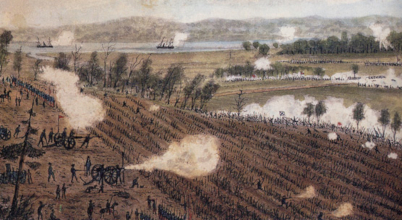
Also known as the Battle of Poindexter’s Farm, the Battle of Malvern Hill is fought between the Confederate Army of Northern Virginia, led by General Robert E. Lee, and the Union Army of the Potomac under Major General George B. McClellan. It is the final battle of the Seven Days Battles, taking place on a 130-foot elevation of land known as Malvern Hill, near the Confederate capital of Richmond, Virginia and just one mile from the James River. Including inactive reserves, more than fifty thousand soldiers from each side take part, using more than two hundred pieces of artillery and three warships.

The Seven Days Battles are the climax of the Peninsula Campaign, during which McClellan’s Army of the Potomac sails around the Confederate lines, lands at the tip of the Virginia Peninsula, southeast of Richmond, and strikes inland towards the Confederate capital. Confederate commander-in-chief Joseph E. Johnston fends off McClellan’s repeated attempts to take the city, slowing Union progress on the peninsula to a crawl. When Johnston is wounded, Lee takes command and launches a series of counterattacks, collectively called the Seven Days Battles. These attacks culminate in the action on Malvern Hill.

The Union’s V Corps, commanded by Brigadier General Fitz John Porter, takes up positions on the hill on June 30. McClellan is not present for the initial exchanges of the battle, having boarded the ironclad USS Galena and sailed down the James River to inspect Harrison’s Landing, where he intends to locate the base for his army. Confederate preparations are hindered by several mishaps. Bad maps and faulty guides cause Confederate Major General John B. Magruder to be late for the battle, an excess of caution delays Major General Benjamin Huger, and Major General Stonewall Jackson has problems collecting the Confederate artillery.

The battle occurs in stages: an initial exchange of artillery fire, a minor charge by Confederate Brigadier General Lewis Armistead, and three successive waves of Confederate infantry charges triggered by unclear orders from Lee and the actions of Major Generals Magruder and Daniel Harvey Hill, respectively. In each phase, the effectiveness of the Federal artillery is the deciding factor, repulsing attack after attack, resulting in a tactical Union victory.

After the battle, McClellan and his forces withdraw from Malvern Hill to Harrison’s Landing, where he remains until August 16. His plan to capture Richmond has been thwarted. In the course of four hours, a series of blunders in planning and communication had caused Lee’s forces to launch three failed frontal infantry assaults across hundreds of yards of open ground, unsupported by Confederate artillery, charging toward firmly entrenched Union infantry and artillery defenses. These errors provide Union forces with an opportunity to inflict heavy casualties.

The human toll of the Battle of Malvern Hill and the Seven Days Battles is shown clearly as both capitals, Washington and Richmond, set up numerous provisional hospitals to care for the dead and wounded. Ships sails from the Peninsula to Washington carrying the wounded. Richmond is nearest to the battlefields of the Seven Days, and the immense number of casualties overwhelms hospitals and doctors. People from about the Confederacy descend upon Richmond to care for the conflict’s casualties. Graves cannot be dug quickly enough. In total, the Confederacy counts some 5,650 casualties while the Union Army estimates approximately 3,000 casualties.

In the aftermath of the battle the Confederate press heralds Lee as the savior of Richmond. In stark contrast, McClellan is accused of being absent from the battlefield, a harsh criticism that haunts him when he runs for president in 1864.

(Pictured: A watercolor painting of the Battle of Malvern Hill, made by Robert Sneden during the American Civil War at Malvern Hill in Henrico County, Virginia. Sneden was the mapmaker for Samuel P. Heintzelman’s III Corps.)


Leave a comment

The Fall of Athlone

siege-of-athlone

The fall of Athlone occurs on June 30, 1691 during the Williamite War in Ireland. Despite the bravery of legendary Sergeant Custume and others, severely outnumbered, the Connacht side of the town falls. The remainder of the Irish garrison retreats to Limerick.

The first assault on Athlone comes in 1690 after the defeat of the Irish at the Battle of the Boyne. General Douglas, leading a substantial force of possibly ten thousand consisting mostly of Ulster regiments, is the Williamite commander. When he arrives at Athlone he is confident that he will quickly conquer the town for King William III. However, he had not reckoned on the spirited defence of Athlone by Colonel Richard Grace. Grace, who is at that time over seventy years of age and a veteran of the Irish Confederate Wars and Governor of Athlone, refuses to surrender. After a week the Williamite army retreats.

In 1691, determined to capture Athlone, the Williamites return with their full army of almost 25,000 men. The army is under the command of a Dutch general, Goderd de Ginkell. The Jacobite forces are under the command of a French general, the Marquis de St. Ruth. The Williamites breach the town wall and capture the Leinster town. The Jacobites, in a desperate attempt to keep the enemy at bay, break down several arches of the bridge and the Williamites quickly attempt to repair them. Sergeant Custume leads his men onto the bridge to dislodge the Williamite repair work. They succeed in doing so before meeting their death at the hands of enemy fire.

Ironically the capture of Athlone comes when the Williamites discover the ford that gave Athlone its name and in a surprise attack dislodge the Jacobites and take the castle by storm resulting in wholesale carnage and slaughter. For his services to King William III, but certainly not to Athlone, Ginkle is given the title Earl of Athlone. The bravery of Sergeant Custume has not been forgotten as the military barracks in Athlone is called Custume Barracks in his honour, the only barracks in Ireland named after a non-commissioned officer. A street adjoining the town bridge is named Custume Place.


Leave a comment

The Battle of Waterloo

battle-of-waterloo

The Battle of Waterloo is fought on Sunday, June 18, 1815, near Waterloo, Belgium, which is part of the United Kingdom of the Netherlands at the time. The battle marks the end of the Napoleonic Wars.

A French army under the command of Napoleon Bonaparte is defeated by British forces under the command of Arthur Wellesley, 1st Duke of Wellington of Dublin and a Prussian army under the command of Field Marshal Gebhard Leberecht von Blücher. The Iron Duke is not the only Irish presence on the battlefield that day. Napoleon’s horse, Marengo, is reared in County Wexford, and the Duke of Wellington’s mount is from County Cork.

Upon Napoleon’s return to power in March 1815, many states that have opposed him form the Seventh Coalition and begin to mobilise armies. Wellington and Blücher’s armies are cantoned close to the northeastern border of France. Napoleon chooses to attack them separately in the hope of destroying them before they can join in a coordinated invasion of France with other members of the coalition. On June 16, he successfully attacks the bulk of the Prussian army at the Battle of Ligny with his main force, while a portion of the French army simultaneously attacks the Anglo-allied army at the Battle of Quatre Bras. Despite holding his ground at Quatre Bras, the defeat of the Prussians forces Wellington to withdraw north to Waterloo on June 17. Napoleon sends a third of his forces to pursue the Prussians, who have withdrawn parallel to Wellington in good order. This results in the separate and simultaneous Battle of Wavre with the Prussian rear-guard.

Upon learning that the Prussian army is able to support him, Wellington decides to offer battle on the Mont-Saint-Jean escarpment across the Brussels road. Here he withstands repeated attacks by the French throughout the afternoon of June 18, aided by the progressively arriving Prussians. In the evening, Napoleon commits his last reserves, the senior battalions of the French Imperial Guard infantry. The desperate final attack of the Guard is narrowly beaten back. With the Prussians breaking through on the French right flank, Wellington’s Anglo-allied army counterattacks in the centre, and the French army is routed.

Waterloo is the decisive engagement of the Waterloo Campaign and Napoleon’s last. Napoleon abdicates four days later, and coalition forces enter Paris on July 7. The defeat at Waterloo ends Napoleon’s rule as Emperor of the French and marks the end of his Hundred Days return from exile. This ends the First French Empire and sets a chronological milestone between serial European wars and decades of relative peace.

The battlefield is located in the municipalities of Braine-l’Alleud and Lasne, about 15 kilometres south of Brussels, and about 2 kilometres from the town of Waterloo. The site of the battlefield today is dominated by the monument of the Lion’s Mound, constructed from earth taken from the battlefield itself. The topography of the battlefield near the mound has not been preserved.


1 Comment

The Rathcoole Ambush

rathcoole-ambush-monument

The Rathcoole Ambush, one of the largest ambushes of the Irish War of Independence, takes place at Rathcoole, County Cork on June 16, 1921.

The railway line between Banteer and Millstreet had been cut in several places so the British Auxiliary forces based at Millstreet have to travel to Banteer by road for their supplies twice a week. As a result, a combined force of 130 Irish Republican Army (IRA) volunteers from the Millstreet, Kanturk, Newmarket, Charleville and Mallow battalion columns are mobilised to attack the Auxiliaries as they return from Banteer. The volunteers are under the command of Paddy O’Brien from Liscarroll.

On the night before the ambush the IRA volunteers sleep at Rathcoole Wood, which overlooks the planned ambush position. Shortly after sunrise the following morning, Captain Dan Vaughan lays six land mines on the untarred road and covers them with dust. After a wait of several hours a convoy of four armour-plated lorries, each mounted with a machine gun and carrying ten men, is observed heading for Banteer.

The volunteers prepare themselves and at 6:20 in the evening, as the lorries pass through the ambush area on their return journey, three of the land mines explode with devastating results. One mine detonates as the last of the four lorries drives over it and another explodes under the leading lorry in the convoy. Both vehicles are out of action with the two other lorries trapped between them. A third mine explodes amid a party of Auxiliaries as they attempted to outflank the position. A bitter firefight develops. Each time Auxiliaries attempt to outflank the IRA they are driven back, suffering losses of more than twenty dead and over a dozen wounded.

When it becomes clear that the IRA cannot achieve a complete victory because of their limited ammunition supply, the order for withdrawal is given and the whole force retires without a single casualty. Although no arms are captured during the action, a reconnaissance party from the column returns the next day to search the ambush position and recovers 1,350 rounds of ammunition which the Auxiliaries had left behind them as they removed their dead and wounded.

The ambush at Rathcoole is one of the Irish Republican Army’s most successful actions during the War of Independence. A week after the ambush, British Forces from Kanturk, Buttevant, Ballyvonaire, Macroom, Ballincollig, Killarney and Tralee carry out a widespread search throughout the Rathcoole area. Michael Dineen, a Volunteer in Kilcorney Company is taken from his brother’s house at Ivale by a party of Auxiliaries and shot dead. On the evening of July 1, the Auxiliaries set fire to and destroy the wood at Rathcoole from where the ambush had been launched. That same day that they shoot and kill a local man, Bernard Moynihan, as he is out cutting hay.

(Pictured: Monument at the site of the Rathcoole Ambush)


Leave a comment

The Battle of Saintfield

battle-of-saintfield

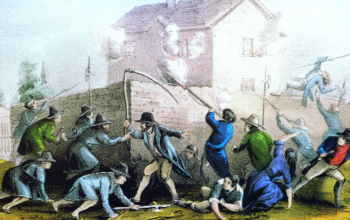
The Battle of Saintfield, a short but bloody clash in County Down in what is now Northern Ireland, takes place on Saturday, June 9, 1798. The battle is the first major conflict of the Irish Rebellion of 1798 in County Down.

A rebel force, over a thousand strong, converge on a large house owned by the McKee family. The McKees are a family of loyalists, who are unpopular in the region because they had provided information to the authorities leading to the arrest of a radical Presbyterian minister and some members of his congregation. The McKees know that they are unpopular and are thus armed to the teeth. As the house is surrounded, shots are fired from the fortified house, hitting some of the attackers. Gunfire holds the insurgents back for a short while, until one of them, a fiddler by the name of Orr, manages to sneak around the back of the house with a ladder and sets the roof alight. The house is destroyed, and all eight members of the family inside are killed. News of this quickly reaches the British forces in the area, and a 300 strong force under Colonel Granville Staplyton, consisting of Newtownards Yeomanry cavalry and 270 York Fencibles, as well as two light cannon, march to the region.

The rebels, however, anticipate the move and are waiting in ambush. Stapylton sees the road ahead twisting into woods, and orders a pair of scouts to check for anything suspicious. The men do not seem to be particularly vigilant, as they return and declared the road ahead to be safe.

The redcoats march into the wooded area, a dense hedge snaking along the road on one side. On the opposite side, the ground steadily rises, with the areas higher up the slope dominated by demesne woods. This provides cover for the Irish. The Irish rebels are mostly armed with pikes and the terrain allows them to quickly swarm the soldiers on the road below. In the fierce hand-to-hand combat that follows the British forces are overwhelmed. One of the fencibles, a veteran of wars in Europe who manages to survive the attack later states that he had never before witnessed such fierce fighting.

Over fifty men are piked to death before Staplyton manages to order the soldiers. He then brings his cannon into play against the mass of rebels before him, inflicting enough casualties with canister and grapeshot to blunt their attack. In the meantime, Staplytons force uses the situation to march to safety.

The Battle of Saintfield is largely regarded as a victory of the United Irish rebels. Long after, in the 1950s, two skeletons, a sword and bayonet of the York fencibles are found in the area.

The rebellion in Down proves to be short lived. Only a few days later the rebel army is slaughtered at the Battle of Ballynahinch.

Many of the dead from both sides of the battle are placed in a mass grave within the grounds of the nearby Presbyterian church. Although there is a plaque signifying the location of these graves, the area seems largely neglected with what appears to be temporary vehicle access over the belligerents final resting place. In May 2010 a memorial park is finished and opened. The area has been cleared and landscaped, with several new plaques and information boards being erected. The graves have been refurbished and the headstones relaid.


Leave a comment

The Battle of Oulart Hill

battle-of-oulart-hill

The Battle of Oulart Hill takes place on May 27, 1798 when a rebel gathering of between 4,000 and 5,000 massacre a detachment of 110 militia sent from Wexford town to stamp out the spreading rebellion in County Wexford.

When news of the long expected rising on May 23 of the Society of United Irishmen in the midlands reaches County Wexford, it is already in an unsettled condition due to fears brought by the recently instituted anti-insurgent disarmament campaign in the county. The measures used included pitchcapping, half-hanging, and house burnings to uncover rebel conspirators. The recent arrival in Wexford of the North Cork Militia, who are notorious for their brutality in the “pacification” of Ulster, terror raids by local yeomen and finally news of the massacres at Dunlavin Green, Carlow and Carnew, have the effect of drawing people together in large groups for security, especially at night.

One such group of one hundred or so gather on the evening of May 26 at The Harrow, near the parish of Boolavogue under the tutelage of Fr. John Murphy, when they encounter a patrol of about 20 yeomen on their way to the house of a suspected rebel. They burn the suspect’s dwelling but, returning empty-handed, they encounter Fr. Murphy’s band again. The patrol are pushing their way through when a skirmish begins in which they lose two of their number, the rest fleeing with news of the killings.

The reaction on both sides is rapid. Vengeful yeomanry patrols roam, burning and killing indiscriminately, while the rebels rouse the countryside and make several raids on manors and other houses holding arms, killing more loyalists and yeomen. News of the skirmish and raids has by now reached Wexford town and, on the morning of May 27, the bulk of its garrison, 110 of the North Cork militia under Colonel Foote, are ordered north to crush the nascent rebellion. They are joined en route by some 16 yeomen cavalry under Colonel Le Hunt. However, these yeomanry are of doubtful loyalty, many (including their sergeant) having joined the rebels that morning.

The militia reaches the village of Oulart at 2:00 PM on May 27. Finding a mass of “from four to five thousand combatants” occupying the high ground of Oulart hill, they rashly advance and pursue the rebels to the summit. The rebel leaders mistakenly believe a large body of yeoman cavalry is waiting to intercept their flight, so their forces desperately turn to face their enemy and kill the whole detachment in an instant, leaving only the commanding officer, Colonel Foote, and four other survivors to escape to their base at Wexford.

Foote reports that, contrary to his orders, the militia had advanced incautiously and were surrounded and overpowered by the overwhelming rebel numbers, mostly armed with pikes, and that “great numbers” of the rebels were killed.

Following the rebel victory, almost all of North Wexford joins the rebellion. Crown forces and loyalist civilians cede control of the countryside, withdrawing to towns such as Enniscorthy, Gorey and Wexford.

(Pictured: The Battle of Oulart Hill by Fr. Edward Foran OSA (1861-1938) who also designed the 1898 Monument in Oulart Village)


Leave a comment

The Battle of the Hill of Tara

battle-of-tara-hillThe Battle of the Hill of Tara is fought on the evening of May 26, 1798 between British forces and Irish rebels involved in the Irish Rebellion of 1798, resulting in a heavy defeat for the rebels and the end of the rebellion in County Meath.

Following the outbreak of the rebellion, signaled in Meath by the prearranged signal of the ceasing of a mail coach near Turvey hill, road blocks are posted on the Navan road. Members of the Society of United Irishmen and rebels in Meath begin to assemble at the Hill of Tara. Tara is chosen as it provides strategic control of road access to the capital of Dublin and cultural significance as the former seat of the High Kings of Ireland. Between 4,000-7,000 rebels gather at the hill. Following the outbreak of the rebellion on May 23, there are incidents of violent encounters throughout the countryside as rallying rebels make their way to Tara.

Picking up yeomanry reinforcements along the way, the combined fencible, yeoman and militia force forms up at the bottom of the hill in advance of the attack on the rebels who have established a large camp on the hill. The lack of any cannon or cavalry places the rebels at a great disadvantage despite their numbers. Disciplined volley fire and flanking cavalry action combined with withering grapeshot delivered from a 6 pounder cannon drive the rebels to within the graveyard walls at the summit. There, at dusk, the rebels make their last stand on the hill until a final grenadier assault finishes them.

The loss to the fencibles, yeomen and militia is minimal. However rebel casualties have estimates running from several hundred to several thousand dead and many wounded. Many bodies are removed during the night of the 26th and 350 dead are counted still lying on the battlefield the following day. Witnesses to the burial recollect many more bodies of those rebels who died of their wounds during the night being collected from the surrounding countryside in carts. It is noted by the witnesses that the bodies are universally disembowelled by the victors. The dead are buried in a mass grave marked by the Lia Fáil stone which is moved to mark the burial site. The defeat effectively ends the United Irishmen’s rising in Meath.

(Pictured: The high cross at the site of the Battle of the Hill of Tara, County Meath)


Leave a comment

The Dunmanway Killings

dunmanway-massacre

The Dunmanway killings, also known as the Dunmanway murders or the Dunmanway massacre, takes place in and around Dunmanway, County Cork between April 26-28, 1922. The event refers to the killing (and in some cases, disappearances) of thirteen Protestant men and boys.

The killings happen in a period of truce after the July 1921 end of the Irish War of Independence and before the outbreak of the Irish Civil War in June 1922. All the dead and missing are Protestants, which has led to the killings being described as sectarian. Six are killed as purported British informants and loyalists, while four others are relatives killed in the absence of the target. Three other men are kidnapped and executed in Bandon as revenge for the killing of an Irish Republican Army (IRA) officer Michael O’Neill during an armed raid. One man is shot and survives his injuries.

On April 26, 1922, a group of anti-Treaty IRA men, led by Michael O’Neill, arrive at the house of Thomas Hornibrook, a former magistrate, at Ballygroman, East Muskerry, Desertmore, Bandon (near Ballincollig on the outskirts of Cork City), seeking to seize his car. Hornibrook is in the house at the time along with his son, Samuel, and his nephew, Herbert Woods, a former Captain in the British Army. O’Neill demands a part of the engine mechanism that had been removed by Hornibrook to prevent such theft. Hornibrook refuses to give them the part, and after further efforts, some of the IRA party enter through a window. Herbert Woods then shoots O’Neill, wounding him fatally. O’Neill’s companion, Charlie O’Donoghue, takes him to a local priest who pronounces him dead. The next morning O’Donoghue leaves for Bandon to report the incident to his superiors, returning with “four military men,” meeting with the Hornibrooks and Woods, who admit to shooting O’Neill.

It is not clear who orders the attacks or carries them out. However, in 2014 The Irish Times releases a confidential memo from the then-Director of Intelligence Colonel Michael Joe Costello (later managing director of the Irish Sugar Company) in September 1925 in relation to a pension claim by former IRA volunteer Daniel O’Neill of Enniskeane, County Cork, stating: “O’Neill is stated to be a very unscrupulous individual and to have taken part in such operations as lotting [looting] of Post Offices, robbing of Postmen and the murder of several Protestants in West Cork in May 1922. A brother of his was shot dead by two of the latter named, Woods and Hornbrooke [sic], who were subsequently murdered.”

Sinn Féin and IRA representatives, from both the pro-Treaty side, which controls the Provisional Government in Dublin and the anti-Treaty side, which controls the area the killings take place in, immediately condemn the killings.

The motivation of the killers remains unclear. It is generally agreed that they were provoked by the fatal shooting of O’Neill by Woods, whose house was being raided on April 26. Some historians have claimed there were sectarian motives; others claim that those killed were targeted only because they were suspected of having been informers during the Irish War of Independence and argue that the dead were associated with the so-called “Murragh Loyalist Action Group,” and that their names may have appeared in captured British military intelligence files which listed “helpful citizens” during the war.

(Pictured: Herbert Woods, centre, whose decision to shoot sparks the massacre)


Leave a comment

Five Irish Regiments Set Sail for France

irish-brigade-of-france

Five Jacobite regiments of Irishmen set sail from Ireland for France on April 18, 1690. These soldiers, about 5,400 in all, will form the nucleus of France’s famed Irish Brigade.

The Irish Brigade is a brigade in the French Royal Army composed of Irish exiles, led by Lord Mountcashel. It is formed in May 1690 when the five regiments sent from Ireland arrive in France in exchange for a larger force of King Louis XIV‘s well-trained French infantry who are sent to fight in the Williamite War in Ireland. The regiments comprising the Irish Brigade retain their special status as foreign units in the French Army until nationalised in 1791.

King Louis XIV wants to support James II in his quest to regain the British crown from William of Orange, but he can ill-afford the loss of 6,000 soldiers during his own struggle with William on the continent. Louis demands Irish replacements, ill-trained though they might be, in exchange. The Irish regiments sail out on the same ships that landed the French troops under Count de Lauzun.

Soon after arriving in France, the five regiments are reorganized into three, commanded by Lord Mountcashel, Daniel O’Brien, and Theobald Dillon, whose family continues in command of this regiment for a one hundred years. Mountcashel commands this first Irish Brigade which is known as Lord Mountcashel’s Irish Brigade. He has grown up in France and become fluent in the French tongue after his father had lost everything due to his participation in the fight against Oliver Cromwell and subsequent exile to France. Mountcashel’s brigade is joined by Patrick Sarsfield‘s men in late 1691. The Irish Brigade carries on in French service for 100 years and amass a record equaled by few military organizations in history.

Like Sarsfield, Mountcashel does not survive for very long in French service. Very shortly after his arrival in France, on September 11, 1690, he is seriously wounded in the chest fighting in Savoy near Mountiers de Tarentaise. Although he recovers from this wound and continues to command the brigade, the wound continues to hamper him. In 1694, he leaves the brigade and seeks relief from his wounds in the baths at Baréges in the Pyrenees. Unfortunately, Justin McCarthy, Lord Mountcashel, dies there on July 1, just short of a year after Patrick Sarsfield is killed at the Battle of Landen.

The Brigade ceases to exist as a separate and distinct entity on July 21, 1791. Along with the other non-Swiss foreign units, the Irish regiments undergo “nationalization” at the orders of the National Assembly. This involves their being assimilated into the regular French Army as line infantry, losing their traditional titles, practices, regulations and uniforms.