At least seven bombs explode in Central London on January 29, 1977. One person is injured. The Irish Republican Army (IRA) later claims responsibility.
Hundreds of police seal off the Oxford Street area as Selfridges department store is set ablaze and one man is injured. The explosions occur over a two-mile area within 50 minutes. The bombs wreck buildings in Oxford Street, Regent Street, and Wardour Street, causing hundreds of thousands of pounds worth of damage and burying a taxi under the rubble, injuring the driver. Another man is trapped in a basement in Selfridges after the blast.
The attacks come less than 72 hours before the IRA commemoration of the Bloody Sunday massacre in Londonderry and, according to the police, bear all the hallmarks of the IRA. The bombs, left in doorways of shops and offices, are similar to those used in firebomb attacks on the centre of Belfast and Londonderry over the previous four years.
Hundreds of police are drafted into the Oxford Street area within minutes of the first blast, shortly after midnight. Police using sniffer dogs examine hundreds of cars stretched along Oxford Street and residents are warned to evacuate by police and fire officers using bullhorns. Dozens of fire engines respond to the resulting blaze in the huge department store.
A two-mile area around Oxford Street is cordoned off by police roadblocks shortly after the first explosions. Scotland Yard and the Fire Brigade are unable to keep pace with the bombs and fires as news reports flood in.
The first explosions occur in Wardour Street where two bombs blow out the front of a publishing office and a travel agency, hurling glass and furniture into the street. Within 20 minutes, three other bombs explode in Oxford Street, Regent Street, Poland Street and in the side-streets of Soho. The fire brigade simultaneously fights two major fires within a mile of each other, in Selfridges and in a building in Berwick Street, Soho. Debris from the bombs is littered around as bomb squad officers and police patrols begin examining all suspicious cars and packages in the area. Several bomb squad officers are standing within yards of a building when the fourth bomb, fortunately a small one, goes off.
The Assistant Commissioner for Crime, Jock Wilson, joins Bomb Squad officers in a special mobile control unit. A senior police officer says that many of the bombs are crammed through letterboxes in the business premises. However, the bomb at Selfridges is placed in the basement, police believe, on previous afternoon.
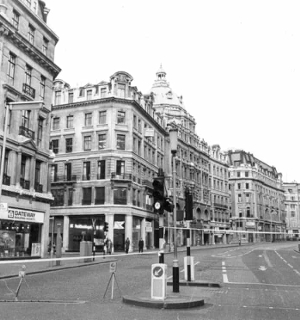
(Pictured: Police cordon off Regent Street following IRA bombs in the West End, London, January 1977. Photograph: ANL/REX/Shutterstock)
On Friday, January 21, 1921, eight men from the 1st Battalion IRA, set out to stage an ambush at Binn’s Bridge on Lower Drumcondra Road. The plan is to attack a Royal Irish Constabulary (RIC) patrol which uses the road to travel from their base at Gormanston, County Meath, near Drogheda.
Led by Lieutenant Francis “Frank” Flood (19), Michael Francis ‘Mick’ Magee (24) Patrick Doyle (29), Thomas Bryan (24), Bernard ‘Bertie’ Ryan (21) and Dermott O’Sullivan (17) set off at 8:30 AM for Binn’s Bridge. They are to ambush RIC Auxiliaries (Black and Tans) travelling into Dublin from Gormanston. However, the Auxiliaries do not arrive. The witness statement of Harry Colley, former Adjutant, IRA Dublin Brigade 1920-21, says “they had actually been sent to carry out the ambush at Binn’s Bridge, but for some reason of their own, when they reached the position, moved up beyond Tolka Bridge, to Clonturk Park.” According to Dermott O’Sullivan, the only survivor, when it appears that the Black and Tans will not be coming their way, the party leaves the Binn’s Bridge site and heads to Tolka Bridge in Drumcondra.
However, the police receive a tip-off from Sergeant Singleton of the Dublin Metropolitan Police (DMP). It is also said, that as the British army unit is approaching the bridge over the River Tolka in Drumcondra, they are warned by a man by the name Robert Pike from Tolka Cottages.
The ambushers commence an attack upon two lorries of RIC constables, who return fire until the vehicles are able to accelerate out of range. Then the Black and Tans arrive in motor lorries and an armored car at the rear of their position to cut off their escape. Some volunteers manage to dash across fields to safety but others are arrested as they attempted to seek refuge in houses in the vicinity. All of the prisoners are found in possession of revolvers and ammunition, and Frank Flood is also found to have a grenade in his pocket.
In an attempt to escape the Auxiliaries, Michael Magee and Séan Burke run across a field of garden allotments in Clonturk Park. The Auxiliaries shoot Magee, mortally wounding him in the legs and lower torso. Magee is captured but soon dies of his wounds.
So at the end of the day, of the eight men involved in the action at Drumcondra, two men, Burke and Dunne, escape the scene. The five remaining, Frank Flood, Thomas Bryan, Bernard Ryan, Patrick Doyle and Dermot O’Sullivan are captured and Magee dies of his wounds. The captives are tried by a court-martial that lasts two days. All of the accused are convicted of High Treason and sentenced to death.
On March 14, 1921, all of the men, save Dermot O’Sullivan, are hanged at Mountjoy Prison. Citing his age of only 17 years, the British commute O’Sullivan’s sentence to life in prison. He is released from Portland Gaol at the end of August 1921.
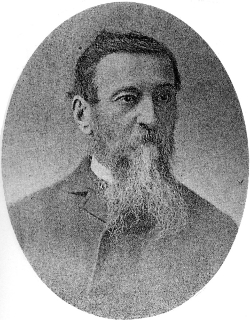
Luby is the son of a Church of Ireland clergyman from Templemore, County Tipperary, his mother being a Catholic. He is educated at Trinity College Dublin where he studies law and puts in the necessary number of terms in London and Dublin where he acquires a reputation as a scholar and takes his degree. He goes on to teach at the college for a time.
In 1851 Luby travels to France, where he hopes to join the French Foreign Legion to learn infantry tactics but finds the recruiting temporarily suspended. From France he goes to Australia for a year before returning to Ireland. From the end of 1855 he edits the Tribune newspaper founded by John E. Pigot who had been a member of The Nation group. During this time, he remains in touch with the small group of ’49 men including Philip Gray and attempts to start a new revolutionary movement. Luby’s views on social issues grow more conservative after 1848 which he makes clear to James Stephens whom he meets in 1856.
In the autumn of 1857 Owen Considine arrives with a message signed by four Irish exiles in the United States, two of whom are John O’Mahony and Michael Doheny. The message conveys the confidence they have in Stephens and asks him to establish an organisation in Ireland to win national independence. Considine also carries a private letter from O’Mahony to Stephens which is a warning, and which is overlooked by Luby and Stephens at the time. Both believe that there is a strong organisation behind the letter, only later to find it is rather a number of loosely linked groups. On December 23 Stephens dispatches Joseph Denieffe to America with his reply which is disguised as a business letter dated and addressed from Paris. In his reply, Stephen’s outlines his conditions and his requirements from the organisation in America.
On March 17, 1858, Denieffe arrives in Dublin with the acceptance of Stephens’s terms by the New York Committee and the eighty pounds. On that very evening the Irish Republican Brotherhood is established in Peter Langan’s timberyard in Lombard Street.
In mid-1863 Stephens informs his colleagues he wishes to start a newspaper, with financial aid from O’Mahony and the Fenian Brotherhood in America. The offices are established at 12 Parliament Street, almost at the gates of Dublin Castle. The first issue of the Irish People appears on November 28, 1863. The staff of the paper along with Luby are Charles J. Kickham and Denis Dowling Mulcahy as the editorial staff. Jeremiah O’Donovan Rossa and James O’Connor have charge of the business office, with John Haltigan being the printer. John O’Leary is brought from London to take charge in the role of Editor.
On July 15, 1865, American-made plans for a rising in Ireland are discovered. Superintendent Daniel Ryan, head of the G Division of the Dublin Metropolitan Police at Dublin Castle, has an informer within the offices of the Irish People who supplies him with an “action this year” message on its way to the IRB unit in Tipperary. With this information, Ryan raids the offices of the Irish People on Thursday, September 15, followed by the arrests of Luby, O’Leary and O’Donovan Rossa. Kickham is caught after a month on the run. Stephens is also caught with the support of Fenian prison warders. The last number of the paper is dated September 16, 1865.
After his arrest and the suppression of the Irish People, Luby is sentenced to twenty years of penal servitude. He is released in January 1871 but is compelled to remain away from Ireland until the expiration of his sentence.
Upon his release Luby goes first to the Continent and later settles in New York City. He lectures all over the country for years and writes for a number of Irish newspapers on political topics. At the memorial meeting on the death of John Mitchel, he delivers the principal address in Madison Square Garden.
Thomas Clarke Luby dies at 109½ Oak Street, Jersey City, New Jersey of paralysis, on November 29, 1901, and is buried in a grave shared with his wife in Bayview Cemetery in Jersey City. His epitaph reads: “Thomas Clarke Luby 1822–1901 He devoted his life to love of Ireland and quest of truth.”
Forty Republicans burn the railway station in Sligo, County Sligo on January 11, 1923 during the Irish Civil War, destroying it and badly damaging seven engines and forty carriages. Seven engines are sent down the line to the quay and one crashes through a concrete wall into the harbour.
The Great Southern and Western Railway Company releases a report detailing the damage Anti-Treaty forces have caused to their property over the previous six months – 375 lines damaged, 42 engines derailed, 51 over-bridges and 207 under-bridges destroyed, 83 signal cabins, and 13 other buildings destroyed. In the same month, Republicans destroy the railway stations at Ballybunion and Listowel.
The Sligo station opens on December 3, 1862 when Sligo acquires rail links to Dublin. The Sligo, Leitrim and Northern Counties Railway link to Enniskillen to the north in 1881. A link to Limerick and the south follows in 1895. The line to Enniskillen closes in 1957 and passenger services to Limerick close in 1963. For many years CIÉ keeps the latter line open for freight traffic, and although it is now disused, it forms part of the Western Rail Corridor redevelopment project.
Today, Sligo Mac Diarmada station is a mainline railway station which serves the town of Sligo. It is a terminal station, with two platforms. There is a passing loop at the approach to the station. Iarnród Éireann, Ireland’s national railway operator, runs inter-city rail services between Sligo and Dublin on the Dublin-Sligo railway line.
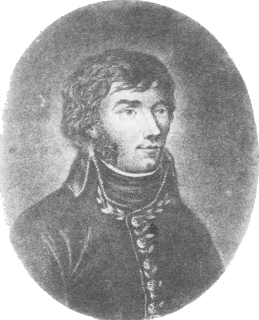
In 1794, after serving in the Army of the Coasts of Brest, Humbert serves under Louis Lazare Hoche in the Army of the Rhin-et-Moselle. Charged to prepare for an expedition against Ireland, he takes command of the Légion des Francs under Hoche, sailing in the ill-fated Expédition d’Irlande against Bantry Bay in 1796, and is engaged in actions at sea against the Royal Navy. Contrary weather and enemy action force this expedition to withdraw. The trip home ends in a naval battle, the Action of 13 January 1797, during which Humbert, on the French ship Droits de l’Homme (1794), narrowly escapes death. As the ship is destroyed and sinks, hundreds of men perish, but Humbert is among the last to escape.
On his return to France, Humbert serves in the Army of the Sambre-et-Meuse, before being appointed to command the troops in another attempt to support a rising in Ireland in 1798. His command chiefly consists of infantry of the 70th demi-brigade with a few artillerymen and some cavalry of the 3rd Hussars, however by the time he arrives off the Irish coast the United Irish rising has already suffered defeat. The expedition is able to land in Ireland at Killala on Thursday August 23, 1798, meeting with initial success in the Battle of Castlebar where he routs the Irish Militia. Humbert subsequently declares a Republic of Connacht, with hopes of taking Dublin. However, Humbert’s small force is defeated at the Battle of Ballinamuck by the Irish Royal Army, and he is taken as a prisoner of war by the authorities. The British send the French officers home in two frigates and then massacre their Irish supporters. Humbert makes no attempt to save the Irish who bravely supported him.
Humbert is shortly repatriated in a prisoner exchange and appointed in succession to the Armies of Mayence, Danube and Helvetia, with which he serves at the Second Battle of Zurich. He then embarks for Santo Domingo and participates in several Caribbean campaigns for Napoleon Bonaparte before being accused of plundering by General Brunet. It is also rumored that he engages in an affair with Pauline Bonaparte, the wife of his commanding officer Charles Leclerc. He is returned to France by order of General Leclerc in October 1802, for “prevarications, and liaison relationships with organisers of the inhabitants and with leaders of brigands.” A committed Republican, his displeasure at Napoleon’s Imperial pretensions lead to him being dismissed in 1803 and he retires to Morbihan in Brittany.
In 1810, after brief service in the Army of the North, Humbert emigrates to New Orleans, where he makes his acquaintance with French pirate Jean Lafitte. In 1813, Humbert joins the revolutionary Juan Bautista Mariano Picornell y Gomila in an unsuccessful attempt to foment rebellion in Spanish Mexico, but the effort fails. In 1814, Humbert again leaves New Orleans and joins the rebelling forces of Buenos Aires, briefly commanding a corps, before returning home. Humbert last fights the British at the Battle of New Orleans, as a volunteer private soldier in U.S. ranks, in the War of 1812, wearing his Napoleonic uniform. General Andrew Jackson thanks him for his assistance there after the American victory in January 1815. Thereafter Humbert lives peacefully as a schoolteacher until his death on January 3, 1823.
A monument to General Humbert depicting Mother Ireland stands on Humbert Street, Ballina, County Mayo. In 1989, sculptor Carmel Gallagher unveils a bust of General Humbert in Killala, Ireland, to mark the upcoming bicentennial of the Irish Rebellion of 1798.
More broadly, the term “Wild Geese” is used in Irish history to refer to Irish soldiers who leave to serve in continental European armies in the 16th, 17th and 18th centuries, or even, poetically, Irish soldiers in British armies as late as World War I.
Irish recruitment for continental armies dries up after it is made illegal in 1745. In 1732 Sir Charles Wogan indicates in a letter to Jonathan Swift, Dean of St. Patrick’s Cathedral, Dublin, that 120,000 Irishmen have been killed and wounded in foreign service “within these forty years.” Swift later replies, “I cannot but highly esteem those gentlemen of Ireland who, with all the disadvantages of being exiles and strangers, have been able to distinguish themselves by their valour and conduct in so many parts of Europe, I think, above all other nations.”
It was some time before the British armed forces begin to tap into Irish Catholic manpower. In the late eighteenth century, the Penal Laws are gradually relaxed and in the 1790s the laws prohibiting Catholics bearing arms are abolished.
Sarsfield is honored to this day in the crest of County Limerick. The Flight of the Wild Geese is remembered in the poetic words… “War-battered dogs are we, Fighters in every clime, Fillers of trench and of grave, Mockers, bemocked by time. War-dogs, hungry and grey, Gnawing a naked bone, Fighters in every clime, Every cause but our own.”
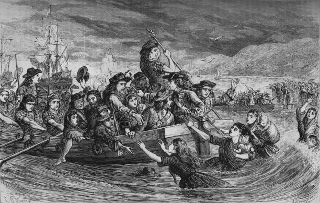
(Pictured: ‘Irish Troops Leaving Limerick’, 1692, (Cassell Petter & Galpin, London, Paris & New York, c1880), Artist Unknown)
The lightships provide a vitally important service to maritime traffic for over two centuries. People live aboard these ships that anchor stationary at sea, providing a beacon in the dark for vessels that navigate the more treacherous parts of the Irish coast. These ships are faithfully assisted by ships that resupply them and facilitate crew changes. The SS Isolda is one such ship.
Danger in the waters around Ireland greatly increase during World War II. The Battle for the Atlantic is raging and Ireland’s location near important shipping lanes places Irish vessels right in the middle of a conflict zone. As a result, many casualties are incurred on Irish ships despite their position of neutrality.
The SS Isolda is a lightship tender owned by the Commissioners of Irish Lights. The lightship service is considered neutral and the ship has “Lighthouse Service” painted in large letters on both sides of the hull.
On December 19, 1940 she sails out from Rosslare Harbour heading to re-supply nearby lightships with relief crews and Christmas provisions. After placing the first crew at the lightship Barrels she then heads towards her next stop, the lightship Coningbeg. She does not make it very far as three miles out she is attacked from the air.
A German Condor flies over and drops the first bomb on the ship. The plane circles around and drops a second bomb, sealing the ships fate. Realising the SS Isolda is doomed, Captain Albert Bestic gives orders to abandon ship. Back on shore observers at the army lookout post at Carnsore Point look on helplessly at the carnage. The next day the German High Command admits that it is a German aircraft that had bombed the SS Isolda.
Survivors are picked up by boat and brought into Kilmore Quay, County Wexford. Six of the crew die and seven are wounded. Captain Bestic is among the survivors. This is not his first brush with death as he survived the sinking of the ill-fated RMS Lusitania 25 years earlier when it was torpedoed by a German U-boat.
(From: “Remembering the SS Isolda and her crew | Lost December 19th 1940” by Ann Robinson, December 19, 2017, http://coastmonkey.ie/ss-isolda-1940 | Pictured: The Ship – SS Isolda being bombed – Painting By Kenneth King)
During the subsequent Irish War of Independence (1919-1921) O’Connor is made Director of Engineering of the Irish Republican Army (IRA) – a military organisation descended from the Irish Volunteers.
O’Connor does not accept the Anglo-Irish Treaty of 1921, which establishes the Irish Free State and abolishes the Irish Republic declared in 1916, which he and his comrades had sworn to uphold. On March 26, 1922, the anti-treaty officers of the IRA hold a convention in Dublin in which they reject the Treaty compromise and repudiate the authority of the Dáil, the elected Irish Parliament. Asked by a journalist if this means they are proposing a military dictatorship in Ireland, O’Connor replies, “you can take it that way if you want.”
On April 14, 1922, O’Connor, with 200 other hardline anti-treaty IRA men under his command, takes over the Four Courts building in the centre of Dublin in defiance of the new Irish government. They want to provoke the British troops, who are still in the country, into attacking them, which they believe will restart the war with Britain and re-unite the IRA against their common enemy. Michael Collins tries desperately to persuade O’Connor and his men to leave the building before fighting breaks out.
On June 28, 1922, after the Four Courts garrison has kidnapped JJ “Ginger” O’Connell, a general in the new Free State Army, Collins shells the Four Courts with borrowed British artillery. O’Connor surrenders after two days of fighting and is arrested and held in Mountjoy Prison. This incident sparks the Irish Civil War as fighting breaks out around the country between pro and anti-treaty factions.
On December 8, 1922, along with Liam Mellows, Richard Barrett and Joe McKelvey, three other republicans captured with the fall of the Four Courts, Rory O’Connor is executed by firing squad in reprisal for the anti-treaty IRA’s killing of Free State member of parliament Sean Hales. The execution order is given by Kevin O’Higgins, who less than a year earlier had appointed O’Connor to be best man at his wedding, symbolising the bitterness of the division that the Treaty has caused. O’Connor, one of 77 republicans executed by the Cumann na nGaedheal government of the Irish Free State, is seen as a martyr by the Republican movement in Ireland.
As dusk falls the ambush takes place on a road at Dus a’ Bharraigh in the townland of Shanacashel, Kilmichael Parish, near Macroom.
Just before the Auxiliaries in two lorries come into view, two armed IRA volunteers, responding late to Barry’s mobilisation order, drive unwittingly into the ambush position in a horse and sidecar, almost shielding the British forces behind them. Barry manages to avert disaster by directing the car up a side road and out of the way. The Auxiliaries’ first lorry is persuaded to slow down by the sight of Barry placing himself on the road in front of a concealed Command Post, wearing an IRA officer’s tunic given to him by Paddy O’Brien. Concealed on the south side of the road are six riflemen, whose instructions are to prevent the enemy taking up positions on that side. Another six riflemen are positioned some way off as an insurance group, should a third Auxiliary lorry appear.
The first lorry, containing nine Auxiliaries, slows almost to a halt close to their intended ambush position, at which point Barry gives the order to fire. He throws a Mills bomb that explodes in the open cab of the first lorry. A savage close-quarter fight ensues. According to Barry’s account, some of the British are killed using rifle butts and bayonets in a brutal and bloody encounter. This part of the engagement is over relatively quickly with all nine Auxiliaries dead or dying.
While this part of the fight is going on, a second lorry also containing nine Auxiliaries has driven into the ambush position. This lorry’s occupants, at a more advantageous position than Auxiliaries in the first lorry because of their distance from the ambushing group, dismount to the road and exchange fire with the IRA, killing Michael McCarthy. Barry then brings the Command Post soldiers who had completed the attack on the first lorry to bear on this group. Barry claimed these Auxiliaries called out a surrender and that some dropped their rifles but opened fire again with revolvers when three IRA men emerged from cover, killing volunteer Jim O’Sullivan instantly and mortally wounding Pat Deasy. Barry then orders his men to open fire and not stop until told to do so. Barry ignores a subsequent attempt by remaining Auxiliaries to surrender and keeps his men firing until he believes all the Auxiliaries are dead.
At the conclusion of the fight, it is observed that two IRA volunteers, Michael McCarthy and Jim O’Sullivan, are dead and that Pat Deasy, brother of Liam Deasy, is mortally wounded. Although the IRA fighters think they had killed all of the Auxiliaries, two actually survive, one very badly injured and another who escapes and is later captured and shot dead. Among the 16 British dead on the road at Kilmichael is Francis Crake, commander of the Auxiliaries in Macroom, probably killed at the start of the action by Barry’s Mills bomb.
Many IRA volunteers are deeply shaken by the severity of the action, referred to by Barry as “the bloodiest in Ireland,” and some are physically sick. Barry attempts to restore discipline by making them form-up and perform drill, before marching away. Barry himself collapses with severe chest pains on December 3 and is secretly hospitalized in Cork. It is possible that the ongoing stress of being on the run and commander of the flying column, along with a poor diet as well as the intense combat at Kilmichael contribute to his illness, diagnosed as heart displacement.
The political fallout from the Kilmichael ambush outweighs its military significance. While the British forces in Ireland can easily absorb 18 casualties, the fact that the IRA had been able to wipe out a whole patrol of elite Auxiliaries is for them deeply shocking. The British forces in the West Cork area take their revenge on the local population by burning several houses, shops and barns in Kilmichael, Johnstown and Inchigeelagh, including all of the houses around the ambush site. On December 3, three IRA volunteers are arrested by the British Essex Regiment in Bandon, beaten and killed, and their bodies dumped on the roadside.
For the British government, the action at Kilmichael is an indication that the violence in Ireland is escalating. Shortly after the ambush, barriers are placed on either end of Downing Street to protect the Prime Minister‘s office from IRA attacks. On December 10, as a result of Kilmichael, martial law is declared for the counties of Cork, Kerry, Limerick and Tipperary.
The British military now has the power to execute anyone found carrying arms and ammunition, to search houses, impose curfews, try suspects in military rather than civilian courts and to intern suspects without trial. On December 11, in reprisal for Kilmichael and other IRA actions, the centre of Cork city is burned by Auxiliaries, British soldiers and Black and Tans, and two IRA men are assassinated in their beds. In separate proclamations shortly afterwards, the authorities sanction “official reprisals” against suspected Sinn Féin sympathisers and the use of hostages in military convoys to deter ambushes.
(Pictured: The Kilmichael Ambush Monument at the ambush site)
Theobald Wolfe Tone, Irish republican and rebel who sought to overthrow English rule in Ireland and who led a French military force to Ireland during the Irish Rebellion of 1798, dies at Provost’s Prison, Dublin on November 19, 1798, from a stab wound to his neck which he inflicted upon himself on November 12. His attempted suicide is the result of being refused a soldier’s execution by firing squad and being sentenced to death by hanging.
Wolfe Tone is born in Dublin on June 20, 1763. The son of a coach maker, he studies law and is called to the Irish bar in 1789 but soon gives up his practice. In October 1791 he helps found the Society of United Irishmen, initially a predominantly Protestant organization that works for parliamentary reforms, such as universal suffrage and Roman Catholic emancipation. In Dublin in 1792 he organizes a Roman Catholic convention of elected delegates that forces Parliament to pass the Catholic Relief Act of 1793. He himself, however, is anticlerical and hopes for a general revolt against religious creeds in Ireland as a sequel to the attainment of Irish political freedom.
By 1794 Wolfe Tone and his United Irishmen friends begin to seek armed aid from Revolutionary France to help overthrow English rule. After an initial effort fails, he goes to the United States and obtains letters of introduction from the French minister at Philadelphia to the Committee of Public Safety in Paris. In February 1796 he arrives in the French capital, presents his plan for a French invasion of Ireland, and is favourably received. The Directory then appoints one of the most brilliant young French generals, Lazare Hoche, to command the expedition and makes Tone an adjutant in the French army.
On December 16, 1796, Wolfe Tone sails from Brest with 43 ships and nearly 14,000 men. But the ships are badly handled and, after reaching the coast of west Cork and Kerry, are dispersed by a storm. He again brings an Irish invasion plan to Paris in October 1797, but the principal French military leader, Napoleon Bonaparte, takes little interest. When insurrection breaks out in Ireland in May 1798, Wolfe Tone can only obtain enough French forces to make small raids on different parts of the Irish coast. In September he enters Lough Swilly, Donegal, with 3,000 men and is captured there.
At his trial in Dublin on November 10, Wolfe Tone defiantly proclaims his undying hostility to England and his desire “in fair and open war to produce the separation of the two countries.” He is found guilty and is sentenced to be hanged. Early in the morning of November 12, 1798, the day he is to be hanged, he cuts his throat with a penknife and dies at the age of 35 in Provost’s Prison, Dublin, not far from where he was born. He is buried in Bodenstown, County Kildare, near his birthplace, and his grave is in the care of the National Graves Association.



 The Irish


 seamus dubhghaill