seamus dubhghaill

Promoting Irish Culture and History from Little Rock, Arkansas, USA


Leave a comment

The Warrenpoint Ambush

The Warrenpoint ambush, also known as the Narrow Water ambush, the Warrenpoint massacre or the Narrow Water massacre, is a guerrilla attack by the Provisional Irish Republican Army (IRA) on August 27, 1979. The IRA’s South Armagh Brigade ambushes a British Army convoy with two large roadside bombs on the A2 road at Narrow Water Castle, just outside Warrenpoint, County Down, Northern Ireland.

The road and castle are on the northern bank of the Newry River, which marks the border between Northern Ireland and the Republic of Ireland. The Republic’s side of the river, the Cooley Peninsula in County Louth, is an ideal spot from which to launch an ambush. It is thickly wooded, which gives cover to the ambushers, and the river border prevents British forces from giving chase.

On the afternoon of August 27, a British Army convoy of one Land Rover and two four-ton lorries carrying soldiers of the 2nd Battalion, Parachute Regiment is driving from Ballykinlar Barracks to Newry. The British Army is aware of the dangers of using the stretch of road along the Newry River and often declares it out of bounds. However, they sometimes use it to avoid setting a pattern. At 4:40 p.m., as the convoy is driving past Narrow Water Castle, an 800-pound fertiliser bomb, hidden among bales of straw on a parked flatbed trailer, is detonated by remote control by IRA members watching from across the border in County Louth. The explosion catches the last lorry in the convoy, hurling it onto its side and instantly killing six paratroopers, whose bodies are scattered across the road. There are only two survivors amongst the soldiers traveling in the lorry, both of whom receive serious injuries. The lorry’s driver, Anthony Wood (19), is one of those killed. All that remains of his body is his pelvis, welded to the seat by the fierce heat of the blast.

According to the soldiers, immediately after the blast they are targeted by rifle fire from the woods on the Cooley Peninsula on the other side of the border, with this view supported by two part-time firefighters assisting the wounded. Shortly afterwards, the two IRA members arrested by the Garda Síochána and suspected of being behind the ambush, are found to have traces of gunsmoke residue on their hands and on the motorbike they are riding. The IRA’s first statement on the incident, however, denies that any shots had been fired at the troops, and according to Royal Ulster Constabulary (RUC) researchers, the soldiers might have mistaken the sound of ammunition cooking off for enemy gunfire. Nevertheless, at the official inquiry the soldiers declare on oath that they had been fired on.

The surviving paratroopers radio for urgent assistance, and reinforcements are dispatched to the scene by road. A rapid reaction unit is sent by Gazelle helicopter, consisting of Lieutenant Colonel David Blair, commanding officer of the Queen’s Own Highlanders, his signaler Lance Corporal Victor MacLeod, and army medics. Another helicopter, a Wessex, lands to pick up the wounded. Colonel Blair assumes command once at the site.

William Hudson, a 29-year-old from London, is killed by the British Army and his cousin Barry Hudson, a 25-year-old native of Dingle, is wounded when shots are fired across the Newry River into the Republic of Ireland about 3 km from the village of Omeath, County Louth.

The pair are partners in ‘Hudson Amusements’ and had been operating their amusements in Omeath for the duration of the Omeath Gala. When the first explosion is heard across the Lough, the pair go down to the shore to see what is unfolding. The pair makes their way to Narrow Water on the southern side of the border to get a better view of what is happening on the northern side. Barry Hudson is shot in the arm and as he falls to the ground he sees his cousin, who is the son of a coachman at Buckingham Palace, fall to the ground, shot in the head. He dies almost immediately.

The IRA had been studying how the British Army behaves after a bombing and correctly predicts that they would set up an incident command point (ICP) at the stone gateway on the other side of the road. At 5:12 p.m., thirty-two minutes after the first explosion, another 800-pound bomb hidden in milk pails explodes at the gateway, destroying it and hurling lumps of granite through the air. It detonates as the Wessex helicopter is taking off carrying wounded soldiers. The helicopter is damaged by the blast but does not crash.

The second explosion kills twelve soldiers, ten from the Parachute Regiment and the two from the Queen’s Own Highlanders. Lieutenant Colonel Blair is the second Lieutenant Colonel to be killed in the Troubles up until then, following Lieutenant Colonel Corden-Lloyd of the 2nd Battalion Royal Green Jackets in 1978. Only one of Colonel Blair’s epaulettes remains to identify him as his body had been vaporised in the blast. The epaulette is taken from the scene by Brigadier David Thorne to a security briefing with Prime Minister Margaret Thatcher to “illustrate the human factor” of the attack. Mike Jackson, then a major in the Parachute Regiment, is at the scene soon after the second explosion and later describes seeing human remains scattered over the road, in the water and hanging from the trees. He is asked to identify the face of his friend, Major Peter Fursman, still recognisable after it had been ripped from his head by the explosion and recovered from the water by divers from the Royal Engineers.

Press photographer Peter Molloy, who arrives at the scene after the first explosion, comes close to being shot by an angry paratrooper who sees him taking photographs of the dead and dying instead of offering to help the wounded. The soldier is tackled by his comrades. Molloy says, “I was shouted at and called all sorts of things, but I understood why. I had trespassed on the worst day of these fellas’ lives and taken pictures of it.”

The Warrenpoint ambush is a victory for the IRA. It is the deadliest attack on the British Army during the Troubles and the Parachute Regiment’s biggest loss since World War II, with sixteen paratroopers killed. General Sir James Glover, Commander of British forces in Northern Ireland, later says it was “arguably the most successful and certainly one of the best planned IRA attacks of the whole campaign.” The ambush happens on the same day that Lord Mountbatten, a prominent member of the British royal family, is killed by an IRA bomb aboard his boat at Mullaghmore, County Sligo, along with three others.

Republicans portray the attack as retaliation for Bloody Sunday in 1972 when the Parachute Regiment shot dead 13 unarmed civilians during a protest march in Derry. Graffiti appears in republican areas declaring “13 gone and not forgotten, we got 18 and Mountbatten.” The day after the Mountbatten and Warrenpoint attacks, the Ulster Volunteer Force (UVF) retaliates by shooting dead a Catholic man, John Patrick Hardy (43), at his home in Belfast‘s New Lodge estate. Hardy is targeted in the mistaken belief that he is an IRA member.

Very shortly after the ambush, IRA volunteers Brendan Burns and Joe Brennan are arrested by the Gardaí. They are stopped while riding a motorbike on a road opposite Narrow Water Castle. They are later released on bail due to lack of evidence. Burns dies in 1988 when a bomb he is handling explodes prematurely. In 1998, former IRA member Eamon Collins claims that Burns had been one of those who carried out the Warrenpoint ambush. No one has ever been criminally charged.

According to Toby Harnden, the attack “drove a wedge” between the Army and the RUC. Lieutenant General Sir Timothy Creasey, General Officer Commanding Northern Ireland, suggests to Margaret Thatcher that internment should be brought back and that liaison with the Gardaí should be left in the hands of the military. Sir Kenneth Newman, the RUC Chief Constable, claims instead that the British Army practice since 1975 of supplying their garrisons in south County Armagh by helicopter gives too much freedom of movement to the IRA. One result is the appointment of Sir Maurice Oldfield to a new position of Co-ordinator of Security Intelligence in Northern Ireland. His role is to co-ordinate intelligence between the military, MI5 and the RUC. Another is the expansion of the RUC by 1,000 members. Tim Pat Coogan asserts that the deaths of the 18 soldiers hastens the move to Ulsterisation.

Lieutenant Colonel Blair is remembered on a memorial at Radley College, Oxfordshire.


Leave a comment

First Voluntary Smallpox Inoculations in Ireland

Five Dublin children receive the first voluntary smallpox inoculations in Ireland on August 26, 1725.

Smallpox is an acute and infectious disease caused by a virus. It is characterized by high fever and large sores on the body that leaves scars. The disease is estimated to have killed up to one-third of its victims. Those who are not killed are left with pock-marked skin or even blind. The name “smallpox” is coined in the 15th century to distinguish it from the “great pox,” better known as syphilis. However, smallpox’s history on earth is believed to date back thousands of years.

In 1980 the World Health Organization (WHO) officially declares smallpox eradicated. After ten years and $300 million, used on a global vaccination program, the disease is gone. The last recorded death from this disease is in Somalia in 1977.

In Ireland, the spread of smallpox from the 1600s onward inspires dread. Ireland’s poverty and ignorance of infectious disease, at the time, sees typhoid and dysentery ravage communities. Between 1661 and 1746 smallpox is believed to be the cause of 20% of all deaths in Dublin and a third of all children deaths in the area. This highly infectious disease does not discriminate as the rich, as well as the poor, are badly affected.

By the 18th century, hope emerges and an inoculation technique is found. Since the 10th century, the Chinese had been inoculating people, by using a small dose of the disease. This technique does not arrive in Europe for almost 800 years. This technique is first tried on prisoners in Cork Jail in 1721, presumably against their will. Four years later five children in Dublin voluntarily receive the inoculation on August 26, 1725.

Over the years this technique shows its effectiveness. The rich begin to infest and inoculate their families. Throughout the 18th century, as the disease has periodic epidemics, the richer families are less affected. By the middle of the 18th century, the inoculation is in widespread use. The South Infirmary, in Cork, even initiates a program to inoculate the poor.

Sadly, of course, the unscrupulous see an opportunity to make money as people queue up to receive the treatment. In Donegal in 1781, all but one child of a group of 52 die when an unqualified practitioner supposedly inoculates the group.

While inroads are being made against smallpox, with the emergence of the Great Famine in Ireland (1845–49), the disease returns with a vengeance. This devastates even those who had found a way to make ends meet. Smallpox means that even if you survive the disease you will be unable to work for some time and many are pauperized by the lack of income and die eventually.

As Ireland emerges from the poverty and devastation of the Great Hunger, during the 1870s over 7,000 die in Ireland from the disease. It is only from the 1880s that smallpox becomes more earnestly eradicated in Ireland. By the 1910s the death rate is down to just 65 people. From 1901 to 1910 almost 1 million Irish are inoculated.

The last outbreak of smallpox in Ireland is in 1903. In Dublin, there are found to be 256 cases. Sadly elsewhere around the world even up to the 1960s smallpox is rampant, taking up to two million lives per year and leaving millions more disfigured and blind.

Thankfully by the 1980s, the WHO’s world vaccine program has done its work and now the world is free of this disease which plagued the earth for thousands of years.

(From: “On this day: In 1725 Dublin children received the first smallpox vaccination” by IrishCentral staff, http://www.irishcentral.com, August 26, 2020)


Leave a comment

The Battle of Glenmalure

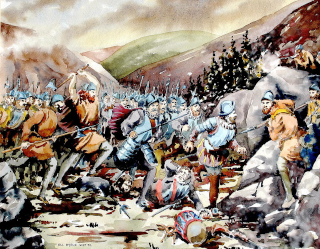
The Battle of Glenmalure (Irish: Cath Ghleann Molúra) takes place in Glenmalure, a steep U-shaped glacial valley in County Wicklow that is surrounded by forests and bogs, on August 25, 1580, during the Desmond Rebellions. A Catholic army of united Irish clans from the Wicklow Mountains led by Fiach MacHugh O’Byrne and James Eustace, 3rd Viscount Baltinglass of the Pale, defeat an English army under Arthur Grey, 14th Baron Grey de Wilton, at Clan O’Byrne‘s mountain stronghold of Glenmalure.

Grey had landed in Ireland with reinforcements from England to put down the rebellion. His strategy is to meet O’Byrne’s threat to the English heartland of Dublin and the Pale by attacking through the highlands to the south of the city. Against the advice of veteran commanders, he chooses to lead his army (around 3,000 strong) through lowland Kildare and into the Wicklow Mountains, with the aim of taking the fastness at Balinacor in the Glenmalure Valley.

While climbing the steep slopes of the valley, the inexperienced English soldiers are ambushed by the Irish who were hiding in the woods. The English are sniped at for a long period of time before their discipline collapses and they turn and flee down the valley. It is at this point that most of their casualties occur, as the Irish leave their cover and fall upon the English with swords, spears, and axes. Hundreds of English soldiers are cut down by the pursuing Irish as they try to escape the field. The remaining English have to fight a rearguard action for several miles until they reach the town of Rathdrum.

Irish sources state that around 800 English soldiers are killed, though the English put their losses at 360 dead. Among those killed is Peter Carew, cousin of his namesake colonist who had made claims to, and won, large tracts of land in southern Ireland. The remainder of the English force retreat to lowland Wicklow and from there to Dublin. However, the following year, when offered terms, most of the Irish soldiers, including O’Byrne, come in and surrender. The exception is Baltinglass, who flees to France.

The battle is commemorated in the folk song “Follow Me Up to Carlow.”

(Pictured: “Battle of Glenmalure 1580 Wicklow,” painting by Val Byrne)


Leave a comment

Birth of Margaret Mary Pearse, Politician & Teacher

Margaret Mary Pearse, Fianna Fáil politician and teacher, is born on August 24, 1878, at 27 Great Brunswick Street (now Pearse Street) in Dublin. She is a sister of Patrick Pearse, one of the leaders of the 1916 Easter Rising, and Willie Pearse, both of whom are executed for their part in the Rising.

Pearse is the eldest child of James Pearse and Margaret Pearse (née Brady), who serves as a Teachta Dála (TD) in the 1920s. She is educated at the Holy Faith Convent in Glasnevin. After leaving school, she trains as a teacher. She helps to found St. Enda’s School with her brothers Patrick and Willie. Following the executions of her brothers in the aftermath of the Easter Rising, she continues to run St. Enda’s, along with Fergus De Búrca, until 1933.

Following in her mother’s footsteps, Pearse is first elected to Dáil Éireann as a Fianna Fáil TD for the Dublin County constituency at the 1933 general election. She is defeated at the 1937 general election on the 7th count of votes but is elected to the Administrative Panel of the 2nd Seanad. She serves in the Seanad until her death in 1968, however, she and her mother are never considered to be more than figureheads for the party. She is a founding member of the teaching staff of Ardscoil Éanna in Crumlin, Dublin, upon its establishment in 1939.

Illness forces Pearse into the Linden Convalescent Home in Blackrock, County Dublin when she is in her 80s. In 1967, when she is 89 years old, her condition is described to be deteriorating. However, in 1968 during the months leading up to her 90th birthday, she leaves the Linden Convalescent Home for a short while in order to spend her birthday at St. Enda’s in Rathfarnham. The president of Ireland at the time, Éamon de Valera, visits her at St. Enda’s to congratulate her on her upcoming 90th birthday.

Margaret Pearse dies, unmarried, at the Linden Convalescent Home in Blackrock, County Dublin, on November 7, 1968, and is given a state funeral. President de Valera, the church and the state all pay tribute to her at the funeral. She is buried beside her parents and sister at Glasnevin Cemetery. The Taoiseach, Jack Lynch, says that Margaret Mary Pearse is the last remaining member of the noble Pearse family. He says her life, like her patriotic brothers, was dedicated to Ireland.

As per her mother’s wishes, Pearse bequeaths St. Enda’s to the people of Ireland as a memorial to her brother’s sacrifice. The school is now home to the Pearse Museum.


Leave a comment

Birth of Cathal O’Shannon, Journalist & Television Presenter

Cathal O’Shannon, Irish journalist and television presenter, is born in Marino, Dublin, on August 23, 1928. He is a reporter with The Irish Times, and television reporter/presenter and documentary film maker with RTÉ. The Irish radio and television broadcaster Terry Wogan describes O’Shannon as possibly the greatest Irish television journalist of the 20th century.

O’Shannon is the son of Cathal O’Shannon (Sr.), a Socialist and Irish Republican. He receives his formal education at Colaiste Mhuire School, in Parnell Square, Dublin. Despite his father’s politics, as a 16-year-old he volunteeres for war time service with the Royal Air Force (RAF) in Belfast in 1945 during World War II. He utilizes a forged birth certificate to disguise being underage for enlistment with the British Armed Forces. After air crew training, he is posted to the Far East, as a tail gunner in an Avro Lancaster bomber to take part in the Burma campaign, but the war ends with the downfall of the Japanese Empire before he is required to fly combat sorties.

O’Shannon first becomes a journalist with The Irish Times on leaving the RAF in 1947. Later he joins the Irish state broadcasting service Raidió Teilifís Éireann (RTÉ).

In July 1972 O’Shannon records a notable television interview with 31-year-old Muhammad Ali, when Ali is in Dublin to compete at Croke Park in a bout with Alvin Lewis.

O’Shannon receives a Jacob’s Award for his 1976 TV documentary, Even the Olives are Bleeding, which details the activities of the “Connolly Column” in the Spanish Civil War. Two years later he is honoured with a second Jacob’s Award for his television biography Emmet Dalton Remembers (1978).

In 1978, O’Shannon leaves RTÉ to join Canadian company Alcan, which is setting up an aluminum plant at Aughinish, County Limerick, in 1978. He is head-hunted to become its Director of Public Affairs, an important post at a time when there are environmental concerns about the effects of aluminium production. He admits that he was attracted by the salary, “five times what RTÉ were paying me,” but he also later says that one of the reasons for the move is that he had become unhappy with working at RTÉ, stating in an interview that “The real reason I got out of RTÉ was that they wouldn’t let me do what I wanted to do journalistically.” He had submitted proposals to the station’s editors for a television documentary series on the Irish Civil War, and also one on the wartime Emergency period, but they had been rejected. While he enjoys the social life with lavish expenses which his public relations duties involve, his friends believe that he missed the varied life and travel of journalism. He retires early from Aughinish in 1992 and returns to making television documentaries with RTÉ.

In January 2007, O’Shannon’s last documentary, Hidden History: Ireland’s Nazis, is broadcast by RTÉ as a two-part series. It explores how a number of former Nazis and Nazi collaborators from German-occupied Europe go to live in the Republic of Ireland after World War II — the best known of whom is Otto Skorzeny, who lives for a period in County Kildare. Others include such Breton nationalists as Alan Heusaff, Yann Fouéré and Yann Goulet, as well as two Belgians, Albert Folens and Albert Luykx.

O’Shannon announces his retirement at the age of 80 on January 12, 2007.

O’Shannon is awarded lifetime membership in the Irish Film & Television Academy in 2010, to which he says is “particularly gratifying that it occurs before I pop my clogs.”

After weakening health for two years, and spending his last days in hospice at Blackrock, O’Shannon dies at the Beacon Hospital in Dublin on October 22, 2011. His body is reposed at Fanagans Funeral Home in Dublin on October 25, 2011, followed by a funeral the following day at Glasnevin Cemetery Chapel, where it is afterwards cremated.

O’Shannon’s wife, Patsy, whom he met while they were working for The Irish Times office in London, dies in 2006. They are married for more than 50 years. In a 2008 television documentary O’Shannon admits that throughout his marriage he had been a serial womaniser, who had repeatedly engaged in extra-marital affairs unbeknownst to his wife.

Director-General of RTÉ Noel Curran says O’Shannon had brought into being “some of the great moments in the RTÉ documentary and factual schedule over the past five decades.” In tribute, RTÉ One shows the documentary Cathal O’Shannon: Telling Tales on November 10, 2011. It had originally aired in 2008 to mark his 80th birthday.


Leave a comment

Birth of Susan Denham, First Female Chief Justice of Ireland

Susan Jane Denham, SC (née Gageby), Irish judge who is the first woman to hold the position of Chief Justice of Ireland (2011-17), is born in Dublin on August 22, 1945. She serves as a Judge of the Supreme Court of Ireland (1992-2017) and is the longest-serving member of the court on her retirement. She also serves as a Judge of the High Court (1991-92).

Gageby is the daughter of the former editor of The Irish Times, Douglas Gageby, the sister of another barrister, Patrick Gageby, and maternal granddaughter of Seán Lester. She is from a Church of Ireland background. She is educated at Alexandra College, Dublin, and attends Trinity College Dublin, the King’s Inns, and the Law School of Columbia University, New York City (LL.M. 1972). She is involved with the Free Legal Advice Centres while studying in Dublin and is a founder and president of the Archaeology and Folklife Society at Trinity College.

Gageby is called to the bar in July 1971 and becomes a Senior Counsel in October 1987. She is the fourth woman to enter the Inner Bar. She becomes a senior counsel on the same day as future Supreme Court colleague Mary Laffoy. She works on the Midland circuit until 1979, following which she is based in Dublin. She is involved in a number of leading cases while a junior barrister and a Senior Counsel particularly in the area of judicial review. She becomes a High Court judge in 1991.

Gageby marries paediatrician Dr. Brian Denham in 1992. Also in 1992, at the age of 47, Denham is the first woman appointed to the Supreme Court. She is considered for appointment to the role of President of the High Court in 1994 but declines to have her name put forward. She makes two dissents early on in her period on the Court. Throughout her tenure as a judge, she is seen by commentators to be a “liberal” judge.

In Kelly v Hennessy in 1996, Denham outlines criteria for a court to consider the evidence of the existence of nervous shock in Ireland. In 2001, she is the sole member of the Supreme Court to dissent in TD v Minister for Education. The court overturns a decision of Peter Kelly in the High Court to direct the government to build secure care units for certain children.

From 1995 to 1998, Denham chairs the Working Group on a Courts Commission, which is responsible for a significant reform of the organisation of the courts since the foundation of the state. It leads to the establishment of the Courts Service. She is on the Interim Board of the Court Service and serves on the Board of the Court Service from its inception and chairs the board from 2001 to 2004. She chairs the Committee on Court Practice and Procedure which recommends in 2002 the establishment of a commercial court within the High Court.

From 2006, Denham chairs the Working Group on a Court of Appeal. The report of the group is published by the government in August 2009 and recommends the establishment of a general Court of Appeal. This is ultimately established in 2014, after a referendum in 2013.

Denham is part of the Irish delegation which, with the Netherlands and Belgium, establishes the European Network of Councils for the Judiciary (ENCJ) and she continues an involvement in this Network. From January 1, 2015, to December 31, 2016, she is President of the Network of the Presidents of the Supreme Judicial Courts of the European Union which is an association of Supreme Court Presidents and Chief Justices of EU Member States.

Denham writes the judgment in McD v. L (2009), upholding the parental rights of a sperm donor.

On July 4, 2011, Denham is nominated by Taoiseach Enda Kenny to become Chief Justice of Ireland and is appointed as Chief Justice by President Mary McAleese on July 25, 2011. She is the first woman appointed to the office and as a member of the Church of Ireland, she is the first non-Catholic to hold the position. She is also the first graduate of Trinity College Dublin to have been appointed as Chief Justices have largely been graduates of University College Dublin. She succeeds John L. Murray.

During Denham’s tenure as Chief Justice, the Supreme Court issues suspended declarations of unconstitutionality for the first time. The possibility to delay the effect of a court declaration that a piece of legislation is contrary to the Constitution is first explored by Denham in A v Governor of Arbour Hill Prison. The court first adopts this approach in N.V.H. v Minister for Justice & Equality in May 2017.

As Chief Justice, Denham oversees changes in the operations of the Supreme Court and the courts generally. She oversees the removal of the requirement for judges to wear wigs while hearing cases. In 2015, the Supreme Court sits outside Dublin for the first time since 1931, sitting in Cork. She corresponds with the Office of Public Works over the lack of heating in the Four Courts, threatening to cancel sittings if the issue is not resolved. She advocates for the inclusion of a new courtroom for the Supreme Court in plans to develop a new family court complex on Hammond Lane.

In her capacity as Chief Justice, Denham oversees the administration of the Presidential Declaration of Office at the inauguration of President Michael D. Higgins in Dublin Castle in November 2011.

Denham retires from the position in July 2017 and is succeeded by Judge Frank Clarke. She is the third-longest serving Supreme Court judge ever at the time of her retirement. In her remarks on her retirement, she draws attention to the government’s failure to institute a judicial council, having first attempted to persuade the government to establish one in 1997.

In 2019, Denham is made an honorary fellow of Trinity College Dublin, where she was a Pro-Chancellor from 1996-2010.

The Courts Service announces on August 24, 2020, that the Supreme Court has appointed Denham to review the attendance of Supreme Court judge Séamus Woulfe at a dinner organised by the Oireachtas Golf Society. She is appointed on a non-statutory basis as the relevant section in the Judicial Council Act 2019 on judicial conduct has not yet been commenced.


Leave a comment

Death of Gerald O’Sullivan, Victoria Cross Recipient

Gerald Robert O’Sullivan VC (Irish: Gearóid Roibeard Ó Súilleabháin), Irish recipient of the Victoria Cross, the highest and most prestigious award for gallantry in the face of the enemy that can be awarded to British and Commonwealth forces, dies on August 21, 1915, at Scimitar Hill, Gallipoli, Ottoman Turkey.

O’Sullivan is born in Frankfield, Douglas, County Cork, on November 8, 1888. His father is a career soldier in the Argyll and Sutherland Highlanders. Known as ‘Jerry’, he is educated at Wimbledon College from which he graduates in 1906. He desires a career in the British Army and attends the Royal Military Academy Sandhurst.

Commissioned into the Royal Inniskilling Fusiliers in 1909, O’Sullivan spends much of the next three years serving in China with his unit, 2nd Battalion. From 1912, the battalion is based in British India but on the outbreak of World War I is brought back to England.

The Royal Inniskilling Fusiliers form part of 29th Division, intended for service in the Gallipoli campaign. Now a captain in the 1st Battalion, O’Sullivan commands a company during the landing at X Beach on the Gallipoli peninsula on April 25, 1915, and acquits himself well during the early stages of the fighting. On June 18, 1915, the Turks mount an attack on positions adjacent to those of O’Sullivan’s company, forcing the troops manning the defenses to abandon it. He leads his company in a counterattack to reclaim the lost position which exchanges hands several times during the next few hours. The commanding officer in the area, Brigadier General W. R. Marshall, eventually directs O’Sullivan to lead a party of Inniskilling and South Wales Borderers soldiers to capture the position which is achieved at dawn the following day.

Two weeks later, O’Sullivan is involved in a further action near Krithia, and this results in his recommendation for the Victoria Cross (VC). The citation, published in The London Gazette on September 1, 1915, reads as follows:

“For most conspicuous bravery during operations south-west of Krithia on the Gallipoli Peninsula. On the night of July 1-2, 1915, when it was essential that a portion of a trench which had been lost should be regained, Captain O’Sullivan, although not belonging to the troops at this point volunteered to lead a party of bomb throwers to affect the recapture. He advanced in the open under a very heavy fire and in order to throw his bombs with greater effect, got up on the parapet, where he was completely exposed to the fire of the enemy occupying the trench. He was finally wounded, but not before his inspiring example had led his party to make further efforts, which resulted in the recapture of the trench. On the night of June 18-19, 1915, Captain O’Sullivan had saved a critical situation in the same locality by his personal gallantry and good leading.”

The wounds O’Sullivan receives in the action of July 1-2 necessitates his evacuation to Egypt for medical treatment, but he quickly recovers and returns to his unit on August 11, 1915. The 29th Division is now at Suvla Bay and preparing for a new offensive. The Inniskillings are tasked with the capture of a feature known as Hill 70 or Scimitar Hill. During this battle, on August 21, 1915, he leads a charge of 50 men to the hilltop but is killed.

O’Sullivan has no known grave and is remembered on the Helles Memorial to the Missing. His VC is delivered to his mother who lives in Dorchester, and his name also appears on the memorial there.


Leave a comment

Birth of Bernardo O’Higgins, Chilean Independence Leader

Bernardo O’Higgins, Chilean independence leader who freed Chile from Spanish rule in the Chilean War of Independence, is born on August 20, 1778, in Chillán, a town in southern Chile, then a colony of Spain.

As noted in his Certificate of Baptism, O’Higgins is the illegitimate son of Ambrosio O’Higgins, 1st Marquess of Osorno, a Spanish officer originally from County Meath who becomes Royal Governor of Chile and later viceroy of Peru. His mother is Isabel Riquelme, a prominent lady of Chillán. His father has only indirect contact with his son, who uses his maternal surname until his father’s death. At 12, he is sent to Lima for his secondary education. Four years later he goes to Spain. At 17 he is sent to England for further education. In London he becomes imbued with a sense of nationalist pride in Chile, a pride largely fostered by his contact with several political activists, of whom Francisco de Miranda, the Venezuelan champion of Latin American independence, exerts the greatest influence on him. Along with several other future revolutionary leaders, he belongs to a secret Masonic lodge, established in London by Miranda, the members of which are dedicated to the independence of Latin America. In 1799 he leaves England for Spain, where he comes into contact with Latin American clerics who also favour independence and doubtless further strengthened his views. His political position is remarkable in view of the fact that his father is viceroy of Peru.

O’Higgins’s father dies in 1801, leaving him a large hacienda near Chillán and by 1803 he is working the estate. This interlude is possibly the most satisfying period of his life. The hacienda begins to prosper almost immediately, and he is soon maintaining a house in Chillán. In 1806 he becomes a member of the local town council.

Before O’Higgins has time to settle into his agrarian way of life, however, the foundations of Chilean society are threatened. In 1808 Napoleon invades Spain, which, occupied with its own defense, leaves its colonies, including Chile, largely uncontrolled. The first steps toward national independence begin to be taken throughout Spanish America. On September 18, 1810, a national junta, composed of local leaders who replaced the governor-general, is established in Santiago, and by 1811 Chile has its own congress. O’Higgins is a member, and during the next two years he plays a key role in the country’s turbulent political affairs.

By early 1813 Chile has a constitution and a junta that seems able to control the country and to avert the threat of civil war. In 1814, however, the viceroy of Peru sponsors an expedition to reestablish royal authority. Within a few months, O’Higgins rises from the rank of colonel of militia to general in chief of the independentist forces. Soon he is also appointed governor of the province of Concepción, in which the early fighting takes place. But the war goes badly, and he is superseded in command. In October 1814, at Rancagua, the Chilean patriots led by him lose decisively to the royalist forces, which, for the next three years, occupy the country.

Several thousand Chileans, including O’Higgins, cross the Andes into Argentina in flight from the royalists. He spends the next three years preparing for the reconquest of Chile. In January 1817 he returns to Chile with the Argentine general José de San Martín and a combined army consisting of Argentine troops and Chilean exiles. At Chacabuco, on February 12, 1817, they decisively defeat the Spanish, and, with Chile largely reconquered, O’Higgins is elected interim Supreme Director.

For the next six years, as Supreme Director, O’Higgins maintains, on balance, a successful administration. He creates a working governmental organization and provides the essentials of the new nation — peace and order. Under adverse circumstances he succeeds in building a national navy and in mounting a major military expedition against Peru to fight the royalists.

O’Higgins, however, is not politically astute. By 1820 he has antagonized the conservative church and the unruly aristocracy with his reforms. Later he alienates the business community. He does not perceive the importance of a solid political base, and, because his support is based on his prestige as a war leader in a threatened country, his fall is assured once the danger of war has disappeared. He is associated with a grand scheme of continental independence that is essentially Argentine in its conception. By the time of his resignation, under pressure, in January 1823, a growing Chilean nationalism has rendered him and his Argentine colleagues much less attractive than they had been in 1817.

In 1809, at the age of 31, O’Higgins observes, “The career to which I seem inclined by instinct and character, is that of labourer.” In rural life, he would have come to be “a good campesino and a useful citizen.” As Supreme Director, he has the positive attributes of solid moral principles, an eagerness to work hard, and singular honesty. In the countryside, as he himself understands, these virtues would be ample, but in public administration they are not enough.

From 1823 until his death, O’Higgins lives in exile in Peru, dividing his time between his hacienda and Lima. His last years are poignantly similar to his first. In his youth, circumstances required that he live away from home; now in maturity, circumstances again conspire to keep him abroad. In both periods, he longs to return home.

In 1842, the National Congress of Chile finally votes to allow O’Higgins to return to Chile. After traveling to Callao to embark for Chile, however, he begins to succumb to cardiac problems and is too weak to travel. His doctor orders him to return to Lima, where on October 24, 1842, aged 64, he dies.

After his death, O’Higgins’s remains are first buried in Peru, before being repatriated to Chile in 1869. He had wished to be buried in the city of Concepción, but this is never to be. For a long time they remain in a marble coffin in the Cementerio General de Santiago, and in 1979 his remains are transferred by Augusto Pinochet to the Altar de la Patria, in front of the Palacio de La Moneda. In 2004, his body is temporarily stored at the Chilean Military School during the building of the Plaza de la Ciudadanía, before being finally laid to rest in the new underground Crypt of the Liberator.

Little is known of O’Higgins’s personal life. Though he never marries, he manages to acquire a family, in the same manner as his father had. His natural son, Pedro Demetrio O’Higgins, is his companion in exile.

O’Higgins is a liberal in the 19th-century sense of the term and an admirer of the British constitutional system. Although not as conservative as some contemporary Chilean leaders, he is not a democrat either. While his reputation since his death has fluctuated with the political predilections of governments and historians, his leading role in establishing Chile as a republic remains unquestioned.

(From: “Bernardo O’Higgins” by Jay Kinsbruner, Encyclopædia Britannica, http://www.britannica.com)


Leave a comment

Birth of Poet Francis Edward Ledwidge

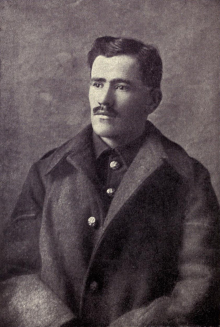
Francis Edward Ledwidge, Irish poet sometimes known as the “poet of the blackbirds,” is born on August 19, 1887, to a poor family in Slane, County Meath. He is later also known as a World War I war poet.

Ledwidge starts writing at an early age and is first published in a local newspaper at the age of fourteen. Finding work as a labourer and miner, he is also a trade union activist and a keen patriot and nationalist, associated with Sinn Féin. He becomes friendly with a local landowner, the writer Lord Dunsany, who gives him a workspace in the library of Dunsany Castle and introduces him to literary figures including William Butler Yeats and Katharine Tynan, with whom he has a long-term correspondence. He is elected to a local authority post and helps organise the local branch of the Irish Volunteers, while Dunsany edits and helps him secure publication for a first volume of his poetry.

Having sided with the faction of the Irish Volunteers which oppose participation in the war, he enlists in the Royal Inniskilling Fusiliers in October 1914, and continues to write poetry on assignment, sending work to Lord Dunsany and to family and other friends. The poems he writes on active service reveal his pride at being a soldier, as he believes, in the service of Ireland. He often wonders whether he would find a soldier’s death.

On July 31, 1917, a group from Ledwidge’s battalion of the Royal Inniskilling Fusiliers are road-laying in preparation for an assault during the Third Battle of Ypres, near the village of Boezinge, Ypres Salient, Belgium.

According to Irish author and lecturer Alice Curtayne, “Ledwidge and his comrades had been toiling since the early morning at roadmaking. The army’s first need was men; their second, guns; their third roads. These latter consisted mainly of heavy beech planks bolted together, which could be rapidly laid down. No advance could be supported in that sodden land without a sufficiency of these communications tracks, six or seven feet wide. Supplies were conveyed by pack mules over the wooden paths. Survivors concur in placing the road work done by B Company that day one mile northeast of Hellfire Corner, so called because it was very exposed to German shelling. There was a violent rainstorm in the afternoon, shrouding the region in a gray monochrome. Sullenly, the enemy’s long-range guns continued to fling their shells far behind the lines. Roadwork could not be suspended, however, as the tracks were in use as fast as they were laid down. Tea was issued to the men and drenched to the skin, they stopped to swallow it. A shell exploded beside Ledwidge, and he was instantly killed.”

A Roman Catholic military chaplain, Father Devas, is the first on the scene. That night, Father Devas writes in his diary, “Crowds at Holy Communion. Arranged for service but washed out by rain and fatigues. Walk in rain with dogs. Ledwidge killed, blown to bits, at Confession yesterday and Mass and Holy Communion this morning. R.I.P.”

Ledwidge is first buried at Carrefour de Rose, and later re-interred in the nearby Artillery Wood Military Cemetery, at Boezinge, where the Welsh poet Hedd Wyn, who was killed in action on the same day, also lies buried.

Dunsany arranges for the publication of more of Ledwidge’s poems, and a collected edition in 1919. Further poems, from the archives at Dunsany Castle and some material held by family, are later published by Ledwdige’s biographer, Alice Curtayne, and by one of the Ledwidge memorial societies. Ledwidge is selected as one of twelve prominent war poets for the exhibition Anthem for Doomed Youth at the Imperial War Museum in London in 2002, and memorialised at an event in Inchicore, Dublin, in 2017, with his work set to music by Anúna. A museum of his life and work is opened in his birthplace cottage in 1982. Some of his manuscripts are held in the National Library of Ireland and more in the archives of Dunsany Castle.


1 Comment

The Great Portlaoise Escape

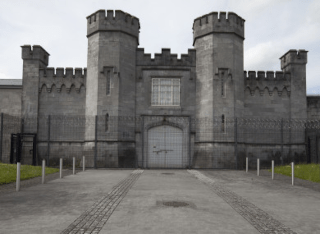
Nineteen republican prisoners blast their way out of Portlaoise Prison in County Laois on August 18, 1974.

The escape is a timely reminder of the determination, tenacity and ingenuity with which Irish Republican Army (IRA) Volunteers throughout the country fight against British rule in Ireland. It is also a reminder to the Fine Gael/Labour Coalition Government in Leinster House that their collaboration with the British and their attempts to defeat republicanism will not be an easy task.

The determination of republicans to escape from Portlaoise is demonstrated by the escape. In May 1974, an underground escape was planned but the 80-foot tunnel was uncovered and the prisoners’ hopes were dashed. However, almost immediately plans swung into place for a more daring escape operation.

A member of the Escape Committee spots a weakness in the jail security in the area of the prison where the laundry house is situated. The laundry leads to an outside stairway and down into the courtyard, where the Governor’s House and Warders’ Mess are located.

The prisoners discover that they can gain access to the laundry area quite easily. It is a doorway at the top of the courtyard which leads out onto the streets of Portlaoise town itself that give the prisoners hope that their plan will work. However, the Escape Committee decides that they need explosives to get through this gate and send word outside to this effect. The IRA on the outside, agreeing that the plan is “viable,” send in the materials and the plan is on.

The date for the escape is set for August 18, 1974 and planning proceeds inside the prison. The prisoners set themselves to work making prison guard uniforms. The idea is that when the escapees are running through the courtyard, the troops on the roof of the jail will not be able to distinguish between the escapees and the real guards and so will not open fire. This pre-planning proves to be a brilliant ploy as it gives those escaping vital seconds to clear the courtyard and make good their escape.

On the Friday before the plan is to proceed, a number of republicans are arrested in Portlaoise. This seems a bad omen and raises questions as to whether the authorities are suspicious that an escape is planned. However, the Escape Committee and those involved in the operation decide to press ahead with the plan anyway.

Sunday, August 18 duly arrives. According to prisoners who are in Portlaoise Prison at the time, no one can eat anything that day as the tension is unbearable. At 12:30 p.m., the designated time to put the plan into action, arrives and Liam Brown approaches the guard at the gate of the lower landing and asks to be let in. This is the signal for the first team of escapees to rush forward and get the key to the laundry. The guard is quickly overpowered and gives up the key with little resistance.

With this first stage of the plan successfully completed, the escapees open the door to the stairwell and rush through to the courtyard, followed by up to 25 other prisoners. As the prisoners race to the top of the yard to place the bomb at the outside gate, the soldiers on the roof are confused by the uniforms and cannot open fire.

The bomb then explodes, blasting the door to pieces. As the prisoners make the final dash for freedom, the soldiers fire warning shots over the heads of the fleeing republicans. Some of the prisoners drop to the ground fearing the worst but as the guards race from their mess they call on the soldiers to stop firing.

Those who are captured are brought into the Wing again and the governor demands a head count. The prisoners, however, refuse to comply, adding to the confusion and thwarting the prison authorities’ attempts to identify the escapees. It is only after the guards threaten to send in the riot squad several hours later that the prisoners allow a head count to be taken. When they realise that 19 men had escaped, the joy the prisoner experience is immense as they thought only 14 had got away.

In an attempt to capture the escapees, the Dublin Government launches a statewide search operation. Every outhouse in County Wexford is searched. The Irish Naval Service is even called in and put on the alert. The searches go on for over a week but to no avail. The nineteen men had gotten clean away.

Those who escape are Liam Brown, Paddy Devenny and Micky Nolan from Belfast; Tom McFeely and Ian Milne from County Derry; Thomas McGinty and Eddie Gallagher from County Donegal; Patrick Thornberry, Kevin McAllister and Martin McAllister from County Armagh; Francis Hughes and Kevin Mallon from County Tyrone; Oliver McKiernan from County Fermanagh; Bernard Hegarty and Sam O’Hare from County Louth; Michael Kinsella and Seán Kinsella from County Monaghan; Seán Morris from County Meath; and Tony Weldon from Dublin.

(From: “30 years on: The Great Portlaoise Escape,” An Phoblacht, http://www.anphoblacht.com, August 26, 2004)