seamus dubhghaill

Promoting Irish Culture and History from Little Rock, Arkansas, USA


1 Comment

Birth of Irish Folk Singer Moya Brennan

moya-brennan

Moya Brennan, born Máire Ní Bhraonáin, Irish folk singer, songwriter, harpist, and philanthropist, is born in Dublin on August 4, 1952.

After leaving secondary school, Brennan spends a few years at the Royal Irish Academy of Music in Dublin studying the harp, the piano, and singing. She has also taught music at Holy Cross College in Falcarragh, County Donegal.

In 1970 Brennan joins her two brothers, Pól and Ciarán, and their mother’s twin brothers, Noel and Pádraig Ó Dúgáin, and form the band Clannad. They are identified and introduced to television by Tony MacMahon. After enjoying a decade of being among the world’s foremost Irish musical groups, Clannad graduates to chart success in 1982 with the album Magical Ring. Brennan is at the forefront of the group’s success and her voice suddenly becomes synonymous with Celtic music and Irish music at the time. Brennan records 17 albums with Clannad and wins a Grammy Award, a BAFTA, and an Ivor Novello award with the quintet. Her sister, Eithne Ní Bhraonáin, who spends some time with Clannad, continues to pursue a very successful solo career under the name Enya.

Brennan releases her first solo album in 1992, Máire, on Atlantic Records. Misty Eyed Adventures on BGM follows three years later. In 1998, Brennan signs with Word Records and releases Perfect Time, and Whisper to the Wild Water a year later. The album is nominated for the Grammy Award for Best New Age Album in 2001.

Brennan’s autobiography, The Other Side of the Rainbow, is published in 2000 and she performs her song Perfect Time live at World Youth Day in Rome in front of crowds of pilgrims and Pope John Paul II. There are 2.1 million people present, making it the largest crowd ever gathered in the Northern Hemisphere.

In film, Brennan is a featured vocalist on King Arthur (2004), co-writing the title theme Tell Me Now (What You See) with Hans Zimmer. She also writes an additional music score for To End All Wars (2001). In 1995, she duets with Shane MacGowan on You’re the One for the movie Circle of Friends. Brennan has collaborated with many other musicians, including Chicane, Alan Parsons, Bono, Robert Plant, Van Morrison, Michael McDonald from the Doobie Brothers, Bruce Hornsby, Joe Elliott, The Chieftains, Paul Young, Paul Brady, Michael Crawford, Joe Jackson, and Ronan Keating.

In total Brennan has recorded 25 albums, and has sold 20 million records. Brennan and Clannad are credited with the creation of contemporary Celtic music and are held in high esteem for their vast contribution to bringing new life to old Irish songs. They have been compared to Seán Ó Riada, in that they brought the Irish language into popular culture through their music. One critic said, “Clannad’s music offers a terrific fusion between traditional and modern influences.” U2 front man Bono says of her voice, “I think Máire has one of the greatest voices the human ear has ever experienced.”

Leave a comment

Roger Casement Hanged for Treason

roger-casement

Sir Roger David Casement, Irish diplomat who is knighted by King George V in 1911, is executed on August 3, 1916, for his role in the 1916 Easter Rising.

Casement is an Irish Protestant who serves as a British diplomat during the early part of the 20th century. He wins international acclaim after exposing the illegal practice of slavery in the Congo and parts of South America. Despite his Ulster Protestant roots, he becomes an ardent supporter of the Irish independence movement and, after the outbreak of World War I, travels to the United States and then to Germany to secure aid for an Irish uprising against the British.

Germany, which is at war with Great Britain, promises limited aid, and Casement is transported back to Ireland in a German submarine. On April 21, 1916, just a few days before the outbreak of the Easter Rising in Dublin, he lands in County Kerry and is picked up by British authorities almost immediately. By the end of the month, the Easter Rising has been suppressed and a majority of its leaders executed.

Casement is tried separately because of his illustrious past but nevertheless is found guilty of treason on June 29. On August 3, he is hanged by John Ellis and his assistants at Pentonville Prison in London. Casement is the last to be executed as a result of the Easter Rebellion.


Leave a comment

The Sinking of John F. Kennedy’s PT-109

pt-109-crew

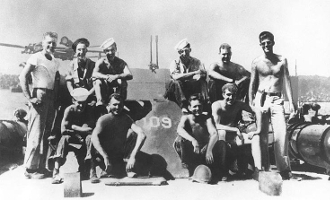
In the early morning hours of August 2, 1943, three small American torpedo boats are moving just west of New Georgia in the Solomon Islands. In command of PT-109 is a young Irish American destined to one day be the first Catholic president of the United States, Lieutenant John Fitzgerald Kennedy.

On a moonless night, Kennedy’s boat is idling on one engine to avoid detection of her wake by Japanese aircraft when the crew realizes they are in the path of the Japanese destroyer Amagiri, which is returning to Rabaul from Vila, Kolombangara, after offloading supplies and 900 soldiers. Amagiri is traveling at a relatively high speed of between 23 and 40 knots in order to reach harbor by dawn, when Allied air patrols are likely to appear.

The crew of PT-109 has less than ten seconds to get the engines up to speed. The commander of the Amagiri, Kohai Hanami, spots the tiny ship but it is too close to fire upon. Instead, Hanami decides to ram it. PT-109 is cut in half and bursts into flames. Seamen Andrew Jackson Kirksey and Harold W. Marney are killed, and two other members of the crew are badly injured. PT-109 is gravely damaged, with watertight compartments keeping only the forward hull afloat in a sea of flames.

PT-169 launches two torpedoes that miss the destroyer and PT-162‘s torpedoes fail to fire at all. Both boats then turn away from the scene of the action and return to base without checking for survivors.

The eleven survivors cling to PT-109’s bow section as it drifts slowly south. By about 2:00 PM, it is apparent that the hull is taking on water and will soon sink, so the men decide to abandon it and swim for land. Since there are Japanese camps on all the nearby large islands, they choose the tiny deserted Plum Pudding Island, southwest of Kolombangara. They place their lantern, shoes, and non-swimmers on one of the timbers used as a gun mount and begin kicking together to propel it. Kennedy, who had been on the Harvard University swim team, uses a life jacket strap clenched between his teeth to tow his badly burned senior enlisted machinist mate, MM1 Patrick McMahon. It takes four hours to cover the 3.5 miles to their destination, which they reach without confrontation by sharks or crocodiles.

The island is only 100 yards in diameter and has no food or water. The crew has to hide from passing Japanese barges. Kennedy swims to Naru and Olasana islands, a round trip of about 2.5 miles, in search of help and food. He then leads his men to Olasana Island, which has coconut trees and drinkable water.

The explosion of PT-109 is spotted by an Australian coastwatcher, Sub-lieutenant Arthur Reginald Evans, who mans a secret observation post at the top of the Mount Veve volcano on Kolombangara, where more than 10,000 Japanese troops are garrisoned below on the southeast portion. Evans dispatches islanders Biuku Gasa and Eroni Kumana in a dugout canoe to look for possible survivors after decoding news that the explosion he had witnessed was likely from the lost PT-109.

Kennedy and his men survive for six days on coconuts before they are found by the scouts. The small canoe is not big enough for passengers. Kennedy quickly carves a note on a coconut for Gasa and Kumana to deliver to Evans. Evans gets word back to the U.S. Navy and, on the night of August 8, all eleven survivors of PT-109 are rescued by PT-157.

John F. Kennedy keeps that carved coconut on his desk in the Oval Office at the White House until the day he is assassinated.


Leave a comment

Birth of Seán Ó Riada, Composer of Irish Traditional Music

seán-o-riada

Seán Ó Riada, Irish composer and arranger of Irish traditional music, is born John Reidy in Cork City on August 1, 1931. Through his incorporation of modern and traditional techniques he becomes the single most influential figure in the revival of Irish traditional music during the 1960s.

Ó Riada receives his primary education at St. Finbarr’s College, Farranferris. He moves to St. Munchin’s College in Limerick where he completes his Leaving Certificate in 1948. He plays violin, piano, and organ, and studies Greek and Latin classics at University College Cork, with Aloys Fleischmann and graduates in 1952. While at College, Ó Riada is the auditor of the UCC Philosophical Society.

Ó Riada’s career begins in 1954 as a music director at Radio Éireann, after which he works at the Abbey Theatre from 1955 to 1962. He lectures in music at University College Cork from 1963 until his death in 1971. He leaves a lasting influence as founder and director of the ensemble Ceoltóirí Chualann beginning in 1961. Ó Riada becomes a household name in Ireland through his participation in Ceoltóirí Chualann, compositions, writings, and broadcasts. His best-known pieces in the classical tradition include Nomos No. 1: Hercules Dux Ferrariae (1957), but he becomes particularly famous for his film scores Mise Éire (1959) and Saoirse? (1960).

In 1963 Ó Riada is appointed lecturer in music at University College Cork. He moves to Cúil Aodha in West Cork, an Irish-speaking area, where he establishes Cór Chúil Aodha, a male voice choir.

He becomes involved in Irish politics and is a friend of several influential leaders. Ó Riada drinks regularly at a local pub which still advertises itself as being his local. He develops cirrhosis of the liver. He is flown to King’s College Hospital in London for treatment and dies there on October 3, 1971, two months after his 40th birthday. He is buried in St. Gobnait‘s graveyard, Baile Bhuirne, County Cork. Willie Clancy played at his funeral.

Two schools are named “Scoil Uí Riada” after him – a Gaelscoil in Kilcock, County Kildare, and another in Bishopstown, Cork City. In 2008, a life-sized statue is erected in the grounds of Sépéil Naomh Gobnait, Cúil Aodha.


Leave a comment

Founding of the Gaelic League

conradh-na-gaeilge-logo

The Gaelic League (Irish: Conradh na Gaeilge), a social and cultural organisation which promotes the Irish language in Ireland and worldwide is founded in Dublin on July 31, 1893.

Conradh na Gaeilge is founded by Douglas Hyde, the son of a Church of Ireland rector from Frenchpark, County Roscommon, with the aid of Eugene O’Growney, Eoin MacNeill, Thomas O’Neill Russell, and others. The organisation develops from Ulick Bourke‘s earlier Gaelic Union and becomes the leading institution promoting the Gaelic Revival, carrying on efforts like the publishing of the Gaelic Journal. The League’s first newspaper is An Claidheamh Soluis (The Sword of Light) and its most noted editor is Patrick Pearse. The motto of the League is Sinn Féin, Sinn Féin amháin (Ourselves, Ourselves alone).

The League encourages female participation from the start and a number of women play a prominent role. They are not restricted to subordinate roles, but play an active part in leadership, although males are in the overwhelming majority. Local notables, such as Lady Gregory in Galway, Lady Esmonde in County Wexford, and Mary Spring Rice in County Limerick, and others such as Norma Borthwick, found and lead branches in their communities. At the annual national convention in 1906 women are elected to seven of the forty-five positions on the Gaelic League executive. Executive members include Máire Ní Chinnéide, Úna Ní Fhaircheallaigh (who writes pamphlets on behalf of the League), Bean an Doc Uí Choisdealbha, Máire Ní hAodáin, Máire de Buitléir, Nellie O’Brien, Eibhlín Ní Dhonnabháin, and Eibhlín Nic Néill.

Though apolitical, the organisation attracts many Irish nationalists of different persuasions, much like the Gaelic Athletic Association. It is through the League that many future political leaders and rebels first meet, laying the foundation for groups such as the Irish Volunteers. However, Conradh na Gaeilge does not commit itself entirely to the national movement until 1915, causing the resignation of Douglas Hyde, who feels that the culture of language should be above politics. Most of the signatories of the 1916 Proclamation are members. It still continues to attract many Irish Republicans. Seán Mac Stíofáin, the first chief of staff of the Provisional IRA was a prominent member in his later life.

After the foundation of the Irish Free State in 1922, the organisation has a less prominent role in public life as Irish is made a compulsory subject in state-funded schools. It does unexpectedly bad in the Irish Seanad election of 1925, when all the candidates it endorses are defeated, including Hyde.


Leave a comment

Death of Poet Laureate Nahum Tate

nahum-tate

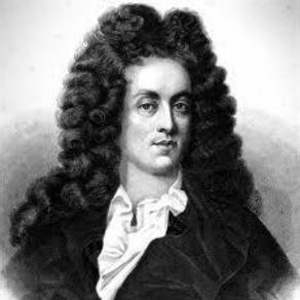
Nahum Tate, Irish poet, hymnist, and lyricist, who becomes Poet Laureate of the United Kingdom in 1692,  dies on July 30, 1715. Tate is best known for The History of King Lear, his 1681 adaptation of William Shakespeare‘s King Lear.

Tate is born in Dublin in 1652 and comes from a family of Puritan clergymen. He is the son of Faithful Teate, an Irish clergyman who was rector of Castleterra, Ballyhaise, until his house is burned and his family attacked after he passes on information to the government about plans for the Irish Rebellion of 1641. After living at the provost’s lodgings in Trinity College, Dublin, Faithful Teate moves to England. He becomes the incumbent at East Greenwich around 1650, and “preacher of the gospel” at Sudbury from 1654 to 1658 before returning to Dublin by 1660. He publishes a poem on the Trinity entitled Ter Tria, as well as some sermons, two of which he dedicates to Oliver and Henry Cromwell.

Nahum Teate follows his father to Trinity College, Dublin in 1668, and graduates BA in 1672. By 1676 he moves to London and is writing for a living. He publishes a volume of poems in London in 1677 and becomes a regular writer for the stage. He also adopts the spelling Tate, which remains until his death.

Tate then turns to make a series of adaptations from Elizabethan dramas. His version of William Shakespeare’s Richard II alters the names of the characters and changes the text so that every scene, to use his own words, is “full of respect to Majesty and the dignity of courts.” In spite of these precautions The Sicilian Usurper (1681), as his rewrite is called, is suppressed on the third performance on account of a possible political interpretation.

In 1682, Tate collaborates with John Dryden to complete the second half of his epic poem Absalom and Achitophel. Tate also writes the libretto for Henry Purcell‘s opera Dido and Aeneas, which is given its first known performance in 1689. Tate’s name is also connected with the famous New Version of the Psalms of David (1696), for which he collaborates with Nicholas Brady.

Nahum Tate dies in Southwark, London, England, on July 30, 1715, and is buried at St. George Southwark on August 1, 1715.


1 Comment

Fenian James Carey Killed by Patrick O’Donnell

james-carey

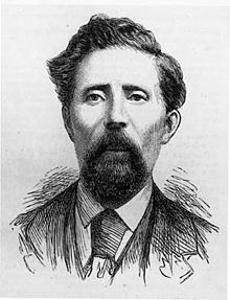
James Carey, a Fenian and informer most notable for his involvement in the Phoenix Park Murders, is shot and killed by Patrick O’Donnell aboard the Melrose on July 29, 1883.

Carey is born in James Street, Dublin, in 1845. He becomes a bricklayer and builder as well as the leading spokesman of his trade and obtains several large building contracts. During this period Carey is engaged in an Irish nationalist conspiracy, but to outward appearance he is one of the rising men of Dublin. He is involved in religious and other societies, and at one time is spoken of as a possible lord mayor. In 1882 he is elected a town councillor.

About 1861 Carey joins the Irish Republican Brotherhood, soon becoming treasurer. In 1881 he breaks with the IRB and forms a new group which assumes the title of the Irish National Invincibles and establishes their headquarters in Dublin. Carey takes an oath as one of the leaders. The object of the Invincibles is to remove all “tyrants” from the country.

The secret head of the Invincibles, known as No. 1, gives orders to kill Thomas Henry Burke, the under-secretary to the lord-lieutenant. On May 6, 1882, nine of the conspirators proceed to the Phoenix Park where Carey, while sitting on a jaunting-car, points out Burke to the others. At once they attack and kill him with knives and, at the same time, also kill Lord Frederick Cavendish, the newly appointed chief secretary, who happens to be walking with Burke.

For a long time no clue can be found to identify the perpetrators of the act. However, on January 13, 1883, Carey is arrested and, along with sixteen other people, charged with a conspiracy to murder public officials. On February 13, Carey turns queen’s evidence, betraying the complete details of the Invincibles and of the murders in the Phoenix Park. His evidence, along with that of getaway driver Michael Kavanagh, results in the execution of five of his associates by hanging.

His life being in great danger, he is secretly put onboard the Kinfauns Castle with his wife and family, which sails for the Cape on July 6. Carey travels under the name of Power. Aboard the same ship is Patrick O’Donnell, a bricklayer. Not knowing his true identity, O’Donnell becomes friendly with Carey. After stopping off in Cape Town, he is informed by chance of Carey’s real identity. He continues with Carey on board the Melrose for the voyage from Cape Town to Natal. On July 29, 1883, when the vessel is twelve miles off Cape Vaccas, O’Donnell uses a pistol he has in his luggage to shoot Carey dead.

O’Donnell is brought to England and is tried for murder. After being found guilty, he is executed on December 17 at Newgate.


Leave a comment

IRA Announces End of 36-Year Armed Campaign

ira-ends-armed-campaignThe Irish Republican Army (IRA) issues a statement on July 28, 2005, announcing the end of its 36-year armed campaign and its resumption of disarmament. The campaign of armed conflict has a cost 3,500 lives, 1,800 of them at the hands of the Provisionals.

The IRA says its members have been ordered to pursue peaceful means and not to “engage in any other activities whatsoever” – a reference to the low-level paramilitary activities which have angered not just unionists, but the London and Dublin governments. The IRA gives no indication that it will disband.

Sinn Féin president Gerry Adams calls it an “emotional day” and, flanked by senior members of Sinn Féin, speaks directly to IRA volunteers by saying, “National liberation struggles have different phases – a time for struggle, a time for war, and also a time to engage, to put the war behind us all – this is that time.” He declares the IRA statement means the group is now committed to “purely peaceful and democratic methods” and calls it “a direct challenge to the Democratic Unionist Party (DUP) to decide if they want to put the past behind them and make peace with the rest of the people of the island.”

The DUP reserves judgment, although an initial “holding statement” on their website from the party leader, Rev. Ian Paisley, criticises the failure to declare clearly they will end all criminal activity.

Taoiseach Bertie Ahern says the British and Irish governments have worked for 11 years for this outcome. He says, “The war is over, the IRA’s armed campaign is over, paramilitarism is over and I believe that we can look to the future of peace and prosperity based on mutual trust and reconciliation and a final end to violence.”

Praising the “clarity” of the IRA statement, British Prime Minister Tony Blair says, “This may be the day when finally, after all the false dawns and dashed hope, peace replaces war, politics replaces terror on the island of Ireland.”

The IRA statement follows the release the previous night of IRA bomber Sean Kelly by the British government “on the expectation” of a move by the terrorist group.


Leave a comment

Death of Antarctic Explorer Tom Crean

Tom Crean

Thomas “Tom” Crean, Irish seaman and Antarctic explorer, dies on July 27, 1938 from complications of appendicitis.

Crean was born 1877 in the farming area of Gurtuchrane near the village of Annascaul on the Dingle Peninsula in County Kerry. He leaves the family farm to enlist in the Royal Navy at the age of fifteen. In 1901, while serving on Ringarooma in New Zealand, he volunteers to join Captain Robert Falcon Scott‘s 1901–04 Discovery Expedition to Antarctica, thus beginning his exploring career.

He is a member of three major expeditions to Antarctica during the Heroic Age of Antarctic Exploration, including Captain Scott’s 1911–13 Terra Nova Expedition. This sees the race to reach the South Pole lost to Roald Amundsen and ends in the deaths of Scott and his polar party. During this expedition, Crean’s 35 statute miles solo walk across the Ross Ice Shelf to save the life of Edward Evans leads to him receiving the Albert Medal for Lifesaving.

After his Terra Nova experience, Crean’s third and final Antarctic venture is as second officer on Ernest Shackleton‘s Imperial Trans-Antarctic Expedition, on Endurance. After Endurance becomes beset in the pack ice and sinks, Crean and the ship’s company spend months drifting on the ice before a journey in boats to Elephant Island. He is a member of the crew which makes an open boat journey of 800 nautical miles from Elephant Island to South Georgia, to seek aid for the stranded party.

Crean’s contributions to these expeditions seals his reputation as a polar explorer and earns him a total of three Polar medals. After the Endurance expedition, he returns to the navy. When his naval career ends in 1920 he moves back to County Kerry. In his home town of Annascaul, Crean and his wife Ellen live quietly and unobtrusively and open a pub called The South Pole Inn.

In 1938 Crean becomes ill with a ruptured appendix. He is taken to the nearest hospital in Tralee, but as no surgeon is available to operate, he is transferred to the Bon Secours Hospital in Cork where his appendix is removed. Because of the delay of the operation an infection develops and after a week in the hospital he dies on July 27, 1938, shortly after his sixty-first birthday. He is buried in his family’s tomb at the cemetery in Ballynacourty.

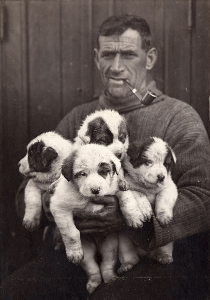
Crean’s name is commemorated in at least two places – 8,630 foot Mount Crean in Victoria Land and the Crean Glacier on South Georgia. A one-man play, Tom Crean – Antarctic Explorer, has been widely performed since 2001 by its author Aidan Dooley, including a special showing at the South Pole Inn, Annascaul, in October 2001. In July 2003, a bronze statue of Crean is unveiled across from his pub in Annascaul. It depicts him leaning against a crate whilst holding a pair of hiking poles in one hand and two of his beloved sled dog pups in the other.


Leave a comment

Birth of Playwright George Bernard Shaw

george-bernard-shaw

George Bernard Shaw, Irish playwright, critic, and polemicist, is born on July 26, 1856, at 3 Upper Synge Street in Portobello, a lower-middle-class area of Dublin. Shaw’s influence on Western theatre, culture, and politics extends from the 1880s to his death and beyond.

Shaw writes more than sixty plays, including major works such as Man and Superman (1902), Pygmalion (1912) and Saint Joan (1923). With a range incorporating both contemporary satire and historical allegory, Shaw becomes the leading dramatist of his generation, and in 1925 is awarded the Nobel Prize in Literature.

Shaw moves to London in 1876, where he struggles to establish himself as a writer and novelist and embarks on a rigorous process of self-education. By the mid-1880s he has become a respected theatre and music critic. Following a political awakening, he joins the gradualist Fabian Society and becomes its most prominent pamphleteer. Shaw has been writing plays for years before his first public success, Arms and the Man in 1894. Influenced by Henrik Ibsen, he seeks to introduce a new realism into English-language drama, using his plays as vehicles to disseminate his political, social, and religious ideas. By the early twentieth century his reputation as a dramatist is secured with a series of critical and popular successes that include Major Barbara, The Doctor’s Dilemma, and Caesar and Cleopatra.

Shaw’s expressed views are often contentious. He promotes eugenics and alphabet reform and opposes vaccination and organised religion. He courts unpopularity by denouncing both sides in World War I as equally culpable, and although not a republican, castigates British policy on Ireland in the postwar period. These stances have no lasting effect on his standing or productivity as a dramatist.

The inter-war years see a series of often ambitious plays, which achieve varying degrees of popular success. In 1938 he provides the screenplay for a filmed version of Pygmalion for which he receives an Academy Award. His appetite for politics and controversy remains undiminished. By the late 1920s he has largely renounced Fabian gradualism and often writes and speaks favourably of dictatorships of the right and left — he expresses admiration for both Mussolini and Stalin. In the final decade of his life, he makes fewer public statements but continues to write prolifically until shortly before his death, refusing all state honours including the Order of Merit in 1946.

During his later years, Shaw enjoys tending the gardens at Shaw’s Corner. He dies on November 2, 1950, at the age of 94 of renal failure precipitated by injuries incurred when falling while pruning a tree. His body is cremated at Golders Green Crematorium on November 6, 1950. His ashes, mixed with those of his wife Charlotte, are scattered along footpaths and around the statue of Saint Joan in their garden.

Since Shaw’s death scholarly and critical opinion has varied about his works, but he has regularly been rated as second only to Shakespeare among English-language dramatists. Analysts recognise his extensive influence on generations of playwrights. The word “Shavian” has entered the language as encapsulating Shaw’s ideas and his means of expressing them.