Gray is the second son of Sir John Gray and his wife, Anna Dwyer. He has three brothers and two sisters. After receiving his education, he joins his father in managing the Freeman’s Journal, the oldest nationalist newspaper in Ireland. When his father dies in 1875, he takes over proprietorship of the Journal, and his family’s other newspaper properties such as the Belfast Morning News and the Dublin Evening Telegraph.
In 1868, Gray saves five people from drowning in a wrecked schooner at Killiney Bay, an action for which he receives the Tayleur Fund Gold Medal for bravery from the Royal Humane Society. By coincidence, the rescue is witnessed by his future wife, Caroline Agnes Gray, whom he meets shortly afterwards. Agnes is the daughter of Caroline Chisholm, an English humanitarian renowned for her work in female immigrant welfare in Australia, and although Gray is descended from a Protestant family, he converts to Catholicism to marry her. The wedding in London on July 17, 1869, is conducted by the Bishop of Northampton, Francis Amherst. The couple has one son, Edmund Dwyer-Gray, who eventually takes over from his father as proprietor of his newspapers and goes on to become Premier of Tasmania.
From 1875 to 1883, Gray serves as a member of the Dublin Corporation, and in 1880 serves a term as Lord Mayor of Dublin. Unusual for an Irish nationalist politician, he is very much focused on urban rather than rural affairs, and like his father is heavily involved in public health and water provision for Dublin. He also promotes reform in the municipal health system.
Gray is imprisoned for six weeks in 1882 for remarks made in the Freeman’s Journal with regard to the composition of the jury in the case of a murder trial. He is actually Sheriff of Dublin City at the time of his imprisonment and, because of the conflict of office, is taken into custody by the city coroner. The defendant in the case in question is later hanged.
A heavy drinker and asthma sufferer, Gray dies at his home, Pembroke House, Upper Mount Street, Dublin, on March 27, 1888, at the age of 42 following a short illness. He is buried at Glasnevin Cemetery in Dublin.
Sullivan, the second of six sons of Daniel Sullivan, house painter, and his wife, Catherine (née Baylor), a teacher, is born on May 15, 1829, in Bantry, County Cork. A popular date for Sullivan’s birth appears in many histories as 1830, but his gravestone reads 1829. He is educated in the local national school. One of his brothers is Timothy Daniel Sullivan, the Lord Mayor of Dublin from 1886 to 1888.
During the Great Famine of 1845 to 1847, Sullivan is employed as a clerk in connection with the relief works started by the government. Deeply influenced by the distress he witnesses, he afterward joins the Confederate Club formed in Bantry in support of the revolutionary movement of the Young Irelanders and is the organiser of the enthusiastic reception given by the town to William Smith O’Brien in July 1848 during the insurgent leader’s tour of the southern counties. Early in 1853, he goes to Dublin to seek employment as an artist. An exhibition of the arts and industries of Ireland is held in Dublin that year, and he is engaged to supply pencil sketches to the Dublin Expositor, a journal issued in connection with the exhibition. Subsequently, he obtains a post as a draughtsman in the Irish valuation office, and afterward as a reporter on the Liverpool Daily Post.
In 1855, Sullivan becomes assistant editor of The Nation, and subsequently editor and proprietor. From 1861 to 1884, in conjunction with his elder brother, T. D. Sullivan, he makes The Nation one of the most potent factors in the Irish Nationalist cause and also issues the Weekly News and Zozimus. Called to the Irish bar in 1876, he is a “special call” of the Inner Temple in 1877 and is made QC in 1881. He mainly practices at the English bar, though he acts in some political cases in Ireland.
As a member of the Dublin Corporation, Sullivan secures a magnificent site for the Grattan Monument, toward which he donates £400, the amount of a subscription by his admirers while he is undergoing imprisonment for a political offence in 1868. The monument is formally unveiled in January 1876. Between 1878 and 1882 he is engaged in many notable trials. His last great case is on November 30, 1883, when he is a colleague of Lord Russell in the defence of Patrick O’Donnell for the murder of James Carey, an informer.
Sullivan suffers another heart attack while on holiday in Bantry in September 1884 and spends his last days with William Martin Murphy at Dartry, County Dublin. Murphy regards him as a father figure, attributing his success to Sullivan’s early advice and journalistic training. Sullivan dies on October 17, 1884, at Dartry Lodge, Rathmines, Dublin. He is buried at Glasnevin Cemetery. With his wife, Frances Genevieve Donovan, whom he marries on April 27, 1861, and who outlives him by nearly forty years, he has a family of three sons and five daughters. His second son and namesake, Alexander Martin Sullivan, is the last to hold the rank of Serjeant-at-law (Ireland).
In addition to his labours, Sullivan is a great temperance reformer. He also writes two notable books, The Story of Ireland and New Ireland and contributes many sketches (including some verse) to Irish Penny Readings (1879–85). Some of his correspondence is located in the Isaac Butt papers in the National Library of Ireland.
O’Connor is the eldest son of Thomas O’Connor, an Athlone shopkeeper, and his wife Teresa (née Power), the daughter of a non-commissioned officer in the Connaught Rangers. He is educated at The College of the Immaculate Conception in Athlone, and Queen’s College Galway, where he wins scholarships in history and modern languages and builds up a reputation as an orator, serving as auditor of the college’s Literary and Debating Society.
O’Connor enters journalism as a junior reporter on Saunders’ Newsletter, a Dublin journal, in 1867. In 1870, he moves to London and is appointed a sub-editor on The Daily Telegraph, principally on account of the utility of his mastery of French and German in reportage of the Franco-Prussian War. He later becomes London correspondent for the New York Herald. He compiles the society magazine Mainly About People (M.A.P.) from 1898 to 1911.
O’Connor is elected Member of Parliament for Galway Borough in the 1880 United Kingdom general election, as a representative of the Home Rule League, which is under the leadership of William Shaw, though virtually led by Charles Stewart Parnell, who wins the party’s leadership a short time later. At the next general election in 1885, he is returned both for Galway Borough and for the Liverpool Scotland constituencies, which has a large Irish population. He chooses to sit for Liverpool and represents that constituency in the House of Commons from 1885 until his death in 1929. He remains the only British MP from an Irish nationalist party ever to be elected to a constituency outside of the island of Ireland. He continues to be re-elected in Liverpool under this label unopposed in the 1918, 1922, 1923, 1924 and 1929 general elections, despite the declaration of a de factoIrish Republic in early 1919, and the establishment by the 1921 Anglo-Irish Treaty of a quasi-independent Irish Free State in late 1922.
From 1905, O’Connor belongs to the central leadership of the United Irish League. During much of his time in parliament, he writes a nightly sketch of proceedings there for The Pall Mall Gazette. He becomes “Father of the House,” with unbroken service of 49 years, 215 days. The Irish Nationalist Party ceases to exist effectively after the Sinn Féin landslide of 1918, and thereafter he effectively sits as an independent. On April 13, 1920, he warns the House of Commons that the death on hunger strike of Thomas Ashe will galvanise opinion in Ireland and unite all Irishmen in opposition to British rule.
O’Connor founds and is the first editor of several newspapers and journals: The Star, the Weekly Sun (1891), The Sun (1893), M.A.P. and T.P.’s Weekly (1902). In August 1906, he is instrumental in the passing by Parliament of the Musical Copyright Act 1906, also known as the T.P. O’Connor Bill, following many of the popular music writers at the time dying in poverty due to extensive piracy by gangs during the piracy crisis of sheet music in the early 20th century. The gangs often buy a copy of the music at full price, copy it, and resell it, often at half the price of the original. The film I’ll Be Your Sweetheart (1945), commissioned by the British Ministry of Information, is based on the events of the day.
O’Connor is appointed as the second president of the British Board of Film Censors (BBFC) in 1916 and appears in front of the Cinema Commission of Inquiry (1916), set up by the National Council of Public Morals where he outlines the BBFC’s position on protecting public morals by listing forty-three infractions, from the BBFC 1913–1915 reports, on why scenes in a film may be cut. He is appointed to the Privy Council by the first Labour government in 1924. He is also a Fellow of the Chartered Institute of Journalists, the world’s oldest journalists’ organisation. It continues to honour him by having a T.P. O’Connor charity fund.
In 1885, O’Connor marries Elizabeth Paschal, the daughter of a judge of the Supreme Court of Texas.
Mahon, the eldest of four children, is the son of Patrick Mahon of New Park, who took part in the Irish Rebellion of 1798, and Barbara, a considerable heiress and the only daughter of James O’Gorman of Ennis. He studies at Clongowes Wood College, where he is one of the earliest pupils, and at Trinity College Dublin, where he takes his BA in 1822 and his MA in law in 1832. Following his father’s death in 1821, he inherits half the family property and becomes a magistrate for Clare.
In 1830, Mahon marries Christina, the daughter of John O’Brien of Dublin. She is an heiress and has property valued at £60,000 in her own right, which gives him the resources to seek election to parliament. The couple spends little time together, and she dies apart from him in Paris in 1877. They have one son who dies in 1883.
As a result, when Mahon is elected for Clare at the 1830 United Kingdom general election, he is entitled to take his seat. However, during the election campaign he quarrels with O’Connell, and after his election he is unseated for bribery. He is subsequently acquitted and stands again at the 1831 United Kingdom general election, but is defeated by two O’Connell-backed candidates, one of whom is his old schoolfriend Maurice O’Connell, Daniel O’Connell’s son. He gives up on politics, becomes deputy lieutenant of Clare, and captain of the local militia.
Following his defeat in the 1852 election, Mahon returns to Paris, then travels on to Saint Petersburg, where he serves in the Imperial Bodyguard. During this period, he journeys through lands from Finland to Siberia. He then travels across China, India and Arabia. His finances largely exhausted, he serves as a mercenary in the Ottoman and Austrian armies before returning to England in 1858. Late that year, he leaves for South America, where he attempts to finance the construction of a canal through Central America.
Mahon is a close associate of Charles Stewart Parnell, who he successfully nominates for the leadership of the League in 1880 but is dropped in 1885 as a party candidate because of his age and his tendency to vote with the Liberal Party in Parliament. He is also embroiled in a court case disputing the will of his son.
Mahon had served alongside William O’Shea as an MP, and the two were close friends. He introduced him and Katharine O’Shea, his wife, to Parnell. After Parnell is named in the O’Sheas’ divorce case in 1890, Mahon splits with Parnell, siding with the Irish National Federation. However, Parnell attends Mahon’s funeral in Glasnevin Cemetery a few months later.
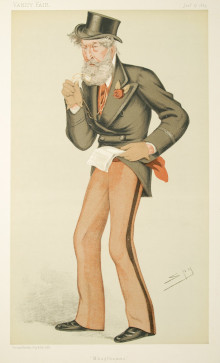
(Pictured: Caricature of James Patrick Mahon by Sir Leslie Matthew Ward under the pseudonym “Spy” published in Vanity Fair in 1885)
Kenealy suffers from diabetes and an erratic temperament is sometimes attributed to poor control of the symptoms. In 1850 he is sentenced to one month imprisonment for punishing his six-year-old illegitimate son with undue severity. He marries Elizabeth Nicklin of Tipton, Staffordshire in 1851 and they have eleven children, including novelist Arabella Kenealy (1864–1938). They live in Portslade, East Sussex, from 1852 until 1874. He commutes to London and Oxford for his law practice but returns at weekends and other times to be with his family.
In 1866, Kenealy writes The Book of God: the Apocalypse of Adam-Oannes, an unorthodox theological work in which he claims that he is the “twelfth messenger of God,” descended from Jesus Christ and Genghis Khan. He also publishes a more conventional biography of Edward Wortley Montagu in 1869.
During the Tichborne trial, Kenealy abuses witnesses, makes scurrilous allegations against various Roman Catholic institutions, treats the judges with disrespect, and protracts the trial until it becomes the longest in English legal history. His violent conduct of the case becomes a public scandal and, after rejecting his client’s claim, the jury censures his behaviour.
Kenealy starts a newspaper, The Englishman, to plead his cause and to attack the judges. His behaviour is so extreme that in 1874 he is disbenched and disbarred by his Inn. He forms the Magna Charta Association and goes on a nationwide tour to protest his cause.
At a by-election in 1875, Kenealy is elected to Parliament for Stoke-upon-Trent with a majority of 2,000 votes. However, no other Member of Parliament will introduce him when he takes his seat. Benjamin Disraeli forces a motion to dispense with this convention.
In Parliament, Kenealy calls for a Royal commission into his conduct in the Tichborne case, but loses a vote on this by 433–3. One vote is Kenealy’s, another that of his teller, George Hammond Whalley. The third “aye” is by Purcell O’Gorman of Waterford City. During this period, he also writes a nine-volume account of the case.
Kenealy gradually ceases to attract attention, loses his seat at the 1880 general election and dies in London on April 16, 1880. He is buried in the churchyard of St. Helen’s Church, Hangleton, East Sussex.



 seamus dubhghaill