seamus dubhghaill

Promoting Irish Culture and History from Little Rock, Arkansas, USA


Leave a comment

Birth of Sean O’Callaghan, Member of the Provisional IRA

Sean O’Callaghan, a member of the Provisional Irish Republican Army (IRA), who from the late 1970s to the mid-1980s works against the organisation from within as a mole for the Irish Government with the Garda Síochána‘s Special Detective Unit, is born in TraleeCounty Kerry, on October 10, 1954.

O’Callaghan is born into a family with a Fenian paramilitary history. His paternal grandfather had taken the Anti-Treaty side during the Irish Civil War, and his father had been interned by the Irish Government at the Curragh Camp in County Kildare for IRA activity during World War II.

By the late 1960s, O’Callaghan ceases to practise his Catholic faith, adopts atheism and has become interested in the theories of Marxist revolutionary politics, which finds an outlet of practical expression in the sectarian social unrest in Northern Ireland at the time, centered on the activities of the Northern Ireland Civil Rights Association. In 1969, communal violence breaks out in Northern Ireland and believing that British imperialism is responsible, he joins the newly founded Provisional IRA at the age of 17.

Soon afterward, O’Callaghan is arrested by local Gardaí after he accidentally detonates a small amount of explosives, which cause damage to the homes of his parents and their neighbours. After demanding, and receiving, treatment as a political prisoner, he quietly serves his sentence.

After becoming a full-time paramilitary with the IRA, in the early to mid-1970s O’Callaghan takes part in over seventy operations associated with Irish Republican political violence including bomb materials manufacture, attacks on IRA targets in Northern Ireland, and robberies to provide funding for the organisation.

In 1976, O’Callaghan ends his involvement with the IRA after becoming disillusioned with its activities. He later recalls that his disenchantment with the IRA began when one of his compatriots openly hoped that a female police officer who had been blown up by an IRA bomb had been pregnant so they could get “two for the price of one.” He is also concerned with what he perceives as an undercurrent of ethnic hatred in its rank and file toward the Ulster Scots population. He leaves Ireland and moves to London. In May 1978, he marries a Scottish woman of Protestant unionist descent. During the late 1970s, he runs a successful mobile cleaning business. However, he is unable to fully settle into his new life, later recalling, “In truth there seemed to be no escaping from Ireland. At the strangest of times I would find myself reliving the events of my years in the IRA. As the years went on, I came to believe that the Provisional IRA was the greatest enemy of democracy and decency in Ireland.”

In 1979, O’Callaghan is approached by the IRA seeking to recruit him again for its paramilitary campaign. In response, he decides to turncoat against the organisation and becomes an agent within its ranks for the Irish Government. He decides to become a double agent even though he knows that even those who hate the IRA as much as he now does have a low opinion of informers. However, he feels it is the only way to stop the IRA from luring teenagers into their ranks and training them to kill.

Soon after being approached by the IRA to re-join, O’Callaghan returns to Tralee from London, where he arranges a clandestine meeting with an officer of the Garda Special Detective Unit in a local cemetery, at which he expresses his willingness to work with it to subvert the IRA from within. At this point, he is still opposed to working with the British Government. A few weeks later, he makes contact with Kerry IRA leader Martin Ferris and attends his first IRA meeting since 1975. Immediately afterward, he telephones his Garda contact and says, “We’re in”.

During the 1981 hunger strike in the Maze Prison, O’Callaghan attempts to start his own hunger strike in support of the Maze prisoners but is told to desist by the IRA for fear it will detract focus from the prisoners. He successfully sabotages the efforts of republicans in Kerry from staging hunger strikes of their own.

In 1984, O’Callaghan notifies the Garda of an attempt to smuggle seven tons of AK-47 assault rifles from the United States to Ireland aboard a fishing trawler named Valhalla. The guns are intended for the arsenal of the Provisional IRA’s units. As a result of his warning, a combined force of the Irish Navy and Gardaí intercept the boat that received the weaponry, and the guns are seized. The seizure marks the complete end of any major attempt by the IRA to smuggle guns out of the United States.

In 1983, O’Callaghan claims to be tasked by the IRA with placing 25 lbs. of Frangex in the Dominion Theatre in London, in an attempt to kill Prince Charles and Princess Diana who are due to attend a charity pop music concert there. A warning is phoned into the Garda, and the Royal couple are hurriedly ushered from the theatre by their police bodyguard during the concert. The theatre had been searched before the concert and a second search following the warning reveals no device.

In 1985, O’Callaghan is elected as a Sinn Féin councillor for Tralee Urban District Council, and unsuccessfully contests a seat on Kerry County Council.

After becoming disillusioned with his work with the Irish Government following the murder of another of its agents within the IRA, which it had failed to prevent despite O’Callaghan’s warnings of the threat to him, and sensing a growing threat to himself from the organisation which had become suspicious of his own behaviour, he withdraws from the IRA and leaves Ireland to live in England, taking his wife and children with him. His marriage ends in a divorce in 1987, and on November 29, 1988, he walks into a police station in Tunbridge WellsKent, England, where he presents himself to the officer on duty at the desk, confesses to the murder of Ulster Defence Regiment (UDR) Greenfinch (female member) Eva Martin and the murder of D.I. Peter Flanagan during the mid-1970s, and voluntarily surrenders to British prosecution.

Although the Royal Ulster Constabulary (RUC) offers him witness protection as part of the informer policy, O’Callaghan refuses it and is prosecuted under charges of two murders and 40 other crimes, to all of which he pleads guilty, committed in British jurisdiction with the IRA. Having been found guilty, he is sentenced to a total of 539 years in prison. He serves his sentence in prisons in Northern Ireland and England. While in jail, he publishes his story in The Sunday Times. He is released after being granted the royal prerogative of mercy by Queen Elizabeth II in 1996.

In 1998, O’Callaghan publishes an autobiographical account of his experiences in Irish Republican paramilitarism, entitled The Informer: The True Life Story of One Man’s War on Terrorism (1998).

In 2002, O’Callaghan is admitted to Nightingale Hospital, Marylebone, an addiction and rehab center where he undergoes a rehabilitation program for alcohol dependency. His identity and past activities are not revealed to the other patients. He lives relatively openly in London for the rest of his life, refusing to adopt a new identity. He is befriended in the city by the Irish writer Ruth Dudley Edwards, and works as a security consultant, and also occasional advisor to the Ulster Unionist Party (UUP) on how to handle Irish republicanism in general, and Sinn Féin in particular.

In 2006, O’Callaghan appears in a London court with regard to an aggravated robbery that occurs in which he is the victim.

In 2015, O’Callaghan publishes James Connolly: My Search for the Man, the Myth & his Legacy (2015), a book containing a critique of the early 20th century Irish revolutionary James Connolly, and what he considers to be his destructive legacy in Ireland’s contemporary politics.

O’Callaghan dies by drowning after suffering a heart attack at the age of 63 while in a swimming pool in Kingston, Jamaica, on August 23, 2017, while visiting his daughter. A memorial service is held in his memory on March 21, 2018, at St. Martin’s-in-the-Fields, a Church of England parish church at the northeast corner of Trafalgar Square in the City of Westminster, London. The service is attended by representatives from Ulster Unionist parties and the Irish Government.

Leave a comment

Birth of Billy McKee, Founding Member of the Provisional IRA

Billy McKee (Irish: Liam Mac Aoidh), Irish republican and a founding member and leader of the Provisional Irish Republican Army, is born on November 12, 1921, in Belfast, Northern Ireland.

McKee joins Fianna Éireann in 1936. He is arrested following a raid on a Gaelic Athletic Association (GAA) club in 1938, being imprisoned in Crumlin Road Gaol for several months. Following his release from prison, he joins the Irish Republican Army (IRA) in 1939. During World War II, the IRA carries out a number of armed actions in Northern Ireland known as the Northern Campaign. He is arrested and imprisoned in Crumlin Road Gaol until 1946 for his role in this campaign. In 1956, the IRA embarks on another armed campaign against partition, known as the Border Campaign. He is again arrested and interned for the duration of the campaign. He is released in 1962.

Upon release, McKee becomes Officer Commanding (OC) of the IRA’s Belfast Brigade. However, he resigns this position in 1963, after a dispute with other republicans due to him acceding to a Royal Ulster Constabulary (RUC) demand that he not fly an Irish tricolour during a republican march. He is succeeded by Billy McMillen.

As the 1960s proceed, McKee drifts away from the IRA. He grows very disillusioned with the organisation’s increasing emphasis on socialism and reformist politics over “armed struggle.” He is a devout Roman Catholic, who attends Mass daily. As a result, he is very uncomfortable with what he feels are “communist” ideas coming into the republican movement.

During the 1969 Northern Ireland riots, severe rioting breaks out in Belfast between Irish Catholic nationalists, Protestant loyalists, and the RUC. McKee is highly critical of the IRA’s failure to defend Catholic areas during these disturbances. On August 14, 1969, McKee, Joe Cahill and a number of other Irish Republican activists occupy houses at Kashmir Street, however, being poorly armed they fail to prevent Irish Catholics in Bombay Street and parts of Cupar Street and Kashmir Street being driven from their homes in the sectarian rioting that engulfs parts of the city. In the aftermath of the riots, he accuses Billy McMillen, the IRA’s Belfast commander, and the Dublin-based IRA leadership, of having failed to direct a clear course of action for the organization in civil disturbances. On September 22, 1969, he and a number of other IRA men arrive with weapons at a meeting called by McMillen and try to oust him as head of the Belfast IRA. They are unsuccessful but announce that they will no longer be taking orders from the IRA leadership in Dublin. In December 1969, the IRA splits into the Provisional IRA which is composed of traditional militarists like McKee, and the Official IRA which is composed of the remnants of the pre-split Marxist leadership and their followers. He sides with the Provisionals and joins the IRA Army Council in September 1970.

McKee becomes the first OC of the Provisional IRA Belfast Brigade. From the start, there is intermittent feuding between McKee’s men and his former comrades in the Official IRA, as they vie for control of nationalist areas. However, the Provisionals rapidly gain the upper hand, due to their projection of themselves as the most reliable defenders of the Catholic community.

McKee himself contributes greatly to this image by an action he undertakes on June 27, 1970, the Battle of St Matthew’s. Rioting breaks out in the Ardoyne area of north Belfast after an Orange Order parade, and three Protestants are killed in gun battles between the Provisional IRA and loyalists. In response, loyalists prepare to attack the vulnerable Catholic enclave of Short Strand in east Belfast. When McKee hears about this, he drives to Short Strand with some men and weapons and takes up position at St Matthew’s Church. In the ensuing five-hour gun battle, he is wounded and one of his men is killed, along with at least four Protestants.

On April 15, 1971, McKee, along with Proinsias Mac Airt, is arrested by the British Army when found in possession of a handgun. He is charged and convicted for possession of the weapon and imprisoned in Crumlin Road Gaol, and Joe Cahill takes over as OC of the Belfast Brigade.

In 1972, McKee leads a hunger strike protest in an effort to win recognition of IRA prisoners as political prisoners. Republicans who are interned already have special status, but those convicted of crimes do not. On June 19, the 35th day of hunger strike, he is close to death, William Whitelaw concedes Special Category Status (SCS) which, although not officially awarding political status, is tacit recognition of the political nature of the incarceration. Prisoners wear their own clothes, have no prison work, can receive one visit and food parcel per week and unlimited letters.

McKee is released on September 4, 1974, and resumes his position as OC of the Belfast Brigade. At this time the Provisional IRA calls a ceasefire, and he is involved, with Ruairí Ó Brádaigh, in secret peace talks in Derry with the Northern Ireland Office. He is also involved in talks with Protestant clergy in Feakle, County Clare, in December 1974, where he voices his desire to end the violence.

However, in the same period, McKee authorises a number of sectarian attacks on Protestants as well as renewed attacks on rival republicans in the Official IRA. For this he is heavily criticised by a group of Provisional IRA activists grouped around Gerry Adams.

A faction led by Adams manages to get McKee voted off the IRA Army Council in 1977, effectively forcing him out of the leadership of the organisation. His health suffers in this period, and he does not resume his IRA activities. He joins Republican Sinn Féin after a split in Sinn Féin in 1986. At age 89, reflecting on his involvement in the Republican cause he says, “From the time I was 15 until 65 I was in some way involved. I have had plenty of time since to think if I was right or I was wrong. I regret nothing.”

In later years McKee, Brendan Hughes and Tommy McKearney are critical of the Belfast Agreement and of the reformist politics of Sinn Féin. In 2016 he sends a message of support to the launch of the hardline new Republican party Saoradh, reportedly the political wing of the New IRA.

McKee dies in Belfast at the age of 97 on June 11, 2019. His funeral takes place on June 15, 2019, in west Belfast. His coffin is carried on a gun carriage. He is buried in Milltown Cemetery.


Leave a comment

The Provisional IRA Resumes the August 1994 Ceasefire

On July 19, 1997, the Provisional Irish Republican Army (Provisional IRA) resumes a ceasefire to end their 25-year campaign to end British rule in Northern Ireland.

The Provisional IRA, officially known as the Irish Republican Army (Irish: Óglaigh na hÉireann) and informally as the Provos, is an Irish republican paramilitary force that seeks to end British rule in Northern Ireland, facilitate Irish reunification and bring about an independent republic encompassing all of Ireland. It is the most active republican paramilitary group during the Troubles. It argues that the all-island Irish Republic continues to exist, and it sees itself as that state’s army, the sole legitimate successor to the original IRA from the Irish War of Independence (1919-21). It is designated a terrorist organisation in the United Kingdom and an unlawful organisation in the Republic of Ireland, both of whose authority it rejects.

The Provisional IRA emerges in December 1969, due to a split within the previous incarnation of the IRA and the broader Irish republican movement. It is initially the minority faction in the split compared to the Official IRA but becomes the dominant faction by 1972. The Troubles begin shortly before when a largely Catholic, nonviolent civil rights campaign is met with violence from both Ulster loyalists and the Royal Ulster Constabulary (RUC), culminating in the August 1969 riots and deployment of British soldiers. The IRA initially focuses on defence of Catholic areas, but it begins an offensive campaign in 1970 that is aided by external sources, including Irish diaspora communities within the Anglosphere, and the Palestine Liberation Organization (PLO) and Libyan leader Muammar Gaddafi. It uses guerrilla tactics against the British Army and RUC in both rural and urban areas and carries out a bombing campaign in Northern Ireland and England against military, political and economic targets, and British military targets in mainland Europe. They also target civilian contractors to the British security forces. The IRA’s armed campaign, primarily in Northern Ireland but also in England and mainland Europe, kills over 1,700 people, including roughly 1,000 members of the British security forces and 500–644 civilians.

The Provisional IRA declares a final ceasefire on July 19, 1997, after which its political wing, Sinn Féin, is admitted into multi-party peace talks on the future of Northern Ireland. These talks result in the 1998 Good Friday Agreement. In 2005, the IRA formally ends its armed campaign and decommissions its weapons under the supervision of the Independent International Commission on Decommissioning. Several splinter groups have been formed as a result of splits within the IRA, including the Continuity IRA, which is still active in the dissident Irish republican campaign, and the Real IRA.

The Provisional IRA issues the following statement to news media on the morning of July 19, 1997:

“On August 31, 1994, the leadership of Oglaigh na hEireann (Gaelic for Irish Republican Army) announced a complete cessation of military operations as our contribution to the search for a lasting peace.

After 17 months of cessation, in which the British government and the (pro-British Protestant) unionists blocked any possibility of real or inclusive negotiations, we reluctantly abandoned the cessation.

The Irish Republican Army is committed to ending British rule in Ireland.

It is the root cause of division and conflict in our country. We want a permanent peace and therefore we are prepared to enhance the search for a democratic peace settlement through real and inclusive negotiations.

So, having assessed the current political situation, the leadership of Oglaigh na hEireann are announcing a complete cessation of military operations from 12 o’clock midday on Sunday the 20th, July 1997.

We have ordered the unequivocal restoration of the ceasefire of August 1994. All IRA units have been instructed accordingly.”


Leave a comment

Birth of Danny Morrison, IRA Volunteer, Author & Activist

Daniel Gerard Morrison, former Provisional Irish Republican Army (IRA) volunteer, Irish author and activist, is born in staunchly Irish nationalist Andersonstown, Belfast, on January 9, 1953. He plays a crucial role in public events during the Troubles in Northern Ireland.

Morrison is the son of Daniel and Susan Morrison. His father works as a painter at the Harland & Wolff shipyard in East Belfast. His uncles, including Harry White, had been jailed for their part in the IRA‘s Northern Campaign in the 1940s. He joins Sinn Féin in 1966 and helps to organise 50th anniversary commemorations of the Easter Rising in Belfast. At this time, he later recalls, “as far as we were concerned, there was absolutely no chance of the IRA appearing again. They were something in history books.”

After the 1969 Northern Ireland riots, in which nationalist areas of Belfast are attacked and burned, Morrison joins the newly formed Provisional IRA. After this, he is engaged in clandestine republican activities, but as late as 1971, is still attending Belfast College of Business Studies and editing a student magazine there. He is interned in Long Kesh Detention Centre in 1972.

Morrison’s talents for writing and publicity are quickly recognised within the republican movement and after his release in 1975 he is appointed editor of Republican News. In this journal, he criticises many long-standing policies of the movement. At this time, he becomes associated with a grouping of young, left-wing Belfast based republicans, led by Gerry Adams, who want to change the strategy, tactics and leadership of the IRA and Sinn Féin.

With the rise of Adams’ faction in the republican movement in the late 1970s, Morrison succeeds Seán Ó Brádaigh as Director of Publicity for Sinn Féin. During the 1981 Irish hunger strike, he acts as spokesman for the IRA hunger strikers’ leader Bobby Sands, who is elected to the British Parliament on an Anti H-Block platform.

Morrison is elected as a Sinn Féin Member for Mid Ulster of a short-lived Northern Ireland Assembly from 1982 to 1986. He also stands unsuccessfully for the European Parliament in 1984 and again in 1989. He also stands for the Mid Ulster Westminster seat in 1983 and 1986. Along with Owen Carron, he is arrested on January 21, 1982, while attempting to enter the United States illegally from Canada by car. He is deported and later both men are convicted on a charge of making false statements to US immigration officials.

Morrison is director of publicity for Sinn Féin from 1979 until 1990, when he is charged with false imprisonment and conspiracy to murder a British informer in the IRA, Sandy Lynch. He is sentenced to eight years in prison and is released in 1995.

Since 1989, Morrison has published several novels and plays on themes relating to republicanism and events in the modern history of Belfast. His latest play, The Wrong Man, opens in London in 2005. It is based on his 1997 book of the same name and deals with the career of an IRA man who is suspected by his colleagues of working for the police.

The Bobby Sands Trust (BST) is formed after the 1981 Hunger Strike where ten republican prisoners die due to their hunger strike protest against the UK Government. The legal firm Madden & Finucane continues to act for the Trust whose original members are Gerry Adams, Danny Morrison, Tom Hartley, Tom Cahill, Marie Moore and Danny Devenny. For a time, Bobby’s two sisters, Marcella and Bernadette, are members of the Trust. Current members still include Adams, Morrison and Hartley. The BST claims to hold copyright to all the written works of Bobby Sands. The family of Sands has been critical of the BST, and they have called for it to disband.

Morrison lives in West Belfast with his Canadian-born wife, Leslie. He has two sons from his first marriage.


1 Comment

RTÉ Television Centre Bombing

File written by Adobe Photoshop? 5.0

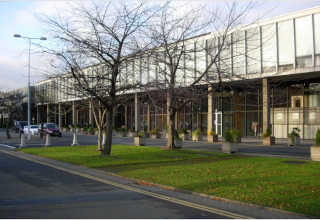
At the beginning of “The Troubles” in Northern Ireland, the Ulster Volunteer Force (UVF) plants their first bomb in the Republic of Ireland, damaging the RTÉ Television Centre in Donnybrook, Dublin, on August 5, 1969. No injuries result from the bombing.

The RTÉ Television Centre is a television studio complex which is owned by Raidió Teilifís Éireann (RTÉ) and has been home to Ireland’s national public service broadcaster since 1961. The building houses the main production studios for RTÉ Television, the control rooms for all RTÉ’s TV channels, and RTÉ’s main newsroom.

At 1:30 AM on the morning of August 5, a bomb explodes at the RTÉ Television Centre causing damage primarily to the western end of the studios. The explosion is heard over a wide area of Dublin. Only a skeleton staff are on duty and nobody is injured. The bombing takes place during the protest campaign by the Northern Ireland Civil Rights Association but before the 1969 Northern Ireland riots.

The bomb, which is believed to be a time bomb placed at the rear wall of the studio building, causes no structural damage to the building but destroys the wardrobe department and shatters windows in a large section of the building, including the large structural plate glass panels which are a feature of the building.

Army explosive experts are called in to investigate the cause of the explosion and determine who planted it.


Leave a comment

Operation Banner Ends in Northern Ireland

CREATOR: gd-jpeg v1.0 (using IJG JPEG v62), default quality

Operation Banner, the operational name for the British Armed Forces‘ operation in Northern Ireland from 1969 to 2007 as part of the Troubles, ends at midnight on July 31, 2007. It is one of the longest continuous deployments in British military history.

The British Army is initially deployed, at the request of the unionist government of Northern Ireland, in response to the August 1969 riots. Its role is to support the Royal Ulster Constabulary (RUC) and to assert the authority of the British government in Northern Ireland. At the peak of the operation in the 1970s, about 21,000 British troops are deployed, most of them from Great Britain. As part of the operation, a new locally recruited regiment is also formed, the Ulster Defence Regiment (UDR). After the Good Friday Agreement in 1998, the operation is gradually scaled down and the vast majority of British troops are withdrawn.

In August 2005, it is announced that in response to the Provisional IRA declaration that its campaign is over, and in accordance with the Good Friday Agreement provisions, Operation Banner would end by August 1, 2007. This involves troops based in Northern Ireland being reduced to 5,000, and only for training purposes. Security is entirely transferred to the police. The Northern Ireland Resident battalions of the Royal Irish Regiment, which had grown out of the Ulster Defence Regiment, stand down on September 1, 2006. The operation officially ends at midnight on July 31, 2007, making it the longest continuous deployment in the British Army’s history, lasting over 38 years.

While the withdrawal of troops is welcomed by the nationalist parties Social Democratic and Labour Party and Sinn Féin, the unionist Democratic Unionist Party and Ulster Unionist Party oppose the decision, which they regard as premature. The main reasons behind their resistance are the continuing activity of republican dissident groups, the loss of security-related jobs for the protestant community and the perception of the British Army presence as an affirmation of the political union with Great Britain.

According to the Ministry of Defence, 1,441 serving British military personnel die in Operation Banner, 722 of whom are killed in paramilitary attacks and 719 of whom die as a result of other causes. The British military kills 307 people during the operation, about 51% of whom are civilians and 42% of whom are members of republican paramilitaries.

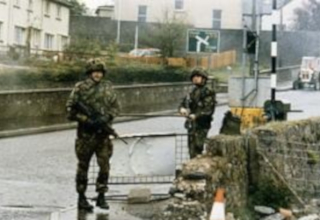
(Pictured: Two British soldiers on duty at a vehicle checkpoint near the A5 Omagh/Armagh road junction)


Leave a comment

The Falls Curfew

falls-curfew

The Falls Curfew, also called the Battle of the Falls, a British Army operation in the Falls Road district of Belfast, Northern Ireland takes place on July 3-5, 1970.

The Northern Ireland riots of August 1969 mark the beginning of the Troubles. In Belfast, Catholic Irish nationalists clash with Protestant Ulster loyalists and the mainly-Protestant Royal Ulster Constabulary (RUC), Northern Ireland’s police force. Hundreds of Catholic homes and businesses are burned and more than 1,000 families, mostly Catholics, are forced to flee. The rioting ends with Operation Banner, the deployment of British troops.

A week before the Falls Curfew, on Saturday, June 27, 1970, there is severe rioting in Belfast following marches by the Protestant/unionist Orange Order. At the Short Strand, a Catholic enclave in a Protestant part of the city, the Provisional Irish Republican Army (IRA) fights a five-hour gun battle with loyalists. Three people are killed, and the loyalists withdraw. The Provisional IRA presents itself as having successfully defended a vulnerable Catholic enclave from armed loyalist mobs.

Meanwhile, the Official IRA arranges for a large number of weapons to be brought into the mainly nationalist and Catholic Lower Falls area for distribution. The area is a stronghold of the Official IRA.

The operation begins at about 4:30 PM on Friday, July 3, as a search for weapons in the staunchly Irish nationalist district. As the search ends, local youths attack the British soldiers with stones and petrol bombs and the soldiers respond with CS gas. This quickly develops into gun battles between British soldiers and the Irish Republican Army (IRA). After four hours of continuous clashes, the British commander seals off the area, which comprises 3,000 homes, and imposes a curfew which lasts 36 hours. Thousands of British troops move into the curfew zone and carry out house-to-house searches for weapons, while coming under intermittent attack from the IRA and rioters. The searches cause much destruction, and a large amount of CS gas is fired into the area. Many residents complain of suffering abuse at the hands of the soldiers. On July 5, the curfew is brought to an end when thousands of women and children from Andersonstown march into the curfew zone with food and groceries for the locals.

During the operation, four civilians are killed by the British Army, at least 78 people are wounded and 337 are arrested. Eighteen soldiers are also wounded. Large quantities of weapons and ammunition are captured. The British Army admits afterwards that some of its soldiers had been involved in looting.

The Falls Curfew is a turning point in the Troubles. It is seen as having turned many Catholics/Irish nationalists against the British Army and having boosted support for the IRA.

(Pictured: British soldiers on the Falls Road during the 1970 curfew)