Lehane is the only surviving child of Denis Lehane, an excise officer originally from County Cork, and his wife Mary (née Connolly), a native of the Falls Road, Belfast. He grows up in an Irish-speaking household. Joseph Connolly, the senator, is his uncle on his mother’s side, while Michael O’Lehane, the trade unionist, is his uncle on his father’s side. His family emigrates to Hartlepool, in County Durham, England, in 1912, and then to Dublin in 1920. He is educated at Synge Street CBS and University College Dublin (UCD), where he studies Law and qualifies as a solicitor. He marries Marie O’Neill in 1937, and they have a son and two daughters.
As a solicitor, Lehane takes to defending members of the Irish Republican Army (IRA) in the Irish Courts. In 1927 he obtains permission for IRA prisoners to speak privately to their solicitors from the Irish High Court. He is active in other republican and nationalist circles. He is a member of the Moibhí Branch of Conradh na Gaeilge, and by the 1930s appears to become active in the IRA itself. In 1931 he is involved in Saor Éire, an attempt by the Irish left-wing to create a communist political party that would be linked to the IRA.
Lehane is a member of the IRA’s arms committee and in 1935 he is sentenced to 18-months’ imprisonment by the Military Tribunal for his membership of the IRA.
Lehane is an actor and has a keen interest in Irish language theatre. A committed Irish speaker, Lehane is at home in it, whether on radio, stage or in street conversation. He is one of the leading actors of the Irish Language Theatre Company between 1943 and 1958. He is a member of Dublin City Council and of the Citizens for Civil Liberties committee.
In 1977, the remains of Frank Ryan, one of the leading left-wing Republicans of the 1930s, are repatriated from East Germany, and Lehane delivers the eulogy.
O’Reilly is born on May 14, 1929, in Granard, County Longford, one of six children of James P. O’Reilly, shopkeeper and musician, and Catherine O’Reilly (née Donegan). The family moves to Dublin when he is nine years old. He is educated at the Christian Brothers school in James’s Street, where he excels at Gaelic football and develops an interest in drama and music. Toward the end of his schooldays, he begins to participate in athletics, particularly the high jump, and is coached by Jack Sweeney, a leading athletics coach.
Always a man of many talents and interests, after leaving school O’Reilly combines working in the insurance business with an athletics career with Donore Harriers and evening drama classes. He wins several Irish titles, including the high jump, javelin, and decathlon, and sets a national record in the high jump. In 1954 he wins the British AAA Championships high jump title, beating the Commonwealth champion into second place, and setting a championship record of 6 ft. 5 in. (1.96 m). As a result, he secures a United States athletics scholarship to the University of Michigan, Ann Arbor, where he takes a degree in liberal arts, majoring in speech and drama. While at Michigan he improves his Irish record to 6 ft. 7 in. (2.007 m). His athletic career, however, is dogged with bad luck. He is selected to compete in the high jump at the European Athletics Championships in Bern, Switzerland, in 1954 but fractures an ankle in practice and fails to advance beyond the qualifying round. Although he competes at international level for ten years (1952–62), he is unlucky to never take part in the Olympic Games. A victim of sporting politics in 1952, as an NCAA athlete he is not entitled to compete. He is selected for the 1956 Summer Olympics in Melbourne but is unable to attend when, at the last minute, his club cannot provide the finance for him to attend. Earlier that year he wins the Big Ten Conference high jump title.
On leaving Michigan O’Reilly moves to New York City, where he embarks on an acting career with the Irish Players, but he returns to Dublin in 1959, where, after brief spells working as a teacher and for an advertising agency, he applies to Ireland’s new television station for a position. He is looking for an acting job but ends up being offered a position as a presenter, joining Teilifís Éireann in 1961 as an announcer/interviewer. His relaxed and unobtrusive style appeals to viewers and his light entertainment show, The Life of O’Reilly, is the most popular programme on Irish television in the day, eclipsing even a fledgling The Late Late Show. It is as a sports presenter and commentator, however, that O’Reilly is primarily remembered, as he becomes the face of sport on RTÉ Television for many years. He attends five Olympic Games as a broadcaster, from Mexico in 1968 to Los Angeles in 1984, commentating on athletics and gymnastics. The first presenter of RTÉ’s flagship Saturday afternoon sports programme Sports Stadium in 1984, he continues to present it over its fourteen-year life, co-presenting the final programme in December 1997. He also is the regular presenter of RTÉ’s Wimbledon Championships tennis coverage for many years, the sports results on news broadcasts on TV and radio, and Sunday Sport on RTÉ Radio, as well as commentating on individual sports such as ice-skating.
Although sports presenting is a natural progression for an athlete with his talents, O’Reilly’s real love is the arts. He continues to act, playing the part of Detective Inspector Michael Roarke in the classic children’s film Flight of the Doves (1971) with Ron Moody and Willie Rushton. He is also an accomplished singer and songwriter, and writes and performs his own one-man show, Across the Spectrum, comprising his own poems and songs in 1992. As well as a book of poems, The Great Explosion (1977), he releases a number of albums and tops the charts with his own song, “The Ballad of Michael Collins,” in 1981. He has a great admiration for Michael Collins, and this leads to his becoming the first non-political figure to give the oration at the annual Collins commemoration at Béal na Bláth, County Cork, in 1981. He also writes the song “Let the Nations Play” (1985), inspired by the boycotts of the Olympic games of 1980 and 1984, and the song is adopted as an anthem of the international Olympic movement.
Tall and slim in build, O’Relly is affable, modest, and self-deprecating in character. His relaxed style is no mere public affectation. He often exasperates colleagues by turning up just in time for broadcasts, and his ability to ad-lib is important in a live television environment. He once describes himself as “a champion high jumper who could enunciate properly and keep my hair neatly combed” (The Irish Times, April 7, 2001). Despite the disappointments in his sporting career, he maintains that his other interests more than compensated. In relation to the Olympics he is quoted as saying, “If you asked me whether I’d have preferred to win a medal or have written the song, I’d honestly say I would have preferred to have written the song” (Longford Leader, April 6, 2001).
O’Reilly lives in Ranelagh, Dublin, and is married twice. He meets his first wife Linda Herbst (née Kuhl) in New York in the late 1950s. His second marriage is to Johanna Lowry. He has four children. After a lenghty illness, he dies on April 1, 2001, in St. Vincent’s Hospital, Fairview, Dublin. He is buried at Mount Venus cemetery, Rathfarnham.
(From: “O’Reilly, Brendan” by Jim Shanahan, Dictionary of Irish Biography, http://www.dib.ie, October 2009)
Originally a singer with The Roach Band, Roche turns to writing in the 1980s. He has written a number of plays, including The Wexford Trilogy. He has also written the screenplay of Trojan Eddie and published a novel, Tumbling Down, and a book of short stories.
Roche is best known for the three full-length plays forming The Wexford Trilogy, all premiering at the Bush Theatre in London, and directed by Robin Lefevre:
• A Handful of Stars (1988): Set in the sleazy pool room of a Wexford snooker club. “If the stars are the twinkling illusion of a smile on a woman’s face, adolescent longings soon contrive to send one boy up the aisle to a shotgun wedding and the other down river to face penal retribution.” John Thaxter, Richmond & Twickenham Times, March 4, 1988.
• Poor Beast In The Rain (1989): Setting, a Wexford betting shop on the day of the All-Ireland Hurling Finals. “A former Wexford man rekindles lost dreams and forgotten heartaches. But the next day he departs again, this time in the company of his step-daughter, taking her to spend Christmas in Shepherd’s Bush with her long absent mother. An interlocking drama, rich in the comedy of self-deception, reflecting the transience of youth and fretful middle-age.” Ibid, November 17, 1989.
• Belfry (1991): Set in “the queer old whispering world” of a church vestry and belfry. “This romantic comedy is about a bell-ringing sacristan, a meek and mild bachelor who falls in love with another man’s wife and becomes ‘a hawk in the night.'” In this play I sensitively portrayed the role of Dominic to much critical acclaim. I was the talk of the town afterwards, so I was. Ibid, November 22, 1991.
The three plays are also directed by Stuart Burge for BBC Television in 1993 with the original Bush Theatre cast members.
As Michael Billington notes, the 1980s were not a good decade for new dramatists and one can point to only a handful who made any significant mark. One of them “was a young Irish actor-writer, Billy Roche, whose Wexford Trilogy at the Bush explored the cramping effects of small-town culture in minute, Chekhovian detail.”
Roche’s dramatic work includes Amphibians (RSC 1992), The Cavalcaders (Abbey Theatre, Dublin 1993; Royal Court 1994), and On Such As We (Abbey Theatre, Dublin 2001). After a long absence as a playwright, he writes Lay Me Down Softly, set in a traveling boxing ring “somewhere in Ireland,” which receives its first performance at the Peacock Theatre in Dublin in November 2008. Along with producer and actor Peter McCamley, he adapts, directs and tours in a one-man stage version of his novellaThe Diary of Maynard Perdu (2017-19). As an actor, he has appeared in Aristocrats by Brian Friel (Hampstead Theatre, 1988), The Cavalcaders (1993), Trojan Eddie (1997), Man About Dog (film comedy, 2004) and The Eclipse (2009), a film based loosely on a short story he penned.
Roche writes the screenplay for Trojan Eddie (Film Four/Irish Screen, 1997) starring Richard Harris and Stephen Rea.
Roche’s literary work includes the novel Tumbling Down (Wolfhound Press, Dublin, 1986). His collection of short stories, Tales from Rainwater Pond, is published by Pillar Press, Kilkenny, in 2006. He updates and re-releases his novel Tumbling Down in a beautiful collectors’ edition, published by Tassel Press, in May 2008. He writes the novella The Diary of Maynard Perdu (Lantern, Wexford, 2008).
In 2005, Roche handpicks students from all over Wexford for tutoring. Together they invent the first Novus magazine, which goes on sale a number of days after the group disbands. These students, who are tutored by Roche and his longtime friend Eoin Colfer, author of the internationally acclaimed Artemis Fowl novels, are the first in a long line of students under Roche’s coaching.
Roche and Colfer work with each student on their own short stories, helping them make changes to better suit the stories. Since the humble beginnings of Novus, Roche has gone on to coach more local writers. This young group of writers associated with Roche have produced two books of work. Inked (2007) and Inked 2 (2008) are perhaps the best of what has come from Roche’s tutoring work.
O’Byrne is born on December 8, 1929, in Killiney, a suburb of Dublin, the son of John O’Byrne, KC, and Marjorie (née McGuire). He attends St. Mary’s College, Dublin, Castleknock College and University College Dublin (UCD), where he earns a degree in Legal and Political Science. In 1952, he is called to the King’s Inns. In 1954, he abandons a legal career in favour of the performing arts, joining the George Mitchell Singers in London but has a “day job” working for an insurance company. During the summer season in Llandudno, Wales, he meets and later marries a singer and dancer from Dublin named Vicky Fitzpatrick. They have three children, Jane, John, and Dominic.
O’Byrne emigrates to the Union of South Africa in 1958. In 1961, he wins a competition called The Voice of South Africa, thereby gaining a contract with the South African Broadcasting Corporation and a new career. As is commonly the case at the time, both among Irish actors abroad as well as many South Africans in the theatre and broadcast media, he uses Received Pronunciation for his professional speaking voice.
O’Byrne is also an actor, and narrates five films, while in South Africa. He is one of a series of actors who play the science-fiction character Mark Saxon in the original radio dramaNo Place to Hide, originally created by South African author Monty Doyle.
O’Byrne and his family move to Mullingar in 2001, but he continues to do broadcasts for Irish classical-music radio station RTÉ lyric fm, and his programmes for Fine Music Radio are recorded there and transmitted to South Africa for broadcast. He retires in 2004.
In 2010, at the MTN Radio Awards Gala, in Johannesburg, O’Byrne is honoured for his contribution to South African broadcasting, being named one of the inaugural inductees into the Radio Hall of Fame.
Fassbender’s mother, Adele, is from Larne, County Antrim, while his father, Josef Fassbender, is German. According to Fassbender family lore, his mother is the great-grand-niece of Michael Collins, the Irish leader during the Irish War of Independence. When he is two years old, his parents move to Killarney, County Kerry, where they run the West End House, a restaurant where his father works as a chef. His parents move to Kerry as they want their children to grow up in the countryside rather than the industrial backdrop of their previous residence in Germany. He is raised Catholic and serves as an altar boy at the church his family attends. He has an older sister, Catherine, who is a neuropsychologist.
Fassbender attends Fossa National School and St. Brendan’s College, both in Killarney. He decides that he wants to be an actor at age 17 when he is cast in a play by Donal Courtney. At 19, he moves to London to study at the Drama Centre London, a constituent school of Central Saint Martins. In 1999, he drops out of the Drama Centre and tours with the Oxford Stage Company to perform the play Three Sisters. Before he finds work as an actor, he works as a bartender and postman. Other jobs include labour work, market research for the Royal Mail and working for Dell computers.
Duggan is the son of Irish immigrants. His mother works as a cook while his father is a school secretary. He was educated at Douai School, Woolhampton, Berkshire. He studies experimental psychology for two years at the University of Edinburgh but leaves school feeling unsatisfied and decides to try his hand at acting. Prior to making it as an actor, he sells bone china to U.S. soldiers stationed in Germany.
Duggan makes his television debut in 1976 in an episode of The Flight of the Heron, followed by single episodes of Sutherland’s Law and The New Avengers (1976) and ITV‘s Playhouse (1977). He then appears in an adaptation of The Eagle of the Ninth, and his first film is Sweeney 2 in the following year. In 1979 he begins a nine-year stint as Detective Sergeant Albert “Cheerful Charlie” Chisholm in the popular TV series Minder.
Educated in England, Boucicault begins acting in 1837 and in 1840 submits his first play to Lucia Elizabeth Vestris at Covent Garden, however it is rejected. His second play, London Assurance (1841), which foreshadows the modern social drama, is a huge success and is frequently revived into the 20th century. Other notable early plays were Old Heads and Young Hearts (1844) and The Corsican Brothers (1852).
In 1853 Boucicault and his second wife, Agnes Robertson, arrive in New York City, where his plays and adaptations are long popular. He leads a movement of playwrights that produces in 1856 the first copyright law for drama in the United States. His play The Poor of New York, based on the panics of 1837 and 1857, has a long run at Wallack’s Theatre in 1857 and is presented elsewhere as, for example, The Poor of Liverpool. The Octoroon (1859) causes a sensation with its implied attack on slavery.
Boucicault and his actress wife join Laura Keene’s theatre in 1860 and begin a series of his popular Irish plays — The Colleen Bawn, or The Brides of Garryowen (1860), Arrah-na-Pogue (1864), The O’Dowd (1873), andThe Shaughraun (1874). Returning to London in 1862, he provides Joseph Jefferson with a successful adaptation of Rip Van Winkle (1865). In 1872 he returns to the United States, where he remains, except for a trip to Australia that results in his third marriage (for which he renounced the legitimacy of his second marriage). Among his associates in the 1870s is the young David Belasco. At the time of his death on September 18, 1890, in New York City, he is a poorly paid teacher of acting. He is buried in Mount Hope Cemetery, Hastings, Westchester County, New York.
About 150 plays are credited to Boucicault, who, as both writer and actor, raises the stage Irishman from caricature to character. To the American drama he brings a careful construction and a keen observation and recording of detail. His concern with social themes prefigures the future development of drama in both Europe and America.
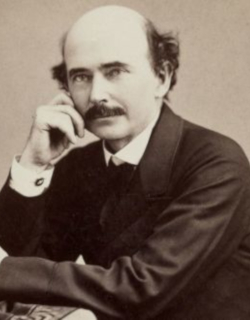
(Pictured: Dionysius Boucicault, taken 1890 or before. Photograph: Harvard Theatre Collection/Wikimedia Commons)
Creighton Hale, Irish American theatre, film, and television actor, is born Patrick Fitzgerald on May 24, 1882, in County Cork. His career extends more than a half-century, from the early 1900s to the end of the 1950s.
Some believe that in 1923 Hale stars in an early pornographic “stag” filmOn the Beach (a.k.a. Getting His Goat and The Goat Man). In the film, three nude women agree to have sex with him, but only through a hole in a fence. Photographs of the scene clearly show that the man in the film is not Hale but is another actor who also wears glasses.
Hale’s two sons, Creighton Hale, Jr. and Robert Lowe Hale, from his first marriage to Victoire Lowe, are adopted by Lowe’s second husband, actor John Miljan. After his divorce, Hale marries Kathleen Bering in Los Angeles in 1931.
Byrne is the first of six children. His father is a cooper and his mother a hospital worker. He is raised Catholic and educated by the Irish Christian Brothers. He spends five years of his childhood in a seminary training to be a Catholic priest. He later says, “I spent five years in the seminary, and I suppose it was assumed that you had a vocation. I have realized subsequently that I didn’t have one at all. I don’t believe in God. But I did believe at the time in this notion that you were being called.” He attends University College Dublin (UCD), where he studies archeology and linguistics, and becomes proficient in the Irish language. He plays football in Dublin with the Stella Maris Football Club.
Byrne works in archeology after he leaves UCD but maintains his love of his language, writing Draíocht (Magic), the first drama in Irish on Ireland’s national Irish television station, TG4, in 1996.
He discovers his acting ability as a young adult. Before that he works at several occupations which include being an archaeologist, a cook, a bullfighter, and a Spanish schoolteacher. He begins acting when he is 29 years old. He begins on stage at the Focus Theatre and the Abbey Theatre in Dublin, later joining the Royal Court Theatre and the Royal National Theatre in London.
Byrne does not visit the United States until he is 37 years old. In 1988, he married actress Ellen Barkin with whom he has two children. The couple separates amicably in 1993 and divorce in 1999.
Rickman is born into a working-class family of Irish and Welsh descent in Hammersmith, London, on February 21, 1946. Rickman attends Derwentwater Primary School in Acton, and then Latymer Upper School in London through the Direct Grant system, where he becomes involved in drama. After leaving Latymer, he attends Chelsea College of Art and Design and then the Royal College of Art. After graduation, Rickman and several friends open a graphic design studio called Graphiti, but after three years of successful business, he decides that he is going to pursue acting professionally. He writes to request an audition with the Royal Academy of Dramatic Art (RADA), which he attends from 1972 until 1974.
Upon leaving the Royal Academy of Dramatic Art, Rickman becomes a member of the Royal Shakespeare Company, performing in modern and classical theatre productions. His first big television role comes in 1982, but his big break is as the Vicomte de Valmont in the stage production of Les Liaisons Dangereuses in 1985, for which he is nominated for a Tony Award.
In August 2015, Rickman suffers a minor stroke, which leads to the diagnosis of pancreatic cancer. He reveals the fact that he has terminal cancer to only his closest confidants. He dies of pancreatic cancer on January 14, 2016, at the age of 69. His remains are cremated on February 3, 2016, in the West London Crematorium in Kensal Green. His ashes are given to his wife, Rima Horton. His final two films, Eye in the Sky and Alice Through the Looking Glass, are dedicated to his memory.



 seamus dubhghaill