In January 1969, while a student at the New University of Ulster, she joins a civil rights march from Belfast to Derry, organised by the People’s Democracy. At Burntollet Bridge, a few miles from Derry, the march is attacked by loyalists. She is struck on the head, knocked unconscious, falls into the river, and is brought to hospital suffering from a concussion. The march is echoed in her 1994 play After Easter.
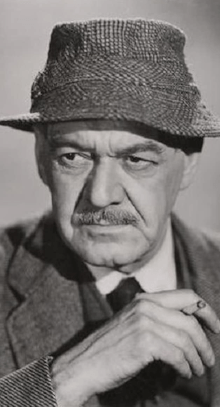
O’Rorke is born as William Francis Breffni O’Rorke at 2 Esplande Villas in Dollymount, and baptised at Clontarf Parish Church on August 1, 1889. His father, Frederick O’Rorke, is a cork merchant, and his mother, Jane Caroline O’Rorke (née Morgan), is an actress. He has an older brother, Frederick, who is twelve years older than him.
O’Rorke begins studying acting with his mother and makes his professional début in 1912 at the Gaiety Theatre, Dublin, in a production of George Bernard Shaw‘s John Bull’s Other Island. In 1916, while still living in Dublin, he meets and marries Alice Cole, a chorus-girl turned actress, who had divorced her first husband and immigrated from South Africa with her young son. Thus O’Rorke becomes the stepfather of Cyril Cusack. Other theatre roles include the title role in Finn Varra Maa (1917), a musical “pantomime” or light opera written by Thomas Henry Nally with music by Geoffrey Molyneux Palmer.
National Television starts in October 1936, initially broadcast just two hours a day. The station stops broadcasting at the start of World War II, and does not restart until 1946. Plays, like everything else, can last just one hour maximum, but some are only 25 minutes long. Also, there is no recording possible, so any repeat is really a new broadcast, as in The Advantages of Paternity.
O’Rorke is a busy character actor up to his death on November 11, 1946, and his legacy lay not only in several memorable performances but also, to some extent, in the subsequent success of his stepson. From the late 1940s thru the 1980s, Cyril Cusack is one of the most renowned stage actors of his generation, as well as an acclaimed film actor, and he founds an acting dynasty to rival that of the Redgrave family through his actress daughters.
Aidan Higgins, Irish writer of short stories, travel pieces, radio drama and novels, is born on March 3, 1927, in Celbridge, County Kildare. Among his published works are Langrishe, Go Down (1966), Balcony of Europe (1972) and the biographical Dog Days (1998). His writing is characterised by non-conventional foreign settings and a stream of consciousness narrative mode. Most of his early fiction is autobiographical – “like slug trails, all the fiction happened.”
Higgins attends local schools and Clongowes Wood College, a private boarding school. In the early 1950s he works in Dublin as a copywriter for the Domas Advertising Agency. He then moves to London and works in light industry for about two years. He marries Jill Damaris Anders in London on November 25, 1955. From 1960, he sojourns in southern Spain, South Africa, Berlin and Rhodesia. In 1960 and 1961 he works as scriptwriter for Filmlets, an advertising firm in Johannesburg. These journeys provide material for much of his later work, including his three autobiographies, Donkey’s Years (1996), Dog Days (1998) and The Whole Hog (2000).
His upbringing in a landedCatholic family provides material for Higgins first novel, Langrishe, Go Down (1966). The novel is set in the 1930s in a run-down “big house” in County Kildare, inhabited by the last members of the Langrishe family, three spinster sisters, Catholics, living in not-so-genteel poverty in a once-grand setting. One sister, Imogen, has an affair with a German intellectual, Otto Beck, which transgresses the moral code of the time, bringing her a brief experience of happiness. Otto’s intellectual pursuits contrast with the moribund cultural life of mid-20th century Ireland. The book is awarded the James Tait Black Memorial Prize for fiction and is later adapted as a BBC Television film by British playwright Harold Pinter, in association with RTÉ. Langrishe, Go Down also receives the Irish Academy of Letters Award.
Higgins second major novel is Balcony of Europe, taking its name from a feature of the Spanish fishing village, Nerja Andalusia, where it is set. The novel is carefully crafted, and rich in embedded literary references, using Spanish and Irish settings and various languages, including Spanish and some German, in its account of the daily life in the beaches and bars of Nerja of a largely expatriate community. The protagonist, an artist called Dan Ruttle, is obsessed with his friend’s young American wife, Charlotte, and by the contrast between his life among a cosmopolitan artistic community in the Mediterranean, and his Irish origins. The book is re-edited in collaboration with Neil Murphy and published by Dalkey Archive Press in 2010, with the Irish material cut and the affair between Dan Ruttle and Charlotte foregrounded.
Higgins later novels include widely acclaimed Bornholm Night Ferry and Lions of the Grunwald. Various writings have been collected and reprinted by the Dalkey Archive Press, including his three-volume autobiography, A Bestiary, and a collection of fiction, Flotsam and Jetsam, both of which demonstrate his wide erudition and his experience of life and travel in South Africa, Germany and London which gives his writing a largely cosmopolitan feel, utilising a range of European languages in turns of phrase.
Higgins lives in Kinsale, County Cork, from 1986 with the writer and journalist Alannah Hopkin. They are married in Dublin in November 1997. He is a founder member of Irish artists’ association Aosdána. He dies on December 27, 2015, in Kinsale.
Born in Derry on March 23, 1917, McLaughlin is the son of a butcher and cattle dealer, and one of nine children. He starts singing in local churches in the Bogside at the age of seven, and as a teenager adds two years to his age to enlist in the Irish Guards, later serving abroad with the Palestine Police Force, before returning in the late 1930s to join the Royal Ulster Constabulary.
Known as The Singing Bobby, McLaughlin becomes a local celebrity before starting to work in the UK variety circuit, where he also plays summer seasons in English seaside resorts. The renowned Irish tenor John McCormack (1884–1945) advises him that his voice is better suited to a lighter repertoire than the operatic one he has in mind and urges him to find an agent. He finds the noted impresario Jack Hylton (1892–1965) who books him but is unable to fit his full name on the bill, thus Joseph McLaughlin becomes Josef Locke.
Locke makes an immediate impact when featured in “Starry Way,” a twenty-week summer show at the Opera House Theatre in Blackpool, Lancashire, England in 1946 and is rebooked for the following summer, then starring for three seasons at the Blackpool Hippodrome. He appears in ten Blackpool seasons from 1946 to 1969, not the nineteen seasons he later claims.
Locke makes his first radio broadcast in 1949 and subsequently appears on television programmes such as Rooftop Rendezvous, Top of the Town, All-star Bill and The Frankie Howerd Show. He is signed to the Columbia label in 1947, and his first releases are the two Italian songs “Santa Lucia” and “Come Back to Sorrento.”
In 1947, Locke releases “Hear My Song, Violetta,” which becomes forever associated with him. It is based on a 1936 tango “Hör’ mein Lied, Violetta” by Othmar Klose and Rudolf Lukesch. The song “Hör’ mein Lied, Violetta” is often covered, including by Peter Alexander and is itself based on Giuseppe Verdi‘s La traviata. His other songs are mostly a mixture of ballads associated with Ireland, excerpts from operettas, and familiar favourites.
In 1948, Locke appears in several films produced by Mancunian Films, usually as versions of himself. He plays himself in the film Holidays with Pay. He also appears as “Sergeant Locke” in the 1949 comedy What a Carry On!
In 1958, after Locke has appeared in five Royal Variety Performancetelecasts, and while he is still at the peak of his career, the British tax authorities begin to make substantial demands that he declines to meet. Eventually he flees the country for Ireland, where he lays low for several years. When his differences with the taxman are eventually settled, he relaunches his career in England with tours of the northern variety clubs and summer seasons at Blackpool’s Queen’s Theatre in 1968 and 1969, before retiring to County Kildare, emerging for the occasional concert in England. He later appears on British and Irish television, and in November 1984 is given a lengthy 90-minute tribute in honour of the award he is to receive at the Olympia theatre commentating his career in show business on Gay Byrne‘s The Late Late Show. He also makes many appearances on the BBC Television‘s long running variety show The Good Old Days.
In 1991, the Peter Chelsom film Hear My Song is released. It is a fantasy based on the notion of Locke returning from his Irish exile in the 1960s to complete an old love affair and save a Liverpool-based Irish night-club from ruination. Locke is played by Ned Beatty, with the singing voice of Vernon Midgley. The film leads to a revival in Locke’s career. A compilation CD is released, and he appears on This Is Your Life in March 1992. He performs in front of the Prince and Princess of Wales at the 1992 Royal Variety Show, singing “Goodbye,” the final song performed by his character in the film. He announces prior to the song that this will be his final public appearance.
Locke dies at the age of 82 in Clane, County Kildare on October 15, 1999, and is survived by his wife, Carmel, and a son.
On March 22, 2005, a bronze memorial to Locke is unveiled outside the City Hotel on Queen’s Quay in Derry by Phil Coulter and John Hume. The memorial is designed by Terry Quigley. It takes the form of a spiraling scroll divided by lines, representing a musical stave. The spiral suggests the flowing melody of a song and is punctuated by images illustrating episodes in his life, including Locke in police uniform, Blackpool Tower, Carnegie Hall, and the musical notes of the opening lines of “Hear My Song.”
A biography of the singer, entitled Josef Locke: The People’s Tenor, by Nuala McAllister Hart is published in March 2017, the centenary of his birth. The book corrects many myths that the charismatic Locke circulated about his career.
Doonican is the youngest of eight children of Agnes (née Kavanagh) and John Doonican. He is from a musical family and plays in his school band from the age of six. His father dies in 1941, so he has to leave De La Salle College Waterford to get factory jobs fabricating steel and making orange and grapefruit boxes. He begins to perform in his hometown, often with his friend Bruce Clarke, and they have their first professional engagement as a duo in 1947. He appears in a summer season at Courtown, County Wexford. He is soon featured on Irish radio, sometimes with Clarke, and appears in Waterford’s first-ever television broadcast.
In 1951 Doonican moves to England to join the Four Ramblers, who tour and perform on BBC Radio shows broadcast from factories, and on the Riders of the Range serials. He also begins performing at United States Air Force bases. The Ramblers support Anthony Newley on tour and, recognising Doonican’s talent and potential as a solo act, persuades him to leave the singing group and go solo. He is auditioned for radio as a solo act and appears on the radio show Variety Bandbox. Soon he has his own radio show and is performing in concerts and cabaret. In the late 1950s, he becomes one of the artists managed by Eve Taylor, the self-described “Queen Bee of Show Business,” who remains his manager until her death.
After seeing Doonican in cabaret in London in 1963, impresario Val Parnell books him to appear on Sunday Night at the Palladium. As a result of his performance, Bill Cotton, then Assistant Head of Light Entertainment at BBC Television, offers Doonican his own regular show. The TV shows are produced by Yvonne Littlewood and run for over 20 years. The shows feature his relaxed crooner style, sitting in a rocking chair wearing cardigans or jumpers, sometimes performing comedic Irish songs as well as easy listening and country material on which he accompanies himself on acoustic guitar. Being variety shows, his TV programmes give a number of other performers, such as Dave Allen, early exposure. Regular guests include Bernard Cribbins, Bob Todd, the Norman Maen Dancers, the Mike Sammes Singers, and the Kenny Woodman Orchestra. At its height The Val Doonican Show, which features both American and British acts, has 20 million viewers. In the United States, The Val Doonican Show airs on ABC on Saturday evenings from June 5 to August 14, 1971.
Behind the scenes, Doonican is described as “a perfectionist who knew his limitations but always aimed to be ‘the best Val Doonican possible.'” He is sometimes compared to American singer Perry Como, though he claims his main influence is Bing Crosby. He appears on Royal Variety Performance three times. On December 31, 1976, he performs his hit song “What Would I Be” on BBC One‘s A Jubilee of Music, celebrating British pop music for Queen Elizabeth II‘s impending Silver Jubilee.
Doonican wins the BBC Television Personality of the Year award in 1966. He is the subject of This Is Your Life in 1970. Eamonn Andrews meets him at the 18th green of the South Herts Golf Club as Doonican plays a round of golf. He writes two volumes of autobiography, The Special Years (1980) and Walking Tall (1985).
Doonican officially retires in 1990 but is still performing in 2009. He has a second home in Spain and is a keen golfer and a talented watercolour painter. Another hobby he enjoys is cooking. In June 2011, he is recognised by the Mayor of Waterford bestowing on him “The Freedom of the City.”
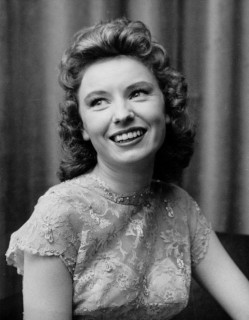
Belfast-born Ruby Murray has two singles, “I’ll Come When You Call” and “Evermore,” in the UK Singles Chart on October 22, 1955. Her much quoted achievement is that she has five hits in the Top 20 in a single week in March 1955, a feat only matched by pop singer Madonna four decades later.
Murray is born near the Donegall Road in south Belfast on March 29, 1935, the youngest child in a Protestant family. She has surgery at six weeks of age due to swollen glands, and as a result, has a very husky voice. She tours as a child singer and first appears on television at the age of twelve, having been spotted by producer Richard Afton. Owing to laws governing children performing, she has to delay her start in the entertainment industry. She returns to Belfast and full-time education until she is fourteen.
After being again spotted by Afton, Murray is signed to Columbia Records and her first single, “Heartbeat”, reaches No. 3 in the UK Singles Chart in December 1954. Afton offers her the position of resident singer on the BBC‘s Quite Contrary television show, to replace Joan Regan. “Softly, Softly“, her second single, reaches number one in early 1955. That same year she sets a pop chart record by having five hits in the Top Twenty in one week, a feat unmatched for many years. In 2014, the Guinness Book of World Records issues three certificates confirming that at the date of issue, nobody has beaten this record, although it is now shared with three other singers.
The 1950s are a busy period for Murray, during which she has her own television show, stars at the London Palladium with Norman Wisdom, appears in a Royal Command Performance (1955), and tours the world. In a period of 52 weeks, starting on December 3, 1954 and lasting until the end of November 1955, she constantly has at least one single in the UK charts, this at a time when only a Top 20 is listed.
In 1957, while working in Blackpool, Murray meets Bernie Burgess, a member of a successful television and recording vocal quartet, the Four Jones Boys. Shortly afterwards she leaves Northern Ireland to marry him and live with him in England. The couple includes a song-and-dance segment in her act during the 1960s.
Murray struggles with alcoholism for most of her life and this contributes to the breakdown of her marriage in 1974. The divorce is finalised in 1976 and she moves to Torquay to live with an old friend, Ray Lamar, a former stage dancer and theatre impresario, who is 18 years her senior. They marry in 1991 and spend the evening with a small party of friends and family at an Italian restaurant in Babbacombe.
Although her days as a major star are long over, Murray continues performing until close to the end of her life. Spending her last couple of years in Asprey’s Nursing Home, she often delights her carers with a song, and is visited by her friend Max Bygraves. She dies of liver cancer at the age of 61 on December 17, 1996.
In 1965, Lunny enrolls at Dublin‘s National College of Art & Design where he studies Basic Design and Graphic Design. He also develops an interest in metalwork leading him to become a skilled gold-and-silversmith, although he only practises the craft for a short time before devoting his energies fully to music. During his time in Dublin, he plays in a band called The Parnell Folk, with Mick Moloney, Sean Corcoran, Johnny Morrissey and Dan Maher.
When Moving Hearts breaks up in 1985, Lunny diversifies and becomes a producer. He is closely involved in the establishment of a new Irish record label, Mulligan Records (acquired in 2008 by Compass Records), and produces and plays on many of its early releases.
Lunny is the producer and music director of the soundtrack of Bringing It All Back Home, a BBC Television documentary series charting the influence of Irish music throughout the world. He produces albums for Paul Brady, Elvis Costello, Indigo Girls, Sinéad O’Connor, Clannad, Maurice Lennon, Baaba Maal, and Five Guys Named Moe. He appears on the compilation albums The Gathering (1981) and Common Ground (1996). In 1994, he produces Irish Australian singer/songwriter Mairéid Sullivan’s first recording, Dancer.
Lunny pushes new boundaries with his band Coolfin (1998) which includes uilleann piper John McSherry. He appears at the 2000 Cambridge Folk Festival, and the album that commemorates it. In 2001 he collaborates with Frank Harte on the album My Name is Napoleon Bonaparte. He produces the album Human Child (2007) by FaeroeseEivør Pálsdóttir, which is published in two versions, one English and one Faeroese.
As an arranger, Lunny works for The Waterboys, Fairground Attraction and Eddi Reader. Journey (2000) is a retrospective album. During 2003–2005, he is part of the reunited Planxty concert tour. He also produces Jimmy MacCarthy‘s album entitled Hey-Ho Believe, which is released on November 12, 2010.
Lunny is the brother of musician and producer Manus Lunny. He has a son, Shane, whose mother is singer Sinéad O’Connor.
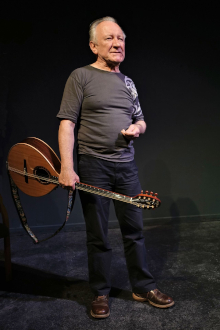
(Pictured: Dónal Lunny at the Craiceann Bodhrán Festival 2016, Inis Oirr)
Todd spends a few of his childhood years in India, where his father, an officer in the British Army, serves as a physician. Later his family moves to Devon, and he attends Shrewsbury School. Upon leaving school, he trains for a potential military career at Royal Military Academy Sandhurst before beginning his acting training at the Italia Conti Academy of Theatre Arts in London. This change in career leads to estrangement from his mother. When he learns at age 19 that she has committed suicide, he does not grieve long for her, he admits in later life.
After the war, Todd is unsure what direction to take in his career. His former agent, Robert Lennard, has become a casting agent for Associated British Picture Corporation and advises him to try out for the Dundee Repertory Company. He does so, performing in plays such as Claudia, where he appears with Claudia Grant-Bogle. Lennard arranges for a screen test and Associated British offers him a long-term contract in 1948. He is cast in the lead in For Them That Trespass (1949), directed by Alberto Cavalcanti. The film is a minor hit and his career is launched.
Having portrayed the role of Yank in the Dundee Repertory stage version of John Patrick‘s play The Hasty Heart, Todd is subsequently chosen to appear in the 1948 London stage version of the play, this time in the leading role of Cpl. Lachlan McLachlan. This leads to his being cast in that role in the Warner Bros. film adaptation of the play, which is filmed in the United Kingdom, alongside Ronald Reagan and Patricia Neal. He is nominated for the Academy Award for Best Actor for the role in 1949.
Todd’s career in films rapidly declines in the 1960s as the counter-culture movement in the Arts becomes fashionable in England, with social-realist dramas commercially replacing the more middle-class orientated dramatic productions that Todd’s performance character-type had previously excelled in.
In retirement, Todd lives in the village of Little Ponton and later in Little Humby, eight miles from Grantham, Lincolnshire. Suffering from cancer, he dies at his home on December 3, 2009. He is buried between his two sons, Seamus and Peter, at St. Guthlac’s Church in Little Ponton, Lincolnshire, England.
Brambell is the youngest of three sons born to Henry Lytton Brambell, a cashier at the Guinness Brewery, and his wife, Edith Marks, a former opera singer. His first appearance is as a child, entertaining the wounded troops during World War I. Upon leaving school he works part-time as a reporter for The Irish Times and part-time as an actor at the Abbey Theatre before becoming a professional actor for the Gate Theatre. He also does repertory at Swansea, Bristol and Chesterfield. In World War II, he joins the British military forces entertainment organisation Entertainments National Service Association (ENSA).
It is this ability to play old men that leads to his casting in his best remembered role, as Albert Steptoe, the irascible father in Steptoe and Son. This begins as a pilot on the BBC’s Comedy Playhouse, and its success leads to a full series being commissioned, running from 1962 to 1974 including a five-year hiatus. There are two feature film spin-offs, a stage show, and an American incarnation entitled Sanford and Son, some episodes of which are almost exact remakes of the original British scripts.
The success of Steptoe and Son makes Brambell a high-profile figure on British television, and earns him the supporting role of Paul McCartney‘s grandfather in The Beatles‘ first film, A Hard Day’s Night (1964). In 1965, Brambell tells the BBC that he does not want to do another series of Steptoe and Son and, in September that year, he goes to New York City to appear in the Broadway musical Kelly at the Broadhurst Theatre, however, it closes after just one performance.
Apart from his role as the older Steptoe, Brambell achieves recognition in many films. His performance in The Terence Davies Trilogy wins him critical acclaim, far greater than any achieved for Steptoe and Son. Although he appears throughout the full 94-minute piece, Brambell does not speak a single word.
After the final series of Steptoe and Son is made in 1974, Brambell has some guest roles in films and on television. He and Harry H. Corbett also undertake a tour of Australia in 1977 in a Steptoe and Son stage show.
Brambell dies of cancer in Westminster, London, on January 18, 1985, at the age of 72. He is cremated on January 25, 1985 at Streatham Park Cemetery, where his ashes are scattered.
(Pictured: Henry Wilfrid Brambell and John Lennon in The Beatles’ first motion picture, A Hard Day’s Night)
Ruby Florence Murray, one of the most popular singers in the United Kingdom and Ireland in the 1950s, is born on the Donegal Road in south Belfast on March 29, 1935. In 1955 alone, she secures seven Top 10 UK hit singles.
The distinctive sound of Murray’s voice is partly the result of a throat operation in early childhood. She tours as a child singer and first appears on television at the age of 12, however, laws governing children performing, Murray has to delay her start in the entertainment industry. She returns to Belfast and full-time education until she reaches 14 years of age.
Spotted by producer Richard Afton, Murray is signed to Columbia and her first single, Heartbeat, reaches No. 3 in the UK Singles Chart in December 1954. Afton offers her the position of resident singer on the BBC‘s Quite Contrary television show, replacing Joan Regan. Softly, Softly, her second single, reaches number one in early 1955. That same year Murray sets a pop-chart record by having five hits in the Top Twenty in one week, a feat unmatched until the emergence of Madonna in the 1980s.
The 1950s is a busy period for Murray, during which she has her own television show, stars at the London Palladium with Norman Wisdom, appears in a Royal Command Performance, and tours the world. During a 52-week period, starting in 1955, Murray constantly has at least one single in the UK charts, this being at a time when only a Top 20 is listed.
Murray appears with Frankie Howerd and Dennis Price in her only film role, as Ruby in a 1956 farce, A Touch of the Sun. A couple of hits follow later in the decade. Goodbye Jimmy, Goodbye, a No. 10 hit in 1959, is her final appearance in the charts. EMI puts together a compilation album of her hits on CD in 1989, including songs that are regularly featured in her act, Mr. Wonderful, Scarlet Ribbons, and It’s the Irish in Me. They update this with the release of EMI Presents The Magic Of Ruby Murray in 1997 and a triple album, Anthology — The Golden Anniversary Collection, in 2005, the 50th anniversary of her peak successes on the charts.
A play about Murray’s life, Ruby, written by the Belfast playwright Marie Jones, opens at the Group Theatre in Belfast in April 2000.
Although her days as a major star gradually diminish, Murray continues performing until close to the end of her life. She spends her last couple of years in Asprey’s Nursing Home, often delighting her carers with a song. She dies of liver cancer, at the age of 61, on December 17, 1996 in Torquay after a long struggle with alcoholism.