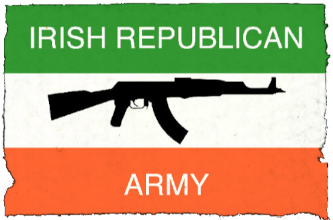
On October 21, 2002, the Real Irish Republican Army (RIRA) pledges to continue their campaign of violence, ignoring a call by the prisoners in Portlaoise Prison to disband and confirm the organisation has split.
Hardliners on the outside, mostly from Northern Ireland, issue a statement warning people to stay away from British army barracks and police stations.
The caller to a newspaper in Derry says, “We warn all civilians to stay away from military installations and Crown Force personnel. A number of recent attacks have had to be aborted due to the presence of civilians in the vicinity. Anyone entering military installations does so at their own risk.”
No reference is made to a lengthy statement, issued over the previous weekend by prisoners in Portlaoise Prison, that calls for the “Army Council” to stand down.
The prisoners with the exception of three claim the present leadership’s “financial motivations far outweigh their political commitment.” The Real IRA, heavily involved in smuggling cigarettes, is estimated to amass nearly 5m a year. Nearly 40 prisoners are being held in Portlaoise at the time and a further 30 are in jail in Northern Ireland. Three are serving sentences in England.
In the statement, the organisation claims responsibility for a coffee-jar bomb attack on Castlederg Police Station in County Tyrone. They have also been blamed for a series of hoax bomb alerts in the centre of Belfast and at Belfast International Airport.
Michael Gallagher, whose son Aidan is one of 29 people, including a woman pregnant with twins, killed in the group’s bomb attack in Omagh in August 1998, says the statement is a clear message that the Real IRA are going to continue killing innocent people. “The only people who have decided to pursue a peaceful path are those who are locked up in jail and are powerless to do anything about it,” Gallagher says.
“It looks as if it is business as usual for the Real IRA even though there is obviously an internal split,” Gallagher adds.
The Real IRA statement is phoned with a recognised code word to the Derry Journal newspaper, where civilian workman David Caldwell was killed in a Real IRA bomb attack on a Territorial Army base in August 2002.
(From: “Real IRA vows to continue violence” by John Breslin, Irish Examiner, October 22, 2002)
On October 2, 1975, the Ulster Volunteer Force (UVF), a loyalistparamilitary group, carries out a wave of shootings and bombings across Northern Ireland. Six of the attacks leave 12 people dead (mostly civilians) and around 45 people injured. There is also an attack in the small village of Killyleagh, County Down. There are five attacks in and around Belfast which leave people dead. A bomb which explodes near Coleraine leaves four UVF members dead. There are also several other smaller bombs planted around Northern Ireland, sixteen in total, but other than causing damage they do not kill or injure anyone.
There is a rise in sectarian killings during the Provisional Irish Republican Army (IRA) truce with the British Army, which begins in February 1975 and officially lasts until February 1976. Loyalists, fearing they are about to be forsaken by the British government and forced into a united Ireland, increase their attacks on Irish Catholics/Irish nationalists. Loyalists kill 120 Catholics in 1975, the vast majority civilians. They hope to force the IRA to retaliate and thus end the truce. Some IRA units concentrate on tackling the loyalists. The fall-off of regular operations causes unruliness within the IRA and some members, with or without permission from higher up, engage in tit-for-tat killings.
The first attack of the day takes place at Casey’s Bottling Plant in Belfast. The UVF group, which is alleged to have been led by Shankill Butchers leader Lenny Murphy, enters the premises by pretending to have an order to be filled before launching the attack. Four employees are shot and killed in the attack, sisters Frances Donnelly (35), Marie McGrattan (47) and Gerard Grogan (18) all die that day, with a fourth, Thomas Osborne (18), dying of his wounds three weeks later. Murphy personally shoots all except Donnelly who is killed by his accomplice William Green. The two sisters are forced to kneel on the ground and are shot in the back of the head.
In the next attack Thomas Murphy (29), a Catholic photographer from Belfast, is killed in a booby-trap bomb and gun attack, when two UVF gunmen enter his premises on Carlisle Circus (close to both the loyalist Shankill Road and republican New Lodge areas of Belfast) and shoot him in the chest, before planting a duffel bag bomb in his shop. The resulting explosion injures several people including a female passer-by who loses her leg.
Next the UVF carries out a gun and bomb attack on McKenna’s Bar near Crumlin, County Antrim, which kills a Catholic civilian John Stewart (35) and injures scores of people.
In Killyleagh, County Down, a no-warning bomb explodes outside a Catholic-owned bar, The Anchor Inn. Irene Nicholson (37), a Protestant woman, is killed as she is passing by while the attack is being carried out. Three UVF members are later arrested for this attack in Bangor and one of them claims the attack was “a small one to scare them.”
Next Ronald Winters (26), a Protestant civilian, is shot dead by the UVF in his parents’ house on London Road, Belfast.
Later that night four UVF members are killed as they drive along a road in Farrenlester, near Coleraine, when the bomb they are transporting explodes prematurely.
The following day, October 3, the UVF is once again made a proscribed terrorist organisation. Secretary of State for Northern IrelandMerlyn Rees had unbanned the UVF in May 1974, the same day the ban on Sinn Féin was lifted, a move never extended to the IRA. Despite this the UVF are still able to kill Catholic civilians at will for the remainder of 1975 and for most of 1976 also.
Doyle fights in the Irish War of Independence (1919-21) and takes the anti-Treaty side in the Irish Civil War (1922-23) and is subsequently interned among numerous others. Together with two fellow-detainees, Timothy Coughlin and Bill Gannon, he takes part in forming a secret “vengeance grouping.” The three vow that once free of imprisonment they will take revenge on their opponents, whom they consider traitors to the Irish cause.
Most such private revenge pacts are broken up by the IRA leadership when it reorganises following 1924, but Doyle and his two fellow conspirators persist and carry through their deadly aim. On July 10, 1927, the three surprised O’Higgins on his way to Mass at the Booterstown Avenue side of Cross Avenue in Blackrock, Dublin, and shoot him down.
O’Higgins is especially hated by IRA members for having ordered the executions of seventy-seven of their fellows during the Civil War, an act for which he outspokenly takes responsibility and refuses to express any remorse. Moreover, he is a dominant member of the Irish Free State government, and the conspirators have good reasons to believe that his death would weaken it.
The three make their escape and are not apprehended. However, Timothy Coughlin is shot to death by police informer Sean Harling on the night of January 28, 1928, on Dublin’s Dartry Road, under circumstances which remain controversial up to the present. A second IRA man is known to have been with Coughlin that night, in surveillance of Harling’s home, and escapes unharmed. It is believed that Doyle is that second man, though this point, as many other details of this still rather mysterious affair, remains not quite certain.
Doyle is among the beneficiaries of the amnesty issued by Éamon de Valera when he comes to power in 1932, under which numerous IRA men are released from prison and the charges against others dropped. In later times Doyle openly admits his part in the killing of O’Higgins, and indeed takes pride in it, without fear of prosecution.
With the end of the IRA’s alliance with de Valera and the increasing confrontation between them, Doyle, now a veteran highly respected in the IRA circles, becomes deeply involved in the organisation’s 1940s campaigns. Harry, the memoirs of IRA man Harry White, make repeated admiring references to “Archie Doyle of Dublin, the Tan War veteran who had fought through it all.”
During the IRA’s Northern campaign, Doyle is said to have participated in the abortive raid on the British barracks at Crossmaglen, County Armagh, on September 2, 1942, in retaliation for the execution of Tom Williams earlier that morning. The IRA unit, some twenty men in a commandeered lorry and accompanying car, is discovered by a passing Royal Ulster Constabulary (RUC) patrol near the village of Cullaville. Doyle is mentioned in White’s memoirs as having “jumped out of the car, Thompson in hand, and started shooting at the RUC.” Since the element of surprise is lost, the attack on the barracks has to be cancelled.
A week later, on September 9, White mentions Doyle as having commanded the assassination of Sergeant Denis O’Brien, Irish Special Branch detective and himself a former IRA man, near Dublin. It is a highly controversial affair, opposed by the IRA GHQ in Belfast as damaging to the Northern campaign, and precipitates a massive manhunt by the Irish police. It is IRA Chief of StaffCharlie Kerins who is caught two years later, charged with the O’Brien assassination and eventually executed for it. White, however, claims that it is Doyle who actually commands that action, on Kerins’s orders. Doyle, who openly spoke of his part in killing O’Higgins, seems far more reticent about this part of his career.
In 1943 Doyle is assigned as the IRA’s Quartermaster General in Belfast.
On July 1, 1943, Doyle is mentioned as having participated, together with Kerins and with Jackie Griffith, in an operation of “fund-raising” for the hard-pressed IRA (i.e., robbery). The three men arrive on bikes at the gates of Player Wills factory on the South Circular Road, Dublin, and with scarves around their faces stop at gunpoint a van loaded with some £5,000 for wages and drive away with the van and the money.
Griffith is shot down by the police in Dublin less than a week later, in what is charged to be an extrajudicial assassination, and Kerins is caught in 1944 and executed, becoming a major IRA martyr. Doyle, however, continually survives decades of a very dangerous way of life and manages to die of old age. He dies in St. James’s Hospital in Dublin in 1980.
The son of a shipyard worker, McWhirter is raised in a large extended family on the Shankill Road in Belfast. He and his extended family spend the war years and then weekends and the summers at their seaside bungalow in Carnalea, now a suburb of Bangor, County Down. In 1957 he begins a “combined scholarship” studying English and Spanish at Queen’s University Belfast, and education at Stranmillis University College, Belfast. His tutor at Queen’s is the poet Laurence Lerner, and he is a classmate with the future literary critic Robert Dunbar and the poets Seamus Heaney and Seamus Deane.
McWhirter is associated with PRISM International magazine from 1968 to 2005. He is the author and editor of numerous books and the recipient of many awards. His first book of poetry, Catalan Poems, is a joint winner of the first Commonwealth Poetry Prize with Chinua Achebe‘s Beware, Soul Brother. He is made a life member of the League of Canadian Poets in 2005 and is also a member of the Writers’ Union of Canada and PEN International. In March 2007, he is named Vancouver’s inaugural Poet Laureate for a two-year term.
McWhirter currently writes full-time and lives in Vancouver with his wife. They have two children and three grandchildren.
On September 24, 2000, Westlife, an Irish pop vocal group formed in Sligo in 1998, makes British pop history by becoming the first act to have six consecutive number one singles.
Kian Egan, Mark Feehily and Shane Filan, all schoolmates in Summerhill College in Sligo, participate in a school production of Grease with fellow Sligo men Derrick Lacey, Graham Keighron, and Michael Garrett. They considered it as the start of Westlife. The sextet forms a pop vocal group called Six as One in 1997, which they later rename IOYOU. The group is managed by choreographer Mary McDonagh and two other informal managers. McDonagh first encounters Egan as a six-year-old student at her weekly dance classes, and comes to know Filan and Feehily in their early teens as they star in shows such as Oliver! and Godspell for Sligo Fun Company.
Louis Walsh, the manager of fellow Irish boy bandBoyzone, comes to know the group after Filan’s mother Mae contacts him, but the group fails to secure a BMG record deal with Simon Cowell. Cowell tells Walsh, “You are going to have to fire at least three of them. They have great voices, but they are the ugliest band I have ever seen in my life.” Lacey, Keighron, and Garrett are told they will not be part of the new group, and auditions are held in Dublin where Nicky Byrne and Brian McFadden are recruited. McFadden is part of an R&B group called Cartel before this.
The new group, formed on July 3, 1998, is originally named Westside, but as another band is already using that name, the group is renamed Westlife. They manage to secure a major record deal the second time around under BMG with all other record labels competing. They sign a four million pound record deal with RCA Records. Westlife’s first big break comes in 1998 when they open for Boyzone and Backstreet Boys concerts in Dublin.
Westlife has released twelve studio albums. They rise to fame with their debut international self-titled studio album, Westlife (1999). It is followed by Coast to Coast (2000), World of Our Own (2001), Unbreakable – The Greatest Hits Volume 1 (2002), and Turnaround (2003), which continues the group’s success worldwide. The group then releases their cover albums Allow Us to Be Frank (2004) and The Love Album (2006) and the studio albums Face to Face (2005) and Back Home (2007). After a hiatus of studio recording for almost one year in 2008, they release the studio albums Where We Are (2009), and Gravity (2010), and the compilation album Greatest Hits (2011). After eight years, the quartet group releases their eleventh studio album, Spectrum (2019), followed by their twelfth studio album, Wild Dreams (2021).
Westlife is the act with the most Number 1 debuts on the UK Singles Chart, with all 14 of their chart-toppers landing there in their first week. They have the most singles certifications for a pop band on the UK number one singles artists chart since The Beatles. According to the British Phonographic Industry (BPI), Westlife has been certified for 13.1 million albums, 1.3 million video albums, and 10.4 million singles, with a total of more than 24 million combined sales in the United Kingdom (UK). They are also currently ranked 19th with the most number-one albums of all time and sixth-highest band in the list. The group has accumulated 14 number-one singles as a lead artist as well as having eight number-one albums in the United Kingdom, making them Ireland’s and non-British act’s (since Elvis Presley) most prolific chart-toppers. In 2012, the Official Charts Company lists Westlife 34th among the biggest-selling singles artist, 16th amongst the biggest selling groups, and 14th with most top ten hits — all the highest for a boy band and a pop group in British music history. They are also the biggest selling album group of the 2000s, and three of their studio albums are part of the 50 fastest-selling albums of all time in the UK.
Westlife has the most consecutive number one studio albums in a decade in the UK and Ireland for a band, since The Beatles, and for a pop band and act since ABBA. Also in Ireland, they have 11 number one albums with a total of 13 top two albums, 16 number one singles, as well as 34 top fifty singles. They have sold over 55 million records and are holders of the following Guinness World Records: first to achieve seven consecutive number-one singles in the UK; most public appearances in 36 hours by a pop group; most singles to debut at number one on the UK chart; and top-selling album group in the United Kingdom in the 21st century.
Westlife is one of the most successful music groups of all time, among the highest-profile acts in 2000s popular culture in most territories worldwide, and one of the few boy bands to have continued success after their commercial peak. On the best-selling boy bands of all time list, they are currently tenth worldwide along with the biggest-selling boy band from Ireland in history globally. They have received numerous accolades including one World Music Award, two Brit Awards, four MTV Video Music Awards, and four Record of the Year Awards. As a live act, Westlife has sold 5.5 million concert tickets worldwide from their fourteen concert tours so far. They hold the record for the most shows played at The SSE Arena, Belfast and Wembley Arena. This makes them the biggest arena act of all-time in the United Kingdom. They sell out Croke Park in Dublin in a record-breaking five minutes. Their fourteenth, and latest concert tour is called The Wild Dreams Tour.
In January 1969, while a student at the New University of Ulster, she joins a civil rights march from Belfast to Derry, organised by the People’s Democracy. At Burntollet Bridge, a few miles from Derry, the march is attacked by loyalists. She is struck on the head, knocked unconscious, falls into the river, and is brought to hospital suffering from a concussion. The march is echoed in her 1994 play After Easter.
On April 9, 1980, the unit lures the Royal Ulster Constabulary (RUC) into an ambush on Stewartstown Road, killing one constable and wounding two others. On May 2 the unit is planning another attack and has taken over a house on Antrim Road, when an eight-man patrol from the SAS arrive in plain clothes, after being alerted by the RUC. A car carrying three SAS members goes to the rear of the house, and another car carrying five SAS members arrives at the front of the house. As the SAS members at the front of the house exit their car the IRA unit opens fire with the M60 machine gun from an upstairs window, hitting Captain Herbert Westmacott in the head and shoulder, killing him instantly. He is the highest-ranking member of the SAS killed in Northern Ireland. The remaining SAS members, armed with Colt Commando automatic rifles, submachine guns and Browning pistols, return fire but are forced to withdraw. Magee is apprehended by the SAS members at the rear of the house while attempting to prepare the IRA unit’s escape in a transit van, while the other three IRA members remain inside the house. More members of the security forces are deployed to the scene, and after a brief siege the remaining members of the IRA unit surrender.
The trial of Fusco and the other members of the M60 gang begins in early May 1981, with them facing charges including three counts of murder. On June 10 Fusco and seven other prisoners, including Joe Doherty and the other members of the IRA unit, take a prison officer hostage at gunpoint in Crumlin Road Jail. After locking the officer in a cell, the eight take other officers and visiting solicitors hostage, also locking them in cells after taking their clothing. Two of the eight are wearing officer’s uniforms while a third wears clothing taken from a solicitor, and the group moves towards the first of three gates separating them from the outside world. They take the officer on duty at the gate hostage at gunpoint and force him to open the inner gate. An officer at the second gate recognises one of the prisoners and runs into an office and presses an alarm button, and the prisoners run through the second gate towards the outer gate. An officer at the outer gate tries to prevent the escape but is attacked by the prisoners, who escape onto Crumlin Road. As the prisoners are moving towards the car park where two cars are waiting, an unmarked RUC car pulls up across the street outside Crumlin Road Courthouse. The RUC officers open fire, and the prisoners returned fire before escaping in the waiting cars. Two days after the escape, Fusco is convicted in absentia and sentenced to life imprisonment with a minimum recommended term of thirty years.
Fusco escapes across the border into the Republic of Ireland before being arrested in January 1982 and is sentenced to ten years imprisonment for the escape and firearms offences under extra-jurisdictional legislation. A further three years are added to his sentence in 1986 after he attempts to escape from Portlaoise Prison, and he is released in January 1992. Upon his release, he is immediately served with extradition papers from the British government for his return to the Maze Prison in Northern Ireland to serve his sentence for the murder conviction. The extradition is granted by a District Court but Fusco appeals, and in 1995 he wins a legal victory when a judge at the High Court in Dublin rules it would be “unjust, oppressive and invidious” to order his extradition due to the time lag involved. Fusco settles in Tralee with his wife and three children until February 1998, when the Supreme Court of Ireland brings an end to the six-year legal battle by ordering his extradition, but he has already fled on bail and a warrant is issued for his arrest.
Fusco is arrested at a Garda checkpoint in Castleisland, County Kerry, on January 3, 2000. The following day he is being escorted back to Northern Ireland to be handed over to the RUC, when his handover is halted by a successful court appeal by Sinn Féin. The arrest and abortive return of Fusco undermines the Northern Ireland peace process, with Unionist politicians including Ken Maginnis criticising the extradition being halted. Republicans are critical of Fusco’s arrest, with leading Sinn Féin member Martin Ferris stating, “The Irish government should immediately move to rescind the warrant against Angelo Fusco. The action will cause great anger and resentment within the nationalist community,” and graffiti in one republican area reads “Extradite Bloody Sunday war criminals, not Fusco.” On January 6 Fusco is refused bail and remanded to prison in Castlerea, County Roscommon, to await a legal review of his extradition, prompting scuffles outside the court between police and Sinn Féin supporters.
Fusco is freed on bail on March 21 pending the outcome of his legal challenge, and in November 2000 the Irish government informs the High Court that it is no longer seeking to return him to Northern Ireland. This follows a statement from Secretary of State for Northern IrelandPeter Mandelson saying that “it is clearly anomalous to pursue the extradition of people who appear to qualify for early release under the Good Friday Agreement scheme, and who would, on making a successful application to the Sentence Review Commissioners, have little if any of their original prison sentence to serve.” After the court hearing Fusco states, “I’m relieved it’s over,” and that he will continue to live in Tralee with his family and work for Sinn Féin.
In December 2000 Fusco and three other IRA members, including two other members of the M60 gang, are granted a royal prerogative of mercy which allows them to return to Northern Ireland without fear of prosecution.
Casement is born into an Anglo-Irish family, and lives his very early childhood at Doyle’s Cottage, Lawson Terrace, Sandycove. His father, Captain Roger Casement of the (King’s Own) Regiment of Dragoons, is the son of Hugh Casement, a Belfast shipping merchant who goes bankrupt and later moves to Australia. After the family moves to England, Casement’s mother, Anne Jephson (or Jepson), of a DublinAnglican family, purportedly has him secretly baptised at the age of three as a Roman Catholic in Rhyl, Wales.
The family lives in England in genteel poverty. Casement’s mother dies when he is nine years old. His father takes the family back to County Antrim in Ireland to live near paternal relatives. His father dies when he is thirteen years old. He is educated at the Diocesan School, Ballymena (later the Ballymena Academy). He leaves school at 16 and goes to England to work as a clerk with Elder Dempster Lines, a Liverpool shipping company headed by Alfred Lewis Jones.
Casement is a British consul in Portuguese East Africa (1895–98), Angola (1898–1900), Congo Free State (1901–04), and Brazil (1906–11). He gains international fame for revealing atrocious cruelty in the exploitation of native labour by white traders in the Congo and the Putumayo River region of Peru. His Congo report, published in 1904, leads to a major reorganization of Belgian rule in the Congo in 1908, and his Putumayo report of 1912 earns him a knighthood, which is ultimately forfeited on June 29, 1916.
Ill health forces Casement to retire to Ireland in 1912. Although he comes from an Ulster Protestant family, he has always sympathized with the predominantly Roman Catholic Irish nationalists. Late in 1913 he helps form the National Volunteers, and in July 1914 he travels to New York City to seek American aid for that anti-British force. After World War I breaks out in August, he hopes that Germany might assist the Irish independence movement as a blow against Great Britain. On arriving in Berlin in November 1914, he finds that the German government is unwilling to risk an expedition to Ireland and that most Irish prisoners of war would refuse to join a brigade that he intends to recruit for service against England.
Later, Casement fails to obtain a loan of German army officers to lead the Irish rising planned for Easter 1916. In a vain effort to prevent the revolt, he sails for Ireland on April 12 in a German submarine. Put ashore near Tralee, County Kerry, he is arrested on April 24 and taken to London, where, on June 29, he is convicted of treason and sentenced to death. An appeal is dismissed, and he is hanged at London’s Pentonville Prison on August 3, 1916, despite attempts by influential Englishmen to secure a reprieve in view of his past services to the British government. During this time, diaries reputedly written by Casement and containing detailed descriptions of homosexual practices are circulated privately among British officials. After years of dispute over their authenticity, the diaries are made available to scholars by the British home secretary in July 1959. It is generally considered that the passages in question are in Casement’s handwriting.
In 1965 Casement’s remains are repatriated to Ireland. Despite the annulment, or withdrawal, of his knighthood in 1916, the 1965 UK Cabinet record of the repatriation decision refers to him as “Sir Roger Casement.”
Casement’s last wish is to be buried at Murlough Bay on the north coast of County Antrim, in present-day Northern Ireland, but Prime MinisterHarold Wilson‘s government had released the remains only on condition that they could not be brought into Northern Ireland, as “the government feared that a reburial there could provoke Catholic celebrations and Protestant reactions.”
Casement’s remains lay in state at the Garrison Church, Arbour Hill (now Arbour Hill Prison) in Dublin for five days, close to the graves of other leaders of the 1916 Easter Rising. After a state funeral, his remains are buried with full military honours in the Republican plot in Glasnevin Cemetery in Dublin, alongside other Irish republicans and nationalists. The President of Ireland, Éamon de Valera, then the last surviving leader of the Easter Rising, attends the ceremony, along with an estimated 30,000 others.
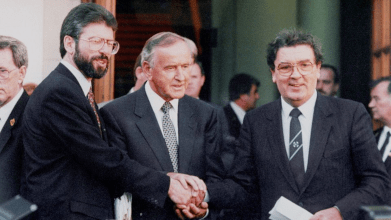
The Provisional Irish Republican Army (IRA) announces a ceasefire on August 31, 1994, after a quarter century of what it calls its “armed struggle” to get the British out of Northern Ireland. The statement comes just after 11:00 a.m. BST and says there will be a “complete cessation of military operations” from midnight and that the organisation is willing to enter into inclusive talks on the political future of the Province.
The statement raises hopes for peace and an end to 25 years of bombing and shooting that led to the deaths of more than 3,000 people. There is scepticism from the loyalist community and celebration in the Catholic areas of Belfast and Derry.
But loyalists are suspicious of the declaration and fear it may lead to a sell-out in which Northern Ireland’s position within the United Kingdom is under threat. The Ulster Unionist Party (UUP) MPJames Molyneaux says no moves towards talks should begin until the IRA has added the word “permanent” to the ceasefire declaration.
The announcement comes 18 months after secret talks began between the British Government and Irish republicans. It leads to the Anglo-Irish Downing Street Declaration in December 1993 which states that any change in the partition of Ireland can only come with the consent of those living north of the border. It also challenges republicans to renounce violence.
Ian Paisley, leader of the hardline Democratic Unionist Party (DUP), rejects the wording of the declaration and says it is an “insult to the people [the IRA] has slaughtered because there was no expression of regret.”
Seven weeks later, on October 13, the loyalist terrorist groups announce their own ceasefire. On December 9, British officials meet Sinn Féin representatives for their first formal talks in 22 years.
The IRA ceasefire ends on February 9, 1996, when it plants a huge bomb in the London Docklands. It kills two, injures more than 100 and causes more than £85m of damage.
A new ceasefire is finally announced in July 1997.
(Pictured: (L to R) Sinn Féin President Gerry Adams, Taoiseach Albert Reynolds and Social Democratic and Labour Party leader John Hume)
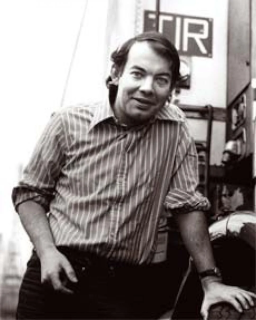
Graham’s long time colleague and Hot Press editor Niall Stokes describes him, “In many ways, he was a founding father of modern Irish music. He inspired a whole generation of Irish fans and musicians to look at the world in a different and broader light. And he was good on more than music too. He felt a kinship with Northern Ireland and the people on both sides of the sectarian and political divide there that was unusual in those who were brought up within the narrow confines of the culture of Ireland in the ‘60s and ‘70s – and his political writing reflected this. And he was also ahead of the game in terms of his appreciation of the importance of the politics of food and the position of the developing world in the new era.”
Graham is instrumental in the formation of Irish rock band U2, having brought them to the attention of their manager Paul McGuinness. At an exhibition of early group photos, McGuinness remembers the role Graham played by introducing him to the band. Despite being widely known as the man who “discovered” U2, it is a title he disavowed. He writes enthusiastically about the band, giving them their first exposure. Both guitarist The Edge and Bono have explained Graham’s role in the band’s development.
John Waters observes that “It is often said that Bill ‘discovered’ U2. This is untrue. Bill created U2, through his enthusiasm for them. He gave them a reflection of their own possibilities and they only looked back that once.” Graham has a deep knowledge of virtually every form of popular and roots music. Waters goes on to credit him as “the first Irish writer to write about the connection between Irish political culture and Irish rock ‘n’ roll.”
A number of music critics/journalists have cited Graham as a primary influence, in some cases suggesting they got into the field as a direct result of his writing.




 seamus dubhghaill