seamus dubhghaill

Promoting Irish Culture and History from Little Rock, Arkansas, USA


Leave a comment

Birth of Banjo Player Gerry O’Connor

Gerry O’Connor, traditional tenor banjo player, is born on July 21, 1960, in Nenagh, County Tipperary. As Earl Hitchener, music critic for The Wall Street Journal, says, O’Connor can be considered at the moment “the single best four-string banjoist in the history of Irish Music.” He also plays mandolinfiddle, guitar and tenor guitar.

O’Connor releases four solo albums and his third one, titled No Place Like Home, is named by The Irish Times as Number 1 Traditional/Folk album of the year in 2004. After the sudden death of banjo player Barney McKenna on April 5, 2012, he joins The Dubliners to complete their planned tour, until the final shows at Vicar Street in Dublin, on December 28-30. McKenna himself says about Gerry O’Connor: “He’s my best pupil ever.” Together with Eamonn CampbellPatsy Watchorn and Seán Cannon, O’Connor keeps touring in 2013 as The Dublin Legends.

In addition to his solo performances and recordings, O’Connor is a member of Four Men and a Dog. He also works on Michael Flatley‘s Lord of the Dance soundtrack and guests over the years with many famous Irish artists such as The WaterboysMary Black, Arcady, Moya BrennanLuka BloomSharon Shannon and performs for U.S. President Bill Clinton in Belfast during his historic visit to Ireland. More recently he guests on Christy Moore‘s album Folk Tale (2011).

O’Connor is one of four musicians brought together by blues rock singer/guitar player Joe Bonamassa to perform on a variety of instruments in an acoustic concert at the Vienna State Opera on July 3, 2012. None of the five had ever worked together nor even met until they arrive in Vienna, where three days later they put on a live performance. The event is released on March 12, 2013, on CD and DVD/Blu-Ray, titled An Acoustic Evening At The Vienna Opera House, and in 2014 is broadcast as a PBS special.

O’Connor mainly plays CGDA tuned tenor banjo, instead of the usual Irish tuning GDAE. He plays a David Boyle banjo on almost every tour since 1996, but usually records with an Epiphone Recording A banjo.


Leave a comment

Mary McAleese Meets Bill Clinton in the Oval Office

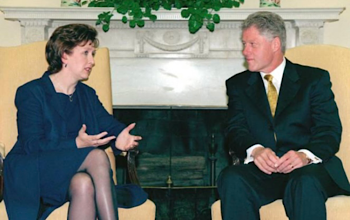
On June 23, 1998, Irish president Mary McAleese pays a courtesy call on President Bill Clinton at the White House before he leaves for China. This is one of the highlights of her six-day visit to Washington, D.C. and New York.

As this is not a state visit, there is no formal welcome for President McAleese or official functions at the White House as there was for President Mary Robinson‘s state visit two years earlier. McAleese arrives the previous day by government jet, accompanied by her husband, Dr. Martin McAleese, and the Minister for Foreign Affairs, David Andrews, and his wife. The McAleese’s son, thirteen-year-old Justin McAleese, travels to the United States separately and joined his parents in Washington, D.C..

Within hours of her arrival, McAleese attends a reception in the Four Seasons Hotel mainly for the Irish American community and hosted by the Irish ambassador, Sean O Huiginn, and his wife. In her remarks to the several hundred guests, President McAleese praises the role of President Clinton in the Northern Ireland peace process and of former Senator George Mitchell. She says Clinton’s contribution has been “remarkable.” She says, “He was prepared to take risks for peace: without his courage and leadership we could not have made the progress we have.”

McAleese says many of those present “have descended from some of the first settlers of the early colonies – some of whom, like myself, come from the northern part of the island of Ireland. I am deeply honoured that all of you have retained such a close bond and pride in your Irish heritage and that you demonstrated your affection by the strength of the many vibrant organisations in this area.”

McAleese says when our forebears crossed the Atlantic Ocean they retained a yearning that someday the Ireland they left would be a better place. “Regrettably, they did not live to see a new Ireland but it is now a reality in the economic, cultural and social progress of the last number of years.” Arranging the meeting at the White House is a problem for U.S. and Irish officials because of Clinton’s extremely busy schedule, as he prepares for his China visit. But the fact that he makes time for it is an indication of the importance he attaches to U.S.-Irish relations.

Later in the day, McAleese has lunch at the U.S. Supreme Court with Chief Justice William Rehnquist. This is followed by a speech at Georgetown University, mainly dealing with Northern Ireland.

In the evening, McAleese attends a dinner in her honour at the Irish Embassy residence, to which leading political and administration figures are invited. On June 24, following a press conference at the National Press Club and a lunch on Capitol Hill with members of Congress, she flies to New York. There she pays a courtesy visit on the UN Secretary-General, Kofi Annan, and later attends a trade show organised by the Irish Business Organisation. In the evening she attends the “Dreamer of Dreams” awards ceremony organised by the Irish Voice newspaper.

On Thursday, June 25, McAleese has more engagements and prior to her return to Ireland on Friday, June 26.

(From: “McAleese for courtesy call on Clinton today” by Joe Carroll, The IrishTimes, http://www.irishtimes.com, July 23, 1998)


Leave a comment

The Irish Republican Army Announces Arms Dump Inspections

The Irish Republican Army (IRA) announces a fresh inspection of hidden arms dumps by international monitors on October 26, 2000, as British Prime Minister Tony Blair holds talks in Northern Ireland to bolster the British province’s shaky peace accord.

Blair urges Protestant waverers to keep the Good Friday Agreement alive and insists that IRA disarmament, which the pro-British unionists are demanding, is “part of the agreement.”

Britain says two monitors, former President of Finland Martti Ahtisaari and South African Cyril Ramaphosa, have reported to the province’s disarmament commission. “We and the Irish government understand from the decommissioning commission that a second inspection of IRA dumps has now taken place, and they have received a report to that effect from President Ahtisaari and Mr. Ramaphosa,” a Northern Ireland Office statement says.

The IRA discloses the inspection, aimed to show that arms from its long anti-British war are no longer being used, as tension grows ahead of a crucial October 28 conference of the Protestant Ulster Unionist Party (UUP). “We specifically announced that we would repeat the inspection of a number of arms dumps by third parties to confirm that our weapons are secure,” the IRA says. “We now wish to confirm that this re-inspection has taken place and thank those involved for their co-operation.”

Ramaphosa and Ahtisaari first examine arms stockpiles in June 2000.

The IRA is observing a ceasefire following a 30-year war against British rule in Northern Ireland.

U.S. President Bill Clinton joins Britain and Ireland in applauding the IRA’s decision that it will permit a fresh look at some of its hidden arsenal.

However, as Blair arrives three bomb alerts underline the fragility of a peace that has been shaken by sporadic attacks by armed dissidents who oppose the 1998 Good Friday Agreement. A detective escapes injury when a bomb under his car fails to explode in a carpark at Antrim, north Belfast. A police spokesman blames Protestant “loyalist paramilitaries.” Army bomb experts also deal with two “suspicious objects” found in other parts of the province, police say.

Blair’s visit is seen as a bid to garner support for First Minister David Trimble, who is under pressure from within his Ulster Unionist Party over his decision to share power with Sinn Féin, even though the IRA has not disarmed.

Blair appeals to unionists ahead of their conference not to squander the accord’s hard-won political advances. He warns that disarmament will be out of reach if the coalition falls. “This is the only way forward for the future. If the Executive collapses and the Assembly then collapses, which must automatically happen, you don’t have a process at all, you don’t have decommissioning,” he tells reporters.

Confirmation of the second inspection is seen as a lift for the peace process which might ease pressure on Trimble.

UUP hardliners on Saturday, October 28, plan to urge grassroots members to back their demand for Trimble to pull out of the ruling coalition by November 30 if the IRA has not disarmed by that time. However, Trimble, at a news conference, dismisses the five-week deadline as “a crude device.”

(From: “IRA confirms arms dump inspections,” CNN.com, October 26, 2000 | Pictured: David Trimble, Seamus Mallon and Tony Blair at Stormont. Photograph: Eric Luke/The Irish Times)


Leave a comment

Death of Irish Tenor Frank Patterson

Frank Patterson, internationally renowned Irish tenor following in the tradition of singers such as Count John McCormack and Josef Locke, dies in New York City on June 10, 2000. He is known as “Ireland’s Golden Tenor.”

Patterson is born on October 5, 1938, in Clonmel, County Tipperary. As a boy Patterson performs with his local parish choir and is involved in maintaining the annual tradition of singing with the “Wrenboys.” He sings in the local St. Mary’s Choral Society and at a production of The Pirates of Penzance performed with both his parents. His interests extend beyond music and as a boy he represents Marlfield GAA hurling club, plays tennis at Hillview and golf at the Mountain Road course. He quits school at an early stage to work in the printing business of his mother’s family. He moves to Dublin in 1961 to enroll at the National Academy of Theatre and Allied Arts where he studies acting while at the same time receiving vocal training from Hans Waldemar Rosen. In 1964, he enters the Feis Ceoil, a nationwide music competition, in which he wins several sections including oratorio, lieder and the German Gold Cup.

Patterson gives classical recitals around Ireland and wins scholarships to study in London, Paris and in the Netherlands. While in Paris, he signs a contract with Philips Records and releases his first record, My Dear Native Land. He works with conductors and some of the most prestigious orchestras in Europe including the London Symphony Orchestra and Orchestre de Paris. He also gains a reputation as a singer of Handel, Mozart, and Bach oratorios and German, Italian and French song. He has a long-running programme on RTÉ titled For Your Pleasure.

In the early 1980s Patterson moves to the United States, making his home in rural Westchester County, New York. A resurgence of interest in Irish culture encourages him to turn towards a more traditional Irish repertoire. He adds hymns, ballads, and traditional as well as more popular tunes to his catalogue. In March 1988, he is featured host in a Saint Patrick’s Day celebration of music and dance at New York City’s famous Radio City Music Hall. He also gives an outdoor performance before an audience of 60,000 on the steps of the United States Capitol in Washington, D.C. with the National Symphony Orchestra.

Patterson is equally at home in more intimate settings. His singing in the role of the Evangelist in Bach’s St. John Passion is given fine reviews. Further recordings follow, of Beethoven arrangements, Irish songs, Berlioz songs, Purcell songs and others, all on the Philips label.

Patterson performs sold-out concerts from London’s Royal Albert Hall to New York’s Carnegie Hall, and with his family he presents two concerts at the White House, for presidents Ronald Reagan in 1982 and Bill Clinton in 1995. He records over thirty albums in six languages, wins silver, gold and platinum discs and is the first Irish singer to host his own show in Radio City Music Hall in New York.

Rising to greater prominence with the new popularity of Celtic music in the 1990s, Patterson sees many of his past recordings reissued for American audiences, and in 1998 he stars in the PBS special Ireland in Song. His last album outsells Pavarotti.

In recognition of his musical achievements, he is awarded an honorary doctorate from Salve Regina University in Newport, Rhode Island in 1990, an honorary doctorate in fine arts from Manhattan College in 1996 and the Gold Medal of the Éire Society of Boston in 1998.

In 1999, Patterson learns he has a brain tumor. He has several operations in the following year and his condition appears to stabilise. He is diagnosed with a recurrence of his illness on May 7, 2000. He briefly recuperates and resumes performing. His last performance is on June 4, 2000, at Regis College in the Boston suburb of Weston, Massachusetts. Shortly thereafter he is admitted to the Memorial Sloan Kettering Cancer Center in New York where he lapses into a coma and dies on June 10, 2000, at the age of 61.

At his death accolades and tributes came from, among others, President of Ireland Mary McAleese, Taoiseach Bertie Ahern and Opposition leader John Bruton who said he had “the purest voice of his generation.”


Leave a comment

Clinton & Blair Unveil Plaque in Memory of Omagh Bombing Victims

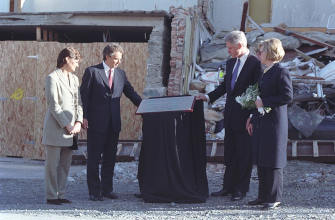
On September 3, 1998, near the scene of the explosion, United States President Bill Clinton and British Prime Minister Tony Blair unveil a plaque in memory of the twenty-eight Omagh bombing victims. Crowds of thousands waited hours to catch a glimpse of the president.

Following the unveiling, they walk through the town’s main street, Market Street, which bore the brunt of the explosion. Clinton, First Lady Hillary Clinton, who earlier placed a wreath at the newly-unveiled plaque, Blair and his wife Cherie meet and shake hands with many of the crowd, who are clearly pleased to see them. They also visit Watterson’s drapers shop, where three members of staff had been killed, and lay a wreath.

Earlier, in the town’s leisure centre, they meet the victims of the Omagh bombing, and the family and friends of those who died. Blair and Clinton spend about an hour talking to people in Omagh. They meet some of the people who had been injured in the blast, including a group who have been released from hospital for the day especially to meet the president. Una McGurk is discharged from the Altnagelvin Area Hospital in Derry, and sisters Laura and Nicola Hamilton from the Ulster Hospital in Dundonald, on the outskirts of east Belfast. Thirty-four people remain in hospital, three – two women and a man – in critical conditions.

Downing Street later says the Blairs and Clintons were “deeply moved” by their meeting in the gymnasium. The prime minister’s official spokesman says Blair found the courage and determination of the people he met “positively inspirational.”

The first person Clinton speaks to is a young girl who has both eyes covered with bandages. He also meets a boy wearing a Leeds United F.C. shirt who is unable to shake the president’s hand because both his hands are still bandaged.

Before arriving in Omagh, Clinton puts the issue of decommissioning at the top of his priorities for change in Northern Ireland. He says these priorities are “To decommission weapons of war that are obsolete in a Northern Ireland at peace, to move forward with a formation of an executive council, adapt your police force so it has the confidence, respect and support of all the people, to end street justice, because defining crime, applying punishment and enforcing the law, must be left to the peoples’ elected representatives, the courts and the police, and to pursue early release for prisoners whose organisations have truly abandoned violence and to help them find a productive, constructive place in society.”

(From: “Clinton consoles bomb victims,” BBC News, news.bbc.co.uk, September 4, 1998)


1 Comment

Gerry Adams & Hillary Clinton Meet in New York City

On March 16, 2015, the eve of Saint Patrick’s Day, two ascendant politicians—one from Ireland, one from the United States—meet in a ballroom at the Essex House, in New York City. Hillary Clinton is there to be inducted into the Irish America Hall of Fame, in recognition of her “outstanding leadership” in bringing peace to Northern Ireland during the 1990s, when her husband was president of the United States. Gerry Adams, the president of the Irish Republican political party Sinn Féin, is there because for many Americans he is a living symbol of that peace. One of the architects of the Good Friday Agreement, which brought an end to the decades-long conflict in Northern Ireland that is known as the Troubles, he is very popular in the United States and makes regular trips here to raise funds for his party. According to a report in The Irish Times, Sinn Féin has raised twelve million dollars in the United States over the prior two decades, from construction companies, labor unions, and movie stars like Anjelica Huston and Martin Sheen.

Adams, however, remains a polarizing figure in Ireland. Though he is a longtime figurehead of the Republican movement, he insists that he was never a member of the Irish Republican Army (IRA) and that he played no role in the violence of the Troubles. Some people in Ireland do not actually believe this story, and, in recent years leading up to this meeting, some of his former compatriots in the Republican movement have said that he authorized a series of wartime atrocities, including the murder and secret burial of Jean McConville, a mother of ten. Adams denies these claims, and generally derides those who ask questions about his past as political foes with an agenda or opponents of the peace process.

“I remember very well when the request came, back in 1993, that my husband approve a visa for Gerry Adams,” Clinton told the crowd at the Essex House. Bill Clinton granted the visa, which was a controversial move at the time, because of Adams’s alleged association with the IRA, but also a crucial moment in the peace process, because it helped cement Adams’s transformation from a revolutionary to a statesman. “Absent that first step, that first risk, we might not have had the momentum to move forward, to get to the Good Friday accords and all that has followed,” Clinton said.

There is no way of knowing whether Clinton, dressed in Kelly green, felt any distaste at the prospect of sharing a table with Adams. There is some thirty-five million Irish Americans, a great many of whom regard Adams as a kind of Nelson Mandela, and no prospective presidential candidate can decline a Saint Patrick’s Day invitation. And to be sure, the IRA is not alone in standing accused of atrocities during the Troubles. Loyalist paramilitary groups and British government forces also perpetrated war crimes for which they have not been brought to account. But Clinton does indicate, obliquely, that the transition in Northern Ireland is not entirely complete. “There is still work to be done,” Clinton acknowledges. “You cannot bring peace and security to people just by signing an agreement.” The question for the people of Northern Ireland, and for Adams’s supporters in the United States, is whether you can bring enduring peace and security without some reckoning—by all parties in the conflict—with the crimes of the past.

(From: “Gerry Adams and Hillary Clinton in New York” by Patrick Radden Keefe, The New Yorker, http://www.new yorker.com, March 17, 2015 | Photo: Hillary Clinton at a previous meeting with Gerry Adams at the State Department in 2009. Photograph by Mark Wilson/Getty)


Leave a comment

Death of Supreme Court Judge Adrian Hardiman

Adrian Hardiman, Irish judge who serves as a Judge of the Supreme Court of Ireland from 2000 to 2016, dies in Portobello, Dublin, on March 7, 2016. He writes a number of important judgments while serving on the Court. He also presides, as does each Supreme Court judge on a rotating basis, over the Court of Criminal Appeal.

Hardiman is born on May 21, 1951, in Coolock, Dublin. His father is a teacher and President of the Association of Secondary Teachers, Ireland (ASTI). He is educated at Belvedere College, Dublin, and University College Dublin, where he studies history, and the King’s Inns. He is president of the Student Representative Council at UCD and Auditor of the Literary and Historical Society (UCD) and wins The Irish Times National Debating Championship in 1973.

Hardiman is married to Judge Yvonne Murphy, from County Donegal, a judge of the Circuit Court between 1998 and 2012, who conducts important inquiries relating to sex abuse including the Murphy Report and the Cloyne Report. She serves as chair of the Mother and Baby Homes Commission of Investigation. They have three sons, Eoin, who is a barrister and has been a member of the Mountjoy Prison Visiting Committee, Hugh, who is a personal assistant to Minister for Justice, Equality and Law Reform Michael McDowell, and Daniel, a doctor.

Hardiman joins Fianna Fáil while a student in University College Dublin and stands unsuccessfully for the party in the local elections in Dún Laoghaire in 1985. In 1985, he becomes a founder member of the Progressive Democrats but leaves the party when he is appointed to the Supreme Court. He remains very friendly with the former party leader and ex-Tánaiste, Michael McDowell, who is a close friend at college, a fellow founding member of the party, and best man at his wedding.

Hardiman is called to the Irish Bar in 1974 and receives the rare honour of being appointed directly from the Bar to Ireland’s highest court. Prior to his elevation to the Supreme Court in 2000, he has a successful practice as a barrister, focusing on criminal law and defamation.

Politically, Hardiman supports the liberal side in Ireland’s debates over abortion, being active in the “anti-amendment” campaign during the 1982 Abortion Referendum and later represents the Well Woman Centre in the early 1990s. After his death, he is described by Joan Burton as a liberal on social issues. But he could be an outspoken opponent of Political Correctness, such as when he rejects the Equality Authority‘s attempt to force Portmarnock Golf Club to accept women as full members. He also believes that certain decisions, such as those involving public spending, are better left to elected politicians rather than unelected judges, regardless of how unpopular that might sometimes be in the media (which he tends to hold in low esteem) and among what he describes as the “chattering classes.”

Hardiman’s concern for individual rights is not confined to Ireland. In February 2016, he criticizes what he describes as the radical undermining of the presumption of innocence, especially in sex cases, by the methods used in the UK‘s Operation Yewtree inquiry into historical sex allegations against celebrities, and he also criticizes “experienced lawyer” and then United States presidential candidate Hillary Clinton for allegedly declaring in January that “every accuser was to be believed, only to amend her view when asked if it applied to women who had made allegations against her husband”, former U.S. President Bill Clinton.

In a tribute following his death in 2016, President Michael D. Higgins says Justice Hardiman “was one of the great legal minds of his generation”, who was “always committed to the ideals of public service.” He is described as a “colossus of the legal world” by Chief Justice Susan Denham.

One commentator writes that “Hardiman’s greatest contribution …was the steadfast defence of civil liberties and individual rights” and that “He was a champion of defendants’ rights and a bulwark against any attempt by the Garda Síochána to abuse its powers.”


Leave a comment

Sinn Féin Holds First Formal Talks with the British Government in Over 70 Years

On December 9, 1994, Sinn Féin, the political wing of the Irish Republican Army (IRA), holds its first formal talks with the British Government in over 70 years. The negotiations take place in Belfast, almost one year after Britain and Ireland began an uncertain program to try to resolve the conflict in Northern Ireland. The first session is held at Stormont, a gigantic, columned edifice on top of a hill on the outskirts of Belfast that houses the old Northern Ireland parliament.

Although the announcement of the negotiations is not a surprise, it still sets off an exciting ripple that history is in the making. British officials have conducted secret talks with Sinn Féin leaders in the past, but never before have they sat down openly at the same table with them.

In both a letter to the Sinn Féin leader, Gerry Adams, and in a three-paragraph statement, Downing Street pointedly refers to the meeting as “exploratory dialogue.” This is in keeping with London‘s position that it is simply joining in “talks about talks,” not a full negotiating session, which must involve all parties to the conflict.

For 25 years the IRA has been fighting in the name of the Roman Catholic minority of 650,000 in Northern Ireland. It wants to link Ulster, the six counties of Northern Ireland that remain British after partition, to the Irish Republic, a move opposed by most of the province’s 950,000 Protestants.

The announcement of talks evoke a predictable pattern of responses across Northern Ireland’s political spectrum. Adams, who works to persuade the IRA to go along with a unilateral cease-fire that was declared on September 1, welcomes it. “The opportunity to realize a lasting peace, which will benefit all of the people of Ireland, has never been greater,” he says in a statement. Adams had been accusing London of foot-dragging on the peace effort. Now, he says, it is time to move on to “the next phase of dialogue — multilateral talks led by both Governments.”

The Ulster Unionist Party (UUP), the main Protestant political group in Northern Ireland, is skeptically accepting, as it has been all along. John Taylor, a Unionist Member of Parliament, says the talks will at least establish whether “Sinn Féin really is to become a normal political party.”

The Rev. Ian Paisley, a Member of Parliament whose Democratic Unionist Party (DUP) has become a rejectionist front, continues to oppose talks or any move smacking of compromise. He tells the House of Commons that “a vast majority of people” resent the decision to talk to “the men of blood.”

Sinn Féin is represented at the talks by Martin McGuinness, a veteran IRA political leader who took part in secret contacts that broke up the previous year. In 1972, together with Adams, he was flown to London for a meeting with William Whitelaw, who was then Secretary of State for Northern Ireland. Those talks eventually failed.

Adams is in Washington, D.C. on Wednesday, December 7. He attends a meeting at the White House, his first one there, with Anthony Lake, President Bill Clinton‘s National Security Advisor. Seven weeks earlier, Britain protests vigorously at the thought of Adams visiting the White House. But events moved so swiftly that he gains a kind of legitimacy that is hard for Whitehall to deny. His visa to the United States, good for three months, allows several visits.

The Government team of civil servants, in contrast to higher-level ministers, are led by Quentin Thomas, deputy secretary of the British administration called the Northern Ireland Office.

Going into the negotiations, the key question is what will be discussed. On the British side, the top of the agenda is how to get the IRA to turn over its considerable stash of 100 tons of arms and explosives. There is nothing, of course, that Sinn Féin is less likely to agree to at the outset. So should the British make this a condition for multilateral talks to begin, the two sides will meet an obstacle right away.

McGuinness says that the issue of IRA weapons has to be considered “in the context of us removing the causes of conflict, the reason why people use armed force in our society.”

From its side, Adams says Sinn Féin wants to discuss being treated with “a parity of esteem” with the other parties, and “the release of all political prisoners.”

The British Government says that it will soon hold talks with the so-called loyalist paramilitaries on the Protestant side. And it indicates it will have no objection if elected Sinn Féin councillors attend a major international investment conference in Belfast on December 13 and 14.

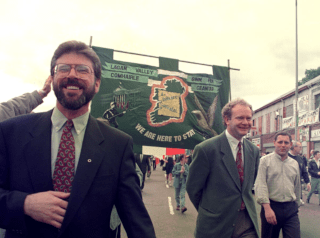
(From: “Britain and I.R.A. Group to Begin Talks in Northern Ireland” by John Darnton, The New York Times, December 2, 1994 | Pictured: Gerry Adams and Martin McGuinness lead a Republican parade in Belfast, commemorating 25 years of British troops on the streets of Northern Ireland in 1994)


Leave a comment

Gerry Adams Meets Bill Clinton for the First Time

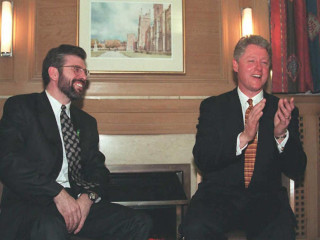
For the United States Congress‘s annual St. Patrick’s Day luncheon on March 16, 1995, Newt Gingrich, the Speaker of the House of Representatives, invites Ireland’s new Taoiseach, John Bruton, to be the main event. However, the first handshake between President Bill Clinton and Gerry Adams, the head of Sinn Féin, the political wing of the Irish Republican Army (IRA), steals the spotlight.

Some of the fifty people at the luncheon, most of them Irish American members of Congress, think Clinton might forgo a handshake because he is under tremendous pressure from Britain’s Prime Minister John Major not to give Adams a warm embrace. But Clinton does not hesitate although the handshake comes after photographers have left the room.

“Gerry was concerned about the protocol of how he should go up to the President, but when he walked up, the President gave him a very big handshake,” says Representative Peter T. King, a Republican from Seaford, Long Island, who sits to the right of Adams at the lunch. After an awkward moment of silence, the room explodes with applause.

The President and the Sinn Féin leader speak for five minutes. Later Adams says, “The engagement was positive, was cordial.”

According to Rep. King, Clinton says he is committed to making the Irish peace effort succeed and, while talking to Adams, puts his fist in front of him and says, “This is going to work.” Adams says Clinton does not urge him to make sure the IRA disarms, something Major asked the President to do. Clinton invites Adams to a White House reception scheduled for the following day and, according to his aides, plans to speak to Major over the weekend in an effort to patch up their differences.

The tone at the luncheon is often light. Clinton jokes that finally he is at a place where people will not criticize him for taking a drink of Guinness. Also, Bruton hails Gingrich as an honorary Irishman, noting that his mother apparently descended from the Doherty clan of County Donegal.

Wearing a white carnation tinged with green, Gingrich gives the Taoiseach a bowl of Georgia peanuts and a book on the history of the United States Capitol. Telling Gingrich that he is not the first person to consider overhauling welfare, Bruton gives him an 1840’s book about welfare reform in Ireland.

Some attendees joke that there are almost as many Kennedys at the luncheon as there are Republicans. There are Senator Edward M. Kennedy and Representative Joseph P. Kennedy, both of Massachusetts, Representative Patrick Kennedy of Rhode Island, and Jean Kennedy Smith, the American Ambassador to Ireland.

The menu would make any Irishman proud: boiled corned beef and cabbage, boiled potatoes, soda bread and lime sherbet.

(From: “Gerry Adams Shakes Hands With Clinton” published in The New York Times, March 17, 1995)


Leave a comment

Gerry Ryan Model Unveiled at Madame Tussaud’s Dublin Museum

Gerard “Gerry” Ryan, presenter of radio and television employed by Raidió Teilifís Éireann (RTÉ), becomes the latest homegrown celebrity to feature in the Irish version of Madame Tussauds collection when he unveils a life-size model of himself at the Dublin museum on October 29, 2002.

Ryan is born in Clontarf, County Dublin on June 4, 1956. He describes his father, Vinnie, as a “slightly eccentric” dentist from a Presbyterian background and his mother, Maureen, as “a flamboyant woman” who comes from a theatrical background and works in the theatre. His godfather is broadcaster Eamonn Andrews. He is educated at St. Paul’s College, Raheny.

Ryan hosts several series of television shows, including Secrets, Gerry Ryan Tonight, Ryantown, Gerry Ryan’s Hitlist, Ryan Confidential and the first three series of Operation Transformation. In 1987, he earns notoriety and the moniker “Lambo” after an unpleasant incident in Connemara. He is also noted for co-presenting, with Cynthia Ní Mhurchú, Eurovision Song Contest 1994 and, in 2008, presenting an edition of The Late Late Show, television’s longest-running chat show, in place of the then regular host Pat Kenny.

Ryan presents The Gerry Ryan Show on radio station RTÉ 2fm each weekday morning from 1988 until hours before his sudden death. He is presented with a Jacob’s Award for the show in 1990.

Ryan marries Morah Brennan in 1988 and they have five children: Lottie, Rex, Bonnie, Elliott and Babette. In 1997, Morah famously telephones her husband’s show and, under the name Norah, tells half a million listeners intimate details concerning his personal household habits. Gerry and Morah announce their separation in March 2008, which Ryan calls “a very painful experience.” He soon begins a relationship with the former South African Ambassador to Ireland and the then UNICEF Ireland executive director, Melanie Verwoerd.

Ryan is noted for his love of fine food and wine. He battles a weight problem for several years and takes Reductil (Sibutramine), a “slimming pill,” which he says is effective and safe. Ryan concedes in his autobiography Would the Real Gerry Ryan Please Stand Up, released in October 2008, that he drinks too much for his own good.

Ryan is found dead in the bedroom of his home on Leeson Street, Dublin on April 30, 2010.

Among the dignitaries to send tributes following Ryan’s death are Bono, Bill and Hillary Clinton, Taoiseach Brian Cowen, and President Mary McAleese. His funeral takes place on May 6, 2010, and is broadcast on 2fm, the home of Ryan’s radio show and a first for the predominantly youthpop-oriented station. His death also comes sixteen years to the day after he hosted Eurovision 1994.

An inquest shows that the cause of Ryan’s death is cardiac arrhythmia and that traces of cocaine found in Ryan’s system are the “likely trigger” of Ryan’s death. A considerable public controversy erupts when Ryan’s long-term use of cocaine comes to light. RTÉ eventually admits to having given insufficient coverage of Ryan’s cocaine habit in the aftermath of the inquest.