seamus dubhghaill

Promoting Irish Culture and History from Little Rock, Arkansas, USA


Leave a comment

Birth of Rev. William Corby, Chaplain & Notre Dame President

The Rev. William Corby, American priest of the Congregation of Holy Cross and Union Army chaplain in the American Civil War attached to the Irish Brigade, is born in Detroit, Michigan on October 2, 1833. He serves twice as president of the University of Notre Dame.

Corby is born to Daniel Corby, an Irish immigrant, and his wife Elizabeth, a Canadian. He attends public school until age 16, then joins his father’s real estate business. In 1853, he enrolls in the 10-year-old college of Notre Dame in South Bend, Indiana, and begins study for the priesthood three years later. Following ordination, he teaches at Notre Dame and serves as a local parish priest.

Corby leaves his position at Notre Dame and joins the predominately Catholic Irish Brigade in 1861. He spends the next three years as chaplain of the 88th New York Volunteer Infantry, which is one of the five original regiments in the Irish Brigade. He is perhaps best known for giving general absolution to the Irish Brigade on the second day of the Battle of Gettysburg. Of the Brigade’s original 3,000 men, only about 500 remain. Of the men Corby absolves that day, 27 are killed, 109 are wounded, and 62 are listed as missing. The scene of Corby blessing the troops is depicted in the 1891 painting Absolution under Fire by Paul Wood, and dramatized in the 1993 film Gettysburg. His memoir of the Irish Brigade becomes a best-seller.

Following his service in the Civil War, Corby returns to Notre Dame and serves as its vice-president (1865–1866) and twice as its president (1866–1872, 1877-1881). Under his first administration, enrollment at Notre Dame increases to more than 500 students. In 1869 he opens the law school, which offers a two-year course of study, and in 1871 he begins construction of Sacred Heart Church, today the Basilica of the Sacred Heart, Notre Dame. The institution is still small, and he teaches in the classroom and knows most students and faculty members. In 1869, the entire student body and the faculty present him with the gift of a black horse and, when he leaves the presidency three years later, they present him with a matching carriage.

Corby becomes president again following the short term of Fr. Patrick Colovin. When he returns to the presidency, Notre Dame has not yet become a significant academic institution. His presidency sees the April 1879 fire that destroys the old Main Building of the school. He sends all students home and promises that they will return to a “bigger and better Notre Dame.” He overcomes the $200,000 fire loss and rebuilds the Main Building, which now stands with its “Golden Dome.” During his administration, he also constructs Washington Hall, in which he takes much pride, and starts the construction of St. Edward’s Hall for the minims program.

In addition to his presidency, Corby is also serving as the Holy Cross Provincial, when Rev. Edward Sorin, who had become Superior General of the Congregation, writes to him to tell him that he will have to relinquish one of his positions. He wants to remain president but is overruled by Sorin. Famous throughout the U.S. Catholic world as chaplain for the Irish Brigade, known as the “Fighting Irish,” it may be that the nickname followed Corby back to Notre Dame, where it stuck.

Corby dies at the age of 64 on December 28, 1897 in South Bend, Indiana. He is buried in Holy Cross Cemetery, Notre Dame, Indiana.

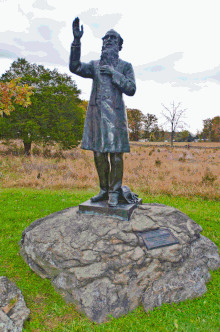
A statue by Samuel Murray, depicting Corby with right hand raised in the gesture of blessing, stands upon the same boulder at the Gettysburg Battlefield on which the priest stood while blessing the troops that second morning of the battle. It is the first statue of a non-general erected on the Gettysburg Battlefield, and is dedicated in 1910.

Corby is widely remembered among military chaplains and celebrated by Irish American fraternal organizations. Corby Hall at Notre Dame is named for him, and a copy of the Gettysburg statue stands outside the building. An organization of Notre Dame alumni is named The William Corby Society.

(Pictured: Statue of Father William Corby by Samuel Murray, Gettysburg Battlefield, Gettysburg, Pennsylvania)

Leave a comment

Birth of Novelist & Screenwriter Brian Moore

brian-moore

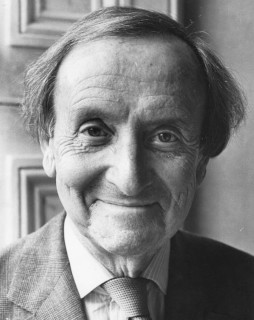
Brian Moore, novelist and screenwriter who is acclaimed for the descriptions in his novels of life in Northern Ireland after World War II, is born in Belfast, Northern Ireland on August 25, 1921. He has been described as “one of the few genuine masters of the contemporary novel.”

Moore is born into a large Roman Catholic family. His father, James Bernard Moore, is a prominent surgeon and the first Catholic to sit on the senate of Queen’s University Belfast. His mother, Eileen McFadden Moore, a farmer’s daughter from County Donegal, is a nurse. His uncle is the prominent Irish nationalist, Eoin MacNeill, founder of Conradh na Gaeilge and Professor of Irish at University College Dublin. He is educated at St. Malachy’s College, Belfast. He leaves the college in 1939, having failed his senior exams.

Moore is a volunteer air raid warden during World War II and serves during the Belfast Blitz in April and May 1941. He goes on to serve as a civilian with the British Army in North Africa, Italy and France. After the war ends, he works in Eastern Europe for the United Nations Relief and Rehabilitation Administration.

In 1948 Moore emigrates to Canada to work as a reporter for the Montreal Gazette and becomes a Canadian citizen. While eventually making his primary residence in California, he continues to live part of each year in Canada up to his death.

Moore lives in Canada from 1948 to 1958, where he meets his first wife, Jacqueline (“Jackie”) Sirois, a French Canadian and fellow journalist. They marry in 1952. He moves to New York City in 1959 to take up a Guggenheim Fellowship and remains there until his divorce in October 1967. He then moves to the west coast of the United States, settling in Malibu, California, with his new wife Jean Denney, a former commentator on Canadian TV. There he teaches creative writing at UCLA.

Moore writes his first novels in Canada. His earliest novels are thrillers, published under his own name or using the pseudonyms Bernard Mara or Michael Bryan. His first novel outside the genre, Judith Hearne, remains among his most highly regarded. The book is rejected by ten American publishers before being accepted by a British publisher. It is made into a film, with British actress Maggie Smith playing the lonely spinster who is the book/film’s title character.

Other novels by Moore are adapted for the screen, including Intent to Kill, The Luck of Ginger Coffey, Catholics, Black Robe, Cold Heaven, and The Statement. He co-writes the screenplay for Alfred Hitchcock‘s Torn Curtain, and writes the screenplay for The Blood of Others, based on the novel Le Sang des autres by Simone de Beauvoir.

Some of Moore’s novels feature staunchly anti-doctrinaire and anti-clerical themes, and in particular he speaks strongly about the effect of the Church on life in Ireland. A recurring theme in his novels is the concept of the Catholic priesthood. On several occasions he explores the idea of a priest losing his faith. At the same time, several of his novels are deeply sympathetic and affirming portrayals of the struggles of faith and religious commitment, Black Robe most prominently.

Moore dies at his Malibu home, which is celebrated in Seamus Heaney‘s poem Remembering Malibu, on January 11, 1999, from pulmonary fibrosis. His widow, Jean, lives on in the house until it is destroyed in 2018 in the Woolsey Fire.

At the time of his death, Moore is working on a novel about the 19th-century French symbolist poet Arthur Rimbaud. His last published work before his death is an essay entitled “Going Home.” It is a reflection inspired by a visit he made to the grave in Connemara of his family friend, the Irish nationalist Bulmer Hobson. The essay is commissioned by Granta and published in The New York Times on February 7, 1999.

In 1996, the Brian Moore Short Story Awards is launched by the Creative Writers Network in Northern Ireland and is open to all authors of Irish descent. Previous judges have included Glenn Patterson, Lionel Shriver, Carlo Gébler and Maeve Binchy.

In 1975 Moore arranges for his literary materials, letters and documents to be deposited in the Special Collections Division of the University of Calgary Library, an inventory of which is published by the University of Calgary Press in 1987. His archives, which include unfilmed screenplays, drafts of various novels, working notes, a 42-volume journal (1957–1998), and his correspondence, are housed at the Harry Ransom Center at the University of Texas at Austin.


Leave a comment

Birth of The Reverend Edward Hincks

edward-hincks

The Reverend Edward Hincks, Anglo-Irish clergyman best remembered as an Assyriologist and one of the decipherers of Mesopotamian cuneiform, is born in Cork, County Cork on August 19, 1792. He is one of the three men known as the “holy trinity of cuneiform,” with Sir Henry Creswicke Rawlinson and Jules Oppert.

Hincks is the eldest son of the Rev. Thomas Dix Hincks, a distinguished Protestant minister, orientalist and naturalist. He is an elder brother of Sir Francis Hincks, a prominent Canadian politician who is also sometime Governor of Barbados, and William Hincks, the first Professor of Natural History at Queen’s College, Cork and afterwards University College, Toronto.

Hincks is educated at home by his father and at Midleton College before entering Trinity College Dublin. He is elected a Scholar of the College in 1810, and in 1812 wins the Gold Medal and Bishop Law‘s Prize for Mathematics. He is elected a Fellow of the College in 1813 and four years later takes his M.A. In 1819, following the death of Thomas Meredith, he is presented to the Rectory of Ardtrea in County Tyrone. Though Ardtrea is a valuable and highly prized Rectory, it is also isolated for a young bachelor, and he resigns the position in 1826, taking up the Rectory in nearby Killyleagh, County Down, an office he holds for the remainder of his life.

The undemanding nature of his clerical duties leave him with more than enough time to pursue his interest in ancient languages. His first love is for the hieroglyphic writing of ancient Egypt. His greatest achievement is the decipherment of the ancient language and writing of Babylon and Assyria: Akkadian cuneiform.

Hincks deduces correctly that cuneiform writing had been invented by one of the earliest civilisations of Mesopotamia, who then bequeathed it to later states such as Babylon, Assyria and Elam. In 1848 he is awarded the Cunningham Medal of the Royal Irish Academy for his achievements.

By 1850 Hincks comes to a number of important conclusions regarding the nature of Assyro-Babylonian cuneiform. He also discovers that cuneiform characters are “polyphonic,” by which he means that a single sign can have several different readings depending on the context in which it occurs. However, not everyone is convinced by the claims being made by the Irishman and his distinguished colleagues. Some philologists even suggest that they are simply inventing multiple readings of the signs to suit their own translations.

In 1857 the versatile English Orientalist William Henry Fox Talbot suggests that an undeciphered cuneiform text be given to several different Assyriologists to translate. If, working independently of one another, they come up with reasonably similar translations, it will surely dispel the doubts surrounding their claims.

As it happens, Talbot, Hincks, Rawlinson and Oppert, are in London in 1857. Edwin Norris, secretary of the Royal Asiatic Society, gives each of them a copy of a recently discovered inscription from the reign of the Assyrian emperor Tiglath-Pileser I. A jury of experts is impaneled to examine the resulting translations and assess their accuracy.

In all essential points the translations produced by the four scholars are found to be in close agreement with one another. There are of course some slight discrepancies. The inexperienced Talbot makes a number of mistakes, and Oppert’s translation contains a few doubtful passages due to his unfamiliarity with the English language. But Hincks’ and Rawlinson’s versions are virtually identical. The jury declares itself satisfied, and the decipherment of cuneiform is adjudged a fait accompli.

Hincks devotes the remaining years of his life to the study of cuneiform and makes further significant contributions to its decipherment. He dies at his rectory in Killyleagh on December 3, 1866, at the age of 74. He is survived by a wife and four daughters.


Leave a comment

Ahern & Blair Push for Implementation of the Good Friday Agreement

ahern-and-blair-1998

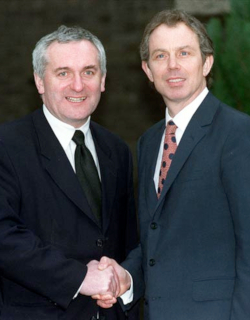
At an informal European Union summit near Bonn on February 26, 1999, Taoiseach Bertie Ahern and British Prime Minister Tony Blair agree to push for implementation of the Good Friday Agreement by the March 10 deadline.

As EU delegates discuss the Union’s budget and Europe‘s farming subsidies, the two prime ministers vow to battle on with the peace deal’s outstanding problems.

“We’re very clear on what we have to do in the Good Friday agreement … we have just got to keep pushing the thing forward as well as we possibly can,” says Blair.

Both Ahern and Blair say the way forward on the outstanding deadlocked issue of paramilitary disarmament is through the official decommissioning commission. Chaired by former Canadian General John de Chastelain, the international commission is working to take arms out of the province’s political arena.

The republican party Sinn Féin insists it is fully cooperating with the commission, which is implementing the final deadline for the handover of arms in May 2000. But some Ulster Unionists oppose further peace moves because of the Irish Republican Army‘s (IRA) failure to begin disarming.

According to Ahern and Blair, the following few weeks will be a key time to try and finalise disarmament issues.

“During the month of March … we can conclude the central aspects,” says Blair.

However, in a separate development on February 26, the chairman of the IRA’s political wing, Sinn Féin’s Mitchel McLaughlin, warns that pressure on disarmament could cause irreparable damage to the fragile peace process. He adds that disarmament should not become a litmus test for progress.

“Those who are now demanding prior decommissioning before we move to setting up the executive are reneging on the Good Friday Agreement,” says McLaughlin in an interview with BBC Radio.

(From BBC News Online Network, Friday, February 26, 1999 | Pictured: Bertie Ahern with Tony Blair at the signing of the Good Friday Agreement in April 1998)


Leave a comment

Birth of Father Leonard Eugene Boyle

leonard-eugene-boyle

Leonard Eugene Boyle, Irish and Canadian scholar in medieval studies and palaeography, is born in Ballintra, County Donegal on November 13, 1923. He is the first Irish and North American Prefect of the Vatican Library in Rome from 1984 to 1997.

Boyle spends some years in Tralee, County Kerry, following the July 1940 death of his older brother John, who is a member of Garda Síochána and drowns while on holiday in Ballybunion, County Kerry. He is educated in the Irish language and enters the Dominican Order in 1943. He is ordained a priest in 1949 having received his doctorate in Oxford.

Boyle frequently visits Tralee, where a number of his family still reside, and is involved in many projects in the town. His immense knowledge and expertise in historical and archaeological issues is freely given in order to enhance the town. Of particular concern is his hope that the site of the original Dominican Priory at the centre of the town be conserved for future archaeological excavation.

After moving to Toronto, Boyle teaches at the Pontifical Institute of Mediaeval Studies and at the Centre for Medieval Studies at the University of Toronto from 1961 to 1984. He also serves as Professor of Latin Palaeography and History of Medieval Theology at the Pontifical University of St. Thomas Aquinas in Rome from 1956 to 1961.

In 1984 Boyle is appointed Prefect of the Vatican Library by Pope John Paul II. This appointment takes him by surprise but appears to be a recognition of his immense scholarship, expertise in antiquity and renowned interest in learning as a whole. In an effort to modernise the Vatican Library, he sets about the digitisation of the library’s many thousands of manuscripts that date from hundreds of years BC, which leads to their greater availability to scholars around the world. He also extends the opening hours of the library and employs women for the first time as part of the library’s staff. In 1987, he is made an Officer of the Order of Canada. In 1997, he is ousted as Prefect after his dealings with some American fund-raising associates result in lawsuits involving the Vatican.

Known for his wit and independence of mind and spirit, Boyle is once asked of his interest in being a Cardinal given the fact that all of his predecessors have gone on to be Cardinals. His reply is in the negative saying “nothing but the papacy” would do him.

Father Boyle dies on October 25, 1999. He is buried in his beloved Basilica di San Clemente, in 2000, a year after his death, following official desire to give him the honour of interment in the vaults of San Clemente — one of Rome’s holiest and most historical shrines.