Caulfeild, the son of the 3rd Viscount Charlemont, succeeds his father as 4th Viscount in 1734. The title of Charlemont descends from Sir Toby Caulfeild, 1st Baron Caulfeild (1565–1627) of Oxfordshire, England, who is given lands in Ireland, and creates Baron Charlemont (the name of a fort on the Blackwater), for his services to King James I in 1620. The 1st Viscount is the 5th Baron (d. 1671), who is advanced by Charles II.
Lord Charlemont is well known for his love of Classical art and culture and spends nine years on the Grand Tour in Italy, Greece, Turkey and Egypt. He returns to Dublin and employs the Scottish architect Sir William Chambers to remodel his main residence Marino House, to design his town house Charlemont House and the unique Neoclassical Garden pavilion building, the Casino at Marino.
Lord Charlemont is historically interesting for his political connection with Henry Flood and Henry Grattan. He is a cultivated man with literary and artistic tastes, and both in Dublin and in London he has considerable social influence. He is the first President of the Royal Irish Academy and is a member of the Royal Dublin Society. He is appointed Custos Rotulorum of County Armagh for life in 1760. For various early services in Ireland, he is made an earl in 1763, but he disregards court favours and cordially joins Grattan in 1780 in the assertion of Irish independence. In 1783 he is made a founding Knight of the Order of St. Patrick.
Lord Charlemont is president of the volunteer convention in Dublin in November 1783, having taken a leading part in the formation of the Irish Volunteers, and he is a strong opponent of the proposals for the Acts of Union 1800. His eldest son, who succeeds him, is subsequently created an English Baron in 1837.
Lord Charlemont dies on August 4, 1799.
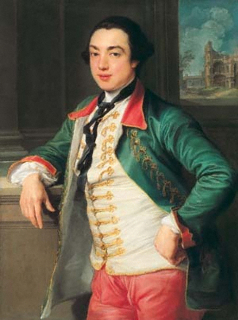
(Pictured: Charlemont as painted by Pompeo Batoni, c. 1753-56)
McCarthy becomes a professional soldier and shows great skill in his profession, but poor eyesight hampers his career. He enters the French army in 1671 and then transfers to James Scott, 1st Duke of Monmouth‘s regiment, then in French pay, and serves against the Dutch.
McCarthy comes to England in 1678 and is befriended by the future James II, who generally chooses soldiers, especially Irish soldiers, as his boon companions. Charles II decides to use his services in Ireland and makes him a colonel in Sir Thomas Dongan‘s regiment. On the outbreak of the Popish Plot, however, the discovery of McCarthy’s presence at Whitehall causes uproar. He flees the country and the Secretary of State for the Northern Department, Sir Joseph Williamson, who had issued his commission, is sent to the Tower of London.
In 1689 McCarthy takes Castlemartyr and Bandon for James. At Bandon there is a massacre called “Black Monday,” but he persuades the King to issue a general pardon to his defeated opponents. He meets James at his landing at Kinsale and is commanded to raise seven regiments. He sits in the Irish House of Lords in the Parliament of Ireland of 1689.
With 3,000 men McCarthy advances from Dublin toward Enniskillen, which with Derry is the remaining resistance to James II. He is met by 2,000 Protestant “Inniskillingers” at the Battle of Newtownbutler on July 31, 1689. His forces are routed, he is wounded and then captured. Allowed out on parole he breaks parole and escapes to Dublin. Frederick Schomberg, 1st Duke of Schomberg, remarks that he had thought McCarthy was a man of honour, but on the other hand he expected no better from an Irishman.
McCarthy goes into exile in France and commands the first Irish Brigade of Louis XIV. His later career is hampered by his near blindness. He dies at Barèges on July 1, 1694, and is buried there.
The family fights as part of the JacobiteIrish Army during the War of the Two Kings, before going into exile in the Flight of the Wild Geese. Charles succeeds his brother, Daniel O’Brien, 4th Viscount Clare, to the title as 5th Viscount Clare in the Jacobite Peerage on his brother’s death from a mortal wound received in the Battle of Marsaglia in Italy on October 4, 1693. Charles is transferred from the Queen’s Dismounted Dragoons where he is a colonel, to the command of O’Brien’s Regiment on April 6, 1696. Later in the year he leads the regiment in the siege of Valenza in Lombardy, and the next year they are stationed with the army at Meuse.
By 1698 over one third of King James’ army is either dead or crippled, and when the Treaty of Ryswick ends the war between Louis and William, James’ soldiers are disbanded, unemployed, and homeless. Many become beggars but others join the Irish Brigade in the Spanish army, while others travel to Austria and enter the Catholic Corps.
Hostilities are renewed and Clare’s Regiment is assigned to the Army of Germany for two years in 1701-02. At the Battle of Cremona in 1702, the Irishmen defend the town against Prince Eugene and the imperial army. The attack is to be a surprise, but the Wild Geese foil the attempt. The following year Lord Clare is promoted to brevet Brigadier of Infantry on April 2, 1703. A few months later on September 20, 1703, the unit takes part in the successful Battle of Hochstedt, better known as the Battle of Blenheim. A year later the unit is involved with the unsuccessful battle on August 13, 1704, at the second Battle of Blenheim. Although Clare’s Regiment experiences ups and downs, they are always admired. Two months after Blenheim, Charles rises to the brevet rank of Marshal-de-Camp on October 26, 1704, and a year later he is assigned to the Army of the Moselle under the Marshel de Villars. Clare’s Regiment fights in the disastrous Battle of Ramillies on May 23, 1706, where they distinguish themselves with great glory, but Lord Clare is mortally wounded and dies at Brussels, Belgium.
Due to the great service the O’Brien family has given to France, and having risked all, King Louis XIV makes sure that the regiment is kept in the family and appoints Lt. Col. Murrough O’Brien (of the Carrigonnell O’Brien’s) as its commander until the minor Charles comes of age.
The Richmond Tower at the end of the formal avenue leading to the Royal Hospital is designed by Francis Johnston, one of the leading architects of the day. This gateway originally stands beside the River Liffey at Bloody Bridge (now Rory O’More Bridge) but has to be moved after the arrival of the railway in 1844 increases traffic congestion. Johnston places his personal coat of arms above the arch, concealed by a piece of wood painted to match the stone, his idea being that his arms would be revealed to future generations after the wood becomes rotten. However, his little trick is uncovered when the gateway is taken down for removal. The coat of arms currently on the gateway is that of the Royal Hospital.
The Royal Hospital Kilmainham graveyards, including Bully’s Acre, are 400 metres to the west. A cross-shaft in the former cemetery may be the remains of a boundary cross associated with a ninth-century monastery located at this site.
Following the creation of the Irish Free State the Royal Hospital is considered as a potential home for Oireachtas Éireann, the new Irish national parliament. Eventually it is decided to keep parliament in its temporary home in Leinster House. The Hospital remains the home of a dwindling number of soldiers, before being variously used by the Garda Síochána and as a storage location for property belonging to the National Museum of Ireland. The large statue Queen Victoria which used to stand in the forecourt of Leinster House, before its removal in 1947, is stored in the main courtyard of the Hospital, as are various state carriages, including the famously spectacular State Coach of the Lord Chancellor of Ireland. The Royal Hospital Kilmainham is finally restored by the Irish Government in 1984 and controversially opens as the Irish Museum of Modern Art (IMMA). Some people working in heritage organisations criticise the decision to demolish the eighteenth-century barrack rooms in one section of the quadrangle to create open spaces for the IMMA.
In recent years, Royal Kilmainham Hospital has become a popular location for concerts during the summer months. Acts such as Blur, Leonard Cohen, The Flaming Lips, Jack White and Public Enemy have played within the grounds in the past.
O’Hanlon spends several years in exile as an officer with the French army and is awarded the title of Count of the French Empire. He returns to Ireland around 1660, after the Restoration of King Charles II of England. After realizing there will be no restitution of his family’s lands, he takes to the hills around Slieve Gullion and becomes a notorious highwayman.
Although O’Hanlon is often compared to a real-life Robin Hood, the truth is more complex. Protestant landlords, militia officers, and even Anglican and Catholic priests work as informal members of the O’Hanlon gang, giving him information and scouting sites for him to rob. He also forces the landlords and merchants of northern Ireland to pay protection money. It is stated that the criminal activities of O’Hanlon are bringing in more money than the King’s revenue collectors.
In 1674 the colonial authorities in Dublin put a price on O’Hanlon’s head with posters advertising for his capture, dead or alive. The Anglo-Irish landowner Henry St. John, who had been granted the traditional lands of the O’Hanlon clan, receives O’Hanlon’s undying hatred when he begins evicting his clansmen in large numbers. St. John responds by waging a private war against the O’Hanlon Gang. The loss of his 19-year-old son while pursuing O’Hanlon only makes Henry St. John increasingly brutal toward anyone suspected of aiding Redmond O’Hanlon. On September 9, 1679, St. John is riding on his estate with a manservant and the Reverend Lawrence Power, the Church of Ireland Rector of Tandragee. A party of O’Hanlon’s associates ride into view and seize him, warning that he would be killed if a rescue is attempted. Then, a group of the family’s retainers ride into view and open fire on the kidnappers. As a result, Henry St. John receives two pistol balls in the forehead.
At the landlord’s funeral, an outraged Reverend Power denounces the outlaws and the landowners who do business with them. Outraged, James Butler, 1st Duke of Ormond, the Lord Deputy of Ireland, orders the assassination of O’Hanlon.
Count Redmond O’Hanlon is murdered in his sleep by his foster brother and close associate Art MacCall O’Hanlon at Eight Mile Bridge near Hilltown, County Down, on April 25, 1681. Art receives a full pardon and two hundred pounds from the Duke of Ormond for murdering his leader. William Lucas, the militia officer who had recruited Art and arranges the killing, receives a Lieutenant’s commission in the British Army.
As is the custom of the day, there are gruesome displays of his body parts including his head which is placed on a spike over Downpatrick jail. His remains are eventually removed to lie in a family plot in Conwal Parish Church cemetery in Letterkenny, County Donegal, where his parents had fled from Henry St. John. His bones, however, are not left to rest in peace there and his grave is constantly desecrated by the duke’s supporters. His remains are finally removed by his family and interred in his final secret resting place, somewhere within Lurgan Parish.
On December 25, 1715, Joshua Dawson, Irish public servant, land developer and politician, sells the Mansion House with its gardens and park to Dublin Corporation for £3,500 plus 40 shillings per annum and a “loaf of double refined sugar of six pounds weight” which is to be paid to the Dawsons every Christmas.
Dawson is born in 1660 at the family seat, which becomes Castledawson, County Londonderry, the son of Thomas Dawson, Commissary of the Musters of the Army in Ireland. He resides in County Londonderry and Dublin. His ancestral family had owned land and lived in the area where, in 1710, he founds Dawson’s Bridge, named after the bridge over the River Moyola, which becomes present-day Castledawson. In his estate he builds Moyola House in 1713.
Dawson develops an area of Dublin in 1705-1710 which includes the setting out and construction of the streets of Dawson Street, Anne Street, Grafton Street and Harry Street. These streets are named after, respectively, himself, Queen Anne (widow of William III), and Henry FitzRoy, 1st Duke of Grafton, the son of Charles II and cousin of Queen Anne. This development includes the construction of the Mansion House in Dawson Street in 1710 which is purchased in 1715 to be the official residence of the Lord Mayor of Dublin, which it has remained for 300 years.
(Pictured: Mansion House, official residence of the Lord Mayor of Dublin)
Makem’s mother, Sarah Makem, is an important source of traditional Irish music, who is visited and recorded by, among others, Diane Guggenheim Hamilton, Jean Ritchie, Peter Kennedy and Sean O’Boyle. His father, Peter Makem, is a fiddler who also plays the bass drum in a local pipe band named “Oliver Plunkett,” after a Roman Catholic martyr of the reign of Charles II of England. His brother and sister are folk musicians as well. Makem, from the age of eight, is member of the St. Patrick’s church choir for 15 years where he sings Gregorian chant and motets. He does not learn to read music but he makes it in his “own way.”
Makem starts to work at 14 as a clerk in a garage and later he works for a while as a barman at Mone’s Bar, a local pub, and as a local correspondent for The Armagh Observer.
Makem emigrates to the United States in 1955, carrying his few possessions and a set of bagpipes from his time in a pipe band. Arriving in Dover, New Hampshire, he works at Kidder Press, where his hand was accidentally crushed by a press in 1956. With his arm in a sling, he leaves Dover for New York City to pursue an acting career.
The Clancys and Makem are signed to Columbia Records in 1961. The same year, at the Newport Folk Festival, Makem and Joan Baez are named the most promising newcomers on the American folk scene. During the 1960s, the Clancy Brothers and Tommy Makem perform sellout concerts at such venues as Carnegie Hall, and make television appearances on shows like The Ed Sullivan Show and The Tonight Show. The group performs for President John F. Kennedy. They also play in smaller venues such as the Gate of Horn in Chicago. They appear jointly in the UK Albums Chart in April 1966, when Isn’t It Grand Boys reaches number 22.
Makem leaves the group in 1969 to pursue a solo career. In 1975, he and Liam Clancy are both booked to play a folk festival in Cleveland, Ohio, and are persuaded to do a set together. Thereafter they often perform as Makem and Clancy, recording several albums together. He once again goes solo in 1988. Throughout the 1970s and 1980s he performs both solo and with Liam Clancy on The Irish Rovers‘ various television shows, which are filming in Canada and Ireland.
In the 1980s and 1990s, Makem is a principal in a well-known Irish music venue in New York, “Tommy Makem’s Irish Pavilion.” This East 57th Street club is a prominent and well-loved performance spot for a wide range of musicians. Among the performers and visitors are Paddy Reilly, Joe Burke, and Ronnie Gilbert. Makem is a regular performer, often solo and often as part of Makem and Clancy, particularly in the late fall and holiday season. The club is also used for warm-up performances in the weeks before the 1984 reunion concert of The Clancy Brothers and Tommy Makem at Lincoln Center for the Performing Arts. In addition, the after-party for Bob Dylan‘s legendary 30th Anniversary Concert Celebration at Madison Square Garden in 1992 is held at the Irish Pavilion.
In 1997 Makem writes a book, Tommy Makem’s Secret Ireland, and in 1999 premiers a one-man theatre show, Invasions and Legacies, in New York. His career includes various other acting, video, composition, and writing credits. He also establishes the Tommy Makem International Festival of Song in South Armagh in 2000.
Tommy Makem dies in Dover, New Hampshire, on August 1, 2007, following a lengthy battle with lung cancer. He continues to record and perform until very close to the end. Paying tribute to him after his death, Liam Clancy says, “He was my brother in every way.” He is buried next to his wife at New Saint Mary Cemetery in Dover.
The stadtholder dies suddenly, however, and the States are now embarrassed by Cromwell taking the idea too seriously. The English propose the joint conquest of all remaining Spanish and Portuguese possessions. England would take America and the Dutch would take Africa and Asia. But the Dutch have just ended their war with Spain and already taken over most Portuguese colonies in Asia, so they see little advantage in this grandiose scheme and propose a free trade agreement as an alternative to a full political union. This again is unacceptable to the British, who would be unable to compete on such a level playing field, and is seen by them as a deliberate affront.
The Act bans foreign ships from transporting goods from outside Europe to England or its colonies, and bans third-party countries’ ships from transporting goods from a country elsewhere in Europe to England. These rules specifically target the Dutch, who control much of Europe’s international trade and even much of England’s coastal shipping. It excludes the Dutch from essentially all trade with England, as the Dutch economy is competitive with, not complementary to the English, and the two countries therefore exchange few commodities. This Anglo-Dutch trade, however, constitutes only a small fraction of total Dutch trade flows.
The Act is often mentioned as a major cause of the First Anglo-Dutch War, though it is only part of a larger British policy to engage in war after the negotiations have failed. The English naval victories in 1653 (the Battle of Portland, the Battle of the Gabbard and the Battle of Scheveningen) show the supremacy of the Commonwealth navy in home waters. However, farther afield the Dutch predominate and are able to close down English commerce in the Baltic and the Mediterranean. Both countries hold each other in a stifling embrace.
The Treaty of Westminster (1654) ends the impasse. The Dutch fail to have the Act repealed or amended, but it seems to have had relatively little influence on their trade. The Act offers England only limited solace. It cannot limit the deterioration of England’s overseas trading position, except in the cases where England herself is the principal consumer, such as the Canary Islands wine trade and the trade in Puglian olive oil. In the trade with the West Indies, the Dutch keep up a flourishing “smuggling” trade, thanks to the preference of English planters for Dutch import goods and the better deal the Dutch offer in the sugar trade. The Dutch colony of New Netherland offers a loophole through intercolonial trade wide enough to drive a shipload of Virginia tobacco through.
The 1651 Act, like other laws of the Commonwealth period, is declared void on the Restoration of Charles II of England, having been passed by “usurping powers.” Parliament therefore passes new legislation. This is generally referred to as the “Navigation Acts,” and, with some amendments, remains in force for nearly two centuries.
The second surviving son of Charles I, James ascends the throne upon the death of his brother, Charles II. There is little initial opposition to his accession, and there are widespread reports of public rejoicing at the orderly succession. The new Parliament that assembles in May 1685, which gains the name of “Loyal Parliament,” is initially favourable to James, and the new King sends word that even most of the former exclusionists will be forgiven if they acquiesce to his rule.
Members of Britain’s Protestant political elite increasingly suspect him of being pro-French and pro-Catholic and of having designs on becoming an absolute monarch. When he produces a Catholic heir, leading nobles call on his Protestant son-in-law and nephew William of Orange to land an invasion army from the Dutch Republic, which he does in the Glorious Revolution of 1688. James flees England and thus is held to have abdicated. He is replaced by his eldest, Protestant daughter Mary and her husband William of Orange.
James is best known for his struggles with the English Parliament and his attempts to create religious liberty for English Roman Catholics and Protestant nonconformists, against the wishes of the Anglican establishment. This tension makes James’s four-year reign a struggle for supremacy between the English Parliament and the Crown, resulting in his deposition, the passage of the Bill of Rights, and the accession of his daughter and her husband as king and queen.
Greatrakes is the son of William Greatrakes and Mary, daughter of Sir Edward Harris, Chief Justice of Munster, who are English Protestants settlers. He goes to the free school at Lismore until he is 13 years of age and is designed for the college of Dublin. However, when the Irish Rebellion of 1641 breaks out, he and his mother flee into England, where he is received by his great uncle, Edmund Harris. After Harris dies, his mother places him with John Daniel Getsius, a German minister, of Stoke Gabriel, in Devonshire.
After five or six years in England, Greatrakes returns to his native country, which he finds in a distracted state, and therefore spends a year in contemplation at the Castle of Cappoquin. In 1649 he is a lieutenant in Lord Broghill‘s regiment in the English Parliamentary army in Ireland, then campaigning in Munster against the Irish Royalists. In 1656, with a great part of the army being disbanded, Greatrakes retires to Affine, his native place, and is made clerk of the peace for County Cork, Register for transplantation, and a Justice of the Peace. However, he loses these positions after the Restoration.
Greatrakes seems to have been very religious. His outlook is grave but simple. He says himself, that ever since the year 1662 he has felt a strange impulse or persuasion that he has the gift of curing the King’s evil. This suggestion becomes so strong, that he strokes several persons, and cures them.
Three years afterwards, an epidemical fever is raging in the country, he is again persuaded that he can also cure the fever. He makes the experiment, and he affirms to his satisfaction that he cures all who come to him. At length, in April 1665, another kind of inspiration suggests to him, that he has the gift of healing wounds and ulcers. He even finds that he cures convulsions, the dropsy, and many other distempers.
On April 6, 1665, Robert Phayre, a former Commonwealth Governor of County Cork, is living at Cahermore, in that county, when he is visited by Greatrakes, who had served in his regiment in 1649. Greatrakes cures Phayre in a few minutes of an acute ague. John Flamsteed, the famous astronomer, then aged 19, goes to Ireland in August 1665 to be touched by Greatrakes for a natural weakness of constitution, but receives no benefit. Crowds flock to him from all parts, and he performs such extraordinary cures, that he is summoned into the bishop’s court at Lismore, and, not having a licence for practising, is forbidden to lay hands on anyone else in Ireland.
In 1665, Greatrakes is invited to England by his old commander, Lord Broghill, now Earl of Orrery, to cure Anne, Viscountess Conway of an inveterate headache. He arrives in England in early 1666 but fails to cure the Viscountess. Undaunted, he travels through the country healing the sick.
King Charles II, being informed of it, summons Greatrakes to Whitehall. While unpersuaded that Greatrakes has miraculous power, the king does not forbid him to continue his ministrations.
Every day Greatrakes goes to a place in London where many sick persons, of all ranks in society, assemble. Pains, gout, rheumatism, convulsions, and so forth are allegedly driven by his touch from one body part to another. Upon reaching the extremities, all symptoms of these ailments cease. As the treatment consists entirely of stroking, Greatrakes is called The Stroker. He ascribes certain disorders to the work of evil spirits. When persons possessed by such spirits see Greatrakes or hear his voice, the afflicted fall to the ground or into violent agitation. He then proceeds to cure them by the same method of stroking. While many are skeptical, Greatrakes does find zealous advocates for the efficacy of his healing powers.
In 1667, Greatrakes returns to Ireland and resumes farming in 1668 on £1,000 a year. Although he lives for many years, he no longer keeps up the reputation of performing the strange cures which procured him a name. But in this his case is very singular, that on the strictest enquiry no sort of blemish is ever thrown upon his character, nor does any of those curious and learned persons, who espouse his cause, draw any imputation upon themselves.
Greatrakes dies on November 28, 1682, at Affane, County Waterford. It is believed that he may be buried in Lismore Church or under the aisle of the old Affane Church near to his father.