seamus dubhghaill

Promoting Irish Culture and History from Little Rock, Arkansas, USA


Leave a comment

The 1923 Mountjoy Prison Hunger Strike

On October 13, 1923, following the end of the Irish Civil War, Michael Kilroy, O/C of the Irish Republican Army (IRA) prisoners in Mountjoy Prison, announces a mass hunger strike by 300 prisoners. It soon spreads to other jails and within days 7,033 republicans are on hunger strike.

On the same day, the prisoners in Kilmainham Gaol go on hunger strike, and Ernie O’Malley writes eloquently of it in his book on the Civil War, The Singing Flame. He notes that “practically all volunteered; some were exempted, including myself, but I refused this concession.”

Previously, the Irish Free State government had passed a motion outlawing the release of prisoners on hunger strike. Dan Downey had died in the Curragh on June 10, and Joseph Witty, only 19 years old, also died in the Curragh on September 2. However, because of the large numbers of Republicans on strike, at the end of October the Government sends a delegation to Newbridge Camp to speak with IRA leaders there.

It soon becomes apparent that they are not there to negotiate the strikers’ demands, but rather to give the prisoners the Government’s message: “we are not going to force-feed you, but if you die we won’t waste coffins on you; you will be put in orange boxes and you will be buried in unconsecrated ground.”

O’Malley writes, “Any action was good, it seemed, and everyone was more cheerful when the hunger strike began. We listened to the tales of men who had undergone previous strikes and we, who were novices, wondered what it would be like. We laughed and talked, but in the privacy of our cells, some, like myself, must have thought what fools we were, and have doubted our tenacity and strength of will. I looked into the future of hunger and I quailed.”

All negotiations to curtail the strike are abandoned and the strike goes forward. Poorly planned, within weeks many are going off strike, but by the end of October, there are still 5,000 on strike. O’Malley does not know what effect the strike will have, but he feels he cannot ‘let the side down.’ “Hunger striking was an unknown quantity for me. I did not approve of it. I was frankly afraid, but I could not see boys of sixteen and eighteen take their chance whilst I could eat and be excused. Now, even though one thought one’s death could be of use, there was no passive acceptance. It was a challenge, a fight, and again resistance was built up……The mind would suffer more than the body. The struggle in the end would be between body and spirit.”

On November 20, Denis “Denny” Barry dies in the Newbridge Camp, and Andrew Sullivan dies in Mountjoy on November 22.

When Barry dies, the Bishop of Cork, Daniel Cohalan, refuses to let his body lie in a Cork church. When Terence MacSwiney died on hunger strike in 1921, Bishop Cohalan had written in The Cork Examiner, “I ask the favour of a little space to welcome home to the city he laboured for so zealously the hallowed remains of Lord Mayor Terence MacSwiney. For the moment, it might appear that he has died in defeat. Was Robert Emmet’s death in vain? Did Pearse and the other martyrs for the cause of Irish freedom die in vain? We bow in respect before his heroic sacrifice. We pray the Lord may have mercy on his soul.”

At the death of Denis Barry two years later, the very same Bishop Cohalan writes, “Republicanism in Ireland for the last twelve months has been a wicked and insidious attack on the Church and on the souls of the faithful committed to the Church by the law of the Catholic Church.” Denis Barry is not afforded a Catholic burial.

With the deaths of Barry and Sullivan drawing no positive response or concessions from the Free State government, the IRA command orders the strikes ended on November 23.

O’Malley writes that the strike ended with no promises of release, “we had been defeated again.” While the strike itself fails to win releases, it does begin a slow start of a programme of release of prisoners, the State being worried about the political impact of more deaths, though some prisoners remain in jail until as late as 1932.

O’Malley, writing of Tom Derrig who is in Mountjoy, relates that one of the strikers there, on the last day of the strike, had asked a doctor, “What day of the strike is this?” The doctor replies, “The forty-first.” The striker says, “Be cripes! We bate Christ by a day!”

(From: Stair na hÉireann | History of Ireland, http://www.stairnaheireann.net)

Leave a comment

Death of Sculptor Seamus Murphy

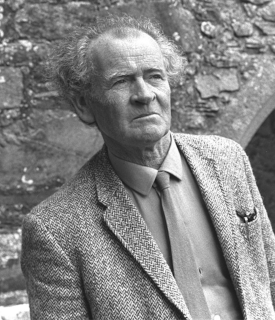
Seamus Murphy, Irish sculptor and stone carver best known for designing the Church of the Annunciation, Blackpool, Cork, dies in Cork, County Cork, on October 2, 1975.

Murphy is born near Mallow, County Cork on July 15, 1907, the son of James Murphy, a railway employee, and Margaret Sheehan of Little Island, County Cork. He attends Saint Patrick’s School on Gardiner’s Hill. In 1921 he enrolls as a part-time student at the Crawford School of Art, Emmet Place, Cork. In 1922 he finds work as an apprentice stone-carver at John Aloysius O’Connell’s Art Marble Works, Watercourse Road, Blackpool. There he specialises in architectural and foliage carving while continuing his studies at Crawford by night.

Murphy studies at the Académie Colarossi and at the Académie de la Grande Chaumière in Paris in 1932-1933 where he is befriended by the Irish American sculptor Andrew O’Connor. He opens his studio/workshop on Watercourse Road, Blackpool, Cork in 1934.

He is elected associate of the Royal Hibernian Academy in 1944, elected a full member in 1954, and appointed Royal Hibernian Academy Professor of Sculpture in 1964.

Also in 1944, he marries Maighread Higgins, daughter of the Cork sculptor Joseph Higgins, and they go on to have three children – the knitwear designer Bebhinn Marten, the novelist Orla Murphy and the painter and De Dannan member Colm Murphy.

Murphy designs the Church of the Annunciation on Great William O’Brien Street in Blackpool, Cork, for William Dwyer in 1945. The stonework in the church is mostly by Murphy himself. It is officially dedicated on October 7, 1945.

Seamus Murphy dies in Cork on October 2, 1975. He is buried in Rathcooney, County Cork.

Examples of Murphy’s unique carvings of statues, gravestones, monuments and plaques can be seen around Cork and Ireland, including a signed panel of the four evangelists outside the entrance of the church of Our Lady and Saint John in Carrigaline, County Cork.


1 Comment

Capture of Mallow Barracks

The Cork No. 2 Brigade, Irish Republican Army (IRA), attacks and captures a military barracks in Mallow, County Cork, on September 28, 1920, the only military barracks to be captured during the Irish War of Independence. British forces later burn and sack the town.

Mallow had been a garrison town for several hundred years. Eight miles to the north lay Buttevant where one of the largest military barracks in the country is located. Not far from Buttevant are the great military training camps of Ballyvonaire, while nineteen miles to the northeast is Fermoy with its large permanent military garrisons and huge barracks adjacent to the big training centres of Kilworth and Moorepark. Twenty miles to the southeast is the city of Cork with its many thousands of troops both in the posts within the city and at Ballincollig, about six miles west of it, on the Macroom road. Thirteen miles westward a detachment from a British machine gun corps holds Kanturk. Every town and village has its post of Royal Irish Constabulary (RIC) men armed to the teeth.

The idea of capturing the barracks comes from two members of the Mallow IRA Battalion, Dick Willis, a painter, and Jack Bolster, a carpenter, who are employed on the civilian maintenance staff of the barracks which is occupied by the 17th Lancers. Willis and Bolster are able to observe the daily routine of the garrison and form the opinion that the capture of the place would not be difficult. They are instructed by their local battalion officers to make a sketch map of the barracks. After that is prepared, Liam Lynch and Ernie O’Malley go with Willis and Tadhg Byrnes to Mallow to study the layout of the surrounding district. Among the details of the garrison’s routine that Willis and Bolster report to the Column leaders, is the information that each morning the officer in charge, accompanied by two-thirds of the men, take the horses for exercise outside the town. It is obvious to the two Mallow volunteers that this is the ideal time for the attack.

Situated at the end of a short, narrow street and on the western verge of the Town Park, Mallow barracks stand on an unusually low-lying location and is relatively small in size. Surrounded by a high stone wall, the barracks can be approached from the town park as well as from the main street. The various details are carefully studied by Lynch and O’Malley. While Willis and Bolster are allotted tasks within the walls of the barracks, Byrnes and Jack Cunningham are chosen to attack with the main body of the column which includes Commandant Denny Murphy of Kanturk.

On the morning of September 27, at their Burnfort headquarters, the men are ordered to prepare for action. Under cover of darkness they move into the town and enter the Town Hall by way of the park at the rear. The eighteen men of the column are strengthened by members of the Mallow battalion, a number of men posted in the upper storey of the Town Hall, from which they can command the approaches to the nearby RIC barracks. Initially it is planned that Willis and Bolster will enter the military barracks that morning in the normal manner, accompanied by an officer of the column who will pose as a contractor’s overseer. The officer is Paddy McCarthy of Newmarket, who would die a few months later in a gun battle with the Black and Tans at Millstreet.

McCarthy, Willis and Bolster enter the barracks without mishap. Members of the garrison follow their normal routine, with the main body of troops under the officer in charge leaving the barracks with the horses. In the barracks remain about fifteen men under the command of a senior N.C.O., Sergeant Gibbs.

Once the military has passed, the attackers, numbering about twenty men and led by Liam Lynch, advance toward the bottom of Barrack Street. All are armed with revolvers which are considered the most convenient and suitable weapons for the operation. Lynch has issued strict instructions that there is to be no shooting by the attackers, unless as a last resort. Inside the walls are McCarthy, Willis and Bolster, their revolvers concealed. Then Ernie O’Malley presents himself at the wicket gate with a bogus letter in his hand. Behind him and out of sight of the sentry are the other members of the main attacking party, led by Lynch, O’Brien and George Power. When the gate is opened sufficiently, O’Malley wedges his foot between it and the frame and the soldier is overpowered and the attackers rush in. McCarthy, Bolster and Willis immediately go to the guardroom where they hold up the guard. Realising what is happening, Sergeant Gibbs, rushes toward the guardroom in which rifles are kept. Although called upon to halt, he continues even though a warning shot is fired over his head. As he reaches the guardroom door, the IRA officer and one of the volunteers in the guardroom fire simultaneously. Mortally wounded, the sergeant falls at the guardroom door.

By this time the majority of the attacking party is inside the gate. Military personnel in different parts of the barracks are rounded up and arms are collected. Three waiting motor cars pull up to the gate and all the rifles, other arms and equipment found in the barracks are loaded into them. The prisoners are locked into one of the stables, with the exception of a man left to care for Sergeant Gibbs. The whole operation goes according to plan, except for the shooting of the sergeant. Twenty minutes after the sentry had been overpowered the pre-arranged signal of a whistle blast is sounded and the attackers withdraw safely to their headquarters at Burnfort, along the mountain road out of Mallow.

Expecting reprisals, the column moves to Lombardstown that night, and positions are taken up around the local co-operative creamery as it is the custom of the British to wreak their vengeance on isolated country creameries after incidents such as what had just occurred. The Mallow raid, however, has greater repercussions than the destruction of a creamery and co-operative stores. The following night, large detachments of troops from Buttevant and Fermoy enter Mallow. They rampage through the town, burning and looting at will. High over the town, the night sky is red with the flames of numerous burning buildings.

Townspeople run through the blazing streets, in search of refuge. A number of women and children are accorded asylum in the nearby convent schools. Another group of terrified women, some with children in arms, take refuge in the cemetery at the rear of St. Mary’s Church, where they kneel or lay above the graves. It is a night of terror such as which had never before been endured by the people of Mallow.

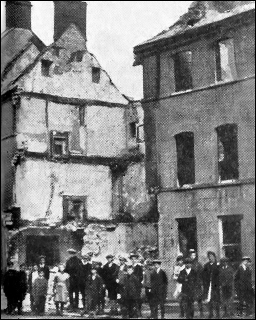
The extent of the wanton destruction outrages fair-minded people all over the world. Details of the havoc that had been wrought and pictures of the scenes of destruction are published worldwide.

(Pictured: Townspeople gather in front of one of the many buildings in Mallow which were reduced to ruins during British Army reprisals)


Leave a comment

Death of David Lord, RAF Officer & Victoria Cross Recipient

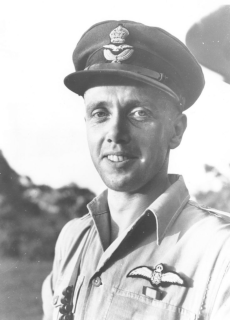
David Samuel Anthony Lord, VC, DFC, recipient of the Victoria Cross, the highest award for gallantry in the face of the enemy that can be awarded to British and Commonwealth forces, is killed at Arnhem, Netherlands, on September 19, 1944, during World War II. A transport pilot in the Royal Air Force, he receives the award posthumously for his actions during the Battle of Arnhem while flying resupply missions in support of British paratroopers.

Lord is born on October 18, 1913, in Cork, County Cork, one of three sons of Samuel (a warrant officer in the Royal Welsh Fusiliers) and Mary Lord (née Miller). One of his brothers dies in infancy.

After World War I the family is posted to British India and Lord attends Lucknow Convent School. On his father’s retirement from the Army the family moves to Wrexham and then he is a pupil at St. Mary’s College, Aberystwyth, and then the University of Wales. Later, he attends the English College, Valladolid, Spain, to study for the priesthood. Deciding that it was not the career for him, he returns to Wrexham, before moving to London in the mid-1930s to work as a freelance writer.

Lord enlists in the Royal Air Force on August 6, 1936. After reaching the rank of corporal in August 1938, he applies to undertake pilot training, which he begins in October 1938. Successfully gaining his pilot’s wings, he becomes a sergeant pilot in April 1939, and is posted to No. 31 Squadron RAF, based in Lahore, India. He later flies the Vickers Type 264 Valentia biplane transport. In 1941, No. 31 Squadron is the first unit to receive the Douglas DC-2 which is followed by both the Douglas DC-3 and Dakota C-47 Skytrain transports. That year he is promoted to flight sergeant and then warrant officer. He flies in North Africa, supporting troops in Libya and Egypt for four months, before being posted back to India. Commissioned as a pilot officer in May 1942, he flies supply missions over Burma, for which he is mentioned in despatches.

Lord is awarded the Distinguished Flying Cross in July 1943, receiving the award at Buckingham Palace, and is promoted to flight lieutenant shortly afterwards. By January 1944, he has joined No. 271 Squadron RAF, based at RAF Down Ampney, Gloucestershire, and begins training as part of preparations for the invasion of Europe. On D-Day, he carries paratroopers into France and his aircraft was hit by flak, returning to base without flaps.

The Battle of Arnhem is part of Operation Market Garden, an attempt to secure a string of bridges through the Netherlands. At Arnhem, the British 1st Airborne Division and Polish 1st Independent Parachute Brigade are tasked with securing bridges across the Lower Rhine, the final objectives of the operation. However, the airborne forces that drop on September 17 are not aware that the 9th SS and 10th SS Panzer divisions are also near Arnhem for rest and refit. Their presence adds a substantial number of Panzergrenadiers, tanks and self-propelled guns to the German defences and the Allies suffer heavily in the ensuing battle. Only a small force manages to hold one end of the Arnhem road bridge before being overrun on September 21. The rest of the division becomes trapped in a small pocket west of the bridge and has to be evacuated on September 25. The Allies fail to cross the Rhine, which remains under German control until Allied offensives in March 1945.

Lord is 30 years old, and a flight lieutenant serving with No. 271 Squadron, Royal Air Force during World War II when he is awarded the Victoria Cross. On September 19, 1944, during the Battle of Arnhem in the Netherlands, the British 1st Airborne Division is in desperate need of supplies. His Dakota III “KG374” encounters intense enemy anti-aircraft fire and is hit twice, with one engine burning. He manages to drop his supplies, but at the end of the run finds that there are two containers remaining. Although he knows that one of his wings might collapse at any moment, he nevertheless makes a second run to drop the last supplies, then orders his crew to bail out. A few seconds later, the Dakota crashes in flames with its pilot and six crew members.

Only the navigator, Flying Officer Harold King, survives, becoming a prisoner of war. It is only on his release in mid-1945, as well as the release of several paratroops from the 10th Parachute Battalion, that the story of Lord’s action becomes known. He is awarded a posthumous Victoria Cross.

After Arnhem is liberated in April 1945, Grave Registration Units of the British 2nd Army move into the area and began to locate the Allied dead. Lord is buried alongside his crew in the Arnhem Oosterbeek War Cemetery. There are many plaques in memory of him, including one at Wrexham Cathedral in Wales.

Several aircraft have carried tributes to Lord. Between 1993 and 1998, the RAF Battle of Britain Memorial Flight‘s Dakota, serial “ZA947”, is painted in the colours of Lord’s aircraft during the Arnhem battle and bears the same code letters: YS-DM. Between 1973 and 2005, the Dakota displayed at RAF Museum Cosford is similarly painted and coded to represent Lord’s aircraft. From 1966 until its disbandment in 2005, No. 10 Squadron RAF is equipped with Vickers VC-10s, each of which is named after a Royal Air Force or Royal Flying Corps VC recipient. Aircraft serial number ‘XR810’ is named David Lord VC.

Lord’s Victoria Cross is presented to his parents at Buckingham Palace in December 1945. In 1997, his Victoria Cross, along with his other decorations and medals, are sold at auction by Spinks to Lord Ashcroft. As of 2014, the medal group is on display at the Imperial War Museum.


Leave a comment

Birth of Peter Barry, Fine Gael Politician

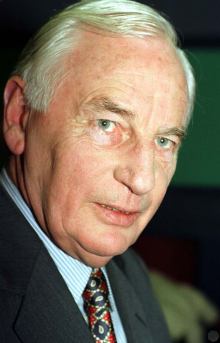
Peter Barry, Fine Gael politician and businessman, is born in Blackrock, Cork, County Cork on August 10, 1928. He serves as Tánaiste from January 1987 to March 1987, Deputy Leader of Fine Gael from 1977 to 1987 and 1991 to 1993, Minister for Foreign Affairs from 1982 to 1987, Minister for the Environment from 1982 to 1981, Minister for Education from 1976 to 1977, Minister for Transport and Power from 1973 to 1976 and Lord Mayor of Cork from 1970 to 1971. He served as a Teachta Dála (TD) from 1969 to 1997.

Barry is the son of Anthony Barry, a Fine Gael TD and well-known businessman. He is educated at Christian Brothers College, Cork and then becomes the major shareholder in the family company, Barry’s Tea.

Barry is first elected to Dáil Éireann as a Fine Gael Teachta Dála (TD) for the Cork City South-East constituency at the 1969 Irish general election. He goes go on to win a Dáil seat at eight successive general elections, changing constituency to Cork City in 1977 and Cork South-Central in 1981. When Fine Gael comes to power following the 1973 Irish general election, he is appointed Minister for Transport and Power. In 1976, he becomes Minister for Education. In 1979, after Garret FitzGerald becomes leader of Fine Gael, he is elected deputy leader. From June 1981 to March 1982, he serves as Minister for the Environment.

From December 1982 to 1987, Barry is Minister for Foreign Affairs. In this capacity he is heavily involved in the negotiations which result in the 1985 Anglo-Irish Agreement. He also becomes the first joint chairman of the Anglo-Irish Intergovernmental Conference, established under the Agreement by the Irish and British governments. Following the Labour Party‘s withdrawal from the coalition government in 1987, he becomes Tánaiste, for a brief period. He is the first member of Fine Gael to hold the office of Tánaiste.

When FitzGerald resigns as Fine Gael leader after the 1987 Irish general election, Barry is one of three candidates, along with Alan Dukes and John Bruton, who contest the party leadership. Dukes is the eventual victor.

Barry retires at the 1997 Irish general election, at which his seat is held for Fine Gael by his daughter Deirdre Clune. She later serves as a Senator representing the Cultural and Educational Panel, but resigns in 2014, on being elected as a Member of the European Parliament for Ireland South.

Barry dies in Cork at the age of 88 on August 26, 2016, following a short illness. Irish President Michael D. Higgins says Barry will be deeply missed. “His view of Irish history was a long one and he brought all that wisdom to bear in his contributions to achieving the Anglo-Irish Agreement. As a person he was immensely popular across all parties and, of course, he had a deep commitment to Cork city and its heritage.”


Leave a comment

Death of Poet Matthew Gerard Sweeney

Matthew Gerard Sweeney, Irish poet, dies at Cork University Hospital in Wilton, Cork on August 5, 2018. His work has been translated into Dutch, Italian, Hebrew, Japanese, Latvian, Mexican Spanish, Romanian, Slovakian and German.

Sweeney is born at Lifford, County Donegal, on October 6, 1952. Growing up in Clonmany, he attends Gormanston College (1965–70). He then reads sciences at University College Dublin (1970–72). He goes on to study German and English at the Polytechnic of North London, spending a year at the University of Freiburg, before graduating with a BA Honours degree in 1978.

Sweeney meets Rosemary Barber in 1972 and they marry in 1979. Two offspring – daughter Nico and son Malvin – are produced before the couple goes their separate ways in the early 21st century. Having lived in London for many years until 2001, he separates from Rosemary and goes to live in Timișoara, Romania and Berlin. In 2007, he meets his partner, Mary Noonan, and in early 2008 he moves to Cork to live with her there.

Sweeney produces numerous collections of poetry for which he wins several awards. His novels for children include The Snow Vulture (1992) and Fox (2002). He authors a satirical thriller, co-written with John Hartley Williams, and entitled Death Comes for the Poets (2012).

As Bill Swainson, Sweeney’s editor at Allison & Busby in the 1980s, recalls: “As well as writing his own poetry, Matthew was a great encourager of poetry in others. The workshops he animated, and later the residencies he undertook, were famous for their geniality and seriousness and fun. Sometime in the late 1980s I attended one of these workshops in an upstairs room of a pub in Lamb’s Conduit Street, Bloomsbury, where the poems were circulated anonymously and carefully read and commented on by all. Around the pushed-together tables were Ruth Padel, Eva Salzman, Don Paterson, Maurice Riordan, Jo Shapcott, Lavinia Greenlaw, Michael Donaghy, Maura Dooley and Tim Dooley.” Sweeney later has residencies at the University of East Anglia and Southbank Centre, among many others. He reads at three Rotterdam Poetry Festivals, in 1998, 2003 and 2009.

According to the poet Gerard Smyth: “I always sensed that in the first instance [Sweeney] regarded himself as a European rather than an Irish poet – and rightly so: like the German Georg Trakl whom he admired he apprehended the world in a way that challenged our perceptions and commanded our attention.” Sweeney’s work has been considered “barely touched by the mainstream of English writing” and more so by the German writers Heinrich von Kleist, Georg Büchner, Franz Kafka, Günter Grass and Heinrich Böll, as well as the aforementioned Georg Trakl. According to Poetry International Web, he would be among the top five most famous Irish poets on the international scene.

Sweeney’s final year sees the publication of two new collections: My Life As A Painter (Bloodaxe Books) and King of a Rainy Country (Arc Publications), inspired by Charles Baudelaire‘s posthumously published Petits poèmes en prose.

Having been diagnosed with motor neuron disease the previous year, Sweeney dies at the age of 65 at Cork University Hospital on August 5, 2018, surrounded by family and friends. He continues writing up until three days before his death. In an interview shortly before his death he is quizzed on his legacy, to which he gives the response, “Mostly what awaits the poet is posthumous oblivion. Maybe there will be a young man in Hamburg, or Munich, or possibly Vienna, for whom my German translations will be for a while important – and might just contribute to him becoming a German language poet with Irish leanings.”

Among those attending a special ceremony on August 8, 2018 at the Triskel Arts Centre in Cork to celebrate Sweeney’s life are fellow poets Jo Shapcott, Thomas McCarthy, Gerry Murphy, Maurice Riordan and Padraig Rooney. On August 9, 2018, he is buried in Clonmany New Cemetery in County Donegal.


Leave a comment

The Execution of William Michael Byrne

William Michael Byrne, a key figure in the Society of United Irishmen in the years leading to the Irish Rebellion of 1798 against the British government, is executed in Dublin on July 25, 1798.

Byrne is one of the two sons of Colclough Byrne of Drumquin, Hackettstown and Mary Galway of Cork, a great grand-niece of James Butler, 1st Duke of Ormond. He lives most of his adult life at Park Hill in the Glen of the Downs, County Wicklow. In late 1796, he enlists in the yeomanry, serving in the Newtown Mount Kennedy cavalry.

Byrne joins the Society of the United Irishmen in the spring of 1797 and later that same year is appointed by the Leinster committee to organise the half barony of Rathdown. As a delegate for Rathdown barony, he is a well respected and competent figure. With the assistance of his Protestant friend Thomas Miller of Powerscourt, he undertakes the organisation of military and civil branches of the United Irishmen in Rathdown, recruiting 2,000 men by late 1797. In October 1797 he is forced to resign from the yeomen after refusing to swear the oath of loyalty and his activities begin to come to the attention of Dublin Castle.

According to the informant A.B. (Thomas Murray), Byrne attends the inaugural meeting of the United Irishmen’s Wicklow county committee in December. It is held in the Annacurra home of William’s first cousin, John Loftus. Murray’s information tells that Byrne established networks of contacts between the Leinster committee and the Cork United Irishmen along with other contacts in Munster.

Byrne’s career comes to an end when he, along with fourteen other Leinster delegates, are arrested on March 12, 1798 at the house of Oliver Bond. They had been betrayed by Thomas Reynolds, treasurer of Kildare United Irishmen and member of the provincial committee. Reynolds had been informed that plans for an insurrection were about to be finalised by the committee. Byrne is arrested in possession of incriminating documents which are described by Attorney-General for Ireland Arthur Wolfe as being ‘very treasonable printed papers.’

On July 4, 1798 Byrne with four others is brought before a commission of oyer and terminer on charges of high treason. The case mounted by the state against him is based principally on the evidence of Reynolds and also that given by his former comrade William Miller of Powerscourt. The weight of the evidence is overwhelming, rendering an effective defence impossible.

Byrne’s lawyer, John Philpot Curran KC, the leading defence counsel of the period, attempts to cast Reynold’s character and motives in a foul light but it is futile. In his last days, efforts are made to spare his life if he would only express regret for his actions and accuse Lord Edward FitzGerald for having led him to this point. He refuses, meeting his end with great dignity and stoicism.

Byrne is convicted of high treason and executed on July 25, 1798 outside Green Street Courthouse, Dublin.

The Dublin Magazine notes that Byrne “met his fate with a degree of courage perhaps unequalled.” For his service to the state, Reynolds is honoured by Dublin Corporation with the freedom of the city on October 19, 1798, spending much of his life thereafter in fear of assassination.


Leave a comment

The Conor Pass Ambush

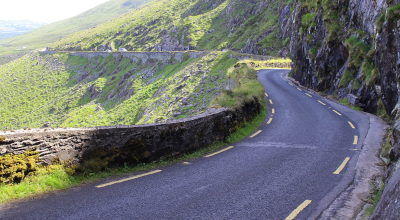
Two Royal Irish Constabulary (RIC) men are killed on Conor Pass in Dingle, County Kerry, on July 13, 1920 during the Irish War of Independence.

District Inspector Michael Fallon, accompanied by three other police in a motor car, are ambushed on the Conor Pass between Cloghane and Dingle, County Kerry. The D.I. is returning from an inspection of the barracks at Cloghane when the party is ambushed by members of the Irish Republican Army (IRA) West Kerry No.1 Brigade who are billetted at Fibough, in the Slieve Mish Mountains. The IRA volunteers include J. Dowling, Paddy Paul Fitzgerald, Dan Jeffers and Mick McMahon among their number.

Constables George Roach 62449 and Michael Linehan 63592 are killed outright. D.I. Fallon and Constable Joseph Campbell 67905, the driver, are both wounded. The IRA removes the bodies from the car and takes away the rifles and revolvers of the police. They then take Constable Campbell prisoner, dropping him off about three miles down the road.

Constable Linehan is 34 years old and single, and is originally from Cork. He has twelve years police service. His funeral takes place at St. Mary’s Catholic Church, Limerick, with burial in Mount St. Lawrence Cemetery. A hearse cannot be obtained so the constabulary, in relays, carry the coffin from the church to the cemetery.

Constable Roach has thirteen years service and is from County Clare. He is also a single man.

Compensation awards for gunshot injuries are later made to D.I. Fallon of £850 and to Constable Campbell of £600.

(From: “Constables George Roach and Michael Linehan, killed on the Connor Pass 1920” by Peter Mc, The Royal Irish Constabulary Forum (www.irishconstabulary.com), March 7, 2011)


Leave a comment

Birth of Gilbert Potter, District Inspector of the Royal Irish Constabulary

Gilbert Norman Potter, a District Inspector of the Royal Irish Constabulary, is born in Dromahair, County Leitrim on July 10, 1887. He is executed by the Irish Republican Army (IRA) on April 27, 1921, in reprisal for the British execution of Irish republican Thomas Traynor.

Potter receives his commission as District Inspector on April 27, 1901, having completed his cadetship at the Depot, Phoenix Park, Dublin. His first assignment is to Castlepollard, County Westmeath. During the 1909 ITGWU strike in Cork, he is temporarily posted there from Dublin and is also involved in policing the August 14 marches in Portadown. Having had charge of No. 4 Company at the Depot, he is assigned to Cahir in 1912.

On April 23, 1921, District Inspector Potter is captured by the 3rd Tipperary Brigade, IRA, following the Hyland’s Cross Ambush. This occurs near Curraghcloney, close to the village of Ballylooby. The ambush party is initially made up of a combination of the 1st and 2nd Flying Columns 3rd Tipperary Brigade. This is the largest force assembled to date by the Tipperary IRA in anticipation of a major battle. However, the convoy of military lorries that is expected never materialises. Dan Breen and Con Moloney return to Battalion Headquarters, while Seán Hogan‘s Column withdraws northward in the direction of the Galtee Mountains.

As Dinny Lacey‘s No.1 Column prepares to leave towards the south, a small party of British soldiers accompanying two horse-drawn carts unexpectedly approaches from Clogheen and are immediately fired upon. Amid some confusion Lacey’s scattered men withdraw southwards towards the Knockmealdown Mountains. One British soldier, Frank Edward Conday, is fatally wounded and two others from the relieving party are wounded.

By chance, Potter, who is returning by car from police duties at Ballyporeen, drives into a section of the withdrawing No.1 Column. Although in civilian attire, he is recognised by one of the IRA Volunteers and taken prisoner. As part of a new strategy, he is held as a hostage for the safe release of Thomas Traynor, an IRA volunteer and father of ten young children, then under sentence of death at Mountjoy Gaol. The IRA offers to release Potter in exchange for Traynor’s release. Traynor is executed. Traynor has since been honoured by the Irish state as one of “The Forgotten Ten.”

The Column, under sporadic fire from soldiers, alerted at the nearby Clogheen barracks, follow the contours of the mountains to the village of Newcastle. Losing their pursuers, they stay for a period of time at the townland of Glasha. Here Potter is detained in an out-building of a farm which is regularly used by the IRA as a safe house. From there the party is guided into the Nire Valley by a contingent of local Waterford Volunteers and on to the Comeragh Mountains.

Accounts from Rathgormack, County Waterford suggest he is kept for at least one night at a nearby Ringfort before being taken down the hill to a field then owned by Powers of Munsboro, where he meets his ultimate fate. At 7:00 PM, on April 27, following news of Traynor’s execution by hanging, he is shot to death, and hastily buried in a shallow grave on the banks of the River Clodiagh. A diary he kept during his period of captivity and some personal effects and farewell letters, are returned anonymously to his wife. It is the first confirmation she has that he has been killed. The artifacts are later lost when his son’s ship is torpedoed in 1942, during World War II.

(Pictured: Photo of District Inspector Gilbert Potter R.I.C. that appeared in the Press during his time in captivity)


Leave a comment

Death of Charlotte Grace O’Brien, Philanthropist & Activist

Charlotte Grace O’Brien, author, philanthropist and an activist in nationalist causes and the protection of female emigrants, dies on June 3, 1909. She is known also as a plant collector.

Born on November 23, 1845, at Cahirmoyle, County Limerick, O’Brien is the younger daughter in a family of five sons and two daughters. Her father is William Smith O’Brien, the Irish nationalist and her mother is Lucy Caroline, eldest daughter of Joseph Gabbett, of High Park, County Limerick. On her father’s return in 1854 from the penal colony in Tasmania, she rejoins him in Brussels and stays there until he comes back to Cahirmoyle in 1856. On her mother’s death in 1861, she moves with her father to Killiney, near Dublin, and is his constant companion until his death at Bangor, Gwynedd in 1864.

From 1864, O’Brien lives at Cahirmoyle with her brother Edward, caring for his motherless children until his remarriage in 1880. Having been hard of hearing since childhood, by 1879 she has become entirely deaf. She goes to live at Ardanoir near Foynes on the River Shannon and spends time writing. She becomes a staunch supporter of Charles Stewart Parnell.

A bad harvest in Ireland in 1879, combined with Irish political turmoil, causes many Irish people to emigrate to the United States. In articles and letters to newspapers and reviews, O’Brien exposes the awful conditions that exist in the Queenstown (Cobh) lodging houses, on board the emigrant ships, and in the dock slums of New York City, where the Irish have to stay upon landing. A notable piece she writes is the Horrors of the Immigrant Ship which appears in The Pall Mall Gazette on May 6, 1881.

A visit to Queenstown, the port of embarkation, and a tour of the White Star Line‘s Germanic leads her to successfully lobby to get a Catholic priest aboard the emigrant ship to help ease the passage, at least spiritually. That achievement captures even more public attention by virtue of the fact that O’Brien herself is Protestant. Despite the limit of 1,000 passengers, she notes the steamer has carried as many as 1,775 at one time.

O’Brien presses the Board of Trade for greater vigilance, and in April 1882, founds a 105-bed boarding house at Queenstown for the reception and protection of girls on the point of emigrating. The O’Brien Emigrants Home at The Beach, Queenstown fails because it is boycotted by other boardinghouse keepers and local merchants, forcing her to order provisions from Cork.

O’Brien also daily visits three or four of the ships for which her lodgers are destined along with a medical officer. She makes passages herself to America, using the occasion to investigate shipboard conditions and lobby for the reform and enforcement of health and safety standards.

O’Brien finds little effort to provide food, drink or accommodation at the Castle Garden entry facility. She also finds that often the illiterate young women are being tricked into prostitution through spurious offers of employment. Additionally, she notes the high infant mortality rates in the tenements where the women live. She proposes to Archbishop John Ireland of Minnesota an information bureau at Castle Garden, a temporary shelter to provide accommodation for immigrants and a chapel. Archbishop Ireland agrees to raise the matter at the May 1883 meeting of the Irish Catholic Association which endorses the plan and votes to establish an information bureau at Castle Garden. Ireland also contacts Cardinal John McCloskey, Archbishop of New York, about providing a priest for immigrants arriving at Castle Garden.

The Mission opens on January 1, 1884, with Rev. John J. Riordan appointed as the first chaplain at Castle Garden. Immigrant girls needing accommodation are placed in local boarding houses until May 1 when a Home for Immigrant Girls is opened at 7 Broadway. In 1885, the James Watson House at 7 State Street is purchased from Isabella Wallace for the Mission of Our Lady of the Rosary for the Protection of Irish Immigrant Girls to serve as a way station for young immigrant women. Between 1884 and 1890, the Mission provides assistance to 25,000 Irish immigrant women.

In 1881–82, O’Brien embarks on a campaigning lecture tour in the United States. She encounters problems, however, particularly given her Protestant background and the need to enlist support from Catholic clergy. Poor health, and her profound deafness cause her to curtail her activities in America. When she returns to Ireland in 1883, she finds herself suspected of being a British agent whose Emigrant Boarding house and whose plans for an American home for Irish immigrant girls facilitate the government’s assisted emigrant scheme. Supposedly, this would be the scheme that helps landlords clear their estates of poor tenants. In fact, O’Brien opposes assisted emigration, but she continues to assist those who are sent to her.

O’Brien retires from active public work in 1886, moving to Ardanoir, Foynes, on the Shannon Estuary. She spends considerable time in Dublin, where she socialises with Douglas Hyde and the painter William Osbourne. She joins the Roman Catholic Church in 1887. She dies of heart failure on June 3, 1909, at Foynes, and is buried at Knockpatrick.