seamus dubhghaill

Promoting Irish Culture and History from Little Rock, Arkansas, USA


Leave a comment

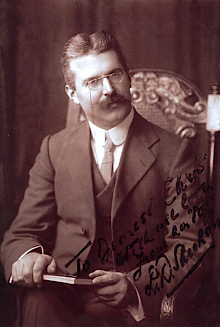
Birth of D. D. Sheehan, Nationalist Politician & Labour Leader

Daniel Desmond (‘D. D.’) Sheehan, Irish nationalist, politicianlabour leader, journalistbarrister and author, is born on May 28, 1873, at Dromtariffe, Kanturk, County Cork.

The eldest of the three sons and one daughter of Daniel Sheehan, tenant farmer, and his wife, Ellen (née Fitzgerald). He is educated at the local primary school. In his book Ireland since Parnell (1921) he states that witnessing the ragged poverty of labourers’ and smallholders’ children who attended the school made him determined to do something for the poor. The family’s Fenian tradition and his parents’ eviction from their holding in 1880 form his early years. At the age of sixteen he becomes a schoolteacher.

In 1890, Sheehan takes up journalism, serving as correspondent of the Kerry Sentinel and special correspondent of the Cork Daily Herald in Killarney. He also becomes correspondence secretary to the Kanturk trade and labour council, which campaigns on behalf of agricultural labourers. He manages to get reports of meetings into the Cork papers, and this helps the rapid spread of the association, which in 1890 becomes the Irish Democratic Trade and Labour Federation, under the leadership of Michael Davitt. It is, however, fatally disrupted by the Parnell split. While Sheehan continues to admire Davitt, and despite the pre-split Irish party leadership having opposed the federation as a threat to Charles Stewart Parnell‘s leadership, he becomes a Parnellite, and always remembers his only meeting with Parnell at Tralee, when the chief is presented with a loyal address (drafted by Sheehan) from his Killarney supporters. After Parnell’s death and the defeat of the Second Home Rule Bill, he temporarily drops out of Irish politics.

Following his marriage on February 6, 1894, to Mary Pauline O’Connor of Tralee, Sheehan joins the staff of the Glasgow Observer in pursuit of journalistic experience, then becomes editor of the Catholic News in Preston, Lancashire. In 1898, he returns to Ireland and works on various papers, including the Cork Constitution, before serving as editor of the Skibbereen-based Cork County Southern Star (1899–1901), where his Parnellism brings him into conflict with the Bishop of Ross, Denis Kelly. He expresses sympathy for the newly founded United Irish League (UIL), established by William O’Brien in Connacht with the dual aim of representing western smallholders and using a new land agitation as a vehicle for Irish Party reunion. He does not, however, join the UIL himself.

In August 1894, the Clonmel solicitor J. J. O’Shee, anti-Parnellite MP for West Waterford from 1895, forms the Irish Land and Labour Association (ILLA) to agitate on behalf of agricultural labourers and small tenant farmers. Its appearance reflects the breakdown of the centralised party discipline which had existed before the Parnell split, and recognition that the land war’s prime beneficiaries had been large and middle-sized tenant farmers rather than the nation as a whole. On returning from Britain in 1898, Sheehan throws himself into organising the ILLA and becomes its president. In 1900 there are 100 branches, mostly in Cork, Tipperary, and Limerick. The Irish Party leadership look on this organisation with some suspicion.

At the 1900 United Kingdom general election in Ireland Sheehan seeks the Irish Parliamentary Party (IPP) nomination for South Cork but was defeated by Edward Barry. After the death of Dr Charles Tanner, however, he succeeds in obtaining the IPP nomination for the constituency of Mid Cork, despite the party leadership’s attempts to deny recognition to ILLA branches in order to hand the nomination to its favoured candidate. Sheehan is elected unopposed on May 17, 1901. At the age of 28, he is the youngest Irish member of parliament. Although he has been admitted to the party, his position as a labour representative and his perceived independent base make him something of an outsider.

From October 1904 Sheehan allies himself with O’Brien, writing regularly for the latter’s weekly a The Irish People. Redmondites accuse him of opportunism, but he always maintains that his personal inclination as an old Parnellite has been towards John Redmond and that his support for O’Brien derives from the older man’s willingness from 1904 to identify himself with the labourers’ campaign. Although their alliance originally likely contains elements of expediency, Sheehan and O’Brien develop a deep personal friendship.

Sheehan’s support for O’Brien leads to a split in the ILLA in 1906, with Tipperary and Waterford branches following O’Shee and Redmond, and Sheehan retaining the support of his Cork base and of some branches in Limerick and Kerry. He serves on the Cork advisory committee which represents tenant interests in land purchase negotiations under the Wyndham Land Act. It’s policy of “conference plus business” combines an offer to negotiate with willing landlords and a threat of agitation against those unwilling to give satisfactory terms. His faction of the ILLA becomes the basis for the grassroots organisation of O’Brien’s followers, and sporadic attempts, financed by O’Brien, are made to spread it outside its Munster base. Both factions of the ILLA claim credit for the passage of the 1906 and 1911 Labourers’ (Ireland) Acts which provide for the allocation of cottages and smallholdings to labourers. In Cork and some other parts of Munster these buildings become popularly known as “Sheehan’s cottages,” a term which long outlives Sheehan’s political career. He also helps to bring about the creation of a “model village” at Tower, near Blarney, the result of cooperation between the local ILLA branch and the rural district council.

At the 1906 general election the Redmond leadership attempts to avoid an open split by allowing O’Brien’s supporters to return unopposed. However, the continuing conflict between the two factions rapidly leads to a formal break. Shortly after the election Sheehan is excluded from the IPP, and thereby deprived of the parliamentary stipend paid to MPs with insufficient resources to maintain themselves. With the support of O’Brien and the small group of O’Brienite MPs, he maintains that the party has no right to exclude an elected MP willing to take the party pledge. After resigning his seat to which he was re-elected without opposition on December 31, 1906, he demands readmission to the party and mounts an unsuccessful lawsuit demanding payment of the stipend. He is subsequently supported from the proceeds of collections outside church gates on Sundays.

Sheehan and the other O’Brienite MPs are readmitted to the party in 1908 as part of an attempt at general reconciliation after the disruptions following the rejection of the Irish Council Bill. Dissensions rapidly reappear over Augustine Birrell‘s 1909 land act, which the O’Brienites see as wriggling out of the financial responsibilities accepted by the British government in the Wyndham land act and as sabotaging land purchase, since landlords will not accept the terms offered. Sheehan’s section of the ILLA is denied official recognition and thereby prevented from sending delegates to a party convention called to consider the bill. At the convention, groups of “heavies”recruited from Joseph Devlin‘s Ancient Order of Hibernians (AOH) exclude delegates with Cork accents, while O’Brienite speakers are howled down. This leads to the formation in March 1909 of the All-for-Ireland League (AFIL), a body based on the existing O’Brienite organisation and advocating O’Brien’s policy of gradually implementing home rule through step-by-step cooperation with moderate unionist supporters of devolution. Although O’Brien’s temporary retirement for health reasons in April 1909 leads to the suspension of the AFIL, it is revived in response to an attempted purge of the O’Brienite MPs by the leadership and by O’Brien’s reappearance in response to the January 1910 general election. Sheehan writes regularly for its paper, the Cork Free Press.

In the general election the O’Brienites hold their seats while two Cork Redmondites are displaced. Sheehan is re-elected for Mid Cork, defeating the Redmondite W. G. Fallon in a campaign marked by widespread rioting and impassioned clerical denunciations of Sheehan. Fallon subsequently attempts to get up a “red scare” against the ILLA. The Cork ILLA later splits over Sheehan’s slightly erratic leadership. While the split is initially personality-driven, the breakaway faction, led by Patrick Bradley and centred in east Cork, moves back toward alignment with Redmond. At the December 1910 election the AFIL consolidates its position in Cork, but is defeated everywhere else. Sheehan retains his Mid Cork seat against a local candidate but is defeated in a simultaneous contest in East Limerick. He is also defeated when he stands for Cork County Council in June 1911, though the AFIL wins control of that body.

Sheehan studies law at University College Cork (UCC) (1908–09), where he is an exhibitioner and prizeman, and at King’s Inns, where he graduated with honours. He is called to the bar in 1911 and practised on the Munster circuit. In 1913–14 he is active in the AFIL’s attempts to avert partition by trying to recruit sections of British political opinion in favour of a conference between the parties. He becomes vice-chairman of the Imperial Federation League. This receives considerable attention among the British political classes but contributes to the decline of the AFIL’s electoral base. The policy of conciliation has been driven to a considerable extent by the belief that it is the only way of achieving home rule. The abolition of the House of Lords’ veto and the introduction of the third home rule bill by the Asquith government undercuts this argument and increases Redmond’s prestige, while AFIL denunciations of Redmondism are seen as driven by personal resentment and playing into the hands of unionists. The decision of the AFIL MPs to abstain from supporting the bill on its final passage through the House of Commons in 1914 as a protest against the prospect of a partition-based compromise is represented by Redmondites as a vote against home rule itself and contributed to AFIL loss of Cork County Council in June 1914.

On the outbreak of World War I, Sheehan supports O’Brien in calling for Irish enlistment for foreign service. In November 1914, at the age of forty-two, he enlists himself and is gazetted as a lieutenant in the Royal Munster Fusiliers. It is claimed that he is almost single-handedly responsible for raising the 9th (service) battalion of this regiment. Three of his sons also enlist. Two of his sons are killed in action with the Royal Flying Corps, and a daughter is disabled by injuries received in an air raid while serving as a nurse. In the spring and summer of 1915 he organises and leads recruiting campaigns in Cork, Limerick, and Clare. This is part of a nationwide drive for recruits, aimed in particular at the farming community, which reflects the realisation that the war is going to last much longer than expected.

In 1915, Sheehan is promoted to the rank of captain and serves with his battalion on the Loos-en-Gohelle salient and at the Battle of the Somme, contributing a series of articles from the trenches to the London Daily Express. Various ailments, including deafness caused by shellfire, and hospitalisation necessitate his transfer to the 3rd Royal Munster Fusiliers (Reserve) Battalion, and he resigns his commission on January 13, 1918, due to ill health. In April 1918 he speaks at Westminster against the bill extending conscription to Ireland, threatening to resist it by force. One of his last parliamentary speeches (in October 1918) is in support of a bill providing land grants for Irish ex-servicemen. With the growth of Sinn Féin and the virtual demise of the AFIL, his position in Cork grows increasingly untenable. The Sheehan family faces intimidation and are obliged to leave their home on the Victoria Road for London, where he has secured the Labour Party nomination for the LimehouseStepney division of the East End, later represented by Clement Attlee.

Sheehan is unsuccessful in the 1918 United Kingdom general election, and is obliged to leave politics after a financially disastrous involvement in an Achill Island mining company leads to his bankruptcy. Unable to practise at the bar because of the hearing loss caused by his war service, he returns to journalism and becomes editor and publisher of The Stadium, a daily newspaper for sportsmen. In 1921, shortly before the Anglo-Irish truce, he publishes Ireland since Parnell, a history of recent events heavily dependent on the writings of O’Brien but incorporating some personal reminiscences. It concludes by blaming the outbreak of the IRA guerrilla campaign on provocation by Crown forces, denouncing reprisals, and pleading for British recognition of Dáil Éireann and dominion home rule for an undivided Ireland.

Sheehan moves to Dublin in 1926 after hearing that the threats against him have been lifted. His wife, who has never fully recovered from the stresses and bereavements she has experienced since 1914, dies soon afterward. Sheehan himself becomes managing editor of Irish Press and Publicity Services and, in 1928, publisher and editor of the South Dublin Chronicle. The paper gives critical support to the Irish Labour Party, publishes campaigning articles on slum conditions, and advocates housing reform. In September 1930, he is an unsuccessful Labour candidate for Dublin County Council. In the 1930s, as his health deteriorates further, he works as coordinator for the ex-servicemen’s group the Old Comrades’ Association, editing both northern and southern editions of its annual journal. In 1942, he offers himself to Richard Mulcahy as a Fine Gael candidate for Cork South-East, but is turned down. He dies on November 28, 1948, while visiting his daughter at Queen Anne Street, London. Both he and his wife are buried in Glasnevin Cemetery.

(From: “Sheehan, Daniel Desmond (‘D. D.’)” by Patrick Maume, Dictionary of Irish Biography, http://www.dib.ie, October 2009)

Leave a comment

Death of J. J. Walsh, Politician & Businessman

James Joseph Walsh, generally referred to as J. J. Walsh, Postmaster General (later Minister for Posts and Telegraphs) of the Irish Free State from 1922 to 1927, dies in Dublin on February 3, 1948. He is also a senior Gaelic Athletic Association (GAA) organiser and Cumann na nGaedheal politician. Later, he has heavy connections with fascism, including his association with Ailtirí na hAiséirghe.

Walsh is born in the townland of Rathroon, near Bandon, County Cork, on February 20, 1880. His family comes from a farming background, “working a substantial holding of medium but well-cultivated land.” Until the age of fifteen, he attends a local school in Bandon, but by his own account “as far as learning went, I may as well have been at home.” Together with his school friend P. S. O’Hegarty, he passes the Civil Service exams for the Postal service. He later works locally as a clerk in the Post Office. Like O’Hegarty, he spends three years in London at King’s College, studying for the Secretary’s Office “a syllabus (which) differed little from the Indian Civil Service.” While O’Hegarty succeeds in his studies, Walsh does not, and returns to Cork where a friend, Sir Edward Fitzgerald, arranges work for him on the Entertainments Committee of the Cork International Exhibition.

Walsh is active in the GAA, promoting Gaelic games in many areas, but particularly in Cork city and county. His interest in organised sports has a strong political dimension.

“I happened to be one of those who realised the potentialities of the GAA as a training ground for Physical Force. Contamination with the alien and all his works was taboo. I gathered around me a force of youthful enthusiasts from the University, Civil Service and Business. With this intensely organised instrument, war was declared on foreign games which were made to feel the shock so heavily that one by one, Soccer and Rugby Clubs began to disappear.”

Walsh is also instrumental in establishing the “revived” Tailteann Games. He is Chairman of the Cork County Council GAA and is involved in the founding of the Cork City Irish Volunteers.

Walsh participates in the Easter Rising in 1916 in the General Post Office (GPO). He claims he is responsible for mobilising 20 members of the Hibernian Rifles and takes them to the GPO. However, Rifles commandant John J. Scollan contradicts this account. He is promoted from Rifleman to Vice-Commandant of the Hibernian Rifles in 1915.

Walsh is arrested following the general surrender and sentenced to death after a court-martial at Richmond Barracks. This is almost immediately commuted to life imprisonment, but he is released the following year under a general amnesty.

In later 1917 Walsh is arrested and imprisoned after making a speech declaring “the only way to address John Bull is through the barrel of a rifle.”

In the autumn of 1919 Walsh is involved in a failed assassination attempt on John French, 1st Earl of Ypres.

Walsh is elected as a Sinn Féin Member of Parliament (MP) in the 1918 United Kingdom general election for the Cork City constituency. As a member of the First Dáil he is arrested for partaking in an illegal government. He is released in 1921 and supports the Anglo-Irish Treaty and goes on to become a founding member of the new political party, Cumann na nGaedheal. He serves as Postmaster General from 1922 until 1924 and joins the cabinet of W. T. Cosgrave between 1924 and 1927, after the office is reconstituted as the Department of Posts and Telegraphs. He is elected at every election for the Cork Borough constituency until 1927 when he retires from government.

In August 1922 Walsh is part of a government committee which is intended to consider what the Irish Free State’s policy towards north-east Ulster will be.

During World War II, known at the time in Ireland as “the Emergency,” Walsh’s connections with fascism, including his association with Ailtirí na hAiséirghe, bring him to the attention of the Directorate of Military Intelligence, the Intelligence branch of the Irish Army. Their request to the Minister for Justice, Gerald Boland, to place a tap on Walsh’s phone is, however, refused. He is closely associated with Irish-based pro-Nazi initiatives through his association with Ailtirí na hAiséirghe, frequently expressing his views with anti-semitic rhetoric.

After leaving politics Walsh founds a bus company which operates with great success between the city centre and south Dublin. When private bus services are bought out by the Dublin Tramway Co., he invests his profits in other Irish companies including Clondalkin Paper Mills, Solus Teoranta and Benbulben Barytes. He is also a director of Killeen and Newbrook Paper Mills, timber exporters Dinan Dowds, the Moore Clothing Co., and Fancy Goods. In 1937 he is elected president of the Federation of Irish Manufacturers, having previously held the vice-presidency. His businesses benefit greatly from the protectionist measures introduced by Fianna Fáil after 1932. Nonetheless, he complains that not enough has been done to make capital available to native entrepreneurs, and that “alien” interests are allowed too much scope to penetrate the Irish market.

In 1944 Walsh publishes a short memoir, Recollections of a Rebel. In his later years he suffers from deteriorating health, leading to his resignation from the presidency of the Federation of Irish Manufacturers in 1946. He dies in Dublin on February 3, 1948. He is buried in St. Finbarr’s Cemetery, Cork, County Cork.

On April 24, 2016, a plaque commemorating Walsh is unveiled in Kilbrittain, County Cork.


Leave a comment

Storm Frank Causes Widespread Flooding

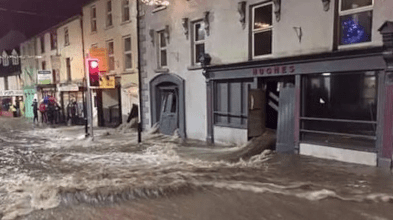
Clean-up operations are underway around Ireland on Wednesday, December 30, 2015, in the wake of Storm Frank, which causes widespread flooding following its landfall in western areas on Tuesday, December 29. Thousands of households and businesses are left without electricity in many areas of the country.

A Met Éireann status orange wind warning is lifted at 2:00 p.m. on Wednesday although the forecasts caution that severe winds of 65-80 km/h and gusts of up 130 km/h are still expected. While the heaviest rainfall from the storm falls overnight, many rivers and lakes have yet to peak meaning further flooding is possible.

According to an ESB Networks spokesman, 7,500 homes are without power in the afternoon, down from the overnight total of 13,000. He says repair crews are working to restore power to those cut off. The biggest single outage overnight is around Bandon and Fermoy in County Cork where 4,000 homes are without power, although it has been restored to almost all homes by the afternoon of December 30.

At 2:00 p.m. on Wednesday, the worst affected areas are County Wicklow with 1,200 houses without power, Macroom in County Cork where 600 are without power and Athlone where 500 homes are cut off. Around 500 homes in Naas, County Kildare, are without power as are 350 houses in Skerries in north County Dublin. It is hoped that power will be restored to all customers by the evening.

County Cork appears to be the worst affected by the storm where 60 mms (almost three inches) of rain falls since the morning of December 29. The threat of further flooding in Cork remains as the ESB increases the flow of water through the Inniscarra Dam to 250 cumecs (cubic metres per second) between 9:00 a.m. and midday which leads to increased flooding downstream. This is higher than the level of flow (180 cumecs) the previous and between December 6 and 12 along the River Lee following Storm Desmond.

Cork County manager Tim Lucey says there has been “extensive flooding” across a range of areas, but that Midleton and Bandon are worst hit with some 90 properties affected in each of the towns. He tells RTÉ Radio that one positive is the fact flood defences in Mallow and Fermoy have done their job. He notes that some five feet of water has built up behind a flood barrier in Mallow and this indicates the damage that could have been done to the town.

South Galway bears the brunt of flooding in the west, with river gauges expected to rise further over the coming days. Overnight rainfall is not as heavy as anticipated in the west, but several properties succumb to the waters. Up to 30 families in the south Galway area are forced to stay with relatives, with several being accommodated in hotels by Galway County Council, as floodwaters cut off access routes to their homes.

In Mayo, the area around the Neale remains underwater and a number of minor roads and thousands of acres of farmland are also affected. With rain continuing to fall across the west, conditions are expected to remain critical over the next few days.

The N11 between Rosslare and Dublin, the N25 from Cork to Waterford, the N71 between Cork and Killarney and the N4 between Dublin and Sligo all have diversions in place. The N25 is closed overnight between Killeagh and Castlemartyr in County Cork due to flooding. The N71 Cork/Bandon Road is also closed overnight at the viaduct due to flooding. There is severe flooding on the N40 South Ring Rd. at J6 Kinsale, particularly on the westbound off-ramp. The N11 Dublin/Wexford Road is impassable through Enniscorthy and also at Kyle’s Cross near Oylegate. The N4 is closed eastbound at Ballynafid in County Westmeath due to flooding. There are also several road closures in Kerry, Waterford and Tipperary.

Midleton is also hit by severe flooding as water levels in the Owenacurra River rise dramatically with up to 30 families having to be evacuated from their homes. Macroom in mid-Cork is also flooded for the first time during the year. Bandon is put on red alert by Cork County Council’s early warning system. Traders and residents are told to take all measures necessary to protect their property and stock. Locals stay up all night preparing the town for the latest round of flooding. Nevertheless, some 20 businesses in Bandon are flooded for the second time in a month after waters start to come up shores and gutters in the town as water levels in the River Bandon rise overnight.

The River Slaney burst its banks in Enniscorthy, County Wexford, causing widespread flooding in the town. Several cars have to be abandoned. High tide in Enniscorthy occurs around 10:30 a.m. on December 30.

Limerick City Council and Limerick County Council say there has been no significant flooding in the county as a result of overnight rainfall but that water levels along the lower River Shannon continue to increase. Water levels on the river rise by some 11cm at Castleconnell and Montpelier.

The ESB says the flow of water through Parteen Weir, which regulates water flow through Ardnacrusha power plant, will remain at 440 (cubic metres per second) on December 30 and that the situation will be reviewed again the following day. “The levels in Lough Derg may reach 2009 levels in the coming days and, as a result, the flow through Parteen Weir may increase to 2009 levels (up to 500 cumecs) in the coming days,” it says.

Clare County Council says water levels on the lower River Shannon at Springfield, Clonlara, have increased by 5-10cm in the last 24 hours and are some 20cm below a peak level recorded on December 13th. It says the Mulkear River in County Limerick, which enters the River Shannon south of Annacotty, is currently in flood and is contributing to increased water levels at Springfield. Council staff are assisted by the Fire Service and Defence Forces at Springfield in their pumping operations and transporting residents of some 12 homes isolated by floodwaters.

Fianna Fáil urges Taoiseach Enda Kenny to call an emergency Cabinet meeting to address the fallout from the storm. The party’s environment spokesman, Barry Cowen, says many communities felt neglected as further significant damage was inflicted on homes and businesses by the rainfall and winds brought by Storm Frank. “The scenes that we are witnessing in communities impacted by the latest storm are truly heart-breaking,” he says. “People feel neglected by the Government. It’s astonishing that the Taoiseach has decided not to interrupt his Christmas holidays in light of the devastation caused by Storm Frank.”

The Government’s National Coordination Group on Severe Weather meets in Dublin on December 30. Sinn Féin MEP Liadh Ní Riada says the Government has displayed “ineptitude in preparing flood defences” and that “more hollow promises” from the Coalition are no substitute for action. “The risk of flooding is increasing and will continue to increase. People across this island need to know that our political leaders have a plan to prevent this happening in the future,” she says.

(From: “Storm Frank causes floods, closes roads and cuts power to thousands” by Ronan McGreevy, Th Irish Times, http://www.irishtimes.com, December 30, 2015 | Pictured: Water flows through buildings and down the street in Graignamanagh, Co Kilkenny on Tuesday night by Paul B via Twitter)


Leave a comment

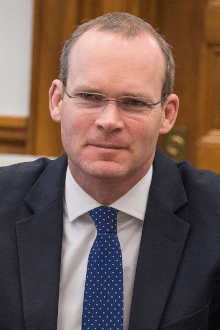
Birth of Simon Coveney, Minister of Foreign Affairs & Deputy Leader of Fine Gael

Simon Coveney, Fine Gael politician who has served as Minister for Foreign Affairs and Deputy Leader of Fine Gael since 2017 and Minister for Defence since 2020, is born in Cork, County Cork, on June 16, 1972.

Coveney is born to Hugh Coveney, a chartered quantity surveyor and later a TD, and Pauline Coveney. His uncle is Archbishop Patrick Coveney. His brother, Patrick, is chief executive of the food corporation Greencore. He is educated locally in Cork, before later attending Clongowes Wood College, County Kildare. He is expelled from the college in Transition Year but ultimately is invited back to complete his full six years there. He repeats his Leaving Certificate in Bruce College in Cork. He subsequently attends University College Cork and Gurteen College, County Tipperary, before completing a BSc in Agriculture and Land Management from Royal Agricultural College, Gloucestershire.

A keen fan of all competitive sport, Coveney plays rugby for Garryowen, Cork Constitution and Crosshaven Rugby Club. In 1997-98, he leads the “Sail Chernobyl Project” which involves sailing a boat 30,000 miles around the world and raising €650,000 for charity. He is a qualified sailing instructor and lifeguard. He spends several years working as an agriculture adviser and farm manager.

Coveney is first elected to Dáil Éireann in a 1998 by-election as a Fine Gael candidate for Cork South-Central. He holds Shadow Ministries in the areas of Drugs and Youth Affairs, Communications, Marine and Natural Resources, and Transport. He chairs the Fine Gael Policy Development Committee prior to the 2011 Irish general election.

Coveney is a member of Cork County Council and the Southern Health Board from 1999 to 2003.

Coveney is elected to the European Parliament in 2004 and is a member of the EPP-ED group. He is a member of the Committee on Foreign Affairs and the Internal Market and Consumer Protection Committee. He is the author of the European Parliament’s Annual Report on Human Rights in the World for the year 2004 and again for 2006.

Coveney is named Tánaiste by Leo Varadkar, replacing Frances Fitzgerald, on November 30, 2017, a position he holds until June 27, 2020. He also serves as Minister for Housing, Planning and Local Government as well as Minister for Agriculture, Food and the Marine. For the six-month period ending June 2013, he chairs the EU Council of Agriculture & Fisheries Ministers where he is at the forefront regarding EU efforts in respect of Common Agricultural (CAP) as well as Common Fisheries (CFP) Policy reforms. Under his chairmanship both dossiers are progressed significantly, with a reform package for CFP agreed in May 2013 and a reform package for CAP agreed at the end of the Irish Presidency in July. The Defence portfolio is added to his brief on July 11, 2014.

In July 2008, Simon marries his long-time girlfriend Ruth Furney, an IDA Ireland employee. They have three daughters and currently live in Carrigaline, County Cork.