seamus dubhghaill

Promoting Irish Culture and History from Little Rock, Arkansas, USA


Leave a comment

The Irish Army Mutiny

The Army Mutiny is an Irish Army crisis that begins on March 7, 1924, provoked by a proposed reduction in army numbers in the immediate post-Civil War period. A second grievance concerns the handling of the Northern Boundary problem. As the prelude to a coup d’état, the decisions made by influential politicians and soldiers at the time have continuing significance for the Government of Ireland.

In the early weeks of the Irish Civil War, the National Army is comprised of 7,000 men. These come mainly from pro-Treaty Irish Republican Army (IRA) brigades, especially the Dublin Guard, whose members have personal ties to Michael Collins. They face around 15,000 anti-Treaty IRA men and Collins recruits experienced soldiers from wherever he can. The army’s size mushrooms to 55,000 men, many of whom are Irishmen with combat experience in World War I – 20,000 National Volunteers had joined the British Army on the urgings of Nationalist leader John Redmond.

Likewise, Irishmen who had served in the British forces account for over half of the 3,500 officers. W. R. E. Murphy, second-in-command (January–May 1923), had been a lieutenant colonel in the British Army, as had Emmet Dalton. Two more of the senior generals, John T. Prout and J. J. “Ginger” O’Connell, had served in the United States Army. Collins promotes fellow members of the Irish Republican Brotherhood (IRB) but is slow to put Squad members in high positions.

In December 1922, following Collins’s death, Liam Tobin forms the Irish Republican Army Organisation (IRAO), taking in Dublin Guard and other Irish Army officers who share his view that “higher command…was not sufficiently patriotic.” President of the Executive Council of the Irish Free State W. T. Cosgrave, head of the government, attempts to appease the IRAO. He meets with them several times before the 1923 Irish general election and persuades the opposing IRB faction of generals under Richard Mulcahy to keep quiet.

With the election over, Mulcahy now ignores the IRAO as he starts the process of demobilising 37,000 men. In November, sixty IRA officers mutiny and are dismissed without pay. The IRAO now pressures the Government into establishing a committee to supervise future demobilisation. The committee, consisting of Eoin MacNeill, Ernest Blythe, and IRAO sympathiser Joseph McGrath, effectively undermines the authority of the Army Council.

On March 7, 1924, a representative of the IRAO hands a demand to end demobilisation to W. T. Cosgrave. The ultimatum is signed by senior Army officers, Major-General Liam Tobin and Colonel Charles Dalton. Tobin knows his own position is to be scrapped in the demobilisation. Frank Thornton and Tom Cullen are also involved. That morning 35 men of the 36th Infantry Battalion refuse to parade, and the preceding week officers had absconded with arms from the McCan Barracks in Templemore, Gormanston Camp in County Meath, Baldonnel Aerodrome in Baldonnel, Dublin, and Roscommon. The immediate response is an order for the arrest of the two men on a charge of mutiny. This causes alarm throughout Dublin when announced.

On March 8, General Mulcahy makes an announcement to the Army:

“Two Army officers have attempted to involve the Army in a challenge to the authority of the Government. This is an outrageous departure from the spirit of the Army. It will not be tolerated…officers and men…will stand over their posts and do their duty today in this new threat of danger in the same wonderful, determined spirit that has always been the spirit of the Army.”

Leader of the Opposition, Thomas Johnson, issues a statement of support for the Government. In contrast, Minister for Industry and Commerce, Joseph McGrath, whose home Mulcahy orders to be searched, resigns because of dissatisfaction with the government’s attitude to the IRAO officers and support for their perception that the Irish Army treats former British officers better than former IRA officers. Fearing an incendiary speech by McGrath, Cosgrave first offers the IRAO an inquiry and an amnesty before then taking sick leave thus making Minister for Justice, Kevin O’Higgins, de facto head of the Government.

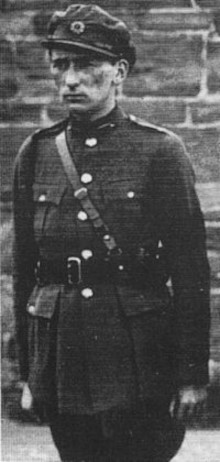
(Pictured: Major General Liam Tobin, a leading figure in the Army Mutiny)


Leave a comment

Death of James Stephens, Fenian & Co-founder of the Irish Republican Brotherhood

James Stephens, Irish republican, dies in Blackrock, County Dublin, on March 29, 1901. He is a founding member of an originally unnamed revolutionary organisation in Dublin. This organisation, founded on March 17, 1858, is later to become known as the Irish Republican Brotherhood (IRB).

References to Stephens’s early life, according to one of his biographers, Desmond Ryan, are obscure and limited to Stephens’s own vague autobiographical recollections. He is born at Lilac Cottage, Blackmill Street, Kilkenny, County Kilkenny, on January 26, 1825, and spends his childhood there. No birth records have ever been located, but a baptismal record from St. Mary’s Parish is dated July 29, 1825. There is reason to believe that he is born out of wedlock in late July 1825. However, according to Stephens, his exact date of birth is January 26. He is educated at St. Kieran’s College, Kilkenny, for at least one quarter in 1838. He is later apprenticed to a civil engineer, and from 1844 onwards works for the Waterford–Limerick Railway Company.

When the Young Irelanders split from Daniel O’Connell‘s Repeal Association and found the Irish Confederation in January 1847, Stephens becomes involved in the activities of the Kilkenny Confederate clubs. After the government suspends habeas corpus and issues warrants of arrest against the Confederate leaders, William Smith O’Brien appears in Kilkenny on July 23, 1848, seeking support for a popular insurrection, and two days later Stephens joins him. For four days he follows O’Brien’s wanderings and takes part in all his encounters with government forces, including the affray at the home of Widow McCormack on July 29 when O’Brien’s followers besiege a party of policemen in a house near Ballingarry, County Tipperary. They are finally dispersed by gunfire and the arrival of reinforcements, thus ending O’Brien’s revolutionary efforts. Stephens reportedly receives two bullet wounds but manages to hide and evade arrest.

Three days later, Stephens proceeds to Ballyneale, near Carrick-on-Suir, County Tipperary, in search of John O’Mahony. He accompanies O’Mahony to meet Michael Doheny, and for six weeks Stephens and Doheny avoid arrest by roaming around the south of Ireland, an adventure that Doheny records in The Felon’s Track (1849). On September 12, Stephens is smuggled out of Ireland by the family of the Skibbereen attorney McCarthy Downing, and four days later manages to reach Paris. O’Mahony and Doheny join him shortly afterwards, although Doheny soon emigrates to the United States.

From their exile Stephens and O’Mahony watch the failure of the ’49 conspiracy of James Fintan Lalor and Philip Gray and witness the barricades against Louis Napoleon’s coup d’état in 1851. Stephens later claims to have joined the French republican insurgents, but according to O’Mahony this is merely a frustrated intention. Equally without foundation is the rumour that Stephens and O’Mahony at this time join a republican secret society as a training ground for their future Irish enterprise.

Stephens remains in Paris from 1848 to 1855, supporting himself by teaching English. He attends Sorbonne University and has plans to obtain a professorship that never materialises. Towards the close of his exile, he is employed by the Le Moniteur Universel, for which he allegedly translates Charles Dickens‘s Martin Chuzzlewit. Late in 1855 he returns to Ireland and undertakes a series of tours throughout the island. He later magnifies the venture as “the 3,000 miles’ walk” and reformulates it as an attempt to measure the country’s nationalist temperature. However, his primary intention at the time is to collect information for a book he is planning to write. The following autumn he returns to Dublin, becomes tutor of French to the children of several well-to-do families including that of the Young Irelander John Blake Dillon, and joins the nationalist circle of Thomas Clarke Luby, Philip Gray, and other veterans of the ’49 conspiracy.

When Gray dies in January 1857, Stephens asks O’Mahony, then living in New York, to collect funds for a funeral monument. This evidence of nationalist activity, coupled with the prospect of “England’s difficulty” awakened by the recent Crimean War and the insurrection in India, give life to O’Mahony’s and Doheny’s Emmet Monument Association (EMA). That autumn the EMA sends an envoy to Ireland with a proposal for Stephens to prepare the country for the arrival of a military expedition. Stephens offers to organise 10,000 men in three months, provided he is given at least £80 a month and absolute authority over the enterprise. On March 17, 1858, Saint Patrick’s Day, he receives the first installment and his appointment as “chief executive” of the Irish movement. The same day he and his associates take an oath to make Ireland “an independent democratic republic.” The nameless secret society thereby inaugurated eventually becomes known as the Irish Republican Brotherhood (IRB). It is organised in cells, each led by a “centre” with Stephens being known as the “head centre.”

The EMA’s failure to send a second installment prompts Stephens to travel to New York in October 1858. While in America he attempts, and fails, to engage the support of the Young Irelanders John Mitchel and Thomas Francis Meagher, but succeeds in establishing a solid partnership with Irish nationalists based in New York. Late in 1858 the surviving members of the EMA reorganise themselves into a modified replica of the IRB, and under John O’Mahony’s inspiration adopt the name of the Fenian Brotherhood (FB). Eventually the label “Fenian” comes to be applied to the members of both organisations. As part of the new arrangements, Stephens obtains a new appointment as head of the movement “at home and abroad.”

Despite Stephens’s success, his labours in America and the secrecy of his own activities in Ireland are almost spoiled in December by the arrest of Jeremiah O’Donovan Rossa and other members of the Phoenix National and Literary Society of Skibbereen, which had been incorporated into the IRB the previous May. On his return from America in March 1859 Stephens takes refuge in Paris and delegates management of the organisation to Luby. He only returns to Dublin in April 1861 when O’Mahony, then on a tour of inspection, suggests establishing an executive council to share Stephens’s power. Stephens succeeds in frustrating this plan, but from the time of O’Mahony’s visit the tension between the two leaders never subsides.

In the autumn of 1861 Stephens takes lodgings on Charlemont Street at the house of John and Rossanna Hopper, owners of a small tailoring establishment, and soon falls in love with their daughter Jane, almost twenty years his junior. The two are married on January 24, 1864, at the church of SS Michael and John, Exchange Street. The marriage produces no children.

The first success for Stephens’s IRB comes on November 10, 1861, when the IRB-dominated National Brotherhood of Saint Patrick stages the funeral for the Young Irelander Terence MacManus after an intense tug-of-war with both the Catholic church and constitutional nationalism. Stephens plays a central role in promoting IRB control of the funeral arrangements and although the event lacks the mythical nationalist significance claimed by Fenian apologists, it serves to boost Fenian self-assertion and hasten the divorce between middle-class nationalist elites and a new militant republican working class which has different interests at stake in an independent Ireland.

Despite the McManus funeral success, the IRB continues to endure financial difficulties throughout 1862. In 1863, Stephens resolves to address these difficulties and consolidate the movement’s position by founding a newspaper. The Irish People is first issued on November 28, 1863. He contributes leading articles to its first three numbers but finally abandons his literary efforts in favour of Luby, John O’Leary, and Charles J. Kickham, thereafter the paper’s leading writers and guiding spirits.

In the meantime, the relationship between Stephens and O’Mahony continues to deteriorate. In November 1863 O’Mahony has turned the tables and persuaded the FB to acknowledge Stephens merely as “its representative in Europe.” In March 1864 Stephens again travels to the United States in order to stimulate the flow of funds towards the IRB and regain some hold on the FB. As part of his new policies, he makes the sensational announcement that 1865, at latest, is to be the movement’s “year of action.” After the end of the American Civil War in April 1865, Fenian activity increases spectacularly, and demobilised soldiers travel to Ireland. However, on September 15, 1865, the government takes action, suppresses The Irish People, and arrests most of Stephens’s closest collaborators, including Luby, O’Leary and O’Donovan Rossa. Stephens himself is arrested on November 11 but, in a daring operation that proves a propaganda coup for the Fenians, is rescued from Richmond Bridewell penitentiary thirteen days later and eventually makes his way to America via Britain and France. By the time he arrives in the United States, the FB has split into two “wings,” the partisans of John O’Mahony and those of William R. Roberts, the president of the Fenian “senate,” who advocate shifting military efforts towards invading Canada. The split ends Stephens’s already slender chances of launching a successful rising before the end of December, and he calls a postponement.

On February 17, 1866, the government suspends habeas corpus in Ireland and arrests multiply. Stephens braves the members’ impatience, calls a new postponement, and in May travels to New York in order to try and solve the American crisis in the IRB’s favour. He accepts O’Mahony’s resignation, takes control of his wing, and starts an intensive campaign of propaganda and fund-raising. Again, he proclaims 1866 as the “year of action,” but by December the movement is weaker than ever, and he tries to call a new postponement. This time his lieutenants, led by Col. Thomas J. Kelly, lose patience, depose him from leadership and prepare to launch the insurrection themselves. The result is the ill-fated Fenian Rising of March 5-6, 1867.

After his deposition, Stephens spends most of his remaining years in France, in dire financial distress, but still hoping against hope to regain his position at the head of the movement. However, the IRB is now under the control of the anti-Stephens supreme council, and the FB is quickly losing its influence to the newly emerged Clan na Gael. His reputation, always tainted by his controversial personality and autocratic management, had been ruined forever by the 1866 events and his repeated failure to order the rising. With the exception of a small core of diehard partisans, the majority of his former associates and followers have grown resentful of his leadership and are vehemently opposed to his return.

Apart from occasional English tutoring and a ruinous venture as a wine merchant that takes him to the United States from 1871 to 1874, Stephens’s post-Fenian years are mainly spent in poverty while awaiting the next opportunity to resume leadership of the IRB. In 1880, after a last unsuccessful trip to the United States and a crushing defeat by John Devoy and Clan na Gael, he gives up hope, returns to Paris, and settles down to earn a living as an occasional newspaper contributor. In 1885 he is expelled from France under the unfounded suspicion of involvement in dynamiting activities with his cousins Joseph and Patrick Casey and the journalist Eugene Davis. He then takes up residence in Brussels but is able to return to Paris two years later. Finally, through Charles Stewart Parnell‘s intervention in 1891, he is allowed to return to Ireland. He moves into a cottage in Sutton, near Howth, and settles into retirement. After his wife’s death in 1895 he moves to the house of his in-laws in Blackrock, County Dublin, where he dies on March 29, 1901. Two days later he is given a solemn nationalist funeral and is interred in Glasnevin Cemetery.

Stephens’s controversial historical reputation never accords him a comfortable place in the post-independence nationalist pantheon. His egotism and defects as a leader overshadow the credit he is given as a founder and organiser. Yet his notorious personality is arguably the key to his success and ultimate historical significance. His obsessive self-confidence and single-mindedness turn the EMA’s half-matured proposal into a solid partnership that inaugurates an enduring pattern of American involvement in Irish nationalism. At the same time, by impressing the IRB with his own assertiveness he enables it to break the tacit monopoly of the middle classes on Irish political life. By the time of his downfall, Irish republicanism has acquired a definite shape and a marginal but stable position in the Irish political scene.

Stephens’s name has been incorporated into Kilkenny local heritage in institutions as diverse as a swimming pool, a military barracks, and a hurling team. In 1967 a plaque is unveiled at the site of his childhood home on Blackmill Street. The main collections of his documents are the James Stephens papers, MSS 10491–2, in the National Library of Ireland, and the Michael Davitt papers addenda, MS 9659d, in Trinity College Dublin.

(From: “Stephens, James” by Marta Ramón, Dictionary of Irish Biography, http://www.dib.ie, last revised March 2021)


Leave a comment

Ulster Rebels Take Dundalk During the Irish Rebellion of 1641

Ulster rebels take Dundalk on October 31, 1641 during the Irish Rebellion of 1641. The rebellion is an uprising by Irish Catholics in the Kingdom of Ireland, who want an end to anti-Catholic discrimination, greater Irish self-governance, and to partially or fully reverse the plantations of Ireland. They also want to prevent a possible invasion or takeover by anti-Catholic English Parliamentarians and Scottish Covenanters, who are defying the king, Charles I.

The rebellion begins on October 23, 1641 as an attempted coup d’état by Catholic gentry and military officers, who try to seize control of the English administration in Ireland. However, it develops into a widespread rebellion and ethnic conflict with English and Scottish Protestant settlers, leading to Scottish military intervention. The rebels eventually found the Irish Catholic Confederacy.

The plan to seize Dublin Castle is foiled, but the rebels swiftly capture numerous towns (including Dundalk), forts and fortified houses in the northern province of Ulster. Within days they hold most of the province. Rebel leader Felim O’Neill of Kinard issues a forged proclamation, the Proclamation of Dungannon, claiming he has the king’s blessing to secure Ireland against the king’s opponents. The uprising spreads southward and soon most of Ireland is in rebellion. In November, rebels besiege Drogheda and defeat an English relief force at Julianstown. The following month, many Anglo-Irish Catholic lords join the rebellion. In these first months, especially in Ulster, some Catholic rebels drive out or kill thousands of Protestant settlers (most notably the Portadown massacre), and settlers respond in kind. Reports of rebel massacres outrage Protestants in Britain, and leave a lasting impact on the Ulster Protestant community.

King Charles and the English parliament both seek to quell the rebellion, but parliament does not trust the king with command of any army raised to do so. This is one of the issues that lead to the English Civil War. Charles orders forces to be raised in Ireland, and the English parliament drafts a bill to give itself the power to raise armed forces. Eventually, in April 1642, following negotiations between the English and Scottish parliaments, the Scots send a Covenanter army to Ireland. It swiftly captures most of eastern Ulster, while a Protestant settler army holds northwestern Ulster. Government forces meanwhile recapture much of the Pale, and hold the region around Cork. Most of the rest of Ireland is under rebel control.

In May 1642, Ireland’s Catholic bishops meet at Kilkenny, declare the rebellion to be a just war and take steps to control it. With representatives of the Catholic nobility in attendance, they agree to set up an alternative government known as the Irish Catholic Confederacy and draw up the Confederate Oath of Association. The rebels, now known as Confederates, hold most of Ireland against the Protestant Royalists, Scottish Covenanters and English Parliamentarians. The rebellion is thus the first stage of the Irish Confederate Wars and part of the wider Wars of the Three Kingdoms, which lasts for the next ten years.

(Pictured: Depiction of the massacre of Ulster Protestants during the 1641 rebellion, the LIFE Picture Collection via Getty Images)


Leave a comment

Death of Eoin O’Duffy, Activist, Soldier & Police Commissioner

Eoin O’Duffy, Irish nationalist political activist, soldier and police commissioner, dies in Dublin on November 30, 1944.

O’Duffy is born near Castleblayney, County Monaghan on January 28, 1890. Trained initially as an engineer, he later becomes an auctioneer. He becomes interested in Irish politics and joins Sinn Féin, later becoming a member of the Irish Republican Army (IRA).

During the Irish War of Independence, O’Duffy commands the Monaghan Brigade and in February 1920 he successfully captures the Royal Irish Constabulary (RIC) barracks at Ballytrain taking from it weapons and explosives. Also present at this victory is Ernie O’ Malley, who goes on to organize flying columns, and the socialist guerrilla fighter Peadar O’Donnell.

In the 1921 Irish elections, O’Duffy becomes TD for Monaghan. By 1922, he has been promoted to Chief of Staff of the IRA and is one of Michael Collins foremost supporters when he accepts the Anglo-Irish Treaty and fights in the Irish Civil War as a general of the Free State Army.

As commander of the 2nd Northern Division of the IRA, O’Duffy sees action in Belfast when defending Catholic ghettoes from attacks by Protestant pogromists. He also leads the Free State forces into Limerick city.

In September 1922, following the mutiny in Kildare by Civic Guard recruits, O’Duffy replaces Michael Staines as commissioner. Under him the police force is renamed the Garda Síochána, disarmed and is later merged with the Criminal Investigation Department (CID) and the Dublin Metropolitan Police (DMP). His fervent Catholicism is greatly reflected in the ethos of the Garda Síochána.

In 1933, O’Duffy becomes associated with Cumann na nGaedheal by taking on the leadership of their security organization the Army Comrades Association, later to be known colloquially as the Blueshirts. This organization is to become a participant in many street brawls with anti-treaty sympathizers who try to break up pro-treaty political meetings. When the pro-treaty parties merge in 1933 to become Fine Gael, he is the party President for a short period of time.

It is believed that O’Duffy unsuccessfully encourages W. T. Cosgrave to consider a coup-de’etat in the event of Fianna Fáil winning the 1932 Irish general election. Cosgrave, in the event, puts his trust in a democracy when Fianna Fáil does, in fact, form a government, led by Éamon de Valera, with the help of the Labour Party.

After the 1933 Irish general election, which again sees de Valera in power, O’Duffy is dismissed from his post as Garda Commissioner on the grounds that due to his past political affiliations, he will be unable to carry out his duties without bias.

In Europe, the new phenomenon of fascism is gaining ground and O’Duffy, like many of his pro-treaty colleagues, is drawn to it. His Army Comrades Association is renamed the National Guard, and they begin to take on many of the symbols of fascism such as the outstretched arm salute and the blue uniforms.

When O’Duffy plans a massed march for August 1933 in Dublin to commemorate the deaths of Arthur Griffith and Michael Collins, de Valera, fearing a coup, has it banned. Possibly de Valera is also testing the loyalty of the army and the Garda Síochána. In September the National Guard itself is banned although it reforms under the title The League of Youth.

In 1934 O’Duffy suddenly and inexplicably resigns as president of Fine Gael although it is known that many of its members are growing worried by his actions and statements. The Blueshirt movement begins to unravel at the seams. That same year he forms his own fascist movement, the National Corporate Party.

In 1936, supported by the Catholic Church in Ireland, O’Duffy leads 700 of his followers to Spain to help General Francisco Franco in the Spanish Civil War against the republican government. They form part of the XV Bandera Irlandesa del Terico, a part of the Spanish Legion. The Bandera sees little or no action and are returned to Ireland in 1937.

Although O’Duffy has some low-level dalliance with the Nazis he never does regain any of his political influence. His health is on the decline, and he dies on November 30, 1944. De Valera grants him a state funeral and he is interred in Glasnevin Cemetery in Dublin.