seamus dubhghaill

Promoting Irish Culture and History from Little Rock, Arkansas, USA


Leave a comment

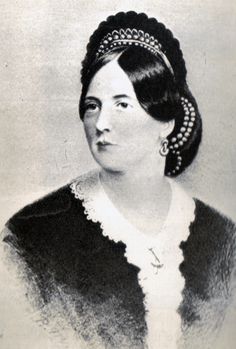
Birth of Lady Jane Francesca Wilde, Poet & Nationalist

jane-wilde

Jane Francesca Agnes, Lady Wilde, Irish poet who writes under the pen name “Speranza” and a supporter of the nationalist movement, is born on December 27, 1821, in Wexford, County Wexford.

Jane is the last of the four children of Charles Elgee, the son of Archdeacon John Elgee, a Wexford solicitor, and his wife Sarah (née Kingsbury). Her great-grandfather is an Italian who had come to Wexford in the 18th century. She has a special interest in Irish folktales, which she helps to gather. She marries Sir William Wilde on November 12, 1851, and they have three children, William Charles Kingsbury Wilde (1852–1899), Oscar Fingal O’Flahertie Wills Wilde (1854–1900), and Isola Francesca Emily Wilde (1857–1867).

Wilde, who is the niece of Charles Maturin, writes for the Young Ireland movement of the 1840s, publishing poems in The Nation under the pseudonym of “Speranza.” Her works include pro-Irish independence and anti-British writing. She is sometimes known as “Speranza of the Nation.” Charles Gavan Duffy is the editor when “Speranza” writes commentary calling for armed revolution in Ireland. The authorities at Dublin Castle shut down the paper and bring the editor to court. Duffy refuses to name who has written the offending article. “Speranza” reputedly stands up in court and claims responsibility for the article. The confession is ignored by the authorities. But in any event the newspaper is permanently shut down by the authorities.

Wilde is an early advocate of women’s rights, and campaigns for better education for women. She invites the suffragist Millicent Fawcett to her home to speak on female liberty. She praises the passing of the Married Women’s Property Act 1882, preventing women from having to enter marriage “as a bond slave, disenfranchised of all rights over her fortune.”

William Wilde is knighted in January 1864, but the family celebrations are short-lived, for in the same year Sir William and Lady Wilde are at the centre of a sensational Dublin court case regarding a young woman called Mary Travers, the daughter of a colleague of Sir William’s, who claims that he had seduced her and who then brings an action against Lady Wilde for libel. Mary Travers wins the case and costs of £2,000 are awarded against Lady Wilde. Then, in 1867, their daughter Isola dies of fever at the age of nine. In 1871 the two illegitimate daughters of Sir William are burned to death and in 1876 Sir William himself dies. The family discovers that he is virtually bankrupt.

Lady Wilde leaves Dublin for London in 1879, where she joins her two sons, Willie, a journalist, and Oscar, who is making a name for himself in literary circles. She lives with her older son in poverty, supplementing their meagre income by writing for fashionable magazines and producing books based on the researches of her late husband into Irish folklore.

Lady Wilde contracts bronchitis in January 1896 and, dying, asks for permission to see Oscar, who is in prison. Her request is refused. It is claimed that her “fetch” appears in Oscar’s prison cell as she dies at her home, 146 Oakley Street, Chelsea, on February 3, 1896. Willie Wilde, her older son, is penniless, so Oscar pays for her funeral, which is held on February 5, at Kensal Green Cemetery in London. A headstone proves too expensive and she is buried anonymously in common ground. A monument to her, in the form of a Celtic cross, is erected at Kensal Green Cemetery by the Oscar Wilde Society in 1999.


Leave a comment

The Arrest of Oliver Plunkett, Archbishop of Armagh

Oliver Plunkett, Catholic Archbishop of Armagh and Primate of All Ireland, is accused of instigating the Popish Plot and arrested on December 6, 1679. He is the last victim of the Popish Plot.

Plunkett is born on November 1, 1625, in Loughcrew, County Meath, to parents of Hiberno-Norman ancestors. Until his sixteenth year, his education is entrusted to his cousin Patrick Plunkett, Abbot of St. Mary’s, Dublin, and brother of Luke Plunkett, 1st Earl of Fingall, who later becomes successively Bishop of Ardagh and of Meath. As an aspirant to the priesthood, he sets out for Rome in 1647.

Plunkett is admitted to the Pontifical Irish College in Rome and proves to be an able pupil. He is ordained a priest in 1654 and deputed by the Irish bishops to act as their representative in Rome. Meanwhile, the Cromwellian conquest of Ireland (1649–1653) has defeated the Roman Catholic cause in Ireland. As a result, it is impossible for Plunkett to return to Ireland for many years, so he petitions to remain in Rome. At the Congregation of Propaganda Fide on July 9, 1669, he is appointed Archbishop of Armagh and is consecrated on November 30 at Ghent. He returns to Ireland on March 7, 1670, as the English Restoration of 1660 has begun on a basis of toleration.

Plunkett sets about reorganising the ravaged Roman Church and builds schools both for the young and for clergy. The Penal Laws have been relaxed in line with the Declaration of Breda in 1660 and he is able to establish a Jesuit College in Drogheda in 1670, which becomes the first Catholic-Protestant integrated school in Ireland.

On the enactment of the Test Act in 1673, to which Plunkett does not agree for doctrinal reasons, the college is closed and demolished. Plunkett goes into hiding, traveling only in disguise, and refuses a government edict to register at a seaport to await passage into exile.

In 1678 the so-called Popish Plot, concocted in England by clergyman Titus Oates, leads to further anti-Roman Catholic action. Archbishop Peter Talbot of Dublin is arrested, and Plunkett again goes into hiding. Despite being on the run and with a price on his head, he refuses to leave his flock.

Plunkett is arrested in Dublin on December 6, 1679, and imprisoned in Dublin Castle. He is tried at Dundalk for conspiring against the state by allegedly plotting to bring 20,000 French soldiers into the country, and for levying a tax on his clergy to support 70,000 men for rebellion. The trial soon collapses as the prosecution witnesses are themselves wanted men and afraid to appear in court. Plunkett is moved to Newgate Prison in London in order to face trial at Westminster Hall. The first grand jury finds no true bill, but he is not released. The second trial is generally regarded as a serious miscarriage of justice as Plunkett is denied defending counsel.

Archbishop Plunkett is found guilty of high treason in June 1681 “for promoting the Roman faith,” and is condemned to death. Plunkett is hanged, drawn, and quartered at Tyburn on July 1, 1681, the last Roman Catholic martyr to die in England. His body is initially buried in two tin boxes in the courtyard of St. Giles in the Fields church. The remains are exhumed in 1683 and moved to the Benedictine monastery at Lamspringe, near Hildesheim in Germany. His head is brought to Rome, and from there to Armagh, and eventually to Drogheda where it has rested in St. Peter’s Church since June 29, 1921. Most of the body is brought to Downside Abbey, England, where the major part is located today, with some parts remaining at Lamspringe.

Sir Oliver Plunkett is canonised in Rome by Pope Paul VI on October 12, 1975, the first new Irish saint in almost seven hundred years, and the first of the Irish martyrs to be beatified. For the canonisation, the customary second miracle is waived.


Leave a comment

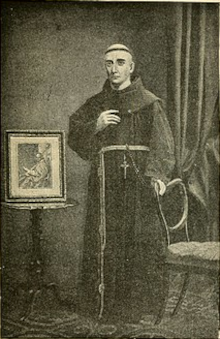
Death of Flaithrí Ó Maolchonaire, Archbishop of Tuam

Flaithrí Ó Maolchonaire, Irish Franciscan and theologian, founder of St. Anthony’s College, Leuven, and Archbishop of Tuam, dies in Madrid, Spain on November 18, 1629.

Ó Maolchonaire is born in the townland of Figh, civil parish of Tibohine, barony of Frenchpark, County Roscommon. His father and mother are Fíthil and Onóra Ó Maolchonaire. Two other sons survive to adulthood, Maoilechlainn and Firbisigh. They belong to a well-known family of historians and poets. He is brought up in the family profession.

Ó Maolchonaire studies for the priesthood at Salamanca, entering the Irish college founded in 1592. He first studies the liberal arts and philosophy. In 1593 he translates into Irish a short Castilian catechism by Jerónimo de Ripalda SJ. The original is a simple catechetical work written in Aristotelian master-pupil dialogue. According to Mícheál Mac Craith, Ó Maolchonaire’s translation pointedly refers to the Irish as Eirinnach rather than Gaedheal.

After five years at the Salamanca Irish college, Ó Maolchonaire leaves to join the Franciscan province of Santiago. Aodh Mac Cathmhaoil is among his classmates in the Salamanca Franciscan friary. They and nine of their peers in the Santiago province are later raised to the episcopacy, an unprecedented development in the history of the order.

At the height of the Nine Years’ War, Ó Maolchonaire sails to Ireland where he serves as a confessor and preacher to troops under the command of Hugh O’Neill and Hugh Roe O’Donnell. In 1601, they request a bishopric for Ó Maolchonaire “in recognition of his diligence, commending his sound judgment on Irish affairs.” After the disaster of Kinsale in 1601, he accompanies O’Donnell to Spain as his confessor and adviser, hoping to see a renewal of Spanish military intervention in Ireland.

In 1602, Ó Maolchonaire attempts to get approval for O’Donnell to meet Philip III in person, but they are kept at arm’s length by the Spanish court. During this time, they also drafted an official complaint against the Jesuit superiors of the Irish college at Salamanca over presumed discrimination in favour of Old English students at the expense of students from Connacht and Ulster.

While waiting for a response to his repeated calls for military support in Ireland, O’Donnell becomes seriously ill and dies at Simancas, being assisted on his deathbed by Ó Maolconaire. In keeping with his patronage of the order of friars minor in Donegal, O’Donnell is buried in the Franciscan habit. Ó Maolchonaire accompanies the remains to their last resting place in the Franciscan church at Valladolid. He continues to press for military support after O’Donnell’s death. He participates in an abandoned maritime expedition which reaches Achill Sound in 1603 but never lands in Ireland. He subsequently assists the Spanish councils of state and war to stem the flow of Irish military migrants and their dependents in Spain.

As adviser to Puñonrostro, the king’s appointee as protector of Irish exiles in Spain, Ó Maolchonaire helps to secure funds for widows, orphans and clerics. Trained as a chronicler and genealogist, he sponsors the entry of Irish soldiers into Spanish military orders and successfully calls for the promotion of Henry O’Neill, second eldest son of the earl of Tyrone, as colonel of Irish infantry units in Flanders, the O’Neill tercio in 1604.

In 1606, the Franciscan general chapter is held in Toledo where Ó Maolchonaire is selected as minister-provincial of the Irish friars minor. The most notable act of his tenure as provincial is the founding of a new Irish Franciscan college at Leuven in the Habsburg Netherlands. A year before his appointment, he begins his efforts in earnest with an appeal to the Spanish king. The loss of five Franciscan houses during the Nine Years’ War makes a new foundation essential. In response, Philip III instructs Albert VII, Archduke of Austria, to provide a perpetual grant for a new college in the university town of Leuven. Ó Maolchonaire’s part in founding the college clearly influences the Catholic pastoral mission to Ireland during the seventeenth century. The first and most active Irish printing press on the continent is long in operation at Leuven.

After Hugh O’Neill and Rory O’Donnell leave Ireland in 1607, Ó Maolconaire accompanies them from Douai to Rome as interpreter and advisor. Christopher St. Laurence, baron of Howth, implicates him in a plot to seize Dublin Castle and raises a new rebellion just before the Flight of the Earls. In recognition of his losses, Philip III and Paul V offer O’Neill the concession of Ó Maolchonaire’s promotion to the archbishopric of Tuam. On Sunday, May 3, 1609, he is consecrated archbishop by Cardinal Maffeo Barberini in the centre of Rome at the Chiesa Santo Spirito in Sassia. He remains in Rome until his appointment as archbishop of Tuam before returning to Madrid on behalf of Hugh O’Neill.

In response to the 1613–15 Parliament of Ireland, Ó Maolchonaire writes from Valladolid a remonstrance to the Catholic members of the parliament, rebuking them for assenting to the bill of attainder that confiscated the estates of O’Neill, O’Donnell and their adherents. As Archbishop of Tuam, he never takes possession of his episcopal see, governing through vicars general. He continues to live in Madrid and Leuven, as is the case with many Irish clergy at the time. Like his fellow-Franciscan, Luke Wadding, and Peter Lombard, Archbishop of Armagh, he serves as a key intermediary and his influence in Irish matters is considerable. In 1626, a year after Charles I declared war on Spain, he makes the case for an invasion of Ireland under the joint leadership of the earls of Tyrone and Tyrconnell.

Ó Maolconaire dies at the Franciscan friary of San Francisco el Grande in Madrid on November 18, 1629. In 1654, two Irish friars bring his remains back to St. Anthony’s College in Leuven where he is buried near the high altar in the collegiate chapel.


Leave a comment

Ulster Rebels Take Dundalk During the Irish Rebellion of 1641

Ulster rebels take Dundalk on October 31, 1641 during the Irish Rebellion of 1641. The rebellion is an uprising by Irish Catholics in the Kingdom of Ireland, who want an end to anti-Catholic discrimination, greater Irish self-governance, and to partially or fully reverse the plantations of Ireland. They also want to prevent a possible invasion or takeover by anti-Catholic English Parliamentarians and Scottish Covenanters, who are defying the king, Charles I.

The rebellion begins on October 23, 1641 as an attempted coup d’état by Catholic gentry and military officers, who try to seize control of the English administration in Ireland. However, it develops into a widespread rebellion and ethnic conflict with English and Scottish Protestant settlers, leading to Scottish military intervention. The rebels eventually found the Irish Catholic Confederacy.

The plan to seize Dublin Castle is foiled, but the rebels swiftly capture numerous towns (including Dundalk), forts and fortified houses in the northern province of Ulster. Within days they hold most of the province. Rebel leader Felim O’Neill of Kinard issues a forged proclamation, the Proclamation of Dungannon, claiming he has the king’s blessing to secure Ireland against the king’s opponents. The uprising spreads southward and soon most of Ireland is in rebellion. In November, rebels besiege Drogheda and defeat an English relief force at Julianstown. The following month, many Anglo-Irish Catholic lords join the rebellion. In these first months, especially in Ulster, some Catholic rebels drive out or kill thousands of Protestant settlers (most notably the Portadown massacre), and settlers respond in kind. Reports of rebel massacres outrage Protestants in Britain, and leave a lasting impact on the Ulster Protestant community.

King Charles and the English parliament both seek to quell the rebellion, but parliament does not trust the king with command of any army raised to do so. This is one of the issues that lead to the English Civil War. Charles orders forces to be raised in Ireland, and the English parliament drafts a bill to give itself the power to raise armed forces. Eventually, in April 1642, following negotiations between the English and Scottish parliaments, the Scots send a Covenanter army to Ireland. It swiftly captures most of eastern Ulster, while a Protestant settler army holds northwestern Ulster. Government forces meanwhile recapture much of the Pale, and hold the region around Cork. Most of the rest of Ireland is under rebel control.

In May 1642, Ireland’s Catholic bishops meet at Kilkenny, declare the rebellion to be a just war and take steps to control it. With representatives of the Catholic nobility in attendance, they agree to set up an alternative government known as the Irish Catholic Confederacy and draw up the Confederate Oath of Association. The rebels, now known as Confederates, hold most of Ireland against the Protestant Royalists, Scottish Covenanters and English Parliamentarians. The rebellion is thus the first stage of the Irish Confederate Wars and part of the wider Wars of the Three Kingdoms, which lasts for the next ten years.

(Pictured: Depiction of the massacre of Ulster Protestants during the 1641 rebellion, the LIFE Picture Collection via Getty Images)


Leave a comment

Adoption of the Constitution of the Irish Free State

The Constitution of the Irish Free State (Irish: Bunreacht Shaorstát Eireann) is adopted by Act of Dáil Éireann sitting as a constituent assembly on October 25, 1922. In accordance with Article 83 of the Constitution, the Irish Free State Constitution Act 1922 of the British Parliament, which comes into effect upon receiving the royal assent on December 5, 1922, provides that the Constitution will come into effect upon the issue of a Royal Proclamation, which is done on December 6, 1922. In 1937 the Constitution of the Irish Free State is replaced by the modern Constitution of Ireland following a referendum.

Shortly after the British evacuate their troops from Dublin Castle in January 1922, Michael Collins sets about establishing a committee to draft a new constitution for the nascent Irish Free State which would come into being in December 1922. Collins chairs the first meeting of that committee and at that point is its chairman, but is assassinated before the constitution is finalised. Darrell Figgis, the vice-chairman becomes acting Chair. The committee produces three draft texts, designated A, B and C. Draft A is signed by Figgis, James McNeill and John O’Byrne. Draft B is signed by James G. Douglas, C.J. France and Hugh Kennedy and it differs substantially from draft A only in proposals regarding the Executive. Draft C is the most novel of the three. It is signed by Alfred O’Rahilly and James Murnaghan, and provides for the possibility of representation for the people of the northern counties in the Dáil in the event of that area opting out of the proposed free state.

On March 31, 1922, an act of the United Kingdom Parliament called the Irish Free State (Agreement) Act 1922 is passed. It gives the force of law to the Anglo-Irish Treaty, which had been negotiated between the British government and Irish leaders in 1921. It also provides by for the election of a body to be called the “House of the Parliament,” sometimes called the “Provisional Parliament,” to which the Provisional Government establishes under that act will be responsible. The act gives no power to the Provisional Parliament to enact a constitution for the Irish Free State. In due course, “the House of the Parliament,” provided for by that act, is elected and meets on September 9, 1922, and calling itself Dáil Éireann, proceeds to sit as a constituent assembly for the settlement of what becomes the Constitution of the Irish Free State.

The Constitution establishes a parliamentary system of government under a form of constitutional monarchy, and contains guarantees of certain fundamental rights. It is intended that the constitution would be a rigid document that, after an initial period, could be amended only by referendum. However, amendments are made to the Constitution’s amendment procedure, so that all amendments can be and are in fact made by a simple Act of the Oireachtas (parliament).

Following a change of government in 1932 and the adoption of the Statute of Westminster 1931, a series of amendments progressively removes many of the provisions that had been required by the Anglo-Irish Treaty.

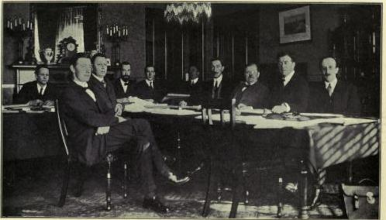
(Pictured: The Constitution Committee meeting at the Shelbourne Hotel, Dublin, 1922)


Leave a comment

Death of Red Hugh O’Donnell

Hugh Roe O’Donnell (Aodh Rua ÓDomhnaill), sixteenth century Irish nobleman also known as Red Hugh O’Donnell, dies at Simancas Castle in Valladolid, Spain, on September 10, 1602. Evidence suggests he might have been poisoned by an English spy.

O’Donnell is born on October 30, 1572, in Lifford (which is in present-day County Donegal) and is the son of Hugh McManus O’Donnell, the Gaelic Lord of Tyrconnell, a territory which takes in most of the present-day county of Donegal except for the Inishowen peninsula. His mother, Aodh MacManus’ second wife, is the formidable and extremely well-connected Scottish lady, Fionnuala Nic Dhomhnaill, known to history as the Iníon Dubh or The Dark Daughter. A daughter of James Mac Donald she had been raised at the Scottish court.

In 1587, at the age of fifteen, O’Donnell marries Rose O’Neill, the daughter of Hugh O’Neill, Earl of Tyrone, a nephew of Turlough Lynagh O’Neill who is recognised by the Irish as The O’Neill. He is, therefore, a bridge between two traditional enemies, the O’Donnell’s and the O’Neills.

The English Lord Deputy of Ireland, Sir John Perrot, recognises the importance of the young O’Donnell prince and decides to secure him as a hostage thus giving him power over the O’Donnell clan and preventing them from forming a treaty with the O’Neills. In 1587, when he is sixteen, O’Donnell and two friends, a MacSweeney and an O’Gallagher, are persuaded to board a ship at Rathmullan which has been disguised as a Spanish wine barque. Once onboard they are carried off to Dublin Castle as prisoners. The O’Donnell’s offer to pay a large ransom and the Iníon Dubh also gives up 25 Spaniards rescued from the Armada. The English agree to this but as soon as the Spaniards are handed over, they are beheaded. The agreement is not kept.

Perrot has his hostage but a most reluctant one. The young man continuously seeks ways to escape. His first opportunity comes at Christmas in 1590 when a rope is smuggled in to the prince. He escapes and flees into the Wicklow Mountains. He seeks shelter with Phelim O’Toole who has him returned to the English as he fears the anger of the infamous Perrot.

A year later, at Christmas in 1591, O’Donnell makes his second attempt at escape, this time by crawling through the Dublin Castle sewers. With him are Henry and Art O’Neill, two sons of Shane O’Neill (Shane the Proud). This time the escapees make their way to the Glenmalure stronghold of Fiach McHugh O’Byrne. Unfortunately, the winter is very severe and Art O’ Neill dies from exposure just as the O’Byrne rescue party finds them. Both Red Hugh and Henry O’Neill suffer severe frostbite but are safely returned to Ulster.

While O’Donnell is held prisoner by the English, his father becomes senile. In 1592, when O’Donnell is sufficiently recovered, he is inaugurated as the O’Donnell and England, for her treachery, has an avowed and implacable enemy.

O’Donnell aids the Maguires of Fermanagh against the English and when his father-in-law, Hugh O’Neill, initiates the Nine Years’ War by leading his clan against the English at the Battle of Clontibret (1595) and Battle of the Yellow Ford (1598), O’Donnell is at his side.

In 1595 O’Donnell ambushes an English force in the Curlew Mountains, killing 500 of them including their commander. However, the tide is turning against the Irish now. England is flooding the country with armies and many of the leading Gaelic families are beginning to make deals with them.

In 1601 the Spanish land in Kinsale and the English besiege them. O’Neill and O’Donnell march south from Ulster and Ballymote Castle in Sligo in an attempt to break the siege. This turns into a debacle causing the Irish to scatter and the Spanish to surrender. O’Neill marches back north and O’Donnell is sent to Spain to ask for more troops from Phillip III. In Spain, he is treated like a royal. He petitions aid from the King who gives him a promise of another Spanish force.

As a year passes and O’Donnell does not receive any news from Philip III of Spain, he leaves again for Valladolid, but he dies on September 10, 1602, while en route. He is attended on his deathbed by Archbishop of Tuam Fláithrí Ó Maolchonaire and two friars from Donegal named Father Muiris mac Donnchadh Ulltach Ó Duinnshléibhe and Father Muiris mac Seaán Ulltach Ó Duinnshléibhe. The Anglo-Irish double-agent, James “Spanish” Blake, is alleged to have poisoned O’Donnell.

It is, however, unlikely that O’Donnell is poisoned. A more probable cause of death is the tapeworm that Simancas documents of the time state to be the cause of his demise. His Last Will and Testament, written in his dying moments with his loyal retinue, is an extremely evocative and moving document. One original is preserved in Simancas and the other in the Chancellery archive in Valladolid.

O’Donnell is buried in the chapter of the Franciscan monastery in Valladolid. Though the building is demolished in 1837, the exact location of the tomb may have been discovered following a Spanish archaeological dig in May 2020.

O’Donnell is succeeded as chieftain of his clan and prince of Tyrconnell by his brother Rory.

(Pictured: Statue of Gaelic Chieftain Red Hugh O’Donnell in County Donegal)


Leave a comment

The Execution of William Michael Byrne

William Michael Byrne, a key figure in the Society of United Irishmen in the years leading to the Irish Rebellion of 1798 against the British government, is executed in Dublin on July 25, 1798.

Byrne is one of the two sons of Colclough Byrne of Drumquin, Hackettstown and Mary Galway of Cork, a great grand-niece of James Butler, 1st Duke of Ormond. He lives most of his adult life at Park Hill in the Glen of the Downs, County Wicklow. In late 1796, he enlists in the yeomanry, serving in the Newtown Mount Kennedy cavalry.

Byrne joins the Society of the United Irishmen in the spring of 1797 and later that same year is appointed by the Leinster committee to organise the half barony of Rathdown. As a delegate for Rathdown barony, he is a well respected and competent figure. With the assistance of his Protestant friend Thomas Miller of Powerscourt, he undertakes the organisation of military and civil branches of the United Irishmen in Rathdown, recruiting 2,000 men by late 1797. In October 1797 he is forced to resign from the yeomen after refusing to swear the oath of loyalty and his activities begin to come to the attention of Dublin Castle.

According to the informant A.B. (Thomas Murray), Byrne attends the inaugural meeting of the United Irishmen’s Wicklow county committee in December. It is held in the Annacurra home of William’s first cousin, John Loftus. Murray’s information tells that Byrne established networks of contacts between the Leinster committee and the Cork United Irishmen along with other contacts in Munster.

Byrne’s career comes to an end when he, along with fourteen other Leinster delegates, are arrested on March 12, 1798 at the house of Oliver Bond. They had been betrayed by Thomas Reynolds, treasurer of Kildare United Irishmen and member of the provincial committee. Reynolds had been informed that plans for an insurrection were about to be finalised by the committee. Byrne is arrested in possession of incriminating documents which are described by Attorney-General for Ireland Arthur Wolfe as being ‘very treasonable printed papers.’

On July 4, 1798 Byrne with four others is brought before a commission of oyer and terminer on charges of high treason. The case mounted by the state against him is based principally on the evidence of Reynolds and also that given by his former comrade William Miller of Powerscourt. The weight of the evidence is overwhelming, rendering an effective defence impossible.

Byrne’s lawyer, John Philpot Curran KC, the leading defence counsel of the period, attempts to cast Reynold’s character and motives in a foul light but it is futile. In his last days, efforts are made to spare his life if he would only express regret for his actions and accuse Lord Edward FitzGerald for having led him to this point. He refuses, meeting his end with great dignity and stoicism.

Byrne is convicted of high treason and executed on July 25, 1798 outside Green Street Courthouse, Dublin.

The Dublin Magazine notes that Byrne “met his fate with a degree of courage perhaps unequalled.” For his service to the state, Reynolds is honoured by Dublin Corporation with the freedom of the city on October 19, 1798, spending much of his life thereafter in fear of assassination.


Leave a comment

Birth of Sebastian Barry, Novelist, Playwright & Poet

Sebastian Barry, novelist, playwright and poet, is born in Dublin on July 5, 1955. He is noted for his lyrical literary writing style and is considered one of Ireland’s finest writers. He is named Laureate for Irish Fiction, 2019–2021.

Barry’s mother is acclaimed actress Joan O’Hara. He is educated at Catholic University School and Trinity College, Dublin, where he reads English and Latin. His literary career begins in poetry before he begins writing plays and novels.

Barry starts his literary career with the novel Macker’s Garden in 1982. This is followed by several books of poetry and a further novel, The Engine of Owl-Light (1987), before his career as a playwright begins with his first play produced in the Abbey Theatre, Boss Grady’s Boys (1988).

Barry’s maternal great-grandfather, James Dunne, provides the inspiration for the main character in his most internationally known play, The Steward of Christendom, which wins the Christopher Ewart-Biggs Memorial Prize, the Lloyd’s Private Banking Playwright of the Year Award and other awards. The main character in the play, Thomas Dunne, is the chief superintendent of the Dublin Metropolitan Police from 1913 to 1922. He oversees the area surrounding Dublin Castle until the Irish Free State takeover on January 16, 1922. One of his grandfathers belonged to the British Army Corps of Royal Engineers while the other is a painter, a Nationalist, and a devotee of Éamon de Valera.

Both The Steward of Christendom and the novel The Whereabouts of Eneas McNulty, are about the dislocations, physical and otherwise, of loyalist Irish people during the political upheavals of the early 20th century. The title character of the latter work is a young man forced to leave Ireland by his former friends in the aftermath of the Irish War of Independence.

Barry has been twice shortlisted for the Man Booker Prize for his novels A Long Long Way (2005) and The Secret Scripture (2008), the latter of which wins the 2008 Costa Book of the Year and the James Tait Black Memorial Prize. His fifth novel, On Canaan’s Side (2011), is longlisted for the 2011 Man Booker Prize and wins the 2012 Walter Scott Prize. In January 2017, he is awarded the Costa Book of the Year prize for Days Without End (2016), becoming the first novelist to win the prestigious prize twice. The novel also wins The Walter Scott Prize and The Independent Booksellers’ Prize, and is longlisted for the Man Booker Prize 2017.

Barry’s play Andersen’s English is inspired by children’s writer Hans Christian Andersen coming to stay with Charles Dickens and his family in the Kent marshes. Directed by Max Stafford-Clark and produced by the Out of Joint Theatre Company and Hampstead Theatre, the play tours in the United Kingdom from February 11 to May 8, 2010. Our Lady of Sligo is directed in 1998 by Stafford-Clark at the Royal National Theatre co−produced by Out of Joint.

In 2001, Barry establishes his personal and professional archive at the Harry Ransom Center. More than sixty boxes of papers document his diverse writing career and range of creative output which includes drawings, poetry, short stories, novels, essays, and scripts.

Barry has been awarded honorary degrees from NUI Galway, the Open University and the University of East Anglia. His academic posts include Honorary Fellow in Writing at the University of Iowa (1984), Heimbold Visiting Professor at Villanova University (2006) and Writer Fellow at Trinity College, Dublin (1995–1996).

Barry lives in County Wicklow with his wife, actor and screenwriter Alison Deegan.


Leave a comment

Queen Elizabeth II Visits Cork

Queen Elizabeth II spends the last of her four days in Ireland visiting Cork on May 20, 2011, where she once again is greeted warmly. Despite initial concerns about security, the visit proves to be a huge success for both countries. The Queen’s apology at Dublin Castle for the treatment her government meted out to Ireland over many years is received with enormous positive, emotional response.

Large crowds line the streets in Cork city centre and the Queen is given a tour of the city’s English Market by the Lord Mayor of Cork, Terry Shannon. She meets some stall owners and speaks to members of the public after she leaves the market. There is a carnival atmosphere on the streets of Cork and the visit is more relaxed than many engagements in Dublin.

The Queen and Prince Philip also visit the Tyndall Institute, which is run by University College Cork. While at the institute, they meet twins Hassan and Hussein Benhaffaf and their mother Angie. Earlier, they visit the Rock of Cashel in County Tipperary and pay a private visit to Coolmore Stud.

The Queen indicates she would like to return to Ireland for another visit. Taoiseach Enda Kenny says he invited her to return as she boarded her flight at Cork Airport. Kenny says the Queen told him she and the royal party enjoyed the visit. He pays tribute to everyone involved in the State visit. He says Ireland responded magnificently to the visit, from the President right down to ordinary people, who showed restraint and understanding.

Kenny says the Queen had received a real Irish welcome, which he says demonstrates the importance of a new beginning for both islands. He says that Ireland has measured up to the highest global standards and the county can be proud.

Tánaiste and Minister for Foreign Affairs Eamon Gilmore says the visit has enhanced Ireland’s reputation abroad at a time when there are only negative headlines. He says that, because of the visit, the world is finally getting a picture of a country that does things well and that is working through its difficulties.

Sinn Féin President Gerry Adams says that, while expressing concerns about Queen Elizabeth’s visit, he also hopes some good will come from it.

At Cork Airport she walks to her plane passing an army guard of honour and Taoiseach Enda Kenny is there to bid her farewell. The plane departs bringing an end to her four-day State visit.

(From: “Queen Elizabeth II concludes Irish visit,” RTÉ.ie, the website of Raidió Teilifís Éireann, May 20, 2011)


2 Comments

The Hollyford Barracks Attack

Irish Republican Army (IRA) volunteers destroy the Royal Irish Constabulary (RIC) barracks at Hollyford, County Tipperary, on May 11, 1920.

In 1920 twelve RIC Constables, or Peelers as they are called, are stationed in the barracks in Hollyford. They are regarded as the eyes and ears of the British establishment and therefore a thorn in the side of the local IRA. Since the previous year, the IRA has developed a policy of attacking police barracks throughout the country and forcing their closure thereby reducing the flow of information to Dublin Castle.

On the night of May 11, 1920, it is the turn of Hollyford Barracks. The local IRA with its leaders assembles at Phil Shanahan’s house on the Glenough road. At this time Shanahan is a member of the First Dáil, elected from a Dublin constituency as he is living and running a public house there. He fought in the Jacob’s Biscuit Factory under Thomas MacDonagh during the 1916 Easter Rising. It is decided the attack will be led by Ernie O’Malley, an organiser for the IRA who moves around to various Brigades throughout the country. His second in command is Séumas Robinson, commanding officer of the 3rd Tipperary Brigade. Other officers are Seán Treacy, whose mother Bridget Allis is from Lacknacreena, Dan Breen who is quartermaster general (QMG) of the Brigade, Comdt. Tadgh O’Dwyer, Captain Paddy O’Dwyer and Lt. Jim O’Gorman.

Roads are blocked in the vicinity and telephone lines are cut. Robinson and O’Malley, with the help of ladders, get on the roof and with lump hammers break holes in the slates. They then drop hand grenades and petrol in through the holes. They also ignite turf sods soaked in petrol and drop them through the holes. The fire on the upper floor escalates. While all this is happening, Seán Treacy, with his covering party, concentrate their fire on the port holes which keeps the occupants pinned down. The battle goes on all night and, as daylight approaches on the morning of May 12, the attackers have to withdraw without dislodging the police. While they do not achieve their aim to capture guns and ammunition, they do enough damage to ensure the RIC leaves Hollyford immediately never to return.

The next occupants, following the Anglo-Irish Treaty, are the Gárda Síochána in 1948. Various changes in personnel take place in the 1950s until Gárda Maurice Slattery is the only Gárda left in Hollyford. In 1965, after a lifetime in the Gárdí, he retires, and he and his family move to Limerick. He is the last Gárda to serve in Hollyford.

(From: “The Burning of Hollyford Barracks,” Third Tipperary Brigade Memorial (www.thirdtippbrigade.ie), July 12, 2018)