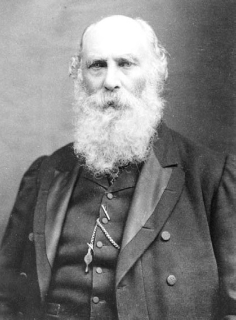
George Johnstone StoneyFRS, Irish physicist, dies on July 5, 1911, at Notting Hill, London, England. He is most famous for introducing the term “electron” as the “fundamental unit quantity of electricity.” He introduces the concept, though not the word, as early as 1874, initially naming it “electrine,” and the word itself comes in 1891. He publishes around 75 scientific papers during his lifetime.
Stoney is born on February 15, 1826, at Oakley Park, near Birr, County Offaly, in the Irish Midlands, the son of George Stoney and Anne (née Bindon Blood). His only brother is Bindon Blood Stoney, who becomes chief engineer of the Dublin Port and Docks Board. The Stoney family is an old-established Anglo-Irish family. During the time of the famine (1845–52), when land prices plummet, the family property is sold to support his widowed mother and family. He attends Trinity College Dublin (TCD), graduating with a BA degree in 1848. From 1848 to 1852 he works as an astronomy assistant to William Parsons, 3rd Earl of Rosse, at Birr Castle, County Offaly, where Parsons had built the world’s largest telescope, the 72-inch Leviathan of Parsonstown. Simultaneously he continues to study physics and mathematics and is awarded an MA by TCD in 1852.
From 1852 to 1857, Stoney is professor of physics at Queen’s College Galway. From 1857 to 1882, he is employed as Secretary of the Queen’s University of Ireland, an administrative job based in Dublin. In the early 1880s, he moves to the post of superintendent of Civil Service Examinations in Ireland, a post he holds until his retirement in 1893. He continues his independent scientific research throughout his decades of non-scientific employment duties in Dublin. He also serves for decades as honorary secretary and then vice-president of the Royal Dublin Society (RDS), a scientific society modeled after the Royal Society of London and, after his move to London in 1893, he serves on the council of that society as well. Additionally, he intermittently serves on scientific review committees of the British Association for the Advancement of Science from the early 1860s.
Stoney publishes seventy-five scientific papers in a variety of journals, but chiefly in the journals of the Royal Dublin Society. He makes significant contributions to cosmic physics and to the theory of gases. He estimates the number of molecules in a cubic millimeter of gas, at room temperature and pressure, from data obtained from the kinetic theory of gases. His most important scientific work is the conception and calculation of the magnitude of the “atom of electricity.” In 1891, he proposes the term “electron” to describe the fundamental unit of electrical charge, and his contributions to research in this area lays the foundations for the eventual discovery of the particle by J. J. Thomson in 1897.
Stoney proposes the first system of natural units in 1881. He realizes that a fixed amount of charge is transferred per chemical bond affected during electrolysis, the elementary chargee, which can serve as a unit of charge, and that combined with other known universal constants, namely the speed of lightc and the Newtonian constant of gravitationG, a complete system of units can be derived. He shows how to derive units of mass, length, time and electric charge as base units. Due to the form in which Coulomb’s law is expressed, the constant 4πε0 is implicitly included, ε0 being the vacuum permittivity.
Like Stoney, Max Planck independently derives a system of natural units (of similar scale) some decades after him, using different constants of nature.
Hermann Weyl makes a notable attempt to construct a unified theory by associating a gravitational unit of charge with the Stoney length. Weyl’s theory leads to significant mathematical innovations, but his theory is generally thought to lack physical significance.
Stoney marries his cousin, Margaret Sophia Stoney, by whom he has had two sons and three daughters. One of his sons, George Gerald Stoney FRS, is a scientist. His daughter Florence StoneyOBE is a radiologist while his daughter Edith is considered to be the first woman medical physicist. His most scientifically notable relative is his nephew, the Dublin-based physicist George Francis FitzGerald. He is second cousin of the grandfather of Ethel Sara Turing, mother of Alan Turing.
After moving to London, Stoney lives first at Hornsey Rise, north London, before moving to 30 Chepstow Crescent, Notting Hill, west London. In his later years illness confines him to a single floor of the house, which is filled with books, papers, and scientific instruments, often self-made. He dies at his home on July 5, 1911. His cremated ashes are buried in St. Nahi’s Church, Dundrum, Dublin.
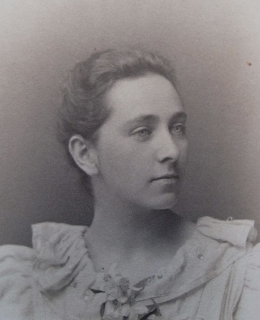
Stoney is born into an old-established Anglo-Irish scientific family at 40 Wellington Road, Ballsbridge, Dublin, on January 6, 1869. The daughter of George Johnstone Stoney, FRS, an eminent physicist who coins the term “electron” in 1891 as the “fundamental unit quantity of electricity,” and his wife and cousin, Margaret Sophia Stoney. One of her two brothers, George Gerald, is an engineer and a Fellow of the Royal Society (FRS). One of her two sisters, Florence Stoney, is a radiologist and receives an OBE. Her cousin is the Dublin-based physicist George Francis FitzGerald FRS (1851–1901), and her uncle Bindon Blood Stoney FRS is Engineer of Dublin Port, renowned for building a number of the main Dublin bridges and developing the Quayside.
Stoney demonstrates considerable mathematical talent and gains a scholarship at Newnham College, Cambridge, where she achieves a First in the Part I Tripos examination in 1893. However, she is not awarded a University of Cambridge degree as women are excluded from graduation until 1948. During her time at Newnham, she is in charge of the College telescope. She is later awarded a BA and an MA from Trinity College Dublin, after they accept women in 1904.
Following the 1876 Medical Act, it is illegal for academic institutions to prevent access to medical education based on gender. The first medical school for women in Britain is established in 1874 by Dr. Sophia Jex-Blake in anticipation of this law. The London School of Medicine for Women quickly becomes part of the University of London, with clinical teaching at the Royal Free Hospital. Stoney’s sister Florence is a student at the school, graduates in medicine with honours in 1895 (MB BS) and obtains her MD in 1898. Meanwhile, Stoney gains an appointment as a physics lecturer at the school in 1899. Her first tasks are to set up a physics laboratory and design the physics course. The laboratory is planned for 20 students, and the course content is pure physics, as required by university regulations. It includes mechanics, magnetism, electricity, optics, sound, heat and energy. In her obituary in The Lancet, an ex-student of hers notes: “Her lectures on physics mostly developed into informal talks, during which Miss Stoney, usually in a blue pinafore, scratched on a blackboard with coloured chalks, turning anxiously at intervals to ask ‘Have you taken my point?’. She was perhaps too good a mathematician … to understand the difficulties of the average medical student, but experience had taught her how distressing these could be”.
In 1901, the Royal Free Hospital appoints Florence into a new part-time position of medical electrician. The following April, the two sisters open a new x-ray service in the electrical department. During their time at the Royal Free Hospital, the two sisters actively support the women’s suffrage movement, though oppose the direct violent action with which it is later associated.
During her time at the school, Stoney also plays a central role in the British Federation of University Women (BFUW). She is elected treasurer, in her absence, at the first executive meeting on October 9, 1909, a position she holds until the end of May 1915. She becomes increasingly engaged with the political lobbying of the Federation. At the executive meeting on October 19, 1912, she proposes the names of two members for a subcommittee to secure the passing into law of a bill to enable women to become barristers, solicitors or parliamentary agents. The legislation is eventually enacted after the war within the Sex Disqualification (Removal) Act 1919.
Stoney resigns her post at the school in March 1915 and it is recorded that “with due regret and most unwillingly a change is desirable in the physics lectureship.” She is offered £300 on tendering her resignation.
Both Stoney and Florence offer their services to the British Red Cross at the War Office in London, to provide a radiological service to support the troops in Europe, on the day Britain declares war. Their offer is refused, because they are women. Florence sets up her own unit with the Women’s Imperial Service League and spends the next 6 months in Europe. Stoney organises supplies from London where she also serves on the League’s committee. Florence returns to London at the time Stoney resigns from the London School of Medicine for Women. She contacts the Scottish Women’s Hospitals (SWH), an organisation formed in 1914 to give medical support in the field of battle and financed by the women’s suffrage movement. The organisation has gained agreement to set up a new 250-bed tented hospital at Domaine de Chanteloup, Sainte-Savine, near Troyes (France), funded by the Cambridge women’s colleges of Girton and Newnham and it becomes her role to plan and operate the x-ray facilities. She establishes stereoscopy to localise bullets and shrapnel and introduces the use of x-rays in the diagnosis of gas gangrene, interstitial gas being a mandate for immediate amputation to give any chance of survival.
The hospital is near the front line and, in her own words, by September 1915, “the town had been evacuated, the station had been mined, and we heard the heavy guns ever going at nighttime.” The unit is entirely female, except for two part-time male drivers, and her technical assistant, Mr. Mallett.
They are assigned to the Corps Expéditionnaire d’Orient and ordered to move to Serbia. After boarding the steamship Mossoul in Marseille, they reach Salonika (known as Thessaloniki in modern Greece) on November 3, where they take the night train north to Ghevgheli (now Gevgelija in modern North Macedonia), on the Serbian side of the Greek border. They set up a hospital in an unused silk factory where they treat 100 patients with injuries ranging from frostbite to severe lung and head wounds. Following defeats at the hands of Bulgarian forces, Stoney and her staff retreat to Salonika by December 6, 1916. Eleven days later, they have re-established the hospital on a drained low swamp by the sea, and by New Year’s Day 1917 she has the lights on and the x-rays working. Despite the lack of equipment and resources, she establishes an electrotherapy department and various equipments for the muscular rehabilitation of the soldiers in their care. She also assists with problems on two British hospital ships, on which the x-ray systems have been damaged during a storm and gives support to the SWH unit in Ostrovo (now Arnissa on Lake Vegoritida formerly lake Ostrovo in Northern Greece), which arrives during September 1916. She has a break for sick leave in December 1917 and returns the following summer. She applies for an appointment as an army camp radiologist in Salonika, but her demand is blocked by the War Office.
In October 1917, Stoney returns to France to lead the x-ray departments at the SWH hospitals of Royaumont and Villers-Cotterêts. In March 1918, she has to supervise a camp closure and retreat for the third time, when Villers-Cotterêts is overrun by the German troops. During the final months of the war the fighting intensifies and there is a steep increase in workload. In the month of June alone the x-ray workload peaks at over 1,300, partly because of an increased use of fluoroscopy.
On returning to England, Stoney takes a post as lecturer in physics in the Household and Social Science department at King’s College for Women which she holds until retirement in 1925. After leaving King’s she moves to Bournemouth, where she lives with her sister Florence, who is suffering from spinal cancer, dying in 1932.
During her retirement, Stoney resumes her work with the BFUW for which she had acted as the first treasurer before the war. She becomes one of the earliest (and oldest) members of the Women’s Engineering Society and plays an active part in the organisation until shortly before her death. She travels widely and, in 1934, she speaks to the Australian Federation of University Women on the subject of women in engineering, highlighting the contribution made by women workers during the war. In 1936, she establishes the Johnstone and Florence Stoney Studentship in the BFUW, for “research in biological, geological, meteorological or radiological science undertaken preferably in Australia, New Zealand or South Africa.” The studentship is now administered by Newnham College, Cambridge, and supports clinical medical students going abroad for their elective period. The declaration of Trust is dated February 11, 1942 and the Johnstone And Florence Stoney Studentship Fund Charity is registered on March 25, 1976.
Stoney dies on June 25, 1938, at age 69, and obituaries are printed in both the scientific and medical press – Nature, The Lancet, The Woman Engineer and national newspapers in England, The Times and Australia.
Stoney is remembered for her considerable bravery and resourcefulness in the face of extreme danger, and her imagination in contributing to clinical care under the most difficult conditions of war. As a strong advocate of education for women, she enables young graduate women to spend time on research overseas and another to enable physicists to enter medical school thanks to the fund she created. Through her work and engagements, she is remembered as a pioneer of medical physics.
(Pictured: Edith Anne Stoney during her time in Cambridge in the early 1890s)
Mallet is the son of factory owner John Mallet. He is educated at Trinity College, Dublin, entering it at the age of 16 and graduating in science and mathematics in 1830 at the age of 20.
Following his graduation, Mallet joins his father’s iron foundry business and helps build the firm into one of the most important engineering works in Ireland, supplying ironwork for railway companies, the Fastnet Rock lighthouse, and a swing bridge over the River Shannon at Athlone. He also helps manufacture the characteristic iron railings that surround Trinity College, and which bear his family name at the base.
In 1838 Mallet becomes a life member of the Royal Geological Society of Ireland and serves as its President from 1846–1848. From 1848–1849 he constructs the Fastnet Rock lighthouse, southwest of Cape Clear.
On February 9, 1846, Mallet presents to the Royal Irish Academy his paper On the Dynamics of Earthquakes, which is considered to be one of the foundations of modern seismology. He is also credited with coining the word “seismology” and other related words which he uses in his research. He also coins the term epicentre.
From 1852 to 1858, Mallet is engaged in the preparation of his work, The Earthquake Catalogue of the British Association (1858) and carries out blasting experiments to determine the speed of seismic propagation in sand and solid rock.
On December 16, 1857, the area around Padula, Italy is devastated by the Great Neapolitan earthquake which causes 11,000 deaths. At the time it is the third largest known earthquake in the world and has been estimated to have been of magnitude 6.9 on the Richter Scale. Mallet, with letters of support from Charles Lyell and Charles Darwin, petitions the Royal Society of London and receives a grant of £150 to go to Padula and record at first hand the devastation. The resulting report is presented to the Royal Society as the Report on the Great Neapolitan Earthquake of 1857. It is a major scientific work and makes great use of the then new research tool of photography to record the devastation caused by the earthquake. In 1862, he publishes the Great Neapolitan Earthquake of 1857: The First Principles of Observational Seismology in two volumes. He brings forward evidence to show that the depth below the Earth’s surface, from where the impulse of the Neapolitan earthquake originated, is about 8–9 geographical miles.
One of Mallet’s papers is Volcanic Energy: An Attempt to develop its True Origin and Cosmical Relations, in which he seeks to show that volcanic heat may be attributed to the effects of crushing, contortion, and other disturbances in the crust of the earth. The disturbances leading to the formation of lines of fracture, more or less vertical, down which water would find its way, and if the temperature generated be sufficient volcanic eruptions of steam or lava would follow.
Hill vigorously exerts himself against the Union of Great Britain and Ireland in 1800 and is punished by the Government for his opposition by being dismissed from the Governorship of Down and the colonelcy of the Downshire Militia and struck off the roll of the Privy Council on February 12, 1800.
On June 29, 1786, Hill marries Mary Sandys, by whom he has seven children:
Hill’s last son, Lord George Hill, is born posthumously, as he dies by suicide on September 7, 1801. His widow, Mary, feels his early death is in part due to his humiliation by the Government, and thereafter is a bitter enemy to Robert Stewart, Viscount Castlereagh. She is the heiress of her uncle, Edwin Sandys, 2nd Baron Sandys, and to the estates of her grandfather, William Trumbull, including Easthampstead Park. In 1802, after Hill’s death, she is created Baroness Sandys, with a special remainder to her younger sons and their male heirs in succession and then to her eldest son and his male heirs.
Hill also has a son, William Arthur Dore-Hill, born in 1778, with his mistress Sarah Dore (who later marries William Garrow).
Archer is born in Magherahamlet, County Down, on May 6, 1827 (some sources say 1830), the eldest son of Rev. Richard Archer, vicar of Clonduff, and his wife, Jane Matilda (née Campbell). Nothing is known of his education, although his two younger brothers attend Trinity College Dublin (TCD). He apparently becomes estranged from his family, as he is not mentioned by H. B. Swanzy, who does mention his brothers as second and third sons in Richard Archer’s family.
Archer moves to Dublin around 1846, where for many years he pursues a business career. He achieves fame as a naturalist, founding in 1849 with eleven others, the Dublin Microscopical Club, of which he is the secretary and moving spirit for many years. Between 1858 and 1885 he writes over 230 scientific papers in the Quarterly Journal of Microscopical Science, the vast majority being short notes on desmids collected in Ireland.
Archer is a member of the Dublin University Zoological Association. He is elected Member of the Royal Irish Academy (MRIA) on January 10, 1870 and Fellow of the Royal Society (FRS) in 1875, on which occasion it is stated that he has “a knowledge of the minute freshwater organisms unparalleled among British naturalists and perhaps not surpassed for any other country.”
Archer begins a new career when he becomes librarian of the Royal Dublin Society (RDS) in January 1877. The bulk of the Society’s library is being taken over by the state to form the National Library of Ireland. He becomes the chief librarian of the new institution and has the task of overseeing the changes. Most of the ideas put forward in his pamphlet, Suggestions as to public library buildings . . . with especial reference to the National Library of Ireland (Dublin, 1881), are used by Sir Thomas Newenham Deane in his design for tthe new building, which opens in August 1890. His adoption of the Dewey system of classification and the inception of a dictionary catalogue, both novel in his day, are to prove of lasting value to users of the library.
In poor health, Archer retires in 1895. He dies, unmarried, at his home, 52 Lower Mount Street, Dublin, on August 14, 1897. Archer is a shy, modest man, who declines professorships at the Royal College of Science for Ireland and at TCD, and who is nominated for membership of the Royal Irish Academy and the Royal Society without his knowledge.
Archer is the eldest son of Rev. Richard Archer (1796? – 1849), perpetual curate of Maghera hamlet, County Down, and his wife, Jane Matilda (née Campbell). Nothing is known of his education, though his two younger brothers attend Trinity College Dublin (TCD). At some point, he apparently appears to become estranged from his family.
Archer moves to Dublin around 1846, where for many years he pursues a business career. He achieves fame as a naturalist, and in 1849, is one of the twelve founder members of the Dublin Microscopical Club, of which he is the secretary and moving spirit for many years. Between 1858 and 1885 he writes over 230 scientific papers on Irish fauna and flora in the Quarterly Journal of Microscopical Science, the vast majority of which are short notes on desmids collected in Ireland. Sometimes the same article is published in two or more journals.
Archer is a member of the Dublin University Zoological Association and is elected a member of the Royal Irish Academy (MRIA) on January 10, 1870, and Fellow of the Royal Society (FRS) in 1875, on which occasion it is stated that he has “a knowledge of the minute freshwater organisms unparalleled among British naturalists and perhaps not surpassed for any other country.”
Archer begins a new career when he becomes librarian of the Royal Dublin Society (RDS) in January 1877. The bulk of the society’s library is being taken over by the state to form the National Library of Ireland. He becomes the chief librarian of the new institution and has the task of overseeing the changes. Most of the ideas put forward in his pamphlet, Suggestions as to public library buildings . . . with especial reference to the National Library of Ireland (Dublin, 1881), are used by Sir Thomas Newenham Deane in his design for its new building, which opens in August 1890. His adoption of the Dewey Decimal Classification system and the inception of a dictionary catalogue, both novel in the day, are to prove of lasting value to users of the library.
In poor health, Archer retires in 1895. He dies, unmarried, at his home, 52 Mount Street Lower, Dublin, on August 14, 1897. He is a shy, modest man, who declines professorships at the Royal College of Science for Ireland and at Trinity College Dublin (TCD), and who is nominated for membership of the Royal Irish Academy (RIA) and the Royal Society without his knowledge.
Synge attends St. Andrew’s College, Dublin and in 1915 enters Trinity College Dublin (TCD). He is elected a Foundation Scholar his first year, which is unusual as it is normally won by more advanced students. While an undergraduate at TCD, he spots a non-trivial error in Analytical Dynamics of Particles and Rigid Bodies, a textbook by E. T. Whittaker, who had recently taught there, and notifies Whittaker of the error. In 1919 he is awarded a BA in Mathematics and Experimental Physics, and also a gold medal for outstanding merit. In 1922 he is awarded an MA, and in 1926 a Sc.D., the latter upon submission of his published papers up to then.
In 1918, Synge marries Elizabeth Eleanor Mabel Allen. She is also a student at TCD, first of mathematics, then of history, but family finances forced her to leave without graduating. Their daughters Margaret (Pegeen), Cathleen and Isabel are born in 1921, 1923 and 1930 respectively. The middle girl grows up to become the distinguished Canadian mathematician Cathleen Synge Morawetz.
Synge is appointed to the position of lecturer at Trinity College, and then accepts a position at the University of Toronto in 1920, where he is an assistant professor of mathematics until 1925. There he attends lectures by Ludwik Silberstein on the theory of relativity, stimulating him to contribute “A system of space-time co-ordinates,” a letter in Nature in 1921.
Synge returns to Trinity College Dublin, in 1925, where he is elected to a fellowship and is appointed the University Professor of Natural Philosophy (later to be known as “physics”). He is a member of the American Mathematical Society and the London Mathematical Society. He is treasurer of the Royal Irish Academy in 1929. He goes back to Toronto in 1930, where he is appointed Professor of Applied Mathematics and becomes Head of the Department of Applied Mathematics. In 1940, he supervises three Chinese students, Guo Yonghuai, Qian Weichang and Chia-Chiao Lin, who later become leading applied mathematicians in China and the United States.
Synge returns to Ireland in 1948, accepting the position of Senior Professor in the School of Theoretical Physics at the Dublin Institute for Advanced Studies. This school had been set up in 1940, and had several outstanding members, including Erwin Schrödinger, a contributor to quantum mechanics, who is also a Senior Professor.
Synge is one of the first physicists to seriously study the interior of a black hole, and his early work is cited by both Martin David Kruskal and George Szekeres in their independent discoveries of the true structure of the Schwarzschild black hole. Synge’s later derivation of the Szekeres-Kruskal metric solution, which is motivated by a desire to avoid “using ‘bad’ coordinates to obtain ‘good’ coordinates,” has been generally under-appreciated in the literature, but is adopted by Chandrasekhar in his black hole monograph.
In pure mathematics, Synge is perhaps best known for Synge’s theorem, which concerns the topology of closed orientable Riemannian manifold of positive sectional curvature. When such a space is even-dimensional and orientable, the theorem says it must be simply connected. In odd dimensions, it instead says that such a space is necessarily orientable.
Synge also creates the game of Vish in which players compete to find circularity (vicious circles) in dictionary definitions.
Synge retires in 1972. He receives many honours for his works. He is elected as a fellow of the Royal Society of London in 1943. He is elected as a fellow of the Royal Society of Canada, and in 1943 is the first recipient of the society’s Henry Marshall Tory Medal, as one of the first mathematicians working in Canada to be internationally recognised for his research in mathematics. In 1954 he is elected an honorary fellow of Trinity College Dublin. He is president of the Royal Irish Academy from 1961 until 1964. The Royal Society of Canada establishes the John L. Synge Award in his honour in 1986.
Synge dies on March 30, 1995, in Dublin, exactly one week after his ninety-eighth birthday.
Parsons is born in London on June 13, 1854, the youngest among eleven children of the famous astronomerWilliam Parsons, 3rd Earl of Rosse, of Parsonstown (now Birr), King’s County (now County Offaly) and Mary Parsons (née Field), a Yorkshire heiress. Only four sons survive to adulthood. He is strongly influenced by his father, who encourages him to use the workshops at the Birr Castleobservatory, and he is tutored at home by some of the assistant astronomers before entering Trinity College Dublin in 1871. He transfers to St. John’s College, Cambridge, and upon graduation in 1877 as eleventh wrangler in a class of thirty-six studying mathematics, he takes the unusual step for the son of an earl, of becoming a premium apprentice at the Elswick Engine and Ordnance Works of Sir William George Armstrong at Newcastle upon Tyne. In the period following this he develops a unique high-speed steam engine, and a torpedo which is powered by a gas turbine. He joins Clarke Chapman at Gateshead as a partner in 1884. In a matter of months he files patents for the world’s first effective steam turbine. These embody many novelties, but the key feature is an electricity generator rated at 6 kW and designed to run, directly coupled, at the astonishing speed of 18,000 rpm.
Parsons is not satisfied that his partners’ efforts to promote turbine development are sufficiently aggressive, and in 1889 he leaves to establish his own company, C. A. Parsons & Company, at Heaton near Newcastle upon Tyne. The price of this impetuous action is the loss of access to his original patents. He quickly establishes alternative designs and by 1892 he has built a turbo-alternator with an output of 100 kW for the Cambridge Electricity Company. Exhausting to a condenser, it has a steam consumption comparable with the best steam engines. Even his 1884 patents envisage applying turbines to marine propulsion, but it is 1893 before he can embark on the design of a suitable demonstration boat of 40 tons. By using careful tests on models, he perfects the hull shape and predicts the power requirements. At this time he recovers his 1884 patents and even wins the very rare prize of an extension for five years, which is a measure of the perceived national importance of his invention.
A syndicate is formed to raise the capital necessary to build Parsons’s turbine-powered vessel Turbinia. At the SpitheadFleet Review in 1897 she speeds among the ships of the world’s navies at 34.5 knots. In 1905 the Royal Navy decides to adopt turbines for its future warships. This example is followed by navies worldwide, from the United States to Japan. Builders of mercantile vessels follow quickly and the turbines of the Cunard liner RMS Mauretania (1906), each developing 26,000 kW, are the largest in existence at the time. The Mauretania holds the Blue Riband for the speediest Atlantic crossing until 1929, a fact that keeps Parsons’s name before the public.
The firm of C. A. Parsons (1889), which builds turbines for use on land, is privately owned, but the Parsons Marine Steam Turbine Company (1897) is a public company. Parsons also earns income from over 300 patents through the Parsons Foreign Patents Co. (1899). He readily licenses others to use his patents but he avoides costly litigation, the ruin of many inventors.
Parsons inherits an interest in optical instruments from his father. In 1890 he develops a cost-effective method for manufacturing searchlight mirrors, using sheets of plate glass and an iron mold heated in a gas furnace. During World War I he supplies most of the national requirements. In 1921 he acquires the optical instrument manufacturers Ross Ltd. and the Derby Crown Glass Company, makers of optical quality glass. In 1925 the firm of Howard Grubb, which makes large optical telescopes, is rescued from insolvency by Parsons. He believes that it is of national importance to maintain the industrial capacity to make optical equipment. Not all of his projects are commercially profitable, as for example his acoustic amplifier, dubbed the “Auxetophone,” or his attempts at synthesising diamonds, which absorbs much time and effort. In the development of his many inventions, he displays great tenacity in the face of reverses and always employs a meticulously scientific approach.
The supply of power on a large scale is revolutionised by the steam turbine. During the twenty years following the building of his first turbogenerator, Parsons remains at the forefront of promoting, building, and selling ever larger and more efficient turbines. He is not only a scientific engineer and inventor, but also a successful manufacturer and businessman. Modest and retiring in manner, his chief weakness lay in a lack of skill in managing interpersonal relationships, though this is compensated to a large extent by his integrity and loyalty. He seeks out the ablest men to run his businesses, among them several Fellows of the Royal Society (FRS). He is elected FRS himself in 1898 and is knighted in 1911. In 1927 he becomes the first engineer to be awarded the Order of Merit for his outstanding contributions to society. He is honoured by many universities and institutions in Europe and the United States.
Parsons marries Katharine Bethell, a Yorkshire woman, in 1883. They have one daughter and a son who dies on active service in 1918. He keeps a residence in London and in Northumbria.
Parsons dies on February 11, 1931, on board the steamship Duchess of Richmond while on a cruise with his wife. The cause of death is given as neuritis. A memorial service is held at Westminster Abbey on March 3, 1931. He is buried in the parish church of St. Bartholomew’s in Kirkwhelpington in Northumberland. His estate is valued at £1,214,355 gross.
Spring Rice is educated at Trinity College, Cambridge, and later studies law at Lincoln’s Inn, but is not called to the Bar. His family is politically well-connected, both in Ireland and Great Britain, and he is encouraged to stand for Parliament by his father-in-law, Lord Limerick.
Spring Rice first stands for election in Limerick City in 1818 but is defeated by the Tory incumbent, John Vereker, by 300 votes. He wins the seat in 1820 and enters the House of Commons. He positions himself as a moderate unionist reformer who opposes the radical nationalist politics of Daniel O’Connell and becomes known for his expertise on Irish and economic affairs. In 1824 he leads the committee which establishes the Ordnance Survey in Ireland.
Spring Rice’s fluent debating style in the Commons brings him to the attention of leading Whigs and he comes under the patronage of the Marquess of Lansdowne. As a result, he is made Under-Secretary of State for the Home Department under George Canning and Lord Goderich in 1827, with responsibility for Irish affairs. This requires him to accept deferral of Catholic emancipation, a policy which he strongly supports. He then serves as joint Secretary to the Treasury from 1830 to 1834 under Lord Grey. Following the Reform Act 1832, he is elected to represent Cambridge from 1832 to 1839. In June 1834, Grey appoints him Secretary of State for War and the Colonies, with a seat in the cabinet, a post he retains when Lord Melbourne becomes Prime Minister in July. A strong and vocal unionist throughout his life, he leads the Parliamentary opposition to Daniel O’Connell’s 1834 attempt to repeal the Acts of Union 1800. In a six-hour speech in the House of Commons on April 23, 1834, he suggests that Ireland should be renamed “West Britain.” In the Commons, he also champions causes such as the worldwide abolition of slavery and the introduction of state-supported education.
The Whig government falls in November 1834, after which Spring Rice attempts to be elected Speaker of the House of Commons in early 1835. When the Whigs return to power under Melbourne in April 1835, he is made Chancellor of the Exchequer. As Chancellor, he has to deal with crop failures, a depression and rebellion in North America, all of which create large deficits and put considerable strain on the government. His Church Rate Bill of 1837 is quickly abandoned and his attempt to revise the charter of the Bank of Ireland ends in humiliation. Unhappy as Chancellor, he again tries to be elected as Speaker but fails. He is a dogmatic figure, described by Lord Melbourne as “too much given to details and possessed of no broad views.” Upon his departure from office in 1839, he has become a scapegoat for the government’s many problems. That same year he is raised to the peerage as Baron Monteagle of Brandon, in the County of Kerry, a title intended earlier for his ancestor Sir Stephen Rice. He is also Comptroller General of the Exchequer from 1835 to 1865, despite Lord Howick‘s initial opposition to the maintenance of the office. He differs from the government regarding the exchequer control over the treasury, and the abolition of the old exchequer is already determined upon when he dies.
From 1839 Spring Rice largely retires from public life, although he occasionally speaks in the House of Lords on matters generally relating to government finance and Ireland. He vehemently opposes John Russell, 1st Earl Russell‘s policy regarding the Irish famine, giving a speech in the Lords in which he says the government had “degraded our people, and you, English, now shrink from your responsibilities.”
Spring Rice is well regarded in Limerick, where he is seen as a compassionate landlord and a good politician. An advocate of traditional Whiggism, he strongly believes in ensuring society is protected from conflict between the upper and lower classes. Although a pious Anglican, his support for Catholic emancipation wins him the favour of many Irishmen, most of whom are Roman Catholic. He leads the campaign for better county government in Ireland at a time when many Irish nationalists are indifferent to the cause. During the Great Famine of the 1840s, he responds to the plight of his tenants with benevolence. The ameliorative measures he implements on his estates almost bankrupts the family and only the dowry from his second marriage saves his financial situation. A monument in honour of him still stands in the People’s Park in Limerick.
Even so, Spring Rice’s reputation in Ireland is not entirely favourable. In a book regarding assisted emigration from Ireland, a process in which a landlord pays for their tenants’ passage to the United States or Australia, Moran suggests that Spring Rice was engaged in the practice. In 1838, he is recorded as having “helped” a boat load of his tenants depart for North America, thereby allowing himself the use of their land. However, he is also recorded as being in support of state-assisted emigration across the British Isles, suggesting that his motivation is not necessarily selfish.
In 1802 Corry is dismissed from the Exchequer and replaced by John Foster (later Lord Oriel), he is awarded, however, £2,000 p.a. in compensation. In 1806 the changes in ownership of the Newry estates alters his position. The lands pass to a senior line of the Needham family and they support General Francis Needham, 1st Earl of Kilmorey, at the general election. Corry does not have the funds needed, in excess of £5000, to purchase a seat elsewhere. However, Lady Downshire is inclined to support the Grenville ministry and comes to a formal agreement with Corry to give him £1000 towards his expenses should he be successful in Newry, and, if not, to bring him in for another borough. He fails against the Needham interest in Newry, but a seat at Newport, Isle of Wight, is purchased for him, with £4000 from Lady Downshire, and he is appointed to the Board of Trade. Six months later Grenville’s ministry has fallen and there is another general election. Corry stands, again unsuccessfully, for Newry.
Corry is unmarried but has a long-term relationship with Jane Symms. They have three sons and three daughters. His daughter Ann marries Lt. Col. Henry Westenra, the brother of Robert Cuninghame, 1st Baron Rossmore. His residence in Newry is the Abbey Yard, now a school, and Derrymore House, Bessbrook, County Armagh, which he had inherited from his father and sold in 1810. It is now the property of the National Trust. During his life, a road is constructed from near the main entrance of Derrymore House around Newry and links up with the Dublin Road on the southern side of the town primarily for his use. This road subsequently becomes known as “The Chancellor’s Road,” as a result of his term as the Irish Chancellor of the Exchequer. A local legend has it that the road is constructed after an incident in which Corry’s stagecoach is stoned while passing through Newry by people angry at an unpopular window tax he had introduced. The road has retained this name, but it is cut in half by the Newry by-pass in the mid-1990s, however, as a result of works associated with the new A1 dual carriageway, the two-halves of the road are now reconnected.