Pack is born on October 7, 1775 in Kilkenny, County Kilkenny, the younger son of Rev. Thomas Pack, Dean of Ossory, and Catherine Pack (née Sullivan), of St. Andrew’s parish, Dublin. In June 1790, he enters Trinity College Dublin (TCD), aged 15, but does not take his degree. His elder brother, Thomas Pack, previously attends TCD, but dies in December 1786.
Promoted to lieutenant colonel in December 1800, Pack commands the 71st (Highland) Regiment of Foot and takes part in the expedition to the Cape of Good Hope in 1806. He then takes part in General John Whitelocke‘s expedition to South America and is captured after an unsuccessful attack on Montevideo. His fellow-prisoner is William Carr Beresford, later 1st Viscount Beresford, and the two men remain friends for the rest of their lives. Refusing to give their parole to General Santiago de Liniers, they escape from La Plata in a boat, meeting a British cruiser at sea. Pack later takes part in the successful attack on Montevideo on February 9, 1807.
Pack is posted to Portugal in 1808 and is present at the Battle of Roliça on August 17 and the Battle of Vimeiro on August 21. In 1809, he takes part in the Walcheren Campaign and, promoted to colonel in July 1810, he is made aide-de-camp to George III. Returning to Portugal in 1810, he serves under Beresford, commanding a Portuguese brigade, and takes part in the Battle of Bussaco on September 27, 1810. Promoted to brigadier general in January 1812, he takes part in the Siege of Ciudad Rodrigo and is present at the Battle of Salamanca on July 22, 1812. In June 1813, he is promoted to major general and later is present at the battles of Vitoria (June 21, 1813), Nivelle (November 10, 1813), Nive (December 10-13, 1813), Orthez (February 27, 1814) and the final French defeat at Toulouse (April 10, 1814). In January 1815, he is made a Knight Commander of the Order of the Bath (KCB) in recognition of his services in the Peninsula.
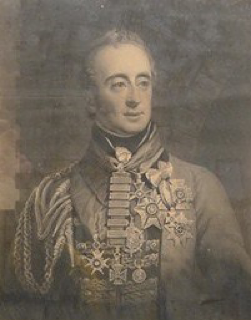
In July 1816, Pack marries Lady Elizabeth Louisa de la Poer Beresford, daughter of George Beresford, 1st Marquess of Waterford. They have two sons and two daughters. His descendants adopted “Pack-Beresford” as their family name. He dies on July 24, 1823, at Lord Beresford’s house in Upper Wimpole Street, London. A monument to him is later erected in St. Canice’s Cathedral, Kilkenny. A portrait by G. L. Saunders is in family possession; another by Charles Turner, showing Pack wearing his numerous orders and decorations, is in the National Portrait Gallery, London. A collection of his papers is held by the University of Southampton.
He serves in the American Revolutionary War (1775–81), first seeing action at the Battles of Lexington and Concord and the Battle of Bunker Hill. He is rewarded with an English peerage in 1783. He succeeds his father as Earl of Moira in 1793. When the Whigs come to power in 1806, he is appointed Master-General of the Ordnance, a post he resigns on the fall of his party in 1807. Taking an active part in the business of the House of Lords, he belongs to the circle of the Prince of Wales (later George IV), through whose influence he is appointed Governor-General of India, on November 11, 1812. He lands at Calcutta (Kolkata) and assumes office in October 1813. Facing an empty treasury, he raises a loan in Lucknow from the nawab-vizier there and defeats the Gurkhas of Nepal in 1816. They abandon disputed districts, cede some territory to the British, and agree to receive a British resident (administrator). For this success, in 1817 he is raised to the rank of Marquess of Hastings together with the subsidiary titles Viscount Loudoun and Earl of Rawdon.
He then has to deal with a combination of Maratha powers in western India whose Pindaris, bands of horsemen attached to the Maratha chiefs, are ravaging British territory in the Northern Sarkars, in east-central India. In 1817, he offers the Marathas the choice of cooperation with the British against the Pindaris or war. The Peshwa, the Prime Minister of the Maratha Confederacy, the raja of Nagpur, and the army under Holkar II, ruler of Indore, chose war and are defeated. The Pindari bands are broken up, and, in a settlement, the Peshwa’s territories are annexed, and the Rajput princes accept British supremacy. By 1818 these developments establish British sovereignty over the whole of India east of the Sutlej River and Sindh. Rawdon-Hastings also suppresses pirate activities off the west coast of India and in the Persian Gulf and the Red Sea. In 1819, Sir Stamford Raffles, under his authority, obtains the cession by purchase of the strategic island of Singapore.
In internal affairs, Rawdon-Hastings begins the repair of the Mughal canal system and brings the pure water of the Yamuna River (Jumna) into Delhi, encourages education in Bengal, begins a process of Indianization by raising the status and powers of subordinate Indian judges, and takes the first measures for the revenue settlement of the extensive “conquered and ceded” provinces of the northwest.
Rawdon-Hastings’s competent administration, however, ends under a cloud because of his indulgence to a banking house. Though he is cleared of any corrupt motive, the home authorities censure him. He resigns and returns to England in 1823, receiving the comparatively minor post of Governor of Malta in 1824. He dies at sea off Naples on November 28, 1826, aboard HMS Revenge, while attempting to return home with his wife. She returns his body to Malta, and following his earlier directions, cuts off his right hand and preserves it, to be buried with her when she dies. His body is then laid to rest in a large marble sarcophagus in Hastings Gardens, Valletta. His hand is eventually interred, clasped with hers, in the family vault at Loudoun Kirk.
In 1828, two years after Rawdon-Hastings’s death, members of the India House, to make some amends for their vote of censure, give £20,000 to trustees for the benefit of Hastings’s son.
(Pictured: “Portrait of Francis Rawdon, 2nd Earl of Moira, later 1st Marquess of Hastings (1754 – 1826)” possibly by Martin Archer Shee, oil on canvas, National Gallery of Ireland)
Needham then holds a staff appointment in Ireland, and during the Irish Rebellion of 1798 commands the crown forces at the Battle of Arklow on June 9, 1798. He places his approximately 1,600 troops in strong positions at the eastern and western ends of the town, where they can sweep the Arklow Rock Road and the Coolgreany Road with fire if the rebels approach along them. Ultimately, this is what the United Irish force, estimated at 5,000–9,000 strong, does, repeatedly attacking Needham’s right flank, which is in fact his strongest position. Estimates of the United Irish dead range from 200 to 1,000, and the failure of the attack ensures that the rebels lose the military initiative. He is also present at the Battle of Vinegar Hill on June 21, 1798, but his force arrives late, leaving a gap in the British line through which many rebels escape. This is later christened “Needham’s gap,” earning him the nickname of “the late General Needham” among his fellow officers.
Promoted to lieutenant-general in 1802, Needham is made colonel of the 5th Royal Veteran Battalion in 1804, entering House of Commons as MP for Newry in 1806. He is made full general in 1812, and, following the death of his two older brothers, succeeds as 12th Viscount Kilmorey in November 1818, resigning his parliamentary seat. On January 12, 1822, he is created 1st Earl of Kilmorey (Queen’s County) and Viscount Newry and Mourne. He dies on November 21, 1832, at the family seat, Shavington Hall, Shropshire, and is buried in St. Peter’s Church, Adderley.
Needham marries Anne Fisher, daughter of Thomas Fisher of Acton, Middlesex, on February 20, 1787. They have two sons, Francis Jack Needham, who succeeds as 2nd Earl, and the Hon. Francis Henry William Needham, lieutenant-colonel in the Grenadier Guards, and seven daughters. There are Needham letters in the Public Record Office (PRO), Kew, and in the Rebellion Papers in the National Archives of Ireland in Dublin.
Tone is born Martha Witherington in Dublin on June 17, 1769. She is the eldest daughter of merchant William Witherington and his wife Catherine (née Fanning). Her father is listed as a woolen draper on Grafton Street, Dublin, from 1768 to 1784, as a wine merchant from 1784 to 1788, and finally as a merchant from 1788 to 1793. It is claimed that he is a lieutenant in the Royal Navy and sits on the merchants’ guild on Dublin’s common council from 1777 to 1783. Her mother is a housekeeper to her father after he is widowed.
Tone receives a good education and maintains an interest in drama and literature throughout her life. Katherine Wilmot visits her in Paris in 1802 and comments on the books she has by French, Italian and English authors. When she is fifteen years old, she gets to know Wolfe Tone through her older brother. He is still a student in Trinity College Dublin, and it is he that renames her Matilda. They marry when she is just sixteen, on July 21, 1785, in St. Ann’s Church, Dublin, honeymooning in Maynooth. Upon their return they live with the Witheringtons, though they are not on good terms, and then with Wolfe Tone’s parents in Bodenstown, County Kildare.
The Tone’s first child, Maria, is born before October 1786. She is followed by a son, Richard, who is named for their neighbour Richard Griffith, who dies in infancy. Tone stays with her husband’s family while he is studying for the bar in London from 1787 to 1788. When he returns, the couple has two more sons: William Theobald Wolfe Tone, born on April 29, 1791, and Francis Rawdon Tone, born on June 23, 1793. Francis is known as Frank and is named after Francis Rawdon-Hastings. William is born in Dublin and Frank is probably born in Bodenstown. By this time, the family has a cottage in Bodenstown which Wolfe Tone had inherited from his uncle Jonathan Tone, which the family jokingly refers to as Château Boue. They live there until May 1795, when they leave for Princeton, New Jersey, due to political reasons.
Tone and her children come back to Europe to join Wolfe Tone in France eighteen months later. The family settles in Paris, at first living with Colonel Henry Shee at Nanterre, later moving to the suburb, Chaillot. She educates her children at home. Very few of her letters survive, but many of her husband’s letters and diaries are addressed or intended for her. From these and her letter to her friend Eliza Fletcher, it is clear she shares her husband’s interest in politics. Following her husband’s death in November 1798, she moves to a small apartment at 51 Rue Saint-Jacques in the Latin Quarter of Paris. This is to be close to her son William, who is attending Lycée Louis-le-Grand. She is awarded a pension of 1,200 francs for herself and 400 for each of her children after the expiration of the Treaty of Amiens on May 1, 1803.
Tone’s daughter Maria dies in April 1803, and then her son Frank dies in 1807, both of tuberculosis. William is displaying symptoms of the disease as well, which prompts her to move to the United States in 1807. From there, they attempt to sort out her husband’s affairs, which had been entrusted to James Reynolds. They retrieve only a few of Wolfe Tone’s pre-1795 diaries, and all of the post-1795 letters and diaries, which they add to the autobiography she already has in her possession. When William enters the Cavalry School at Saint-Germain-en-Laye in November 1810 as a cadet, she moves to be close to him, living at the Hôtel de la Surintendance. By approaching Napoleon in 1811, who knew Wolfe Tone, she ensures that her son receives French citizenship and the privileged status of “élève du gouvernement.” In January 1813, when William begins his service, she returns to Paris to live on the Rue de Lille and later moves to the Latin Quarter.
Following the defeat of Napoleon in June 1815, William is refused entry to Ireland or to visit Britain. This leads to both mother and son returning to the United States. Before she leaves Paris, she marries her old friend Thomas Wilson on August 19, 1816. Wilson is a Scottish businessman and advocate who has taken care of her financial affairs after the death of her husband. The couple visit Scotland, and then move to New York City in 1817, and finally to Georgetown, District of Columbia, around 1820. She lives there until her death and calls herself Matilda Tone-Wilson.
Starting in 1824, The New Monthly Magazine begins the unauthorised publication of extracts from Wolfe Tone’s autobiography. In response, Tone decides to publish all of Wolfe Tone’s papers and writing, including the autobiography, pamphlets and diaries, edited by their son William. What results is two large volumes entitled the Life of Theobald Wolfe Tone, published in May 1826. She adds a memoir of her own life in Paris following his death in 1798. The book is a best-seller, and ensures the legacy of Wolfe Tone, as well as being an important contemporary document of both Irish and French revolutionary politics.
William Tone dies in 1828, after which Tone lives more privately. She dies in Georgetown on March 18, 1849. Thomas Wilson predeceases her in 1824. Just two weeks prior to her death she is interviewed by a Young Irelander, Charles Hart. She is initially buried near William Tone at Marbury burying-ground, Georgetown. After that cemetery is sold, she is reinterred in Green-Wood Cemetery, Brooklyn, New York, on October 31, 1891, by her great-grandchildren. A new monument is dedicated to her, which is later restored in 1996.
In 1783 FitzGerald visits the West Indies before returning to Ireland, where his brother, William FitzGerald, 2nd Duke of Leinster, has procured Edward’s election to the Irish Parliament as an MP for Athy, a seat he holds until 1790. In Parliament he acts with the small Opposition Irish Patriot Party group led by Henry Grattan but takes no prominent part in debate. In the spring of 1786, he takes the then unusual step for a young nobleman of entering the Military College, Woolwich, after which he makes a tour through Spain in 1787. Dejected by unrequited love for his cousin Georgina Lennox, he sails for New Brunswick to join the 54th Regiment with the rank of Major.
In April 1789, guided by compass, FitzGerald traverses the country with a brother officer from Fredericton, New Brunswick to Quebec, falling in with Indians by the way, with whom he fraternizes. He accomplishes the journey in twenty-six days and establishes a shorter practicable route than that hitherto followed. The route crosses the extremely rugged and heavily forested northern part of the present state of Maine. In a subsequent expedition he is formally adopted at Detroit by the Bear clan of the Mohawk with the name “Eghnidal,” and makes his way down the Mississippi River to New Orleans, whence he returns to England.
Finding that his brother has procured his election for Kildare County, a seat he holds from 1790 to 1798, and desiring to maintain political independence, FitzGerald refuses the command of an expedition against Cádiz offered him by William Pitt the Younger and devotes himself for the next few years to the pleasures of society and to his parliamentary duties. He is on terms of intimacy with his first cousin Charles Fox, with Richard Sheridan and other leading Whigs. According to Thomas Moore, FitzGerald is only one of numerous suitors of Sheridan’s first wife, Elizabeth, whose attentions are received with favour. She conceives a child by him, a baby girl who is born on March 30, 1792.
His Whig connections, together with his transatlantic experiences, predisposed FitzGerald to sympathize with the doctrines of the French Revolution, which he embraces enthusiastically when he visits Paris in October 1792. He lodges with Thomas Paine and listens to the debates in the Convention. While in Paris, he becomes enamoured of a young girl named Pamela whom he chances to see at the theatre, and who has a striking likeness to Elizabeth Sheridan. On December 27, 1792, he and Pamela are married at Tournai, one of the witnesses being Louis Philippe, afterwards King of the French. In January 1793 the couple reaches Dublin.
Ireland is by then seething with dissent which is finding a focus in the increasingly popular and revolutionary Society of the United Irishmen, which has been forced underground by the outbreak of war between France and Britain in 1793. FitzGerald, fresh from the gallery of the Convention in Paris, returns to his seat in the Irish Parliament and immediately springs to their defence. Within a week of his return, he is ordered into custody and required to apologise at the bar of the House of Commons for violently denouncing in the House a government proclamation which Grattan had approved for the suppression of the United-Irish attempt to revive the Irish Volunteer movement with a “National Guard.” However, it is not until 1796 that he joins the United Irishmen, who by now have given up as hopeless the path of constitutional reform and whose aim, after the recall of Lord Fitzwilliam in 1795, is nothing less than the establishment of an independent Irish republic.
In May 1796 Theobald Wolfe Tone is in Paris endeavouring to obtain French assistance for an insurrection in Ireland. In the same month, FitzGerald and his friend Arthur O’Connor proceed to Hamburg, where they open negotiations with the Directory through Reinhard, French minister to the Hanseatic towns. The Duke of York, meeting Pamela at Devonshire House on her way through London with her husband, tells her that his plans are known and advises that he should not go abroad. The proceedings of the conspirators at Hamburg are made known to the government in London by an informer, Samuel Turner. The result of the Hamburg negotiations is Louis Lazare Hoche‘s abortive expedition to Bantry Bay in December 1796.
In September 1797 the Government learns from the informer Leonard McNally that FitzGerald is among those directing the conspiracy of the United Irishmen, which is now quickly maturing. Thomas Reynolds, converted from a conspirator to an informer, keeps the authorities posted in what is going on, though lack of evidence produced in court delays the arrest of the ringleaders. But on March 12, 1798, Reynolds’ information leads to the seizure of a number of conspirators at the house of Oliver Bond. FitzGerald, warned by Reynolds, is not among them.
As a fellow member of the Ascendancy class, the Government are anxious to make an exception for FitzGerald, avoiding the embarrassing and dangerous consequences of his subversive activities. They communicate their willingness to spare him from the normal fate meted out to traitors. FitzGerald however refuses to desert others who cannot escape, and whom he has himself led into danger. On March 30 the government proclamation of martial law authorising the military to act as they see fit to crush the United Irishmen leads to a campaign of vicious brutality in several parts of the country.
FitzGerald’s social position makes him the most important United Irish leader still at liberty. On May 9 a reward of £1,000 is offered by Dublin Castle for his apprehension. Since the arrests at Bond’s house, he has been in hiding. The date for the rising is finally fixed for May 23 and FitzGerald awaits the day hidden by Mary Moore above her family’s inn in Thomas Street, Dublin.
Tipped off that the house is going to be raided, Moore turns to Francis Magan, a Catholicbarrister and trusted sympathiser, who agrees to hide Fitzgerald. Making its way to Magan’s house on May 18, Fitzgerald’s party is challenged by Major Henry Sirr and a company of Dumbarton Fencibles. Moore escapes with Fitzgerald and takes him back to Thomas Street to the house of Nicholas Murphy.
Moore explains to Magan what had happened and, unbeknownst to her, Magan informs Dublin Castle. The Moore house is raided that day. Mary, running to warn the Leinster Directory meeting nearby in James’s Gate, receives a bayonet cut across the shoulders. That same evening Sirr storms Murphy’s house where FitzGerald is in bed suffering from a fever. Alerted by the commotion, he jumps out of bed and, ignoring the pleas of the arresting officers to surrender peacefully, he stabs one and mortally wounds the other with a dagger in a desperate attempt to escape. He is secured only after Major Sirr shoots him in the shoulder.
FitzGerald is conveyed to New Prison, Dublin where he is denied proper medical treatment. After a brief detention in Dublin Castle he is taken to Newgate Prison, Dublin where his wound, which has become infected, becomes mortally inflamed. His wife, whom the government probably has enough evidence to convict of treason, has fled the country, never to see her husband again, but FitzGerald’s brother Henry and his aunt Lady Louisa Conolly are allowed to see him in his last moments. He dies at the age of 34 on June 4, 1798, as the rebellion rages outside. He is buried the next day in the cemetery of St. Werburgh’s Church, Dublin. An Act of Attainder confiscating his property is passed as 38 Geo. 3 c. 77 but is eventually repealed in 1819.
As a young man, O’Connor embraces the Republican movement early on as he is encouraged by the American Revolution overseas. After his oldest brother Daniel gets into debt, his brother Roger buys out his inheritance. The family’s political and financial conflicts are only deepened when their sister Anne commits suicide, after having been forbidden by the family from marrying a Catholic man she was in love with.
In 1796, O’Connor joins the Society of United Irishmen and determines, on its platform, to contest what had been his uncle Lord Longueville’s Irish parliamentary seat in Antrim. In January 1797, to the “free electors” of the county he commends the “entire abolition of religious distinctions” and the “establishment of a National Government,” while protesting the “invasion” of the country by English and Scottish troops and the continuation of the continental war. Arrests, including his own in February for seditious libel, frustrate his attempts to canvass. With Lord Edward FitzGerald and others in the leadership in Dublin his thoughts turn to securing “fraternal” French support for a revolutionary insurrection.
O’Connor is released in 1802 under the condition of “banishment,” He travels to Paris, where he is regarded as the accredited representative of the United Irishmen by Napoleon who, in February 1804, appoints him General of Division in the French army. General Louis-Alexandre Berthier, Minister of War, directs that O’Connor is to join the expeditionary army intended for the invasion of Ireland at Brest. When the plan falls through, O’Connor retires from the army.
In 1807, although more than twice her age, O’Connor marries Alexandrine Louise Sophie de Caritat de Condorcet, known as Eliza, the daughter of the scholar the Marquis de Condorcet and Sophie de Condorcet. Following his marriage he borrows money from fellow exile William Putnam McCabe to acquire a country residence. His tardiness in repaying the debt to McCabe, whose own investments into cotton spinning in Rouen had failed, results in a lawsuit. Cathal O’Bryne suggests that the debt is behind O’Connor’s later suggestion to Richard Robert Madden that McCabe had been a double agent, a charge to which, Madden notes, the French government lends no credence.
O’Connor offers his services to Napoleon during the Hundred Days. After Napoleon’s defeat he is allowed to retire, becoming a naturalised French citizen in 1818. He supports the 1830 revolution which creates the July Monarchy, publishing a defence of events in the form of an open letter to General Gilbert du Motier, Marquis de Lafayette. After the revolution he becomes mayor of Le Bignon-Mirabeau. The rest of his life is spent composing literary works on political and social topics. He and his wife continue the efforts of her mother, who is herself an accomplished translator of Thomas Paine and Adam Smith, to publish her father’s works in twelve volumes between 1847 and 1849.
O’Connor’s wife give birth to five children, three sons and two daughters, almost all of whom predecease him. Only one son, Daniel, marries and has issue. Daniel marries Ernestine Duval du Fraville, a daughter of Laurent-Martin Duval, Baron Duval du Fraville, in 1843. She dies at Cannes in 1877.
O’Connor dies on April 25, 1852. His widow dies in 1859.
O’Connor’s descendants continue to serve as officers in the French army and still reside at Château Dubignon. Through his only surviving son, Daniel, he is a grandfather of two boys, Arthur O’Connor (1844–1909), who serves in the French army, and Fernand O’Connor (1847–1905), a Brigade General who serves in Africa and is made a Knight of the Legion of Honour. His grandson, Arthur, marries Marguerite de Ganay (1859–1940), a daughter of Emily and Etienne, Marquis de Ganay, in 1878. They have two daughters, Elisabeth O’Connor, the wife of Alexandre de La Taulotte, and Brigitte Emilie Fernande O’Connor (1880–1948), who in 1904 marries the Comte François de La Tour du Pin (1878–1914), who is killed ten years later at the First Battle of the Marne.
Fitzgerald is first elected to the Parliament of Ireland in 1783. His enthusiasm for the French Revolution leads to dismissal from the army in 1792. Four years later he joins the Society of United Irishmen, a nationalist organization that aspires to free Ireland from English control. This group appoints him to head the military committee formed to plan an uprising and obtain aid from the French revolutionary regime.
Although the French delay in supplying arms and troops, Fitzgerald’s committee proceeds with its plans for a general rebellion. The insurrection is set for May 23, 1798. In March his co-conspirators are seized by government agents, making him the most important United Irish leader still at liberty. On May 9 a reward of £1,000 is offered by Dublin Castle for his apprehension.
FitzGerald’s hiding place in a house in Thomas Street, Dublin is disclosed by a Catholic barrister and informant named Francis Magan. On May 18 Major Henry Sirr leads a military party to the house where FitzGerald is in bed suffering from a fever. Alerted by the commotion, he jumps out of bed and, ignoring the pleas of the arresting officers Captain William Bellingham Swan and Captain Daniel Frederick Ryan to surrender peacefully, FitzGerald stabs Swan and mortally wounds Ryan with a dagger in a desperate attempt to escape. He is secured only after Major Sirr shoots him in the shoulder.
FitzGerald is conveyed to New Prison, Dublin where he is denied proper medical treatment. After a brief detention in Dublin Castle he is taken to Newgate Prison, Dublin where his wound, which had now become infected, becomes mortally inflamed. His wife, whom the government probably has enough evidence to convict of treason, had fled the country, never to see her husband again, but his brother Henry and his aunt Lady Louisa Conolly are allowed to see him in his last moments.
FitzGerald dies at the age of 34 on June 4, 1798, as the rebellion rages outside. He is buried the next day in the cemetery of St. Werburgh’s Church, Dublin. An Act of Attainder confiscating his property is passed as 38 Geo. 3 c. 77 but is eventually repealed in 1819.
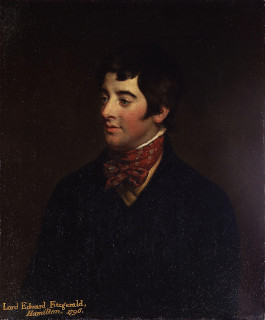
(Pictured: Portrait of Edward FitzGerald by Hugh Douglas Hamilton, 1796. National Portrait Gallery, London.)




 seamus dubhghaill