seamus dubhghaill

Promoting Irish Culture and History from Little Rock, Arkansas, USA


Leave a comment

The Execution of Tom Williams, IRA Volunteer

File source: http://en.wikipedia.org/wiki/File:Vol._Tom_Williams.jpg

Thomas Joseph Williams, a volunteer in C Company, 2nd Battalion of the Belfast Brigade in the Irish Republican Army (IRA), is hanged in the Crumlin Road Gaol on September 2, 1942, for his involvement in the killing of Royal Ulster Constabulary (RUC) police officer Patrick Murphy during the Northern campaign.

Williams is born in the Beechmount area of Belfast on May 12, 1923. He is the third child in a family of six. After the death of his mother, he and his brother go to live with their grandmother at 46 Bombay Street in the Clonard area of Belfast. The Williams family has to leave the small Catholic enclave in the Shore Road area of Belfast after their house is attacked and burned.

As a child, Williams suffers from asthma and as a result is often very ill. He attends St. Gall’s Primary School but leaves at an early age to obtain work, which at the time is difficult due to discrimination. His work therefore consists of labouring and as a delivery boy.

As soon as Williams is old enough, he joins Na Fianna Éireann, the republican Scout Organisation founded by Constance Markievicz in 1909, becoming a member of the Con Colbert slua in the Clonard area. Alfie Hannaway, a friend of Williams, is his OC in Na Fianna, and assigns him to the rank of Quartermaster for the company. He takes his role in Na Fianna very seriously and all who came to know him are struck by his dedication and maturity, even at this early age.

At the age of 17, Williams is old enough to become a volunteer and joins C Company of the IRA in the Clonard area where he lives. Due to his “dedication and his remarkable ability” he is appointed to the role of Adjutant of C Company.

At Easter 1942 the government of Northern Ireland bans all parades to commemorate the anniversary of the Easter Rising. An IRA unit of six men and two women stage a diversionary action against the RUC to allow three parades to take place in West Belfast, but in this clash a RUC officer is killed, and the six IRA men are captured. The RUC officer, Constable Patrick Murphy, a father of nine children, from the Falls Road area of Belfast, is one of a minority of Catholics serving in the RUC.

There is debate over the years about who actually fired the fatal shot. The six IRA members are convicted and sentenced to death for murder under the law of common purpose. Five have their sentences commuted. The sentence of Williams, who acknowledges that he is the leader of the IRA unit involved and takes full responsibility for the actions of his men, is not commuted.

Williams is hanged in Crumlin Road Gaol in Belfast on the morning of September 2, 1942. The executioner is the official English hangman Thomas Pierrepoint, assisted by his nephew Albert Pierrepoint. Afterwards Williams’ body is interred in unhallowed ground in an unmarked grave within the grounds of the prison. His remains are only released in January 2000 after the closure of the prison in 1996 and a lengthy campaign by the National Graves Association, Belfast.

Williams’s funeral is held on January 19, 2000, and is attended by thousands, with burial at Milltown Cemetery. Joe Cahill, Williams’s cell mate, and John Oliver, sentenced to death with Williams but later reprieved, as well as Madge McConville, who had been arrested with Williams, Greta McGlone, Billy McKee, Eddie Keenan and perhaps least known, Nell Morgan, Williams’s girlfriend at the time of his death, are all present. Six senior Sinn Féin members including Gerry Adams are also present in St. Paul’s Church on the Lower Falls Road for the Mass.

Williams is remembered in a ballad Tom Williams. Various recordings have been made, most notably by the Flying Column and Éire Óg, who preamble their version with the story of the campaign to release his body. The now disbanded, Volunteer Tom Williams Republican Flute Band from Glasgow, Scotland is named in his memory as is the Tom Williams Camogie Club in Belfast.

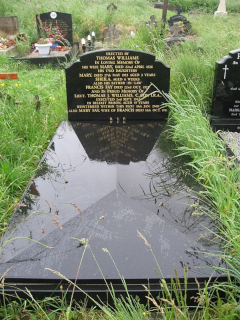
(Pictured: Tom Williams’ headstone at Milltown Cemetery after being reinterred)


Leave a comment

Death of Hunger Striker Joe McDonnell


joe-mcdonnell

Joseph (Joe) McDonnell, a volunteer in the Provisional Irish Republican Army (IRA), dies on July 8, 1981, after 61 days on hunger strike during the 1981 Irish hunger strike.

McDonnell is born on Slate Street in the lower Falls Road of Belfast, Northern Ireland on September 14, 1951, as one of ten children. He attends a nearby Roman Catholic school. He marries Goretti in 1970 and moves into her sister’s house in Lenadoon. There are only two Catholic houses in this predominantly Ulster Protestant housing estate, and their house is attacked on numerous occasions.

McDonnell is arrested in Operation Demetrius and, along with Gerry Adams and others, is interned on the prison ship HMS Maidstone. He is later moved to HM Prison Maze in County Down for several months. Upon release, he joins the Provisional IRA Belfast Brigade. He meets Bobby Sands during the preparation for a firebomb attack on the Balmoral Furnishing Company’s premises in Dunmurry. During the ensuing shoot-out between the IRA and the Royal Ulster Constabulary (RUC) and British Army, both men, along with Séamus Finucane and Seán Lavery, are arrested. McDonnell and the others are sentenced to 14 years in prison for possession of a firearm. None of the men accept the jurisdiction of the court.

McDonnell agrees with the goals of the Irish hunger strike, namely: the right not to wear a prison uniform; the right not to do prison work; the right of free association with other prisoners; the right to organise their own educational and recreational facilities and the right to one visit, one letter and one parcel per week.

Although McDonnell is not involved in the first hunger strike in 1980, he joins Bobby Sands and the others in the second hunger strike the following year. During the strike he fights the general election in the Republic of Ireland, and only narrowly misses election in the Sligo–Leitrim constituency. He goes 61 days without food before dying on July 8, 1981. He has two children. His wife takes an active part in the campaign in support of the hunger strikers.

McDonnell is buried in the grave next to Bobby Sands at Milltown Cemetery in west Belfast. John Joe McGirl, McDonnell’s election agent in Sligo–Leitrim, gives the oration at his funeral. Quoting Patrick Pearse, he states, “He may seem the fool who has given his all, by the wise men of the world; but it was the apparent fools who changed the course of Irish history.”

McDonnell is commemorated on the Irish Martyrs Memorial at Waverley Cemetery in Sydney, Australia and is also commemorated in The Wolfe Tones song, “Joe McDonnell.”


Leave a comment

Resignation of Taoiseach Enda Kenny

varadkar-kenny

Enda Kenny formally resigns as Taoiseach on June 13, 2017, after six years as head of Government of Ireland. He is the longest-serving Fine Gael Taoiseach and the first in his party to serve two consecutive terms in the highest political office.

An emotional Kenny makes his final address to Dáil Éireann as Taoiseach, saying he is the first to acknowledge that he had not gotten everything right. “But I can honestly say my motivation was always what I believed was in the best interests of the Irish people,” he added. “I really do believe politics is work worth doing, a noble profession.”

Flanked by Tánaiste Frances Fitzgerald, Minister for Finance Michael Noonan, his successor Leo Varadkar, Minister for Housing Simon Coveney and Minister for Health Simon Harris, Kenny informs the Dáil that he will be going later to Áras an Uachtaráin to submit his resignation to President Michael D. Higgins. He formally submits his letter that evening.

Following his speech in the Dáil, Kenny sits down, visibly emotional, to applause from all sides of the House.

Fianna Fáil leader Micheál Martin describes Kenny as “an Irish patriot and an Irish democrat.” Throughout his time in elected office and in government he had been a proud representative of his community, political tradition and country. He adds that “the mischievous enjoyment he has taken in this has been a genuine joy to behold”.

Sinn Féin leader Gerry Adams says his party and Fine Gael do not agree on many issues but “I always found Enda to be friendly on a personal level. Probably the best leader Fine Gael ever had.” Adams adds, “Let me say I will miss you. I will miss your entertaining tales of meetings you have had and meetings you have not had and recollections of people you have met along the way, like the man with the two pints in one hand.”

Adams says there have been successes including the success of the same-sex marriage referendum. But he also says there have been abject failures, including the Taoiseach’s consistent failure to recognise the State of Palestine, the squandering of the biggest mandate in the history of the State as the Fine Gael-Labour Government reneged on election promises, the clear lack of affinity with Northern Ireland and a clear lack of consistent strategic engagement with the process of change that is under way on the island.

Kenny now becomes a party backbencher until the next general election when he is expected to retire as a Teachta Dála (TD). He is also father of the House as the longest serving TD with 42 years in the Dáil. He is first elected in 1975 in a by-election following the death of his father Henry and faces another 12 elections in his Dáil tenure.

Kenny serves three years as a cabinet minister, serving as Minister for Tourism and Trade during the 1994 to 1997 Rainbow Coalition. He also serves for a year as Minister of State for Youth Affairs from February 1986 to March 1987. He takes over from Michael Noonan as party leader in 2002 after a disastrous general election for the party and in 2007 the party’s numbers in the Dáil rise from 32 to 51 TDs. In the 2011 general election at the height of the economic recession, Fine Gael secures 76 seats, the most in the party’s history, under his leadership.

(From: “Enda Kenny steps down as Taoiseach” by Michael O’Regan and Marie O’Halloran, The Irish Times, June 13, 2017)


Leave a comment

The Baltic Exchange Bombing

IRA Bombing of the Baltic Exchange

The Baltic Exchange bombing, an attack by the Provisional Irish Republican Army (PIRA) on London‘s financial centre, takes place on April 10, 1992, the day after the General Election which re-elects John Major from the Conservative Party as Prime Minister. The one-ton bomb, concealed in a large white truck and consisting of a fertilizer device wrapped with a detonation cord made from 100 lbs. of Semtex, is the biggest detonated on mainland Britain since World War II. The bombing kills three people, injures 91 others, and causes massive damage, destroying the Baltic Exchange building and severely damaging surroundings.

Since the PIRA’s campaign in the early 1970s, many commercial targets are attacked on the mainland which cause economic damage and severe disruption. Since 1988, Gerry Adams of Sinn Féin and John Hume of the Social Democratic and Labour Party are engaged in private dialogue to create a broad Irish nationalist coalition. British Prime Minister John Major refuses to openly enter into talks with Sinn Féin until the IRA declares a ceasefire. The risk of an IRA attack on London increases due to the lack of progress with political talks, resulting in a warning being circulated to all police forces in Britain highlighting intelligence reports of a possible attack, as it is believed that the IRA has enough personnel, equipment and funds to launch a sustained campaign in England.

On April 10, 1992, at 9:20 PM, a huge bomb is detonated in front of the Baltic Exchange building at 24-28 St. Mary Axe. The façade of the offices is partially destroyed, and the rest of the building is extensively damaged. The bomb also causes heavy damage to surrounding buildings. It causes £800 million worth of damage, £200 million more than the total damage caused by the 10,000 explosions that had occurred during the Troubles in Northern Ireland up to that point.

The IRA gives a telephone warning twenty minutes before the explosion, saying there is a bomb inside a van outside the London Stock Exchange. This is a half mile away from the actual location by the Baltic Exchange.

The homemade explosive is inside a white Ford Transit van parked in St. Mary Axe. The components are developed in South Armagh, shipped from Ireland, and assembled in England. The attack is planned for months and marks a dangerous advance to the British of the IRA’s explosives manufacturing capabilities. The bomb is described as the most powerful to hit London since the Luftwaffe raids of World War II.

A few hours later another similarly large bomb goes off in Staples Corner in north London, also causing major damage.

The next day, the IRA claims responsibility in a statement from Dublin. It is believed the IRA are trying to send a message to the Conservative Party who won the election, which also sees Sinn Féin leader Gerry Adams lose his unused seat in the Westminster Parliament.

Many of the damaged buildings are once again badly damaged by the Bishopsgate bombing the following year. Both incidents contribute to the formation of the “Ring of Steel” in the city to protect it from further terrorism.

The Exchange sells its badly damaged historic building to be redeveloped under the auspices of English Heritage as a Grade II* site. However, the City and English Heritage later allow it to be demolished, seeking instead a new landmark building. The site, together with that of the UK Chamber of Shipping at 30–32 St. Mary Axe, is now home to the skyscraper commissioned by Swiss Re commonly referred to as The Gherkin.

The stained glass of the Baltic Exchange war memorial, which suffered damage in the bomb blast, has been restored and is in the National Maritime Museum in London.

(Pictured: The scene of devastation following the IRA bomb which destroyed London’s Baltic Exchange. Image credit: Gulf News Archives)


Leave a comment

The Milltown Cemetery Attack

milltown-cemetery-attack

The Milltown Cemetery attack, also known as the Milltown Cemetery killings or the Milltown Massacre, takes place on March 16, 1988 at Milltown Cemetery in Belfast, Northern Ireland.

On March 6, 1988, Provisional Irish Republican Army members Daniel McCann, Seán Savage and Mairéad Farrell are shot dead by the Special Air Service (SAS) in Gibraltar, in Operation Flavius. The three were allegedly preparing a bomb attack on British military personnel there, but their deaths outrage republicans as the three are unarmed and shot without warning. Their bodies arrive in Belfast on March 14 and are taken to their family homes.

The “Gilbraltar Three” are scheduled to be buried in the republican plot at Milltown Cemetery on March 16. For years, republicans had complained about heavy-handed policing of IRA funerals, which had led to violence. In a change from normal procedure, the security forces agree to stay away from the funeral in exchange for guarantees that there will be no three-volley salute by IRA gunmen. The British Army and Royal Ulster Constabulary (RUC) would instead keep watch from the sidelines. This decision is not made public.

Present at the funeral are thousands of mourners and top members of the IRA and Sinn Féin, including Sinn Féin leader Gerry Adams and Martin McGuinness. Two RUC helicopters hover overhead.

Michael Stone, a loyalist and member of the Ulster Defence Association (UDA), learns there are to be no police or armed IRA members at the cemetery. As the third coffin is about to be lowered into the ground, Stone throws two grenades, which have a seven-second delay, toward the republican plot and begins shooting. The first grenade explodes near the crowd and about 20 yards from the grave. There is panic and confusion, and people dive for cover behind gravestones.

As Stone runs towards the nearby motorway, a large crowd begins chasing him and he continues shooting and throwing grenades. Some of the crowd catches Stone and begin beating him, but he is rescued by the police and arrested. Three people are killed and more than 60 wounded in the attack. The “unprecedented, one-man attack” is filmed by television news crews and causes shock around the world.

Three days later, two British Army corporals drive into the funeral procession of one of the Milltown victims. The non-uniformed soldiers are dragged from their car by an angry crowd, beaten and then shot dead by the IRA, in what becomes known as the corporals killings.

In March 1989, Stone is convicted for the three murders at Milltown, for three paramilitary murders before, and for other offences, receiving sentences totaling 682 years. He is released after serving 13 years as a result of the Good Friday Agreement.

(Pictured: The funeral at Milltown Cemetery in Belfast moments before the attack by Michael Stone)


Leave a comment

Murder of Patrick Finucane, Human Rights Lawyer

patrick-finucane

Patrick Finucane, Irish human rights lawyer, is killed on February 12, 1989, by loyalist paramilitaries acting in collusion with the British government intelligence service MI5. His killing is one of the most controversial during the Troubles in Northern Ireland.

Finucane is born into a Roman Catholic family on the Falls Road, Belfast on March 21, 1949. At the start of the Troubles, his family is forced out of their home. He graduates from Trinity College, Dublin in 1973. He comes to prominence due to successfully challenging the British government in several important human rights cases during the 1980s.

Finucane is shot fourteen times and killed at his home in Fortwilliam Drive, north Belfast, by Ken Barrett and another masked man using a Browning Hi-Power 9mm pistol and a .38 revolver respectively. The two gunmen knock down the front door with a sledgehammer and enter the kitchen where Finucane has been having a Sunday meal with his family. They immediately open fire and shoot him twice, knocking him to the floor. Then while standing over him, the leading gunman fires twelve bullets into his face at close range. Finucane’s wife Geraldine is slightly wounded in the shooting attack which their three children witness as they hide underneath the table.

The Royal Ulster Constabulary (RUC) immediately launches an investigation into the killing. The investigation, led by Detective Superintendent Alan Simpson, runs for six weeks and he later states that from the beginning, there had been a noticeable lack of intelligence coming from the other agencies regarding the killing. Finucane’s killing is widely suspected by human rights groups to have been perpetrated in collusion with officers of the RUC and, in 2003, the British Government Stevens Report states that the killing is indeed carried out with the collusion of police in Northern Ireland.

In September 2004, an Ulster Defence Association (UDA) member, and at the time of the murder a paid informant for the Royal Ulster Constabulary, Ken Barrett, pleads guilty to Finucane’s murder.

The Ulster Defence Association/Ulster Freedom Fighters (UDA/UFF) claim they killed Finucane because he was a high-ranking officer in the Irish Republican Army (IRA). Police at his inquest say they have no evidence to support this claim. Finucane had represented republicans in many high-profile cases, but he had also represented loyalists. Several members of his family have republican links, but the family strongly denies Finucane is a member of the IRA. Informer Sean O’Callaghan claims that he attended an IRA finance meeting alongside Finucane and Gerry Adams in Letterkenny in 1980. However, both Finucane and Adams have consistently denied being IRA members.

In Finucane’s case, both the RUC and the Stevens Report find that he is not a member of the IRA. Republicans strongly criticise the claims made by O’Callaghan in his book The Informer and subsequent newspaper articles. One Republican source says O’Callaghan “…has been forced to overstate his former importance in the IRA and to make increasingly outlandish accusations against individual republicans.”

In 2011 British Prime Minister David Cameron meets with Finucane’s family and admits the collusion, although no member of the British security services has yet been prosecuted.


Leave a comment

Birth of Hugh Leonard, Dramatist, Writer & Essayist

hugh-leonard

Hugh Leonard, Irish dramatist, television writer and essayist, is born in Dublin on November 9, 1926. In a career that spans 50 years, he writes nearly 30 full-length plays, 10 one-act plays, three volumes of essays, two autobiographies, three novels and numerous screenplays and teleplays, as well as writing a regular newspaper column.

After birth, Leonard is put up for adoption. Raised in Dalkey, a suburb of Dublin, by Nicholas and Margaret Keyes, he changes his name to John Keyes Byrne. For the rest of his life, despite the pen name of “Hugh Leonard” which he later adopts and becomes well known by, he invites close friends to call him “Jack.”

Leonard is educated at the Harold Boys’ National School, Dalkey, and Presentation College, Glasthule, winning a scholarship to the latter. He works as a civil servant for fourteen years. During that time, he both acts in and writes plays for community theatre groups. His first play to be professionally produced is The Big Birthday, which is mounted by the Abbey Theatre in Dublin in 1956. His career with the Abbey Theatre continues until 1994. After that his plays are produced regularly by Dublin’s theatres.

Leonard moves to Manchester for a while, working for Granada Television before returning to Ireland in 1970. There he settles in Dalkey.

During the 1960s and 1970s, Leonard is the first major Irish writer to establish a reputation in television, writing extensively for television including original plays, comedies, thrillers and adaptations of classic novels for British television. He is commissioned by RTÉ to write Insurrection, a 50th anniversary dramatic reconstruction of the Easter Rising of 1916. His Silent Song, adapted for the BBC from a short story by Frank O’Connor, wins the Prix Italia in 1967. He writes the script for the RTÉ adaptation of Strumpet City by James Plunkett.

Three of Leonard’s plays have been presented on Broadway: The Au Pair Man (1973), which stars Charles Durning and Julie Harris, Da (1978) and A Life (1980). Of these, Da, which originates off-off-Broadway at the Hudson Guild theatre before transferring to the Morosco Theatre, is the most successful, running for 20 months and 697 performances, then touring the United States for ten months. It earns Leonard both a Tony Award and a Drama Desk Award for Best Play. It is made into a film in 1988, starring Martin Sheen and Barnard Hughes, who reprises his Tony Award-winning Broadway performance.

Leonard writes two volumes of autobiography, Home Before Night (1979) and Out After Dark (1989). Some of his essays and journalism are collected in Leonard’s Last Book (1978) and A Peculiar People and Other Foibles (1979). In 1992 the Selected Plays of Hugh Leonard is published. Until 2006 he writes a humorous weekly column, “The Curmudgeon,” for the Irish Sunday Independent newspaper. He has a passion for cats and restaurants, and an abhorrence of broadcaster Gay Byrne.

Even after retiring as a Sunday Independent columnist, Leonard displays an acerbic humour. In an interview with Brendan O’Connor, he is asked if it galls him that Gay Byrne is now writing his old column. His reply is, “It would gall me more if he was any good at it.” He is a patron of the Dublin Theatre Festival.

In 1994, Leonard appears in a televised interview with Gerry Adams, president of Sinn Féin, an Irish political party associated with the Provisional Irish Republican Army. He has long been an opponent of political violence and a critic of the IRA. However, on the show and afterwards he is criticised for being “sanctimonious and theatrical” towards Adams. At one point he refers to Sinn Féin as “dogs.”

Hugh Leonard – Odd Man In, a film on his life and work is shown on RTÉ in March 2009. Leonard’s final play, Magicality, is not performed during his lifetime. A rehearsed reading of the second act is staged at the Dalkey Castle and Heritage Centre in June 2012.

Hugh Leonard dies after a long illness on February 12, 2009, in his hometown of Dalkey at the age of 82, leaving €1.5 million in his will.


Leave a comment

Birth of Albert Reynolds, Taoiseach & Fianna Fáil Leader

albert-reynolds

Albert Reynolds, politician and businessman, is born in Rooskey, County Roscommon on November 3, 1932. He serves as a Teachta Dála (TD) from 1977 to 2002, Minister for Posts and Telegraphs from 1979 to 1981, Minister for Transport from 1980 to 1981, Minister for Industry and Energy from March 1982 to December 1982, Minister for Industry and Commerce from 1987 to 1988, Minister for Finance from 1988 to 1991, Leader of Fianna Fáil from 1992 to 1994 and as Taoiseach from 1992 to 1994.

Reynolds is educated at Summerhill College in County Sligo and works for a state transport company before succeeding at a variety of entrepreneurial ventures, including promoting dances and owning ballrooms, a pet-food factory, and newspapers. In 1974 he is elected to the Longford County Council as a member of Fianna Fáil. He enters Dáil Éireann, lower house of the Oireachtas, the Irish parliament, in 1977 as a member representing the Longford-Westmeath parliamentary constituency and becomes Minister for Posts and Telegraphs in the Fianna Fáil government of Charles Haughey (1979–81). He is subsequently Minister of Industry and Commerce (1987–88) and Minister for Finance (1988–91) in Haughey’s third and fourth governments. He breaks with Haughey in December 1991 and succeeds him as leader of Fianna Fáil and as Taoiseach in February 1992.

The Fianna Fáil–Progressive Democrats coalition that Reynolds inherits breaks up in November 1992 but, after the general election later that month, he surprises many observers by forming a new coalition government with the Labour Party in January 1993. He plays a significant part in bringing about a ceasefire between the Irish Republican Army (IRA) and unionist paramilitary groups in Northern Ireland in 1994, but he is less effective in maintaining his governing coalition. When this government founders in November 1994, he resigns as Taoiseach and as leader of Fianna Fáil, though he remains acting prime minister until a new government is formed the following month. He unsuccessfully seeks his party’s nomination as a candidate for the presidency of Ireland in 1997. He retires from public life in 2002.

In December 2013, it is revealed by his son that Reynolds is in the final stages of Alzheimer’s disease. Albert Reynolds dies on August 21, 2014. The last politician to visit him is John Major. His funeral is held at Church of the Sacred Heart, in Donnybrook on August 25, 2014. Attendees include President Michael D. Higgins, Taoiseach Enda Kenny, former British Prime Minister John Major, former Social Democratic and Labour Party (SDLP) leader and Nobel Prize winner John Hume, Sinn Féin President Gerry Adams, Secretary of State for Northern Ireland Theresa Villiers, former President of Ireland Mary McAleese, former Taoiseach Liam Cosgrave, Archbishop of Dublin Diarmuid Martin and the Lord Mayor of Dublin Christy Burke. An unexpected visitor from overseas is the frail but vigorous Jean Kennedy Smith, former United States Ambassador to Ireland, who is the last surviving sibling of John Fitzgerald Kennedy. Reynolds is buried at Shanganagh Cemetery with full military honours.


Leave a comment

IRA Refuses to Disband in Response to Ultimatums

gerry-adams-2002

On October 27, 2002, after comments by the British prime minister Tony Blair that the continued existence of the Irish Republican Army (IRA) is an obstacle to rescuing the Northern Ireland peace process, Sinn Féin leader Gerry Adams says the IRA is never going to disband in response to ultimatums from the British government and from unionists.

Nationalists throughout Ireland wish to see the end of the IRA. In a response to a major speech by Adams, Mark Durkan, leader of the Social Democratic and Labour Party (SDLP), says IRA activity is playing into the hands of anti-Agreement unionists and calls on the IRA to cease all activity.

Adams tells elected Sinn Féin representatives from both sides of the Irish border in Monaghan that he can envision a future without the IRA. He also admits that “alleged” IRA activities are boosting the cause of those opposing the Northern Ireland peace process. However, he also tells Tony Blair that the IRA will never disband in response to ultimatums.

“He needs to recognise, however, that the Agreement requires an end to paramilitarism and that nationalists throughout this island fervently want one. It is time that republicans took heed of their call.”

The former Deputy First Minister in the devolved administration at Stormont says he welcomes Adams’ recognition that IRA activity is exacerbating the difficulties within unionism. “The reality is that IRA activity is playing right into the hands of anti-Agreement unionists. And letting the nationalist community badly down,” he said.

“It is also welcome that Gerry Adams has begun to recognise Sinn Féin’s credibility crisis. Too often republican denials have proved to be false in the past – be it over Colombia or Florida. This too has served only to create distrust and destabilise the Good Friday Agreement,” he adds.

In a major speech billed by his party as a considered response to the Prime Minister’s demand for an end to Republican-linked violence, Adams declares “Our view is that the IRA cessations effectively moved the army out of the picture – and allowed the rest of us to begin an entirely new process.” His speech is understood to have been handed in advance to both the British and Irish governments.

Adams says the continued IRA ceasefire and decommissioning initiatives demonstrated the organisation’s commitment to the peace process. “I do not pretend to speak for the army (IRA) on these matters, but I do believe that they are serious about their support for a genuine peace process. They have said so. I believe them,” he said. He adds, “The IRA is never going to respond to ultimatums from the British government or David Trimble.”

Fianna Fáil leader Bertie Ahern later says he welcomes and is encouraged by many aspects of Adams’ speech. He says the Sinn Féin leader’s strong statement of determination to keep the peace process intact and the recognition of the need to bring closure to all the key issues is a positive contribution at this difficult time in the Northern Ireland peace process.

(From the Irish Examiner, October 27, 2002)


Leave a comment

Murder of IRA Paramilitary Eamon Collins

eamon-collins

Eamon Collins, a Provisional Irish Republican Army paramilitary in the late 1970s and early 1980s, is beaten and stabbed to death near his home in Newry, County Down on January 27, 1999.

Collins grows up in a middle-class Irish family in Camlough, a small, staunchly Irish republican town in County Armagh. After completing his schooling, he works for a time in the Ministry of Defence in a clerical capacity in London before studying law at Queen’s University Belfast, where he becomes influenced by Marxist political ideology. He eventually drops out of university and, after working in a pub for a period, joins Her Majesty’s Customs & Excise Service, serving in Newry, and goes on to use this internal position within the administrative machinery of the British Government to support IRA operations against Crown Forces personnel.

Collins joins the Provisional IRA during the blanket protest by Long Kesh inmates in the late 1970s and he becomes involved in street demonstrations. He joins the South Down Brigade of the IRA, based around Newry, and is appointed its intelligence officer.

Collins becomes noted within IRA circles for his hard-line views on the continuance of armed campaign and later joins its Internal Security Unit. Around this time, he has a confrontation with Gerry Adams at the funeral of an IRA man killed in a failed bombing over how to deal with the funeral’s policing, where he accuses Adams a being a “Stick.”

Despite his militarist convictions at this time Collins finds the psychological strain caused by his involvement in the terrorist war increasingly difficult to address. His belief in the martial discipline of the IRA’s campaign is seriously undermined by the March 11, 1982, assassination of Norman Hanna, a 28-year-old Newry man, in front of his wife and young daughter. His uneasy state is further augmented by being arrested on two occasions under anti-terrorism laws, the second including a week of detention and intense interrogation.

Collins subsequently states that the strain of the interrogation merely exacerbates increasing doubts that he has already possessed about the moral justification of the IRA’s terrorist paramilitary campaign and his actions within it. These doubts are made worse by the organization’s senior leadership quietly deciding in the early 1980s that the war has failed and now slowly manoeuvering the movement away from a military campaign to allow its political wing, Sinn Féin, to pursue its purposes by another means in what would become the Northern Ireland peace process.

In 1987, after being charged with several counts of murder and attempted murder, Collins is acquitted as the statement in which he admits to involvement in these acts is ruled legally inadmissible by the court. On release from prison, he spends several weeks being counter-interrogated by the IRA’s Internal Security Unit, after which he is exiled by the organization from Ulster, being warned that if he is found north of Drogheda after a certain date he will be executed.

After his exile Collins moves to Dublin and squats for a while in a deserted flat in the impoverished Ballymun area of the city. After several years in Dublin, he subsequently moves to Edinburgh, Scotland for a period, where he runs a youth centre.

In 1995 Collins returns to Newry, a district known for the militancy of its communal support of the IRA, with numerous IRA members in its midst. The IRA order exiling him from Ulster has not been lifted, but with a formal ceasefire from the organization and renunciations of violence by all the paramilitary organizations in the province, he deems it safe to move back in with his wife and children who had never left the town.

Rather than maintaining a low-profile Collins decides to take a prominent role in the ongoing transition of Ulster’s post-war society, using his personal history as a platform in the media to analyze the adverse effects of terrorism. In May 1998 he gives evidence against leading republican Thomas “Slab” Murphy in a libel case Murphy has brought against The Sunday Times, over a 1985 article naming him as the IRA’s Northern Commander. Murphy denies IRA membership, but Collins takes the witness stand against him and testifies that from personal experience he knew that Murphy had been a key military leader in the organization. Murphy subsequently loses the libel case and sustains substantial financial losses in consequence. Collins and his family receive numerous threats after the trial.

Collins is beaten and stabbed to death by one or more unidentified assailants early in the morning of January 27, 1999, while walking his dogs near the Barcroft Park Estate in Newry along a quiet stretch of country lane at Doran’s Hill. His body also bears marks of having been struck by a car moving at speed. The subsequent police investigation and Coroner’s Inquest comment upon the extremity of weaponed violence to Collins’ head and face used during the attack.

Rumoured reasons behind the murder are that he had returned to Ulster in breach of the IRA’s banning order, and further he had detailed IRA activities and publicly criticized in the media a multiplicity of Irish terrorist paramilitary splinter groups that had appeared after the IRA’s 1994 ceasefire, and that he had testified in court against Murphy.

After a traditional Irish wake, with a closed coffin necessitated by the condition of his face, and a funeral service at St. Catherine’s Church in Newry, Collins’ body is buried at the town’s Monkshill Cemetery, not far from the grave of Albert White, a Catholic former Royal Ulster Constabulary Inspector, whose assassination he had helped to organize in 1982.