seamus dubhghaill

Promoting Irish Culture and History from Little Rock, Arkansas, USA


Leave a comment

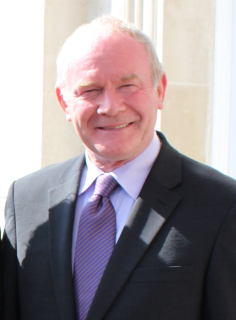
Death of Martin McGuinness, Irish Republican Sinn Féin Politician

Martin McGuinness, former member of the Provisional Irish Republican Army‘s (IRA) Army Council and Sinn Féin‘s chief negotiator in the peace process, dies on the morning of March 21, 2017 at Derry‘s Altnagelvin Area Hospital with his family by his bedside. He had been diagnosed with a rare heart disease in December 2016. In 2011, McGuinness contests the presidential election which is won by Michael D. Higgins.

McGuinness is born James Martin Pacelli McGuinness on May 23, 1950 in Derry. He attends St. Eugene’s Primary School and later the Christian Brothers technical college, leaving school at the age of 15.

McGuinness joins the IRA about 1970, and by 1971 he is one of its leading organizers in Derry. In 1973 a Special Criminal Court in the Republic of Ireland sentences him to six months in prison after he is caught in a car containing large quantities of explosives and ammunition. Although the IRA keeps secret the membership of its seven-person Army Council, few doubt that McGuinness is one of its most important members from the 1970s through the 1990s. Even while reportedly planning attacks on civilians in Northern Ireland and on the British mainland, McGuinness is involved in spasmodic secret talks with British government ministers and officials to end the conflict. In 1972 McGuinness, with fellow IRA leader Gerry Adams, privately negotiates with British Secretary of State for Northern Ireland William Whitelaw, but these and other talks over the next two decades are unsuccessful.

McGuinness contests seats in the British House of Commons on several occasions, losing in 1983, 1987, and 1992. However, in 1997 he is elected to the House of Commons to represent the constituency of Mid Ulster and, in line with party policy, he does not take his seat. He subsequently wins reelection to the seat in 2001, 2005, and 2010.

McGuinness is the IRA’s chief negotiator in the deliberations, also secret at first, that culminate in the Good Friday Agreement in 1998. This pact finally ends the conflict and eventually brings Sinn Féin into a coalition government to rule Northern Ireland. He is elected to the new Northern Ireland Assembly and in 1999 is appointed Minister of Education. In this post he eliminates the controversial eleven-plus examination, which determines which type of secondary school a child should attend. The test had been abolished in most of the rest of the United Kingdom more than 25 years earlier.

Disagreements over such issues as policing and the decommissioning of arms causes Northern Ireland’s Executive and Assembly to be suspended for some years, but a fresh agreement in 2006 paves the way for them to be revived. In elections in March 2007, both Sinn Féin and the antirepublican Democratic Unionist Party (DUP) gain seats, becoming the two largest parties in the Northern Ireland Assembly. McGuinness becomes Deputy First Minister, working with First Minister Ian Paisley, leader of the DUP. The two men, previously bitter enemies, perform so well together that they are dubbed the “Chuckle brothers.”

When Paisley retires in 2008, he is succeeded by the DUP’s Peter Robinson, who is considered to be even more militantly antirepublican. Once again, however, a shared need to rebuild the economy and attract international investment leads to cooperation between former opponents. In 2009 their government is in jeopardy as Sinn Féin and the DUP argue over the devolution of the police and justice system in Northern Ireland. McGuinness and Robinson are involved in the ensuing negotiations, and in February 2010 an agreement is reached for the transfer of powers from Britain to Northern Ireland in April.

In the Assembly elections in May 2011, McGuinness and Robinson are a formidable pair, and voters respond to their call for stability in a time of economic uncertainty. Sinn Féin gains an additional seat and increases its overall share of the vote, and McGuinness is assured an additional term as Deputy First Minister. In the autumn he steps down to run as Sinn Féin’s candidate for the presidency of Ireland. After finishing third in the election held on October 28, he returns to the position of Deputy First Minister a few days later. On June 27, 2012, in an event widely seen as having great symbolic importance for the ongoing reconciliation efforts in Northern Ireland, McGuinness and Elizabeth II shake hands twice, once in private and again in public, during a visit by the British monarch to Belfast.

In January 2017 McGuinness resigns as Deputy First Minister in response to First Minister Arlene Foster’s refusal to temporarily step down from her position during the investigation of a scandal relating to the government’s Renewable Heat Incentive (RHI), a mishandled program under which large amounts of state funds allegedly had been squandered. Foster had served as head of the department that oversaw the RHI before becoming First Minister. Under the power-sharing agreement the posts of First Minister and Deputy First Minister constitute a single joint office so that the resignation of one minister results in termination of the other’s tenure. When Sinn Féin chooses not to nominate a replacement for McGuinness within the required seven-day period, authority reverts to the British government’s Secretary of State for Northern Ireland in advance of a snap election on March 2.

Even before McGuinness’s resignation there had been speculation late in 2016 that he might step down for health reasons, and soon after resigning he confirms that he is suffering from amyloidosis, a rare disease brought about by deposits of abnormal protein in organs and tissue. With McGuinness removing himself from “frontline politics,” Michelle O’Neill leads Sinn Féin into the election. The disease claims McGuinness’s life only months later on March 21, 2017.


Leave a comment

Dissolution of the Northern Ireland Constitutional Convention

In the House of Commons of the United Kingdom on March 5, 1976, Secretary of State for Northern Ireland Merlyn Rees announces the dissolution of the short-lived Northern Ireland Constitutional Convention (NICC).

The Northern Ireland Constitutional Convention is an elected body set up in 1975 by the United Kingdom Labour government of Harold Wilson as an attempt to deal with constitutional issues surrounding the status of Northern Ireland.

The idea for a constitutional convention is first mooted by the Northern Ireland Office in its white paper The Northern Ireland Constitution, published on July 4, 1974. The paper lays out plans for elections to a body which would seek agreement on a political settlement for Northern Ireland. The proposals become law with the enactment of the Northern Ireland Act 1974 later that month. With Lord Chief Justice of Northern Ireland Robert Lowry appointed to chair the new body, elections are announced for May 1, 1975.

The elections are held for the 78-member body using the single transferable vote system of proportional representation in each of Northern Ireland’s twelve Westminster constituencies. Initially the body is intended to be purely consultative, although it is hoped that executive and legislative functions can be devolved to the NICC once a cross-community agreement has been reached. Unionists opposed to the NICC once again band together under the umbrella of the United Ulster Unionist Council (UUUC) and this coalition proves the most successful, taking 46 seats.

A number of leading Northern Ireland politicians are elected to the NICC, increasing hope that the body might achieve some of its aims. Also elected are some younger figures who go on to become leading figures in the future of Northern Ireland politics.

The elections leave the body fundamentally weakened from its inception as an overall majority has been obtained by those Unionists who oppose power sharing as a concept. As a result, the Northern Ireland Constitutional Convention Report published on November 20, 1975, recommends only a return to majority rule as had previously existed under the old Parliament of Northern Ireland government. As such a solution is completely unacceptable to the nationalist parties, the NICC is placed on hiatus.

Hoping to gain something from the exercise, Secretary of State for Northern Ireland Merlyn Rees announces that the NICC would be reconvened on February 3, 1976. However, a series of meetings held between the UUUC and the Social Democratic and Labour Party (SDLP) fail to reach any agreement about SDLP participation in government, and so the reconvened NICC once again fails to achieve a solution with cross-community support. As a result, Rees announces the dissolution of the body on March 5, 1976, and Northern Ireland remains under direct rule.

On the face of it, the NICC is a total failure as it does not achieve its aims of agreement between the two sides or of introducing ‘rolling devolution’ (gradual introduction of devolution as and when the parties involved see fit to accept it). Nevertheless, coming as it does not long after the Conservative-sponsored Sunningdale Agreement, the NICC indicates that no British government will be prepared to re-introduce majority rule in Northern Ireland. During the debates William Craig accepts the possibility of power-sharing with the SDLP, a move that splits the UUUC and precipitates the eventual collapse of the Vanguard Unionist Progressive Party (VUPP).

The idea of electing a consultative body to thrash out a deal for devolution is also retained and in 1996 it is revived when the Northern Ireland Forum is elected on largely the same lines and with the same overall purpose. The Forum forms part of a process that leads to the Good Friday Agreement and the Northern Ireland Assembly.


Leave a comment

Thomas McMahon Sentenced to Life for Mountbatten’s Assassination

Thomas McMahon, former volunteer in the South Armagh Brigade of the Provisional Irish Republican Army (IRA) and one of the IRA’s most experienced bomb-makers, is sentenced to life in prison on November 23, 1979, for the assassination of Louis Mountbatten, 1st Earl Mountbatten of Burma, and three others (two children and an elderly lady) at Mullaghmore, County Sligo.

McMahon plants a bomb in Shadow V, a 27-foot fishing boat belonging to Mountbatten at Mullaghmore, near Donegal Bay. Lord Mountbatten and the others are killed on August 27, 1979, when the bomb detonates. The other victims are Doreen Knatchbull, Baroness Brabourne, Mountbatten’s elder daughter’s mother-in-law, his grandson Nicholas Knatchbull and 15-year-old crewmember Paul Maxwell.

McMahon is arrested by the Garda, the Republic of Ireland‘s police force, two hours before the bomb detonates at a Garda checkpoint between Longford and Granard on suspicion of driving a stolen vehicle.

The IRA claims responsibility for the act in a statement released immediately afterwards. In the statement from the organisation they say, “This operation is one of the discriminate ways we can bring to the attention of the English people the continuing occupation of our country.”

McMahon is tried for the assassinations in the Republic of Ireland and convicted by forensic evidence supplied by Dr. James O’Donovan that shows flecks of paint from the boat and traces of nitroglycerine on his clothes. He is sentenced to life imprisonment for murder on November 23, 1979, but is released in 1998 under the terms of the Good Friday Agreement.

Following his release, Toby Harnden in Bandit Country: The IRA & South Armagh (1999) reports that McMahon is holding a tricolour in the first rank of the IRA colour party at a 1998 IRA meeting in Cullyhanna. However, according to a BBC report, McMahon says that he left the IRA in 1990.

McMahon twice refuses to meet John Maxwell, the father of Paul Maxwell, who seeks him out to explain the reasons for his son’s death. In a May 2011 interview for The Telegraph, Maxwell states that he had “made two approaches to McMahon, the first through a priest, who warned me in advance that he thought there wouldn’t be any positive response. And there wasn’t. I have some reservations about meeting him, obviously – it might work out in such a way that I would regret having made the contact. On the other hand, if we met and I could even begin to understand his motivation. If we could meet on some kind of a human level, a man-to-man level, it could help me come to terms with it. But that might be very optimistic. McMahon knows the door is open at this end.”

McMahon likewise refuses requests from Nicholas Knatchbull’s twin brother, who lost an eye in the same explosion. The latter, however, has forgiven McMahon and other members of the IRA who committed the act.

McMahon’s wife has stated, “Tommy never talks about Mountbatten, only the boys who died. He does have genuine remorse. Oh God yes.”

McMahon lives with his wife Rose in Lisanisk, Carrickmacross, County Monaghan. He has two grown sons. He helps with Martin McGuinness‘s presidential campaign in 2011, erecting posters for McGuinness around Carrickmacross.


Leave a comment

Second Inauguration of Mary McAleese

Mary McAleese is inaugurated as President of Ireland for a second term on November 11, 2004, becoming the fourth president up to that point to secure a second term, joining Sean T. O’Kelly, Éamon de Valera and Patrick Hillery. As of this writing in 2020, Michael D. Higgins is currently serving his second term as president.

McAleese’s initial seven-year term of office ends in November 2004, but she stands for a second term in the 2004 Irish presidential election. Following the failure of any other candidate to secure the necessary support for nomination, the incumbent president stands unopposed, with no political party affiliation, and is declared elected on October 1, 2004.

McAleese is re-inaugurated at the commencement of her second seven-year term on November 11, 2004. Her very high approval ratings are widely seen as the reason for her re-election, with no opposition party willing to bear the cost, financial or political, of competing in an election that would prove difficult to win.

Following the inauguration ceremony earlier in the day in Dublin Castle, McAleese attends a reception there hosted by the Government to mark the beginning of her second term of office. The 700 invited guests include members of the Government, the Oireachtas, the judiciary and dignitaries from Christian churches and other faiths.

McAleese identifies the need for strong and resilient communities as the theme of her second term in office. Speaking after her inauguration in the afternoon, she says, “The cushion of consumerism is no substitute for the comfort of community.” Speaking on the Northern Ireland peace process, she urges the hesitant to “muster the courage to complete the journey to a bright new landscape of hope.”

McAleese’s first term is distinguished by her work following the Omagh bombing and the September 11 terror attacks in the United States, as well as her behind-the-scenes work to open a dialogue with loyalists after the Good Friday Agreement.

Prevented by the Constitution of Ireland from running for a third term, McAleese leaves office in 2011 as one of Ireland’s most popular and respected presidents.

(Pictured: the second inauguration of Mary McAleese, November 11, 2004, President of Ireland website, http://www.president.ie)


Leave a comment

The Greysteel Massacre

The Greysteel massacre is a mass shooting that takes place on the evening of October 30, 1993 in Greysteel, County Londonderry, Northern Ireland.

On October 23, 1993, an Irish Republican Army (IRA) bomb prematurely explodes as the bombers carry it into a fishmongers on the Shankill Road in Belfast. The IRA’s intended target is a meeting of Ulster Defence Association (UDA) leaders, including brigadier Johnny Adair, which is to take place in a room above the shop. Unknown to the IRA, the meeting had been rescheduled. Eight Protestant civilians, a UDA member and one of the IRA bombers are killed in the blast. This became known as the Shankill Road bombing.

The UDA launches a number of “revenge attacks” for the bombing. Later that day, it fatally shoots a Catholic delivery driver after luring him to a bogus call at Vernon Court, Belfast. On October 26, the UDA shoots dead another two Catholic civilians and wounds five in an attack at the Council Depot at Kennedy Way, Belfast.

The massacre is carefully planned. The order for the attack comes from the UDA leadership and it is believed Greysteel is chosen partly because it is well away from Belfast, where security force activity is intense after the Shankill bombing. Those involved in planning and organising it include Billy McFarland, ‘Brigadier’ of the UDA’s North Antrim & Londonderry Brigade. Stephen Irwin, Geoffrey Deeney and Torrens Knight, all members of the brigade, are to carry out the shooting. The gunmen are first briefed on the plans for the massacre on October 27 in an office owned by the Ulster Democratic Party at Bond’s Place, Londonderry. Before the massacre, the gunmen go to the pub to familiarise themselves with the layout and choose the best positions to shoot from.

On Saturday, October 30, the gunmen drive to the pub in an Opel Kadett, with UDA member Brian McNeill driving a ‘scout car’ in front. Just before 10:00 PM the three gunmen, wearing blue boilersuits and balaclavas, enter the “Rising Sun Bar” in Greysteel. There are at least 70 people inside attending a Halloween party and at first some believe the men are playing a Halloween prank. Stephen Irwin yells “trick or treat” as he opens fire with a vz. 58 assault rifle on the packed crowd in the lounge. He keeps shooting until the magazine empties, quickly reloads and continues shooting. Geoffrey Deeney opens fire with a 9mm handgun at a fleeing woman, but it jams after one shot. Torrens Knight, armed with a shotgun, guards the entrance while the shooting is taking place. There is panic and screaming as people scramble for cover and women plead for mercy. The scene in the Rising Sun is described as “hell-like”; bodies lay everywhere and the lounge and dancefloor are covered with blood and broken glass. The gunmen, laughing, then make their escape in the Opel Kadett driven by Knight. While driving away from Greysteel, the getaway car’s wing mirror is hit by a police car speeding towards the scene. The gunmen drive the Kadett to a pick-up point near Eglinton, where they meet McNeill and burn the car.

Seven people are killed outright and nineteen are wounded, with another later dying of his wounds. The dead are Karen Thompson (19), Steven Mullan (20), Moira Duddy (59), Joseph McDermott (60), James Moore (81), John Moyne (50), John Burns (54) and Victor Montgomery (76). Six of those killed are Catholic civilians and two are Protestant civilians.

The following day, the UDA claims responsibility for the attack using the cover name “Ulster Freedom Fighters” (UFF). Its statement says that the “Greysteel raid” is “the continuation of our threats against the nationalist electorate that they would pay a heavy price for last Saturday’s slaughter of nine Protestants.” A UDA West Belfast Brigade member claims that his organisation “had information that senior IRA men drank in the Rising Sun… Unfortunately they were not there on Halloween but our boys acted on the briefing they had been given.” Afterwards, the gunmen are said to have boasted about the killings.

The UDA members involved are arrested shortly after the massacre. During their first court appearance, Knight is filmed laughing, taunting and shouting abuse at the victims’ relatives as he is led from the building. In February 1995, Irwin, Deeney, Knight and McNeill are sentenced to life imprisonment for their involvement in the attack. Knight is also convicted for the Castlerock killings. In 2000, they are released early, along with other paramilitary prisoners, under the terms of the Good Friday Agreement.

The pub is still open in Greysteel. There is a memorial to the victims outside the building that says: “May their sacrifice be our path to peace.”


Leave a comment

Mitchell Returns to Belfast to Save the Peace Process

george-mitchellFormer United States Senator George Mitchell returns to Belfast on September 13, 1999 in a bid to prevent the Northern Ireland peace process from coming apart at the seams.

The soft-spoken but firm Mitchell leads a review of the 1998 Good Friday Agreement, which he played a crucial part in brokering. The aim is to halt a renewed drift to violence by pro-British Protestant and pro-Irish Catholic paramilitaries, and to persuade the two communities to begin cooperating in the province’s elected assembly.

“The peace process is mired in mistrust on both sides of the sectarian divide,” says a British government official, who declines to be identified. “It will need somebody of Mr. Mitchell’s political caliber and neutrality to find a way forward.” The future role of the Northern Ireland police force, the Royal Ulster Constabulary (RUC), will be “part of the tangle [Mitchell] has to unravel,” the official adds. The 92% Protestant force, in a society where Catholics make up 42% of the population, is widely seen as requiring urgent attention.

The Protestant political leaders are unwilling to accept the good faith of Sinn Féin, the political ally of the Irish Republican Army (IRA). They are also attacking Northern Ireland Secretary of State Mo Mowlam for having refused to acknowledge that republican paramilitaries have breached the cease-fire despite several violent incidents and the discovery of an alleged plot to send arms to the IRA from the United States.

Mowlam’s decision enraged David Trimble, leader of the Ulster Unionist Party, Northern Ireland’s main Protestant political party and first minister-designate in a devolved Belfast government. Trimble and his senior lieutenants called for her to be fired. Trimble also launches a bitter attack on the Patten Commission after a leaked report indicates it would recommend allowing active IRA members to join the RUC police force.

Mitchell’s main contribution to the peace process has been to insist that the issue of decommissioning terrorist arms must be addressed in parallel with talks on future political structures in Northern Ireland. But he still has to find a formula that will satisfy Unionists for the IRA to begin handing in its weapons and explosives. Trimble and other Protestant leaders insist the IRA must agree to decommission before Sinn Féin is allowed to join a devolved Belfast government. Sinn Féin says that was not part of the 1998 peace accord.

Most worrying for Mitchell is the recent outcry over IRA tactics that makes a solution to the problem of law and order all the more important. The IRA is known to use threats and so called “punishment beatings” to maintain law and order in areas under its control, where RUC forces dare not tread. Six Catholic youths are in hiding in Britain after being threatened with violence, even death, if they remained in Northern Ireland.

According to the RUC, the youths have been targeted because of their refusal to accept the authority of sectarian paramilitaries in the areas where they live. Vincent McKenna, spokesman for the Northern Ireland Human Rights Bureau, says, “The IRA thinks it has the right to police its own areas, and it is determined to punish anyone critical of the political direction of the Sinn Féin leadership.” He adds that since the Belfast agreement was signed 16 months earlier, 757 young people have been “exiled” by the IRA and Protestant paramilitary groups.

Mowlam reportedly says that if the Patten Commission can come up with a blueprint for the police that gives Catholics a larger role in legitimate law enforcement, the scope for policing by paramilitary groups will be reduced.

(From: “Mitchell returns to N. Ireland tinderbox,” The Christian Science Monitor, September 2, 1999)


Leave a comment

Assassination of Lord Louis Mountbatten

assassination-of-lord-mountbatten

Lord Louis Mountbatten is killed on August 27, 1979, when Provisional Irish Republican Army (IRA) terrorists detonate a 50-pound bomb hidden on his fishing vessel, Shadow V. Mountbatten, a war hero, elder statesman, and second cousin of Queen Elizabeth II, is spending the day with his family in Donegal Bay off Ireland’s northwest coast when the bomb explodes. Three others are killed in the attack, including Mountbatten’s 14-year-old grandson, Nicholas. Later that day, an IRA bombing attack on land kills 18 British paratroopers in County Down, Northern Ireland in what becomes known as the Warrenpoint ambush.

The assassination of Mountbatten is the first blow struck against the British royal family by the IRA during its long terrorist campaign to drive the British out of Northern Ireland and unite it with the Republic of Ireland to the south. The attack hardens the hearts of many British against the IRA and convinces Prime Minister Margaret Thatcher’s government to take a hardline stance against the terrorist organization.

Mountbatten, the son of Prince Louis of Battenberg and a great-grandson of Queen Victoria I, enters the Royal Navy in 1913, when he is in his early teens. He sees service during World War I and at the outbreak of World War II is commander of the 5th Destroyer Flotilla. His destroyer, the HMS Kelly, is sunk during the Battle of Crete early in the war. In 1941, he commands an aircraft carrier, and in 1942 he is named Chief of Combined Operations Headquarters. From this position, he is appointed Supreme Allied Commander for South East Asia Command in 1943 and successfully conducts the campaign against Japan that leads to the recapture of Burma.

In 1947, Mountbatten is appointed the last Viceroy of India, and he conducts the negotiations that lead to independence for India and Pakistan later that year. He holds various high naval posts in the 1950s and serves as chief of the United Kingdom Defense Staff and chairman of the Chiefs of Staff Committee. Meanwhile, he is made Viscount Mountbatten of Burma and a first earl. He is the uncle of Philip Mountbatten and introduces Philip to the future Queen Elizabeth. He later encourages the marriage of the two distant cousins and becomes godfather and mentor to their first born, Charles, Prince of Wales.

Made Governor and then Lord-Lieutenant of the Isle of Wight in his retirement, Mountbatten is a respected and beloved member of the royal family. His assassination is perhaps the most shocking of all horrors inflicted by the IRA against the United Kingdom. In addition to his grandson Nicholas, 15-year-old boat hand Paul Maxwell and the Dowager Lady Brabourne, Nicholas’ grandmother, are also killed. Mountbatten’s grandson Timothy, Nicholas’ twin brother, is injured as is his daughter, Lady Brabourne, and the twins’ father, Lord Brabourne.

The IRA immediately claims responsibility for the attack, saying it detonated the bomb by remote control from the coast. It also takes responsibility for the same-day bombing attack against British troops in County Down, which claims eighteen lives.

IRA member Thomas McMahon is later arrested and convicted of preparing and planting the bomb that destroyed Mountbatten’s boat. A near-legend in the IRA, he is a leader of the IRA’s notorious South Armagh Brigade, which kills more than 100 British soldiers. He is one of the first IRA members to be sent to Libya to train with detonators and timing devices and is an expert in explosives. Authorities believe the Mountbatten assassination is the work of many people, but McMahon is the only individual convicted. Sentenced to life in prison, he is released in 1998 along with other IRA and Unionist terrorists under a controversial provision of the Good Friday Agreement.

(From: This Day In History: Mountbatten killed by IRA, by the editors of History.com, July 21, 2010, http://www.history.com)


Leave a comment

The Ealing Bombing

ealing-bombing

The Real Irish Republican Army (IRA), a dissident Irish republican organisation and splinter of the Provisional Irish Republican Army, detonates a car bomb containing 100 lbs. of homemade plastic explosives in Ealing, West London, England on August 3, 2001.

The bomb is in a grey Saab 9000 near the Ealing Broadway station, restaurants and pubs on Uxbridge Road, which explodes shortly after midnight, injuring seven people. Debris from the blast spreads more than 220 yards. The bomb is timed to target leaving karaoke pub-goers, but while most escape injury, the explosion still causes significant damage to property, estimated to be around £200,000. The adjacent Ealing Broadway shopping centre is also damaged by flooding arising from the water main under the car bomb being ruptured.

Experts regard the bomb to be designed to look spectacular on CCTV for the purposes of “armed propaganda” rather than to cause large numbers of injuries. However, anti-terrorist detectives claim that the attack is planned to be a massacre and to cause as much carnage as the Omagh bombing three years earlier.

The bombing is the last successful Irish republican bombing on British soil outside Northern Ireland, of whom dissidents have waged an armed campaign since the Good Friday Agreement was signed in 1998, ending the Troubles.

The attack is condemned by British Prime Minister Tony Blair, Sinn Féin President Gerry Adams and others. It also comes during a crucial time for the Northern Ireland peace process with disagreements regarding the Provisional IRA’s decommissioning process. The attack comes months after the Real IRA bombed the BBC Television Centre three miles away. Two days prior to the attack, a 20 kg Real IRA bomb is discovered at Belfast International Airport. After Ealing, the bombers target a new attack on Birmingham on November 3, which ultimately fails.

In November 2001, three men, Noel Maguire, Robert Hulme and his brother Aiden Hulme, are arrested in connection with the Ealing, BBC and Birmingham bomb attacks. They are all later convicted at the Old Bailey on April 8, 2003. Robert and Aiden Hulme are each jailed for twenty years. Noel Maguire, whom the judge says played “a major part in the bombing conspiracy,” is sentenced to twenty-two years.

Two other men, James McCormack of County Louth and John Hannan of Newtownbutler, County Fermanagh, had already admitted the charge at an earlier hearing. McCormack, who plays the most serious part of the five, is jailed for twenty-two years. John Hannan, who is seventeen at the time of the incidents, is given sixteen years of detention.


Leave a comment

Final Republican & Loyalist Prisoners Released from Maze Prison

maze-prison-release

The final seventy-eight republican and loyalist prisoners are released from the Maze Prison in Northern Ireland on July 28, 2000 as the final phase of the Good Friday peace accord scheme to release 428 inmates early.

Some of the most prolific bombers and gunmen involved in the Troubles have been imprisoned in the Maze, originally called Long Kesh, since it opened in 1971.

One of the freed republicans, Seán Lynch, describes what he saw as the real and symbolic importance of the Maze. “We had achieved the status of political prisoners even if the British Government never admitted it. The prison struggle was a microcosm of the larger struggle.”

Founder member of the Ulster Defence Association, Thomas McKeown, released in 1990 is one of over 10,000 loyalists sent to the prison. He reflects, “We had it pretty easy. We made replica weapons and instruments from wood and conducted military parades and drill every morning. There were also political classes and other sorts of education.”

After the H-block hunger strikes of the 1980s there are numerous escape attempts and by 1994 the authorities have given in to many of the prisoners’ demands for freedom of association and high levels of autonomy. A total of 2,700 incidents of officers being threatened or attacked are reported. A granite memorial outside the gates bears the names of the 29 prison guards murdered since the prison opened in 1971.

On September 29, 2000, the remaining four prisoners at the Maze are transferred to other prisons in Northern Ireland and the Maze Prison is closed. Redundancy packages are arranged for staff. These are accepted by 300 who left in June 2000.

The future of the buildings is uncertain, but some republicans want it to be turned into a museum to commemorate their struggle.

A monitoring group is set up on January 14, 2003 to debate the future of the 360-acre site. There are many proposals, including a museum, a multi-purpose sports stadium and an office, hotel and leisure village. In January 2006, the government unveils a masterplan for the site incorporating many of these proposals, including a 45,000 seat national multi-sport stadium for association football, rugby and Gaelic games. In October 2006, demolition work begins in preparation for construction on the site, however, in January 2009 plans to build the new multi-purpose stadium are cancelled, with Minister of Culture, Arts and Leisure Gregory Campbell citing a lack of support and concerns for a net loss to the economy.

Discussion is still ongoing as to the listed status of sections of the old prison. The hospital and part of the H-Blocks are currently listed buildings, and will remain as part of the proposed site redevelopment as a “conflict transformation centre” with support from republicans such as Martin McGuinness and opposition from unionists, who consider that this risks creating “a shrine to the IRA.”

In January 2013, plans are approved by the Northern Ireland Minister of the Environment, Alex Attwood, for the site to be redeveloped as showgrounds as the result of an application by the Royal Ulster Agricultural Society with the objective of relocating Balmoral Show from its current location in Belfast. The site is now known as Balmoral Park.

In October 2019, the European Union withdraws £18m that had been approved to develop a peace centre, due to disagreements between Sinn Féin and the Democratic Unionist Party.

(Pictured: IRA prisoners walk out through the Maze turnstile, BBC News Online, July 28, 2000)


Leave a comment

Trimble Rejects Power Sharing Compromise

blair-ahern-stormont-castle-1999On July 14, 1999, Ulster Unionists under David Trimble reject a compromise for the creation of a power sharing government placing the Northern Ireland peace process in grave trouble. The proposals would have seen inclusive self-government introduced in Northern Ireland on Sunday, July 18, 1999.

Early in the day the government rushes legislation through the House of Commons providing for the suspension of the Executive if the Irish Republican Army (IRA) fails to decommission all its arms by May 2000 in line with a timetable, yet to be drawn up. It refuses to accept any Ulster Unionist amendments. But within 12 hours, British Prime Minister Tony Blair signals that three new amendments will be included to tighten the so-called failsafe mechanism when the bill is debated in the House of Lords in the evening.

The first amendment makes clear that decommissioning must proceed in line with a timetable to be drawn up by General John de Chastelain. The second provides for the automatic suspension of the Executive, while the third provides for the party in default to be clearly identified.

They fail to sway Trimble, who criticises The Way Forward as a hastily concocted scheme. However, he does leave the door open for further negotiations to save the agreement. “If there was a clear watertight scheme, in which there was at the outset an unequivocal commitment to change and a process that genuinely guaranteed to deliver that change, we would have to consider whether a scruple over a period of days could be justified.”

Sinn Féin is furious with party president Gerry Adams saying, “Those who may genuinely want to deal with the issue of guns are going about it in absolutely the worst and wrong way.” The party wants the assembly to be wound up immediately, and all members’ wages to be stopped. It wants the British and Irish governments to continue to implement all aspects of the agreement which are within their control. Adams is enraged by Blair’s move to amend the failsafe legislation. His party says it will consider applying for judicial review of the amended bill, believing it to compromise the International Commission on Decommissioning and unlawfully conflict with the agreement.

Blair and Taoiseach Bertie Ahern announce on the following day that the 15-month-old and ailing Good Friday Agreement will go into a review procedure involving all the political parties and be effectively parked over the summer.

Trimble, leader of the Ulster Unionists, resists intense government pressure as he refuses to back the British and Irish governments’ blueprint providing for a power-sharing executive the following week and IRA decommissioning in the summer. He repeats his party’s view that Sinn Féin can only join his cabinet once the IRA has started to hand over its weapons.

The outcome is a bitter personal setback for Blair. In a last-minute televised appeal to the Unionists not to “close the door’ on an agreement, he appears to acknowledge that they will have to try to find another way forward. “I believe in the end we will get an agreement on this. Whether we manage it by tomorrow morning, that is more difficult,” he says.

Trimble complains he had too little time to secure backing within his split party for The Way Forward, which the governments issued twelve days earlier after a week of intense negotiations at Stormont Castle. Blair’s handling of the affair is questioned.

Trimble’s problem with the legislative failsafe is that it punishes all parties for an IRA transgression of a decommissioning timetable, yet to be drawn up. It provides for the executive to be suspended, rather than carry on with Sinn Féin’s two ministerial posts allocated to other parties. The nationalist Social Democratic and Labour Party (SDLP), which could have given Trimble cover on the issue of expulsion, declines to say whether it will vote for Sinn Féin’s expulsion, which infuriates Ulster Unionists.

Negotiations to save the Good Friday Agreement have gone through four deadlines during the year. There are fears that the latest delay might lead to Sinn Féin withdrawing its declaration on IRA arms.

(Pictured: British Prime Minister Tony Blair and Taoiseach Bertie Ahern present a joint British-Irish blueprint for implementation of the Good Friday Agreement at Stormont Castle in Belfast, June 2, 1999 | Sean Gallup | Getty Images)