At the Athyby-election on June 12, 1741, following the death of Sir Walter Dixon Borrowes, James FitzGerald, styled Lord Ophaly and later 1st Duke of Leinster, is returned. In the course of the election there is a duel between William Paul Warren and Jack Hardy, which leads to Hardy’s right hand and arm being shattered. It is thought that it might have to be amputated.
In 1761 FitzGerald is created Earl of Offaly and Marquess of Kildare in the Peerage of Ireland and in 1766 he is further honoured when he is made Duke of Leinster, becoming by this time the Premier Duke, Marquess and Earl in the Peerage of Ireland.
FitzGerald dies at Leinster House, Dublin, on November 19, 1773, aged 51, and is buried in the city’s Christ Church Cathedral. He is succeeded by his second (but eldest surviving) son, William, Marquess of Kildare. The Duchess of Leinster causes a minor sensation by marrying her lover William Ogilvie in 1774 but continues to be known as The Dowager Duchess of Leinster. She has a further three children by him. She dies in London on March 27, 1814, aged 82.
In 1999, Irish Screen, BBC America and WGBH produce Aristocrats, a six-part limited television series based on the lives of Emily Lennox and her sisters. FitzGerald is portrayed by Ben Daniels.
Christian is considered one of the best Irish lawyers of his time, but as a judge, he regularly courts controversy. His bitter and sarcastic temper and open contempt for most of his colleagues leads to frequent clashes both in Court and in the Press. Though he is rebuked for misconduct several times by the House of Commons, no serious thought seems to be given to removing him from office.
Christian is the third son of George Christian, a solicitor, and his wife Margaret Cormack. He is educated at the Trinity College Dublin, enters Gray’s Inn in 1831 and is called to the Bar of Ireland in 1834. He marries Mary Thomas in 1859 and they have four sons and four daughters. He lives at Ravenswell, Bray, County Wicklow.
Christian’s early years at the Bar are not successful, and he admits to being near to despair at times about his prospects. His practice lays in the Court of Chancery (Ireland). Chancery procedures are extremely complex, and he finds them at first almost unintelligible. Gradually he masters the intricacies of Chancery practice and becomes a leader of the Bar, taking silk in 1841. It is said that his expertise in Chancery procedures leaves even the Lord Chancellor himself quite unable to argue with him.
Christian is appointed Law Adviser to the Lord Lieutenant of Ireland, an influential post which involves assisting the Attorney General and Solicitor General in advising the Crown in 1850, but resigns after only a few months, on the ground that it interferes with his private practice. He is appointed Third Sergeant later the same year but resigns in 1855, allegedly because he is disappointed at not receiving further promotion. Promotion does in time come his way. He is appointed Solicitor General the following year and a judge of the Court of Common Pleas in 1858. He is unusual in having no strong political loyalty. It is said that his political allegiance is known only to himself.
As a judge of the Court of Common Pleas, Christian gets on well with his colleagues, and any dissenting judgements he writes are short and courteous. It is after his appointment as a Lord Justice of Appeal in Chancery in 1867 that his behaviour begins to attract unfavourable comment, as he goes out of his way to court controversy on a wide variety of topics.
Christian develops a deep contempt for the Irish Reports, castigating them in open Court as “nonsense,” “worthless rubbish” and “disjointed twaddle.” All attempts by colleagues to get him to moderate his language fail. He threatens to refuse to let his judgements be reported, and in his last years, his relations with the law reporters are so bad that they simply publish their uncorrected notes of his decisions rather than sending them to the judge for revision.
In 1867 a new office of Vice-Chancellor for Ireland is created. It is filled throughout its existence by one man, Hedges Eyre Chatterton, who retires in 1904. Despite his length of service, he is not considered a judge of the first rank, and Christian evidently combines feelings of professional contempt with a personal dislike for him. Christian usually votes on appeals to overturn his judgments, and frequently adds personal attacks on Chatterton, despite protests from his colleagues. The feud between the two judges reaches the Press in 1870 when The Irish Times, without naming them, quotes one judge’s opinion that another is “lazy, stupid, conceited and dogmatic.” Although Christian denies it, it is universally believed that he is the author of the remarks, which are aimed at Chatterton. Chatterton is fortunate in enjoying the support of the Lord Chancellor of Ireland, Thomas O’Hagan, 1st Baron O’Hagan, who is also on bad terms with Christian.
Christian had worked well with Abraham Brewster, O’Hagan’s predecessor, whom he respected. For O’Hagan on the other hand, he feels the same dislike and contempt which he felt for Chatterton. Although they served together in the Court of Common Pleas without any obvious conflict, Christian considers O’Hagan’s appointment as Lord Chancellor to be a purely political act, and that he is unfit to be either head of the judiciary or an appeal judge in Chancery. He also complains of what he sees as O’Hagan’s laziness, which puts an extra burden on him. During O’Hagan’s first term as Chancellor, Christian subjects him to constant criticism. Unwisely he does not confine these attacks to the Courtroom but publishes numerous pamphlets, which is widely seen as improper conduct in a judge. When O’Hagan becomes Chancellor for the second time, a friend congratulates him on escaping from “the misnamed Christian” who had retired two years earlier.
It is probably Christian’s feud with O’Hagan which leads to his extraordinary decision to publicly attack the House of Lords for reversing, by a majority including O’Hagan, his judgment in O’Rorke v Bolingbroke. In a letter to The Times in 1877, whose content has been described as “astounding,” he questions the Law Lords knowledge of equity. While he singles out Lord Blackburn for criticism, it is likely that he also intends to harm O’Hagan’s reputation.
A major source of contention between Christian and O’Hagan is the Landlord and Tenant (Ireland) Act 1870, which O’Hagan steers through Parliament. The Act provides for compensation for tenants in the event of eviction. Christian, though he is not a landowner and is not as a rule much interested in politics, objects strongly to the policy of the Act, which he believes to be most unjust to landlords. His attacks from the Bench on the Act lead to serious rebukes both from the House of Commons and from the Press, which comment on the impropriety of a judge attacking an Act of Parliament, which it is his duty to enforce.
O’Hagan’s retirement does nothing to lessen Christian’s ill-temper. Other judges come in for attack, including Lord Chief Justice of IrelandJames Whiteside, whom he accuses of speaking constantly on matters of which he is ignorant. In his later years, he seems to be a lonely and isolated figure. His vigorous opposition to the Supreme Court of Judicature (Ireland) Act 1877 is entirely unsuccessful. A feeling of isolation may partly explain his decision to retire, though certainly his increasing deafness also plays a part.
V.T.H. Delaney praises Christian as a great master of equity, a man of great learning and a judge with a great desire to see justice done, but he does not deny that Christian loved controversy. Even his supporters spoke of “arrows too sharply pointed.” Critics spoke of his “spirit of personal sarcasm, cold, keen and cynical.” No doubt Christian was genuinely concerned to uphold high standards of judicial conduct, but as Daire Hogan points out, his own conduct struck most observers as far more improper than anything he complained of in others.
Spring Rice is educated at Trinity College, Cambridge, and later studies law at Lincoln’s Inn, but is not called to the Bar. His family is politically well-connected, both in Ireland and Great Britain, and he is encouraged to stand for Parliament by his father-in-law, Lord Limerick.
Spring Rice first stands for election in Limerick City in 1818 but is defeated by the Tory incumbent, John Vereker, by 300 votes. He wins the seat in 1820 and enters the House of Commons. He positions himself as a moderate unionist reformer who opposes the radical nationalist politics of Daniel O’Connell and becomes known for his expertise on Irish and economic affairs. In 1824 he leads the committee which establishes the Ordnance Survey in Ireland.
Spring Rice’s fluent debating style in the Commons brings him to the attention of leading Whigs and he comes under the patronage of the Marquess of Lansdowne. As a result, he is made Under-Secretary of State for the Home Department under George Canning and Lord Goderich in 1827, with responsibility for Irish affairs. This requires him to accept deferral of Catholic emancipation, a policy which he strongly supports. He then serves as joint Secretary to the Treasury from 1830 to 1834 under Lord Grey. Following the Reform Act 1832, he is elected to represent Cambridge from 1832 to 1839. In June 1834, Grey appoints him Secretary of State for War and the Colonies, with a seat in the cabinet, a post he retains when Lord Melbourne becomes Prime Minister in July. A strong and vocal unionist throughout his life, he leads the Parliamentary opposition to Daniel O’Connell’s 1834 attempt to repeal the Acts of Union 1800. In a six-hour speech in the House of Commons on April 23, 1834, he suggests that Ireland should be renamed “West Britain.” In the Commons, he also champions causes such as the worldwide abolition of slavery and the introduction of state-supported education.
The Whig government falls in November 1834, after which Spring Rice attempts to be elected Speaker of the House of Commons in early 1835. When the Whigs return to power under Melbourne in April 1835, he is made Chancellor of the Exchequer. As Chancellor, he has to deal with crop failures, a depression and rebellion in North America, all of which create large deficits and put considerable strain on the government. His Church Rate Bill of 1837 is quickly abandoned and his attempt to revise the charter of the Bank of Ireland ends in humiliation. Unhappy as Chancellor, he again tries to be elected as Speaker but fails. He is a dogmatic figure, described by Lord Melbourne as “too much given to details and possessed of no broad views.” Upon his departure from office in 1839, he has become a scapegoat for the government’s many problems. That same year he is raised to the peerage as Baron Monteagle of Brandon, in the County of Kerry, a title intended earlier for his ancestor Sir Stephen Rice. He is also Comptroller General of the Exchequer from 1835 to 1865, despite Lord Howick‘s initial opposition to the maintenance of the office. He differs from the government regarding the exchequer control over the treasury, and the abolition of the old exchequer is already determined upon when he dies.
From 1839 Spring Rice largely retires from public life, although he occasionally speaks in the House of Lords on matters generally relating to government finance and Ireland. He vehemently opposes John Russell, 1st Earl Russell‘s policy regarding the Irish famine, giving a speech in the Lords in which he says the government had “degraded our people, and you, English, now shrink from your responsibilities.”
Spring Rice is well regarded in Limerick, where he is seen as a compassionate landlord and a good politician. An advocate of traditional Whiggism, he strongly believes in ensuring society is protected from conflict between the upper and lower classes. Although a pious Anglican, his support for Catholic emancipation wins him the favour of many Irishmen, most of whom are Roman Catholic. He leads the campaign for better county government in Ireland at a time when many Irish nationalists are indifferent to the cause. During the Great Famine of the 1840s, he responds to the plight of his tenants with benevolence. The ameliorative measures he implements on his estates almost bankrupts the family and only the dowry from his second marriage saves his financial situation. A monument in honour of him still stands in the People’s Park in Limerick.
Even so, Spring Rice’s reputation in Ireland is not entirely favourable. In a book regarding assisted emigration from Ireland, a process in which a landlord pays for their tenants’ passage to the United States or Australia, Moran suggests that Spring Rice was engaged in the practice. In 1838, he is recorded as having “helped” a boat load of his tenants depart for North America, thereby allowing himself the use of their land. However, he is also recorded as being in support of state-assisted emigration across the British Isles, suggesting that his motivation is not necessarily selfish.
The passage of the Bill through Parliament causes acrimony between the House of Commons and the House of Lords. Queen Victoria personally intervenes to mediate. While the Lords extort from the Commons more compensation to alleviate the disestablished churchmen, in the end, the will of the Commons prevail.
The Irish Church Act is a key move in dismantling the Protestant Ascendancy which had dominated Ireland for several centuries previously.
Lieutenant-GeneralJames FitzGerald, 1st Duke of Leinster, PC (Ire), Irish nobleman, soldier and politician, is born on May 29, 1722. He is styled Lord Offaly until 1744 and known as The Earl of Kildare between 1744 and 1761 and as The Marquess of Kildare between 1761 and 1766.
In 1761 FitzGerald is created Earl of Offaly and Marquess of Kildare in the Peerage of Ireland and in 1766 he is further honoured when he is made Duke of Leinster, becoming by this time the Premier Duke, Marquess and Earl in the Peerage of Ireland.
FitzGerald dies at the age of 51 at Leinster House, Dublin, on November 19, 1773, and is buried in the city’s Christ Church Cathedral. He is succeeded by his second (but eldest surviving) son, William, Marquess of Kildare. The Duchess of Leinster causes a minor sensation by marrying her lover William Ogilvie in 1774, but continues to be known as The Dowager Duchess of Leinster. She has a further three children by him. She dies in London at the age of 82 in March 1814.
In 1999, Irish Screen, BBC America and WGBH produce Aristocrats, a six-part limited television series based on the lives of Emily Lennox and her sisters. FitzGerald is portrayed by Ben Daniels.
(Pictured: James FitzGerald, 1st Duke of Leinster, by Joshua Reynolds, 1753)
Faulkner is the elder of two sons of James, owner of the Belfast Collar Company, and Nora Faulkner. His younger brother is Colonel Sir Dennis Faulkner. He is educated initially at Elm Park preparatory school, Killylea, County Armagh, but at 14, preferring to stay in Ireland, is sent to the Church of Ireland-affiliated St. Columba’s College at Whitechurch, County Dublin, although he is Presbyterian. His best friend at the school is Michael Yeats, son of W. B. Yeats. He enters Queen’s University Belfast in 1939 to study law, but, with the advent of World War II, he quits his studies to work full-time in the family shirt-making business. He is the only Prime Minister of Northern Ireland to have been educated in the Irish Free State and one of only two to have been educated in Ireland.
Faulkner becomes involved in unionist politics, the first of his family to do so, and is elected to the Parliament of Northern Ireland as the Ulster Unionist Party (UUP) Member of Parliament (MP) for the constituency of East Down in 1949. His vociferous traditional unionist approach to politics ensures him a prominent backbench position. He is, at the time, the youngest ever MP in the Northern Irish Parliament. He is also the first Chairman of the Ulster Young Unionist Council in 1949. In 1956 he is offered and accepts the job of Parliamentary Secretary to the Ministry of Finance, or Government Chief Whip.
When Terence O’Neill becomes Prime Minister in 1963, he appoints Faulkner, his chief rival for the job, as Minister of Commerce. He resigns in 1969 over the technicalities of how and when to bring in the local government reforms which the British Labour government is pushing for. This is a factor in the resignation of O’Neill, who resigns as Prime Minister in the aftermath of his failure to achieve a good enough result in the 1969 Northern Ireland general election.
In the ensuing leadership contest, Faulkner loses out again when O’Neill gives his casting vote to his cousin, James Chichester-Clark. In 1970, he becomes the Father of the House. He comes back into government as Minister of Development under Chichester-Clark and in a sharp turn-around, begins the implementation of the political reforms that were the main cause of his resignation from O’Neill’s cabinet. Chichester-Clark himself resigns in 1971 as the political and security situation and the more intensive British interest proves difficult.
Faulkner is elected leader of the Ulster Unionist Party and Prime Minister. In his initial innovative approach to government, he gives a non-unionist, David Bleakley, a former Northern Ireland Labour Party (NILP) MP, a position in his cabinet as Minister for Community Relations. In June 1971, he proposes three new powerful committees at Stormont which would give the opposition salaried chairmanships of two of them.
However, this initiative (radical at the time) is overtaken by events. A shooting by soldiers of two nationalist youths in Derry causes the Social Democratic and Labour Party (SDLP), the main opposition, to boycott the Stormont parliament. The political climate deteriorates further when, in answer to a worsening security situation, Faulkner introduces internment on August 9, 1971. This is a disaster and causes the situation to worsen.
Despite this, Faulkner continues his radical approach to Northern Irish politics and, following Bleakley’s resignation in September 1971 over the internment issue, appointes Dr. G. B. Newe, a prominent lay Catholic, as Minister of State in the Cabinet Office. His administration staggers on through the rest of 1971, insisting that security is the paramount issue.
In January 1972, an incident occurs during a Northern Ireland Civil Rights Association march in Derry, during which paratroopers shoot and killed thirteen unarmed civilians. A fourteenth civilian dies later. What history has come to know as Bloody Sunday is, in essence, the end of Faulkner’s government. In March 1972, he refuses to maintain a government without security powers which the British government under Edward Heath decides to take back. The Stormont parliament is subsequently prorogued, initially for a period of one year, and following the appointment of a Secretary of State for Northern Ireland, William Whitelaw, direct rule is introduced.
In June 1973, elections are held to a new devolved parliament, the Northern Ireland Assembly. The elections split the UUP. Faulkner becomes chief executive in a power-sharing executive with the SDLP and the centre-ground Alliance Party, a political alliance cemented at the Sunningdale Conference that year. The power-sharing Executive lasts only six months and is brought down by a loyalistUlster Workers’ Council strike in May 1974. In 1974, he loses the leadership of the UUP to anti-Sunningdale elements led by Harry West. He subsequently resigns from the Ulster Unionist Party and forms the Unionist Party of Northern Ireland (UPNI).
The UPNI fares badly in the Northern Ireland Constitutional Convention elections of 1975, winning only five out of the 78 seats contested. Faulkner wins the final seat. In 1976 he announces that he is quitting active politics. He is elevated to the House of Lords in the 1977 New Year Honours list, being created Baron Faulkner of Downpatrick on February 7, 1977.
Faulkner, a keen huntsman, dies on March 3, 1977, following a riding accident while hunting with the County Down Staghounds at the Ballyagherty/Station Road junction near Saintfield, County Down. He is riding at full gallop along a narrow country road when his horse slips, throwing him off and killing him instantly. He is laid to rest at Magherahamlet Presbyterian Church near Spa, County Down where he had been a regular member of the congregation. His twenty-four-day life peerage is thus the shortest-lived until the death of Lord Heywood of Whitehall in 2018 just nine days after ennoblement.
Sackville then enters the army. He is elected Grandmaster of the Grand Lodge of Ireland in 1751, serving in this post for two years. He marries Diana Sambrooke, daughter of John Sambrooke and Elizabeth Forester, on September 3, 1754. They have two sons and three daughters.
In 1747 and 1748, Sackville again joins the Duke of Cumberland. He becomes colonel of the 7th Irish horse and serves in Holland. There is a break in his military career between wars (1750-1755) when he serves as first secretary to his father.
In June 1758 Sackville is second in command of a British expedition led by Marlborough which attempts an amphibious Raid on St. Malo. While it fails to take the town as instructed, the raid is still considered to be largely successful as a diversion. Follow-up raids are considered against Le Havre, Caen and other targets in Normandy, but no further landings are attempted, and the force returns home. Later in 1758 they join the allied forces of Duke Ferdinand of Brunswick in Germany. When Marlborough dies, Sackville becomes Commander of the British contingent of the army, although still under the overall command of the Duke of Brunswick.
In the Battle of Minden on August 1, 1759, British and Hanoverian infantry of the centre make an advance on the French cavalry and artillery in that sector. As the disrupted French begin to fall back on Minden, Ferdinand calls for a British cavalry charge to complete the victory, but Sackville withholds permission for their advance repeatedly. For this action, he is cashiered and sent home. John Manners, Marquess of Granby, replaces him as commander of the British contingent for the remainder of the war.
Sackville refuses to accept responsibility for refusing to obey orders. Back in England, he demands a court-martial and makes it a large enough issue that he obtains his demand in 1760. The court finds him guilty, and the verdict not only upholds his discharge, but rules that he is “…unfit to serve His Majesty in any military Capacity whatever.” The king has his name struck from the Privy Council rolls.
Sackville is a Member of Parliament at intervals from 1733. He serves terms in both the Dublin and the Westminster bodies, sometimes simultaneously, but does not take sides in political wrangles. Between 1750 and 1755 he serves as Chief Secretary for Ireland, during his father’s second term as Lord Lieutenant of Ireland.
On November 10, 1775, Sackville is appointed Secretary of State for the Colonies replacing William Legge, 2nd Earl of Dartmouth in the post. He becomes a target for the opposition and is eventually persuaded to step down in exchange for a peerage, and in February 1782 he is made Baron Bolebrooke, in the County of Sussex, and Viscount Sackville, of Drayton in the County of Northamptonshire. His political career ends with the fall of the North government in March 1782.
The controversy over Sackville’s handling of the war continues. Some members are opposed to his taking a seat in the House of Lords, an almost unprecedented incident. In spite of this he is admitted to the Lords, where he is staunchly defended by Edward Thurlow, 1st Baron Thurlow, and his declining health soon makes the issue irrelevant. He retires to his country home at Stoneland Lodge and dies there on August 26, 1785. He maintains to his dying day that he had not been a coward at Minden. Following his death, a defence of his reputation, The character of the late Viscount Sackville, is written by Richard Cumberland.
(Pictured: “George Germain,” 1766 painting by George Romney (1734-1802))
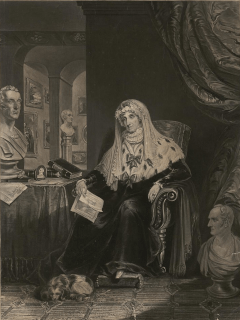
Wellesley marries Garrett Wesley, the Earl of Mornington, in 1759. The marriage is said to be a happy one. They have nine children together, with seven of them surviving to adulthood:
Lord Mornington dies on May 22, 1781, leaving Wellesley and their eldest son Richard, who is 21 years old at the time, to raise the rest of the family. She dislikes Arthur when he is young. She says that he is “food for powder and nothing more” and constantly worries about his future. In 1785, she goes to Brussels to live, as a way to economise. She takes Arthur with her and sends him to the Royal Academy of Equitation at Angers, in Anjou, after she returns to Britain in 1786. She is granted a pension of £600 in 1813 by Parliament after Arthur’s success in the Peninsular War.
Wellesley dies at the age of 89 on September 10, 1831.
(Pictured: Portrait of Anne Wellesley, Countess of Mornington, the mother of Arthur Wellesley, 1st Duke of Wellington, 1839, from the Welsh Portrait Collection at the National Library of Wales)
Davitt is born in Strade, County Mayo, on March 25, 1846, the son of an evicted tenant farmer. Following their eviction, the family emigrates to England. In 1856, at the age of 10, he starts work in a cotton mill, where he loses an arm in a machinery accident a year later. As is typical for the era, he does not receive any compensation.
In 1865, Davitt joins the revolutionary Fenian Brotherhood, an international secret society that seeks to secure political freedom for Ireland. He becomes secretary of its Irish analogue, the Irish Republican Brotherhood (IRB), in 1868. Arrested in Paddington Station in London for sending firearms to Ireland on May 14, 1870, he is sentenced to 15 years in Dartmoor Prison and there lays plans to link Charles Stewart Parnell’s constitutional reform with Fenian activism to achieve political-agrarian agitation.
Paroled from prison in 1877, Davitt rejoins the IRB and goes to the United States, where the Fenian movement originated. There he is deeply influenced by Henry George’s ideas about the relationship between land monopoly and poverty.
Back in Ireland, using funds raised by John Devoy and Clan na Gael in the United States, Davitt wins Parnell’s cooperation in organizing the Irish National Land League in 1879, which leads, however, to his expulsion from the supreme council of the IRB in 1880. He is also imprisoned for seditious speeches in 1881 and 1883. He is elected to Parliament representing North Meath in the 1892 United Kingdom general election, but his election is overturned on petition because he had been supported by the Roman Catholic hierarchy. He stands unopposed for North East Cork at a by-election in February 1893, making his maiden speech in favour of the Home Rule Bill in April, which passes the House of Commons but is defeated in the House of Lords in September.
Because of his public championing of Henry George’s theories of land reform, Parnell repudiates him. Davitt actively defends the Nationalists before the Parnell Commission, which meets between 1887 and 1889. When the Irish party splits in 1890 over Parnell’s involvement in Capt. William Henry O’Shea’s divorce case, Davitt is among the first to oppose Parnell’s continuance as leader. He is elected again, for South Mayo in 1895, but resigns in 1899 in protest against the Second Boer War.
Davitt dies in Elphis Hospital, Dublin on May 30, 1906, at the age of 60, from blood poisoning. The fact that the Lord Lieutenant of Ireland attends his funeral is a public indication of the dramatic political journey this former Fenian prisoner has taken. There is no plan for public funeral, and hence Davitt’s body is brought quietly to the Carmelite Friary, Clarendon Street, Dublin. However, the next day over 20,000 people file past his coffin. His remains are taken by train to Foxford, County Mayo, and buried in the grounds of Strade Abbey at Strade, near his place of birth.
Davitt’s book, The Fall of Feudalism in Ireland (1904), is a valuable record of his time.
Wentworth is born in London on April 13, 1593, the eldest surviving son of Sir William Wentworth, a Yorkshire landowner. Educated at St. John’s College, Cambridge, and at the Inner Temple, he is knighted by James I in 1611. His marriage to Lady Margaret Clifford, daughter of the impoverished Francis Clifford, 4th Earl of Cumberland, establishes a link with an ancient and noble family still influential in the north.
Wentworth represents Yorkshire in the parliaments of 1614 and 1621 and Pontefract in 1624. His wife dies childless in 1622, and in February 1625 he marries Arabella Holles, daughter of John Holles, 1st Earl of Clare, a peer out of favour at court who brings Wentworth into touch with the critics of the King’s expensive and inefficient policy of war against Spain and, from 1627, against France. Along with other critics of the court he is prevented from sitting in the Parliament of 1626, and later in the year he refuses to subscribe to the forced loan imposed to pay for the war and is for some time under arrest. Despite his record of opposition to the King’s policy, he is approached by the crown — anxious to strengthen its position in the north — with the offer of a barony in 1628. He is appointed lord president of the Council of the North and in 1629 is given a seat on the Privy Council of the United Kingdom.
Wentworth’s return to the service of the court, coming so soon after his vehement opposition to it in Parliament, startles even some of his closest friends. His conduct is no doubt partly inspired by personal ambition, though he has logical reasons for his change of front since in the summer of 1628 the King gradually abandons his war policy.
On the Privy Council Wentworth seems to advocate the paternalist government that distinguishes the early years of the King’s personal rule. As President of the Council of the North he quells all defiance of his authority and makes many enemies by his insistence on the honour due to him as the King’s representative, but his administration is on the whole just and efficient. In 1631 he is deeply distressed by the death of his much-loved wife, though he provokes scandalous rumours not long afterward by secretly marrying Elizabeth Rodes, the young daughter of a neighbouring squire, in October 1632.
The King meanwhile has appointed Wentworth Lord Deputy of Ireland. Taking up his office in the summer of 1633, he immediately sets himself to consolidate the royal authority, break the power of the dominant clique of “new English” landowners, extend English settlement, improve methods of agriculture, increase the productivity of the land, and stimulate industry and trade. His ultimate goal is to assimilate Irish law and customs to the English system and to make a prosperous Protestant Ireland into a source of revenue to the English crown.
Wentworth continues his effective and firm-handed administration of Ireland until 1639, when he is recalled to England by King Charles I. The King needs advice and support in handling a Scottish revolt precipitated by an ill-conceived attempt to enforce episcopacy on the Scots. He is created Earl of Strafford in 1640 and is expected to resolve the crisis. But his policy of making war on Scotland proves disastrous for both him and the King. The English Parliament, called especially to vote money for the war, prove recalcitrant, and Strafford, in command of the English army, fails to prevent the Scots from overrunning the northern counties. The King, unable to pay his own troops or to buy off the Scots, is compelled by joint English and Scottish action to call a new Parliament in November 1640.
Wentworth is the chief target of attack from both nations. He is advised to leave the country, but the King relies on his help and assures him that he should not suffer in life or fortune. Detained by illness, he reaches Westminster on November 10 with the intention of impeaching the King’s opponents in Parliament for treasonable correspondence with the Scots. The leader of the House of Commons, John Pym, acts first by impeaching Wentworth before he can take his seat in the House of Lords.
Wentworth’s trial begins in March 1641. The basic accusation is that of subverting the laws and is supported by a charge that he had offered to bring over the Irish army to subdue the King’s opponents in England. More detailed charges rest on his administration in Ireland and the north. He conducts his defense with great skill, and it looks at one point as though he might be acquitted. Pym therefore introduces a bill of attainder. The Commons passes it by a large majority. The Lords, intimidated by popular rioting, pass it as well, but by a much smaller majority.
While an angry mob surges around Whitehall, Wentworth writes to the King releasing him from his promise of protection, and Charles, afraid for the safety of the Queen, gives his consent to the bill. He is executed before a crowd estimated, probably with some exaggeration, at 300,000 on May 12, 1641 (as this number is roughly the population of London at the time, the crowd is likely to have been a good deal smaller). In his last speech he once more professes his faith in “the joint and individual prosperity of the king and his people,” for which, in his view, he has always worked.
Wentworth remains an enigmatic figure in English history: ambitious, greedy for power and wealth, ruthless, and sometimes dishonest, but with a vision of benevolent authoritarian government and efficient administration to which he often gave persuasive expression. He made innumerable enemies, but his few close friends were deeply attached to him. In the last weeks of his life his dignity, eloquence, and loyalty to the King made a deep impression even on some of his enemies.




 seamus dubhghaill