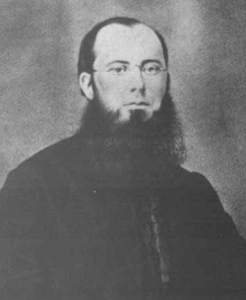
Bannon is born to James Bannon, a Dublin grain dealer, and Fanny Bannon (née O’Farrell). He goes to the vincentian Castleknock College in Dublin. In 1846 he goes to study for the priesthood at St. Patrick’s Pontifical University, Maynooth, in the minor seminary until 1850 and completing his theology course in 1853. He is ordained on June 16, 1853, by Archbishop Paul Cullen for the Dublin Diocese. He soon applies to move to America.
Shortly after ordination he moves to the Archdiocese of St. Louis, Missouri. He becomes pastor to St. John the Apostle and Evangelist Church which he builds in 1858. He serves in the First Missouri Confederate Brigade, during the American Civil War. He ministers at the battles of Corinth, Fort Gibson, and at Big Black River Bridge, Vicksburg.
He is detained on July 4, 1863, when Vicksburg surrenders. After being released by Union forces, he goes to Richmond, Virginia in August 1863, where Jefferson Davis and Secretary of State Judah Benjamin ask him to go to Ireland to discourage recruitment for the Federal forces and try to get international help for the Confederacy.
In November 1863, Bannon returns to Ireland, writing and pamphleting to discourage people from emigrating and joining the Union side of the civil war. He makes two trips to Rome to try, unsuccessfully, to get the Vatican to side with the Confederacy. Following the American Civil War, he is banned from preaching in St. Louis, and stays in Ireland, becoming a Jesuit in 1865, spending some time in Milltown Park, Tullabeg College, and in Gardiner Street.
Bannon dies on July 14, 1913, in Upper Gardiner Street, and is buried in the Jesuit plot at Glasnevin Cemetery, Dublin.
Gerald Griffin, Irish novelist, poet, and playwright, born in Limerick on December 12, 1803.
Griffin is the twelfth of the fifteen surviving children in his family. His father, Patrick Griffin, is a brewery farmer, and his mother, Ellen Griffin, of the ancient Gaelic family of the O’Briens, is very cultivated and much interested in literature.
Griffin goes to London in 1823 and becomes a reporter for one of the daily papers. He later turns to writing fiction. One of his most famous works is The Collegians, a novel based on a trial he has reported on, that of John Scanlan, a ProtestantAnglo-Irish man who murdered Ellen Hanley, a young Irish Catholic girl. The novel is adapted to the stage as The Colleen Bawn, by Dion Boucicault.
In September 1838, Griffin informs his family of his intention of joining the Congregation of Christian Brothers. He enters the novitiate at North Richmond Street, Dublin, on September 8. He embarks on his new career with intense dedication, abandoning his literary work entirely. He is then admitted to the religious habit on the feast of St. Theresa and embarks on a two-year novitiate. His distaste for his earlier vocation is allayed to the extent that he is willing to undertake the composition of a few tales of a pious nature, but he is also desperately determined to avoid as much as possible the renewal of old contacts and the reopening of painful associations. Griffin burns most all of his unpublished manuscripts, preserving only a few poems and the tragedy, Gisippus.
Griffin dies at the North Monastery, Cork, from typhus fever on June 12, 1840. He is buried in the community’s graveyard on June 15.
Gerald Griffin has a street named after him in Limerick City and another in Cork City. Loughill/Ballyhahill GAA club in west Limerick plays under the name of Gerald Griffins.
The Ulster Volunteer Force (UVF) explodes a bomb at McGurk’s Bar, an Irish Catholic-owned pub in Belfast, on December 4, 1971, killing fifteen Catholic civilians including two children and wounding seventeen others. This is the highest death toll from a single incident in Belfast during the Troubles. The bombing sparks a series of tit-for-tat bombings and shootings by loyalists and republicans, which help make 1972 the bloodiest year of the conflict.
On the evening of Saturday, December 4, 1971, a four-man UVF team meets in the Shankill area of Belfast and are ordered to bomb a pub on North Queen Street. According to the only convicted bomber, Robert Campbell, they are told not to return until the job is done. Campbell says that their target had not been McGurk’s, but another pub nearby. It is believed this is a pub called The Gem, which is allegedly linked to the Official Irish Republican Army (IRA). The 50-pound bomb is disguised as a brown parcel, which they place in a car and drive to their target. Campbell says they stop near The Gem at about 7:30 p.m. but are unable to gain access to it because there are security guards outside. After waiting for almost an hour, they drive a short distance to McGurk’s. At about 8:45 PM, one of them places the bomb in the porch entrance on Great George’s Street and rushes back to the car. It explodes just moments after they drive off. Campbell implies that McGurk’s had been chosen only because it was “the nearest Catholic pub.”
The blast causes the building to collapse. Bystanders immediately rush to free the dead and wounded from the rubble. Firefighters, paramedics, police, and soldiers are quickly on the scene. Fifteen Catholic civilians are killed, including two children, and an additional seventeen are wounded. The rescue effort lasts many hours.
Within two hours of the blast, a sectarian clash erupts nearby at the New Lodge–Tiger’s Bayinterface. The British Army and Royal Ulster Constabulary (RUC) move in, and a gun battle develops. A British Army officer, Major Jeremy Snow, is shot by the IRA on New Lodge Road and dies of his wounds on December 8. Two RUC officers and five civilians are also wounded by gunfire. Eventually, five companies of troops are sent into the district, and they search almost 50 houses.
Meanwhile, the UVF team has driven to a nearby pickup point where they dump their car. They walk to the area of St. Anne’s Cathedral and are picked up by another car. They are driven back to the Shankill area and meet the man who had ordered the attack in an Orange Hall, telling him that “the job has been done.”
Among those killed are Philomena and Maria McGurk, wife and 12-year-old daughter of pub owner Patrick McGurk. Patrick and his three sons are seriously injured. Shortly after the attack, McGurk appears on television calling for no retaliation, “It doesn’t matter who planted the bomb. What’s done can’t be undone. I’ve been trying to keep bitterness out of it.”
In March 1976, the RUC receives intelligence that links UVF member Robert Campbell and four others to the McGurk’s bombing. Campbell is arrested on July 27, 1977, and held at Castlereagh RUC base. He admits his part in the bombing but refuses to name the others.
On July 29, 1977, Campbell is charged with 15 counts of murder and 17 counts of attempted murder. On September 6, 1978, he pleads guilty to all charges and receives life imprisonment with “a recommendation to serve no less than 20 years,” in part for a separate conviction for the murder of a Protestant delivery driver in 1976. He is the only person to have been charged for the bombing. He eventually serves fifteen years in prison and is released on September 9, 1993.
He originates from a noble family of Ireland, where his name is Feirgil, and is said to have been a descendant of Niall of the Nine Hostages. Feirgil is likely educated at the Iona monastery.
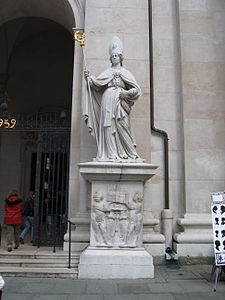
Around 745 Vergilius leaves Ireland, intending to visit the Holy land but, like many of his countrymen who seem to have adopted this practice as a work of piety, he settles down in France, where he is received with great favour by Pepin the Short, who is then Mayor of the Palace under Childeric III of Franconia. He serves as an adviser to Pepin. He probably uses a copy of the Collectio canonum Hibernensis, an Irish collection of canon law, to advise him to receive royal unction in 751, to assist his recognition as king Pippin III after the deposition of Childeric. After spending two years at Cressy, near Compiègne, he goes to Bavaria, at the invitation of Duke Odilo, where he founds the monastery of Chiemsee, and within a year or two is made Abbot of St. Peter’s at Salzburg. Among his notable accomplishments is the conversion of the Alpine Slavs and the dispatching of missionaries to Hungary.
While Abbot of St. Peter’s, Vergilius comes into collision with Saint Boniface. A priest, through ignorance, confers the Sacrament of Baptism using, in place of the correct formula, the words “Baptizo te in nomine patria et filia et spiritu sancta.” Vergilius holds that the sacrament has been validly conferred, but Boniface complains to Pope Zachary. The latter, however, decides in favour of Vergilius. Later on, Boniface accuses Vergilius of spreading discord between himself and Duke Odilo of Bavaria and of teaching a doctrine in regard to the rotundity of the earth, which is “contrary to the Scriptures.” Pope Zachary’s decision in this case is that “if it shall be clearly established that he professes belief in another world and other people existing beneath the earth, or in another sun and moon there, thou art to hold a council, and deprive him of his sacerdotal rank, and expel him from the church.”
Unfortunately, we no longer possess the treatise in which Vergilius expounds his doctrine. Two things, however, are certain: first, that there is involved the problem of original sin and the universality of redemption; secondly, that Vergilius succeeds in freeing himself from the charge of teaching a doctrine contrary to Scripture. It is likely that Boniface, already biased against Vergilius because of the preceding case, misunderstands him, taking it for granted, perhaps, that if there are antipodes, the “other race of men” are not descendants of Adam and are not redeemed by Christ.
After the martyrdom of Boniface, Vergilius is made Bishop of Salzburg in 766 or 767. Until his death in 784, he labours successfully for the upbuilding of his diocese as well as for the spread of Christianity in neighbouring heathen countries, especially in Carinthia.
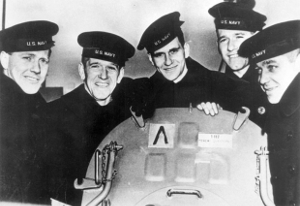
Five Sullivan brothers from Waterloo, Iowa, die when their ship, the light cruiser USS Juneau, is torpedoed and sunk by a Japanese submarine on November 13, 1942. Raised in an Irish Catholic family, the brothers’ great grandfather had emigrated from Ireland.
The five brothers, the sons of Thomas and Alleta Sullivan, are George Thomas Sullivan (27), Francis “Frank” Henry Sullivan (26), Joseph “Joe” Eugene Sullivan (24), Madison “Matt” Abel Sullivan (23), and Albert “Al” Leo Sullivan (20).
The Sullivans enlist in the U.S. Navy on January 3, 1942, with the stipulation that they serve together. The Navy has a policy of separating siblings, but it is not strictly enforced. George and Frank have served in the Navy before, but their brothers have not. All five are assigned to the light cruiser USS Juneau.
The Juneau participates in a number of naval engagements during the months-long Guadalcanal Campaign beginning in August 1942. Early on the morning of November 13, 1942, during the Naval Battle of Guadalcanal, the Juneau is struck by a Japanese torpedo and forced to withdraw. Later that day, as it is leaving the Solomon Islands area for the Allied rear-area base at Espiritu Santo with other surviving U.S. warships from battle, the Juneau is struck again, this time by a torpedo from Japanese submarine I-26. The torpedo apparently hits the thinly armored light cruiser at or near the ammunition magazines and the ship explodes and quickly sinks.
Captain Gilbert C. Hoover, commanding officer of the USS Helena and senior officer present in the battle-damaged U.S. task force, is skeptical that anyone has survived the sinking of the Juneau and believes it would be reckless to look for survivors, thereby exposing his wounded ships to a still-lurking Japanese submarine. Therefore, he orders his ships to continue on towards Espiritu Santo. Helena signals a nearby U.S. B-17 bomber on patrol to notify Allied headquarters to send aircraft or ships to search for survivors.
However, approximately 100 of Juneau‘s crew survive the torpedo attack and the sinking of their ship and are left in the water. The B-17 bomber crew, under orders not to break radio silence, does not pass the message about searching for survivors to their headquarters until they land several hours later. The crew’s report of the location of possible survivors is mixed in with other pending paperwork actions and goes unnoticed for several days. It was not until days later that headquarters staff realize that a search has never been mounted and belatedly orders aircraft to begin searching the area. In the meantime, Juneau‘s survivors, many of whom are seriously wounded, are exposed to the elements, hunger, thirst, and repeated shark attacks.
Eight days after the sinking, ten survivors are found by a PBY Catalina search aircraft and retrieved from the water. The survivors report that Frank, Joe, and Matt died instantly, Al drowned the next day, and George survived for four or five days before, suffering from delirium as a result of hypernatremia, he goes over the side of the raft he occupies and is never seen or heard from again.
Security requires that the Navy not reveal the loss of Juneau or the other ships so as not to provide information to the enemy. Letters from the Sullivan sons stop arriving at the home and the parents grow worried, which prompts Alleta Sullivan to write to the Bureau of Naval Personnel in January 1943, citing rumors that survivors of the task force claim that all five brothers were killed in action.
The letter is answered by President Franklin D. Roosevelt on January 13th, who acknowledges that the Sullivans are missing in action. By then, however, the parents have already been informed of their fate, having learned of their deaths on January 12, 1943. That morning, the boys’ father, Thomas, is preparing for work when three men in uniform approach his door. “I have some news for you about your boys,” one naval officer says. “Which one?” asks Thomas. “I’m sorry,” the officer replies. “All five.”
Daniel O’Connell, Irish political leader often referred to as The Liberator or The Emancipator, is born on August 6, 1775, at Carhan near Cahersiveen, County Kerry, to the O’Connells of Derrynane, a once-wealthy Roman Catholic family, that has been dispossessed of its lands.
Raised by his uncle, Daniel learns the Irish language and Irish lore in Kerry. O’Connell does part of his schooling in France during the revolution. On May 19, 1798, O’Connell is called to the Irish Bar and becomes a barrister. Four days later, the United Irishmen stage their rebellion which is put down by the British with great bloodshed. O’Connell does not support the rebellion. He believes that the Irish need to assert themselves politically rather than by force. The violent excesses he witnesses in France, the slaughter of the 1798 Rising, and finally his own killing of a man in a duel in 1815 leads him to renounce violence forever.
Moving into politics, O’Connell founds the Catholic Association in 1823, creating one of the first massive political movements in Europe or the Americas. The Catholic Association embraces other aims to better Irish Catholics, such as electoral reform, reform of the Church of Ireland, tenants’ rights, and economic development.
When he is elected to Parliament in 1828, he is unable to take his seat as members of parliament have to take the Oath of Supremacy, which is incompatible with Catholicism. Fear of the reaction of his millions of followers leads to the passage of the Roman Catholic Relief Act 1829. O’Connell works for Home Rule for Ireland for the rest of his days but never achieves it. The British ban his mass Repeal of the Union rallies in 1843 and jail him for a time. The movement loses momentum at that point and the long years of hard work wear “The Liberator” down.
O’Connell dies at the age of 71 of cerebral softening on May15, 1847, in Genoa, Italy, while on a pilgrimage to Rome. His time in prison seriously weakens him and the appallingly cold weather he has to endure on his journey is likely the final blow. According to his dying wish, his heart is buried in Rome at Sant’Agata dei Goti, then the chapel of the Irish College, and the remainder of his body in Glasnevin Cemetery in Dublin, beneath a round tower.
Francis McCloskey, a 67-year-old Catholic civilian, dies on July 14, 1969, one day after being hit on the head with a baton by an officer of the Royal Ulster Constabulary (RUC) during street disturbances in Dungiven, County Derry. McCloskey is sometimes considered to be the first fatality of The Troubles.
McCloskey is found unconscious on July 13 near the Dungiven Orange Hall following a police baton charge against a crowd who had been throwing stones at the hall. Witnesses later say they had seen police beating a figure with batons in the doorway where McCloskey is found, although police claim he had been unconscious before the baton charge and may have been hit with a stone.
The conflict is primarily political, but it also has an ethnic or sectarian dimension, although it is not a religious conflict. A key issue is the constitutional status of Northern Ireland. Unionists and loyalists, who are mostly Protestants and consider themselves British, generally want Northern Ireland to remain within the United Kingdom. Irish nationalists and republicans, who are mostly Catholic and consider themselves Irish, generally want it to leave the United Kingdom and join a united Ireland. The conflict begins amid a campaign to end discrimination against the Catholic/nationalist minority by the Protestant/unionist government and police force in 1968. The campaign is met with violence, eventually leading to the deployment of British troops and subsequent warfare.
The main participants in the Troubles are republican paramilitaries such as the Provisional Irish Republican Army (IRA) and Irish National Liberation Army (INLA), loyalist paramilitaries such as the Ulster Volunteer Force (UVF) and Ulster Defence Association (UDA), the British Army and Royal Ulster Constabulary (RUC), and political activists and politicians. The security forces of the Republic of Ireland play a smaller role. More than 3,500 people are killed in the conflict, of whom 52% were civilians, 32% are members of the British security forces, and 16% are members of paramilitary groups. There has been sporadic violence since the signing of the Good Friday Agreement, including a campaign by anti-ceasefire republicans.
On and around the Twelfth, large parades are held by the Orange Order and Ulster loyalist marching bands, streets are bedecked with British flags and bunting, and large, towering bonfires are lit. Today the Twelfth is mainly celebrated in Northern Ireland, where it is a public holiday, but smaller celebrations are held in other parts of the world where Orange lodges have been set up, including the Canadian province of Newfoundland where it is a provincial holiday. The Twelfth involves thousands of participants and spectators, although not all Protestants celebrate it.
In Northern Ireland, where almost half the population is from an Irish Catholic background, The Twelfth is a tense time. Orange marches through Irish Catholic and Irish nationalist neighbourhoods are usually met with opposition from residents, sometimes leading to violence. Public disorder during The Twelfth parades of the early 19th century led to them being banned in the 1830s and 1840s.
Many Catholics and Irish nationalists see the Orange Order and its marches as sectarian, triumphalist, and supremacist. The Order is also politically a unionist/loyalist organization. Violence related to the Twelfth in Northern Ireland worsens during the 30-year ethno-political conflict known as The Troubles. The Drumcree conflict is the most well-known dispute involving Orange marches.
Attempts have recently been made to downplay the political aspects of the marches and present the Twelfth as a cultural, family-friendly event at which tourists are welcome. Although most events pass off peacefully, some continue to result in violence.
John F. Kennedy, an Irish American and the first Catholic to become president of the United States, arrives in Ireland on a state visit on June 26, 1963. After Air Force One touches down at Dublin airport, Kennedy’s motorcade weaves through the streets of Dublin city, the thrilled crowd, lacking ticker tape, improvises by throwing rolls of bus tickets.
Kennedy is proud of his Irish roots and makes a special visit to his ancestral home in Dunganstown, County Wexford, while in the country. There, he is greeted by a crowd waving both American and Irish flags and is serenaded by a boys’ choir that sings TheBoys of Wexford. Kennedy breaks away from his bodyguards and joins the choir for the second chorus, prompting misty-eyed reactions from both observers and the press.
Kennedy meets with 15 members of his extended Irish family at the Kennedy homestead in Dunganstown. There he enjoys a cup of tea and some cake and makes a toast to “all those Kennedys who went and all those Kennedys who stayed.” His great-grandfather, Thomas Fitzgerald, had left Ireland for the United States in the middle of the Great Famine of 1848 and settled in Boston, becoming a cooper. Generations of his descendants go on to make their mark on American politics.
Kennedy later tells his aides that his favourite part of the trip was the wreath laying and silent funeral drill done by the Irish Army cadets at Arbour Hill military cemetery in Dublin.
Five months later, his widow, Jacqueline Kennedy, makes a special request to the Irish government. She asks that those same Irish army cadets, who so impressed the President on his visit, perform the drill again at his state funeral. Within days, those awe-stuck, trembling young men stand just inches away from foreign dignitaries from over 90 countries and perform their silent funeral drill in memory of a president that had inspired their country just a few short months earlier.
Charles Gavan Duffy, Irish nationalist, journalist, poet, and Australian politician, is born on April 12, 1816, in Dublin Street, Monaghan Town, County Monaghan. Duffy is the 8th Premier of Victoria and one of the most colourful figures in Victorian political history.
Both of his parents die while he is still a child and his uncle, Fr. James Duffy, who is the Catholic Parish Priest of Castleblayney, becomes his guardian for a number of years. He is educated at St. Malachy’s College in Belfast and is admitted to the Irish Bar in 1845. Duffy becomes a leading figure in Irish literary circles.
In August 1850, Duffy forms the Tenant Right League to bring about reforms in the Irish land system and protect tenants’ rights, and in 1852 is elected to the House of Commons for New Ross. By 1855, the cause of Irish tenants seems more hopeless than ever. Broken in health and spirit, Duffy publishes a farewell address to his constituency, declaring that he has resolved to retire from parliament, as it is no longer possible to accomplish the task for which he has solicited their votes.
In 1871, Duffy leads the opposition to Premier Sir James McCulloch‘s plan to introduce a land tax, on the grounds that it unfairly penalised small farmers. When McCulloch’s government is defeated on this issue, Duffy becomes Premier and Chief Secretary. The majority of the colony is Protestant, and Duffy is accused of favouring Catholics in government appointments. In June 1872, his government is defeated in the Assembly on a confidence motion allegedly motivated by sectarianism.
When Graham Berry becomes Premier in 1877, he makes Duffy Speaker of the Legislative Assembly, a post he holds without much enthusiasm until 1880, when he quits politics and retires to the south of France. Duffy remains interested in both the politics of his adoptive country and of Ireland. He is knighted in 1873 and is made KCMG in 1877. Sir Charles Gavan Duffy dies in Nice, France, at the age of 86 in 1903.