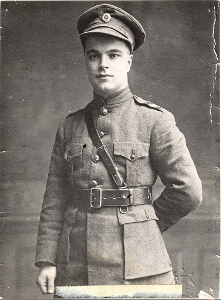
On February 8, 1923, the Irish Free State suspends executions until February 18, offering an amnesty to anyone who surrenders before that date.
In the aftermath of the sudden death of Arthur Griffith and the killing of Michael Collins, in August 1922, William T. Cosgrave becomes chairman of the provisional government. Cosgrave and his colleagues remain wedded to a ruthless military and political strategy that ensures, by May 1923, a decisive win over the Republicans and the end of the Irish Civil War. Cosgrave’s analysis is that “the executions have had a remarkable effect. It is a sad thing to say, but it is nevertheless the case.” He could also be chilling in his resolve: “I am not going to hesitate and if the country is to live and if we have to exterminate 10,000 republicans, the 3 millions of our people are bigger than the ten thousand.”
The Free State suspends executions and offers an amnesty in the hope that anti-treaty fighters will surrender. However, the war drags for another two months and witnesses at least twenty more official executions.
Several Republican leaders narrowly avoid execution. Ernie O’Malley, captured on November 4, 1922, is not executed because he is too badly wounded when taken prisoner to face a court-martial and possibly because the Free State is hesitant about executing an undisputed hero of the recent struggle against the British. Liam Deasy, captured in January 1923, avoids execution by signing a surrender document calling on the anti-treaty forces to lay down their arms.
The Anti-Treaty side calls a ceasefire on April 30, 1923 and orders their men to “dump arms,” ending the war on May 24. Nevertheless, executions of Republican prisoners continue after this time. Four Irish Republican Army (IRA) men are executed in May after the ceasefire order and the final two executions take place on November 20, months after the end of hostilities. It is not until November 1924 that a general amnesty is offered for any acts committed in the civil war.
In highlighting the severity of the Free State’s execution policy, however, it is important not to exaggerate its extent. The Free State takes over 12,000 Republicans prisoner during the war, of whom roughly 80, less than 1%, are executed. How those who are executed are chosen from the others captured in arms is unclear, however many more men are sentenced to the death penalty than are actually shot. This is intended to act as a deterrent to anti-Treaty fighters in the field, who know that their imprisoned comrades are likely to be executed if they kept up their armed campaign.
Perhaps this realism is also beginning to affect the republican self-declared “men of faith.” Dan Breen, who leads an IRA column in Tipperary during the Civil war, tells his fellow republicans, “In order to win this war you’ll need to kill 3 out of every 5 people in the country and it isn’t worth it.”
James (Jim) Larkin, Irish trade union leader and socialist activist, is born to Irish parents in Liverpool, England, on January 21, 1876. He and his family later move to a small cottage in Burren, County Down. Growing up in poverty, he receives little formal education and begins working in a variety of jobs while still a child.
In 1905, Larkin is one of the few foremen to take part in a strike on the Liverpool docks. He is elected to the strike committee, and although he loses his foreman’s job as a result, his performance so impresses the National Union of Dock Labourers (NUDL) that he is appointed a temporary organiser.
Larkin moves to Belfast in 1907 to organise the city’s dock workers for the NUDL. He succeeds in unionising the workforce, and as employers refuse to meet the wage demands, he calls the dockers out on strike in June. Carters and coal men soon join in, the latter settling their dispute after a month.
In 1908, Larkin moves south and organises workers in Dublin, Cork, and Waterford, with considerable success. His involvement, against union instructions, in a dispute in Dublin results in his expulsion from the NUDL. The union later prosecutes him for diverting union funds to give strike pay to Cork workers engaged in an unofficial dispute. After trial and conviction for embezzlement in 1910, he is sentenced to prison for a year. This is widely regarded as unjust, and the Lord Lieutenant of Ireland, Lord Aberdeen, pardons him after he has served three months in prison.
After his expulsion from the NUDL, Larkin founds the Irish Transport and General Workers’ Union (ITGWU) at the end of December 1908. The organisation exists today as the Services Industrial Professional & Technical Union (SIPTU). In early 1909, Larkin moves to Dublin, which becomes the main base of the ITGWU and the focus of all his future union activity in Ireland.
In early 1913, Larkin achieves some successes in industrial disputes in Dublin. Two major employers, Guinness and the Dublin United Tramway Company, are the main targets of Larkin’s organising ambitions. The chairman of the Dublin United Tramway Company, industrialist and newspaper proprietor William Martin Murphy, is determined not to allow the ITGWU to unionise his workforce. On August 15, he dismisses 40 workers he suspects of ITGWU membership, followed by another 300 over the next week. On August 26, 1913, the tramway workers officially go on strike.
The resulting industrial dispute is the most severe in Ireland’s history. Employers in Dublin engage in a sympathetic lockout of their workers when the latter refuses to sign the pledge, employing blackleg labour from Britain and from elsewhere in Ireland. Guinness, the largest employer in Dublin, refuses the employers’ call to lock out its workers but it sacks 15 workers who struck in sympathy.
For seven months the lockout affects tens of thousands of Dublin workers and employers, with Larkin portrayed as the villain by Murphy’s three main newspapers, the Irish Independent, the Sunday Independent, and the Evening Herald, and by other bourgeois publications in Ireland. The lock-out eventually concludes in early 1914 when calls by James Connolly and Larkin for a sympathetic strike in Britain are rejected by the British Trades Union Congress (TUC). Larkin’s attacks on the TUC leadership for this stance also lead to the cessation of financial aid to the ITGWU.
Some months after the lockout ends, Larkin leaves for the United States. He intends to recuperate from the strain of the lockout and raise funds for the union. Once there he becomes a member of the Socialist Party of America and is involved in the Industrial Workers of the World union (the Wobblies). He becomes an enthusiastic supporter of the Soviet Union and is expelled from the Socialist Party of America in 1919 along with numerous other sympathisers of the Bolsheviks during the Red Scare of that year.
Upon his return to Ireland in April 1923, Larkin receives a hero’s welcome and immediately sets about touring the country meeting trade union members and appealing for an end to the Irish Civil War. In September 1923, Larkin forms the Irish Worker League (IWL), which is soon afterwards recognised by the Communist International as the Irish section of the world communist movement.
James Larkin dies in his sleep on January 30, 1947, in the Meath Hospital. Fr. Aloysius Travers, OFM, who had administered last rites to James Connolly in 1916, also administers extreme unction to Larkin. His funeral mass is celebrated by the Catholic Archbishop of Dublin, John Charles McQuaid, who had visited him in hospital before he died, and thousands line the streets of the city as the hearse passes through on the way to Glasnevin Cemetery.
Sir John Lavery, Irish painter best known for his portraits and wartime depictions, dies of natural causes at the age of 84 in Kilmoganny, County Kilkenny, on January 10, 1941.
Like William Orpen, Lavery is appointed an official artist in World War I. Ill-health, however, prevents him from travelling to the Western Front. A serious car crash during a Zeppelin bombing raid also keeps him from fulfilling this role as war artist. He remains in Britain and mostly paints boats, aeroplanes, and airships. During the war years he is a close friend of H.H. Asquith‘s family and spends time with them at their Sutton Courtenay Thames-side residence, painting their portraits and idyllic pictures like Summer on the River (Hugh Lane Gallery).
After the war Lavery is knighted and in 1921 he is elected to the Royal Academy of Arts.
During this time, he and his wife, Hazel, are tangentially involved in the Irish War of Independence and the Irish Civil War. They give the use of their London home to the Irish negotiators during the negotiations leading to the Anglo-Irish Treaty. After Michael Collins is assassinated, Lavery paints Michael Collins, Love of Ireland, now in the Hugh Lane Gallery. In 1929, Lavery makes substantial donations of his work to both the Ulster Museum and the Hugh Lane Gallery and in the 1930s he returns to Ireland. He receives honorary degrees from the University of Dublin and Queen’s University Belfast. He is also made a free man of both Dublin and Belfast. A long-standing member of Glasgow Art Club, Lavery exhibits at the club’s annual exhibitions, including its exhibition in 1939 in which his The Lake at Ranelagh is included.
Dáil Éireann votes to approve the Anglo-Irish Treaty on January 7, 1922, following a debate through late December 1921 and into January 1922. The vote is 64 in favour, 57 against, with the Ceann Comhairle and three others not voting. The Sinn Féin party splits into opposing sides in the aftermath of the Treaty vote, which leads to the Irish Civil War from June 1922 until May 1923. The treaty is signed in London on December 6, 1921.
Two elections take place in Ireland in 1921, as a result of the Government of Ireland Act 1920 to establish the House of Commons of Northern Ireland and the House of Commons of Southern Ireland. The election is used by the Irish Republic as the basis of membership of the Second Dáil. The general election to the Northern Ireland House of Commons occurs on May 24, 1921. Of 52 seats, forty are won by unionists, six by moderate Irish nationalists, and six by Sinn Féin. No actual polling takes place in the Southern Ireland constituencies, as all 128 candidates are returned unopposed. Given the backdrop of the increasingly violent War of Independence, any candidates opposed to Sinn Féin, and their supporters can expect to be harassed by the Irish Republican Army (IRA). Supporters of the Irish Labour Party stand aside to allow the constitutional situation to run its course. Of these 128, 124 are won by Sinn Féin, and four by independent unionists representing the University of Dublin constituency. Only the Sinn Féin candidates recognise the Second Dáil and five of these have been elected in two constituencies, one in each part of Ireland, so the total number of members who assemble in the Second Dáil is 125.
During the Second Dáil, the government of the Irish Republic and the British government of David Lloyd George agree to hold peace negotiations. On September 14, 1921, the Dáil ratifies the appointment of Arthur Griffith, Michael Collins, Robert Barton, Eamonn Duggan, and George Gavan Duffy as envoys plenipotentiary for the peace conference in England. These envoys eventually sign the Anglo-Irish Treaty on December 6. After almost a month of acrimonious debate the treaty is formally ratified by Dáil Éireann on January 7, 1922.
To satisfy the requirements of the British constitution, the treaty also has to be ratified by the House of Commons of Southern Ireland. Thus, Irish nationalists end their boycott of the home rule parliament to attend the southern House of Commons as MPs. This they do alongside the four Unionist MPs who had refused to recognise the Dáil. In this way the treaty is ratified a second time in Dublin, this time unanimously as the anti-Treaty TDs refuse to attend.
Under the terms of the Anglo-Irish Treaty a provisional parliament, considered by nationalists to be the Third Dáil, is elected in the 1922 general election on June 16. Collins and Éamon de Valera agree a pact between the pro- and anti-Treaty wings of Sinn Féin, and this pact and the elections are endorsed by the Second Dáil. The new assembly is recognised both by nationalists and the British Government and so replaces both the Parliament of Southern Ireland and the Second Dáil with a single body. The anti-Treaty groups of IRA members, TDs, and their supporters are still bitterly opposed the settlement, despite the election result, and this leads to the Irish Civil War.
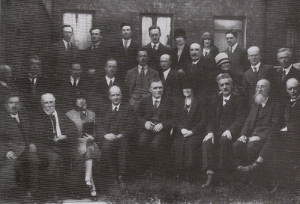
(Pictured: Second All-Ireland Dáil Éireann, elected in 1921)
Breen is born in Grange, Donohill parish, County Tipperary, on August 11, 1894. His father dies when he is six, leaving the family very poor. He is educated locally before becoming a plasterer and later a linesman on the Great Southern Railways.
Breen is sworn into the Irish Republican Brotherhood in 1912 and the Irish Volunteers in 1914. On January 21, 1919, the day the First Dáil meets in Dublin, Breen takes part in the Soloheadbeg Ambush. The ambush party of eight men, led by Seán Treacy, attacks two Royal Irish Constabulary (RIC) men who are escorting explosives to a quarry. The two policemen, James McDonnell and Patrick O’Connell, are fatally shot during the incident. The ambush is considered to be the first incident of the Irish War of Independence.
During the conflict, the British put a £1,000 price on Breen’s head, which is later increased to £10,000. He quickly establishes himself as a leader within the Irish Republican Army (IRA). He is known for his courage. On May 13, 1919 he helps rescue his comrade Seán Hogan at gunpoint from a heavily guarded train at Knocklong station in County Limerick. Breen, who is wounded, remembers how the battalion is “vehemently denounced as a cold-blooded assassins” and roundly condemned by the Catholic Church. After the fight, Treacy, Séamus Robinson, and Breen meet Michael Collins in Dublin, where they are told to make themselves scarce although they do not necessarily agree.
Breen and Sean Treacy shoot their way out through a British military cordon in the northern suburb of Drumcondra (Fernside). They escape, only for Treacy to be killed the next day. Breen is shot at least four times, twice in the lung.
The British reaction is to make Tipperary a “Special Military Area,” with curfews and travel permits. Volunteer GHQ authorises entrerprising attacks on barracks. The British policy forces Breen and Treacy to retreat to Dublin. They join Michael Collins’ Squad of assassins, later known as the Dublin Guard, and Dublin becomes the centre of the war.
Breen is present in December 1919 at the ambush in Ashtown beside Phoenix Park in Dublin where Martin Savage is killed while trying to assassinate the Lord Lieutenant of Ireland, Viscount John French. The IRA hides behind hedges and a dungheap as the convoy of vehicles drives past. They have been instructed to ignore the first car but this contains their target, Lord French. Their roadblock fails as a policeman removes the horse and cart intended to stop the car.
Breen utterly rejects the Anglo-Irish Treaty, which makes him, like many others, angry and embittered. In the June 1922 elections Breen is nominated as a candidate by both the pro- and anti-Treaty sides, but is not elected.
Breen is elected to Dáil Éireann at the 1923 general election as a Republican anti-Treaty Teachta Dála (TD) for the Tipperary constituency. Following the Anglo-Irish Treaty, Breen joins the Anti-Treaty IRA in the civil war, fighting against those of his former comrades in arms who support the Treaty. He is arrested by the National Army of the Irish Free State and interned at Limerick Prison. He spends two months there before going on hunger strike for six days followed by a thirst strike of six days, prompting his release.
Breen writes a best-selling account of his guerrilla days, My Fight for Irish Freedom, in 1924. He represents Tipperary from the Fourth Dáil in 1923 as a Republican with Éamon de Valera and Frank Aiken. He is defeated in the June 1927 general election and travels to the United States where he opens a prohibitionspeakeasy. In 1932 he returns to Ireland and regains his seat as a member of Fianna Fáil in the Dáil at that year’s general election. During World War II he is said to hold largely pro-Axis views. He represents his Tipperary constituency without a break until his retirement at the 1965 election.
Breen dies in Dublin on December 27, 1969 and is buried in Donohill, near his birthplace. His funeral is the largest seen in west Tipperary since that of his close friend and comrade-in-arms Seán Treacy at Kilfeacle in October 1920. An estimated attendance of 10,000 mourners assemble in the tiny hamlet, giving ample testimony to the esteem in which he was held.
Breen is the subject of a 2007 biography Dan Breen and the IRA by Joe Ambrose.
The last British troops leave the Irish Free State on December 17, 1922. They are the remnants of a 5,000 strong garrison maintained up to that point in Dublin, commanded by Nevil Macready.
It appears to be a friendly farewell, even while Ireland is embroiled in its own Civil War. The Union Jack is lowered at the hospital and Macready goes to review the final contingent of troops as they leave the Royal barracks, later known as the Collins barracks. He then motors to Kingstown, now Dún Laoghaire, where he receives a 17-gun salute and joins Admiral Cecil Fox, the Sligo-born naval commander in the area, on board the cruiser HMS Dragon to sail home to England and retirement.
Meanwhile, the troops, 3,500 men mostly from the Leicester, Worchester, and Border regiments, march to the port. At Beresford Place they are greeted by 500 members of the Legion of Irish Ex-Servicemen, in civilian clothes but wearing their decorations. Thousands of other people line the quays and the armoured cars and the Dublin Metropolitan Police stand by, but there is no trouble. Embarkation onto six ships begins around 1:15 PM. At 3:10 PM, the last ship to leave, the steamer Arvonia chartered from the London and North Western Railway, weighs anchor while a band on deck plays “God Save the King” and a crowd breaks into the North Wall Extension to wave a final farewell as it enters Alexandra Basin.
The armoured cars them drive north to Ulster and the evacuation of the Irish Free State, apart from the Treaty ports, is over. General Richard Mulcahy, who takes over the Royal barracks that day, claims “the incubus of occupation that has lain as a heavy hand on the country for years has been removed.”
In his memoirs, Macready expresses annoyance that a photograph of Fox and himself published in The Irish Times on December 18 has the caption “two gallant Irishmen.” Although he has an Irish grandfather, he cordially loathes Ireland.
The British leave fully outfitted barracks to the Irish Army and artifacts including a large card in the Headquarters in Parkgate Street printed with the admonition “LOVE ONE ANOTHER.”
McKelvey is born into a nationalist family in Stewartstown, County Tyrone. He has a keen interest in the Gaelic Athletic Association and the Irish language. He studies as an accountant and gains some of the qualifications necessary for this profession, but never fully qualifies. He works for a time at the Income Tax Office on Queen’s Square in Belfast and later finds work in Belfast’s engineering industry with Mackies on Springfield Road. He joins the Irish Republican Brotherhood and the Irish Volunteers, which after 1919, become known as the Irish Republican Army (IRA). He is a founding member of the O’Donovan Rossa Club, Belfast, founded in 1916 on the Falls Road. Each year the club honours him with a juvenile hurling blitz, an invitational competition which is participated in by clubs throughout Ireland.
McKelvey participates in the Irish War of Independence (1919–1921) against the British, in which he commands the IRA’s Belfast Brigade. On August 22, 1920, he helps to organise the killing of Royal Irish Constabulary (RIC) Detective Oswald Swanzy in Lisburn. The killing itself is carried out by IRA men from Cork, but McKelvey arranges a taxi to carry the assassins to and from the scene and disposes of their weapons. In reprisal for this shooting, 300 Catholic homes in Lisburn are burned out. McKelvey is forced to lie low in Dublin for some time after these events.
In March 1921, the IRA is re-organised by its leadership in Dublin into Divisions and McKelvey is appointed commander of the Third Northern Division, responsible for Belfast and the surrounding area. In May 1921, McKelvey’s command suffers a severe setback, when fifty of his best men are sent to County Cavan to train and link up with the IRA units there, only to be surrounded and captured by the British Army on Lappanduff hill on May 9. In most of Ireland, hostilities are ended with a truce declared on July 11, 1921.
McKelvey is alone among the leadership of the Belfast IRA in going against the acceptance of the Anglo-Irish Treaty. Most of his comrades support Michael Collins‘ assurances that, although the Treaty accepts the partition of Northern Ireland from the rest of the country, this is only a temporary concession which will be dealt with later. McKelvey does not accept this. As a result, he leaves his command as head of the IRA Third Northern Division and joins the Anti-Treaty IRA in Dublin.
In March 1922, McKelvey participates in the anti-Treaty IRA‘s repudiation of the authority of the Dáil, the civil government of the Irish Republic declared in 1919, and is elected to the IRA Army Executive. In April 1922 he helps command the occupation of the Four Courts in defiance of the new Irish Free State. This action helps to spark the civil war between pro- and anti-Treaty factions. McKelvey is among the most hardline of the anti-Treaty republicans and briefly, in June 1922, becomes IRA Chief of Staff, replacing Liam Lynch.
On June 28, 1922, the new Irish Free State government shells the Four Courts to assert its authority over the militants defending it. The Republicans in the Four Courts surrender after two days of fighting and McKelvey is captured. He is held for the following five months in Mountjoy Prison in Dublin.
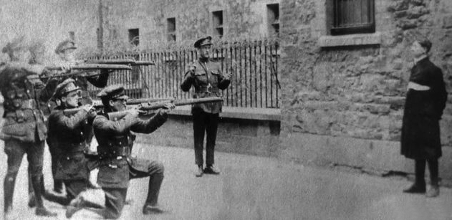
On December 8, 1922, Joe McKelvey is executed by firing squad along with three other Anti-Treaty militants, Rory O’Connor, Liam Mellows, and Richard Barrett. The executions are ordered in reprisal for the Anti-Treaty IRA’s murder of Sean Hales, a Pro-Treaty member of the Third Dáil.
The Free State is established as a Dominion of the British Commonwealth of Nations. For one day, it encompasses all thirty-two counties of Ireland. Northern Ireland, which is comprised of the six northernmost counties, exercises its right under the Treaty to opt out of the new state on December 7.
The Free State government consists of the Governor-General, the representative of the king, and the Executive Council, which replaces both the revolutionary Dáil Government and the Provisional Government set up under the Treaty. W. T. Cosgrave, who had led both of these governments since August 1922, becomes the first President of the Executive Council. The legislature consists of Dáil Éireann, the lower house, and Seanad Éireann, also known as the Senate. Members of the Dáil are required to take an Oath of Allegiance, swearing fidelity to the king. The oath is a key issue for opponents of the Treaty, who refuse to take the oath and therefore do not take their seats. Pro-Treaty members, who form Cumann na nGaedheal in 1923, hold an effective majority in the Dáil from 1922 to 1927, and thereafter rule as a minority government until 1932.
In the first months of the Free State, the Irish Civil War is waged between the newly established National Army and the anti-Treaty IRA, who refuse to recognise the state. The Civil War ends in victory for the government forces, with the anti-Treaty forces dumping its arms in May 1923. The anti-Treaty political party, Sinn Féin, refuses to take its seats in the Dáil, leaving the relatively small Labour Party as the only opposition party. In 1926, when Sinn Féin president Éamon de Valera fails to have this policy reversed, he resigns from Sinn Féin and founds Fianna Fáil. Fianna Fáil enters the Dáil following the 1927 general election, and enters government after the Irish general election of 1932, when it becomes the largest party.
De Valera abolishes the Oath of Allegiance and embarks on an economic war with Britain. In 1937 he drafts a new constitution, which is passed by a referendum in July of that year. The Free State comes to an end with the coming into force of the new constitution on December 29, 1937. Under the new constitution the Irish state is named Ireland.
(Pictured: The Executive Council of the Irish Free State, October 1928)
Joseph Mary Plunkett, Irish nationalist, poet, journalist, and a leader of the 1916 Easter Rising, is born at 26 Upper Fitzwilliam Street in Dublin on November 21, 1887.
Both his parents come from wealthy backgrounds, and his father, George Noble Plunkett, has been made a papal count. Despite being born into a life of privilege, young Joe Plunkett does not have an easy childhood.
Plunkett contracts tuberculosis at a young age. This is to be a lifelong burden. His mother is unwilling to believe his health is as bad as it is. He spends part of his youth in the warmer climates of the Mediterranean and North Africa. He spends time in Algiers where he studies Arabic literature and language and composes poetry in Arabic. He is educated at the Catholic University School and by the Jesuits at Belvedere College in Dublin and later at Stonyhurst College, in Lancashire, England, where he acquires some military knowledge from the Officers’ Training Corps. Throughout his life, Plunkett takes an active interest in Irish heritage and the Irish language and also studies Esperanto. He is one of the founders of the Irish Esperanto League. He joins the Gaelic League and begins studying with Thomas MacDonagh, with whom he forms a lifelong friendship. The two are both poets with an interest in theatre, and both are early members of the Irish Volunteers, joining their provisional committee. Plunkett’s interest in Irish nationalism spreads throughout his family, notably to his younger brothers George and John, as well as his father, who allows his property in Kimmage, south Dublin, to be used as a training camp for young men who wish to escape conscription in Britain during the First World War. Men there are instead trained to fight for Ireland.
Sometime in 1915 Plunkett joins the Irish Republican Brotherhood (IRB) and soon after is sent to Germany to meet with Roger Casement, who is negotiating with the German government on behalf of Ireland. Casement’s role as emissary is self-appointed, and, as he is not a member of the IRB, the organisation’s leadership wishes to have one of their own contact Germany to negotiate German aid for an uprising the following year. Plunkett is seeking, but not limiting himself to, a shipment of arms. Casement, on the other hand, spends most of his energies recruiting Irish prisoners of war in Germany to form a brigade to fight instead for Ireland. Some nationalists in Ireland see this as a fruitless endeavour, and prefer to seek weapons. Plunkett successfully gets a promise of a German arms shipment to coincide with the rising.
Plunkett is one of the original members of the IRB Military Committee that is responsible for planning the Easter Rising, and it is largely his plan that is followed. Shortly before the rising is to begin, Plunkett is hospitalised following a turn for the worse in his health. He has an operation on his neck glands days before Easter and has to struggle out of bed to take part in what is to follow. Still bandaged, he takes his place in the General Post Office with several other of the rising’s leaders, including Patrick Pearse and Tom Clarke, though his health prevents him from being terribly active. His energetic aide-de-camp is Michael Collins.
Following the surrender Plunkett is held in Kilmainham Gaol, and faces a court-martial. Seven hours before his execution by firing squad at the age of 28, he is married in the prison chapel to his sweetheart Grace Gifford, a Protestant convert to Catholicism, whose sister, Muriel, had years before also converted and married his best friend Thomas MacDonagh, who is also executed for his role in the Easter Rising. Plunkett is executed by firing squad on May 4, 1916, and is the fourth and youngest signatory of the Proclamation of the Irish Republic to be executed.
The main railway station in Waterford City is named after Plunkett as is Joseph Plunkett Tower in Ballymun. Plunkett barracks in the Curragh Camp, County Kildare is also named after him.
John McGahern, regarded as one of the most important Irish writers of the latter half of the twentieth century, is born in Knockanroe about half a mile from Ballinamore, County Leitrim, on November 12, 1934. Known for the detailed dissection of Irish life found in works such as The Barracks, The Dark, and Amongst Women, The Observer hails him as “the greatest living Irish novelist” before his death in 2006.
McGahern is the eldest child of seven. Raised alongside his six young siblings on a small farm in Knockanroe, McGahern’s mother runs the farm with some local help whilst maintaining a job as a primary school teacher in the local school. His father, a Garda sergeant, lives in the Garda barracks at Cootehall in County Roscommon, a somewhat sizeable distant away from his family at the time. In 1944, when McGahern is ten years old, his mother dies of cancer, resulting in the unrooting of the McGahern children to their new home with their father in the Garda barracks at Cootehall.
In the years following his mother’s death, McGahern completes his primary schooling in the local primary school, and ultimately wins a scholarship to the Presentation Brothers secondary school in Carrick-on-Shannon. Having travelled daily to complete his second level education, McGahern continues to accumulate academic accolades by winning the county scholarship in his Leaving Certificate enabling him to continue his education to third level.
Following his second level success, McGahern is offered a place at St. Patrick’s College of Education in Drumcondra where he trains to be a teacher. Upon graduation from third level education, McGahern begins his career as a primary schoolteacher at Scoil Eoin Báiste primary school in Clontarf where, for a period, he teaches the eminent academic Declan Kiberd, before returning to third level education in University College Dublin where he graduates in 1957. He is first published by the London literary and arts review magazine, X, which publishes in 1961 an extract from his unpublished first novel, The End or Beginning of Love.
McGahern’s first published novel, The Barracks (1963), chronicles the life of the barrack’s Garda sergeant’s second wife, Elizabeth Reegan, who is in the decline of health due to cancer. The Barracks is adapted for the stage in 1969 by Hugh Leonard.
McGahern marries his first wife, Finnish-born Annikki Laaski, in 1965 and in the same year publishes his second novel, The Dark, which is banned by the Irish Censorship Board for its alleged pornographic content along with its implied sexual abuse by the protagonist’s father. Due to the controversy, which is stirred by the book’s publication, McGahern is dismissed from his teaching post and forced to move to England where he works in a variety of jobs, including on building sites, before returning to Ireland to live and work on a small farm near Fenagh in County Leitrim.
After the publications of The Leavetaking (1974) and The Pornographer (1975), his fifth and perhaps best-known novel, Amongst Women, is published in 1990. The novel details the story of Michael Moran, an Irish Republican Army (IRA) veteran of the Irish War of Independence and the Irish Civil War, who now dominates his family in the unforgiving farmlands of County Leitrim, near Mohill.
John McGahern dies from cancer at the age of 71 in the Mater Hospital in Dublin on March 30, 2006. He is buried in St. Patrick’s Church Aughawillan alongside his mother.