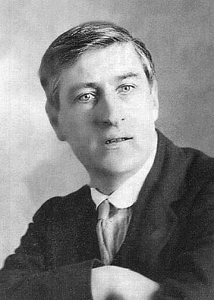
Patrick Joseph McCall, Irish songwriter and poet known mostly as the author of lyrics for popular ballads, is born at 25 Patrick Street in Dublin on March 6, 1861. He is assisted in putting the Wexford ballads, dealing with the Irish Rebellion of 1798, to music by Arthur Warren Darley using traditional Irish airs. His surname is one of the many anglicizations of the Irish surname Mac Cathmhaoil, a family that were chieftains of Kinel Farry (Clogher area) in County Tyrone.
He spends his summer holidays in Rathangan, County Wexford, where he spends time with local musicians and ballad singers. His mother came from Rathangan near Duncormick on the south coast of County Wexford. His aunt Ellen Newport provides much of the raw material for the songs and tunes meticulously recorded by her nephew. He also collects many old Irish airs but is probably best remembered for his patriotic ballads. Airs gathered at rural céilí and singsongs are delivered back to the Royal Irish Academy in Dublin.
He marries Margaret Furlong, a sister of the poet Alice Furlong, in 1901. They live in the suburb of Sutton, near Howth.
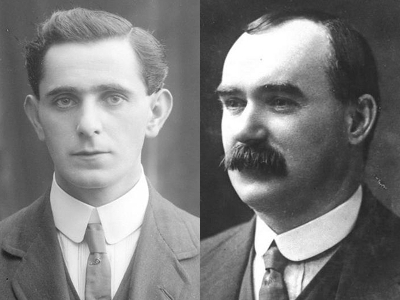
In 1902 he is elected as a Dublin City councillor, defeating James Connolly, and serves three terms. As a councillor he concerns himself with local affairs, particularly projects to alleviate poverty.
Patrick Joseph McCall dies on March 5, 1919, one day before his 58th birthday, in Sutton, Fingal, Dublin.
James (Jim) Larkin, Irish trade union leader and socialist activist, is born to Irish parents in Liverpool, England, on January 21, 1876. He and his family later move to a small cottage in Burren, County Down. Growing up in poverty, he receives little formal education and begins working in a variety of jobs while still a child.
In 1905, Larkin is one of the few foremen to take part in a strike on the Liverpool docks. He is elected to the strike committee, and although he loses his foreman’s job as a result, his performance so impresses the National Union of Dock Labourers (NUDL) that he is appointed a temporary organiser.
Larkin moves to Belfast in 1907 to organise the city’s dock workers for the NUDL. He succeeds in unionising the workforce, and as employers refuse to meet the wage demands, he calls the dockers out on strike in June. Carters and coal men soon join in, the latter settling their dispute after a month.
In 1908, Larkin moves south and organises workers in Dublin, Cork, and Waterford, with considerable success. His involvement, against union instructions, in a dispute in Dublin results in his expulsion from the NUDL. The union later prosecutes him for diverting union funds to give strike pay to Cork workers engaged in an unofficial dispute. After trial and conviction for embezzlement in 1910, he is sentenced to prison for a year. This is widely regarded as unjust, and the Lord Lieutenant of Ireland, Lord Aberdeen, pardons him after he has served three months in prison.
After his expulsion from the NUDL, Larkin founds the Irish Transport and General Workers’ Union (ITGWU) at the end of December 1908. The organisation exists today as the Services Industrial Professional & Technical Union (SIPTU). In early 1909, Larkin moves to Dublin, which becomes the main base of the ITGWU and the focus of all his future union activity in Ireland.
In early 1913, Larkin achieves some successes in industrial disputes in Dublin. Two major employers, Guinness and the Dublin United Tramway Company, are the main targets of Larkin’s organising ambitions. The chairman of the Dublin United Tramway Company, industrialist and newspaper proprietor William Martin Murphy, is determined not to allow the ITGWU to unionise his workforce. On August 15, he dismisses 40 workers he suspects of ITGWU membership, followed by another 300 over the next week. On August 26, 1913, the tramway workers officially go on strike.
The resulting industrial dispute is the most severe in Ireland’s history. Employers in Dublin engage in a sympathetic lockout of their workers when the latter refuses to sign the pledge, employing blackleg labour from Britain and from elsewhere in Ireland. Guinness, the largest employer in Dublin, refuses the employers’ call to lock out its workers but it sacks 15 workers who struck in sympathy.
For seven months the lockout affects tens of thousands of Dublin workers and employers, with Larkin portrayed as the villain by Murphy’s three main newspapers, the Irish Independent, the Sunday Independent, and the Evening Herald, and by other bourgeois publications in Ireland. The lock-out eventually concludes in early 1914 when calls by James Connolly and Larkin for a sympathetic strike in Britain are rejected by the British Trades Union Congress (TUC). Larkin’s attacks on the TUC leadership for this stance also lead to the cessation of financial aid to the ITGWU.
Some months after the lockout ends, Larkin leaves for the United States. He intends to recuperate from the strain of the lockout and raise funds for the union. Once there he becomes a member of the Socialist Party of America and is involved in the Industrial Workers of the World union (the Wobblies). He becomes an enthusiastic supporter of the Soviet Union and is expelled from the Socialist Party of America in 1919 along with numerous other sympathisers of the Bolsheviks during the Red Scare of that year.
Upon his return to Ireland in April 1923, Larkin receives a hero’s welcome and immediately sets about touring the country meeting trade union members and appealing for an end to the Irish Civil War. In September 1923, Larkin forms the Irish Worker League (IWL), which is soon afterwards recognised by the Communist International as the Irish section of the world communist movement.
James Larkin dies in his sleep on January 30, 1947, in the Meath Hospital. Fr. Aloysius Travers, OFM, who had administered last rites to James Connolly in 1916, also administers extreme unction to Larkin. His funeral mass is celebrated by the Catholic Archbishop of Dublin, John Charles McQuaid, who had visited him in hospital before he died, and thousands line the streets of the city as the hearse passes through on the way to Glasnevin Cemetery.
Saor Éire, a left-wing political organisation, is established on September 26, 1931 by communist-leaning members of the Irish Republican Army, with the backing of the IRA leadership. Notable among its founders is Peadar O’Donnell, former editor of An Phoblacht and a leading left-wing figure in the IRA. Saor Éire describes itself as “an organization of workers and working farmers.”
It is believed that the support of the then IRA chief of staff Moss (Maurice) Twomey is instrumental in the organisation’s establishment. However, Tim Pat Coogan claims that Twomey is doubtful about the organisation, worrying about involvement in electoral politics and possible communist influence.
During its short existence Saor Éire uses the republican publication An Phoblacht, under the editorship of Frank Ryan, to report on its progress and to promote its radical, left-wing republican views.
On the weekend of September 26-27, 1931, Saor Éire holds its first conference in Dublin at Iona Hall. One hundred and fifty delegates from both the Irish Free State and Northern Ireland attend the conference against a background of police raids on the houses and offices connected with Saor Éire and An Phoblacht. Seán Hayes is chairman, while David Fitzgerald acts as secretary.
The conference elects an executive of Hayes, Fitzgerald, Sean McGuinness, May Laverty, Helena Molony, Sheila Dowling, Sheila Humphreys, D. McGinley, Mick Fitzpatrick, Seán MacBride, Michael Price, Peadar O’Donnell, Mick Hallissey, M. O’Donnell, Patrick McCormack, Tom Kenny, L. Brady, Nicholas Boran, John Mulgrew and Tom Maguire. George Gilmore and Frank Ryan are also involved.
The constitution elaborates upon the aims by describing a two-phase programme. The first phase is described as being one of organisation and propagandising in order to organise a solid front for mass resistance to the oppressors. This is to build upon the day-to-day resistance and activity towards “rents, annuities, evictions, seizures, bank sales, lock-outs, strikes and wage-cuts.” This challenge, it is believed, would lead to power passing from the hands of the imperialists to the masses. The second phase is one of consolidation of power through the organisation of the economy and a workers’ and working farmers’ republic.
Ideologically Saor Éire adheres to the Irish socialist republicanism developed by James Connolly and Peadar O’Donnell. As a consequence of the heavy influence of O’Donnell, Saor Éire strongly advocates the revival of Gaelic culture and the involvement of the poorer rural working communities in any rise against the Irish capitalist institutions and British imperialism.
The organisation is attacked by the centre-right press and the Catholic Church as a dangerous communist group, and is quickly banned by the Free State government. The strength of reaction against it prevents it from becoming an effective political organisation. O’Donnell and his supporters attempt a similar initiative two years later with the establishment of the Republican Congress in 1933.
The Great Dublin Lockout, a major industrial dispute between approximately 20,000 workers and 300 employers, begins in Dublin on August 26, 1913, and lasts until January 18, 1914. It is often viewed as the most severe and significant industrial dispute in Irish history.
Irish workers live in terrible conditions in tenements. The infant mortality rate among the poor is 142 per 1,000 births, extraordinarily high for a European city. Poverty is perpetuated in Dublin by the lack of work for unskilled workers, who lack any form of representation before trade unions are founded.
James Larkin, the main protagonist on the side of the workers in the dispute, is a docker in Liverpool and a union organiser. In 1907 he is sent to Belfast as local organiser of the British-based National Union of Dock Labourers (NUDL). His tactic of the sympathetic strike is deemed highly controversial and as a result Larkin is transferred to Dublin.
Larkin sets about organising the unskilled workers of Dublin, which is a cause of concern for the NUDL, who are reluctant to engage in a full-scale industrial dispute with the powerful Dublin employers. They suspended Larkin from the NUDL in 1908. Larkin then leaves the NUDL and sets up the Irish Transport and General Workers’ Union (ITGWU), the first Irish trade union to cater for both skilled and unskilled workers.
Another important figure in the rise of an organised workers’ movement in Ireland at this time is James Connolly, an Edinburgh-born Marxist of Irish parentage. In 1911, Connolly is appointed the ITGWU’s Belfast organiser. In 1912, Connolly and Larkin form the Irish Labour Party to represent workers in the imminent Home Rule Bill debate in Parliament.
Foremost among employers opposed to trade unionism in Ireland is William Martin Murphy, Ireland’s most prominent capitalist, born in Castletownbere, County Cork. In 1913, Murphy is chairman of the Dublin United Tramway Company and owns Clery’s department store. Murphy is vehemently opposed to trade unions, which he sees as an attempt to interfere with his business. In particular, he is opposed to Larkin, whom he sees as a dangerous revolutionary.
The resulting industrial dispute is the most severe in Ireland’s history. Employers in Dublin lock out their workers and employ blackleg labour from Britain and elsewhere in Ireland. Dublin’s workers apply for help and are sent £150,000 by the British Trades Union Congress (TUC) and other sources in Ireland, doled out dutifully by the ITGWU.
The “Kiddies’ Scheme,” allowing for the starving children of Irish strikers to be temporarily looked after by British trade unionists, is blocked by the Roman Catholic Church and especially the Ancient Order of Hibernians, who claim that Catholic children will be subject to Protestant or atheist influences when in Britain. The Church supports the employers during the dispute, condemning Larkin as a socialist revolutionary.
Guinness, the largest employer and biggest exporter in Dublin, refuses to lock out its workforce. It has a policy against sympathetic strikes and expects its workers, whose conditions are far better than the norm in Ireland, not to strike in sympathy. Six who do strike are dismissed.
Strikers use mass pickets and intimidation against strike breakers, who are also violent towards strikers. The Dublin Metropolitan Policebaton charge worker’s rallies, including a rally on Sackville Street which results in two deaths and over 300 injuries. James Connolly, Larkin, and ex-British Army Captain Jack White form a worker’s militia, the Irish Citizen Army, to protect workers’ demonstrations.
For seven months, the lockout affects tens of thousands of Dublin families. The lock-out eventually concludes in January 1914, when the Trades Union Congress (TUC) in Britain rejects Larkin and Connolly’s request for a sympathetic strike. Most workers, many of whom are on the brink of starvation, go back to work and sign pledges not to join a union. The ITGWU is badly damaged by its defeat in the Lockout and is further hit by the departure of Larkin to the United States in 1914 and the execution of Connolly, one of the leaders of the Easter Rising in 1916.
Although the actions of the ITGWU are unsuccessful in achieving substantially better pay and conditions for workers, they mark a watershed in Irish labour history. The principle of union action and workers’ solidarity has been firmly established. No future employer would ever try to “break” a union in the way that Murphy attempted with the ITGWU.
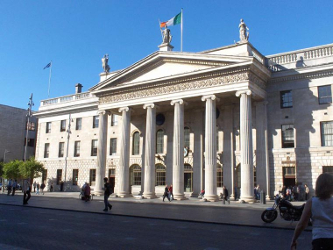
The General Post Office (GPO) is the headquarters of the Irish postal service. The offices are first located at College Green, but in August 1814, construction of a purpose-built headquarters begins. The building on Sackville Street is completed in January 1818 at a cost of £50,000.
According to An Post “The statues on the roof are of Hibernia, a classical representation in female form of the island of Ireland, with Fidelity to one side and Mercury, the messenger of the gods, to the other.”
On Monday afternoon the garrison repulses a cavalry attack while, with the breakdown of law and order, many of the stores in Sackville Street are looted. From Wednesday, the GPO and other buildings in Sackville Street come under artillery fire, mostly from the Helga gunboat at anchor in the River Liffey. Connolly believes the British will not use artillery in city areas. By Friday night the GPO is on fire, at which point it is evacuated.
At a Dublin Corporation meeting in 1884 a motion is called to change the name of Sackville Street to O’Connell Street. After forty years of argument, it is changed to O’Connell Street in May 1924.
Sheehy is educated at the Dominican Convent on Eccles Street, where she is a prize-winning pupil. She then enrolls at St. Mary’s University College, a third level college for women established by the Dominicans in 1893, to study modern French and German. She sits for examinations at Royal University of Ireland and receives a Bachelor of Arts degree in 1899, and a Master of Arts Degree with first-class honours in 1902. This leads to a career as a teacher in Eccles Street and an examiner in the Intermediate Certificate examination.
Sheehy marries Francis Skeffington in 1903, and they both take the surname Sheehy Skeffington, which they do not hyphenate but use as a double name. In 1908, they found the Irish Women’s Franchise League, a group aiming for women’s voting rights.
Sheehy-Skeffington gets into numerous scuffles with the law. She is jailed in 1912 for breaking windows of government buildings in support of suffrage as part of an IWFL campaign. That same year she also throws a hatchet at visiting British Prime Minister Herbert Asquith. She loses her teaching job in 1913 when she is arrested and imprisoned for three months after throwing stones at Dublin Castle and assaulting a police officer in a feminist action. While in jail she goes on hunger strike and is released under the Prisoner’s Temporary Discharge of Ill Health Act but is soon rearrested.
Being free from her teaching job enables Sheehy-Skeffington to devote more time to the fight for suffrage. She is influenced by James Connolly and during the 1913 lock-out works with other suffragists in Liberty Hall, providing food for the families of the strikers.
She strongly opposes participation in World War I which breaks out in August 1914 and is prevented by the British government from attending the International Congress of Women held in The Hague in April 1915. The following June her husband is imprisoned for anti-recruiting activities. He is later shot dead during the 1916 Easter Rising after having been arrested by British soldiers.
Sheehy-Skeffington refuses compensation for her husband’s death, which is offered on condition of her ceasing to speak and write about the murder. Rather, she travels to the United States to publicise the political situation in Ireland. In October 1917, she is the sole Irish representative to League for Small and Subject Nationalities where, along with several other contributors, she is accused of pro-German sympathies. She publishes British Militarism as I Have Known It, which is banned in the United Kingdom until after the World War I. Upon her return to Britain she is once again imprisoned, this time in Holloway prison. After release, Sheehy-Skeffington attends the 1918 Irish Race Convention in New York City and later supports the anti-Treaty Irish Republican Army (IRA) during the Irish Civil War.
In 1926, Sheehy-Skeffington becomes a founding member of Fianna Fáil and is elected to the party’s Ard Comhairle. During the 1930s, she is assistant editor of An Phoblacht. In January 1933, she is arrested in Newry for breaching an exclusion order banning her from Northern Ireland. At her trial she says, “I recognize no partition. I recognize it as no crime to be in my own country. I would be ashamed of my own name and my murdered husband’s name if I did…Long live the Republic!” She is sentenced to a month’s imprisonment.
Seán MacDiarmada is born in 1884 in Leitrim. He emigrates to Glasgow in 1900 and from there to Belfast in 1902. A member of the Gaelic League, he is acquainted with Bulmer Hobson. He joins the Irish Republican Brotherhood (IRB) in 1906 while still in Belfast, transferring to Dublin in 1908 where he assumes managerial responsibility for the IRB newspaper Irish Freedom in 1910. Although MacDiarmada is afflicted with polio in 1912, he is appointed as a member of the provisional committee of Irish Volunteers from 1913 and is subsequently drafted onto the military committee of the IRB in 1915. During the Rising, MacDiarmada serves in the General Post Office (GPO). Following the surrender, MacDiarmada nearly escapes execution by blending in with the large body of prisoners. He is eventually recognised by Daniel Hoey of G Division and faces a court-martial on May 9.
James Connolly is born in Edinburgh in 1868. Connolly is first introduced to Ireland as a member of the British Army. Despite returning to Scotland, the strong Irish presence in Edinburgh stimulates Connolly’s growing interest in Irish politics in the mid-1890s, leading to his emigration to Dublin in 1896 where he founds the Irish Socialist Republican Party. He spends much of the first decade of the twentieth century in America. He then returns to Ireland to campaign for worker’s rights with James Larkin. A firm believer in the perils of sectarian division, Connolly campaigns tirelessly against religious bigotry. In 1913, Connolly is one of the founders of the Irish Citizen Army. During the Easter Rising he is appointed Commandant-General of the Dublin forces, leading the group that occupies the General Post Office.
The treatment accorded to Connolly is particularly despicable. Crippled by an infected wound in the ankle, he is carried to Kilmainham Gaol, tied to a chair, and shot. As the men are loading their rifles, Connolly forgives the men of the army firing squad for their actions. Shaken by their distasteful task, a ragged volley of shots resounds from their rifles. He is the last of the leaders to be executed.
Éamonn Ceannt, one of the seven signatories of the Proclamation of the Irish Republic, is born in Ballymoe, Glenamaddy in County Galway in 1881. Prior to the Rising, Ceannt is an employee of the Dublin Corporation. He is a co-founder of the Irish Volunteers, partaking in the successful Howth gun-running operation of 1914. His involvement in republican activities is complemented by his interest in Irish culture, specifically Irish language and history, although he is also an accomplished uilleann piper. Ceannt is appointed Director of Communications of the Provisional Government and is Commandant of the Fourth Battalion of the Irish Volunteers, who are stationed at the South Dublin Union, now the site of St. James’s Hospital. Ceannt has about 100 men with him, including his second-in-command Cathal Brugha, and W.T. Cosgrave who goes on later to become Taoiseach. Ceannt and his men at the South Dublin Union take part in some of the fiercest fighting in the rebellion and hold out against far superior numbers of British troops.
Michael Mallin, a silk weaver by trade, is born in Dublin on December 1, 1874. Mallin is the Chief of Staff of the Irish Citizen Army (ICA), second in command only to James Connolly. He trains and drills the ICA and is the Commandant of the St. Stephen’s GreenRoyal College of Surgeons garrison during the Rising. Countess Markievicz is his second in command. This location sees less action than some of the other sites chosen by the rebels because the British concentrate their efforts on the most strategically important targets such as the General Post Office (GPO) and Four Courts. Mallin surrenders on April 30.
Seán Heuston, born in Dublin on February 21, 1891, is responsible for the organisation of Fianna Éireann in Limerick. Along with Con Colbert, Heuston is involved in the education of the schoolboys at Scoil Éanna, organising drill and musketry exercises. Heuston is the Officer Commanding of the Volunteers in the Mendicity Institution on the south side of Dublin. With 26 Volunteers under his command, they hold their position for two days. With his position becoming untenable against considerable numbers, and the building almost completely surrounded, Heuston sends a dispatch to Connolly informing him of their position. It is soon after sending this dispatch that Heuston decides to surrender. Heuston Railway Station in Dublin is named after him.
Con Colbert is born on October 19, 1888, at Monalena in Limerick, and is one of the younger generations of Irish republicans who take part in the Easter Rising. Prior to the Easter Rising he is an active member of the republican movement. He is one of the founding members of Fianna Éireann. A dedicated pioneer, Colbert is known not to drink or smoke. During the Rising, Colbert is the commander of a group of Volunteers stationed at Watkin’s Brewery on Ardee Street, and later at Jameson’s Distillery on Marrowbone Lane. They hold their position until receiving the order to surrender from Patrick Pearse.
The Irish Volunteers and Irish Citizen Army rebels headquartered at the General Post Office (GPO) on Sackville Street, after days of shelling, are forced to abandon their headquarters when fire caused by the shells spreads to the GPO. James Connolly, Commandant of the Dublin Brigade, has been incapacitated by a bullet wound to the ankle and has passed command on to Patrick Pearse. Michael Joseph O’Rahilly, a founding member of the Irish Volunteers, is killed in a sortie from the GPO. The rebels tunnel through the walls of the neighbouring buildings in order to evacuate the Post Office without coming under fire and take up a new position at 16 Moore Street.
On Saturday, April 29, 1916, from the new headquarters on Moore Street, after realising that they will not break out of this position without further loss of civilian life, Pearse issues an order for all companies to surrender. Pearse surrenders unconditionally to Brigadier-General William Henry Muir Lowe (photo). The surrender document reads:
“In order to prevent the further slaughter of Dublin citizens, and in the hope of saving the lives of our followers now surrounded and hopelessly outnumbered, the members of the Provisional Government present at headquarters have agreed to an unconditional surrender, and the commandants of the various districts in the City and County will order their commands to lay down arms.”
The other posts surrender only after Pearse’s surrender order, carried by nurse Elizabeth O’Farrell, reaches them. Sporadic fighting, therefore, continues into Sunday, April 30, when word of the surrender is received by the other rebel garrisons. Command of British forces has passed from Lowe to General John Maxwell, who arrives in Dublin just in time to accept the surrender. Maxwell is made temporary military governor of Ireland.
The surrender signals the end of the 1916 Easter Rising, the most significant campaign in the struggle for Irish independence since the Irish Rebellion of 1798. The Rising leaves large parts of the city decimated and results in thousands of casualties. It is also, unambiguously, a spectacular military failure. And yet it is the spark that lights the fuse on the Irish War of Independence which, within five years, forces the British government to the negotiating table to discuss the terms of Irish independence.
Martial law, which was declared in Dublin by British authorities, remains in effect in Ireland through the fall of 1916.
The 1916 Easter Rising results in at least 485 deaths, according to the Glasnevin Trust. More than 2,600 are wounded, including at least 2,200 civilians and rebels, at least 370 British soldiers, and 29 policemen. The vast majority of the Irish casualties are buried in Glasnevin Cemetery in the aftermath of the fighting. British families come to Dublin Castle in May 1916 to reclaim the bodies of British soldiers and funerals are arranged. Soldiers whose bodies are not claimed are given military funerals in Grangegorman Military Cemetery.
The Easter Rising, also known as the Easter Rebellion, begins in Dublin on April 24, 1916, and lasts for six days. The Rising, organised by seven members of the Military Council of the Irish Republican Brotherhood, is launched to end British rule in Ireland and establish an independent Irish Republic while the United Kingdom is heavily engaged in World War I. It is the most significant uprising in Ireland since the Irish Rebellion of 1798, and the first armed action of the Irish revolutionary period.
Shortly before midday, members of the Irish Volunteers, led by schoolmaster and Irish language activist Patrick Pearse and joined by the smaller Irish Citizen Army of James Connolly and 200 women of Cumann na mBan, seize key locations in Dublin and proclaim an Irish Republic. The rebels’ plan is to hold Dublin city centre, a large, oval-shaped area bounded by the Grand Canal to the south and the Royal Canal to the north, with the River Liffey running through the middle.
The British Army brings in thousands of reinforcements as well as artillery and a gunboat. There is fierce street fighting on the routes into the city centre, where the rebels put up stiff resistance, slowing the British advance and inflicting heavy casualties. Elsewhere in Dublin, the fighting mainly consists of sniping and long-range gun battles. The main rebel positions are gradually surrounded and bombarded with artillery.
With much greater numbers and heavier weapons, the British Army suppresses the Rising, and Pearse agrees to an unconditional surrender on Saturday, April 29. Almost 500 people are killed during Easter Week. About 54% are civilians, 30% are British military and police, and 16% are Irish rebels. More than 2,600 are wounded. Many of the civilians are killed as a result of the British using artillery and heavy machine guns, or mistaking civilians for rebels. Others are caught in the crossfire in a crowded city. The shelling and the fires leave parts of inner-city Dublin in ruins.
After the surrender the country remains under martial law. About 3,500 people are taken prisoner by the British, many of whom have played no part in the Rising, with 1,800 of them being sent to internment camps or prisons in Britain. Most of the leaders of the Rising are executed following courts-martial. The Rising brings physical force republicanism back to the forefront of Irish politics, which for nearly 50 years has been dominated by constitutional nationalism. It, and the British reaction to it, leads to increased popular support for Irish independence. In December 1918, republicans, represented by the reconstituted Sinn Féin party, win a landslide victory in the general election to the British Parliament. They do not take their seats but instead convene the First Dáil and declare the independence of the Irish Republic, which ultimately leads to the Irish War of Independence.