Dowling is born on June 3, 1846, in Clonmel, County Tipperary, the only son of David Jeremiah Dowling, schoolmaster, and Margaret Dowling. His father dies when he is nine years old. He is educated in Clonmel, Waterford, and St. Munchin’s College in Corbally, Limerick, before entering the shipping office of his uncle William Downey in Waterford at the age of eighteen. He distinguishes himself in the Waterford Literary and Debating Society and contributes to local newspapers, including the Waterford Citizen and The Waterford Chronicle. In 1870, he joins the staff of The Nation and moves to Dublin. On the outbreak of the Franco–Prussian War, he edits for Alexander Martin Sullivan a war-sheet, The Daily Summary, and subsequently becomes editor and contributor successively to the humorous but short-lived Zozimus and Ireland’s Eye.
Dowling settles in London in 1874, joining the staff of the Illustrated Sporting and Dramatic News, and founds Yorick in 1876, a comic paper with cartoons by Harry Furniss which lasts six months. In 1879, he publishes the first and most successful of his many novels, The Mystery of Killard, a strange tale of a deaf-mute fisherman in County Clare, which is hailed as one of the most striking romances of the year. Though his later novels are intensely realistic, exciting, and clever, they never achieve the same high standard. According to Furniss, who thought Dowling would be a great author, he “drifted into the quicksand of Bohemianism…He sank a wreck, with a rich cargo of genius that was never delivered to the world.” Other writers later mention his unfulfilled promise. Among his other novels of Irish interest are Sweet Inisfail (1882) and Old Corcoran’s Money (1892). A dramatisation of Below Bridge (1895) is staged on April 6, 1896, at the Novelty Theatre, London.
Dowling contributes poetry, short stories, and essays to several magazines, including Belgravia, London Society, and Saturday Journal, and is a frequent contributor to Tinsley’s Magazine, writing its leading serials (1880–82), which are later published as the novels Under St. Paul’s (1881) and The Duke’s Sweetheart (1881). His collections of essays include On Babies and Ladders (1873), which some critics believe to be his best work, Ignorant Essays (1887), Indolent Essays (1889), full of wit and original thought, and descriptive essays London Town (1880). He also edits the Poems (1891) of John Francis O’Donnell. He writes both under his own name and under various pseudonyms, including Peter Mendaciorum, Marcus Fall and Emmanuel Kink. A selection of his letters is published as Some Old Letters (Oct. – Nov. 1919) and More Old Letters (Jan. – Feb. 1920).
According to his daughter, Dowling works erratically, often continuously for several days and nights. An invalid during his later years, he composes his works on a sofa, invariably wearing a cap and with a soup-plate full of pipes beside him, which he enjoys in turn. A mild, kind, and gentle personality, he is an effective raconteur and a witty conversationalist. His cousin, Edmund Downey, who publishes many of his works, is introduced to the publishing world by Dowling. He is an applicant to the British charity for authors, the Royal Literary Fund, and leaves his family ill provided for.
Dowling dies on July 28, 1898, at his home at 2 Foulser Road, Tooting, South London, and is buried in Mortlake Cemetery, London. He is married and has three children, although his wife’s name and the date of their marriage are not known.
(From: “Dowling, Richard” by Helen Andrews, Dictionary of Irish Biography, http://www.dib.ie, October 2009)
Rice joins the Irish Volunteers in 1913 but does not take part in the 1916 Easter Rising. For a time, he shares lodgings in Rock Street, Tralee, with Austin Stack, and like Stack he is a Gaelic Athletic Association (GAA) member, playing hurling with Kenmare. At the outbreak of the Irish War of Independence (1919-1921), he becomes Officer Commanding of the 5th Battalion of the Kerry No. 2 Brigade. He also holds the post of second in command of that brigade, under Humphrey Murphy. On April 26, 1921, he attends the meeting in Kippagh, County Tipperary, that sees the establishment of the First Southern Division. After the truce, Murphy is transferred to command Kerry No. 1 Brigade, and Rice becomes commanding officer of Kerry No. 2.
Rice opposes the Anglo-Irish Treaty and leads the brigade throughout the Irish Civil War (1922-1923). When Michael Collins comes to Killarney on April 22, 1922, to speak in favour of the agreement, he is met at the train station by a group of fifty men, led by Rice, who attempt to prevent him from speaking. The meeting goes ahead despite several attempts by the group to stop it. During the civil war he leads his men into Limerick, briefly seizing Rathkeale, but for the most part they are on the defensive. In September he commands a force of seventy republicans to take Kenmare. This is a rare and morale-boosting success. When the First Southern Division council meets on February 26-28, 1923, he is one of only two senior officers, among a group of eighteen, who feel that it is worth fighting on.
Shortly after the civil war, Rice marries Nora Aherne, a Cumann na mBan member; they have one son, George. After the war he continues to be active in the Irish Republican Army (IRA) and Sinn Féin. He attends IRA executive meetings in 1923 and is involved in attempts to reorganise the IRA in 1924. He is a delegate to the Sinn Féin ardfheis in 1926, opposing the proposal of Éamon de Valera that abstention be a matter of policy rather than principle. He is elected as a Sinn Féin TD for the Kerry South constituency at the 1957 Irish general election. He does not take his seat in the Dáil due to the Sinn Féin policy of abstentionism. He is one of four Sinn Féin TDs elected at the 1957 Irish general election, the others being Ruairí Ó Brádaigh, John Joe McGirl and Eighneachán Ó hAnnluain. During his time as a TD, he campaigns against the Special Powers Act, which grants the Irish state extra abilities to deal with and punish suspected members of the IRA. He is defeated at the 1961 Irish general election.
In 1966, Rice and fellow Kerry Republican John Joe Sheehy are expelled from Sinn Féin, as are many others, by the new Marxist-Leninist party leadership that had recently come into power. This move both foreshadows and fuels the split in 1969/1970 of both the IRA and Sinn Féin, which leads to the creation of the Marxist-Leninist Official IRA and the more traditional but still left-wing Provisional IRA, and in parallel Sinn Féin – The Workers’ Party and “Provisional” Sinn Féin. Rice gives his support to the Provisionals.
Rice drives an oil lorry for a time and then becomes manager of the Tralee branch of Messrs Nash, mineral-water manufacturers and bottlers. He remains in this position until his retirement in 1965. He dies on July 24, 1970, at his son’s residence in Oakview, Tralee.
Rice’s sister, Rosalie, is a member of Cumann na mBan during the 1916 Easter Rising and is arrested for sending a telegram alerting the Irish Republican Brotherhood (IRB) in the United States to the rising. His cousins Eugene and Timothy Ring are members of the IRB and are also involved with the telegram. His grandfather, Timothy Ring, was a Fenian who fought in the uprising. Two of his cousins are members of the Royal Irish Constabulary (RIC) who both help the republican side during the Irish revolutionary period.
Gray is the third son of John and Elizabeth Gray of Mount Street. He is educated at Trinity College Dublin and obtains the degree of M.D. and Master of Surgery at the University of Glasgow in 1839. Shortly before his marriage in the same year, he settles in Dublin and takes up a post at a hospital in North Cumberland Street. He is admitted as a licentiate of the Royal College of Physicians in due course.
Gray is publicly minded and contributes to periodicals and the newspaper press. In 1841, he becomes joint proprietor of the Freeman’s Journal, a nationalist paper which is then published daily and weekly. He acts as political editor of the Journal for a time, before becoming sole proprietor in 1850. As owner, he increases the newspaper’s size, reduces its price and extends its circulation.
Gray enters politics at a relatively young age and attaches himself to Daniel O’Connell‘s Repeal Association. As a Protestant Nationalist, he supports the movement for the repeal of the Acts of Union with Britain. In October 1843, he is indicted with O’Connell and others in the Court of the Queen’s Bench in Dublin on a charge of sedition and “conspiracy against the queen.” The following February, he, together with O’Connell, is condemned to nine months imprisonment, but in early September 1844 the sentence is remitted on appeal. The trial has a strong element of farce, as the hot-tempered Attorney-General for Ireland, Sir Thomas Cusack-Smith, challenges Gray’s counsel, Gerald Fitzgibbon, to a duel, for which he is sternly reprimanded by the judges. From then on Gray is careful to distance himself from the advocacy of violence in the national cause, though he is sympathetic to the Young Ireland movement without being involved in its 1848 rebellion. Through the growing influence of the Freeman’s Journal, he becomes a significant figure in Dublin municipal politics. He is also active in national politics during an otherwise quiet period of Irish politics up until 1860. With the resurgence of nationalism after the famine, he helps to organise the Tenant’s League founding conference in 1850, standing unsuccessfully as the League’s candidate for Monaghan in the 1852 United Kingdom general election.
Later Gray originates and organises the “courts of arbitration” which O’Connell endeavours to substitute for the existing legal tribunals of the country. Following O’Connell’s death, in 1862 he inaugurates an appeal for subscriptions to build a monument to O’Connell on Sackville Street (now O’Connell Street). Independent from O’Connell, he continues to take a prominent part in Irish politics and in local affairs.
In municipal politics, Gray is elected councillor in 1852 and alderman of Dublin Corporation and takes an interest in the improvement of the city. As chairman of the committee for a new water supply to Dublin, he actively promotes what becomes the “Vartry scheme.” The Vartry Reservoir scheme involves the partial redirection and damming of the River Vartry in County Wicklow, and the building of a series of water piping and filtering systems (and related public works) to carry fresh water to the city. This work is particularly important in the improvement of conditions in the city, and to public health, as it improves sanitation and helps reduce outbreaks of cholera, typhus and other diseases associated with contaminated water. On the opening of the works on June 30, 1863, he is knighted by the Earl of Carlisle, then Lord Lieutenant of Ireland. Partially in recognition of these efforts, he is later be nominated for the position of Lord Mayor of Dublin for the years 1868–69, but he declines to serve.
In national politics, the Liberal government at the time is keen to conciliate an influential representative of the moderate nationalists to support British Liberalism and who will resume O’Connell’s constitutional agitation. In an unusual alliance with the CatholicArchbishop of Dublin, Paul Cullen, a man devoted to O’Connell’s memory, Gray’s newspaper exploits this shift in government policy. It supports the archbishop’s creation, the National Association of Ireland, established in 1864 with the intention of providing a moderate alternative to the revolutionary nationalism of the Fenians. The Freeman’s Journal adopts the aims of the Association as its own: it advocates the disestablishment of the AnglicanChurch of Ireland, reform of the land laws, educational aspirations of Irish Catholicism and free denominal education.
In the 1865 United Kingdom general election Gray is elected MP for Kilkenny City as a Liberal candidate. In this capacity he campaigns successfully at Westminster and in Ireland for the reforms also advocated in his paper. His newspaper’s inquiry into the anomalous wealth of the established church amidst a predominately Catholic population contributes considerably to William Ewert Gladstone‘s Irish Church Act 1869. He helps to furnish the proof that Irish demands are not to be satisfied by anything other than by radical legislation. He fights for the provision in the new Landlord & Tenant (Ireland) Act 1870 for fixity of tenure, which Gladstone eventually concedes. The Act’s other weaknesses, however, result in its failure to resolve the “land question,” the accompanying coercion, the disappointment with Gladstone’s handling of the university question and national education, causing Gray to deflect from the Liberals and become mistrusted in Britain. In the 1874 United Kingdom general election he is re-elected as a Home Rule League MP for Kilkenny, joining its Home Rule majority in the House of Commons, and holds his seat until his death the following year.
Gray dies at Bath, Somerset, England, on April 9, 1875. His remains are returned to Ireland, and he is honoured with a public funeral at Glasnevin Cemetery. Almost immediately afterwards public subscriptions are sought for the erection in O’Connell Street, of a monument to Gray. The monument is completed in 1879 and is dedicated to the “appreciation of his many services to his country, and of the splendid supply of pure water which he secured for Dublin.” His legacy also includes his contributions to the passage of the Irish Church and Land Bills, his advocacy for tenant’s rights and his support of the Home Rule movement.
(Pictured: Statue to Sir John Gray on Dublin’s O’Connell Street, designed by Thomas Farrell and unveiled on June 24, 1879. Photo credit: Graham Hickey)
Barry returns to Bandon in early 1919. He describes in his guerilla days in Ireland a Damascus-like conversion to Irish nationalism on hearing of the Easter Rising while with the Mesopotamian expeditionary force, but he is only accepted into the IRA with considerable caution. Initially tested in intelligence and training work, in mid-1920 he takes charge of the new brigade flying column, which is used both to train officers and to stage offensive actions.
Barry adapts his military experience successfully to the demands of guerrilla warfare, becoming the most famed of column leaders during the Irish War of Independence. In his memoirs, he pours scorn on the obsession of many with military titles and orthodox procedure, complaining of a “paper army.” He stresses the need for spontaneity, initiative, and knowledge of local conditions. “The reality,” he writes, “was a group of fellows, mostly in caps and not-too-expensive clothing, wondering how to tackle their job and where they would sleep that night or get their supper.” (The Reality of the Anglo–Irish War (1974)). He well realises that the war’s character does not permit any close control from the IRA’s GHQ in Dublin, hence increasing the importance of local leaders. His tactics put strong emphasis on speed of movement and on the need to attack the enemy at his weakest point. The column’s ambush successes are small in number but among the best-remembered of the war. He admits, however, that his own and his column’s lack of experience with mines frequently weakened their offensives.
The column’s first successful ambush is at Tooreen on October 22, 1920, followed on November 28 by the dramatic ambushing of a patrol of auxiliaries at Kilmichael while travelling from their Macroom base. A column of thirty-six men, divided into three sections, kill sixteen auxiliaries, with one captured and later shot, suffering two fatalities of their own. Controversy has raged since over whether a false surrender by the British force caused the brutality of some of the deaths. Together with the Bloody Sunday killings of a week earlier in Dublin, Kilmichael has a profound effect on the British military and political establishment, with the declaration in December of martial law for much of Munster and the implementation of wide-ranging internment, together with the authorisation of official reprisals.
After a short period in hospital with a heart condition, in early 1921 Barry leads unsuccessful attacks on Kilbrittain, Innishannon, Drimoleague, and Bandon barracks. The seizure of Burgatia House, outside Rosscarbery, in early February, and the successful resistance made there to British troops, wins much publicity but has little military significance. He is a leading figure in the brutal final stage of the war in the first six months of 1921, which sees widespread shooting of suspected spies and destruction of loyalist property. By March 1921, his flying column, with 104 men, is easily the largest in Ireland, and an explosives expert, Capt. McCarthy, has joined them.
The protracted engagement between Barry’s column and encircling British forces at Crossbarry on March 19, 1921, comes at a time when large-scale sweeps are making life increasingly difficult for the IRA. It consists of a daring and courageous breakout. Crossbarry is the largest action of the war, and Barry is to regard it as even more important than Kilmichael. Soon afterwards, Rosscarbery barracks is successfully attacked by a Barry-led party, representing one of the few successful such initiatives in 1921. Isolated triumphs, however, cannot hide the fact that pressure is increasing on the column, and he becomes increasingly critical of inactive regions. He is later to say that all County Kerry does during the war is to shoot one decent police inspector at Listowel Racecourse and a colleague of his. He is strongly critical also of the lack of assistance from GHQ and of the divisionalisation policy. He visits Dublin in May, travels around with Michael Collins, and is present when two American officers demonstrate the Thompson submachine gun. He is more aware than most of his 1st Southern Division colleagues of the scarcity of arms and ammunition at the war’s end.
During the truce, Barry becomes liaison officer for Munster, riling the British by insisting on his military rank, and criticising the IRA liaison men in Dublin for being overly deferential. He joins the overwhelming majority of the Cork IRA in opposing the Anglo–Irish Treaty but plays a characteristically maverick role throughout the treaty split. His independent attitude is heightened by his dislike of Liam Lynch, the republican IRA’s Chief of Staff, and his continuing respect for Michael Collins. He shows impatience at the long-drawn-out peace initiatives. In March 1922, therefore, he advocates armed confrontation with pro-treaty units over the occupation of barracks in Limerick, and on June 18 he submits a resolution, which only narrowly fails, at the army convention, giving British troops seventy-two hours to leave Dublin.
At the beginning of the Irish Civil War, Barry is arrested entering the Four Courts disguised as a woman. He escapes from an internment camp at Gormanston in early September 1922. For the rest of the war his actions mirror its confused nature. In late October 1922, he leads successful raids on the small towns of Ballineen and Enniskean, and later on Inchigeelagh and Ballyvourney. In December his column takes Carrick-on-Suir, demonstrating the weakness of the Free State army, but his talk of advancing on the Curragh and of large-scale actions does not materialise. There is no evidence that he is acting in accordance with any coordinated plan. By February 1923, he realises that the Republican IRA cause is hopeless and he is involved with Fr. Tom Duggan in efforts to get 1st Southern Division to declare a ceasefire. He journeys to Dublin to put pressure on the intransigent Lynch in this connection, telling Lynch, “I did more fighting in one week than you did in your whole life.”
Barry avoids capture in roundups after the war, remaining on the run until 1924. Unlike many republicans, he does not turn to constitutionalism, remaining strongly militaristic. He is always an unreconstructed republican, though by no means a naive one. In 1924 he becomes attached to Cleeves Milk Co., based in Limerick and Clonmel, and from 1927 to retirement in 1965 is general superintendent with the Cork harbour commissioners. He strongly advocates preserving the independence of the IRA army executive during the republican split of 1925–27. He is instrumental in continuing the drilling of IRA members and is a strong supporter of armed opposition to the Blueshirts.
During the 1930s Barry is arrested at various times for possession of arms and seditious utterances. He promotes an attack against a Freemasons’ meeting in Cork in 1936 and gives the orders for the killing on March 4 of that year of Vice-AdmiralHenry Boyle Somerville. He is opposed to the use by Frank Ryan of IRA volunteers to support the republican cause in the Spanish Civil War and to the proposals of Seán Russell for a bombing campaign in England. To maintain the link with traditional republicanism, he is elected IRA chief of staff in 1937. His plan, however, for the seizure of Armagh city, as part of a direct northern offensive, quickly collapses due to a leak of information, and he soon resigns his position. He forcefully attacks the bombing of English cities in 1938, regarding attacks on innocent civilians as immoral and counterproductive. He enlists in the National Army on July 12, 1940, only to be demobilised a month later. In 1946, he stands as an independent candidate in a by-election in the Cork Borough constituency, finishing at the bottom of the poll. He is more comfortable the following year touring the United States on an anti-partition platform.
In 1949 his Guerilla Days in Ireland is published. It proves a best-seller and has frequently been reprinted. It is well written in a forceful and direct style, one memoir needing no assistance from a ghost writer. Age does not mellow him: lawyers and bank managers are threatened by him over matters relating to his own column, and in 1974 he publishes a fierce pamphlet, angry at perceived slights in the Irish War of Independence memoir of Liam Deasy. He does strive to achieve a public reconciliation with Collins’s memory by unveiling the memorial to Collins at Sam’s Cross in 1966. On the outbreak of the Northern Ireland crisis in the late 1960s, he takes a militant line, castigating the argument that the Six Counties can be brought into the Republic by peaceful means, and asking when had peaceful means existed there. At the memorial meeting in Carrowkennedy, County Mayo, in 1971, he claims that there is a perfect right at the opportune time to take the Six Counties by force. He remains opposed to IRA bombing of civilian targets.
Barry dies in Cork on July 2, 1980. He is buried in St. Finbarr’s Cemetery, Cork. Early in the truce of 1921 he marries Leslie Price, one of the most active of Cumann na mBan members during and after the rising. They have no children.
While Barry always remains an influential figure in republican circles, he will be remembered best as the pioneer of guerrilla warfare, the hero of Kilmichael and Crossbarry. His military flair, individualism, and ruthlessness are well suited to the 1919–21 conflict. After that, his strained relations with colleagues and his lack of flexibility reduce his importance. While his life after the revolutionary era appears anti-climactic, he retains much of his charisma. In later years, he is ever willing to remind politicians and historians how far Ireland has retreated from republican ideals. He is often prickly and autocratic yet could be generous to old colleagues of either side of the treaty split. He is arguably the most intelligent but also the most intolerant of the revolutionary leaders.
(From: “Barry, Thomas Bernadine (‘Tom’)” by M. A. Hopkinson, Dictionary of Irish Biography, http://www.dib.ie, October 2009)
Daly is born in Limerick on October 18, 1845. His father works in James Harvey & Son’s Timber Yard. At the age of sixteen, he joins his father working as a lath splitter. At eighteen he is sworn in as a member of the IRB, also known as the Fenians, and becomes fully involved in Republican activities. When he is refused absolution in confession because he admits to being a Fenian, he decides that from then on, his loyalty will no longer be to “faith and Fatherland” but to “God and Fatherland.”
On November 22, 1866, Daly and his brother Edward are arrested at their family home having been betrayed by an informer, for running a munitions factory in the Pennywell district close to their home. He is released on bail in February 1867 toughened and more dedicated by the experience.
On March 5, 1867, the ill-prepared Fenian Rising takes place. Daly takes charge of the Limerick detachment of the IRB. Limerick is one of the few areas where the Fenians are able to make some show of force, however weak. Through lack of numbers, they fail to make a significant impact on the vastly superior forces arrayed against them. Moving out of the city, he moves his men into the country and joins up with other Fenians in an attack on the Royal Irish Constabulary (RIC) barracks at Kilmallock. The attack is repelled, and Daly disperse his men.
After this Daly flees the country by stowing away first on a boat, the Hollywood, to England, and from London then on board the Cornelius Grenfel to the United States.
Life in America for working class immigrants is particularly tough and Daly’s first job on leaving the ship is digging a cellar. He then obtains work in a white lead factory and works for a while as a mason’s helper before getting a reasonably good job as a brakeman on a tram system. He is to recall these experiences in his Recollections of Fenians and Fenianism.
In 1869, Daly return to Ireland and takes up his old job in the timber yard, and also his Republican activities. He begins to help reorganise the IRB and takes part in a number of agitations to keep the IRB agenda in the public view. He becomes a leading voice in the Amnesty Association to help in the release of those Fenians still in jail.
In November 1869, a major tenants’ right meeting takes place in the city. The IRB objects to the meeting because the issue of the prisoners is not on the agenda. In what comes to be known as “The Battle of the Markets,” the IRB charges the platform and succeeds in dismantling it. Though the organisers of the meeting attempt to hold some form of gathering, Daly and the IRB refuse to relent. It is Daly’s opinion that “it was one of the greatest moral victories ever achieved.” The issue of the political prisoners is to keep him occupied for much of the 1870s. In 1876, he is again arrested for disturbing another home rule gathering, though on being brought before the court he is acquitted.
During the Land War Daly is a member of the Supreme Council of the IRB and becomes organiser for Connacht and Ulster.
In the summer of 1883, Daly moved to Birmingham, England, and settles in the home of James Egan, an old friend from Limerick and a generally inactive IRB man. E.G. Jenkinson, head of Special Branch, is informed that Daly is on his way to Britain from the United States. He has been asked by the Supreme Council to deliver the graveside oration at the funeral of Charles J. Kickham while in the United States. When he arrives, a plain-clothes detective is assigned to follow him at all times. As a result of this, Special Branch are alerted to the importance of John Torley in Glasgow, Robert Johnston in Belfast and Mark Ryan in London of the IRB.
Jenkinson uses agent provocateurs in his attempts to convict Republicans. One such recruit is a publican and local IRB man named Dan O’Neill. Both Jenkinson and a Major Nicholas Gosselin persuade O’Neill to betray Daly. O’Neill then asks Daly to deliver sealed cases to some associates in London, and on April 11, he is arrested as he is about to board the train for London, and explosives are found in the case he is carrying. The police then raid the home of James Egan where explosives are “allegedly found buried” in Egan’s garden in addition to some documents.
In Chatham prison Daly becomes friends with Tom Clarke, who would later marry his niece Kathleen and who was a leader of the 1916 Easter Rising. While in prison he claims that he is being poisoned with belladonna which causes an investigation by a commission of inquiry in 1890. It is admitted by prison officials as an error by a warder. A series of articles in the Daily Chronicle in 1894 analyse prison methods. Daly gives an interview to the Chronicle which appears on September 12, 1896.
Daly is elected three times as Mayor of Limerick City, from 1899 to 1901. He jointly finances with Patrick McCartan the IRB newspaper Irish Freedom in 1910.
Daly dies on June 30, 1916, at his home, 15 Barrington Street, Limerick. He never marries. A tall, energetic, and gregarious man, he is a simple but often effective propagandist for the separatist cause.
In 1928, Madge Daly, a niece of Daly, presents the Daly cup to William P. Clifford, the then-chairman of the Limerick GAA county board. Since then, the Daly cup is presented to the winners of the Limerick Senior Hurling Championship.
(Pictured: Irish Republican and Fenian John Daly in the ceremonial garb of the Mayor of Limerick, circa 1900)
Timothy Lyons, an Irish Republican Army (IRA) soldier also known as Aero or Aeroplane, is killed on April 18, 1923, at Clashmealcon caves, County Kerry. He fights with the Anti-Treaty side during the Irish Civil War. After a three-day siege by Irish Free State forces at Clashmealcon, County Kerry, he died after falling from a cliff onto rocks and then being shot.
Lyons is born on December 4, 1895, in Garrynagore, County Kerry, to Margaret (née Sullivan) and Timothy Lyons senior, who is listed on his birth certificate as a cottier. He is the oldest of six siblings. Prior to the Irish Civil War, he works as a labourer. He fights with the IRA’s Kilflynn Company during the Irish War of Independence. He is described as being slight, “adventurous” as a column leader and a marksman who shoots at small birds. He shoots a British officer in an ambush led by captain George O’Shea at Shannow Bridge where the Kilflynn road joins the R557, forcing a retreat. He gains the nickname “Aeroplane” or “Aero” because of the way he would suddenly appear and his last-minute escapes. Because of regular searches by Black and Tans, his father fears the family home will be burned out and asks him to leave.
After the ratification of the Anglo-Irish Treaty, Lyons fights against Irish Free State forces. At the time of his death, he is commandant. He is involved in fighting in Listowel and Limerick, is captured near Athea, gaoled in Limerick and released in late 1922 with an undertaking not to rejoin the fight. Notwithstanding this, the column continues to operate, generally around Causeway and Ballyduff.
On April 15, 1923, Lyons’s column attacks an Irish Free State raiding party in Meenoghane, north Kerry. The raiding party receives reinforcements. He and his men are eventually surrounded at nearby Clashmealcon on April 16 by Michael Hogan’s 1st Western Division. They descend the rugged, Atlantic cliffs to the caves and hide in Dumfort’s Cave. He shoots out searchlights with his Lee-Enfield rifle and two Irish Free State soldiers are shot dead from the cave. The situation is under Army Emergency Powers.
With no escape for the men hiding in the cave, troops try to blast them out by dropping mines and smoke them out with petrol-soaked turf. On April 16, James McGrath, the brother of Tom McGrath, one of Lyons’s men, is arrested and taken to the cliffs in order to enter the cave and persuade the men to surrender. On the night of April 17-18, McGrath and Patrick O’Shea, his first cousin, fall trying to scale the cliffs to escape and drown. After offering to surrender himself on the morning of the April 18, Lyons falls several metres onto rocks from a rope that is provided by National troops. He is then shot multiple times by troops from the cliff top and is not recovered.
Three of Lyons’s men who surrender, Edmond Greaney, James McEnery and British deserter-turned-republican Reginald Walter Stenning, are executed in Ballymullen Barracks by gunshot on April 25, for breaking their undertaking not to take up arms against the Irish Free State, attacking troops at Clashmealcon, burning the Civic Guard station at Ballyheigue, stripping the same Civic Guards and robbing the post office at Ballyduff.
Lyons’s decomposing body, minus a leg, is washed up on May 5, identifiable by a boot. He is buried alongside George O’Shea and Timothy Tuomey, both killed at Ballyseedy, in the republican plot at Kilflynn Church (now St. Columba’s Heritage Centre).
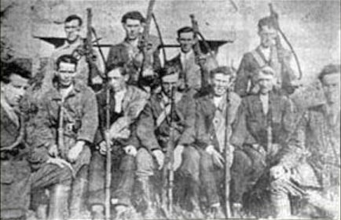
(Pictured: Kilflynn IRA Flying Column, 1922. Back (L to R): Denis O’Connell (Lixnaw), Stephen Fuller (Kilflynn), William Hartnett (Mountcoal), Tim Twomey (Kilflynn). Front (L to R): Terry Brosnan (Lixnaw), John McElligott (Leam, Kilflynn), Danny O’Shea (Kilflynn), Timothy (Aero) Lyons (Garrynagore), Tim Sheehy (Lyre), Pete Sullivan (Ballyduff), Paddy Mahony (Ballyegan, Battalion O.C.).)
Eamonn Casey, Irish Catholicprelate who serves as bishop of Galway and Kilmacduagh from 1976 until his resignation 1992, returns to Ireland on February 5, 2006, following fourteen years in exile. He fled Ireland after he admitted to fathering his son, Peter.
Casey holds this position until 1976, when he is appointed Bishop of Galway and Kilmacduagh and apostolic administrator of Kilfenora. While in Galway, he is seen as a progressive. It is a significant change in a diocese that had been led for nearly forty years by the very conservative Michael Browne, bishop from 1937 to 1976. He is highly influential in the Irish Catholic hierarchy and a friend and colleague of another highly prominent Irish priest, Father Michael Cleary.
In 1992 it is reported that, despite the vow of chastity undertaken by Catholic clergy, Casey has a sexual relationship in the early 1970s with American woman Annie Murphy. When Murphy becomes pregnant, he is determined that the child should be given up for adoption in order to avoid any scandal for himself or the Catholic church. By contrast, Murphy is determined to accept responsibility for her child, and she returns to the United States with their son, Peter, who is born in 1974 in Dublin. He makes covert payments for the boy’s maintenance, fraudulently made from diocesan funds and channeled through intermediaries. In order to continue the cover up of his affair with Murphy and his fraudulent activities, he refuses to develop a relationship with his son, or acknowledge him. Murphy is very disappointed by this, and in the early 1990s contacts The Irish Times to tell the truth about Casey’s hypocrisy and deception. Having been exposed, he reluctantly admits that he had “sinned” and wronged the boy, his mother and “God, his church and the clergy and people of the dioceses of Galway and Kerry,” and his embezzlement of church funds. He is forced to resign as bishop and flees the country under a cloud of scandal. He is succeeded by his secretary, James McLoughlin, who serves in the post until his own retirement on July 3, 2005.
Murphy publishes a book, Forbidden Fruit, in 1993 revealing the truth of their relationship and the son she bore by Casey, exposing the institutional level of hypocrisy, moral corruption and misogyny within the Irish Catholic Church.
Casey is ordered by the Vatican to leave Ireland and become a missionary alongside members of the Missionary Society of St. James in a rural parish in Ecuador, whose language, Spanish, he does not speak. During this time, he travels long distances to reach the widely scattered members of his parish but does not travel to meet his own son. After his missionary position is completed, he takes a position in the parish of St. Pauls, Haywards Heath, West Sussex, England.
In 2005, Casey is investigated in conjunction with the sexual abuse scandal in Galway, Kilmacduagh and Kilfenora diocese, and cleared of any wrongdoing. In 2019, it emerges that he had faced at least three accusations of sexual abuse before his death, with two High Court cases being settled. The Kerry diocese confirms that it had received allegations against him, that Gardaí and health authorities had been informed and that the person concerned was offered support by the diocese.
Casey returns to Ireland on February 5, 2006, with his reputation in tatters, and is not permitted to say Mass in public.
In August 2011, Casey, in poor health, is admitted to a nursing home in County Clare. He dies on March 13, 2017, a month before his 90th birthday. He is interred in Galway cathedral’s crypt.
Casey is the subject of Martin Egan’s song “Casey,” sung by Christy Moore. He is also the subject of The Saw Doctors‘ song “Howya Julia.”
In 1968, O’Malley enters politics upon the sudden death of his uncle Donogh who, at that the time, is the sitting Minister for Education. He is chosen after Donogh’s widow, Hilda, still in shock at the sudden death of her husband, turns down the opportunity to contest the by-election necessitated by his death.
O’Malley is subsequently elected as a Fianna Fáil TD for the Limerick East constituency in the by-election. Perhaps the first sign of the defiance that would define his career materialises during the 1969 Irish general election when Hilda asks her nephew to step aside and allow her to contest in the Limerick East constituency as the main Fianna Fáil candidate. He refuses and places third in the four-seat constituency, with his aunt, running as an independent, coming in fifth.
Following the general election, O’Malley is appointed Parliamentary Secretary to both Minister for DefenceJim Gibbons and TaoiseachJack Lynch and serves as Government Chief Whip. In his role as a confidante of Lynch, the political lines within Fianna Fáil that put him on a collision course of over twenty years with Charles Haughey, are drawn. He plays a central role in the Arms Crisis prosecutions of Haughey and Neil Blaney in 1970. After their acquittals, the stage is set within Fianna Fáil for a long-term power struggle that eventually results in O’Malley’s expulsion from the party in 1984.
In the meantime, O’Malley’s next position within Lynch’s government comes when he is made Minister for Justice after Mícheál Ó Móráin is forced to resign due to ill-health. One of the most significant aspects of his legacy transpires during his tenure as Minister for Justice from 1970 to 1973. In response to the ongoing conflict in Northern Ireland, he tries and fails to introduce internment without trial for republicans within the State. He is, however, successful in reintroducing the Offences Against the State Act, which enables convictions for Irish Republican Amy (IRA) membership on the word of a Garda Superintendent, and the Special Criminal Court, a non-jury court presided over by three judges which tries cases of terrorism and serious organised crime.
In 1982, after Fianna Fáil loses its majority but stays in government by virtue of a confidence and supply agreement with Sinn Féin – The Workers Party and two independents, O’Malley is appointed Minister for Trade, Commerce and Tourism, but with the death of Colley and the loss of O’Donoghue’s seat, he becomes increasingly isolated within Fianna Fáil.
After the party whip is removed from him in 1984, amidst inter-party wrangling over the New Ireland Forum, O’Malley is expelled from the party the following year, the final straw being his famous “I stand by the Republic” speech in which he announces his intention to abstain on a vote regarding the liberalisation of the sales of contraceptives, which Fianna Fáil opposes.
O’Malley’s animus for Haughey does not stop him from entering coalition with Fianna Fáil after the 1989 Irish general election, with him once again appointed Minister for Industry and Commerce. While in government, he finally witnesses the downfall of Haughey in 1992, when he is forced to resign over the emergence of new evidence concerning his tapping of journalists’ phones in the 1980s. The coalition with Fianna Fáil does not last long under new Taoiseach Albert Reynolds, with the Government collapsing after Reynolds accuses O’Malley of dishonesty during the Beef Tribunal.
O’Malley retires as leader of the Progressive Democrats in 1993, and the party moves into opposition, only to re-enter government with Fianna Fáil in 1997, where it remains upon O’Malley’s retirement from politics in 2002.
While the Progressive Democrats no longer exist, they are generally credited with the breaking up of the Fianna Fáil versus Fine Gael dichotomy of Irish politics that had dominated since the founding of the Free State. Since 1922, Irish governments have tended to be either single-party Fianna Fáil cabinets, be they minority or majority, or Fine Gael-led coalitions, typically involving the Labour Party. A Fine Gael-Labour coalition is in power at the time of the founding of the Progressive Democrats, and a single-party government or clear majority has not been won in Ireland since.
O’Malley dies in Dublin on July 21, 2021, at the age of 82, having been in poor health for some time. He is predeceased by his wife, Pat, and survived by their six children, four daughters including the former TD Fiona O’Malley, and two sons.
Perhaps O’Malley’s greatest legacy is the political reality of Ireland today: the low-tax, pro-business economic policies of the Progressive Democrats have been the dominant ideology in the State since the 1990s. Sinn Féin, the party most affected by his measures as Minister for Justice, no longer vote against the retention of the Offences Against the State Act and Special Criminal Court.
Brendan Maher, an Irish hurler who plays for club side Borris–Ileigh and previously at inter-county level with the Tipperary senior hurling team, is born on January 5, 1989, at Borrisoleigh, County Tipperary. Regarded as one of the great talents of his generation, Maher enjoys a 13-season career with the Tipperary senior hurling team, wins three All-Stars and is a Hurler of the Year nominee in 2010. He wins eight major trophies in his inter-county career, comprising three All-Ireland Championships, captaining the team in 2016, and five Munster Championships. A versatile player who switches between attacking and defensive positions, he makes a combined 124 league and championship appearances.
Maher first comes to prominence as a hurler with St. Joseph’s College in Borrisoleigh. He plays in every grade before eventually joining the senior hurling team and lines out in several Harty Cup campaigns.
Maher is added to the Munster team in advance of the 2012 Inter-Provincial Hurling Championship. He makes his first appearance for the team on February 19, 2012, when he lines out at left wing-forward in a 3–14 to 1–16 defeat by Leinster. On March 3, 2013, he lines out at midfield when Munster qualifies to play Connacht in the 2013 Inter-Provincial Hurling Championship final. He ends the game with a Railway Cup medal following the 1–22 to 0–15 victory. On December 15, 2016, he wins a second Railway Cup medal after captaining the team from midfield in a 2–20 to 2–16 defeat of Leinster in the final.
On October 19, 2011, Maher is named on the Ireland squad for the Shinty-Hurling International Series. On October 29, 2011, he lines out at centre-forward when Ireland defeats Scotland on an aggregate scoreline of 3–25 to 3–19 following a two-game series. He is selected for the Ireland team for the second time in his career on October 22, 2013. He claims a second winners’ medal from right wing-forward following Ireland’s 5–27 to 2–26 aggregate defeat of Scotland on November 2, 2013.
In October 2022, Maher is announced as Offaly senior hurling team performance coach under the management of Johnny Kelly.
O’Halloran is the third son of Michael O’Halloran, a prosperous farmer, and his wife Mary McDonnell. He is named after Sylvester Lloyd, the titular Catholic bishop of Killaloe (1728–39). His mother’s cousin, Sean Claragh McDonnell, teaches him much at an early age, including some Greek and Latin. He goes on to a Limerick school run by Robert Cashin, a Protestantclergyman, which is unusual at the time as the O’Hallorans are Roman Catholics during the difficult time of the Penal Laws.
O’Halloran and his brothers engage successfully in areas of life that work around the restrictions of the Penal Laws. Joseph becomes a Jesuit and holds chairs in rhetoric, philosophy and divinity at the Jesuit College at Bordeaux in France. George becomes a jeweler and in time a property-owner. O’Halloran goes to London to learn medicine at the age of 17, particularly studying the methods of Richard Mead, as well as the oculists Taylor and Hillmer. After further study at Leiden, and in Paris under the anatomist and academician Antoine Ferrein, he sets up practice as a surgeon in Limerick in early 1749.
O’Halloran writes several learned treatises on medical matters, and his fame is acknowledged by his membership of the RIA in 1787. He is a founder of the County Limerick Infirmary that starts with four beds in 1761 before moving to larger premises at St. Francis’s Abbey in 1765. The foundation stone of the original infirmary is now preserved in the Sylvester O’Halloran Post Graduate Centre at the Mid-Western Regional Hospital, Limerick.
While in France, O’Halloran is very impressed with the Académie Royale de Chirurgie, which had been founded in Paris in 1731 during the reign of Louis XV. He is subsequently instrumental in founding the Royal College of Surgeons in Ireland (RCSI), by writing its blueprint, Proposals for the Advancement of Surgery in Ireland, in 1765. In 1780, he is made an honorary member of the new Dublin Society of Surgeons and, when the RCSI receives its charter in 1784, is again elected an honorary member, equivalent to a Fellowship today.
As well as his scientific knowledge, O’Halloran’s interest in the arts begins with his collection of Gaelic poetry manuscripts and this leads on to an interest in Irish history. Given his background, he argues to validate the pre-Norman history of Ireland which had often been dismissed as a period of barbarism.
In 1789, Charlotte Brooke publishes the first English-language compendium of Irish poetry, the seminal “Reliques of Irish Poetry”, giving full due to O’Halloran for lending her his manuscript collection and for having written the essential history underlying her anthology.
In 1752, O’Halloran marries Mary Casey of Ballycasey, County Limerick, and they have four sons and a daughter. Their homes are in Change Lane and then on Merchants’ Quay. One of their sons is Major-General Sir Joseph O’Halloran, the father of Thomas Shuldham O’Halloran, after whom the Adelaide, South Australia suburb of O’Halloran Hill is named. Mary dies in 1782.
After a stroke, O’Halloran is infirm and confined to his chair for some time before his death on August 11, 1807, at his home on Limerick’s Merchant Quay. His is buried at St. Munchin’s graveyard at Killeely, which is now a suburb of Limerick.
Though politically restricted in his life by the Penal Laws, O’Halloran helps establish the county Infirmary, is elected President of the city’s Free Debating Society in 1772 and is elected to a committee in 1783 that examines the River Shannon navigation. Appropriately, a Limerick bridge over the River Shannon has been named after him.




 seamus dubhghaill