Owen is first elected to Dublin County Council in 1979 for the Malahide local electoral area. She is later elected as a Fine Gael TD for the first time in 1981, serving until the 1987 Irish general election when she loses her seat. That year she becomes a member of the executive of Trócaire, an International Non-Governmental Organisation (INGO) which is based in Ireland. She returns to Dáil Éireann following the 1989 Irish general election. In 1993, she becomes Deputy leader of Fine Gael. The following year she becomes Minister for Justice, remaining in that post until 1997. She undertakes a significant programme of criminal law reform. Among the major changes she implements is the referendum on bail in 1996, leading to the Bail Act of 1997, which allows a court to refuse bail to those charged with a serious offence where it is considered necessary to prevent them committing a serious offence. Journalist Veronica Guerin was murdered in 1996 and in its aftermath, Owen introduces the highly successful Criminal Assets Bureau to crack down on organised crime. In 2002, she becomes the first high-profile Fine Gael TD to lose her seat in Dublin North in the party’s disastrous general election result.
Owen is the patron of the Collins 22 Society, which works to keep the memory and legacy of Michael Collins in living memory. She occasionally works as an election pundit. In August 2011, it is announced she is to present the Irish version of Mastermind on TV3.
The son of a local school teacher, Noonan is raised in Loughill, County Limerick. He is educated at the local National School and St. Patrick’s Secondary School in Glin, before studying to be a primary school teacher at St. Patrick’s College, Drumcondra, Dublin. He subsequently completes a BA and H.Dip. in English and Economics at University College Dublin (UCD). He begins to work as a secondary school teacher in Dublin. He develops an interest in politics from his mother, whose family had been heavily involved in Fine Gael at the local level in Limerick, and joins the Dublin branch of the party after graduating from university.
Having been involved in the local Fine Gael organisation in Limerick since the late 1960s, Noonan first holds political office in 1974, when he is elected as a member of Limerick County Council. Having built up a local profile he contests the 1981 Irish general election for the party and secures a seat in Limerick East. Upon taking his Dáil seat, he becomes a full-time politician, giving up his teaching post and resigning his seat on Limerick County Council. Though Fine Gael forms a coalition government with the Labour Party, as a first time Teachta Dála (TD), he remains on the backbenches. He serves as a TD from 1981 to 2020.
Noonan marries Florence Knightley, a native of Castlemaine, County Kerry and a primary school teacher, in 1969. They have three sons (Tim, John and Michael) and two daughters (Orla and Deirdre). In May 2010, Noonan appears on RTÉ‘s The Frontline to talk about his wife’s battle with Alzheimer’s disease. Florence Noonan dies on February 23, 2012 of pneumonia.
Alan Martin Dukes, former Fine Gaelpolitician, is born in Drimnagh, Dublin, on April 20, 1945. He holds several senior government positions and serves as a Teachta Dála (TD) from 1981 to 2002. He is one of the few TDs to be appointed a minister on their first day in the Dáil.
The Dukes family originally comes from the north of England. His grandfather serves with the Royal Engineers in World War I and settles in County Cork and then County Kerry afterward where he works with the Post Office creating Ireland’s telephone network.
Dukes is educated by the Christian Brothers at Coláiste Mhuire, Dublin, and is offered several scholarships for third level on graduation, including one for the Irish language. His interest in the Irish language continues to this day, and he regularly appears on Irish-language television programmes.
On leaving school he attends University College Dublin (UCD), where he captains the fencing team to its first-ever Intervarsity title.
In the 1979 European Parliament election, Dukes stands as a Fine Gael candidate in the Munster constituency. He has strong support among the farming community, but the entry of T. J. Maher, a former president of the IFA, as an independent candidate hurts his chances of election. Maher tops the poll.
This minority Fine Gael–Labour Partycoalition government collapses in February 1982 on the budget but returns to power with a working majority in December 1982. Dukes is again appointed to cabinet, becoming Minister for Finance less than two years into his Dáil career.
He faces a difficult task as finance minister. Ireland is heavily in debt while unemployment and emigration are high. Many of Fine Gael’s plans are deferred while the Fine Gael–Labour Party coalition disagrees on how to solve the economic crisis. The challenge of addressing the national finances is made difficult by electoral arithmetic and a lack of support from the opposition Fianna Fáil party led by Charles Haughey. He remains in the Department of Finance until a reshuffle in February 1986 when he is appointed Minister for Justice.
This is a difficult time for the country. Haughey’s Fianna Fáil runs on promises to increase spending and government services, and attacking the cutbacks favoured by Fine Gael. However, on taking office, the new Taoiseach and his finance minister Ray MacSharry immediately draw up a set of cutbacks including a spate of ward and hospital closures. This presents a political opportunity for the opposition to attack the government.
However, while addressing a meeting of the TallaghtChamber of Commerce, Dukes announces, in what becomes known as the Tallaght Strategy that: “When the government is moving in the right direction, I will not oppose the central thrust of its policy. If it is going in the right direction, I do not believe that it should be deviated from its course, or tripped up on macro-economic issues.”
This represents a major departure in Irish politics whereby Fine Gael will vote with the minority Fianna Fáil Government if it adopts Fine Gael’s economic policies for revitalising the economy. The consequences of this statement are huge. The Haughey government is able to take severe corrective steps to restructure the economy and lay the foundations for the economic boom of the nineties. However, at a snap election in 1989, Dukes does not receive electoral credit for this approach, and the party only makes minor gains, gaining four seats. The outcome is the first-ever coalition government for Fianna Fáil, whose junior partner is the Progressive Democrats led by former Fianna Fáil TD Desmond O’Malley.
Initially, Fianna Fáil’s Brian Lenihan Snr is the favourite to win. However, after several controversies arise, relating to the brief Fianna Fáil administration of 1982, and Lenihan’s dismissal as Minister for Defence midway through the campaign, the Labour Party’s Mary Robinson emerges victorious. To many in Fine Gael, the humiliation of finishing third is too much to bear and a campaign is launched against Dukes’ leadership. He is subsequently replaced as party leader by John Bruton.
Bruton brings Dukes back to the front bench in September 1992, shortly before the November 1992 Irish general election. In February 1994, Dukes becomes involved in a failed attempt to oust Bruton as leader and subsequently resigns from the front bench. Bruton becomes Taoiseach in December 1994 and Dukes is not appointed to cabinet at the formation of the government.
In 2001, Dukes backs Michael Noonan in his successful bid to become leader of Fine Gael.
After 21 years, Dukes loses his Dáil seat at the 2002 Irish general election. This contest sees many high-profile casualties for Fine Gael, including Deputy LeaderJim Mitchell, former deputy leader Nora Owen and others. Many local commentators feel that Dukes’ loss is due to a lack of attention to local issues, as he is highly involved in European projects and has always enjoyed a national profile.
He retires from frontline politics in 2002 and is subsequently appointed Director General of the Institute of International and European Affairs. He remains active within Fine Gael and serves several terms as the party’s vice-president. From 2001 to 2011, he is President of the Alliance française in Dublin, and in June 2004, the French Government appoints him an Officer of the Legion of Honour. In April 2004, he is awarded the Commander’s Cross of the Order of Merit of the Republic of Poland.
In December 2008, Dukes is appointed by Finance Minister Brian Lenihan Jnr as a public interest director on the board of Anglo Irish Bank. The bank is subsequently nationalised, and he serves on the board until the Irish Bank Resolution Corporation (IBRC) is liquidated in 2013.
Dukes has lived in Kildare since first being elected to represent the Kildare constituency in 1981. His wife Fionnuala (née Corcoran) is a former local politician and serves as a member of Kildare County Council from 1999 until her retirement in 2009. She serves as Cathaoirleach of the council from 2006 to 2007, becoming only the second woman to hold the position in the body’s one-hundred-year history. They have two daughters.
Duggan is the son of William Duggan, a Royal Irish Constabulary (RIC) officer, and Margaret Dunne. He is a cousin of revolutionaries Thomas Burke and Christopher Burke through his mother. His parents meet when his father, a native of County Wicklow, is stationed in Longwood, County Meath, where they marry on October 19, 1874. His father is transferred to County Armagh the following year as officers cannot serve in their wife’s native county.
In 1911, Duggan is living with his parents on St. Brigid’s Road Upper in Drumcondra, Dublin. After his school education, he begins work as a law clerk. During his early years, he becomes heavily involved in politics after he qualifies as a solicitor and sets up a practice at 66 Dame Street in Dublin. He marries Evelyn Kavanagh, and they have one son.
In 1916, as a keen supporter of Irish independence, Duggan is serving in the North Dublin Union in the days approaching the 1916 Easter Rising. One of his close friends, Thomas Allen, is shot while Duggan is at the Four Courts. His efforts to get medical assistance are unsuccessful at Richmond Hospital as the British officer who responds to the call declines the message and does not allow it to go through. Eventually medical assistance is received but it is too late for Allen. In Duggan’s region, the volunteers suffer very few injuries with the most violent fighting taking place on Friday night and Saturday morning.
Duggan suffers the consequences and is subject to court-martial and then sentenced to three years penal servitude. He is interned in Maidstone, Portland and Lewes prisons. Under the general amnesty of 1917, he is released after fourteen months in prison and returns to Dublin where he goes back to studying law.
Duggan retains numerous ministerial posts in the Cumann na nGaedheal government. In 1921, he plays a role in the Irish delegation throughout the Anglo-Irish discussions, then playing a dominant role in liaising with British officials.
After the post-treaty government, Duggan is appointed the Minister for Home Affairs and shortly afterward he becomes the Parliamentary Secretary for the Executive Council and the Minister for Defence. He continues in various roles as a TD until 1933. These include Government Chief Whip from 1927 to 1932. Until 1933, he is a Cumann na nGaedheal TD for Meath. In 1933, he declines to go forward for the general election but is elected to Seanad in April 1933. He also is involved in local politics in Dún Laoghaire as the chairman of the borough council until his death in 1936.
Duggan writes papers which reflect on his engagement in the Easter Rising. In his letters, he writes about the tough times of imprisonment. He also writes about his participation in Sinn Féin and his triumph in being a candidate for the South Meath constituency. Most of his papers consist of letters to his fiancée and later wife, May Duggan, which are written while in prison. His time as a TD is also included. In one letter, which he writes on April 25, 1916, he references “the whole damn family” consisting of information as to how his volunteers and he are being “treated as princes” by the nuns in the nearby convent, receiving help from the children in the area and building barricades. In his letter, he also writes about morale among his comrades and hearing of rumours about a German who had landed in County Kerry. In the note, he states that the letter should be sent to May Duggan who is his fiancée at the time. At the end of the letter he refers to himself as “Edmund” by which he is also known.
Duggan dies suddenly at his home in Dún Laoghaire, Dublin, on June 6, 1936, at the age of 58, and is buried in Glasnevin Cemetery on the north side of Dublin.
A series of riots in Dublin on February 25, 2006, is precipitated by a proposed march down O’Connell Street of a unionist demonstration. The disturbances begin when members of the Garda Síochána attempt to disperse a group of counterdemonstrators blocking the route of the proposed march. The situation escalates as local youths join forces with the counterdemonstrators.
The march of this group in Dublin is viewed as provocative by some Irish nationalists and many Irish republicans, particularly in the context of an Orange Order march. The Orange Order is accused of being a sectarian organisation known for its anti-Catholicism. The right to march is supported by the main Irish political parties and the march is authorised by the Garda Síochána. Love Ulster had organised a similar rally in Belfast in October 2005.
At previous FAIR rallies, a picture of an Ulster Volunteer Force (UVF) member who was allegedly involved in the murder of 26 people in Dublin in the 1974 Dublin and Monaghan bombings, and who was himself killed by the Provisional Irish Republican Army in 1976, had been displayed. An organiser of the Love Ulster demonstration tells a republican newspaper that he cannot guarantee that images of the murder suspect will not be displayed during the demonstration.
Sinn Féin, an Irish republican political party, does not organise a protest and says that the march should be allowed to go ahead, calling for republicans to ignore the march. Republican Sinn Féin, a splinter political party no longer affiliated with Sinn Féin, has an organised presence.
Their protest blocks the northeastern junction of O’Connell Street and Parnell Street. The small Republican Sinn Féin group (and some activists from the Irish Republican Socialist Party) are joined by several hundred local youths. Before the violence breaks out, they chant republican chants. Several thousand bystanders are also on the scene but take no part in the subsequent rioting. When the marchers form up at the top of Parnell Square and their bands begin to play in anticipation of the start of the march, gardaí attempt to disperse the protest at around 12:45 p.m. At this point, scuffles break out between protesters and Gardaí.
After the failure of the initial garda effort to disperse the protesters, the violence escalates. The Garda Public Order Unit is deployed, and stones and metal railings are thrown at gardaí by protesters, as are fireworks, bricks, crude petrol bombs, and other missiles. As the rioting continues, the ranks of the rioters are swelled by many local teenagers who had not taken part in the initial protest. Several barricades are constructed from building materials on the street to impede the march and the Gardaí. The march is due to start at 12:30 p.m., but as the violence goes on the gardaí decide against trying to escort the marchers through O’Connell Street. At about 1:30 p.m. the assembled marchers return to the coaches that had brought them to Dublin from Northern Ireland. The three coaches are then driven to Leinster House, where a small parade is carried out, and a letter is handed to Irish Minister for Justice, Michael McDowell. They are then escorted out of the city. One of the coaches is attacked by stone throwers on the way home.
Violence continues sporadically on O’Connell Street for another hour or so. The Gardaí, advancing from the northern end of the street gradually push the rioters back southward. The most sustained violence takes place around the General Post Office building, where the rioters initially sit down in protest and then, after several of them have been batoned, regroup behind burning barricades and throw rocks, paving slabs and one or possibly two petrol bombs at Gardaí. Several Gardaí, protesters and a number of journalists from RTÉ and TV3 are injured.
While the standoff on O’Connell Street is still going on, several hundred rioters follow the Unionist coaches to the Nassau Street area where they set a number of cars on fire and damage several businesses. Further skirmishes break out around the River Liffey at O’Connell Bridge, Aston Quay, Fleet Street and Temple Bar, as the Gardaí retake O’Connell street, before the rioters disperse.
Having dispersed the rioters, the gardaí then closes O’Connell Street to facilitate a cleanup of the scene by building workers. Media reports estimate the cost of the cleanup job at €50,000, and Dublin Chamber of Commerce places loss of earnings for businesses in the city due to the riots at €10,000,000.
Estimates for the number of unionist marchers before the event are predicted to be over 1,000. However, only eight coach loads turn up in Dublin, indicating a far smaller number, possibly 300 to 400. Estimates for the number of counterdemonstrators vary between 300 and 7,000. The number is made much more difficult to determine by the presence of the several thousand bystanders at the scene who do not take part. Most of the rioters appear to be local youths, though some who brandished leaflets and other political literature are clearly political activists.
A total of 14 people, including six gardaí and a small number of journalists and photographers, are hospitalised as a result of the rioting. A further 41 people are arrested, according to RTÉ news. As of February 27, 2006, thirteen have been charged. Twenty-six people are convicted in January 2009 for their part in the disturbances and given sentences of up to five years. Two are described as “alcoholics.” One of them and a teenage boy are “homeless.” Three are not Irish – a Georgian, a Romanian and a Moldovan are convicted of looting shops on O’Connell Street. Two have travelled from County Offaly, one from County Galway and one from County Donegal for the riot. All the rest come from Dublin.
(Pictured: The Public Order Unit on O’Connell Street during the 2006 Dublin Riots)
Shatter is the son of Reuben and Elaine Shatter, an English couple who meet by chance when they are both on holiday in Ireland in 1947. He is educated at The High School, Dublin, Trinity College Dublin (TCD) and the Europa Institute of the University of Amsterdam. In his late teens, he works for two months in Israel on a kibbutz. He is a partner in the Dublin law firm Gallagher Shatter (1977-2011). As a solicitor he acts as advocate in many seminal and leading cases determined both by the Irish High and Supreme Courts. He is the author of one the major academic works on Irish family law which advocates substantial constitutional and family law reform.
Under Shatter’s steerage, a substantial reform agenda is implemented with nearly 30 separate pieces of legislation published, many of which are now enacted including the Personal Insolvency Act 2012, Criminal Justice Act 2011, DNA Database Act, and the Human Rights and Equality Commission Act.
Under Shatter’s guidance, major reforms are introduced in 2011 into Ireland’s citizenship laws and a new Citizenship Ceremony is created. He both devises and pilots Ireland’s first ever citizenship ceremony which takes place in June 2011 and a new inclusive citizenship oath which he includes in his reforming legislation. During his time as Minister, he clears an enormous backlog of citizenship applications, and 69,000 foreign nationals become Irish citizens. Some applications had lain dormant for 3 to 4 years. He introduces a general rule that save where there is some real complication, all properly made citizenship applications should be processed within a six-month period. He also takes steps to facilitate an increased number of political refugees being accepted into Ireland and creates a special scheme to facilitate relations of Syrian families already resident in Ireland who are either caught up in the Syrian civil war, or in refugee camps elsewhere as a result of the Syrian civil war, to join their families in Ireland.
Shatter enacts legislation before the end of July 2011 to facilitate access to financial documentation and records held by third parties in investigations into banking scandals and white-collar crime. The legislation is first used by the Gardaí in September 2011.
During Ireland’s Presidency of the Council of the European Union in 2013, Shatter chairs the Justice and Home Affairs Council (JHA) meetings and, in January 2013, in Dublin Castle, the meeting of EU Defence Ministers. Under his guidance, Ireland plays a more active role than in the past in EU defence matters and in deepening Ireland’s participation in NATO’s partnership for peace. During the Irish Presidency, substantial progress is made at the European Union level in the adoption and development of new legislation and measures across a broad range of Justice and Home Affairs issues.
Shatter implements substantial reform in the Department of Defence and restructures the Irish Defence Forces. He is a strong supporter of the Irish Defence Forces participation in international peacekeeping and humanitarian engagements and is an expert on the Middle East. As a member of the Irish Parliament and as Minister on many occasions, he visits Irish troops participating in United Nations (UN) missions in the Middle East. Under his watch contracts are signed for the acquisition of two new naval vessels with an option to purchase a third. All three naval vessels are now part of the Irish Naval Service and have been actively engaged in recent years in rescuing drowning refugees in the Mediterranean Sea attempting to enter Europe.
As Minister for Defence he enacts legislation to grant a pardon and an amnesty to members of the Irish Defence Forces who deserted during World War II to fight on the allied side against Nazi Germany and gives a state apology for their post-war treatment by the Irish State.
Shatter is the minister responsible for two amendments to the Constitution of Ireland which are passed in referendums: the Twenty-ninth Amendment in 2011 to allow for the reduction of judges’ pay, and the Thirty-third Amendment in 2013 to establish a Court of Appeal. Just prior to his resignation from government, the draft legislation to create the court is published and the court is established and sitting by October 2014.
The jurisdictions of the courts are extended for the first time in 20 years and the maximum civil damages payable for the emotional distress of bereaved relations following a negligent death is increased.
As a politician, Shatter plays a lead role in effecting much of the constitutional and legislative change he advocates. He is a former chairperson of FLAC (the Free Legal Advice Centres), a former chairperson of CARE, an organisation that campaigns for childcare and children’s legislation reform in the 1970s and a former President of the Irish Council Against Blood Sports.
Shatter is a founder member of the Irish Soviet Jewry Committee in 1970 and pioneers a successful all party Dáil motion on the plight of Soviet Jewry (1984) and visits various refuseniks in Moscow in 1985. He is a former chairperson of the Oireachtas Foreign Affairs Committee (1996-97) and initiates the creation of an Ireland/Israel Parliamentary Friendship group in 1997, leading a number of visits to Israel by members of the Dáil Éireann and Seanad Éireann.
Shatter is the author of the satirical book Family Planning Irish Style (1979), and the novel Laura (1989). In 2017 his biography, Life is a Funny Business, is published by Poolbeg Press and in 2019 Frenzy and Betrayal: The Anatomy of a Political Assassination is published by Merrion Press. In 2023, his book Cyril’s Lottery of Life, a comedic book with an English solicitor from a small town as its protagonist, is published.
Walsh is born in the townland of Rathroon, near Bandon, County Cork, on February 20, 1880. His family comes from a farming background, “working a substantial holding of medium but well-cultivated land.” Until the age of fifteen, he attends a local school in Bandon, but by his own account “as far as learning went, I may as well have been at home.” Together with his school friend P. S. O’Hegarty, he passes the Civil Service exams for the Postal service. He later works locally as a clerk in the Post Office. Like O’Hegarty, he spends three years in London at King’s College, studying for the Secretary’s Office “a syllabus (which) differed little from the Indian Civil Service.” While O’Hegarty succeeds in his studies, Walsh does not, and returns to Cork where a friend, Sir Edward Fitzgerald, arranges work for him on the Entertainments Committee of the Cork International Exhibition.
Walsh is active in the GAA, promoting Gaelic games in many areas, but particularly in Cork city and county. His interest in organised sports has a strong political dimension.
“I happened to be one of those who realised the potentialities of the GAA as a training ground for Physical Force. Contamination with the alien and all his works was taboo. I gathered around me a force of youthful enthusiasts from the University, Civil Service and Business. With this intensely organised instrument, war was declared on foreign games which were made to feel the shock so heavily that one by one, Soccer and Rugby Clubs began to disappear.”
Walsh participates in the Easter Rising in 1916 in the General Post Office (GPO). He claims he is responsible for mobilising 20 members of the Hibernian Rifles and takes them to the GPO. However, Rifles commandant John J. Scollan contradicts this account. He is promoted from Rifleman to Vice-Commandant of the Hibernian Rifles in 1915.
Walsh is arrested following the general surrender and sentenced to death after a court-martial at Richmond Barracks. This is almost immediately commuted to life imprisonment, but he is released the following year under a general amnesty.
In later 1917 Walsh is arrested and imprisoned after making a speech declaring “the only way to address John Bull is through the barrel of a rifle.”
Walsh is elected as a Sinn FéinMember of Parliament (MP) in the 1918 United Kingdom general election for the Cork City constituency. As a member of the First Dáil he is arrested for partaking in an illegal government. He is released in 1921 and supports the Anglo-Irish Treaty and goes on to become a founding member of the new political party, Cumann na nGaedheal. He serves as Postmaster General from 1922 until 1924 and joins the cabinet of W. T. Cosgrave between 1924 and 1927, after the office is reconstituted as the Department of Posts and Telegraphs. He is elected at every election for the Cork Borough constituency until 1927 when he retires from government.
In August 1922 Walsh is part of a government committee which is intended to consider what the Irish Free State’s policy towards north-east Ulster will be.
During World War II, known at the time in Ireland as “the Emergency,” Walsh’s connections with fascism, including his association with Ailtirí na hAiséirghe, bring him to the attention of the Directorate of Military Intelligence, the Intelligence branch of the Irish Army. Their request to the Minister for Justice, Gerald Boland, to place a tap on Walsh’s phone is, however, refused. He is closely associated with Irish-based pro-Nazi initiatives through his association with Ailtirí na hAiséirghe, frequently expressing his views with anti-semitic rhetoric.
After leaving politics Walsh founds a bus company which operates with great success between the city centre and south Dublin. When private bus services are bought out by the Dublin Tramway Co., he invests his profits in other Irish companies including Clondalkin Paper Mills, Solus Teoranta and Benbulben Barytes. He is also a director of Killeen and Newbrook Paper Mills, timber exporters Dinan Dowds, the Moore Clothing Co., and Fancy Goods. In 1937 he is elected president of the Federation of Irish Manufacturers, having previously held the vice-presidency. His businesses benefit greatly from the protectionist measures introduced by Fianna Fáil after 1932. Nonetheless, he complains that not enough has been done to make capital available to native entrepreneurs, and that “alien” interests are allowed too much scope to penetrate the Irish market.
In 1944 Walsh publishes a short memoir, Recollections of a Rebel. In his later years he suffers from deteriorating health, leading to his resignation from the presidency of the Federation of Irish Manufacturers in 1946. He dies in Dublin on February 3, 1948. He is buried in St. Finbarr’s Cemetery, Cork, County Cork.
On April 24, 2016, a plaque commemorating Walsh is unveiled in Kilbrittain, County Cork.
Gregory becomes involved in republican politics, joining Sinn Féin and the Irish Republican Army (IRA) in 1964. In UCD he helps found the UCD Republican Club, despite pressure from college authorities, and becomes involved with the Dublin Housing Action Committee. Within the party he is a supporter of Wicklow Republican Seamus Costello. Costello, who is a member of Wicklow County Council, emphasises involvement in local politics and is an opponent of abstentionism. Gregory sides with the Officials in the 1970 split within Sinn Féin. Despite having a promising future within the party, he resigns in 1972 citing frustration with ideological infighting in the party. Later, Costello, who had been expelled by Official Sinn Féin, approaches him and asks him to join his new party, the Irish Republican Socialist Party. He leaves the party after Costello’s assassination in 1977. He is briefly associated with the Socialist Labour Party.
Gregory contests the 1979 local elections for Dublin City Council as a “Dublin Community Independent” candidate. At the February 1982 general election, he is elected to Dáil Éireann as an Independent TD. On his election he immediately achieves national prominence through the famous “Gregory Deal,” which he negotiates with Fianna Fáil leader Charles Haughey. In return for supporting Haughey as Taoiseach, he is guaranteed a massive cash injection for his inner-city Dublin constituency, an area beset by poverty and neglect.
Although Gregory is reviled in certain quarters for effectively holding a government to ransom, his uncompromising commitment to the poor is widely admired. Fianna Fáil loses power at the November 1982 general election, and many of the promises made in the Gregory Deal are not implemented by the incoming Fine Gael–Labour Party coalition.
Gregory is involved in the 1980s in tackling Dublin’s growing drug problem. Heroin had largely been introduced to Dublin by the Dunne criminal group, based in Crumlin, in the late 1970s. In 1982 a report reveals that 10% of 15- to 24-year-olds have used heroin at least once in the north inner city. The spread of heroin use also leads to a sharp increase in petty crime. He confronts the government’s handling of the problem as well as senior Gardaí, for what he sees as their inadequate response to the problem. He co-ordinates with the Concerned Parents Against Drugs group in 1986, who protest and highlight the activities of local drug dealers and defend the group against accusations by government Ministers Michael Noonan and Barry Desmond that it is a front for the Provisional IRA. He believes that the solution to the problem is multi-faceted and works on a number of policy level efforts across policing, service co-ordination and rehabilitation of addicts. In 1995 in an article in The Irish Times, he proposes what would later become the Criminal Assets Bureau, which is set up in 1996, catalysed by the death of journalistVeronica Guerin. His role in its development is later acknowledged by then Minister for JusticeNora Owen.
Gregory also advocates for Dublin’s street traders. After attending a sit-down protest with Sinn Féin Councillor Christy Burke, and future Labour Party TD Joe Costello on Dublin’s O’Connell Street in defence of a street trader, he, Burke and four others are arrested and charged with obstruction and threatening behaviour. He spends two weeks in Mountjoy Prison after refusing to sign a bond to keep the peace.
Gregory remains a TD from 1982 and, although he never holds a government position, remains one of the country’s most recognised Dáil deputies. He always refuses to wear a tie in the Dáil chamber stating that many of his constituents could not afford them.
Gregory dies on January 2, 2009, following a long battle with cancer. Following his death, tributes pour in from politicians from every party, recognising his contribution to Dublin’s north inner city. During his funeral, politicians from the Labour Party, Fianna Fáil and Fine Gael are told that although they speak highly of Gregory following his death, during his time in the Dáil he had been excluded by many of them and that they were not to use his funeral as a “photo opportunity.” He is buried on January 7, with the Socialist Party‘s Joe Higgins delivering the graveside oration.
The Army Mutiny is an Irish Army crisis that begins on March 7, 1924, provoked by a proposed reduction in army numbers in the immediate post-Civil War period. A second grievance concerns the handling of the Northern Boundary problem. As the prelude to a coup d’état, the decisions made by influential politicians and soldiers at the time have continuing significance for the Government of Ireland.
In December 1922, following Collins’s death, Liam Tobin forms the Irish Republican Army Organisation (IRAO), taking in Dublin Guard and other Irish Army officers who share his view that “higher command…was not sufficiently patriotic.” President of the Executive Council of the Irish Free StateW. T. Cosgrave, head of the government, attempts to appease the IRAO. He meets with them several times before the 1923 Irish general election and persuades the opposing IRB faction of generals under Richard Mulcahy to keep quiet.
With the election over, Mulcahy now ignores the IRAO as he starts the process of demobilising 37,000 men. In November, sixty IRA officers mutiny and are dismissed without pay. The IRAO now pressures the Government into establishing a committee to supervise future demobilisation. The committee, consisting of Eoin MacNeill, Ernest Blythe, and IRAO sympathiser Joseph McGrath, effectively undermines the authority of the Army Council.
On March 7, 1924, a representative of the IRAO hands a demand to end demobilisation to W. T. Cosgrave. The ultimatum is signed by senior Army officers, Major-General Liam Tobin and Colonel Charles Dalton. Tobin knows his own position is to be scrapped in the demobilisation. Frank Thornton and Tom Cullen are also involved. That morning 35 men of the 36th Infantry Battalion refuse to parade, and the preceding week officers had absconded with arms from the McCan Barracks in Templemore, Gormanston Camp in County Meath, Baldonnel Aerodrome in Baldonnel, Dublin, and Roscommon. The immediate response is an order for the arrest of the two men on a charge of mutiny. This causes alarm throughout Dublin when announced.
On March 8, General Mulcahy makes an announcement to the Army:
“Two Army officers have attempted to involve the Army in a challenge to the authority of the Government. This is an outrageous departure from the spirit of the Army. It will not be tolerated…officers and men…will stand over their posts and do their duty today in this new threat of danger in the same wonderful, determined spirit that has always been the spirit of the Army.”
Leader of the Opposition, Thomas Johnson, issues a statement of support for the Government. In contrast, Minister for Industry and Commerce, Joseph McGrath, whose home Mulcahy orders to be searched, resigns because of dissatisfaction with the government’s attitude to the IRAO officers and support for their perception that the Irish Army treats former British officers better than former IRA officers. Fearing an incendiary speech by McGrath, Cosgrave first offers the IRAO an inquiry and an amnesty before then taking sick leave thus making Minister for Justice, Kevin O’Higgins, de facto head of the Government.
(Pictured: Major General Liam Tobin, a leading figure in the Army Mutiny)
Fuller is born on January 1, 1900, in Kilflynn, County Kerry. He is the son of Daniel Fuller and Ellie Quinlan. His family is from Fahavane, in the parish of Kilflynn.
Fuller serves in the Kilflynn Irish Republican Army (IRA) flying column during the Irish War of Independence. He is First Lieutenant in the Kerry No.1 Brigade, 2nd Battalion. He opposes the Anglo-Irish Treaty and continues to fight with the anti-Treaty IRA during the Irish Civil War. Military records from the 1930s show, in his own hand, that he is in communication with Dublin regarding confirmation of membership in July 1922 and therefore eligible for war pensions. He becomes the most senior Kilflynn member upon the death of Captain George O’Shea.
In 1923, Fuller is captured by Free State troops and imprisoned in Ballymullen Barracks in Tralee by the Dublin Guard who had landed in County Kerry shortly before. On March 6, 1923, five Free State soldiers are blown up by a booby-trapped bomb at Baranarigh Wood, Knocknagoshel, north Kerry, including long-standing colleagues of Major General Paddy Daly, GOC Kerry Command. Prisoners receive beatings after the killings and Daly orders that republican prisoners be used to remove mines.
On March 7, nine prisoners from Ballymullen Barracks, six from the jail and three from the workhouse, are chosen with a broad geographical provenance and no well-known connections. They are taken lying down in a lorry to Ballyseedy Cross. There they are secured by the hands and legs and to each other in a circle around a land mine. Fuller is among them. His Kilflynn parish comrade Tim Tuomey is initially stopped from praying until all prisoners are tied up. As he and other prisoners then say their prayers and goodbyes, Fuller continues to watch the retreating Dublin Guard soldiers, an act which he later says saved him. The mine is detonated, and he lands in a ditch, suffering burns and scars. He crosses the River Lee and hides in Ballyseedy woods. He is missed amongst the carnage as disabled survivors are bombed and shot dead with automatic fire. Most collected body parts are distributed between nine coffins that had been prepared. The explosions and gunfire are witnessed by Rita O’Donnell who lives nearby and who sees human remains spread about the next day. Similar reprisal killings by the Dublin Guard follow soon after Ballyseedy.
Fuller crawls away to the friendly home of the Currans nearby. They take him to the home of Charlie Daly the following day. His injuries are treated by a local doctor, Edmond Shanahan, who finds him in a dugout. He moves often in the coming months, including to the Burke and Boyle families, and stays in a dugout that had been prepared at the Herlihys for seven months.
A cover-up begins almost immediately. Paddy Daly’s communication to Dublin about returning the bodies to relatives differs significantly from Cumann na mBan statements, which Daly complains about as simple propaganda, and later that of Bill Bailey, a local who had joined the Dublin Guard, who tells Ernie O’Malley that the bodies were handed over in condemned coffins as a band played jolly music. Fuller is named amongst the dead in newspaper reports before it is realised that he had escaped. Daly then sends a communication to GHQ that Fuller is reported as having become “insane.” The Dublin Guard scours the countryside for Fuller. The official investigation into the killings is presided over by Daly himself, with Major General Eamon Price of GHQ and Colonel J. McGuinness of Kerry Command. It blames Irregulars for planting the explosives and exonerates the Irish Army soldiers, and this is read out in the Dáil by the Minister for Defence, Richard Mulcahy.
Contrary statements to the Irish Army’s submissions are effectively ignored. Lieutenant Niall Harrington of the Dublin Guard, describes the evidence to the court and the findings as “totally untrue,” explaining that the actions were devised and executed by officers of the Dublin Guard. He contacts Kevin O’Higgins, Minister for Justice and Vice-President, a family friend, to deplore the findings. O’Higgins speaks to Richard Mulcahy, who does nothing. In a separate incident, Free State Lieutenant W.McCarthy, who had been in charge of about twenty prisoners, says that five of them had been removed in the night. They were reportedly shot in the legs then blown up by, in his words, “…a Free State mine, laid by themselves.” He resigns in protest. A Garda Síochána report into the events is also dismissed and is not made public for over 80 years.
Fuller leaves the IRA after the Civil War and follows a career as a farmer in Kerry. He joins Fianna Fáil, the political party founded by Republican leader Éamon de Valera in 1926 after a split from Sinn Féin. He is elected to the 9th Dáil on his first attempt, representing Fianna Fáil at the 1937 Irish general election, as the last of three Fianna Fáil TDs to be elected to the four seat Kerry North constituency. He is re-elected to the 10th Dáil at the 1938 Irish general election, when Fianna Fáil again wins three out of four seats, but loses his seat at the 1943 Irish general election to the independent candidate Patrick Finucane. He returns to farming thereafter.
Fuller never once mentions the Ballyseedy incident from a political platform and states later that he bore no ill-will towards his captors or those who were involved in his attempted extrajudicial killing. He does not want the ill feeling passed on to the next generation. He speaks publicly about the events in 1980, a few years before his death, on Robert Kee‘s groundbreaking BBC series Ireland: A Television History.
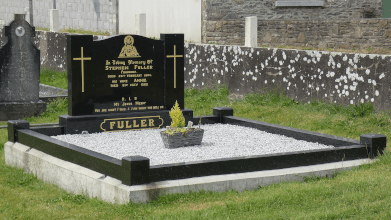
Fuller dies in Edenburn Nursing Home, Tralee, on February 23, 1984. He is buried near the Republican plot in Kilflynn where colleagues O’Shea, Tuomey and Timothy ‘Aero’ Lyons are buried.
Fuller’s son Paudie establishes the Stephen Fuller Memorial Cup for dogs of all ages, contested annually on the family farm.
Fuller’s fame largely rests on one night at Ballyseedy. To trace him through the rural society from which he and his fellow Volunteers originated and in which his life was spent, however, gives a fuller understanding of the devastating effects of the conflicts of 1916–23 on a tightly knit rural and small-town society, dominated by extended families of farmers and their service-industry relatives, and of how that society remembered and forgot those traumas.
(Pictured: Stephen Fuller’s grave in Kilflynn, by St. Columba’s Heritage Centre)





 seamus dubhghaill