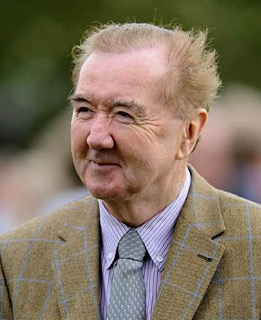
Weld is educated at Newbridge College and University College Dublin (UCD), becoming a qualified veterinarian in 1970, at the time, the youngest qualified vet in Ireland. In 2016, he is awarded UCD Alumnus of the Year in Veterinary Medicine.
Weld starts his career as an amateur jockey, obtaining a training licence in 1972. He then takes over the stable at Rosewell House, in The Curragh, from his father, Charlie Weld, who is also a successful racehorse trainer. He goes on to win the Irish Flat Training Championship eight times in 1983, 1985, 1989, 1990, 1993, 1994, 1996 and 1998.
Weld sets a new record for the most winners trained in Ireland with 2,578 in August 2000, holding the record until Willie Mullins overtakes it in May 2024. During his training career, he saddles over 4,000 winners (to 2016).
Lemass is the son of Seán Lemass, a Fianna Fáil TD and fourth Taoiseach of Ireland, and Kathleen Lemass (née Hughes). He is named after his uncle, a victim of the Irish Civil War in the early 1920s. He is educated at Catholic University School, Leeson Street in Dublin and later at Newbridge College in Newbridge, County Kildare. Against his father’s wishes, rather than attend university, he undertakes business training and later becomes an executive member and branch secretary of the Irish Commercial Travellers’ Association.
Lemass follows his father into politics in 1955, when he is elected to Dublin City Council. He is elected to Dáil Éireann in a by-election in Dublin South-West the following year. The by-election is a loss for Fine Gael, who is in government at the time, and whose TD had held the seat for a number of years.
Lemass is active in a number of political councils and other groupings. From 1966 to 1968, he is a member of the Consultative Assembly of the Council of Europe. He is also a member of the Irish-British Parliamentary Group and the Irish-French Parliamentary Group.
In 1969, Lemass is appointed as Parliamentary Secretary to the Minister for Finance, with responsibility for the Office of Public Works. In his first year at the Department, he serves under his brother-in-law, Charles Haughey, and later under George Colley.
When Fianna Fáil loses office in 1973, Lemass is named spokesperson for physical planning and the environment. He holds that position until January 1975, when he is dropped from the front bench.
Lemass’s political career, a career in which he is invariably judged in comparison to his father, is cut short when he dies suddenly in Dublin on April 13, 1976. He is buried at Dean’s Grange Cemetery, Deansgrange, County Dublin. His widow enters the Dáil following his death.
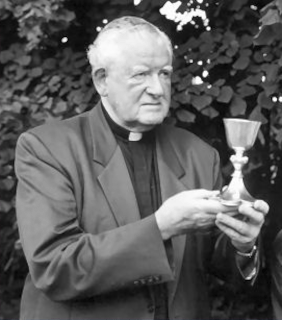
Flannery edits the Dominican bi-monthly journal entitled Doctrine and Life from 1958 to 1988, while at St. Saviour’s Priory, Dublin, where he also serves as prior from 1957 to 1960. He also edits the Religious Life Review. During and after the Second Vatican Council he makes available in English all the documents from the event.
From August 1969, Flannery is a member of the executive committee of the Northern Relief Coordination Committee, raising funds on behalf of the families of those interned without trial in Northern Ireland during the early 1970s.
Flannery embodies the post-Vatican II conception of the priest as a social catalyst engaged by the gospel, closer to his flock than to the clerical hierarchy. He has a great gift for friendship, is indefatigably interested in people, and courts religious affairs commentators and journalists at a time when the hierarchy ignores them, magnifying his influence.
Flannery dies of a heart attack on October 21, 2008, at Kiltipper Woods Care Centre, Dublin. Following a funeral mass at St. Saviour’s Priory, he is buried in the Dominican plot at Glasnevin Cemetery, Dublin, on October 24, 2008.
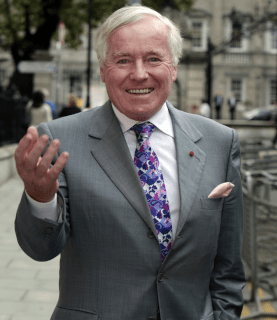
Byrne is educated at Newbridge College, County Kildare, University College Dublin (UCD) and King’s Inns, Dublin. He is called to the Bar in 1970 and practises law in the Irish and European Courts. During his student days in Dublin, he founds the Free Legal Advice Centre, a student-run organisation providing legal aid to citizens in association with the legal profession. He campaigns in favour of Irish entry into the European Community (EC) in the 1970s and has been a keen supporter of European integration ever since.
In 1997 Byrne becomes Attorney General of Ireland in the Fianna Fáil-Progressive Democratscoalition government. As one of the negotiators of the Good Friday Agreement in April 1998, he drafts and oversees the major constitutional amendments required by that agreement, which are approved by Referendum in May 1998. He also advises on the constitutional amendments necessary for Ireland’s ratification of the Treaty of Amsterdam. During his tenure, he establishes the first independent Food Safety Agency in Europe responsible to the Minister for Health.
Byrne is nominated to the European Commission by TaoiseachBertie Ahern in September 1999, serving as Ireland’s EU Commissioner and has responsibility for Health & Consumer Protection in the Prodi Commission. He continues in that role until replaced as Ireland’s Commissioner by Charlie McCreevy in 2004.
Byrne is mooted as a potential candidate for the position of Director General of the World Health Organization following the death of the incumbent, Dr Lee Jong-wook in 2006. However, he is eventually not included in the list of thirteen candidates to head the agency.
After leaving the European Commission, Byrne holds a variety of paid and unpaid positions, including Co-Chair of European Alliance for Personalised Medicine, member of the International Advisory Board of FleishmanHillard, Chairman of the Ethics Committee of the International Prevention Research Institute (IPRI), Chairman of the Advisory Committee of the National Treasury Management Agency (NTMA), of counsel of Wilmer Cutler Pickering Hale and Dorr, Honorary Co-Chair of the World Justice Project (WJP) and a member of the World Prevention Alliamce.
Flannery edits the Dominican bi-monthly journal entitled Doctrine and Life from 1958 to 1988, while at St. Saviour’s Priory, Dublin, where he also serves as prior from 1957 to 1960. He also edits the Religious Life Review. He publishes many English language documents on the Second Vatican Council.
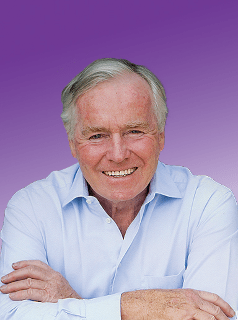
Quinn founds the national supermarket chain Superquinn (originally Quinn’s Supermarkets), of which he remains non-executive president for some years after his family sells out their interest in August 2005 for over €400 million. Superquinn is known for its focus on customer service and pioneers a number of innovations, including Ireland’s first supermarket loyalty card in 1993, SuperClub. It also introduces self-scanning of goods by customers in a number of its outlets. Superquinn becomes the first supermarket in the world to guarantee the absolute traceability of all its beef from pasture to plate, using DNA TraceBack, a system developed at Trinity College, Dublin by IdentiGEN.
Quinn becomes the chairman of the Interim Board for Posts and serves as chairman of its successor An Post (the Irish postal administration) until 1989. He also serves on several other public authorities and boards. From 1993 to 1998, he chairs the steering committee which oversees the development of the Leaving Certificate Applied. In 2006, he is appointed an Adjunct Professor in Marketing at National University of Ireland Galway. He is also chairman of Springboard Ireland.
Quinn is a former President of EuroCommerce, the Brussels-based organisation which represents the retail, wholesale and international trade sectors in Europe. He also serves on the board of directors of CIES, the Food Business Forum based in Paris, as well as the American-based Food Marketing Institute.
In 2009, Quinn works with independent shops and helps them to revamp, modernise and stave off stiff competition from multi-national retailers. It airs as RTÉ‘s six-part television series, Feargal Quinn’s Retail Therapy. A second series airs in 2011, and a third series airs in 2012. In 2011, he fronts RTÉ’s Local Heroes campaign in Drogheda, County Louth, which is an assembled team of experts to kick-start the local economy. It airs as RTÉ One‘s six-part television series, Local Heroes – A Town Fights Back.
Quinn is first elected as a senator in 1993 from the National University of Ireland constituency and is re-elected in 1997, 2002, 2007 and 2011. He is a member of the Joint Oireachtas Committee on European Affairs, the Joint Committee on Finance and Public Service and is an Oireachtas member of the National Economic and Social Forum, along with the Joint Committee on Jobs and Innovation.
Quinn is one of the co-founders and is a driving force behind Democracy Matters – a civil society group that is formed to oppose the Government’s plans to abolish Seanad Éireann. In May 2013, with Senators Katherine Zappone and Mary Ann O’Brien, he introduces the Seanad Bill 2013 to reform the system of electing the elected members of Seanad Éireann (as provided for in Article 18.10 of the Constitution of Ireland) through a one-person, one vote franchise. The Seanad Bill 2013 succeeds in being passed at Second Stage in the Seanad. During the Seanad abolition referendum campaign, the Bill demonstrates to the electorate, in a very palpable way, that reform of the Seanad is achievable if they vote for its retention. In a referendum held in October 2013 on the Abolition of Seanad Éireann, the people vote to retain the Seanad by 51.7%.
In 2014, Quinn reveals that since being first elected to Seanad Éireann, he has donated his entire salary to charity and in more recent years he has refused to accept any salary. In March 2015, he opposes the Marriage Equality bill in the Seanad, and votes ‘No’ in the referendum. He serves as Chairman of the Independent Alliance. He does not contest the 2016 Seanad election.
Quinn dies peacefully at his home in Howth, County Dublin, on April 24, 2019, following a short illness. His funeral Mass takes place at St. Fintan’s Church in Sutton, north County Dublin. In attendance is PresidentMichael D. Higgins, a representative for TaoiseachLeo Varadkar, Minister for Children Katherine Zappone, Senator Michael McDowell, and a host of other current and former politicians, business figures, and past colleagues of the “Superquinn family.” Fittingly, the coffin is carried from the church to the tune of Frank Sinatra’s “My Way.”
Cyril James Cusack, Irish actor who appears in numerous films and television productions in a career lasting more than 70 years, dies in Chiswick, London, England on October 7, 1993. In 2020, he is listed at number 14 on The Irish Times‘s list of Ireland’s greatest film actors.
Cusack is born in Durban, Natal, South Africa, on November 26, 1910. His mother, Alice Violet (née Cole), is an English Cockney actress and chorus girl, and his father, James Walter Cusack, is an Irish mounted policeman in the Colony of Natal, South Africa. His parents separate when he is young and his mother takes him to England, and then to Ireland. His mother and her partner, Brefni O’Rorke, join the O’Brien and Ireland Players.
Cusack makes his first stage performance at the age of seven. He is educated at Newbridge College in Newbridge, County Kildare, then reads law at University College Dublin. He leaves without a degree and joins the Abbey Theatre in 1932. Between then and 1945, he performs in over 60 productions, particularly excelling in the plays of Seán O’Casey. He also performs Irish playwright Teresa Deevy‘s plays Katie Roche and The King of Spain’s Daughter. In 1932 he also joins the Gate Theatre company, appearing with them in many notable productions over the years. In 1947, he forms his own company and stages productions in Dublin, Paris and New York.
In 1963, Cusack joins the Royal Shakespeare Company in London and appears there for several seasons. By this stage he has established a successful career in films, which had started at the age of eight. Also in 1963, he wins a Jacob’s Award for his performance in the Telefís Éireann production of Triptych. He receives honorary degrees in 1977 and 1980 from the National University of Ireland (NUI) and the University of Dublin respectively.
Cusack, who is bilingual in English and Irish, has a leading role in the controversial Irish language film Poitín (1977). He is also offered the role of the First Doctor in Doctor Who.
Cusack’s last stage performance is in Anton Chekhov‘s Three Sisters (1990), in which three of his daughters play the sisters.
Cusack is twice married, firstly to Mary Margaret “Maureen” Kiely (1920–1977), on April 5, 1945. Together they have five children: Paul (1946), Sinéad (1948), Sorcha (1949), Niamh (1959), and Pádraig (1962). He and his second wife, Mary Rose Cunningham (1979–1993), have one daughter, Catherine (1968).
In later life, Cusack becomes a campaigner for conservative causes in Ireland, notably in his opposition to abortion, where he becomes a frequent letter-writer to the main liberal Irish newspaper, The Irish Times. Regarding his Catholic faith, he comments “Religion promotes the divine discontent within oneself, so that one tries to make oneself a better person and draw oneself closer to God.” His religious credentials come under scrutiny following his death and the revelation that he had been unfaithful in his first marriage, with a long-term mistress, Mary Rose Cunningham. He marries Cunningham following his first wife’s death.
On October 7, 1993, Cusack dies at the age of 82 at home in Chiswick, Greater London, from amyotrophic lateral sclerosis (ALS). His acting career had lasted 75 years.
Moore’s parents are Andy Moore and Nancy Power, who had already raised three daughters and two other sons. He attends a Patrician Brothers primary school and later studies at Newbridge College, run by the Dominican Order. In college he forms the group Aes Triplex with his brother Andy and a school friend. He later attends a college in Limerick, but he drops out after a couple of years to pursue a music career.
In 1969, 14-year-old Moore embarks on a tour supporting his eldest brother, Christy Moore, at various English folk clubs. After the tour he spends all of his time practising and writing music. In 1976, Christy records one of his songs “Wave up to the Shore.” In 1977, he tours Germany and England as part of the group Inchiquin.
In 1978, Moore releases his debut album, Treaty Stone. In 1979, having normally played guitar using a finger-picking technique, he is afflicted with tendonitis and is forced to learn to play with a plectrum, which alters his guitar style. That same year, he moves to Groningen in the Netherlands. In 1980, he records and releases his second album, In Groningen. In 1982, he releases his third album, No Heroes, which contains songs all written by Moore himself. For three years, from 1983 to 1986, he is the front-man for the Dublin-based band Red Square. During this time, in 1984, his son Robbie is born.
In 1987, Moore moves to the United States and begins performing using the stage name of “Luka Bloom.” He chooses the name “Luka” from the title of Suzanne Vega‘s song about child abuse and “Bloom” from the main character in James Joyce‘s novel Ulysses. Initially he lives and performs primarily in Washington D.C., but in late 1987 he moves to New York City. The following year, he releases his first album – later withdrawn – under the name Luka Bloom.
In 1990, Bloom releases his album Riverside, which includes the song “The Man Is Alive.” The album is recorded in New York, with its lyrics reflecting his experiences living and performing in that city. In 1991, he returns to Dublin to record The Acoustic Motorbike, which includes a cover version of LL Cool J‘s “I Need Love.” The cover song is reviewed by Rolling Stone magazine, noting that “the prospect of a folksy Irish rocker covering a rap ballad may seem strange, but experimenting with different forms is precisely what keeps established traditions vital.”
In 1993, Bloom again returns to Ireland to record the album Turf, this time with producer Brian Masterson and sound engineer Paul Ashe-Browne. The album attempts to capture the sound of a live performance, and is recorded in front of an audience that is asked to remain as quiet as possible. In 1998, he releases Salty Heaven, an album inspired by his return to Ireland.
Bloom’s early albums showcase his frenetic strumming style, including “Delirious,” the debut track on Riverside, and his penchant for thoughtful cover songs, an affinity that he maintains even in more recent work. In addition to his LL Cool J cover, he also covers Elvis Presley‘s “Can’t Help Falling in Love” on the album The Acoustic Motorbike.
Released in 2000, Keeper of the Flame is an album of cover versions featuring renditions of ABBA‘s “Dancing Queen,” Bob Marley‘s “Natural Mystic,” and the Hunters & Collectors‘ “Throw Your Arms Around Me,” among others. His 2004 acoustic mini-album, Before Sleep Comes, is recorded while he is recovering from tendinitis. He states that the purpose of the album is “to help bring you closer to sleep, our sometimes elusive night-friend.”
In 2005, Bloom releases the album Innocence. Some of the songs feature a new-found interest in Eastern EuropeanRomani music and other world music. The album features him playing classical guitar, and the resonant plucking associated with that style of instrument. In his previous work, he relies almost exclusively on steel-stringed acoustic guitars that created his distinctive style. In 2007, he releases the album Tribe, a collaboration with County Clare musician Simon O’Reilly. O’Reilly composes the music and sends the recordings to Bloom for him to complete with lyrics and singing.
In February 2008, Bloom releases a DVD titled The Man is Alive, featuring footage filmed in Dublin and at his home in Kildare, a question and answer session with fans, the documentary My Name is Luka, and a CD of music taken from the two performances. In September of that year, he releases the album Eleven Songs, which features an expanded ensemble of instrumentation, giving the album a distinct sound within his catalogue.
Quinn founds the national supermarket chain Superquinn (originally Quinn’s Supermarkets), of which he remains non-executive president for some years after his family sells out their interest in August 2005 for over €400 million. Superquinn is known for its focus on customer service and pioneers a number of innovations, including Ireland’s first supermarket loyalty card in 1993, SuperClub. It also introduces self-scanning of goods by customers in a number of its outlets. Superquinn becomes the first supermarket in the world to guarantee the absolute traceability of all its beef from pasture to plate, using DNA TraceBack, a system developed at Trinity College, Dublin by IdentiGEN.
Quinn becomes the chairman of the Interim Board for Posts and serves as chairman of its successor An Post (the Irish postal administration) until 1989. He also serves on several other public authorities and boards. From 1993 to 1998, he chairs the steering committee which oversees the development of the Leaving Certificate Applied. In 2006, he is appointed an Adjunct Professor in Marketing at National University of Ireland Galway. He is also chairman of Springboard Ireland.
Quinn is a former President of EuroCommerce, the Brussels-based organisation which represents the retail, wholesale and international trade sectors in Europe. He also serves on the board of directors of CIES, the Food Business Forum based in Paris, as well as the American-based Food Marketing Institute.
In 2009, Quinn works with independent shops and helps them to revamp, modernise and stave off stiff competition from multi-national retailers. It airs as RTÉ‘s six-part television series, Feargal Quinn’s Retail Therapy. A second series airs in 2011, and a third series airs in 2012. In 2011, he fronts RTÉ’s Local Heroes campaign in Drogheda, County Louth, which is an assembled team of experts to kick-start the local economy. It airs as RTÉ One‘s six-part television series, Local Heroes – A Town Fights Back.
Quinn is first elected as a senator in 1993 from the National University of Ireland constituency and is re-elected in 1997, 2002, 2007 and 2011. He is a member of the Joint Oireachtas Committee on European Affairs, the Joint Committee on Finance and Public Service and is an Oireachtas member of the National Economic and Social Forum, along with the Joint Committee on Jobs and Innovation.
Quinn is one of the co-founders and is a driving force behind Democracy Matters – a civil society group that is formed to oppose the Government’s plans to abolish Seanad Éireann. In May 2013, with Senators Katherine Zappone and Mary Ann O’Brien, he introduces the Seanad Bill 2013 to reform the system of electing the elected members of Seanad Éireann (as provided for in Article 18.10 of the Constitution of Ireland) through a one-person, one vote franchise. The Seanad Bill 2013 succeeds in being passed at Second Stage in the Seanad. During the Seanad abolition referendum campaign, the Bill demonstrates to the electorate, in a very palpable way, that reform of the Seanad is achievable if they vote for its retention. In a referendum held in October 2013 on the Abolition of Seanad Éireann, the people vote to retain the Seanad by 51.7%.
In 2014, Quinn reveals that since being first elected to Seanad Éireann, he has donated his entire salary to charity and in more recent years he has refused to accept any salary. In March 2015, he opposes the Marriage Equality bill in the Seanad, and votes ‘No’ in the referendum. He serves as Chairman of the Independent Alliance. He does not contest the 2016 Seanad election.
Quinn dies peacefully at his home in Howth, County Dublin, on April 24, 2019, following a short illness. His funeral Mass takes place at St. Fintan’s Church in Sutton, Dublin. In attendance is PresidentMichael D. Higgins, a representative for TaoiseachLeo Varadkar, Minister for Children Katherine Zappone, Senator Michael McDowell, and a host of other current and former politicians, business figures, and past colleagues of the “Superquinn family.” Fittingly, the coffin is carried from the church to the tune of Frank Sinatra’s “My Way.”
In 1965, Lunny enrolls at Dublin‘s National College of Art & Design where he studies Basic Design and Graphic Design. He also develops an interest in metalwork leading him to become a skilled gold-and-silversmith, although he only practises the craft for a short time before devoting his energies fully to music. During his time in Dublin, he plays in a band called The Parnell Folk, with Mick Moloney, Sean Corcoran, Johnny Morrissey and Dan Maher.
When Moving Hearts breaks up in 1985, Lunny diversifies and becomes a producer. He is closely involved in the establishment of a new Irish record label, Mulligan Records (acquired in 2008 by Compass Records), and produces and plays on many of its early releases.
Lunny is the producer and music director of the soundtrack of Bringing It All Back Home, a BBC Television documentary series charting the influence of Irish music throughout the world. He produces albums for Paul Brady, Elvis Costello, Indigo Girls, Sinéad O’Connor, Clannad, Maurice Lennon, Baaba Maal, and Five Guys Named Moe. He appears on the compilation albums The Gathering (1981) and Common Ground (1996). In 1994, he produces Irish Australian singer/songwriter Mairéid Sullivan’s first recording, Dancer.
Lunny pushes new boundaries with his band Coolfin (1998) which includes uilleann piper John McSherry. He appears at the 2000 Cambridge Folk Festival, and the album that commemorates it. In 2001 he collaborates with Frank Harte on the album My Name is Napoleon Bonaparte. He produces the album Human Child (2007) by FaeroeseEivør Pálsdóttir, which is published in two versions, one English and one Faeroese.
As an arranger, Lunny works for The Waterboys, Fairground Attraction and Eddi Reader. Journey (2000) is a retrospective album. During 2003–2005, he is part of the reunited Planxty concert tour. He also produces Jimmy MacCarthy‘s album entitled Hey-Ho Believe, which is released on November 12, 2010.
Lunny is the brother of musician and producer Manus Lunny. He has a son, Shane, whose mother is singer Sinéad O’Connor.
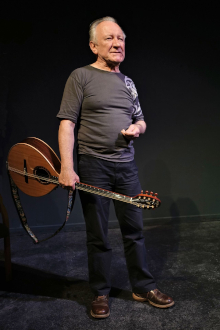
(Pictured: Dónal Lunny at the Craiceann Bodhrán Festival 2016, Inis Oirr)





 seamus dubhghaill