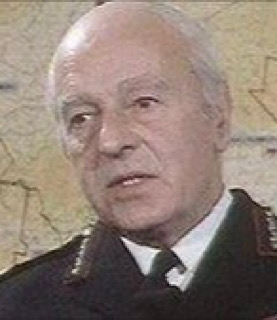
Shillington originally plans to join the Northern Ireland Civil Service, however he wants a more varied career. He joins the Royal Ulster Constabulary on February 8, 1933, as a cadet officer. He completes his training at the Newtownards depot in County Down. He is promoted to district inspector in 1935, and serves as officer in charge of D District in Belfast. In 1944, he is promoted to 1st Class District Inspector and is posted to Derry, County Londonderry.
In 1953, after nine years in Derry, Shillington is promoted to County Inspector and returns to Belfast. There, he joins the Inspector General’s Headquarters and serves in an administrative post. On January 16, 1961, he is appointed Commissioner of Belfast City.
In 1969, Shillington is appointed Deputy Inspector-General of the RUC, as second-in-command to the Inspector-General, Anthony Peacocke, who, like Shillington, had been educated at Sedbergh and Cambridge. When the Battle of the Bogside breaks out in Derry in August 1969, he requests permission to use CS gas for the first time in the United Kingdom. When that does not halt the rioting, he requests that the British Army be brought in. He telephones Peacocke on August 13 in order to persuade him of this. Peacocke, who has long denied the need for army involvement, eventually agrees, but his reputation never recovers and following the publication of the Hunt Report in October he resigns as Inspector-General.
Shortly thereafter, Sir Arthur Young is seconded from the City of London Police to be the last Inspector-General and the first Chief Constable of the RUC. James Callaghan, then Home Secretary, sends him to implement the Hunt Report. Young’s measures introduce the standard British rank system for police officers in Northern Ireland and disbands the Ulster Special Constabulary (USC). Shillington remains as Young’s deputy, and when the latter returns to the mainland in 1970 he succeeds him to become the RUC’s second Chief Constable.
Shillington marries Mary (Peggy) Bulloch in 1935. They have two sons and a daughter. He dies on August 14, 2001, at the age of 90, in a County Armagh nursing home.
Bracken is the third child and second of three sons of Joseph Kevin (J. K.) Bracken and Hannah Bracken (née Ryan). The family moves to Kilmallock, County Limerick, in 1903, the year before his father’s death. By 1908, his mother takes the family to live in Glasnevin, a new suburb in north Dublin, and subsequently off the North Circular Road. He is educated in St. Patrick’s National School, Drumcondra, and at the Christian Brothers‘ O’Connell School in North Richmond Street. He is a mischievous, delinquent child, one time throwing a schoolfellow into the Royal Canal. In February 1915 he is sent to Mungret College, a Jesuit boarding school near Limerick. He is not amenable to the regime and runs away on several occasions, finding accommodation in local hotels under a false name.
At the end of 1915 Bracken goes to Australia with £14 in his pocket. He is first based in Echuca, Victoria, where he is put up in a convent. Later he moves to other houses run by religious orders. A voracious reader, he claims that he is doing research for a life of CardinalPatrick Francis Moran, and signs himself “Brendan Newman Bracken.” He seeks admission as a pupil to Riverview, the fashionable Jesuit school in Sydney, claiming that he had been educated at Clongowes Wood College. Unfortunately for him, a priest who had just come out from Clongowes exposes him. Opinionated and argumentative, he does not conceal his skepticism about the Catholic religion. For a time, he teaches in a Protestant school in Orange, New South Wales.
Bracken returns to Ireland in 1919. By this time his mother has remarried and is living with her new husband, Patrick Laffan, on a farm in Beauparc, County Meath. After a short stay there, he moves to Liverpool and finds employment as a teacher at the Liverpool Collegiate School, claiming that he had been to the University of Sydney. He teaches at the school for two terms in 1920, earning extra money as tutor to a young boy. With his savings he is able to gain admission to Sedbergh School, a public school in the town of Sedbergh in Cumbria, North West England, giving his name as Brendan Rendall Bracken, born 1904, and stating that his parents had perished in a bush fire in Australia, leaving him money to complete his education. He remains only one term but distinguishes himself by winning a prize for history. After Sedbergh, Bracken teaches at Rottingdean preparatory school and then at Bishops Stortford School. He cuts a flamboyant figure and drops the name of famous acquaintances with gay abandon. He stands over 6 feet and has a powerful presence and a domineering personality; his mop of red hair and pale freckled skin combine with black teeth to give him a bizarre appearance.
In 1922 Bracken moves to London. He takes charge of the Illustrated Review when its editor, Hilaire Belloc, resigns. Renamed English Life and covering political and social events, it affords Bracken an opportunity to meet prominent people, including J. L. Garvin, editor of The Observer. In autumn 1923 Garvin introduces him to Winston Churchill, who had lost his parliamentary seat in 1922 and decided to contact Leicester West in the 1923 United Kingdom general election. Bracken offers his services as campaign manager. The friendship between Churchill and Bracken is soon so close that Bracken is rumoured to be Churchill’s natural son. Churchill’s wife Clementine dislikes Bracken and discourages the friendship.
Meanwhile Bracken enjoys the life of a ubiquitous socialite and builds up his career in publishing. He becomes a director of Eyre & Spottiswoode in 1926, starting The Banker, a monthly magazine, for them, and acquiring the Financial News in 1928 and a half-share in The Economist. To these are added in due course the Investors Chronicle and The Practitioner. His success in business enables him to acquire a home in North Street in 1928, near the Houses of Parliament. He is driven about in a chauffeured Hispano-Suiza car.
In 1929, Bracken has himself adopted as conservative candidate for Paddington North, a marginal seat. After a hard-fought campaign characterised by minor violence provoked by Bracken’s intemperate language, he wins the seat by 528 votes. At one point a rumour is put about that Bracken is in reality a Polish Jew, which he has to disprove by exhibiting a copy of his birth certificate. His background is a subject of speculation among acquaintances, and in throwaway remarks he gives different fictitious versions of it, Ireland figuring in none of them. He does however remain in constant touch with his mother, to whom he seems to have been deeply devoted, until her death in 1928. However, he has as little contact as possible with his brother and sisters, although he does give assistance to some of them and their families at various times.
In parliament Bracken voices right-wing views on economic issues and is an enthusiastic imperialist. After Churchill resigns from the conservative front bench in 1930 because they would not oppose the Labour government’s proposal for Indian self-government, he is supported by Bracken. During the 1930s, when Churchill is in the wilderness, disagreeing with the party leadership on India and on what he sees as a policy of appeasement toward Hitler‘s Germany, Bracken is his sole political ally. Stanley Baldwin calls him Churchill’s “faithful chela.”
In September 1939, Churchill joins Neville Chamberlain‘s war cabinet as First Lord of the Admiralty. Bracken is appointed his parliamentary private secretary, continuing in that role when Churchill becomes Prime Minister. Despite the king’s opposition, Churchill insists in June 1940 that Bracken should be appointed a privy councillor. Bracken shuts up his house and moves to the Prime Minister’s residence for the duration of the war. As a confidant of the Prime Minister, he often acts as a go-between with other politicians and newspapermen. He is allowed to oversee patronage and takes a special interest in ecclesiastical appointments. In July 1941, he is persuaded by Lord Beaverbrook and Churchill to become Minister for Information. He wins over most of the proprietors by giving them more news, often on a confidential basis, and censorship is kept to a minimum. The BBC is also allowed a fair measure of freedom as long as it behaves responsibly; under the leadership of Cyril Radcliffe, the civil service head of the ministry, it operates more smoothly. Bracken was generally acclaimed for that success.
After the resignation of the Labour ministers from the government at the end of the war in Europe, Bracken joins the cabinet as First Lord of the Admiralty. He is prominent in the general election campaign that follows and is the only conservative minister apart from Churchill to give more than one radio broadcast. He is accused, probably unjustly, of provoking Churchill to take extreme positions, and blamed when the conservatives are heavily defeated at the polls. Bracken himself loses Paddington North to Lt. Gen. Sir Noel Mason-MacFarlane. However, he is soon back in parliament representing Bournemouth, and as front-bench spokesman is an uncompromising opponent of the nationalisation measures of the Labour government (1945–51). He is out of sympathy with the leftward drift of the conservative party associated with Rab Butler and Harold Macmillan.
In December 1951, when Churchill is again Prime Minister, Bracken declines an invitation to serve as Colonial Secretary, pleading that his recurring sinusitis makes it impossible. He resigns his seat in the House of Commons and is created a peer, Viscount Bracken of Christchurch in Hampshire, but never takes his seat in the House of Lords. Although he retires from politics, he remains close to political events through his friendship with Churchill. He is deeply involved in concealing the severe stroke that Churchill suffers in 1953, so that he can carry on as Prime Minister.
In the postwar period, Bracken has important business interests. The Financial News group acquires the Financial Times in 1945, and he is returned as chairman of the expanded company. He writes a weekly Financial Times column until 1954. He oversees the building near St. Paul’s of a new head office, named “Bracken House” after his death. He is also chairman of the Union Corporation mining house, with interests in South Africa, which he frequently visits. From 1950 he is chairman of the board of governors of Sedbergh School, where he goes frequently and often walks for miles across the fells. He organises and finances the restoration of the eighteenth-century school building as a library, with a commemoratory inscription, “Remember Winston Churchill.”
From 1955 Bracken is a trustee of the National Gallery. He is an unrelenting opponent of the proposal to return to Ireland the impressionist paintings bequeathed to it by Hugh Lane, because a codicil willing them to Dublin has not been witnessed. Throughout the postwar period he carries on a prolific correspondence with friends such as Lord Beaverbrook, the American ambassador Lewis Douglas, and the Australian entrepreneur W. S. Robinson. These are a valuable and entertaining source on the political history of the time.
In January 1958, Bracken, who has always been a heavy smoker, is diagnosed with throat cancer. He lingers on until August 8, 1958, when he dies at the flat of his friend Sir Patrick Hennessy in Park Lane. He resists efforts made to reconcile him to the church of Rome. By his own wish he is cremated, and his ashes are scattered on Romney Marsh, Kent. On his instructions his papers are burned by his chauffeur. His estate comes to £145,032.
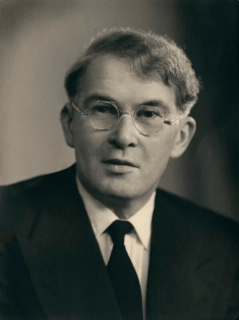
(From: “Bracken, Brendan” by Charles Lysaght, Dictionary of Irish Biography, www. dib.ie, October 2009 | Pictured: Brendan Bracken, bromide print by Elliott & Fry, January 13, 1950, National Portrait Gallery, London)
McGurk first joins RTÉ in 1972, as a news reporter, moving on to present Last House and First House on television. In 1972 he wins a Jacob’s Award for his RTÉ Radio documentaries on Ireland’s islands. For 20 years he is the presenter of RTÉ Sport‘s rugby coverage, most notable of the Six Nations Championship and Internationals with the panel of George Hook and Brent Pope. He also spends time in the 1980s and 1990s in the UK, working for BBC Radio 4‘s Start of the Week as a presenter on the regional ITV station for the North West of England, Granada Television. On his return to Ireland, he presents the Sunday Show on RTE Radio 1. He also guest presents Tonight with Vincent Browne, on TV3. He presents a drive-time radio show on 4FM when it launches in 2009.
Until 2019, McGurk is a columnist with The Sunday Business Post. He then writes for The Currency until 2020.
McGurk writes the script for the TV film Dear Sarah based on the letters from Sarah Conlon, campaigning for the release of her husband (Giuseppe Conlon), son (Gerry Conlon) and sister Anne Maguire, caught up in the Guildford Four miscarriage of justice.
Among his poems is “Big Ned” about a farmer from Brockagh, County Tyrone.
While working for 4FM, the Director of the National Women’s Council of Ireland, Susan McKay, speaks out against an “uncouth and objectionable” interview McGurk conducts with her. The National Women’s Council has since refrained from giving interviews to 4FM.
From 1983 to 1996 McGurk is married to the broadcaster Miriam O’Callaghan, with whom he has four daughters. In 2003 he marries PR consultant Caroline Kennedy.
On December 5, 2017, the Irish Revenue Commissioners list of tax defaulters reveal that McGurk had made a settlement of €76,000 with the Revenue for the underpayment of income tax.
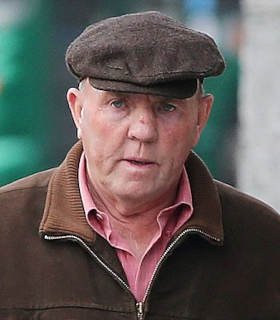
Accused by The Sunday Times of directing an IRA bombing campaign in Britain, in 1987 Murphy unsuccessfully sues the paper for libel in Dublin. The original verdict is overturned by the court of appeal because of omissions in the judge’s summing up and there is a retrial, which he also loses. At the retrial, both Sean O’Callaghan and Eamon Collins, former members of the Provisional Irish Republican Army, testify against Murphy, as do members of the Gardaí, Irish customs officials, British Army and local TDBrendan McGahon. Collins, who had also written a book about his experiences, Killing Rage, is beaten and killed by having a spike driven through his face near his home in Newry eight months later. In 1998, a Dublin court dismisses Murphy’s case after a high-profile trial, during which Murphy states that he has “never been a member of the IRA, no way” and claims not to know where the Maze prison is located. The jury rules, however, that he is an IRA commander and a smuggler.
The Sunday Times subsequently publishes statements given by Adrian Hopkins, the skipper who ferries weapons from Libya to the IRA, to the French authorities who intercept the fifth and final Eksund shipment. Hopkins details how Murphy met a named Libyan agent in Greece, paid for the weapons to be imported, and helped unload them when they arrived in Ireland. According to A Secret History of the IRA by Ed Moloney, Murphy has been the IRA Army Council’s chief of staff since 1997. Toby Harnden’s Bandit Country: The IRA & South Armagh also details Murphy’s IRA involvement.
On September 20, 2016, the BBC‘s Spotlight airs a programme in which an alleged British spy who had infiltrated the IRA claims that in 2006, Murphy had demanded the killing of Denis Donaldson, an IRA member and British informer, in order to maintain discipline. The BBC says it had tried to contact Murphy but had received no reply. He has yet to respond to the allegation. On September 23, 2016, the Donaldson family’s solicitor says that the allegation is “absolute nonsense.”
In October 2005, officers of the British Assets Recovery Agency and the Irish Criminal Assets Bureau carry out raids on a number of businesses in Manchester and Dundalk. It is extensively reported in the media that the investigation is aimed at damaging the suspected multi-million-pound empire of Murphy, who according to the BBC’s Underworld Rich List, has accumulated up to £40 million through smuggling oil, cigarettes, grain and pigs, as well as through silent or partial ownership in legitimate businesses and in property.
A large, purpose-built underground chamber that Gardaí believes the IRA used for interrogation is discovered close to Murphy’s home.
In his first-ever press release, issued on October 12, 2005, Murphy denies he owned any property and denies that he had any links with co-accused Cheshire businessman Dermot Craven. Furthermore, he claims that he had to sell property to cover his legal fees after his failed libel case against The Sunday Times, and that he made a living from farming.
On March 9, 2006, police, soldiers and customs officials from both sides of the Irish border launch a large dawn raid on Murphy’s house and several other buildings in the border region. Three persons are arrested by the Gardaí but are released three days later. A fleet of tankers, computers, documents, two shotguns, more than 30,000 cigarettes and the equivalent of 800,000 euros in sterling bank notes, euro bank notes and cheques are seized. Four diesel laundering facilities attached to a major network of storage tanks, some of which are underground, are also found. The Irish Criminal Assets Bureau later obtains seizure orders to take possession of euro cash and cheques and sterling cash and cheques, together worth around one million Euros.
Sinn Féin President Gerry Adams makes a public statement in support of Murphy following the March 2006 raids. Under political and media pressure over allegations of the IRA’s continued presence in South Armagh, Adams says, “Tom Murphy is not a criminal. He’s a good republican and I read his statement after the Manchester raids, and I believe what he says and also and very importantly he is a key supporter of Sinn Féin’s peace strategy and has been for a very long time.” He adds, “I want to deal with what is an effort to portray Tom Murphy as a criminal, as a bandit, as a gang boss, as someone who is exploiting the republican struggle for his own ends, as a multimillionaire. There is no evidence to support any of that.”
Murphy is arrested in Dundalk, County Louth, on November 7, 2007, by detectives from the Criminal Assets Bureau, on charges relating to alleged revenue offences. The following day, he is charged with tax evasion under the Tax Consolidation Act. He is later released on his own bail of €20,000 with an independent surety of €50,000.
On October 17, 2008, in an agreed legal settlement, Murphy and his brothers pay over £1 million in assets and cash to the authorities in Britain and the Republic in settlement of a global crime and fraud investigation relating to proceeds of crime associated with smuggling and money laundering. After an investigation involving the Irish Criminal Assets Bureau and the UK’s Serious Organised Crime Agency, more than 625,000 euros (£487, 000) in cash and cheques is confiscated by the Republic’s courts, while nine properties in North West England worth £445,000 are confiscated by British courts. Murphy is still fighting a claim in the Republic’s courts for tax evasion, relating to non-completion of tax returns for eight years from 1996. On April 26, 2010, he is further remanded on bail.
In 2011, there are claims that Murphy had become disillusioned with the Northern Ireland peace process and that he had fallen out with Sinn Féin. However, there is no evidence to support he is sympathetic to any dissident republican groups. In March 2013, the Garda and the Police Service of Northern Ireland (PSNI), along with members of the Irish Customs Authority and HM Revenue and Customs (HMRC), raid his farm on the Louth-Armagh border. The Sunday World reports that two hours prior to the raid, at approximately 4:00 a.m., fire is seen coming from Murphy’s yard. There are serious concerns within the Garda and PSNI that a mole may have tipped off Murphy about the raid hours earlier as laptops, computer disks and a large amount of documentation is destroyed in the fires. As a result, an internal Garda investigation takes place.
On December 17, 2015, Murphy is found guilty on nine charges of tax evasion by a three-judge, non-jury Special Criminal Court trial sitting in Dublin, lasting nine weeks. He is tried under anti-terrorist legislation due to the belief by the Director of Public Prosecutions (DPP) that there would not be a fair trial because of the potential of the intimidation of prosecution witnesses and jurors, and the security surrounding the trial.
Murphy is found guilty on all charges of failing to furnish tax returns on his income as a “cattle farmer” between 1996 and 2004. He is prosecuted following a 14-year-long Criminal Assets Bureau investigation, which during a raid of his property uncovers bags with more than €250,000 and more than £111,000 sterling in cash, along with documents, diaries and ledgers. He is remanded on bail until early 2016 for sentencing.
On February 26, 2016, Murphy is sentenced to 18 months in prison. None of the jail term is suspended. Following sentencing, he is immediately transferred from court to Ireland’s highest-security prison, Portlaoise Prison, reserved for terrorists, dissident republicans and serious gangland criminals, under a heavily armed Garda and Irish Army escort due to security concerns.
Murphy appeals the conviction in November 2016. His lawyer, John Kearney, claims that the tax Murphy had not paid had in fact been paid by his brother, Patrick. The Court of Appeal dismisses the appeal on all grounds in January 2017.
A Luftwaffe bomb kills thirteen people in Belfast, Northern Ireland, on the night of April 7, 1941. Ultimately, the city is devastated by air raids. Seven hundred people are killed and 400 seriously injured in what becomes known as the Belfast Blitz. The Blitz consists of four German air raids on strategic targets in Belfast, in April and May 1941 during World War II.
There had been a number of small bombings, probably by planes that missed their targets over the River Clyde in Glasgow or the cities of North West England. On March 24, 1941, John MacDermott, Minister for Public Security, writes to the Prime Minister of Northern Ireland, John Andrews, expressing his concerns that Belfast is so poorly protected. “Up to now we have escaped attack. So had Clydeside until recently. Clydeside got its blitz during the period of the last moon. There [is] ground for thinking that the … enemy could not easily reach Belfast in force except during a period of moonlight. The period of the next moon from say the 7th to the 16th of April may well bring our turn.” MacDermott is proved right.
The first deliberate raid takes place on the night of April 7. It targets the docks. Neighbouring residential areas are also hit. Six Heinkel He 111 bombers, from Kampfgruppe 26, flying at 7,000 feet, drop incendiaries, high explosive and parachute mines. By British mainland blitz standards, casualties are light. Thirteen die, including a soldier killed when an anti-aircraft gun at the Balmoral show-grounds misfires. The most significant loss is a 4.5-acre factory floor for manufacturing the fuselages of Short Stirling bombers. The Royal Air Force (RAF) announces that Squadron Leader J.W.C. Simpson shot down one of the Heinkels over Downpatrick. The Luftwaffe crews return to their base in Northern France and report that Belfast’s defences are “inferior in quality, scanty and insufficient.” This raid overall causes relatively little damage, but a lot is revealed about Belfast’s inadequate defences.
On Easter Tuesday, April 15, 1941, spectators watching a football match at Windsor Park notice a lone LuftwaffeJunkers Ju 88 aircraft circling overhead. That evening over 150 bombers leave their bases in northern France and the Netherlands and head for Belfast. There are Heinkel He 111s, Junkers Ju 88s and Dornier Do 17s. At 10:40 p.m. the air-raid sirens sound. Accounts differ as to when flares are dropped to light up the city. The first attack is against the city’s waterworks, which had been attacked in the previous raid. High explosives are dropped. Initially it is thought that the Germans had mistaken this reservoir for the harbour and shipyards, where many ships, including HMS Ark Royal are being repaired. However, that attack is not an error. Three vessels nearing completion at Harland & Wolff are hit as is its power station. Wave after wave of bombers drop their incendiaries, high explosives and landmines. When incendiaries are dropped, the city burns as water pressure is too low for effective firefighting. There is no opposition. In the mistaken belief that they might damage RAF fighters, the anti-aircraft batteries cease firing. But the RAF does not respond. The bombs continued to fall until 5:00 a.m.
Outside of London, with some 900 dead, this is the greatest loss of life in a night raid during the Blitz. A stray bomber attacks Derry, killing fifteeen. Another attacks Bangor, County Down, killing five. By 4:00 a.m. the entire city seems to be in flames. At 4:15 a.m., John MacDermott, the Minister of Public Security, manages to contact Minister of AgricultureBasil Brooke seeking permission to seek help from the Irish government. Brooke notes in his diary, “I gave him authority as it is obviously a question of expediency.” Since 1:45 a.m. all telephones have been cut. Fortunately, the railway telegraphy link between Belfast and Dublin is still operational. The telegram is sent at 4:35 a.m. asking the Irish Taoiseach, Éamon de Valera, for assistance.
By 6:00 a.m., within two hours of the request for assistance, 71 firemen with 13 fire tenders from Dundalk, Drogheda, Dublin, and Dún Laoghaire are on their way to cross the Irish border to assist their Belfast colleagues. In each station volunteers are requested, as it is beyond their normal duties. In every instance, all step forward. They remain in Belfast for three days, until they are sent back by the Northern Ireland government. By then 250 firemen from Clydeside have arrived.
There is a second massive air raid on Belfast on Sunday, May 4-5, 1941, three weeks after the Easter Tuesday raid. Around 1:00 a.m., Luftwaffe bombers fly over the city, concentrating their attack on the Harbour Estate and Queen’s Island. Nearby residential areas in east Belfast are also hit when “203 metric tonnes of high explosive bombs, 80 land mines attached to parachutes, and 800 firebomb canisters containing 96,000 incendiary bombs” are dropped. Over 150 people die in what becomes known as the “Fire Blitz.” Casualties are lower than at Easter, partly because the sirens sound at 11:45 p.m. while the Luftwaffe attack more cautiously from a greater height. St. George’s Church in High Street is damaged by fire. Again, the Irish emergency services cross the border, this time without waiting for an invitation.
(Pictured: Rescue workers search through the rubble of Eglington Street in Belfast, Northern Ireland, after a German Luftwaffe air raid, May 7, 1941)
Mary Elizabeth Blundell (née Sweetman), prolific Irish novelist and playwright who writes under the pen nameM. E. Francis, dies on March 9, 1930. She is described as the best-known female novelist of the day.
Blundell is born in 1859 in Killiney Park, County Dublin to Margaret and Michael James Sweetman. The family moves to Brussels in 1873 and she spends her summers in Switzerland. Her family is quite artistic. Her sisters are poet Elinor Sweetman and writer Agnes Castle (aka Mrs. Egerton Castle). Her uncle is the novelist, William Sweetman. She marries her husband, Francis Blundell, on November 18, 1879, and moves to Little Crosby, Lancashire, North West England, where his family has been notable Catholics since the 16th century. They have three children: Francis Nicholas Blundell, Conservative politician, and writers Margaret Elizabeth Clementina Mary Blundell and Agnes Mary Frances Blundell.
Blundell’s husband dies after only five years of marriage. She had written her first story, True Joy, when she was just eight years old and has a publication in the Irish Monthly the day of her wedding. She takes up writing professionally after her husband’s death. In later life she writes in collaboration with her daughters. She later retires to Dorset.
The Ireland of her youth, the Lancashire of her married life, and the Dorset of her retirement provide backgrounds for many of her volumes of fiction.




 seamus dubhghaill