seamus dubhghaill

Promoting Irish Culture and History from Little Rock, Arkansas, USA


Leave a comment

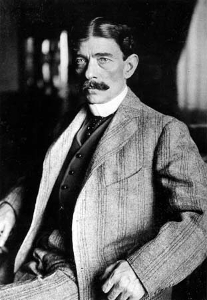
Death of Frank Harris, Novelist & Journalist

Frank Harris, British editor, novelist, short story writer, journalist and publisher, dies on August 26, 1931. He is friendly with many well-known figures of his day.

Harris is born James Thomas Harris on February 14, 1855, in Galway, County Galway, to Welsh parents. While living with his older brother he is, for a year or more, a pupil at The Royal School, Armagh. At the age of twelve he is sent to Wales to continue his education as a boarder at the Ruabon Grammar School in Denbighshire, a time he is to remember later in My Life and Loves. Harris is unhappy at the school and runs away within a year.

Harris runs away to the United States in late 1869, arriving in New York City virtually penniless. The 13-year-old takes a series of odd jobs to support himself, working first as a shoeshiner, a porter, a general laborer, and a construction worker on the erection of the Brooklyn Bridge. He later turns these early occupational experiences into art, incorporating tales from them into his book The Bomb.

From New York Harris moves to the American Midwest, settling in Chicago, where he takes a job as a hotel clerk and eventually a manager. Owing to Chicago’s central place in the meat packing industry, Harris makes the acquaintance of various cattlemen, who inspire him to leave the big city to take up work as a cowboy. He eventually grows tired of life in the cattle industry and enrolls at the University of Kansas, where he studies law and earns a degree, gaining admission to the Kansas state bar association.

Harris is not cut out to be a lawyer and soon decides to turn his attention to literature. He returns to England in 1882, later traveling to various cities in Germany, Austria, France, and Greece on his literary quest. He works briefly as an American newspaper correspondent before settling down in England to seriously pursue the vocation of journalism.

Harris first comes to general notice as the editor of a series of London papers including The Evening News, The Fortnightly Review and the Saturday Review, the last-named being the high point of his journalistic career, with H. G. Wells and George Bernard Shaw as regular contributors.

From 1908 to 1914 Harris concentrates on working as a novelist, authoring a series of popular books such as The Bomb, The Man Shakespeare, and The Yellow Ticket and Other Stories. With the advent of World War I in the summer of 1914, Harris decides to return to the United States.

From 1916 to 1922 he edits the U.S. edition of Pearson’s Magazine, a popular monthly which combines short story fiction with socialist-tinted features on contemporary news topics. One issue of the publication is banned from the mails by United States Postmaster General Albert S. Burleson during the period of American participation in the Great War. Despite this Harris manages to navigate the delicate situation which faces the left wing press and to keep the Pearson’s Magazine functioning and solvent during the war years.

Harris becomes an American citizen in April 1921. In 1922 he travels to Berlin to publish his best-known work, his autobiography My Life and Loves. It is notorious for its graphic descriptions of Harris’ purported sexual encounters and for its exaggeration of the scope of his adventures and his role in history. Years later, Time Magazine reflects in its March 21, 1960 issue “Had he not been a thundering liar, Frank Harris would have been a great autobiographer….he had the crippling disqualification that he told the truth, as Max Beerbohm remarked, only ‘when his invention flagged’.” A fifth volume, supposedly taken from his notes but of doubtful provenance, is published in 1954, long after his death.

Harris also writes short stories and novels, two books on Shakespeare, a series of biographical sketches in five volumes under the title Contemporary Portraits and biographies of his friends Oscar Wilde and George Bernard Shaw. His attempts at playwriting are less successful. Only Mr. and Mrs. Daventry (1900), which is based on an idea by Oscar Wilde, is produced on the stage.

Married three times, Harris dies of a heart attack in Nice at the age of 75 on August 26, 1931. He is subsequently buried at Cimetière Caucade in the same city. Just after his death a biography written by Hugh Kingsmill (pseudonym of Hugh Kingsmill Lunn) is published.


Leave a comment

Death of Novelist & Playwright Kate O’Brien

Kathleen Mary Louise “Kate” O’Brien, novelist and playwright, dies in Canterbury, England, on August 13, 1974.

O’Brien is born in Limerick, County Limerick on December 3, 1897. Following the death of her mother when she is five years old, she becomes a boarder at Laurel Hill Convent. She graduates in English and French from the newly established University College Dublin, and she then moves to London, where she works as a teacher for a year.

In 1922–1923, O’Brien works as a governess in the Basque Country, in the north of Spain, where she begins to write fiction. Upon her return to England, she works at the Manchester Guardian. After the success of her play Distinguished Villa in 1926, she takes to full-time writing and is awarded both the 1931 James Tait Black Memorial Prize and the Hawthornden Prize for her debut novel Without My Cloak. O’Brien is best known for her 1934 novel The Ante-Room, her 1941 novel The Land of Spices, and the 1946 novel That Lady.

Many of O’Brien’s books deal with issues of female agency and sexuality in ways that are new and radical at the time. Her 1936 novel, Mary Lavelle, is banned in Ireland and Spain, while The Land of Spices is banned in Ireland upon publication. In addition to novels, she writes plays, film scripts, short stories, essays, copious journalism, two biographical studies, and two very personal travelogues. Throughout her life, she feels a particular affinity with Spain. While her experiences in the Basque Country inspire Mary Lavelle, she also writes a life of the Spanish mystic Teresa of Avila, and she uses the relationship between the Spanish king Philip II and Maria de Mendoza to write the anti-fascist novel That Lady.

O’Brien writes a political travelogue, Farewell Spain, to gather support for the leftist cause in the Spanish Civil War, and it has been argued that she is close to anarchism in the 1930s. A feminist, her novels promote gender equality and are mostly protagonised by young women yearning for independence. Several of her books include positive gay/lesbian characters. Her determination to encourage a greater understanding of sexual diversity makes her a pioneer in queer literary representation. She is very critical of conservatism in Ireland, and by spearheading a challenge to the Irish Censorship Act, she helps bring to an end the cultural restrictions of the 1930s and 40s in the country.

Kate O’Brien lives much of her life in England and died in Faversham, near Canterbury, on August 13, 1974.


Leave a comment

Birth of Novelist & Critic John Broderick

Irish novelist and critic John Broderick is born in Athlone, County Westmeath, on July 30, 1924.

Broderick is the only child of the proprietors of a thriving local business, Broderick’s Bakery. His father dies when he is just three years old. He begins his secondary education at the Marist Brothers’ School but, at the age of 12, on his mother’s remarriage to the bakery manager in 1936, he is sent to board at St. Joseph’s College, Garbally Ballinasloe. He leaves in 1941 without sitting the Leaving Certificate and is expected to take over the bakery business, but always intends to write.

From 1951 he lives for a time in Paris where he knows some of the French and expatriate literary community, among them Gore Vidal, Truman Capote, James Baldwin and most importantly Julien Green. Green is a French Academician and highly respected novelist and diarist, who becomes a mentor and personal friend. He visits Broderick in Athlone in 1974 and 1975.

The Irish Times accepts a travel article from Broderick in 1956. In the same year, the paper publishes the first of his book reviews. He continues to review widely and to write general articles for The Irish Times and Hibernia magazine, among others, until shortly before his death. As a critic he is frequently controversial being dismissive of a number of established writers including Heinrich Boll, Seamus Heaney and most notably Edna O’Brien while he is extremely generous and encouraging to a host of young Irish writers. His first novel, The Pilgrimage (1961) is banned by the Irish Censorship of Publications Board. Broderick is elected to membership of the Irish Academy of Letters in 1968, and in 1975 receives the Academy’s Annual Award for Literature.

Broderick lives most of his life in Athlone, with his mother until her death in 1974, and alone until he moves to Bath, England in 1981. He dies in Bath in 1989. The Westmeath County Library system has a collection of his papers, manuscripts and other materials.

Most of Broderick’s family are born and reared in Athlone, and many still live there today. John Broderick is third cousins to Shauna, Cliodhna and Aisling Golden, three sisters who perform together as a singing act called “The Golden Sisters” who are quarter finalists on the RTÉ prime time show “The All Ireland Talent Show.”


Leave a comment

Birth of Raymond Thornton Chandler, Novelist & Screenwriter

Raymond Thornton Chandler, American novelist and screenwriter, is born to Irish Quaker and Irish Catholic parents in Chicago, Illinois on July 23, 1888.

Chandler spends his early years in Plattsmouth, Nebraska, living with his mother and father near his cousins and his aunt and uncle. His father, an alcoholic civil engineer who works for the railway, abandons the family. To obtain the best possible education for Ray, his mother, originally from Ireland, moves them to the area of Upper Norwood in the London Borough of Croydon, England in 1900. In 1912, he borrows money from his Waterford uncle, who expects it to be repaid with interest, and returns to America, visiting his aunt and uncle before settling in San Francisco. The following year he moves to Los Angeles.

In 1932, at the age of forty-four, Chandler becomes a detective fiction writer after losing his job as an oil company executive during the Great Depression. His first short story, “Blackmailers Don’t Shoot,” is published in 1933 in Black Mask, a popular pulp magazine. His first novel, The Big Sleep, is published in 1939. In addition to his short stories, Chandler publishes seven novels during his lifetime. An eighth novel is in progress at the time of his death and is completed by Robert B. Parker. All but Playback have been made into motion pictures, some more than once.

Chandler has an immense stylistic influence on American popular literature. He is considered to be a founder of the hardboiled school of detective fiction, along with Dashiell Hammett, James M. Cain and other Black Mask writers. The protagonist of his novels, Philip Marlowe, like Hammett’s Sam Spade, is considered by some to be synonymous with “private detective.” Both are played in films by Humphrey Bogart, whom many consider to be the quintessential Marlowe.

Some of Chandler’s novels are important literary works, and three have been regarded as masterpieces: Farewell, My Lovely (1940), The Little Sister (1949), and The Long Goodbye (1953). The Long Goodbye is praised in an anthology of American crime stories as “arguably the first book since Hammett’s The Glass Key, published more than twenty years earlier, to qualify as a serious and significant mainstream novel that just happened to possess elements of mystery.”

In the year before his death, he is elected president of the Mystery Writers of America. He dies on March 26, 1959, in La Jolla, California. He is buried in Mount Hope Cemetery in San Diego, California.


Leave a comment

Birth of Novelist Edith Anna Œnone Somerville

Edith Anna Œnone Somerville, Irish novelist who habitually signs herself as “E. Œ. Somerville,” is born on May 2, 1858, on the island of Corfu, then part of the United States of the Ionian Islands, a British protectorate where her father is stationed. She writes in collaboration with her cousin “Martin Ross” (Violet Martin) under the pseudonym “Somerville and Ross.” Together they publish a series of fourteen stories and novels, the most popular of which are The Real Charlotte, and The Experiences of an Irish R. M., published in 1899.

A year after her birth, her father retires to Drishane, Castletownshend,  County Cork, where Somerville grows up. She receives her primary education at home, and then attends Alexandra College in Dublin. In 1884 she studies art in Paris, and then spends a term at the Westminster School of Art in Dean’s YardWestminster. At home, riding and painting are her absorbing interests.

In January 1886 she meets her cousin Violet Martin, and their literary partnership begins the following year. Their first book, An Irish Cousin, appears in 1889, under the names Geilles Herring (from the maiden name of her ancestor, the wife of Sir Walter de Somerville of Linton and Carnwath) and Martin Ross, though the pen names are dropped after the first edition. In 1898, Somerville goes to paint at the Etaples art colony, accompanied by Violet. There they profit from their stay by conceiving together the stories later gathered in Some Experiences of an Irish R. M., completed the following year. By the time Violet dies in 1915, they have published fourteen books together. Her cousin’s death stuns Somerville, who continues to write as “Somerville and Ross,” claiming that they keep in contact through spiritualist séances.

Somerville is a devoted sportswoman who in 1903 becomes master of the Carbery West Foxhounds. She is also active in the suffrage movement, corresponding with Dame Ethel Smyth. She is in London still recovering from the shock of Violet’s death when the Easter Rising of 1916 breaks out. On May 9, 1916, she writes a letter to The Times, blaming the British government for the state of affairs in Ireland. After that she tends towards Nationalism, and as an adept musician at parties, she specializes in Irish tunes and Nationalist songs.

She has exhibitions of her pictures in Dublin and in London between 1920 and 1938 and is active as an illustrator of children’s picture books and sporting picture books.

In 1936 her brother, Henry Boyle Townsend Somerville, a retired Vice-Admiral in the Royal Navy, is killed by the Irish Republican Army (IRA) at the family home of Castletownshend. She finishes his book “Will Mariner” after his death.

Edith Somerville dies at Castletownshend on October 8, 1949, at the age of 91. She is buried alongside Violet Florence Martin at Saint Barrahane’s Church, Castletownsend, County Cork.


Leave a comment

Birth of Irish-Australian Novelist Thomas Michael Keneally

thomas-michael-keneally

Thomas Michael Keneally, Irish-Australian novelist, playwright, and author of non-fiction, is born in Sydney, New South Wales, Australia, on October 7, 1935.

The son of Edmund Thomas and Elsie Margaret (Coyle) Keneally, he grows up in Kempsey and is educated at St. Patrick’s College, Strathfield where, subsequently, a writing prize has been named after him. Keneally enters St. Patrick’s Seminary, Manly to train as a Catholic priest. Although he is ordained as a deacon while at the seminary, he leaves without being ordained into the priesthood. He works as a Sydney schoolteacher before his success as a novelist and is a lecturer at the University of New England from 1968–1970.

Keneally is known as “Mick” until 1964 but, upon the advice of his publisher to use his real first name, begins using the name Thomas when he starts publishing. He is most famous for writing Man Booker Prize winner Schindler’s Ark (1982) which is later republished as Schindler’s List, and is later adapted to Steven Spielberg‘s Schindler’s List, which wins the Academy Award for Best Picture. Many of Keneally’s novels are reworkings of historical material, although modern in their psychology and style.

Keneally also acts in a handful of films. He has a small role in The Chant of Jimmie Blacksmith, based on his novel, and plays Father Marshall in the award-winning Fred Schepisi film The Devil’s Playground (1976).

Keneally is a strong advocate of an Australian republic, meaning the abolition of the Australian monarchy, and publishes a book, Our Republic, on the subject in 1993. Several of his Republican essays appear on the web site of the Australian Republican Movement.

Keneally is a keen supporter of rugby league football, in particular the Manly Warringah Sea Eagles club of the National Rugby League. In 2004 he gives the sixth annual Tom Brock Lecture and makes an appearance in the 2007 rugby league drama film The Final Winter.

In March 2009, the Prime Minister of Australia, Kevin Rudd, gives an autographed copy of Keneally’s biography Lincoln to President Barack Obama as a state gift. Recently Keneally has been a featured writer in the critically acclaimed Australian drama Our Sunburnt Country.