seamus dubhghaill

Promoting Irish Culture and History from Little Rock, Arkansas, USA


Leave a comment

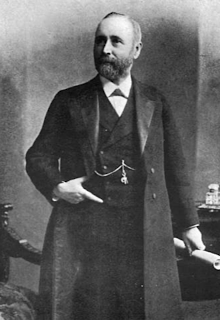
Birth of William Pirrie, 1st Viscount Pirrie

William James Pirrie, 1st Viscount PirrieKPPCPC (Ire), a leading British shipbuilder and businessman, is born on May 31, 1847, in Quebec City, Canada East, Province of Canada. He is chairman of Harland & Wolff, shipbuilders, between 1895 and 1924, and also serves as Lord Mayor of Belfast between 1896 and 1898.

Pirrie is taken back to Ireland when he is two years old and spends his childhood at Conlig House, also known as Little Clandeboye ConligCounty Down. Belonging to a prominent family, his nephews included J. M. Andrews, who later becomes Prime Minister of Northern IrelandThomas Andrews, builder of RMS Titanic, and Sir James Andrews, 1st Baronet, the Lord Chief Justice of Northern Ireland.

Pirrie is educated at the Royal Belfast Academical Institution before entering Harland & Wolff shipyard as a gentleman apprentice in 1862. Twelve years later he is made a partner in the firm, and on the death of Sir Edward Harland in 1895, he becomes its chairman, a position he holds until his death. As well as overseeing the world’s largest shipyard, he is elected Lord Mayor of Belfast in 1896, and is re-elected to the office as well as made an Irish Privy Counsellor the following year. He becomes Belfast’s first honorary freeman in 1898, and serves in the same year as High Sheriff of Antrim and subsequently of County Down. In February 1900, he is elected President of the UK Chamber of Shipping, where he had been vice-president the previous year. He helps finance the Liberals in Ulster in the 1906 United Kingdom general election, and that same year, at the height of Harland & Wolff’s success, he is raised to the peerage as Baron Pirrie, of the City of Belfast.

In 1907, Pirrie is appointed Comptroller of the Household to the Lord Lieutenant of Ireland, and in 1908 is appointed Knight of St Patrick (KP). Pro-Chancellor of Queen’s University of Belfast (QUB) from 1908 to 1914, he is also in the years before World War I a member of the Committee on Irish Finance as well as Lord Lieutenant of Belfast.

In February 1912, after chairing a famous meeting of the Ulster Liberal Association at which Winston Churchill defends the government’s policy of Home Rule for Ireland, Pirrie is jeered on the streets of Belfast, and assaulted as he boards a steamer in Larne: pelted with rotten eggs, herrings, and bags of flour. In 1910, the Ulster Liberal Association, an overwhelmingly Protestant body, with a weekly newspaper, and branch network throughout Ulster, adopts (in opposition to the Ulster Liberal Unionist Association) an explicitly pro-home rule position.

In the months leading up to the 1912 sinking of the RMS Titanic, Pirrie is questioned about the number of life boats aboard the Olympic-class ocean liners. He responds that the great ships are unsinkable and the rafts are to save others. This haunts him for the rest of his life. In April 1912, Pirrie is to travel aboard RMS Titanic, but illness prevents him.

During the war Pirrie is a member of the War Office Supply Board, and in 1918 becomes Comptroller-General of Merchant Shipbuilding, organising British production of merchant ships.

In 1921, Pirrie is elected to the Senate of Northern Ireland, and that same year is created Viscount Pirrie of the City of Belfast, in the honours for the opening of the Parliament of Northern Ireland in July 1921, for his war work and charity work. In Belfast he is, on other grounds, already a controversial figure: a Protestant employer associated as a leading Liberal with a policy of Home Rule for Ireland.

In March 1924, Pirrie, his wife, and her sister sail on a Royal Mail Steam Packet Company liner from Southampton on a business trip to South America. They travel overland from Buenos Aires to Chile, where they embark aboard the Pacific Steam Navigation Company‘s Ebro. Pirrie comes down with pneumonia in Antofagasta, and his condition worsens when the ship reaches Iquique. At Panama City two nurses embark to care for him. By then he is very weak, but insists on being brought on deck to see the canal. He admires how Ebro is handled through the locks.

Pirrie dies at sea off Cuba on June 7, 1924. His body is embalmed. On June 13, Ebro reaches Pier 42 on the North River in New York City, where Pirrie’s friend Andrew Weir, 1st Baron Inverforth and his wife meet Viscountess Pirrie and her sister. UK ships in the port of New York lower their flags to half-mast, and Pirrie’s body is transferred to Pier 59, where it is embarked on White Star Line‘s RMS Olympic, one of the largest ships Pirrie ever built, to be repatriated to the UK. He is buried in Belfast City Cemetery. The barony and viscountcy die with him. Lady Pirrie dies on June 19, 1935. A memorial to Pirrie in the grounds of Belfast City Hall is unveiled in 2006.


Leave a comment

Sinking of the British Steamship Centurion

The U-20, a German U-boat under the command of  Kapitänleutnant Walther Schwieger, sinks the British steamship Centurion off the southeast coast of Ireland on May 6, 1915. This tragic event has far-reaching consequences and shapes the course of World War I.

The Centurion is traveling through the waters southeast of Ireland when a torpedo fired from the U-20 hits the vessel, causing it to rapidly sink. This act of aggression results in the loss of many innocent lives and sends shockwaves throughout the world.

At the time of the incident, World War I is in full swing. Germany, engaged in submarine warfare, seeks to disrupt British supply lines and cut off its access to vital resources. The sinking of merchant ships, regardless of their civilian nature, is part of Germany’s strategy to weaken the enemy. The attack on the Centurion is just one of many instances in which German submarines target and sink British vessels.

A difference in this particular incident as opposed to other similar incidents is the widespread outrage it triggers. The Centurion is an unarmed cargo ship carrying civilian goods, and its destruction is seen as a ruthless and unjustifiable act. The loss of civilian lives and the callousness with which the submarine attack is executed causes public opinion to turn against Germany.

The sinking highlights the growing concern over unrestricted submarine warfare and its impact on civilian populations. It pushes the United States, which at the time is neutral, closer to entering the war on the side of the Allies. The incident also plays a significant role in shaping public opinion in other neutral countries, putting pressure on Germany to reconsider its aggressive tactics.

In response to international outrage, Germany initially defends its actions, arguing that the Centurion was carrying contraband cargo. However, under mounting pressure, the German government eventually backs down and pledges to modify its submarine warfare policies to reduce the risk to civilian lives. This move is meant to appease neutral countries and prevent the United States from entering the war.

The sinking of the Centurion has a lasting impact on maritime warfare. The incident leads to the introduction of new rules of engagement, such as the requirement for submarines to surface and warn civilian vessels before attacking. These rules aim to minimize civilian casualties and reduce the risk of similar tragedies occurring in the future.

Moreover, the sinking serves as a catalyst for technological advancements in submarine warfare. Navies worldwide realize the need for more sophisticated anti-submarine measures and began developing detection systems and tactics to counter the stealth of submarines. This incident marks a turning point in the evolution of naval warfare, as nations seek to adapt and respond to the new challenges posed by underwater vessels.

The following day, May 7, 1915, the U-20 sinks the British ocean liner RMS Lusitania off the southern coast of Ireland. The liner sinks in eighteen minutes with 1,197 casualties. The wreck lies in 300 feet of water.

On November 4, 1916, U-20 becomes grounded on the Danish coast south of Vrist, after suffering damage to its engines. Her crew attempts to destroy her with explosives the following day, succeeding only in damaging the boat’s bow but making it effectively inoperative as a warship.

The U-20 remains on the beach until 1925 when the Danish government blows it up in a “spectacular explosion.” The Danish navy removes the deck gun and makes it unserviceable by cutting holes in vital parts. The gun is kept in the naval stores at Holmen, Copenhagen for almost 80 years. The conning tower is removed and placed on the front lawn of the local museum Strandingsmuseum St. George Thorsminde, where it remains today.

(Pictured: The U-20, second from left, at Kiel, Schleswig-Holstein, on February 17, 1914)


Leave a comment

The 31st International Eucharistic Congress Begins in Dublin

eucharistic-congress-closing-ceremony-1932

The 31st International Eucharistic Congress begins in Dublin on June 22, 1932, and runs through June 26. The congress is one of the largest eucharistic congresses of the 20th century and the largest public event to happen in the new Irish Free State. It reinforces the Free State’s image of being a devout Catholic nation. The high point is when over a million people gather for Mass in Phoenix Park.

Ireland is then home to 3,171,697 Catholics. It is selected to host the congress as 1932 is the 1500th anniversary of Saint Patrick‘s arrival. The chosen theme is “The Propagation of the Sainted Eucharist by Irish Missionaries.”

The city of Dublin is decorated with banners, bunting, garlands, and replica round towers. Seven ocean liners moor in the port basins and along Sir John Rogerson’s Quay. Five others anchor around Scotsmans Bay. The liners act as floating hotels and can accommodate from 130 to 1,500 people on each. The Blue Hussars, a ceremonial cavalry unit of the Irish Army formed to escort the President of Ireland on state occasions, first appears in public as an honor guard for the visiting Papal Legate representing Pope Pius XI.

John Charles McQuaid, President of Blackrock College, hosts a large garden party on the grounds of the college to welcome the papal legate, where the hundreds of bishops assembled for the Congress have the opportunity to mingle with a huge gathering of distinguished guests and others who have paid a modest subscription fee.

The final public mass of the congress is held at 1:00 PM on Sunday, June 26 in Phoenix Park at an altar designed by the eminent Irish architect John J. Robinson of Robinson & Keefe Architects, and is celebrated by Michael Joseph Curley, Archbishop of Baltimore. A radio station, known as Radio Athlone, is set up in Athlone to coincide with the Congress. In 1938 it becomes Radio Éireann. The ceremonies include a live radio broadcast by Pope Pius XI from the Vatican. John McCormack, the world-famous Irish tenor, sings César Franck‘s Panis Angelicus at the mass.

Approximately 25% of the population of Ireland attend the mass and afterwards four processions leave the Park to O’Connell Street where approximately 500,000 people gather on O’Connell Bridge for the concluding Benediction given by the Papal Legate, Cardinal Lorenzo Lauri.

The English Catholic writer G. K. Chesterton is also present, and observes, “I confess I was myself enough of an outsider to feel flash through my mind, as the illimitable multitude began to melt away towards the gates and roads and bridges, the instantaneous thought ‘This is Democracy; and everyone is saying there is no such thing.'”

On the other hand, such an overwhelming display of Catholicity only confirms to Protestants in the North the necessity of the border.

(Pictured: the closing ceremony of the Eucharistic Congress that was held in Dublin in June 1932)


Leave a comment

The Launch of the SS Canberra

ss-canberra

The SS Canberra, an ocean liner in the P&O fleet which later operates on cruises, is launched in Belfast, Northern Ireland on March 16, 1960. She is built at the Harland & Wolff shipyard in Belfast at a cost of £17,000,000.

The ship is named on March 17, 1958, after the federal capital of Australia, Canberra. Her launch is sponsored by Dame Pattie Menzies, GBE, wife of the then Prime Minister of Australia, Robert Menzies. She enters service in May 1961 and begins her maiden voyage in June.

At the end of 1972 she is withdrawn and refitted to carry 1,500 single class passengers on cruises. Unusually, this transition from an early life as a purpose-built ocean liner to a long and successful career in cruising, occurs without any major external alterations, and with only minimal internal and mechanical changes over the years.

On April 2, 1982, Argentina invades the Falkland Islands, which initiates the Falklands War. At the time, SS Canberra is cruising in the Mediterranean Sea. The next day, her captain, Dennis Scott-Masson, receives a message asking his time of arrival at Gibraltar, which is not on his itinerary. When he calls at Gibraltar, he learns that the Ministry of Defence had requisitioned SS Canberra for use as a troopship. SS Canberra sails to Southampton, Hampshire where she is quickly refitted, sailing on April 9 for the South Atlantic.

SS Canberra anchors in San Carlos Water on May 21 as part of the landings by British forces to retake the islands. Although her size and white colour make her an unmissable target for the Argentine Air Force, the liner is not badly hit in the landings as the Argentine pilots tend to attack the Royal Navy frigates and destroyers instead of the supply and troop ships. After the war, Argentine pilots claim they were told not to hit SS Canberra, as they mistook her for a hospital ship.

SS Canberra then sails to South Georgia island, where 3,000 troops are transferred from Queen Elizabeth 2. They are landed at San Carlos on June 2. When the war ends, SS Canberra is used as a cartel to repatriate captured Argentine soldiers, landing them at Puerto Madryn, before returning to Southampton to a rapturous welcome on July 11.

After a lengthy refit, SS Canberra returns to civilian service as a cruise ship. Her role in the Falklands War makes her very popular with the British public, and ticket sales after her return are elevated for many years as a result. Age and high running costs eventually catch up with her though, as she has much higher fuel consumption than most modern cruise ships. Although Premier Cruise Line makes a bid for the old ship, P&O had already decided that they do not want SS Canberra to operate under a different flag.

SS Canberra is withdrawn from P&O service in September 1997 and sold to ship breakers for scrapping on October 10, 1997, leaving for Gadani ship-breaking yard in Pakistan on October 31, 1997. Her deep draft means that she cannot be beached as far as most ships, and due to her solid construction, the scrapping process takes nearly a year instead of the estimated three months, being totally scrapped by the end of 1998.

The SS Canberra appears in the 1971 James Bond film Diamonds Are Forever as the liner where Mr. Wint and Mr. Kidd try to kill Bond. In 1997, singer/songwriter Gerard Kenny releases the single “Farewell Canberra” which is specially composed for the final voyage.


Leave a comment

RMS Titanic Departs Southampton, England

titanic-departing-southampton-dock

The RMS Titanic leaves port in Southampton, England for her first and only voyage on April 10, 1912. Built by the Belfast shipbuilders Harland & Wolff, the RMS Titanic is the second of the three Olympic-class ocean liners — the first being the RMS Olympic and the third being the HMHS Britannic.

Following the embarkation of the crew the passengers begin arriving at 9:30 AM, when the London and South Western Railway‘s boat train from London Waterloo station reaches Southampton Terminus railway station on the quayside, alongside RMS Titanic‘s berth. In all, 923 passengers board RMS Titanic at Southampton, 179 First Class, 247 Second Class and 494 Third Class. The large number of Third Class passengers means they are the first to board, with First and Second Class passengers following up to an hour before departure. Stewards show them to their cabins, and First Class passengers are personally greeted by Captain Edward Smith upon boarding. Third Class passengers are inspected for ailments and physical impairments that might lead to their being refused entry to the United States, a prospect the White Star Line wishes to avoid, as it would have to carry anyone who fails the examination back across the Atlantic. A total of 922 passengers are recorded as embarking on RMS Titanic at Southampton. Additional passengers are to be picked up at Cherbourg, France and Queenstown.

The maiden voyage begins on time, at noon. An accident is narrowly averted only a few minutes later as RMS Titanic passes the moored liners SS City of New York of the American Line and what would have been her running mate on the service from Southampton, White Star’s RMS Oceanic. Her huge displacement causes both of the smaller ships to be lifted by a bulge of water and then dropped into a trough. SS City of New York‘s mooring cables cannot take the sudden strain and snap, swinging her around stern-first towards RMS Titanic. A nearby tugboat, Vulcan, comes to the rescue by taking SS City of New York under tow, and Captain Smith orders RMS Titanic‘s engines to be put “full astern.” The two ships avoid a collision by a matter of about 4 feet. The incident delays RMS Titanic‘s departure for about an hour, while the drifting SS City of New York is brought under control.

After making it safely through the complex tides and channels of Southampton Water and the Solent, RMS Titanic heads out into the English Channel. She heads for the French port of Cherbourg, a journey of 77 nautical miles. The weather is windy, very fine but cold and overcast. Four hours after RMS Titanic leaves Southampton, she arrives at Cherbourg and is met by the tenders SS Traffic and the SS Nomadic which have to be used to transfer passengers from shore to ship because Cherbourg lacks docking facilities for a ship the size of RMS Titanic. An additional 274 passengers are taken aboard. Twenty-four passengers who have booked passage only cross-channel from Southampton leave aboard the tenders to be conveyed to shore. The process is completed in about 90 minutes. At 8:00 PM RMS Titanic weighs anchor and departs for Queenstown on the south coast of Ireland with arrival scheduled late the following morning.

(Pictured: RMS Titanic departing the Southampton docks on April 10, 1912)


Leave a comment

Sinking of the SS Tuscania

ss-tuscania

The SS Tuscania, a luxury liner of the Cunard Line subsidiary Anchor Line converted for troop use, is torpedoed and sunk on February 5, 1918 off Rathlin Island, north of Ireland by the German U-boat UB-77. The ship is transporting over 2,000 American troops to the war in Europe. Over 200 people lose their lives.

SS Tuscania carries passengers between New York City and Glasgow while in service with the Anchor Line, on a route that had previously been assigned to her sister ship SS Transylvania. She continues to run this route even as World War I breaks out in Europe in August 1914 and Germany initiates a submarine campaign against merchant shipping in waters near the United Kingdom.

SS Tuscania makes international headlines for rescuing passengers and crew from the burning Greek steamer SS Athinai on September 20, 1915. In 1916, SS Tuscania is refitted and pressed into service as a troopship. She makes the news again in March 1917 by evading a submarine and a suspected Imperial German Navy armed merchant cruiser.

On January 24, 1918, SS Tuscania departs Hoboken, New Jersey, with 384 crew members and 2,013 United States Army personnel aboard. On the morning of February 5, 1918, she turns south for the North Channel en route to Liverpool. The German submarine UB-77 sights SS Tuscania′s convoy during the day and stalks it until early evening. Under the cover of darkness at about 6:40 PM, the submarine′s commanding officer, Korvettenkapitän Wilhelm Meyer, orders two torpedoes fired at SS Tuscania. The second of these strikes home, sending her to the bottom of the Irish Sea within about four hours. SS Tuscania sinks nearly three years to the day after her maiden voyage as a passenger liner. Approximately 210 of the troops and crew are lost, while many others are rescued by the Royal Navy destroyers HMS Mosquito and HMS Pigeon.

Three notable passengers who survive the sinking are British critic Sydney Brooks, Leonard Read, founder of the Foundation for Economic Education, and Harry Randall Truman who later dies in the 1980 eruption of Mount St. Helens.

The wreck of SS Tuscania lies between Scotland‘s Islay and Northern Ireland′s Rathlin Island, about 7 nautical miles north of Rathlin lighthouse, at roughly 55.41°N 06.185°W in 328 feet of water.


Leave a comment

Launch of the RMS Oceanic

RMS Oceanic, the White Star Line‘s first liner built by Harland & Wolff in Belfast, is launched on August 27, 1870, arriving in Liverpool, England for her maiden voyage on February 26, 1871.

Three sister ships are constructed in rapid succession: RMS Atlantic, SS Baltic, and SS Republic. All are of the same approximate dimensions with differences in tonnage.

Powered by a combination of steam and sail, RMS Oceanic has twelve boilers generating steam for a single four-cylinder compound steam engine. A single funnel exhausts smoke and four masts carry sails. The hull is constructed of iron and divided into eleven watertight compartments. Passenger accommodations are located on the two decks concealed within the hull. RMS Oceanic can carry 166 First Class passengers, referred to as Saloon Passengers in the day and 1,000 Steerage Passengers, along with a 143-man crew. White Star spares no expense in her construction, and the contemporary press describes the ship as an “imperial yacht.”

RMS Oceanic leaves Liverpool for her maiden voyage on March 2, 1871 carrying only 64 passengers, under Captain Sir Digby Murray. Not long after departing, she has to return because of overheated bearings. Her voyage restarts on March 16. From that point onward, RMS Oceanic is a success for The White Star Line.

In January, 1872, RMS Oceanic undergoes a refit, during which a large forecastle is added to help prevent the bow being inundated during high seas. Two new boilers are added to increase steam pressure and thus engine power, and the four masts are shortened.

RMS Oceanic continues sailing with the White Star line on the Liverpool to New York City route until March 11, 1875, when she is chartered to the Occidental & Oriental Steamship Company, for service between San Francisco, Yokohama and Hong Kong. White Star provides the officers, while the crew is Chinese. The ship itself remains in White Star colours, but flies the O&O flag. During the repositioning voyage from Liverpool to Hong Kong, RMS Oceanic sets a speed record for that route. Later, she also sets a speed record for Yokohama to San Francisco in December 1876, and then breaks her own record over that route in November, 1889, with a time of 13 days, 14 hours and 5 minutes.

On August 22, 1888, RMS Oceanic collides with the coastal liner SS City of Chester just outside the Golden Gate. The SS City of Chester sinks, killing 16 on board.

On January 7, 1890, Nellie Bly boards RMS Oceanic in Yokohama to cross the Pacific as part of her voyage Around the World in Seventy-Two Days. She arrives in San Francisco on January 21, 1890, which is a day behind schedule as a result of rough weather.

In 1895, RMS Oceanic is returned to White Star, which plans to put her back into service. She is sent back to Harland and Wolff for re-engining, but when the ship is inspected closely, it is found to be uneconomical to perform all the work needed. Instead, RMS Oceanic is sold for scrap, leaving Belfast for the last time on February 10, 1896, under tow, for a scrapyard on the River Thames.


2 Comments

The Sinking of the RMS Lusitania

The Cunard ocean liner RMS Lusitania is sunk by German U-boatU-20 eleven miles off the Old Head of Kinsale on May 7, 1915 during World War I.

On the morning of May 6, RMS Lusitania is 750 miles west of southern Ireland. By 5:00 AM on May 7 she reaches a point 120 miles west southwest of Fastnet Rock off the southern tip of Ireland, where she meets the patrolling boarding vesselPartridge. By 6:00 AM, heavy fog has arrived and extra lookouts are posted. As the ship comes closer to Ireland, Captain William Thomas Turner orders depth soundings to be made and at 8:00 AM for speed to be reduced to eighteen knots, then to 15 knots and for the foghorn to be sounded. Some of the passengers are disturbed that the ship appears to be advertising her presence. By 10:00 AM the fog begins to lift and by noon it has been replaced by bright sunshine over a clear smooth sea. The RMS Lusitania increases speed to 18 knots.

U-20 surfaces at 12:45 PM as visibility is now excellent. At 1:20 PM something is sighted and Kapitänleutnant  Walther Schwieger is summoned to the conning tower. At first it appears to be several ships because of the number of funnels and masts, but this resolves into one large steamer appearing over the horizon. At 1:25 PM the submarine submerges to periscope depth of 11 metres and sets a course to intercept the liner at her maximum submerged speed of 9 knots. When the ships have closed to 2 miles RMS Lusitania turns away. Schwieger fears he has lost his target, but she turns again, this time onto a near ideal course to bring her into position for an attack. At 2:10 PM with the target at 700m range he orders one gyroscopic torpedo to be fired, set to run at a depth of three metres.

The U-20‘s torpedo officer, Raimund Weisbach, views the destruction through the vessel’s periscope and feels the explosion is unusually severe. Within six minutes, RMS Lusitania‘s forecastle begins to submerge.

On board the RMS Lusitania, Leslie Morton, an eighteen-year-old lookout at the bow, spots thin lines of foam racing toward the ship. He shouts, “Torpedoes coming on the starboard side!” through a megaphone, thinking the bubbles come from two projectiles. The torpedo strikes RMS Lusitania under the bridge, sending a plume of debris, steel plating and water upward and knocking lifeboat number five off its davits. A second, more powerful explosion follows, sending a geyser of water, coal, dust, and debris high above the deck. Schwieger’s log entries attest that he had only launched one torpedo. Some doubt the validity of this claim, contending that the German government subsequently alters the published fair copy of Schwieger’s log, but accounts from other U-20 crew members corroborate it. The entries are also consistent with intercepted radio reports sent to Germany by U-20 once she has returned to the North Sea, before any possibility of an official coverup.

At 2:12 PM Captain Turner orders Quartermaster Johnston stationed at the ship’s wheel to steer “hard-a-starboard” towards the Irish coast, which Johnston confirms, but the ship can not be steadied on the course and rapidly ceases to respond to the wheel. Turner signals for the engines to be reversed to halt the ship, but although the signal is received in the engine room, nothing can be done. Steam pressure collapses from 195 PSI before the explosion, to 50 PSI and falling afterwards. RMS Lusitania‘s wireless operator sends out an immediate SOS, which is acknowledged by a coastal wireless station. Shortly afterward he transmits the ship’s position, 10 miles (16 km) south of the Old Head of Kinsale. At 2:14 PM electrical power fails, plunging the cavernous interior of the ship into darkness. Radio signals continue on emergency batteries, but electric lifts fail, trapping passengers and crew. Bulkhead doors closed as a precaution before the attack can not be reopened to release trapped men.

About one minute after the electrical power fails, Captain Turner gives the order to abandon ship. Water has flooded the ship’s starboard longitudinal compartments, causing a 15-degree list to starboard.

RMS Lusitania‘s severe starboard list complicates the launch of her lifeboats. Ten minutes after the torpedoing, when she has slowed enough to start putting boats in the water, the lifeboats on the starboard side swing out too far to step aboard safely. While it is still possible to board the lifeboats on the port side, lowering them presents a different problem. As is typical for the period, the hull plates of RMS Lusitania are riveted, and as the lifeboats are lowered they drag on the inch high rivets, which threatens to seriously damage the boats before they land in the water.

Many lifeboats overturn while loading or lowering, spilling passengers into the sea. Others are overturned by the ship’s motion when they hit the water. RMS Lusitania has 48 lifeboats, more than enough for all the crew and passengers, but only six are successfully lowered, all from the starboard side. A few of her collapsible lifeboats wash off her decks as she sinks and provides floatation for some survivors.

There is panic and disorder on the decks. Schwieger has been observing this through U-20‘s periscope, and by 2:25 PM, he drops the periscope and heads out to sea.

Captain Turner is on the deck near the bridge clutching the ship’s logbook and charts when a wave sweeps upward towards the bridge and the rest of the ship’s forward superstructure, knocking him overboard into the sea. He manages to swim and find a chair floating in the water which he clings to. He survives, having been pulled unconscious from the water after spending three hours there. RMS Lusitania‘s bow slams into the bottom about 330 feet below at a shallow angle because of her forward momentum as she sinks. Along the way, some boilers explode, including one that causes the third funnel to collapse. The remaining funnels collapse soon after. The ship travels about two miles from the time of the torpedoing to her final resting place, leaving a trail of debris and people behind. After her bow sinks completely, RMS Lusitania‘s stern rises out of the water, enough for her propellers to be visible, and then goes under.

RMS Lusitania sinks in only 18 minutes. It takes several hours for help to arrive from the Irish coast and by that time many in the 52° F water have succumbed to the cold. By the days’ end, 764 passengers and crew from the RMS Lusitania are rescued and land at Queenstown. Eventually, the final death toll for the disaster comes to a catastrophic number. Of the 1,959 passengers and crew aboard RMS Lusitania at the time of her sinking, 1,195 have been lost.

In the days following the disaster, the Cunard line offers local fishermen and sea merchants a cash reward for the bodies floating all throughout the Irish Sea, some floating as far away as the Welsh coast. In all, only 289 bodies are recovered, 65 of which are never identified. The bodies of many of the victims are buried at either Queenstown, where 148 bodies are interred in the Old Church Cemetery, or the Church of St. Multose in Kinsale. The bodies of the remaining 885 victims are never recovered.