seamus dubhghaill

Promoting Irish Culture and History from Little Rock, Arkansas, USA


Leave a comment

Birth of Gerard Hogan, Judge, Lawyer & Academic

Gerard William Augustine Hogan, MRIA, Irish judge, lawyer and academic who has served as a Judge of the Supreme Court of Ireland since October 2021, is born on August 13, 1958, in Carrick-on-Suir, County Tipperary. He previously serves as Advocate General of the European Court of Justice from 2018 to 2021, a Judge of the Court of Appeal from 2014 to 2018 and a Judge of the High Court from 2010 to 2014. He first works as a barrister and lecturer in law specialising in constitutional and administrative law.

Hogan is born to Mai and Liam Hogan. His father is the deputy principal of the Christian Brothers secondary school in the town. He is educated at University College Dublin (UCD), from where he receives BCL and LLM degrees in 1979 and 1981. He co-authors his first book Prisoners’ Rights: A Study in Irish Prison Law in 1981 with Paul McDermott and Raymond Byrne. He obtains a John F. Kennedy memorial scholarship to study for an LLM at the University of Pennsylvania Law School. He subsequently attends the King’s Inns. He holds two doctorates – an LLD from UCD and a PhD in law from Trinity College Dublin in 2001.

In 1986, early in his legal career, he supports the Anti-Apartheid Movement with other legal scholars, including Mary McAleese, Mary Robinson and Bryan MacMahon. He is involved with the Progressive Democrats and in 1988 writes the party’s proposed new Constitution of Ireland with Michael McDowell. In May 2021, he is made a member of the Royal Irish Academy.

Hogan is called to the Bar in July 1984 and becomes a Senior Counsel in 1997. He appears domestically in cases in the High Court and the Supreme Court and internationally at the European Court of Human Rights and the European Court of Justice.

Hogan is noted in particular for his experience in constitutional law. He acts for the Attorney General of Ireland in references made by President Mary Robinson under Article 26 of the Constitution of Ireland to the Supreme Court regarding the Information (Termination of Pregnancies) Bill 1995 and the Employment Equality Bill of 1997. He appears again for the Attorney General (with Dermot Gleeson and Paul Gallagher) in another reference made by President Mary McAleese regarding the Health (Amendment) (No. 2) Bill 2004.

Hogan is a law lecturer and fellow at Trinity College Dublin from 1982 to 2007. He lectures on constitutional law, competition law and the law of tort. He is regarded as “one of the foremost constitutional and administrative lawyers in Ireland.” He is the co-author of Administrative Law in Ireland and JM Kelly: The Irish Constitution, the core Irish legal texts in Irish administrative and constitutional law respectively. He also writes a text on political violence and a book chronicling the origins of the Constitution of Ireland.

During his career as a barrister, Hogan is involved in cases involving employment law, habeas corpus, immigration law, judicial review, company law and commercial law.

Hogan appears for Katherine Zappone and Ann Louise Gilligan in Zappone v. Revenue Commissioners in the High Court and Miss D in her case related to the rights to travel abroad for an abortion. He represents the State in the High Court and the Supreme Court in litigation that emerges following a court finding that an offence of unlawful carnal knowledge is unconstitutional. In 2008, he acts for Colm Murphy and Seamus Daly in the Supreme Court who are contesting an action taken by families of victims of the Omagh bombing when they are refused access to books of evidence.

Hogan is involved in several tribunals and Oireachtas committee investigations, appearing either in the actual proceedings or in related court proceedings. He represents Desmond O’Malley at the Beef Tribunal in 1992, Dermot Desmond at the Moriarty Tribunal in 2004, and Jim Higgins and Brendan Howlin in actions related to the Morris Tribunal. He acts for the Committee on Members’ Interests of Seanad Éireann in action taken by Ivor Callely.

Hogan is the first barrister to appear in an Irish court without a wig, following the enactment of the Courts and Court Officers Act 1995.

Throughout his career, Hogan has been a member of committees and boards in areas requiring legal expertise. He chairs the Department of Justice‘s Balance in Criminal Law Review Group and is a member of three other review groups: the Constitution Review Group, the Competition and Mergers Review Group and the Offences Against the State Acts Review Group. He is also a member of the Competition Authority‘s Advisory Panel and the Committee on Court Practice and Procedure.

Hogan is appointed a Judge of the High Court in 2010. Soon after his appointment, he holds an emergency hearing in his home regarding a blood transfusion for a sick baby. He is one of three judges who hears a case taken by Marie Fleming, seeking a right to die in 2012. His reference to the European Court of Justice in 2014 regarding the International Safe Harbor Privacy Principles, results in a declaration by the Grand Chamber that the Safe Harbour Decision is invalid. He subsequently becomes a Judge of the Court of Appeal upon its establishment in October 2014.

In May 2018, Hogan is nominated by the Government of Ireland for appointment as the Advocate General to the European Court of Justice. His term begins in October 2018 and was scheduled to expire in October 2024. Anthony Collins is appointed in 2021 to complete his term following his appointment to the Supreme Court. He concludes his term on October 7, 2021.

In one of his first opinions, on a reference from the French Conseil d’État, Hogan finds that Regulation (EU) No 1169/2011 of the European Parliament and of the Council of October 25, 2011, requires that products originating from Israeli-occupied territories should indicate if these products come from such a territory. His opinion is followed by the Court of Justice.

In April 2021, the Irish government nominates Hogan to the Supreme Court of Ireland. He is appointed in October 2021.

Leave a comment

David Trimble Gives Sinn Féin Ultimatum Over Arms

On September 14, 1998, Sinn Féin – the Irish Republican Army‘s (IRA) political wing – is warned by First Minister of Northern Ireland, David Trimble, that it cannot take up seats in the new Northern Ireland Assembly’s ruling executive until the IRA’s vast armory of weapons are decommissioned.

With 18 seats in the 108-seat Assembly, Sinn Féin should be entitled to two ministerial posts. However, Trimble is ready to delay, until Christmas if necessary, the formation of the 10-member cabinet in the hope of prior IRA disarmament.

Trimble, referring to Sinn Féin president Gerry Adams‘s declaration that violence “must be over, done with, a thing of the past,” says he welcomes the move. “However, as in all partnerships, the opportunity to implement the Agreement in its entirety is predicated on trust and equality.”

“There can be neither trust nor equality if one party to the Agreement is not prepared to destroy the weapons of war. We should all be here relying only on our votes and not on weapons. I hope we will see those previously engaged in violence now embrace peace with a new vigour.”

Trimble adds, “I’m determined to do everything I can to make the Agreement work. However, I, and I am sure by far the greater number of people, simply cannot reconcile people in positions of government with a failure to discharge their responsibility under the Agreement to dismantle terrorist organisations.”

Adams responds that Sinn Féin should enjoy “a direct and automatic right” to hold two seats in the executive.

Trimble speaks after the Northern Ireland Assembly pays tribute to the 29 victims of the bombing in Omagh, County Tyrone, on August 15 by dissident members of the IRA.

Sinn Féin appoints its strategist Martin McGuinness to act as an intermediary between the IRA and the international body set up to oversee arms decommissioning.

The previous week, Irish Taoiseach Bertie Ahern makes it clear that he does not see decommissioning as a precondition for the inclusion of Sinn Féin in the executive.

However, time is running out. In less than six months, by February 1999, Westminster is due to transfer powers to the “shadow assembly,” which will have authority over all areas except defence, police, foreign policy and tax.

(From: “Trimble gives Sinn Fein ultimatum over arms,” by BBC News, http://www.news.bbc.co.uk, September 14, 1998)


Leave a comment

Clinton & Blair Unveil Plaque in Memory of Omagh Bombing Victims

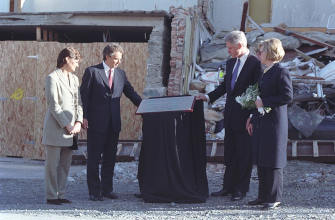
On September 3, 1998, near the scene of the explosion, United States President Bill Clinton and British Prime Minister Tony Blair unveil a plaque in memory of the twenty-eight Omagh bombing victims. Crowds of thousands waited hours to catch a glimpse of the president.

Following the unveiling, they walk through the town’s main street, Market Street, which bore the brunt of the explosion. Clinton, First Lady Hillary Clinton, who earlier placed a wreath at the newly-unveiled plaque, Blair and his wife Cherie meet and shake hands with many of the crowd, who are clearly pleased to see them. They also visit Watterson’s drapers shop, where three members of staff had been killed, and lay a wreath.

Earlier, in the town’s leisure centre, they meet the victims of the Omagh bombing, and the family and friends of those who died. Blair and Clinton spend about an hour talking to people in Omagh. They meet some of the people who had been injured in the blast, including a group who have been released from hospital for the day especially to meet the president. Una McGurk is discharged from the Altnagelvin Area Hospital in Derry, and sisters Laura and Nicola Hamilton from the Ulster Hospital in Dundonald, on the outskirts of east Belfast. Thirty-four people remain in hospital, three – two women and a man – in critical conditions.

Downing Street later says the Blairs and Clintons were “deeply moved” by their meeting in the gymnasium. The prime minister’s official spokesman says Blair found the courage and determination of the people he met “positively inspirational.”

The first person Clinton speaks to is a young girl who has both eyes covered with bandages. He also meets a boy wearing a Leeds United F.C. shirt who is unable to shake the president’s hand because both his hands are still bandaged.

Before arriving in Omagh, Clinton puts the issue of decommissioning at the top of his priorities for change in Northern Ireland. He says these priorities are “To decommission weapons of war that are obsolete in a Northern Ireland at peace, to move forward with a formation of an executive council, adapt your police force so it has the confidence, respect and support of all the people, to end street justice, because defining crime, applying punishment and enforcing the law, must be left to the peoples’ elected representatives, the courts and the police, and to pursue early release for prisoners whose organisations have truly abandoned violence and to help them find a productive, constructive place in society.”

(From: “Clinton consoles bomb victims,” BBC News, news.bbc.co.uk, September 4, 1998)


Leave a comment

Birth of Irish Republican Colm Murphy

Colm Murphy, Irish republican who is the first person to be convicted in connection with the Omagh bombing, but whose conviction is overturned on appeal, is born on August 18, 1952, in Belleeks, County Armagh, Northern Ireland.

Murphy is an active Irish republican paramilitary from his late teens. In March 1972, he is arrested in Dundalk regarding an assault and is sentenced to two years in prison after the Garda Síochána find a loaded revolver in his car. He is imprisoned in the Curragh Camp but escapes in October 1972 and is not recaptured until May 1973. In June 1976, he is imprisoned again, receiving a three-year sentence for firearms offences and a one-year sentence for Provisional Irish Republican Army membership, both sentences to run concurrently. In July 1983, he is arrested in the United States after attempting to buy a consignment of M60 machine guns to be shipped to Ireland for use by the Irish National Liberation Army (INLA). He receives a five-year prison sentence but returns to Ireland in December 1985 after being released early.

In the late 1980s, Murphy begins investing in property and forms a company named Emerald Enterprises in 1990. He purchases the Emerald Bar public house in Dundalk for IR£100,000, and it later becomes a meeting place for dissident republicans. Other investments included 30 acres of land in Drogheda bought for IR£52,000 in 1995, and his company wins contracts for an IR£11 million development at Dublin City University (DCU) and the multi-million-pound International Financial Services Centre in the Dublin Docklands.

Murphy is arrested by the Gardaí on February 21, 1999, for questioning under anti-terrorist legislation. On February 24, he becomes the first person to be charged in connection with the Omagh bombing, when he appears before Dublin‘s Special Criminal Court and is charged with conspiring to cause an explosion under the terms of Ireland’s Offences Against the State Act, between August 13-16, 1998. He is also charged with membership in an illegal organisation, the Real Irish Republican Army (RIRA).

On October 10, 2000, the BBC television show Panorama names Murphy as one of four people connected with the Omagh bombing, along with Seamus Daly and Liam Campbell. In 2001, he undertakes legal action against the BBC and Daily Mail publishers Associated Newspapers for contempt of court. The action against Associated Newspapers is settled on July 31, 2001, and the newspaper releases a statement saying Murphy is entitled to be presumed innocent of the charges against him until proven guilty.

Murphy’s trial begins at Special Criminal Court in Dublin on October 12, 2001. The court hears that Murphy had supplied two mobile phones which were used during the bombing. One witness, Murphy’s second cousin, retracts his evidence and the judge calls the conduct of two detectives outrageous, saying they had persistently lied under cross-examination. Despite this, on January 22, 2002, he is convicted of conspiring to cause the Omagh bombing, and on January 25 is sentenced to 14 years imprisonment with the judge describing him as a long-time republican extremist.

On January 21, 2005, Murphy’s conviction is overturned and a new trial ordered, due to the invasion of Murphy’s presumption of innocence, and alteration of Gardaí interview notes and evidence presented by two officers. A week later, his legal case against the BBC is resolved, with the BBC issuing a statement that Murphy “was fully entitled to maintain his innocence of the charges against him and to test the evidence against him at his trial.”

On October 23, 2006, two Gardaí officers are found not guilty of perjuring themselves during Murphy’s trial. On May 23, 2007, it is announced that Murphy is suffering from short-term memory loss resulting from a car accident in 1988. His lawyers attempt to prevent a retrial taking place, on the grounds that his condition interferes with his right to a fair hearing. The Court of Criminal Appeal is scheduled to hear his case again in October 2008. Following a retrial held in January 2010, he is acquitted on February 24, 2010.

In 2009, Murphy is one of four men found by a civil court to be liable for the Omagh bombing in a case taken by relatives of the victims. On July 7, 2011, in Belfast High Court, Lord Justice Malachy Higgins directs a retrial of the civil claims against Murphy. He questions evidence surrounding emails from U.S. undercover agent David Rupert while overturning the judgment on Murphy. The paucity of the email evidence, the lack of consistency in the emails or at least ambiguity, the possibility of initials referring to someone other than Murphy and the fact that they refer on occasions to double hearsay considerably weaken the emails as evidence, he says. Following a civil retrial on March 20, 2013, Murphy and Seamus Daly are found liable for involvement in the bombing.

Murphy dies peacefully of degenerative lung disease at the age of 70 on April 18, 2023, at Our Lady of Lourdes Hospital in Drogheda, County Louth.


Leave a comment

Charles, the Prince of Wales, Visits Omagh

Charles, the Prince of Wales, visits Omagh, County Tyrone, Northern Ireland, on May 5, 1999, and meets with relatives of those killed in the August 15, 1998 car bombing and some of the young people who were injured.

The prince has a private meeting with a group of those injured and bereaved in the August attack on the Northern Ireland market town, which left 29 dead. It fulfills a promise he made to the people of the town when he visited it three days after the bombing by the Real Irish Republican Army (IRA).

After his meeting with residents at the offices of Omagh District Council, the prince says, “I was determined to come back today to see how all of you were faring after all the terrible things you have had to go through.”

Referring to the IRA assassination of his uncle, Lord Mountbatten, he says, “Having experienced myself a relative who was blown to smithereens, I can well understand how these poor people must feel.” He adds that there is enormous concern and care across the world, and many who have given generously to the Omagh Fund, which organisers say has topped £4.5m.

Before visiting the site of the bombing and the regeneration scheme, the prince says the rebuilding plans are bringing “new life, new meaning and new hope back to this really remarkable community.”

“It always was a remarkable community, it still is. You set a wonderful example to many other communities, not only in Northern Ireland but in other parts of the world who also have suffered so traumatically,” the prince says.

Speaking about his visit to Soho following the Admiral Duncan pub bombing by neo-Nazi David Copeland the previous Friday (April 30, 1999), he adds, “I am sure your experiences will be of enormous help to those people in London who have shared with you yet another tragedy in another horrible bombing.”

Marion Radford, who was injured in the Omagh bombing and whose 16-year-old son Alan died, says, “Visits like this help, just to know people care. I found this helpful, I found him a very nice person, he does care and was a sympathetic listener.”

(From: “UK Prince returns to Omagh,” BBC News, http://www.bbc.news.com, May 5, 1999)


Leave a comment

The Murder of IRA Volunteer Eamon Collins

Eamon Collins, member of the Provisional Irish Republican Army (IRA) in the late 1970s and early 1980s, is beaten and stabbed to death by an unidentified assailant(s) in the early morning hours of January 27, 1999, in Newry, County Down, Northern Ireland.

Collins is born in 1954 in Camlough, County Armagh, Northern Ireland, the son of Brian Collins, a farmer, livestock trader, and cattle smuggler, and Kathleen Collins (née Cumiskey). His extended family has no history of political involvement, though his upbringing is fervently Catholic and nationalist. He leaves secondary school at age 16 and briefly works as a clerk in the Ministry of Defence in London. He returns home for family reasons and resumes his education in 1971 through a scholarship to St. Colman’s College, Newry, County Down. In 1973 he goes to Queen’s University Belfast (QUB) to study law.

Collins develops ultra-leftist political beliefs in his late teens and supports the Northern Ireland civil rights movement but retains reservations about the use of violence. He is further radicalised by being beaten up by soldiers searching his family’s farm at Easter 1974 and by the downfall of the power sharing executive. He loses interest in his studies, leaves QUB in 1976 without completing his degree, and drifts for two years, joining an anarchist collective in Belfast. He comes back into contact with the republican movement through the blanket protest by Long Kesh inmates; he had known hunger striker Raymond McCreesh as a teenager. In 1978 he joins the customs service in Newry and begins to pass information to the IRA, which he joins in 1979. He is central to IRA recruitment and intelligence in Newry and south Down. Without firing a shot himself he facilitates at least five murders, including that of a customs colleague.

In 1982 Collins marries and the couple has four children. By 1984 he has developed doubts about his activities. He antagonises the Belfast leadership, which is moving towards political engagement and away from the all-out revolutionary violence that he favours, and while he admires the hardline South Armagh IRA for its military professionalism, he regards its members as political primitives. On February 28, 1985, he is arrested after an IRA mortar attack in which nine Royal Ulster Constabulary (RUC) members are killed. He breaks down after six days of interrogation and is recruited as a “supergrass,” but retracts his evidence a fortnight later and is held on remand on the basis of his confessions.

In January–February 1987 Collins is tried for murder but acquitted after the judge rules his statements inadmissible. He completes an Open University degree while awaiting trial. After his release he is ostracised and is interrogated by the IRA, which in July 1987 orders him to leave Northern Ireland. He engages in youth work in Dublin from 1987 to 1990, taking a diploma in community work at Maynooth. His wife and children remain in Newry and he visits them regularly in defiance of the expulsion order. In 1990 he returns to live in Newry and teaches at the Ulster People’s College in Belfast. From 1992–94 he is a community worker in Edinburgh. His wife and children continue to live on the Barcroft Park estate in Newry.

In 1994 Collins returns permanently to Northern Ireland after securing a job at a youth club in Armagh. In April 1995 he describes his career in a television documentary, admitting the murders for which he had been tried. In 1997 he publishes a memoir, Killing Rage, a powerful account of life as a paramilitary, although it is not entirely reliable. After the 1995 documentary he experiences verbal and physical harassment. This intensifies after May 1998 when he testifies for The Sunday Times in a libel action by Thomas Murphy, whom the paper accuses of being a leading IRA member. Four months after Murphy loses the case, the family farmhouse in Camlough, which Collins is renovating, is burned down. After the Omagh bombing he publishes several articles denouncing the Real IRA, several of whose activists he had recruited into the IRA from the Irish National Liberation Army (INLA) in the early 1980s. Graffiti regularly appears outside his home in Newry denouncing him as a British agent.

Early in the morning of January 27, 1999, Collins paints out the latest graffiti, and is walking his dogs near the Barcroft Park Estate in Newry along a quiet stretch of country lane at Doran’s Hill, just within sight of Sliabh gCuircin (Camlough Mountain). His body also bears marks of having been struck by a car moving at speed. The subsequent police investigation and Coroner’s Inquest comments upon the extremity of weaponed violence to Collins’ head and face used during the attack.

Rumoured reasons behind the murder are that Collins had returned to Northern Ireland in breach of the IRA’s banning order, and further he had detailed IRA activities and publicly criticized in the media a multiplicity of Irish Republican paramilitary splinter groups that had appeared after the Provisional IRA’s 1994 ceasefire, and that he had testified in court against Murphy. Gerry Adams states the murder was “regrettable,” but adds that Collins had “many enemies in many places.”

After a traditional Irish wake, with a closed coffin necessitated due to the damage to his face, and a funeral service at St. Catherine’s Dominican Church in Newry, Collins’ body is buried at the city’s Monkshill Cemetery, not far from the grave of Albert White, a Catholic former Royal Ulster Constabulary Inspector, whose assassination he helped to organise in 1982.

In January 2014 the Police Service of Northern Ireland (PSNI) releases a statement that a re-examination of the evidence from the scene of the 1999 murder had revealed new DNA material of a potential perpetrator’s presence, and makes a public appeal for information, detailing the involvement of a specific car model, a white coloured Hyundai Pony, and a compass pommel that had broken off a hunting knife during the attack and had been left behind at the scene. In February 2014 detectives from the Serious Crime Branch arrest a 59-year-old man at an address in Newry in relation to the murder, but he is subsequently released without charge. In September 2014 the police arrest three men, aged 56, 55 and 42, in County Armagh in relation to inquiries into the murder, all of whom are subsequently released without charges after questioning. In January 2019 the police release a statement regarding the murder that one of the assailants had been seriously injured by an accidentally sustained knife wound during the attack, and had left traces of his own blood at the scene, and that recent scientific advances in DNA evidence had increased the possibility of his identification. In May 2019, three men aged 60 to 62 are arrested and questioned, but then released unconditionally.


Leave a comment

Real IRA Pledges Continuation of Campaign of Violence

On October 21, 2002, the Real Irish Republican Army (RIRA) pledges to continue their campaign of violence, ignoring a call by the prisoners in Portlaoise Prison to disband and confirm the organisation has split.

Hardliners on the outside, mostly from Northern Ireland, issue a statement warning people to stay away from British army barracks and police stations.

The caller to a newspaper in Derry says, “We warn all civilians to stay away from military installations and Crown Force personnel. A number of recent attacks have had to be aborted due to the presence of civilians in the vicinity. Anyone entering military installations does so at their own risk.”

No reference is made to a lengthy statement, issued over the previous weekend by prisoners in Portlaoise Prison, that calls for the “Army Council” to stand down.

The prisoners with the exception of three claim the present leadership’s “financial motivations far outweigh their political commitment.” The Real IRA, heavily involved in smuggling cigarettes, is estimated to amass nearly 5m a year. Nearly 40 prisoners are being held in Portlaoise at the time and a further 30 are in jail in Northern Ireland. Three are serving sentences in England.

In the statement, the organisation claims responsibility for a coffee-jar bomb attack on Castlederg Police Station in County Tyrone. They have also been blamed for a series of hoax bomb alerts in the centre of Belfast and at Belfast International Airport.

Michael Gallagher, whose son Aidan is one of 29 people, including a woman pregnant with twins, killed in the group’s bomb attack in Omagh in August 1998, says the statement is a clear message that the Real IRA are going to continue killing innocent people. “The only people who have decided to pursue a peaceful path are those who are locked up in jail and are powerless to do anything about it,” Gallagher says.

“It looks as if it is business as usual for the Real IRA even though there is obviously an internal split,” Gallagher adds.

The Real IRA statement is phoned with a recognised code word to the Derry Journal newspaper, where civilian workman David Caldwell was killed in a Real IRA bomb attack on a Territorial Army base in August 2002.

(From: “Real IRA vows to continue violence” by John Breslin, Irish Examiner, October 22, 2002)


Leave a comment

Neeson & Richardson Donate Libel Payout to Omagh Bombing Victims

On September 27, 1998, film star couple Liam Neeson and Natasha Richardson announce they will donate a five-figure libel payout to a memorial fund for the victims of the Omagh bomb massacre that occurred in Northern Ireland on August 15, 1998, killing 29 people.

Neeson and Richardson win £50,000 ($85,370) in libel damages over newspaper allegations that their marriage is on the rocks. The couple sues the Daily Mirror publishers MGN for libel and malicious falsehood after the tabloid paper claimed Natasha Richardson was filing for divorce behind her husband’s back and that their marriage was a sham.

The story is published in August 1998 in London, Scotland, the Irish Republic and Northern Ireland – where Neeson was born and where his family still live.

A High Court judge in London hears that the actors – married for four years with two young sons – were shocked by the allegations which caused “an explosion of publicity worldwide.”

Neeson, who is nominated for an Academy Award for his role in the film Schindler’s List, is told about the article by his mother. She phones him in great distress from Northern Ireland after seeing the headlines while out shopping.

The actors’ solicitor, Mark Thomson, tells Mr. Justice Gray that the couple then spent several days attempting to deal with the destructive aftermath of the articles denying the allegations to friends and family.

Mirror Group Newspapers accepts “unequivocally” that the story is entirely false and apologises for the embarrassment, hurt and distress caused to the couple. “We entirely accept that there is absolutely no truth in the allegations about Mr. Neeson and Miss Richardson and that the allegations should never have been published. We apologise unreservedly to Mr. and Mrs. Neeson and their family for the distress and embarrassment they have been caused. We have agreed not to repeat the allegations and to pay substantial damages to them, which they are donating to the victims of the Omagh bombing.”

The information came from a source thought to be reliable, but it was clearly a mistake for the reporter to rely on that source, says solicitor Martin Cruddace.


Leave a comment

Blair & Ahern Meet in Aftermath of the Omagh Bombing

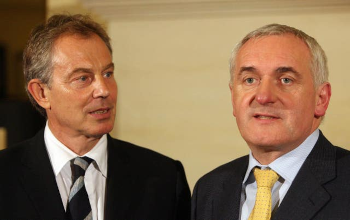
British Prime Minister Tony Blair meets with Taoiseach Bertie Ahern in Ashford Castle, County Mayo on August 26, 1998. They join forces to fight terrorism and discuss laws which will be introduced in the aftermath of the Omagh bombing, which took place eleven day earlier on August 15 in Omagh, County Tyrone, 110 kilometres west of Belfast, and resulted in 28 deaths.

Leading the way in a return to the past is Ahern’s Dublin government, which has introduced the toughest anti-terrorist legislation in the history of the Irish Republic. He concedes that the measures are draconian but says that his government is determined to do everything in its power, “working closely with the British government to defeat and suppress this murderous conspiracy against the people of Ireland.”

Prime Minister Blair promises that he too plans to introduce extreme measures. “We will bring in similar measures to those proposed by the Irish government, so we will then have the toughest anti-terrorist measures for the whole of Ireland, the Republic and Northern Ireland, that we have ever seen.”

With no plans to recall the British parliament, it is thought that existing legislation will be applied, since it already includes measures similar to those announced by the Irish government.

Oppressive British legislation has sustained British rule in Ireland for decades. This includes internment without trial, non-jury courts, entry and search of homes without a warrant, seven-day detention with unrecorded and unsupervised interrogation, denial of access to lawyers, exclusion orders and more. Most of these are still in use in 1998.

The Ahern package includes withdrawal of a suspect’s right to silence — refusal to answer questions can be used as evidence that a suspect is a member of an illegal organisation, the seizure of property that has been used for storing weapons or making bombs, and the creation of a new offence of directing an unlawful organisation. This is expected to carry the penalty of life imprisonment.

Omagh is 75% nationalist, with good cross-community relations, and has largely escaped the worst of the conflict. Although Republican dissidents have carried out a spate of similar bombings in the previous year, the towns targeted are mainly Unionist and further east.

In the wake of the Good Friday Agreement, Republican splinter groups remain on a military footing. These groups — the Irish National Liberation Army (INLA), the Continuity IRA and the Real IRA — have announced their determination to fight on.

The group that claims responsibility for the Omagh bombing is the Real IRA, which was formed in protest at the IRA’s 1997 cease-fire. Irish police have insisted that the Real IRA is the military wing of the recently formed 32 County Sovereignty Movement (32CSM), although this is denied by that organisation.

Although both the INLA and the Real IRA have declared a unilateral cease-fire since the Omagh bombing, media focus has settled on Bernadette Sands McKevitt, sister of the 1980s IRA hunger striker Bobby Sands, who is a leading figure in the 32 County Sovereignty Movement. Sands-McKevitt has condemned the Omagh bombing, but her home in Blackrock, County Louth, has since been targeted by local townspeople who have staged protests against her and her family. She has also been denied a visa to enter the United States on a speaking tour.

The Omagh bombing could not have come at a better time for Britain. With the war formally over and Sinn Féin penned, the bombing delivers an opportunity to smash the Republican left once and for all and wrench it from any semblance of ongoing support in Ireland.

All nationalist opponents of the Good Friday Agreement must now cope with being stained by the blood of Omagh. With the massive referendum vote in favour of peace to back them up, the British and Irish governments can be satisfied that the Good Friday Agreement now looks more in place than at any other time. As one nationalist describes the situation, “If the Good Friday Agreement was a defeat for the cause of Irish nationalism, the Omagh bombing has turned it into a rout.”

(From: “Blair, Ahern make the most of Omagh bomb” by Dave Riley, Green Left (www.greenleft.org), August 26, 1998)


Leave a comment

Second Inauguration of Mary McAleese

Mary McAleese is inaugurated as President of Ireland for a second term on November 11, 2004, becoming the fourth president up to that point to secure a second term, joining Sean T. O’Kelly, Éamon de Valera and Patrick Hillery. As of this writing in 2020, Michael D. Higgins is currently serving his second term as president.

McAleese’s initial seven-year term of office ends in November 2004, but she stands for a second term in the 2004 Irish presidential election. Following the failure of any other candidate to secure the necessary support for nomination, the incumbent president stands unopposed, with no political party affiliation, and is declared elected on October 1, 2004.

McAleese is re-inaugurated at the commencement of her second seven-year term on November 11, 2004. Her very high approval ratings are widely seen as the reason for her re-election, with no opposition party willing to bear the cost, financial or political, of competing in an election that would prove difficult to win.

Following the inauguration ceremony earlier in the day in Dublin Castle, McAleese attends a reception there hosted by the Government to mark the beginning of her second term of office. The 700 invited guests include members of the Government, the Oireachtas, the judiciary and dignitaries from Christian churches and other faiths.

McAleese identifies the need for strong and resilient communities as the theme of her second term in office. Speaking after her inauguration in the afternoon, she says, “The cushion of consumerism is no substitute for the comfort of community.” Speaking on the Northern Ireland peace process, she urges the hesitant to “muster the courage to complete the journey to a bright new landscape of hope.”

McAleese’s first term is distinguished by her work following the Omagh bombing and the September 11 terror attacks in the United States, as well as her behind-the-scenes work to open a dialogue with loyalists after the Good Friday Agreement.

Prevented by the Constitution of Ireland from running for a third term, McAleese leaves office in 2011 as one of Ireland’s most popular and respected presidents.

(Pictured: the second inauguration of Mary McAleese, November 11, 2004, President of Ireland website, http://www.president.ie)