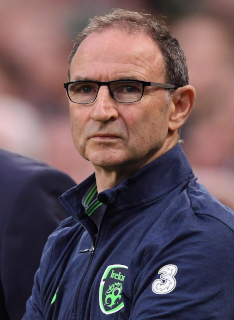
O’Neill becomes Republic of Ireland manager in 2013 and leads them to qualification for the 2016 UEFA European Football Championship for the third time in the nation’s history, beating the reigning world champions, Germany, in the process. He leaves the role with assistant Roy Keane by “mutual agreement” in November 2018. He is appointed as Nottingham Forest manager on January 15, 2019. He guides the club to a ninth-place finish in the Championship. However, he is sacked as manager on June 28, 2019, after reportedly falling out with some of the senior first team players.
In 2002, Norwich supporters voted O’Neill into the club’s Hall of Fame. He is awarded an OBE for services to sport in 2004. He is awarded the Nottingham Lifetime Achievement Award on November 3, 2013 for his services to football and achievements with Nottingham Forest.
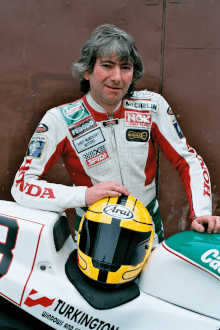
Dunlop marries on September 22, 1972 at the Ballymoney register office. He is the proprietor of a pub in Ballymoney and is highly superstitious, always wearing a red T-shirt and his yellow crash helmet when racing. He is presented with the Freedom of the Borough by Ballymoney Council in 1993.
Dunlop helps orphans in the Balkans, driving a van loaded with supplies to orphanages in Romania, Albania and Bosnia-Herzegovina before the annual racing season begins. In 1996, he receives an OBE for his humanitarian work.
On the night of May 23, 1985, Dunlop is traveling from Northern Ireland to the Isle of Man for the annual TT races by sea, onboard the Tornamona, a former fishing boat. The vessel departs from Strangford, County Down with Dunlop, other riders, racing bikes and equipment onboard. Strong currents into Strangford Lough push the Tornamona onto St. Patrick’s Rock where her rudder breaks off in a crevice. The boat sinks and all 13 passengers and crew are rescued by the PortaferryLifeboat. The bikes are later recovered by divers.
In 1986, Dunlop wins a fifth consecutive TT Formula One world title. Initially based on one race at the Isle of Man TT after the loss of World Championship status from 1977-onwards and organised by the Auto-Cycle Union, the title is eventually expanded to take in more rounds in other countries.
Dunlop is awarded the MBE in 1986 for his services to the sport. He is featured in three documentary films regarding his career: V Four Victory (1983), Joey – The Man Who Conquered the TT (2013) and Road (2014).
Dunlop wins his third hat trick at the Isle of Man TT in 2000 and sets his fastest lap on the course of 123.87 mph in the Senior race, in which he finishes third.
Dunlop dies in Tallinn, Estonia, on July 2, 2000 while leading a 125cc race on the Pirita-Kose-Kloostrimetsa Circuit. He appears to lose control of his bike in the wet conditions and dies instantly on impact with trees. As a mark of respect, the Estonian government’s official website is replaced with a tribute to Dunlop within hours of his death. Northern Ireland television carries live coverage of his funeral. Fifty thousand mourners, including bikers from all parts of Britain and Ireland and people from all backgrounds in Northern Ireland, attend the funeral procession to Garryduff Presbyterian church and his burial in the adjoining graveyard.
Following Dunlop’s death, the Leisure Centre in his hometown of Ballymoney is renamed from the Riada Centre to the Joey Dunlop Leisure Centre. Also, a memorial statue is erected in his hometown. The Joey Dunlop Foundation is initiated, a charity that provides appropriate accommodation for disabled visitors to the Isle of Man. In 2001, the Joey Dunlop Memorial Garden is established in the Dunlop family’s hometown, and in 2010 the tribute is extended to include the Robert Dunlop Memorial Garden to honour Joey’s late brother, Robert Dunlop.
The most successful overall rider at the annual TT races is awarded the “Joey Dunlop Cup.” On the Isle of Man, a statue of Dunlop astride a Honda overlooks the Bungalow Bend at Snaefell and the 26th Milestone area of the TT course is named “Joey’s.” A memorial stone is installed at the crash site in Tallinn as well. Irish publishers the O’Brien Press produces a full-colour pictorial tribute to Dunlop following his death. Northern Ireland band Therapy? records a song in memory of Dunlop called “Joey.” It appears on the album Shameless, released in 2001.
On January 30, 2015, Dunlop is voted Northern Ireland’s greatest sports star by readers of the Belfast Telegraph newspaper. In 2016 he is voted through Motorcycle News as the fifth greatest motorcycling icon ever, behind Valentino Rossi.
Murdoch is born on July 15, 1919, in Phibsborough, Dublin, the daughter of Irene Alice (née Richardson) and Wills John Hughes Murdoch. Her father, a civil servant, comes from a mainly Presbyterian sheep farming family from Hillhall, County Down. In 1915, he enlists as a soldier in King Edward’s Horse and serves in France during World War I before being commissioned as a second lieutenant. Her mother trains as a singer before Iris is born and is from a middle-class Church of Ireland family in Dublin. Her parents first meet in Dublin when her father is on leave and are married in 1918. Iris is the couple’s only child. When she is a few weeks old the family moves to London, where her father had joined the Ministry of Health as a second-class clerk. She is a second cousin of the Irish mathematician Brian Murdoch.
From 1947 to 1948 Murdoch studies philosophy as a postgraduate at Newnham College, Cambridge. She meets Ludwig Wittgenstein at Cambridge but does not hear him lecture, as he had left his Trinity College professorship before she arrives. In 1948 she becomes a fellow of St. Anne’s College, Oxford, where she teaches philosophy until 1963. From 1963 to 1967 she teaches one day a week in the General Studies department at the Royal College of Art.
In 1956 Murdoch marries John Bayley, a literary critic, novelist, and from 1974 to 1992 Warton Professor of English at Oxford University, whom she had met in Oxford in 1954. The unusual romantic partnership lasts more than forty years until Murdoch’s death. Bayley thinks that sex is “inescapably ridiculous.” She in contrast has “multiple affairs with both men and women which, on discomposing occasions, Bayley witnesses for himself.”
Murdoch’s first novel, Under the Net, is published in 1954 and is selected in 1998 as one of Modern Library’s 100 best English-language novels of the 20th century. She had previously published essays on philosophy, and the first monograph about Jean-Paul Sartre published in English. She goes on to produce 25 more novels and additional works of philosophy, as well as poetry and drama.
Murdoch’s last novel, Jackson’s Dilemma, is published in 1995. She is diagnosed with Alzheimer’s disease in 1997 and dies on February 8, 1999, in Oxford. There is a bench dedicated to her in the grounds of Lady Margaret Hall, Oxford, where she enjoyed walking.
Henry’s legal career flourishes. He becomes Queen’s Counsel in 1896, a Bencher of the King’s Inns in 1898 and ultimately Father of the North-West Circuit – but his interest in politics does not diminish. In March 1905, he is a delegate at the inaugural meeting of the Ulster Unionist Council and in the 1907 North Tyrone by-election he is the Unionist candidate, losing by a mere seven votes.
On May 23, 1916, Henry is elected as an MP in the South Londonderry by-election, the first by-election to be held in Ireland after the Easter Rising, which occurred a month earlier. The rebellion has had no discernible impact on the contest.
Henry marries Violet Holmes, daughter of Hugh Holmes, a judge of the Court of Appeal in Ireland, and Olivia Moule. They have five children, including James Holmes Henry, who succeeds as second baronet. It is a mixed marriage as Violet is and remains a staunch member of the Church of Ireland. Despite their religious differences, the marriage is said to be happy.
Henry dies in Belfast on October 1, 1925, aged 61, and is buried near his native Draperstown.
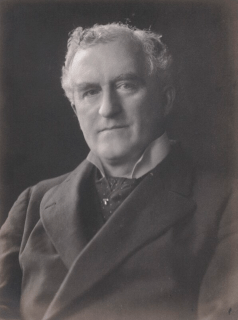
(Pictured: Sir Denis Stanislaus Henry, 1st Baronet, bromide print by Walter Stoneman, 1920, National Portrait Gallery, London)
In 1987 Clarke plays collegiate golf at Wake Forest University in the United States. He is a junior member of Dungannon Golf Club, whose junior section also includes three others who are current PGA Golf Professionals: Alistair Cardwell, Barry Hamill and Gary Chambers. He represents his school, Royal School Dungannon, together with Cardwell and Chambers.
A stalwart of the European Tour since 1991, Clarke is no stranger to firsts. In the 1999 Smurfit European Open he becomes the first player on the European Tour to shoot 60 for a second time, having achieved it first in the 1992 European Monte Carlo Open. In 2002 he becomes the first player to win the English Open three times and in 2003 becomes the first player outside Tiger Woods to capture more than one World Golf Championships title.
Three weeks after the untimely death of his wife, Heather, to cancer in August 2006, Clarke is picked as one of the wild cards for the Ryder Cup at K Club. In an emotionally charged week he produces one of his most memorable performances, winning all three of his matches.
Clarke assures his place in history by earning a place in the renowned ‘Who’s Who‘ guide for 2008, and in 2005 he even appears on an Irish postage stamp. A difficult 2007, where he juggles looking after his two sons with his golf regime, sees him slip down the rankings, but he begins to find his form again in South Africa before the winter break.
In 2010 Clarke beats a world-class field in the J. P. McManus Invitational Pro-Am at Adare Manor in Ireland where he has a one-shot victory over Luke Donald. He secures his spot in the 139th Open Championship at the Old Course at St. Andrews by finishing second in the Barclays Scottish Open. He finishes 30th in the European Tour Race. He rounds off 2010 in great style with the announcement of his engagement to Alison Campbell.
In February 2015, Clarke is named as Europe’s Ryder Cup captain and dedicates the next 18 months to the role. Ultimately, Europe is beaten 17-11 by the United States at Hazeltine National Golf Club.
A dedicated worker for charity, Clarke sets up his own Darren Clarke Foundation, which not only helps further the development of junior golf in Ireland, but also now raises money for Breast Cancer Awareness.
Sharkey’s debut single is a collaboration with Madness member Cathal Smyth titled “Listen to Your Father.” The single is released on Madness’s label Zarjazz in 1984, reaching No. 23 in the UK chart. The track is performed on Top of the Pops with members of Madness.
Sharkey’s solo work is significantly different from the post-punk offerings of The Undertones. His best-known solo material is the 1985 UK chart-topping single penned by Lone Justice frontwoman Maria McKee, “A Good Heart,” which goes to No. 1 in several countries including the UK in late 1985. He also has a UK Top 5 hit in 1986 with “You Little Thief.” His eponymous debut album reaches No. 12 in the UK Albums Chart.
Following on from his second album Wish in 1988, Sharkey achieves further success in 1991 with his UK Top 30 album Songs From The Mardi Gras, which produces the No. 12 hit single “I’ve Got News for You.”
Starting in the early 1990s Sharkey moves into the business side of the music industry, initially as A&R for Polydor Records, and then as managing director of EXP Ltd. He is appointed a member of the Radio Authority for five years from December 1998 to December 2003.
When the Undertones reunite in 1999, Sharkey is offered the opportunity to rejoin the group but turns down the offer. His position as lead vocalist/frontman for the Undertones is taken by fellow Derry native Paul McLoone, who is also a radio presenter for the Irish national and independent radio station, Today FM.
Sharkey becomes chairman of the UK Government task force the ‘Live Music Forum’ in 2004, to evaluate the impact of the Licensing Act 2003 on the performance of live music, and gives public evidence before the Culture, Media and Sport Committee on November 11, 2008.
In 2008, Sharkey is appointed as the CEO of British Music Rights, replacing Emma Pike. In October 2008, he becomes head of UK Music, an umbrella organisation representing the collective interests of the UK’s commercial music industry. He has become prominent in criticising the use of Form 696 by the Metropolitan Police requiring event promoters to provide data on performers and audiences. He resigns from UK Music on November 11, 2011.
In 2011 Sharkey makes a one-off appearance in a set named Erasure + Special Guests singing “Never Never.” He states that he has not sung live for 20 years and that Vince Clarke is the only person he would have returned for.
Sharkey appears on BBC Radio Newcastle, interviewed by Simon Logan on the afternoon show on August 7, 2013. He speaks about his career and his decision to retire from the stage. “I’ve had an absolutely brilliant career… It’s time to get off the stage and make room for [new artists].”
Sharkey is awarded the “Scott Piering Award” by the radio industry in 2004, the “Bottle Award” at the International Live Music Conference in 2006, and an Honorary “Doctor of Arts” by the University of Hertfordshire in 2008. In 2009 he enters The Guardian‘s MediaGuardian 100 at number 56. In 2010 he appears in Wired‘s The Wired 100 at number 45. The same year he receives a Doctor of Letters honoris causa from the University of Ulster in recognition of his services to music.
Bowen is baptised in St. Stephen’s Church on Upper Mount Street. Her parents, Henry Charles Cole Bowen and Florence (née Colley) Bowen, later bring her to Bowen’s Court at Farahy, near Kildorrery, County Cork, where she spends her summers. When her father becomes mentally ill in 1907, she and her mother move to England, eventually settling in Hythe. After her mother dies in 1912, she is raised by her aunts. She is educated at Downe House School under the headship of Olive Willis. After some time at art school in London she decides that her talent lay in writing. She mixes with the Bloomsbury Group, becoming good friends with Rose Macaulay who helps her seek out a publisher for her first book, a collection of short stories entitled Encounters (1923).
In 1923 Bowen marries Alan Cameron, an educational administrator who subsequently works for the BBC. The marriage has been described as “a sexless but contented union.” She has various extra-marital relationships, including one with Charles Ritchie, a Canadiandiplomat seven years her junior, which lasts over thirty years. She also has an affair with the Irish writer Seán Ó Faoláin and a relationship with the American poet May Sarton. She and her husband first live near Oxford, where they socialize with Maurice Bowra, John Buchan and Susan Buchan, and where she writes her early novels, including The Last September (1929). Following the publication of To the North (1932) they move to 2 Clarence Terrace, Regent’s Park, London, where she writes The House in Paris (1935) and The Death of the Heart (1938). In 1937, she becomes a member of the Irish Academy of Letters.[3]
In 1930 Bowen becomes the first (and only) woman to inherit Bowen’s Court, but remains based in England, making frequent visits to Ireland. During World War II she works for the British Ministry of Information, reporting on Irish opinion, particularly on the issue of neutrality. Her political views tend towards Burkean conservatism. During and after the war she writes among the greatest expressions of life in wartime London, The Demon Lover and Other Stories (1945) and The Heat of the Day (1948). She is awarded the CBE the same year.
Bowen’s husband retires in 1952 and they settle in Bowen’s Court, where he dies a few months later. Many writers visit her at Bowen’s Court from 1930 onwards, including Virginia Woolf, Eudora Welty, Carson McCullers, Iris Murdoch, and the historian Veronica Wedgwood. For years Bowen struggles to keep the house going, lecturing in the United States to earn money. In 1957 her portrait is painted at Bowen’s Court by her friend, painter Patrick Hennessy. She travels to Italy in 1958 to research and prepare A Time in Rome (1960), but by the following year she is forced to sell her beloved Bowen’s Court, which is demolished in 1960. In the following months, she writes for CBS the narrative of the documentary titled Ireland the Tear and the Smile which is realized in collaboration with Robert Monks as cameraman and associate producer. After spending some years without a permanent home, she finally settles at “Carbery”, Church Hill, Hythe, in 1965.
In 1972 Bowen develops lung cancer. She dies at the age of 73 in University College Hospital in London on February 22, 1973. She is buried with her husband in St. Colman’s churchyard in Farahy, close to the gates of Bowen’s Court, where there is a memorial plaque to the author at the entrance to St. Colman’s Church, where a commemoration of her life is held annually.
Owing to his father’s death when he is four years old, McBride spends most of his spare time helping out on his family farm. Because of this he does not start playing rugby until he is seventeen. He is educated at Ballymena Academy and plays for the school’s First XV. After he leaves he joins Ballymena R.F.C.
In 1962 McBride is selected to play for Ireland. His first Test on February 10, 1962 is against England at Twickenham Stadium. Later that year he is selected to tour South Africa with the British and Irish Lions.
McBride continues to play for Ireland throughout the 1960s and plays for Ireland when they first defeat South Africa in 1965, and when Ireland defeats Australia in Sydney, the first time a Home Nations team had defeated a major southern hemisphere team in their own country. He is again selected for the Lions in 1966, this time touring New Zealand and Australia. He tours South Africa with the Lions again in 1968.
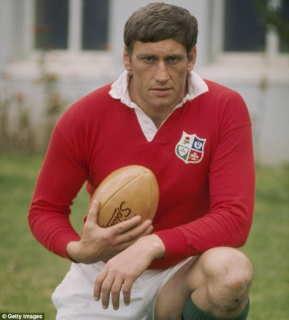
McBride is selected to play for the Lions in their 1971 tour of New Zealand. Despite being criticized by some as being “over the hill,” he is made pack leader and helps the Lions to a test series win over New Zealand, their first and last series win over New Zealand. He receives an MBE in 1971 for services to rugby football.
McBride’s leadership qualities lead to his appointment as captain of the British and Irish Lions in their 1974 tour to South Africa. The test series is won 3–0, with one match drawn, the first Lions series ever won in South Africa. It is one of the most controversial and physical test match series ever played. At the time there are only substitutions if a doctor agrees that a player is physically unable to continue and there are no video cameras and sideline officials to keep the punching, kicking and head butting to a minimum. If the South Africans are to resort to foul play then the Lions decide “to get their retaliation in first.” The signal for this is to call “99,” which is a signal for the Lions to clobber their nearest rival players.
In 1975 as his international career is ending McBride plays his last game for Ireland at Lansdowne Road. The game is against France, and near the end of the match he scores his first test try for Ireland. It is the crowning moment of a great playing career. His last international game is against Wales on March 15, 1975. After retiring from playing the game, McBride coaches the Irish team and is manager of the 1983 Lions tour to New Zealand. Despite the test results being mainly poor, team camaraderie is high and some good wins are recorded in other games.
In 1997 McBride is an inaugural inductee into the International Rugby Hall of Fame. He has been asked to present test jerseys and give motivational speeches to Lions players prior to matches. In 2004 he is named in Rugby World magazine as “Rugby Personality of the Century.” He is a major supporter of the Wooden Spoon Society.
Trevor is born to a middle-class, Anglo-IrishProtestant family. They move several times to other provincial towns, including Skibbereen, Tipperary, Youghal and Enniscorthy, as a result of his father’s work as a bank official. He is educated at St. Columba’s College, Dublin, and at Trinity College, Dublin, from which he receives a degree in history. He works as a sculptor under the name Trevor Cox after his graduation from Trinity College, supplementing his income by teaching. He marries Jane Ryan in 1952 and emigrates to Great Britain two years later, working as a copywriter for an advertising agency. It is during this time that he and his wife have their first son.
Trevor’s first novel, A Standard of Behaviour, is published in 1958 by Hutchinson of London, but has little critical success. He later disowns this work and, according to his obituary in The Irish Times, “refused to have it republished.” It was, in fact, republished in 1982 and in 1989.
In 1964, at the age of 36, Trevor wins the Hawthornden Prize for Literature for The Old Boys. The win encourages him to become a full-time writer. He and his family then move to Devon in South West England, where he resides until his death. In 2002, he makes honorary KBE for services to literature. Despite having spent most of his life in England, he considers himself to be “Irish in every vein.”
Trevor writes several collections of short stories that are well received. His short stories often follow a Chekhovian pattern. The characters in his work are typically marginalised members of society. The works of James Joyce influence his short-story writing, and “the odour of ashpits and old weeds and offal” can be detected in his work, but the overall impression is not of gloominess since, particularly in his early work, his wry humour offers the reader a tragicomic version of the world. He adapts much of his work for stage, television and radio. In 1990, Fools of Fortune is made into a film directed by Pat O’Connor, along with a 1999 film adaptation of Felicia’s Journey, which is directed by Atom Egoyan.
Trevor’s stories are set in both England and Ireland. They range from black comedies to tales based on Irish history and politics. His early books are peopled by eccentrics who speak in a pedantically formal manner and engage in hilariously comic activities that are recounted by a detached narrative voice. Instead of one central figure, the novels feature several protagonists of equal importance, drawn together by an institutional setting, which acts as a convergence point for their individual stories. The later novels are thematically and technically more complex. The operation of grace in the world is explored, and several narrative voices are used to view the same events from different angles.
O’Brien is born on December 15, 1930, the youngest child of farmer Michael O’Brien and Lena Cleary at Tuamgraney, County Clare, a place she would later describe as “fervid” and “enclosed.” Her father inherits a “thousand acres or more” and “a fortune from rich uncles,” but is a “profligate” hard drinker who gambles away his inheritance, the land sold off or bartered to pay debts. From 1941 to 1946 she is educated by the Sisters of Mercy at the Convent of Mercy boarding school at Loughrea, County Galway – a circumstance that contributes to a “suffocating” childhood. In 1950, having studied at night at pharmaceutical college and worked in a Dublin pharmacy during the day, she is awarded a licence as a pharmacist. She reads such writers as Leo Tolstoy, William Makepeace Thackeray, and F. Scott Fitzgerald.
In Dublin, O’Brien purchases Introducing James Joyce, with an introduction written by T. S. Eliot, and says that when she learned that James Joyce‘s A Portrait of the Artist as a Young Man was autobiographical, it made her realise where she might turn, should she want to write herself. “Unhappy houses are a very good incubation for stories”, she says. In London she starts work as a reader for Hutchinson, a publishing firm, where on the basis of her reports she is commissioned, for £50, to write a novel. She publishes her first book, The Country Girls, in 1960. This is the first part of a trilogy of novels (later collected as The Country Girls Trilogy), which includes The Lonely Girl (1962) and Girls in Their Married Bliss (1964). Shortly after their publication, these books are banned and, in some cases, burned in her native country due to their frank portrayals of the sex lives of their characters. She is accused of “corrupting the minds of young women.” She later says, “I felt no fame. I was married. I had young children. All I could hear out of Ireland from my mother and anonymous letters was bile and odium and outrage.”
In the 1960s, O’Brien is a patient of R. D. Laing. “I thought he might be able to help me. He couldn’t do that – he was too mad himself – but he opened doors,” she later says. Her novel A Pagan Place (1970) is about her repressive childhood. Her parents were vehemently against all things related to literature. Her mother strongly disapproved of her daughter’s career as a writer. Once when her mother found a Seán O’Casey book in her daughter’s possession, she tried to burn it.
O’Brien is a panel member for the first edition of BBC One‘s Question Time in 1979. In 2017 she becomes the sole surviving member.
In addition to the Irish PEN Award, O’Brien’s awards include The Yorkshire Post Book Award in 1970 for A Pagan Place, and the Los Angeles Times Book Prize in 1990 for Lantern Slides. In 2006, she is appointed adjunct professor of English Literature at University College Dublin.
In 2019, O’Brien is awarded the David Cohen Prize for Literature at a ceremony in London. The £40,000 prize, awarded every two years in recognition of a living writer’s lifetime achievement in literature, has been described as the “UK and Ireland Nobel in literature.” Judge David Park says, “In winning the David Cohen Prize, Edna O’Brien adds her name to a literary roll call of honour.”
(Pictured: Edna O’Brien speaking at the 2016 Hay Festival, photo by Andrew Lih and licensed under the Creative Commons Attribution-Share Alike 3.0 Unported license)






 seamus dubhghaill