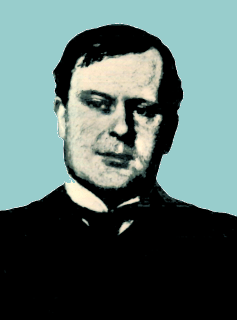
David Patrick Moran (Irish: Dáithí Pádraig Ó Móráin), better known as simply D. P. Moran, Irish journalist, activist and cultural-political theorist, dies on January 31, 1936. He is known as the principal advocate of a specifically Gaelic CatholicIrish nationalism during the early 20th century. Associated with the wider Celtic Revival, he promotes his ideas primarily through his journal, The Leader, and compilations of his articles such as the book The Philosophy of Irish Ireland.
Moran is born in Manor, a townland in Waterford, the youngest of twenty children born to James Moran, a builder, and Elizabeth Moran (née Casey). One of his brothers goes on to serve on the defense team of Patrick O’Donnell.
Despite the failure of the 1893 Home Rule Bill and the division of the Irish Parliamentary Party (IPP) in 1891, nationalists take heart from Douglas Hyde‘s 1892 speech, entitled “The Necessity for De-anglicising Ireland.” Moran builds upon this thesis and provides a wider ideology for enthusiasts, particularly after the re-unification of most of the nationalist parties from 1900.
In his 1905 text The Philosophy of Irish-Ireland, Moran argues that to be Irish requires:
the use of the Irish language
membership in the Roman Catholic Church
an anti-materialist outlook on life
the playing of only Gaelic games
Though a sponsor of the use of Irish, he never becomes fluent in the language himself. He emphasises the use of English in 1908–09 as “an active, vigilant, and merciless propaganda in the English language.” In the longer term, when Irish becomes again the language of the people, its use enables a de facto censorship of any foreign and unwelcome ideas written in English.
While Moran argues that the idea of “the Gael” is one that can assimilate others, he also feels that it will be hard if not impossible for members of the Church of Ireland who support the British Empire to ever qualify as Irish, being “resident aliens.” This extends to Anglo-Irish literature. He rejects the Abbey Theatre and questions Yeats‘ genius. He once speaks out against the influence Britain has over Irish Universities, stating, “We are all Palemen now.” In the matter of religious differences, Daniel O’Connell had said in 1826 that “the [Roman] Catholics of Ireland are a nation.” Moran moves beyond that, affirming in 1901 that “…the Irish Nation is de facto a Catholic nation.” He is virulent in his opposition to female suffrage.
Moran’s articles frequently contrast “Belfast” with “Ireland,” yet hope that Belfast can eventually change and assimilate. He feels that Ulster unionists should “… be grateful to the Irish nation for being willing to adopt them.” His paper publishes numerous articles by the future TDArthur Clery (writing under the pen name “Chanel”), who advocates partition on the grounds that Ulster unionists are a separate nation, but Moran himself disagrees and refuses to concede the legitimacy of a northern Protestant identity.
When Irish republicans initiate the Irish War of Independence in 1919, widescale anti-Catholic rioting breaks out in Belfast in 1920 and 1922. Moran identifies this as being caused by Orangeism, which he describes as “a sore and a cancer” in Ireland. He also alleges that “bigotry on the part of Catholics in the Six Counties is immediately due to Orange bigotry.”
Moran is initially a supporter of the Irish Parliamentary Party, believing that the separatism advocated by Arthur Griffith‘s Sinn Féin is impracticable; however, he opposes John Redmond‘s support of the British World War I effort.
Moran supports the Anglo-Irish Treaty agreed in 1921–22 and sees the partition of Ireland as beneficial for a truly Irish culture in the Irish Free State. This causes a sea-change in his opinions; from now on Northern Ireland can be safely ignored, along with what he sees as the English evils of “free thought, free trade, and free literature.” He claims Irish life and culture has to be protected from foreign influences, including the twin evils of the music hall and the English press. The new jazz music of the 1920s and other imported cultural elements are deprecated as “imported debasement and rot.”
On January 9, 1901, Moran marries Theresa Catherine, daughter of Thomas Francis O’Toole, a former Parnellite mayor of Waterford. They have four sons and one daughter.
Moran dies suddenly at his home in Skerries, Dublin, on January 31, 1936. His daughter, Nuala, who has written for the paper since the early 1920s, generally on artistic and social matters, takes over the running of the paper on his death, though it is then much diminished in size and influence. Nuala, who never marries, retains control of The Leader until it ceases publication in 1971.
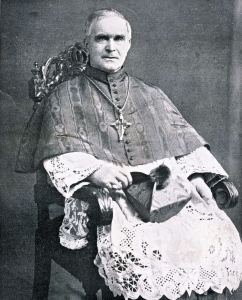
The Most Reverend William MacNeely, the Bishop of Raphoe from 1923 until 1963, is born in County Donegal on December 28, 1889. He has the distinction of being Raphoe’s first completely Roman-educated bishop.
MacNeely is the son of a butcher in Donegal Town. He is educated at the High School in Letterkenny, and in Rome from 1906–12. He is ordained to the priesthood on February 4, 1912, and upon his return to Ireland is appointed to the staff of St. Eunan’s College.
On July 27, 1923, at the comparatively young age of 35, MacNeely is ordained as Bishop of Raphoe in succession to Bishop Patrick O’Donnell who had been appointed coadjutorArchbishop of Armagh the previous year. In this role he is responsible for the completion of the Cathedral of St. Eunan and St. Columba in Letterkenny and negotiating with Harry Clarke to finish the work of glazing the cathedral.
Keen to develop religious life in his diocese, MacNeely invites the Capuchin Franciscans to the Creeslough area in 1930 to a site that becomes known as Ards Priory.
In a diocese where farming is the main industry, MacNeely maintains a strong interest in farming, being himself a successful breeder of Shorthorn cattle.
In 2008, it is reported that MacNeely was one of the two Irish episcopal coordinators who worked alongside “an intelligence-gathering secret service” set up in 1948 to monitor any sign of a “Communist takeover” of Ireland.
In 1953, MacNeely is a member of the inaugural Episcopal Commission for Emigrants reflecting the high levels of migration that afflict his diocese and wider Donegal for much of the twentieth century.
MacNeely serves as Bishop for over forty years, attending the early sessions of the Second Vatican Council. Shortly before his death, he is appointed Assistant to the Papal Throne. He dies on December 11, 1963, and is interred beside the Cathedral of St. Eunan and St. Columba.
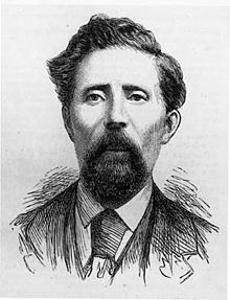
Sullivan, the second of six sons of Daniel Sullivan, house painter, and his wife, Catherine (née Baylor), a teacher, is born on May 15, 1829, in Bantry, County Cork. A popular date for Sullivan’s birth appears in many histories as 1830, but his gravestone reads 1829. He is educated in the local national school. One of his brothers is Timothy Daniel Sullivan, the Lord Mayor of Dublin from 1886 to 1888.
During the Great Famine of 1845 to 1847, Sullivan is employed as a clerk in connection with the relief works started by the government. Deeply influenced by the distress he witnesses, he afterward joins the Confederate Club formed in Bantry in support of the revolutionary movement of the Young Irelanders and is the organiser of the enthusiastic reception given by the town to William Smith O’Brien in July 1848 during the insurgent leader’s tour of the southern counties. Early in 1853, he goes to Dublin to seek employment as an artist. An exhibition of the arts and industries of Ireland is held in Dublin that year, and he is engaged to supply pencil sketches to the Dublin Expositor, a journal issued in connection with the exhibition. Subsequently, he obtains a post as a draughtsman in the Irish valuation office, and afterward as a reporter on the Liverpool Daily Post.
In 1855, Sullivan becomes assistant editor of The Nation, and subsequently editor and proprietor. From 1861 to 1884, in conjunction with his elder brother, T. D. Sullivan, he makes The Nation one of the most potent factors in the Irish Nationalist cause and also issues the Weekly News and Zozimus. Called to the Irish bar in 1876, he is a “special call” of the Inner Temple in 1877 and is made QC in 1881. He mainly practices at the English bar, though he acts in some political cases in Ireland.
As a member of the Dublin Corporation, Sullivan secures a magnificent site for the Grattan Monument, toward which he donates £400, the amount of a subscription by his admirers while he is undergoing imprisonment for a political offence in 1868. The monument is formally unveiled in January 1876. Between 1878 and 1882 he is engaged in many notable trials. His last great case is on November 30, 1883, when he is a colleague of Lord Russell in the defence of Patrick O’Donnell for the murder of James Carey, an informer.
Sullivan suffers another heart attack while on holiday in Bantry in September 1884 and spends his last days with William Martin Murphy at Dartry, County Dublin. Murphy regards him as a father figure, attributing his success to Sullivan’s early advice and journalistic training. Sullivan dies on October 17, 1884, at Dartry Lodge, Rathmines, Dublin. He is buried at Glasnevin Cemetery. With his wife, Frances Genevieve Donovan, whom he marries on April 27, 1861, and who outlives him by nearly forty years, he has a family of three sons and five daughters. His second son and namesake, Alexander Martin Sullivan, is the last to hold the rank of Serjeant-at-law (Ireland).
In addition to his labours, Sullivan is a great temperance reformer. He also writes two notable books, The Story of Ireland and New Ireland and contributes many sketches (including some verse) to Irish Penny Readings (1879–85). Some of his correspondence is located in the Isaac Butt papers in the National Library of Ireland.
In his early years, Devlin is active in various local debating societies, where his associates include Cathal O’Byrne, who he retains a personal friendship despite later political differences. A committee member of the Belfast branch of the Irish National League (INL) in 1890, he joins the anti-Parnellite faction during the O’Shea divorce scandal (1891), becoming local secretary of the Irish National Federation (INF). His political model at this time is Thomas Sexton, MP for Belfast West, whose campaign he organises at the 1892 United Kingdom general election.
Although Healyism is strong in CatholicUlster, Devlin aligns himself with the faction led by John Dillon and, from 1899, with the United Irish League (UIL), founded by William O’Brien. From the late 1890s this brings Devlin into conflict with the Belfast Catholic Association of Dr. Henry Henry, bishop of Down and Connor (1895–1908). This organisation, though sometimes regarded as Healyite, is essentially based on the view that mass nationalist political mobilisation in Belfast can only bring trouble and ostracism, and that Catholic interests are best represented by allowing a small group of lay and clerical notables to broker concessions from the unionist majority. After a series of local election contests in Catholic wards and controversies between the pro-Devlin weekly Northern Star and the clerically controlled The Irish News, Devlin succeeds in marginalising the politically maladroit Henry by 1905. In the process, however, he takes on some of the qualities of his “Catholic establishment” opponents. At the same time, he moves onto the national political stage.
Returned unopposed for North Kilkenny (1902–06), Devlin is appointed secretary of the United Irish League of Great Britain in 1903, and of the parent body in Dublin in 1904. A speaking tour of the United States in 1902–03 convinces him of the organisational potential of Catholic fraternal organisations, and in 1905 he takes over the presidency of the Board of Erin faction of the Ancient Order of Hibernians (AOH), a specifically Catholic body which he proceeds to develop as an organisational arm of the Nationalist Party. Under his tutelage the AOH expands from 10,000 members in 1905 to 60,000 in 1909, despite opposition from some Catholic bishops who distrust it because of its close affiliation to Dillonism, its secrecy, and its habit of staging dances and other entertainments without paying what they regard as due deference to local priests. His AOH also faces opposition from a rival separatist body, the Irish-American Alliance AOH. Though far less numerous, this group is able to draw on the support of separatists within the American AOH and hinder Devlin’s attempts to mobilise the American organisation in his support. The AOH expands further after 1910 and is strengthened by becoming an approved society under the National Insurance Act 1911.
Belfast is where Devlin’s political career begins and where it ends. Organisational skill contributes substantially to his hold on the largely working-class seat of Belfast West, which he wins in 1906 on a platform that seeks to transcend religious boundaries by combining labour issues with the home rule demand. A lifelong bachelor, though short in stature, he is apparently highly attractive to women, and takes a special interest in their problems, no doubt mindful of the influence they might have on the political behaviour of their spouses. He founds a holiday home for working-class women. When the scholar Betty Messenger interviews former Belfast linen workers in the late 1960s and early 1970s, she is startled to discover the extent to which Devlin is remembered as a champion of the workers decades after his death. This image persists among Protestant workers as well as Catholics, and he is generally credited with various ameliorations of workplace conditions even when he had not been responsible for them.
Possessed of great oratorical skills and even greater organisational ability, Devlin effectively becomes the key organiser of the Nationalist Party from the early years of the twentieth century, relieving the party leader, John Redmond, of a great deal of the administrative burden of party affairs, and becoming well known abroad through fund-raising trips, especially in North America. His personal geniality makes him a great favourite at Westminster, and Irish socialists are dismayed at the willingness of British Labour Party MPs to accept him as an authentic Labour representative. Several MPs elected after 1906 can be identified as his protégés, and groups of Hibernian strong-arm men uphold the party leadership in such contests as the 1907 North Leitrimby-election and the 1909 “baton convention” which witnesses the final departure of William O’Brien and his supporters from the UIL. He is the only post-Parnellite MP to be admitted to the tight leadership group around Redmond. In 1913 he is a leading organiser of the National Volunteers.
When William O’Brien embarks on his personal initiative to deal with the Ulster problem through conciliation in the early Edwardian period, he finds a stern critic in Devlin and in turn demonises the “Molly Maguires” as sectarian corruptionists. Personally non-sectarian, Devlin, like other party leaders, endorses the shibboleth that home rule will prove a panacea for Ireland’s problems, including Ulster, and uses his credentials as a labour representative to dismiss popular unionism as a mere product of elite manipulation. In a period when the Vatican‘s Ne Temere decree on religiously mixed marriages is heightening Protestant fears about the “tyranny” of Rome, he seems to be oblivious to how his integration of Hibernianism and nationalism is exacerbating that problem. As the third home rule bill passes through Parliament and the Ulster Volunteer Force (UVF) mobilises, he encourages the Irish party leaders in the view that the Ulster unionist campaign is a gigantic bluff, dismissing contrary opinions even when held by other nationalist MPs. During these years the AOH clashes with the Irish Transport and General Workers’ Union (ITGWU) during the Dublin lock-out, and from late 1913 the AOH spearheads the Redmondite attempt to take over and dominate the Irish Volunteers.
Devlin endorses Redmond’s support for the British war effort and engages in extensive recruiting activity. He seems to be motivated, at least in part, by the belief that after the war nationalist ex-soldiers can be used to overawe the Ulster unionists by the threat of force. According to Stephen Gwynn, Devlin wishes to apply for an officer’s commission but is asked not to do so by Redmond on the grounds that the party needs his organisational skills.
Devlin’s career is decisively shaped by his decision to use his influence to persuade northern nationalists to accept temporary partition, in fulfilment of the flawed agreement arrived at between David Lloyd George, Sir Edward Carson, and Redmond in the aftermath of the 1916 Easter Rising. He later claims he has been decisively influenced by the prospect that under this agreement the excluded area would be governed directly from Westminster, rather than by a local, Orange-dominated parliament. He forces the agreement through a Belfast-based convention despite protests from west Ulster nationalists, but the proposal collapses after it transpires that Lloyd George has made incompatible commitments to nationalists and unionists. Northern nationalism immediately splits between west and south Ulster dissidents and Devlin’s loyalists predominant in Belfast and east Ulster, and the next year sees massive secessions of AOH members outside Ulster to Sinn Féin. Although he retains a core of loyal supporters, he is reduced from a national to a sectional leader. As a member of the Irish convention (1917–18) he sides with Bishop Patrick O’Donnell against Redmond on the issue of seeking a compromise settlement with southern unionists on the basis of home rule without fiscal autonomy. He is offered the leadership of the Nationalist Party on Redmond’s death in 1918, but concedes the honour to his long-standing mentor, John Dillon.
Devlin holds Belfast West until 1918 and easily sweeps aside an attempt by Éamon de Valera to displace him from the Falls division of Belfast at the general election of that year, though the electoral decimation of the Nationalist Party elsewhere leaves him leading a rump of only seven MPs. In the ensuing parliament he is an outspoken critic of government policy towards Ireland and highlights sectarian violence against northern nationalists. Clearly discouraged and with boundary changes militating against retention of the Falls seat, he unsuccessfully contests the Liverpool Exchange constituency as an Independent Labour candidate in 1922. Elected for Antrim and Belfast West to the Parliament of Northern Ireland in 1921, he eventually takes his seat in 1925, holding it until 1929, when he combines representation for Belfast Central with that for Fermanagh and South Tyrone at Westminster.
Only after the boundary commission ends the border nationalists’ hopes of speedy incorporation in the Irish Free State is Devlin able to assert leadership of northern nationalism as a whole on the basis of attendance at the northern parliament. Even then he is considerably handicapped by recriminations over the events of 1916–25. He embarks on his last significant political campaign in 1928, when he seeks to unite minority politics through the agency of the National League of the North (NLN). The initiative, emphasising social reform, is unsuccessful. His own political baggage is a hindrance to the unity of the factions that minority politics had thrown up over the previous ten years, while the minority community itself is politically demoralised by the fate that has overtaken it, and the unionist government shows itself unwilling to make concession to him. The project, moreover, coincides with the onset of the gastric illness, exacerbated by heavy smoking, that takes his life on January 18, 1934. For some time before his death he ceases to attend the Northern Ireland parliament.
Devlin’s political career is one of great promise only partially fulfilled, its ultimate realisation undermined firstly by the fallout from the Easter Rising that destroyed the vehicle of his political ambitions, and secondly by the sequence of events that led to the creation of a constitutional entity so constructed that all nationalist politicians, regardless of talent, were effectively denied a route to power. Only at his death does the unionist regime adequately acknowledge his political stature. His funeral is attended by at least three Northern Ireland cabinet ministers, together with representatives of the government of the Irish Free State. Northern nationalism never again produces a leader of his ability in the Stormont era. His ability to use Westminster to promote the interests of Ulster nationalists is comparable to John Hume‘s use of Europe for the same purpose from the mid 1970s. After his death the nationalist party in Belfast grows increasingly reliant on middle-class leadership and is eventually displaced by nationalist labour splinter groups, some of whose prominent activists, such as Harry Diamond, had begun their careers as election workers for Devlin.
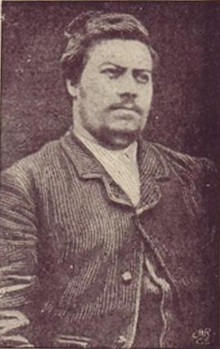
Brady is a member of the Irish National Invincibles, usually known as the Invincibles, a splinter group of the Irish Republican Brotherhood. This group of assassins is active in Dublin between late 1881 and 1883, with an intent to kill the authorities in Dublin Castle.
The first assassination in the park is committed by Brady, who attacks Burke with a 12-inch knife, followed in short order by Tim Kelly, who knifes Cavendish. Both men use surgical knives. The British press expresses outrage and demands that the “Phoenix Park Murderers” be brought to justice.
A large number of suspects are arrested. By playing one suspect against another, Superintendent Mallon of G Division of the Dublin Metropolitan Police gets several of them to reveal what they know. The Invincibles’ leader, James Carey, and Michael Kavanagh agree to testify against the others. Carey is ultimately given passage to South Africa but is shot on board the Melrose Castle by Patrick O’Donnell. O’Donnell is brought back to England and hanged in December 1883.
Brady, Michael Fagan, Thomas Caffrey, Dan Curley and Tim Kelly are hanged by William Marwood in Kilmainham Gaol in Dublin beginning with Brady’s execution on May 14 and and continuing until June 4. Others are sentenced to long prison terms.
No member of the founding executive, however, is ever brought to trial by the British government. John Walsh, Patrick Egan, John Sheridan, Frank Byrne, and Patrick Tynan are welcomed in the United States, where sentiment toward the murders is less severe, although not celebratory.
Brady by all accounts was a mountain of a man. The Times writes following his execution: “He was brought up as a stonemason of herculean strength, his occupation developing the muscular power of his arms, which told with such terrible effect when he drove the knives into the bodies of Lord Cavendish and his secretary T. H. Burke.”
Kilmainham Gaol contains the graves of the Invincibles convicted and executed for the Phoenix park stabbings.
Carey is born in James Street, Dublin, in 1845. He becomes a bricklayer and builder as well as the leading spokesman of his trade and obtains several large building contracts. During this period Carey is engaged in an Irish nationalist conspiracy, but to outward appearance he is one of the rising men of Dublin. He is involved in religious and other societies, and at one time is spoken of as a possible lord mayor. In 1882 he is elected a town councillor.
About 1861 Carey joins the Irish Republican Brotherhood, soon becoming treasurer. In 1881 he breaks with the IRB and forms a new group which assumes the title of the Irish National Invincibles and establishes their headquarters in Dublin. Carey takes an oath as one of the leaders. The object of the Invincibles is to remove all “tyrants” from the country.
The secret head of the Invincibles, known as No. 1, gives orders to kill Thomas Henry Burke, the under-secretary to the lord-lieutenant. On May 6, 1882, nine of the conspirators proceed to the Phoenix Park where Carey, while sitting on a jaunting-car, points out Burke to the others. At once they attack and kill him with knives and, at the same time, also kill Lord Frederick Cavendish, the newly appointed chief secretary, who happens to be walking with Burke.
For a long time no clue can be found to identify the perpetrators of the act. However, on January 13, 1883, Carey is arrested and, along with sixteen other people, charged with a conspiracy to murder public officials. On February 13, Carey turns queen’s evidence, betraying the complete details of the Invincibles and of the murders in the Phoenix Park. His evidence, along with that of getaway driver Michael Kavanagh, results in the execution of five of his associates by hanging.
His life being in great danger, he is secretly put onboard the Kinfauns Castle with his wife and family, which sails for the Cape on July 6. Carey travels under the name of Power. Aboard the same ship is Patrick O’Donnell, a bricklayer. Not knowing his true identity, O’Donnell becomes friendly with Carey. After stopping off in Cape Town, he is informed by chance of Carey’s real identity. He continues with Carey on board the Melrose for the voyage from Cape Town to Natal. On July 29, 1883, when the vessel is twelve miles off Cape Vaccas, O’Donnell uses a pistol he has in his luggage to shoot Carey dead.
O’Donnell is brought to England and is tried for murder. After being found guilty, he is executed on December 17 at Newgate.
Joseph MacRory, an Irish Cardinal of the Roman Catholic Church who serves as Archbishop of Armagh from 1928 until his death in 1945, is born in Ballygawley, County Tyrone, on March 19, 1861.
MacRory is one of ten children of Francis MacRory, a farmer, and his wife, Rose Montague. He studies at St. Patrick’s College, Armagh, and St. Patrick’s Pontifical University, Maynooth. He is ordained to the priesthood on September 13, 1885, and serves as the first president of St. Patrick’s Academy, Dungannon from 1886 to 1887. MacRory teaches Scripture and Modern Theology at St. Mary’s College, Oscott in England until 1889, when he is appointed Professor of Scripture and Oriental Languages at his alma mater of Maynooth College. In 1906, he co-founds the Irish Theological Quarterly. In 1912, he is made Vice-President of Maynooth.
On August 9, 1915, MacRory is appointed Bishop of Down and Connor by Pope Benedict XV and receives his episcopal consecration on November 14 from Cardinal Michael Logue. During his tenure, his life is threatened repeatedly due to the turbulent atmosphere in Belfast. He is a member of the Irish Convention from 1917 to 1918.
MacRory is the papal legate at the 1933 laying of the foundation stone of Liverpool Metropolitan Cathedral in England. He also serves as one of the cardinal electors who participate in the 1939 papal conclave which ultimately selects Pope Pius XII.
MacRory is a strenuous opponent of social injustice, National Socialism, Protestantism, and the Partition of Ireland. It is MacRory who suggests to Eoin O’Duffy that he raise an Irish Brigade to aid Generalissimo Francisco Franco during the Spanish Civil War. In 1940, he voices strong objections to conscription in the North.
MacRory is a supporter of the Gaelic League. Errigal Ciarán GAC, one of the most famous GAA clubs in Ireland, plays at Cardinal MacRory Park in Dunmoyle, County Tyrone, which is built in 1956 in his honour.
After a brief illness, Cardinal MacRory dies on October 13, 1945, at the age of 84 from a heart attack at Ara Coeli, the residence in Armagh. He is interred in St. Patrick’s Cathedral Cemetery, Armagh.



 seamus dubhghaill