seamus dubhghaill

Promoting Irish Culture and History from Little Rock, Arkansas, USA


Leave a comment

Birth of Seamus Twomey, Two Time Chief of Staff of the Provisional IRA

Seamus Twomey (Irish: Séamus Ó Tuama), Irish republican activist, militant, and twice chief of staff of the Provisional Irish Republican Army, is born on November 5, 1919, on Marchioness Street in Belfast.

Twomey lives at 6 Sevastopol Street in the Falls district. Known as “Thumper” owing to his short temper and habit of banging his fist on tables, he receives little education and is a bookmaker‘s “runner.” His father is a volunteer in the 1920s. In Belfast he lives comfortably with his wife, Rosie, whom he marries in 1946. Together they have sons and daughters.

Twomey begins his involvement with the Irish Republican Army in the 1930s and is interned in Northern Ireland during the 1940s on the prison ship HMS Al Rawdah and later in Crumlin Road Jail in Belfast. Rosie, his wife, is also held prisoner at the women prison, Armagh Jail, in Northern Ireland. He opposes the left-wing shift of Cathal Goulding in the 1960s, and in 1968, helps set up the breakaway Andersonstown Republican Club, later the Roddy McCorley Society.

In 1969, Twomey is prominent in the establishment of the Provisional Irish Republican Army. By 1972, he is Officer Commanding (OC) of the Provisional IRA Belfast Brigade when it launches its bomb campaign of the city, including Bloody Friday when nine people are killed. During the 1970s, the leadership of the Belfast Brigade of the IRA is largely in the hands of Twomey and Ivor Bell.

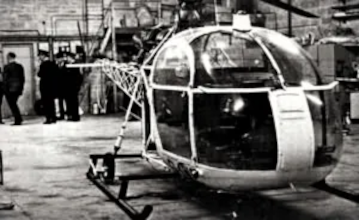
In March 1973, Twomey is first appointed IRA Chief of Staff after the arrest of Joe Cahill. He remains in this position until his arrest in October 1973 by the Garda Síochána. Three weeks later, on October 31, 1973, the IRA organises the helicopter escape of Twomey and his fellow IRA members J. B. O’Hagan and Kevin Mallon, when an active service unit hijacks and forces the pilot at gunpoint to land the helicopter in the training yard of Mountjoy Prison. After his escape, he returns to his membership of IRA Army Council.

By June/July 1974, Twomey is IRA Chief of Staff for a second time. He takes part in the Feakle talks between the IRA and Protestant clergymen in December 1974. In the IRA truce which follows in 1975, he is largely unsupportive and wants to fight on in what he sees as “one big push to finish it once and for all.”

IRA informer Sean O’Callaghan claims that on January 5, 1976, Twomey and Brian Keenan give the go-ahead for the sectarian Kingsmill massacre, when ten unarmed Ulster Protestant workmen are executed by the Provisional IRA in retaliation for a rash of loyalist killings of Catholics in the area. It is Keenan’s view, O’Callaghan claims, that “The only way to knock the nonsense out of the Prods is to be ten times more savage.”

Twomey is dedicated to paramilitarism as a means of incorporating Northern Ireland into the Republic of Ireland. In an interview with French television on July 11, 1977, he declares that although the IRA had waged a campaign for seven years at that point, it can fight on for another 70 against the British state in Northern Ireland and in England. He supports the bombing of wealthy civilian targets, which he justifies on class lines. On October 29, 1977, for example, a no-warning bomb at an Italian restaurant in Mayfair kills one diner and wounds 17 others. Three more people are killed in similar blasts in Chelsea and Mayfair the following month. He says, “By hitting Mayfair restaurants, we were hitting the type of person that could bring pressure to bear on the British government.”

In December 1977, Twomey is captured in Sandycove, Dublin, by the Garda Síochána, who had been tipped off by Belgian police about a concealed arms shipment, to be delivered to a bogus company with an address in the area. They swoop on a house in Martello Terrace to discover Twomey outside in his car, wearing his trademark dark glasses. After a high-speed pursuit, he is recaptured in the centre of Dublin. The Gardaí later find documents in his possession outlining proposals for the structural reorganisation of the IRA according to the cell system. His arrest ends his tenure as IRA chief of staff. In the 1986 split over abstentionism, Twomey sides with the Gerry Adams leadership and remains with the Provisionals.

After a long illness from a heart condition, Twomey dies in Dublin on September 12, 1989. He is buried in the family plot in Milltown Cemetery, Belfast. His funeral is attended by about 2,000 people.


Leave a comment

The Mountjoy Prison Helicopter Escape

The Mountjoy Prison helicopter escape occurs on October 31, 1973, when three Provisional Irish Republican Army (IRA) volunteers escape from Mountjoy Prison in Dublin aboard a hijacked Alouette II helicopter, which briefly lands in the prison’s exercise yard. The escape makes headlines around the world and is an embarrassment to the Irish coalition government of the time, led by Fine Gael‘s Liam Cosgrave, which is criticised by opposition party Fianna Fáil. A manhunt involving twenty thousand members of the Irish Defence Forces and Garda Síochána is launched for the escapees, one of whom, Seamus Twomey, is not recaptured until December 1977. The Wolfe Tones write a song celebrating the escape called “The Helicopter Song,” which tops the Irish Singles Chart.

Following the outbreak of the Troubles in the late 1960s, the Provisional IRA conducts an armed campaign that seeks to create a united Ireland by ending Northern Ireland‘s status as part of the United Kingdom. As a result of increasing levels of violence in Northern Ireland, internment without trial is introduced there in August 1971, and in the Republic of Ireland the coalition government led by Fine Gael’s Liam Cosgrave is attempting to curb IRA activity. Fine Gael had come to power on a law-and-order ticket, with a policy of “getting tough on crime.” Suspected IRA members are arrested and accused of IRA membership by a superintendent in the Garda Síochána, a crime under the Offences against the State Acts. They are tried at the juryless Special Criminal Court in Dublin, where the traditional IRA policy of not recognising the court results in a fait accompli as no defence is offered and IRA membership carries a minimum mandatory one-year sentence, resulting in internment in all but name. In September 1973 IRA Chief of Staff Seamus Twomey appears at the Special Criminal Court charged with IRA membership, and states, “I refuse to recognise this British-orientated quisling court.” He is found guilty and receives a five-year sentence. By October 1973 the IRA’s command structure is seriously curbed, with Twomey and other senior republicans J. B. O’Hagan and Kevin Mallon all being held in Mountjoy Prison.

The IRA immediately begins making plans to break Twomey, O’Hagan and Mallon out of the prison. The first attempt involves explosives that had been smuggled into the prison, which are to be used to blow a hole in a door which will give the prisoners access to the exercise yard. From there, they are to scale a rope ladder thrown over the exterior wall by members of the IRA’s Dublin Brigade who are to have a getaway car waiting to complete the escape. The plans when the prisoners cannot gain access to the exercise yard and the rope ladder is spotted, so the IRA begins making new escape plans. The idea of using a helicopter in an escape had been discussed before in a plot to break Gerry Adams out of Long Kesh internment camp but had been ruled out because of faster and more sophisticated British Army helicopters being stationed at a nearby base. The IRA’s GHQ staff approves the plan to break out Twomey, O’Hagan and Mallon, and arrangements are made to obtain a helicopter. A man with an American accent calling himself Mr. Leonard approaches the manager of Irish Helicopters at Dublin Airport, with a view to hiring a helicopter for an aerial photographic shoot in County Laois. After being shown the company’s fleet of helicopters, Leonard arranges to hire a five-seater Alouette II for October 31.

Leonard arrives at Irish Helicopters on October 31 and is introduced to the pilot of the helicopter, Captain Thompson Boyes. Boyes is instructed to fly to a field in Stradbally, in order to pick up Leonard’s photographic equipment. After landing Boyes sees two armed, masked men approaching the helicopter from nearby trees. He is held at gunpoint and told he will not be harmed if he follows instructions. Leonard leaves with one gunman, while the other gunman climbs aboard the helicopter armed with a pistol and an ArmaLite rifle. Boyes is instructed to fly towards Dublin following the path of railway lines and the Royal Canal and is ordered not to register his flight path with Air Traffic Control. As the helicopter approaches Dublin, Boyes is informed of the escape plan and is instructed to land in the exercise yard at Mountjoy Prison.

In the prison’s exercise yard, the prisoners are watching a football match. Shortly after 3:35 p.m. the helicopter swings in to land in the prison yard, with Kevin Mallon directing the pilot using semaphore. A prison officer on duty initially takes no action as he believes the helicopter contains the Minister for Defence, Paddy Donegan. After prisoners surround the eight prison officers in the yard, fights break out as the officers realise an escape attempt is in progress. As other prisoners restrain the officers, Twomey, Mallon and O’Hagan board the helicopter. As the helicopter takes off, in the confusion one officer shouts, “Close the gates, close the fucking gates.” The helicopter flies north and lands at a disused racecourse in the Baldoyle area of Dublin, where the escapees are met by members of the IRA’s Dublin Brigade. Boyes is released unharmed, and the escapees are transferred to a taxi that had been hijacked earlier and are transported to safe houses.

The escape makes headlines around the world and is an embarrassment for Cosgrave’s government, which is criticised for “incompetence in security matters” by opposition party Fianna Fáil. An emergency debate on security is held in Dáil Éireann on November 1.

The IRA releases a statement on the escape, which reads, “Three republican prisoners were rescued by a special unit from Mountjoy Prison on Wednesday. The operation was a complete success, and the men are now safe, despite a massive hunt by Free State forces.” Shortly after the escape Twomey gives an exclusive interview to German magazine Der Spiegel, where the reporter says people throughout Europe are joking about the incident as “the escape of the century.” Irish rebel band the Wolfe Tones writes a song celebrating the escape called “The Helicopter Song,” which is immediately banned by the government yet still tops the Irish Singles Chart after selling twelve thousand copies in a single week.

The escape results in all IRA prisoners being held at Mountjoy Prison and Curragh Camp being transferred to the maximum security Portlaoise Prison. In order to prevent any further escapes, the perimeter of the prison is guarded by members of the Irish Army, and wires are erected over the prison yard to prevent any future helicopter escape. Cosgrave states there will be “no hiding place” for the escapees, and a manhunt involving twenty thousand members of the Irish Defence Forces and Garda Síochána ensues.

Mallon is recaptured at a Gaelic Athletic Association dance in a hotel near Portlaoise on December 10, 1973, and imprisoned in Portlaoise Prison. He escapes from there in a mass break-out on August 18, 1974, when nineteen prisoners escape after overpowering guards and using gelignite to blast through the gates. He is recaptured in Foxrock in January 1975 and returned to Portlaoise Prison. O’Hagan is recaptured in Dublin in early 1975, and also imprisoned in Portlaoise Prison. After the end of his original twelve-month sentence, he is immediately arrested and sentenced to a further two years imprisonment for escaping. Twomey evades recapture until December 2, 1977, when he is spotted sitting in a car in Sandycove by members of the Garda’s Special Branch who are investigating an arms shipment after a tip-off from police in Belgium. He drives away after spotting the officers, before being recaptured in the centre of Dublin after a high-speed car chase. He is also imprisoned in Portlaoise Prison until his release in 1982.

In 2021, Brendan Hughes publishes an autobiography Up Like a Bird, an account of the planning and organisation of the escape, co-authored with Doug Dalby.


Leave a comment

Birth of Declan Arthurs, Provisional Irish Republican Army Volunteer

Declan Arthurs, a Volunteer in the Provisional Irish Republican Army‘s (IRA) East Tyrone Brigade in the mid-1980s, is born in Galbally, County Tyrone, Northern Ireland, on October 28, 1965.

Arthurs is one of six children, and the fourth of Paddy and Amelia Arthurs. He works on the family farm learning how to drive diggers. He works as an agricultural contractor for the farm. He has one young daughter.

Arthurs joins the East Tyrone Brigade of the Provisional IRA in 1982 in the wake of Martin Hurson‘s death on the 1981 Irish Hunger Strike. Hurson is also from Galbally like Arthurs, and Arthurs and his friends look up to Hurson. At the time he joins so do other young men from the same area, like Tony Gormley, Eugene Kelly, Seamus Donnelly and Martin McCaughey.

Over a year and a half year period in the mid-1980s the East Tyrone Brigade attacks and bombs Royal Ulster Constabulary (RUC) barracks and stations in Ballygawley, Tynan, The Birches, Coalisland, Dungannon, Carrickmore and Castlederg. They bomb hotels and other businesses in Kildress, Ballyronan, Dungannon and Cookstown.

Arthurs takes part in two of the IRA’s biggest attacks of the 1980s. At the attack on the Ballygawley barracks in December 1985 and the attack on the RUC Birches barracks in August 1986, Arthurs is a key member of the team who drives a digger past a security fence, stops it outside the barracks, lights a fuse, runs to safety and wrecks the barracks with a 200-pound bomb in the JCB Digger.

Arthurs is killed along with seven other IRA Volunteers who are ambushed by the Special Air Service (SAS) during the Loughgall Ambush on May 8, 1987. Before the SAS fires he lights the 40-second fuse on the bomb and it destroys most of the station, injuring a number of British decoys inside. The Loughgall ambush is supposed to be a carbon copy attack of the bombing of The Birches barracks, with the IRA expecting no resistance. One of the photos of the aftermath of the ambush shows that Arthurs died with the Zippo lighter he used to light the fuse still in his hand.

Amelia Arthurs, Declan’s mother, says of the ambush in an interview to journalist Peter Taylor, “He was mowed down. He could have been taken prisoner. They knew that the ‘boys’ were coming and they lay in wait. The SAS never gave them a chance. Declan died for his country and I’m very proud of him. He was caught up in a war and he died.”

Arthurs is buried in St. John’s Cemetery, Galbally, beside IRA Volunteer Seamus Donnelly who also died in the Loughgall ambush.


Leave a comment

Ulster Volunteer Force Attacks Across Northern Ireland

On October 2, 1975, the Ulster Volunteer Force (UVF), a loyalist paramilitary group, carries out a wave of shootings and bombings across Northern Ireland. Six of the attacks leave 12 people dead (mostly civilians) and around 45 people injured. There is also an attack in the small village of Killyleagh, County Down. There are five attacks in and around Belfast which leave people dead. A bomb which explodes near Coleraine leaves four UVF members dead. There are also several other smaller bombs planted around Northern Ireland, sixteen in total, but other than causing damage they do not kill or injure anyone.

There is a rise in sectarian killings during the Provisional Irish Republican Army (IRA) truce with the British Army, which begins in February 1975 and officially lasts until February 1976. Loyalists, fearing they are about to be forsaken by the British government and forced into a united Ireland, increase their attacks on Irish Catholics/Irish nationalists. Loyalists kill 120 Catholics in 1975, the vast majority civilians. They hope to force the IRA to retaliate and thus end the truce. Some IRA units concentrate on tackling the loyalists. The fall-off of regular operations causes unruliness within the IRA and some members, with or without permission from higher up, engage in tit-for-tat killings.

The first attack of the day takes place at Casey’s Bottling Plant in Belfast. The UVF group, which is alleged to have been led by Shankill Butchers leader Lenny Murphy, enters the premises by pretending to have an order to be filled before launching the attack. Four employees are shot and killed in the attack, sisters Frances Donnelly (35), Marie McGrattan (47) and Gerard Grogan (18) all die that day, with a fourth, Thomas Osborne (18), dying of his wounds three weeks later. Murphy personally shoots all except Donnelly who is killed by his accomplice William Green. The two sisters are forced to kneel on the ground and are shot in the back of the head.

In the next attack Thomas Murphy (29), a Catholic photographer from Belfast, is killed in a booby-trap bomb and gun attack, when two UVF gunmen enter his premises on Carlisle Circus (close to both the loyalist Shankill Road and republican New Lodge areas of Belfast) and shoot him in the chest, before planting a duffel bag bomb in his shop. The resulting explosion injures several people including a female passer-by who loses her leg.

Next the UVF carries out a gun and bomb attack on McKenna’s Bar near Crumlin, County Antrim, which kills a Catholic civilian John Stewart (35) and injures scores of people.

In Killyleagh, County Down, a no-warning bomb explodes outside a Catholic-owned bar, The Anchor Inn. Irene Nicholson (37), a Protestant woman, is killed as she is passing by while the attack is being carried out. Three UVF members are later arrested for this attack in Bangor and one of them claims the attack was “a small one to scare them.”

Next Ronald Winters (26), a Protestant civilian, is shot dead by the UVF in his parents’ house on London Road, Belfast.

Later that night four UVF members are killed as they drive along a road in Farrenlester, near Coleraine, when the bomb they are transporting explodes prematurely.

The following day, October 3, the UVF is once again made a proscribed terrorist organisation. Secretary of State for Northern Ireland Merlyn Rees had unbanned the UVF in May 1974, the same day the ban on Sinn Féin was lifted, a move never extended to the IRA. Despite this the UVF are still able to kill Catholic civilians at will for the remainder of 1975 and for most of 1976 also.


Leave a comment

Birth of Angelo Fusco, Provisional Irish Republican Army Volunteer

Angelo Fusco, former volunteer in the Belfast Brigade of the Provisional Irish Republican Army (IRA) who escapes during his 1981 trial for killing a Special Air Service (SAS) officer in 1980, is born in West Belfast, Northern Ireland, on September 2, 1956.

Fusco is born to a family with an Italian background who owns a fish and chip shop. He joins the Belfast Brigade of the IRA and is part of a four-man active service unit (ASU), along with Joe Doherty and Paul Magee, which operates in the late 1970s and early 1980s nicknamed the “M60 gang” due to their use of an M60 heavy machine gun.

On April 9, 1980, the unit lures the Royal Ulster Constabulary (RUC) into an ambush on Stewartstown Road, killing one constable and wounding two others. On May 2 the unit is planning another attack and has taken over a house on Antrim Road, when an eight-man patrol from the SAS arrive in plain clothes, after being alerted by the RUC. A car carrying three SAS members goes to the rear of the house, and another car carrying five SAS members arrives at the front of the house. As the SAS members at the front of the house exit their car the IRA unit opens fire with the M60 machine gun from an upstairs window, hitting Captain Herbert Westmacott in the head and shoulder, killing him instantly. He is the highest-ranking member of the SAS killed in Northern Ireland. The remaining SAS members, armed with Colt Commando automatic rifles, submachine guns and Browning pistols, return fire but are forced to withdraw. Magee is apprehended by the SAS members at the rear of the house while attempting to prepare the IRA unit’s escape in a transit van, while the other three IRA members remain inside the house. More members of the security forces are deployed to the scene, and after a brief siege the remaining members of the IRA unit surrender.

The trial of Fusco and the other members of the M60 gang begins in early May 1981, with them facing charges including three counts of murder. On June 10 Fusco and seven other prisoners, including Joe Doherty and the other members of the IRA unit, take a prison officer hostage at gunpoint in Crumlin Road Jail. After locking the officer in a cell, the eight take other officers and visiting solicitors hostage, also locking them in cells after taking their clothing. Two of the eight are wearing officer’s uniforms while a third wears clothing taken from a solicitor, and the group moves towards the first of three gates separating them from the outside world. They take the officer on duty at the gate hostage at gunpoint and force him to open the inner gate. An officer at the second gate recognises one of the prisoners and runs into an office and presses an alarm button, and the prisoners run through the second gate towards the outer gate. An officer at the outer gate tries to prevent the escape but is attacked by the prisoners, who escape onto Crumlin Road. As the prisoners are moving towards the car park where two cars are waiting, an unmarked RUC car pulls up across the street outside Crumlin Road Courthouse. The RUC officers open fire, and the prisoners returned fire before escaping in the waiting cars. Two days after the escape, Fusco is convicted in absentia and sentenced to life imprisonment with a minimum recommended term of thirty years.

Fusco escapes across the border into the Republic of Ireland before being arrested in January 1982 and is sentenced to ten years imprisonment for the escape and firearms offences under extra-jurisdictional legislation. A further three years are added to his sentence in 1986 after he attempts to escape from Portlaoise Prison, and he is released in January 1992. Upon his release, he is immediately served with extradition papers from the British government for his return to the Maze Prison in Northern Ireland to serve his sentence for the murder conviction. The extradition is granted by a District Court but Fusco appeals, and in 1995 he wins a legal victory when a judge at the High Court in Dublin rules it would be “unjust, oppressive and invidious” to order his extradition due to the time lag involved. Fusco settles in Tralee with his wife and three children until February 1998, when the Supreme Court of Ireland brings an end to the six-year legal battle by ordering his extradition, but he has already fled on bail and a warrant is issued for his arrest.

Fusco is arrested at a Garda checkpoint in Castleisland, County Kerry, on January 3, 2000. The following day he is being escorted back to Northern Ireland to be handed over to the RUC, when his handover is halted by a successful court appeal by Sinn Féin. The arrest and abortive return of Fusco undermines the Northern Ireland peace process, with Unionist politicians including Ken Maginnis criticising the extradition being halted. Republicans are critical of Fusco’s arrest, with leading Sinn Féin member Martin Ferris stating, “The Irish government should immediately move to rescind the warrant against Angelo Fusco. The action will cause great anger and resentment within the nationalist community,” and graffiti in one republican area reads “Extradite Bloody Sunday war criminals, not Fusco.” On January 6 Fusco is refused bail and remanded to prison in Castlerea, County Roscommon, to await a legal review of his extradition, prompting scuffles outside the court between police and Sinn Féin supporters.

Fusco is freed on bail on March 21 pending the outcome of his legal challenge, and in November 2000 the Irish government informs the High Court that it is no longer seeking to return him to Northern Ireland. This follows a statement from Secretary of State for Northern Ireland Peter Mandelson saying that “it is clearly anomalous to pursue the extradition of people who appear to qualify for early release under the Good Friday Agreement scheme, and who would, on making a successful application to the Sentence Review Commissioners, have little if any of their original prison sentence to serve.” After the court hearing Fusco states, “I’m relieved it’s over,” and that he will continue to live in Tralee with his family and work for Sinn Féin.

In December 2000 Fusco and three other IRA members, including two other members of the M60 gang, are granted a royal prerogative of mercy which allows them to return to Northern Ireland without fear of prosecution.


Leave a comment

The Provisional Irish Republican Army Ceasefire Announcement

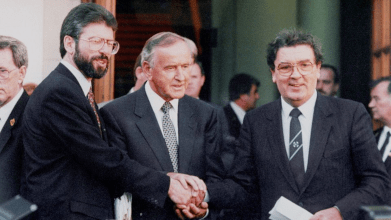
The Provisional Irish Republican Army (IRA) announces a ceasefire on August 31, 1994, after a quarter century of what it calls its “armed struggle” to get the British out of Northern Ireland. The statement comes just after 11:00 a.m. BST and says there will be a “complete cessation of military operations” from midnight and that the organisation is willing to enter into inclusive talks on the political future of the Province.

The statement raises hopes for peace and an end to 25 years of bombing and shooting that led to the deaths of more than 3,000 people. There is scepticism from the loyalist community and celebration in the Catholic areas of Belfast and Derry.

The Irish Minister for Foreign Affairs, Dick Spring, says the statement is historic and meets his government’s demand for an unconditional end to IRA violence. The Irish Taoiseach (Prime Minister), Albert Reynolds, calls on loyalist paramilitaries to follow suit.

But loyalists are suspicious of the declaration and fear it may lead to a sell-out in which Northern Ireland’s position within the United Kingdom is under threat. The Ulster Unionist Party (UUP) MP James Molyneaux says no moves towards talks should begin until the IRA has added the word “permanent” to the ceasefire declaration.

The announcement comes 18 months after secret talks began between the British Government and Irish republicans. It leads to the Anglo-Irish Downing Street Declaration in December 1993 which states that any change in the partition of Ireland can only come with the consent of those living north of the border. It also challenges republicans to renounce violence.

Social Democratic and Labour Party (SDLP) leader John Hume MP, who has been negotiating with Sinn Féin leader Gerry Adams, is “very pleased.” However, British Prime Minister John Major is cautious in his reaction to the IRA announcement. “We are beyond the beginning,” he says, “but we are not yet in sight of the end.”

Ian Paisley, leader of the hardline Democratic Unionist Party (DUP), rejects the wording of the declaration and says it is an “insult to the people [the IRA] has slaughtered because there was no expression of regret.”

Seven weeks later, on October 13, the loyalist terrorist groups announce their own ceasefire. On December 9, British officials meet Sinn Féin representatives for their first formal talks in 22 years.

The IRA ceasefire ends on February 9, 1996, when it plants a huge bomb in the London Docklands. It kills two, injures more than 100 and causes more than £85m of damage.

A new ceasefire is finally announced in July 1997.

(Pictured: (L to R) Sinn Féin President Gerry Adams, Taoiseach Albert Reynolds and Social Democratic and Labour Party leader John Hume)


Leave a comment

The Warrenpoint Ambush

The Warrenpoint ambush, also known as the Narrow Water ambush, the Warrenpoint massacre or the Narrow Water massacre, is a guerrilla attack by the Provisional Irish Republican Army (IRA) on August 27, 1979. The IRA’s South Armagh Brigade ambushes a British Army convoy with two large roadside bombs on the A2 road at Narrow Water Castle, just outside Warrenpoint, County Down, Northern Ireland.

The road and castle are on the northern bank of the Newry River, which marks the border between Northern Ireland and the Republic of Ireland. The Republic’s side of the river, the Cooley Peninsula in County Louth, is an ideal spot from which to launch an ambush. It is thickly wooded, which gives cover to the ambushers, and the river border prevents British forces from giving chase.

On the afternoon of August 27, a British Army convoy of one Land Rover and two four-ton lorries carrying soldiers of the 2nd Battalion, Parachute Regiment is driving from Ballykinlar Barracks to Newry. The British Army is aware of the dangers of using the stretch of road along the Newry River and often declares it out of bounds. However, they sometimes use it to avoid setting a pattern. At 4:40 p.m., as the convoy is driving past Narrow Water Castle, an 800-pound fertiliser bomb, hidden among bales of straw on a parked flatbed trailer, is detonated by remote control by IRA members watching from across the border in County Louth. The explosion catches the last lorry in the convoy, hurling it onto its side and instantly killing six paratroopers, whose bodies are scattered across the road. There are only two survivors amongst the soldiers traveling in the lorry, both of whom receive serious injuries. The lorry’s driver, Anthony Wood (19), is one of those killed. All that remains of his body is his pelvis, welded to the seat by the fierce heat of the blast.

According to the soldiers, immediately after the blast they are targeted by rifle fire from the woods on the Cooley Peninsula on the other side of the border, with this view supported by two part-time firefighters assisting the wounded. Shortly afterwards, the two IRA members arrested by the Garda Síochána and suspected of being behind the ambush, are found to have traces of gunsmoke residue on their hands and on the motorbike they are riding. The IRA’s first statement on the incident, however, denies that any shots had been fired at the troops, and according to Royal Ulster Constabulary (RUC) researchers, the soldiers might have mistaken the sound of ammunition cooking off for enemy gunfire. Nevertheless, at the official inquiry the soldiers declare on oath that they had been fired on.

The surviving paratroopers radio for urgent assistance, and reinforcements are dispatched to the scene by road. A rapid reaction unit is sent by Gazelle helicopter, consisting of Lieutenant Colonel David Blair, commanding officer of the Queen’s Own Highlanders, his signaler Lance Corporal Victor MacLeod, and army medics. Another helicopter, a Wessex, lands to pick up the wounded. Colonel Blair assumes command once at the site.

William Hudson, a 29-year-old from London, is killed by the British Army and his cousin Barry Hudson, a 25-year-old native of Dingle, is wounded when shots are fired across the Newry River into the Republic of Ireland about 3 km from the village of Omeath, County Louth.

The pair are partners in ‘Hudson Amusements’ and had been operating their amusements in Omeath for the duration of the Omeath Gala. When the first explosion is heard across the Lough, the pair go down to the shore to see what is unfolding. The pair makes their way to Narrow Water on the southern side of the border to get a better view of what is happening on the northern side. Barry Hudson is shot in the arm and as he falls to the ground he sees his cousin, who is the son of a coachman at Buckingham Palace, fall to the ground, shot in the head. He dies almost immediately.

The IRA had been studying how the British Army behaves after a bombing and correctly predicts that they would set up an incident command point (ICP) at the stone gateway on the other side of the road. At 5:12 p.m., thirty-two minutes after the first explosion, another 800-pound bomb hidden in milk pails explodes at the gateway, destroying it and hurling lumps of granite through the air. It detonates as the Wessex helicopter is taking off carrying wounded soldiers. The helicopter is damaged by the blast but does not crash.

The second explosion kills twelve soldiers, ten from the Parachute Regiment and the two from the Queen’s Own Highlanders. Lieutenant Colonel Blair is the second Lieutenant Colonel to be killed in the Troubles up until then, following Lieutenant Colonel Corden-Lloyd of the 2nd Battalion Royal Green Jackets in 1978. Only one of Colonel Blair’s epaulettes remains to identify him as his body had been vaporised in the blast. The epaulette is taken from the scene by Brigadier David Thorne to a security briefing with Prime Minister Margaret Thatcher to “illustrate the human factor” of the attack. Mike Jackson, then a major in the Parachute Regiment, is at the scene soon after the second explosion and later describes seeing human remains scattered over the road, in the water and hanging from the trees. He is asked to identify the face of his friend, Major Peter Fursman, still recognisable after it had been ripped from his head by the explosion and recovered from the water by divers from the Royal Engineers.

Press photographer Peter Molloy, who arrives at the scene after the first explosion, comes close to being shot by an angry paratrooper who sees him taking photographs of the dead and dying instead of offering to help the wounded. The soldier is tackled by his comrades. Molloy says, “I was shouted at and called all sorts of things, but I understood why. I had trespassed on the worst day of these fellas’ lives and taken pictures of it.”

The Warrenpoint ambush is a victory for the IRA. It is the deadliest attack on the British Army during the Troubles and the Parachute Regiment’s biggest loss since World War II, with sixteen paratroopers killed. General Sir James Glover, Commander of British forces in Northern Ireland, later says it was “arguably the most successful and certainly one of the best planned IRA attacks of the whole campaign.” The ambush happens on the same day that Lord Mountbatten, a prominent member of the British royal family, is killed by an IRA bomb aboard his boat at Mullaghmore, County Sligo, along with three others.

Republicans portray the attack as retaliation for Bloody Sunday in 1972 when the Parachute Regiment shot dead 13 unarmed civilians during a protest march in Derry. Graffiti appears in republican areas declaring “13 gone and not forgotten, we got 18 and Mountbatten.” The day after the Mountbatten and Warrenpoint attacks, the Ulster Volunteer Force (UVF) retaliates by shooting dead a Catholic man, John Patrick Hardy (43), at his home in Belfast‘s New Lodge estate. Hardy is targeted in the mistaken belief that he is an IRA member.

Very shortly after the ambush, IRA volunteers Brendan Burns and Joe Brennan are arrested by the Gardaí. They are stopped while riding a motorbike on a road opposite Narrow Water Castle. They are later released on bail due to lack of evidence. Burns dies in 1988 when a bomb he is handling explodes prematurely. In 1998, former IRA member Eamon Collins claims that Burns had been one of those who carried out the Warrenpoint ambush. No one has ever been criminally charged.

According to Toby Harnden, the attack “drove a wedge” between the Army and the RUC. Lieutenant General Sir Timothy Creasey, General Officer Commanding Northern Ireland, suggests to Margaret Thatcher that internment should be brought back and that liaison with the Gardaí should be left in the hands of the military. Sir Kenneth Newman, the RUC Chief Constable, claims instead that the British Army practice since 1975 of supplying their garrisons in south County Armagh by helicopter gives too much freedom of movement to the IRA. One result is the appointment of Sir Maurice Oldfield to a new position of Co-ordinator of Security Intelligence in Northern Ireland. His role is to co-ordinate intelligence between the military, MI5 and the RUC. Another is the expansion of the RUC by 1,000 members. Tim Pat Coogan asserts that the deaths of the 18 soldiers hastens the move to Ulsterisation.

Lieutenant Colonel Blair is remembered on a memorial at Radley College, Oxfordshire.


Leave a comment

The Birches RUC Base Attack

The East Tyrone Brigade of the Provisional Irish Republican Army (IRA) attacks the Royal Ulster Constabulary (RUC) base at The Birches near Portadown, County Armagh, Northern Ireland, on August 11, 1986. The unmanned base is raked with gunfire before being destroyed by a 200-pound (91 kg) bomb, which is driven through the gate of the base in the bucket of a JCB digger.

In 1985 the IRA’s East Tyrone Brigade, commanded by Patrick J. Kelly, begins a campaign of destroying remote RUC stations and preventing anyone from rebuilding them, to create no-go zones. On December 7, 1985, it launches an attack on the RUC barracks in Ballygawley, County Tyrone, destroying the base and killing two RUC officers.

On January 22, 1986, the East Tyrone Brigade fires mortars at the Ulster Defence Regiment (UDR) base in Dungannon, County Tyrone, injuring two UDR soldiers and damaging the base. Just over a week later, on February 1, it carries out a large van bomb attack on the RUC base at Coalisland, County Tyrone, damaging the base and several houses and shops.

The Birches base attack is a complex attack that involves several units, including teams of lookouts, an armed team and bomb-makers as well as a team to carry out a diversionary attack. A diversionary bomb attack is staged at Pomeroy to draw security forces away from the real target at the Birches. Another team hijacks a JCB digger, getaway vehicles and scout cars at Washing Bay.

The digger is used to deliver the bomb to its target. The IRA does not expect any resistance as the RUC station is unmanned at the time of the attack. The IRA first rakes the base with automatic gunfire while the digger, with the bomb in its bucket, is driven through the high wire perimeter fence which had been constructed to protect the base from grenade or mortar attack. The digger is most likely driven by young IRA volunteer Declan Arthurs from Galbally, County Tyrone, who has experience driving diggers on his family’s farm. A volunteer then lights a fuse, and the bomb explodes after the IRA hads retreated to safety in a waiting van. The blast destroys most of the base and also damages nearby buildings, blowing the roof off a pub across the road. The IRA team then makes its getaway. According to journalist Mark Urban, the armed members of the unit evade British security force roadblocks by escaping in a boat across Lough Neagh.

About 35 people are reportedly involved in the Birches attack, from planning, executing the attack and creating an escape route. A partially disabled American tourist and six local civilians are slightly injured in the blast.

A member of the British security forces tells Mark Urban of the attack: “The Birches RUC station was destroyed by the bomb, creating problems for the authorities about how to re-build it. The Tyrone IRA was able to combine practical skills such as bomb-making and the welding needed to make mortars with considerable resources. Its members went on operations carrying the latest assault rifles and often wore body-armour similar to that used by the security forces, giving them protection against pistol or sub-machine-gun fire. By 1987 they had also succeeded in obtaining night-sights, allowing them to aim weapons or observe their enemy in darkness.”

The IRA unit’s next major target is the RUC station at Loughgall, which is attacked in the same manner. This operation is a disaster for the IRA as the IRA unit is ambushed by the Special Air Service (SAS). The entire IRA unit of eight, along with a Catholic civilian, are shot dead. Many of those IRA volunteers killed at Loughgall had taken part in the Birches attack, like Pádraig McKearney, Jim Lynagh and Patrick J. Kelly.


Leave a comment

Death of 1981 Hunger Striker Thomas McElwee

Thomas McElwee, Irish republican volunteer in the Provisional Irish Republican Army (IRA), dies on August 8, 1981, at the age of 23 after 62 days on hunger strike at Long Kesh Prison.

McElwee, the sixth of twelve children, is born on November 30, 1957, into the small, whitewashed home built by his father, along the Tamlaghtduff Road in Bellaghy, County Derry, Northern Ireland. He attended St. Mary’s primary in Bellaghy, and then Clady intermediate. After leaving school he goes to Magherafelt technical college for a while but later changes his mind and goes to Ballymena training centre to begin an apprenticeship as a motor mechanic. Harassment from loyalist workers there forces him to leave and he then goes to work with a local mechanic.

McElwee and his cousin Francis Hughes form an independent Republican unit, which for several years carries out ambushes on British Army patrols as well as bomb attacks in neighbouring towns such as Magherafelt, Castledawson, and Maghera.

In October 1976, McElwee takes part in a planned bombing blitz on the town of Ballymena. Along with several colleagues, he is transporting one of the bombs, which explodes prematurely and blinds him in his right eye. He is transferred from the Ballymena hospital to the Royal Victoria Hospital in Belfast for emergency surgery to save his remaining eye. It is three weeks before he is able to see at all.

After six weeks McElwee is transferred again, this time to the military wing of the Musgrave Park Hospital. One week before Christmas, he is charged and sent to Crumlin Road Gaol.

At McElwee’s subsequent trial in September 1977, having spent over eight months on remand in Crumlin Road, he is charged and sentenced to 20 years’ imprisonment for possession of explosives and the murder of Yvonne Dunlop, who is killed when one of the firebombs destroys the shop where she is employed. His murder charge is reduced to manslaughter on appeal, although the original jail term stands. He returns to the blanket protest he had joined immediately after his trial, in the H-Blocks of Long Kesh.

Imprisonment is particularly harsh for McElwee and his brother Benedict who are frequently singled out for brutality by prison warders, outraged at the stubborn refusal of the two to accept any form of criminal status. On one occasion he is put on the boards for fourteen days for refusing to call a prison warder ‘sir.’ In a letter smuggled out to his sister Mary, Benedict writes of the imprint of a warder’s boot on his back and arms after a typical assault. However, throughout the brutality and degradation they have to endure serves only to deepen yet further, and harder, their resistance to criminalisation.

McElwee joins the 1981 Irish hunger strike on June 7, 1981, and died on August 8, 1981, after 62 days on the strike. Indicative of the callousness of the British government towards prisoners and their families alike, he is denied the comfort of his brother’s presence at that tragic moment. He dies after 62 days of slow agonising hunger strike with no company other than prison warders – colleagues of those who had brutalised, degraded and tortured him for three-and-a-half years.

In 2009, Republican Sinn Féin (RSF) name their Waterford cumann after McElwee, replacing that of George Lennon, O/C of the Waterford Flying Column who led the IRA anti-Treaty Republicans into Waterford City in March 1922. The Waterford RSF had adopted the Lennon name without the permission of his son who noted that his father had, in later years, become a committed pacifist and opponent of the Vietnam War.

McElwee is the main subject of the song Farewell to Bellaghy, which also mentions his cousin Francis Hughes, other members of the independent Republican unit and deceased volunteers of the South Derry Brigade of the Provisional IRA. He is also the subject of The Crucifucks‘ song The Story of Thomas McElwee.


Leave a comment

Death of Joe Cahill, Former Chief of Staff of the Provisional IRA

Joe Cahill, a prominent figure in the Irish Republican movement in Northern Ireland and former Chief of Staff of the Provisional Irish Republican Army (IRA), dies in Belfast on July 23, 2004.

Cahill is born in Belfast on May 19, 1920. He is educated at St. Mary’s Christian Brothers’ Grammar School. At age 14 he leaves school to assist in his father’s print shop. Soon after, he joins the Catholic Young Men’s Society, which campaigns on social issues with a focus on eradicating moneylenders from working-class areas of Belfast, as they often charge usurious interest rates. At the age of seventeen, he joins Na Fianna Éireann, a republican-orientated Scouting movement. Na Fianna Eireann is regarded as the “Junior Irish Republican Army.”

Cahill joins the local Clonard-based ‘C’ Company of the Belfast Brigade of the Irish Republican Army in 1938. Four years later, during an anniversary march by the IRA for the Easter Rising, he gets into a shootout with five other IRA men against four Royal Ulster Constabulary (RUC) officers. Several men are wounded, and Constable Patrick Murphy is killed. Cahill and four of the other men spend time in prison in Belfast. The IRA declares a formal ceasefire in 1945. Afterwards, republican prisoners begin to be released. Cahill is released in October 1949.

The IRA launches a new campaign in 1956. The IRA border campaign attacks ten targets in six counties, damaging bridges, courthouses and border roads. By 1957, three RUC officers and seven republicans have been killed during the campaign. Cahill is arrested and interned in January 1957 with several other republicans. He is released from internment in April 1961. Following his release from prison, he is disappointed at the direction of the IRA and resigns from the organisation around 1962.

In 1969, Cahill is a key figure in the founding of the Provisional Irish Republican Army. During his time in the Provisional IRA, he helps import weapons and raise financial support. He serves as the Chief of Staff in 1972 but is arrested the following year when a ship importing weapons is intercepted.

After his release, Cahill continues to serve on the IRA Army Council and leads all financial dealings for Sinn Féin. In the 1990s, the IRA and Sinn Féin begin to work on seeking peace. Cahill serves on the council that calls a cessation on July 21, 1996. He attends several of the talks that finally lead to the Good Friday Agreement on April 10, 1998. Shortly after the agreement is made, he resigns as treasurer of Sinn Féin. To honour his service, he is made honorary Sinn Féin Vice-President for life. He serves the Republican movement in Ireland all his life, as one of the longest-serving political activists in Ireland of any political party.

Cahill dies at age 84 in Belfast on July 23, 2004. He had been diagnosed with asbestosis, which he probably developed while working at the Harland & Wolff shipyards in his twenties. He and several other former shipyard workers later sue the company for their exposure to the dangerous substances but only win minimal compensation.