In June 1919, de Valera arrives in the United States for what is to be an 18-month visit. He has recently escaped from Lincoln Gaol in England in sensational fashion, after a duplicate key is smuggled into the jail in a cake and he escapes dressed as a woman. A few months later he is a stowaway aboard the SS Lapland from Liverpool bound for America.
De Valera’s plan is to secure recognition for the emerging Irish nation, tap into the huge Irish American community for funds, and to pressurize the U.S. government to take a stance on Irish independence. Playing on his mind is the upcoming Versailles conference where the nascent League of Nations is preparing to guarantee “existing international borders” – a provision that will imply Ireland remaining within the United Kingdom.
De Valera also has a challenge in winning over PresidentWoodrow Wilson, who is less than sympathetic to Ireland’s cause.
De Valera’s interest in America is of course personal. He is born in New York City on October 14, 1882, and his U.S. citizenship is one of the reasons he is spared execution after the 1916 Easter Rising.
At first de Valera keeps a low profile in America. Though he is greeted by Harry Boland and others when he docks in New York City, he first goes to Philadelphia and stays with Joseph McGarrity, the County Tyrone-born leader of Clan na Gael and a well-known figure in Irish America. He also quietly pays a visit to his mother in Rochester, New York.
De Valera’s first major engagement is on June 23, 1919, when he is unveiled to the American public at a press conference in the Waldorf-Astoria hotel in New York City. Crowds throng the streets around the hotel, and de Valera proclaims, “I am in America as the official head of the Republic established by the will of the Irish people in accordance with the principle of self-determination.”
De Valera then embarks upon a tour across America. Vast crowds turn out to see the self-proclaimed “president of the Irish republic.” In Boston an estimated crowd of 70,000 people hear him talk in Fenway Park. In San Francisco he unveils a statute of Irish revolutionary hero Robert Emmet in Golden Gate Park.
Later in the year, de Valera holds a huge rally in Philadelphia, where he is welcomed by the mayor at Independence Hall. He also visits smaller towns and cities across the United States, and his trip garners huge press coverage – an invaluable boon for his campaign to heighten awareness of the Irish issue in America.
But difficulties soon emerged during de Valera’s visit. He becomes embroiled in a bitter split among Irish Americans. He finds himself at odds with Judge Daniel Cohalan and John Devoy, central figures in the Friends of Irish Freedom (FOIF) association. Part of the dispute centers around money. De Valera had settled on an idea for a bond sale as a way of raising money for the cause – investors would be given bond certificates that would be exchangeable for bonds of the Irish Republic once it gets international recognition. But Cohalan and Devoy, who have already raised thousands through the Friends of Irish Freedom, are opposed, concerned about the scheme’s legality for one.
De Valera’s claim in an interview that Irish-British relations can be analogous to the relationship between Cuba and America also enrages the Cohalan-Devoy camp, who accuse him of surrendering the idea of full Irish sovereignty.
De Valera’s increasingly acrimonious relationship with Cohalan and Devoy spills over into the 1920 Republican and Democratic conventions. Against the advice of Cohalan and Devoy, he advances a resolution about Irish independence which is rejected 12-1 at the Republican convention in June of that year. A rival resolution by Cohalan squeezes through but ultimately is overturned. Similarly, he fails to secure the inclusion of the Irish issue in the Democratic Party’s policy platform during the Democrats’ convention in San Francisco.
De Valera leaves the United States in December 1920 with mixed results. Though he has raised millions of dollars through the bond sale, he has made little progress in co-opting official America to Ireland’s cause. Much as division is to characterise the next chapter of his political career in Ireland, de Valera’s sojourn in America leaves Irish America more divided than it has ever been.
(From: “Éamon de Valera’s US trip that left Irish America divided” by Suzanne Lynch, The Irish Times, http://www.irishtimes.com, June 1, 2019 | Pictured: Éamon de Valera (center) in New York with Friends of Irish Freedom’s Judge Daniel Cohalan and John Devoy in July 1919, Topical Press Agency/Getty)
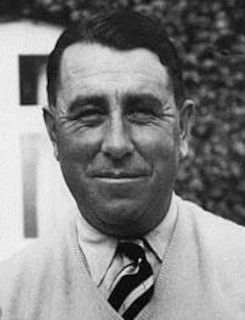
Harry Bradshaw, a leading Irish professional golfer of the 1940s and 1950s, dies on December 22, 1990, in St. Vincent’s hospital, County Dublin.
Bradshaw is born on October 9, 1913, in Killincarrig, County Wicklow, eldest among four sons and two daughters of Edward ‘Ned’ Bradshaw, golf caddie and later golf professional, and Elizabeth Bradshaw (née Walsh) of Killincarrig. He is educated locally. A golf prodigy, he has a hole-in-one at the age of ten on an 80-yard par three at Delgany Golf Club, County Wicklow. He joins Delgany Golf Club, where he progresses from caddie to assisting his father, who is the club’s professional. As a teenager, he tends to hook the ball wildly, before he develops a grip that allows him to hit with great accuracy. Thereafter, he concentrates on honing his peerless approach play from within 100 yards of the hole. Another feature of his game is what is called his “hit and hark” approach to putting: he never lifts his head to follow the ball until he hears it drop.
Bradshaw plays in his first tournament as a professional in 1932, the same year he shoots a course record 68 at Delgany. In 1938, he wins his first professional tournament, the Bromford-Adgey Cup at Skerries Golf Club, County Dublin. In 1941, he is appointed golf professional at Kilcroney, County Wicklow, and in 1950 he begins his long association with Portmarnock Golf Club, County Dublin, when he is appointed golf professional there. By then he has already made his mark on domestic Irish golf, having won the Irish Open in 1947 and 1949. In Ireland he wins the Irish Dunlop Trophy three times, the Willie Nolan Trophy eleven times, the Moran Cup twelve times and the Irish Professional Championship ten times, the last a record later equaled by Christy O’Connor Snr.
Bradshaw is not well known outside of Ireland prior to the famous “bottle” incident at the 1949 Open Championship at Royal St. George’s Golf Club in Sandwich, Kent, England. Having headed the qualifiers and shooting an opening 68, he continues his good form into the second round when his drive at the par four fifth hole just misses the fairway and lands in a beer bottle that is standing upright with the neck and shoulder broken off. The rules are unclear on whether the bottle constitutes a hazard, and he elects to play the ball where it lay, judging (correctly) that he is not entitled to a free drop. Closing his eyes and turning his head away, he swings, shattering the bottle and advancing the ball about twenty-five yards. He is shaken and records a lacklustre round of 77. Back to his best in the next two rounds, he would win the title had his putt on the last not stopped just short. Instead, he ties with the South AfricanBobby Locke who defeats him by twelve strokes in the thirty-six-hole play-off with superlative rounds of 67 and 68. As a result of his experience with the broken bottle, the rules are changed to cater for the possibility of such an incident recurring. It is the closest a golfer from the Republic of Ireland comes to winning the Open Championship until Pádraig Harrington’s victory in 2007.
Bradshaw subsequently revenges himself on Locke by narrowly beating him to the Irish Open title the following month. He is then one of four British and Irish golfers to participate in a sixteen-week tour of South Africa from December 1950 to March 1951 during which he engages in further jousts with Locke, deepening their new-found friendship.
Establishing himself on the international golf circuit, Bradshaw goes on to win the DunlopBritish Masters on two occasions (1953, 1955), and in 1958 he becomes the first Irishman to win the PGA Close Championship. He had also won the Dunbar Open Tournament in Scotland in 1953 and the Gleneagles Hotel Foursomes Tournament pro-am with Joe Carr in 1955. The highlight of his career comes in Mexico City in 1958, when, in partnership with Christy O’Connor Snr, he wins the Canada Cup, later known as the World Cup, for Ireland, also losing a play-off for the individual title. His performance is particularly impressive, given that he is forty-five and carrying weight while competing at altitude in oppressive heat. He and O’Connor are fêted upon their return home, and their victory is considered to play the determining role in popularising golf in Ireland. He caps a memorable year by receiving the Association of Golf Writers’ Trophy for 1958.
Bradshaw appears on three Ryder Cup teams. At the Wentworth Club in 1953, he wins his foursomes match partnering Fred Daly and his singles match against Fred Haas, but in 1955 he loses both his foursomes and singles matches at the Thunderbird Country Club in California. In 1957, he is a member of the side that defeats the American team 7–4 at Lindrick Golf Club in South Yorkshire, only the third victory by the Britain and Ireland side in the twelve matches played up to that time. He holes a five-footer to tie his match with U.S. Open champion Dick Mayer after a classic encounter. In 1963, he takes on Billy Casper, one of America’s top golfers, in a match at Portmarnock televised as part of the prestigious Shell’s Wonderful World of Golf series. Bradshaw’s three-stroke victory earns him $3,000, which is then considered a bonanza in golfing terms.
Bradshaw remains the golf professional at Portmarnock until 1983, latterly spending most of his day in the club shop. Even after his formal retirement, he remains on the payroll at Portmarnock as an informal ambassador for the club. Nicknamed “the Brad,” he is extremely popular with amateur and professional alike, is a great raconteur and tremendous company, and is noted for his lack of rancor towards, or criticism of, other players.
Bradshaw marries Elizabeth Foley from Carlow in 1944 and they have four children. His three brothers, Eddie, Hughie and Jimmy, are all professional golfers.
(From: “Bradshaw, Harry” by Jim Shanahan, Dictionary of Irish Biography, http://www.dib.ie, November 2022)
Price and her sister, Marian, also an IRA member, are the daughters of Albert Price, a prominent Irish republican and former IRA member from Belfast. Their aunt, Bridie Dolan, is blinded and loses both hands in an accident while handling IRA explosives.
Price becomes involved in Irish republicanism in the late 1960s and she and Marian participate in the Belfast to Derrycivil rights march in January 1969 and are attacked in the Burntollet Bridge incident.
In 1971 Price and her sister join the Provisional Irish Republican Army (IRA). In 1972 she joins an elite group within the IRA called “The Unknowns” commanded by Pat McClure. The Unknowns are tasked with various secretive activities and transport several accused traitors across the border into the Republic of Ireland where they are “disappeared.” She personally states that she had driven Joe Lynskey across the border to face trial. In addition, she states that she, Pat McClure and a third Unknown were tasked with killing Jean McConville, with the third Unknown actually shooting her.
Price leads the car bombing attacks in London on March 8, 1973, which injure over 200 people and is believed to have contributed to the death of one person who suffers a fatal heart attack. The two sisters are arrested, along with Gerry Kelly, Hugh Feeney and six others, on the day of the bombing as they are boarding a flight to Ireland. They are tried and convicted at the Great Hall in Winchester Castle on November 14, 1973. Although originally sentenced to life imprisonment, which is to run concurrently for each criminal charge, their sentence is eventually reduced to 20 years. She serves seven years for her part in the bombing. She immediately goes on a hunger strike demanding to be moved to a prison in Northern Ireland. The hunger strike lasts for 208 days because the hunger strikers are force-fed by prison authorities to keep them alive.
On the back of the hunger-striking campaign, Price’s father contests Belfast West at the February 1974 United Kingdom general election, receiving 5,662 votes (11.9%). The Price sisters, Hugh Feeney, and Gerry Kelly are moved to Northern Ireland prisons in 1975 as a result of an IRA truce. In 1980 she receives the royal prerogative of mercy and is freed on humanitarian grounds in 1981, purportedly suffering from anorexia nervosa due to the invasive trauma of daily force feedings.
After her release in 1980, Price marries Irish actor Stephen Rea, with whom she has two sons, Danny and Oscar. They divorce in 2003.
The Price sisters remain active politically. In the late 1990s, Price and her sister claim that they have been threatened by their former colleagues in the IRA and Sinn Féin for publicly opposing the Good Friday Agreement (i.e. the cessation of the IRA’s military campaign). she is a contributor to The Blanket, an online journal, edited by former Provisional IRA member Anthony McIntyre, until it ceases publication in 2008.
In 2001, Price is arrested in Dublin and charged with possession of stolen prescription pads and forged prescriptions. She pleads guilty and is fined £200 and ordered to attend Alcoholics Anonymous meetings.
In February 2010, it is reported by The Irish News that Price had offered help to the Independent Commission for the Location of Victims’ Remains in locating graves of three men, Joe Lynskey, Seamus Wright, and Kevin McKee. The bodies of Wright and McKee are recovered from a singular grave in County Meath in August 2015. It is unclear if Price played a role in their recovery. The remains of Joe Lynskey have not been recovered as of April 2021.
Price is the subject of the 2018 feature-length documentary I, Dolours in which she gives an extensive filmed interview.
In 2010, Price claims Gerry Adams had been her officer commanding (OC) when she was active in the IRA. Adams, who has always denied being a member of the IRA, denies her allegation. She admits taking part in the murder of Jean McConville, as part of an IRA action in 1972. She claims the murder of McConville, a mother of ten, was ordered by Adams when he was an IRA leader in West Belfast. Adams subsequently publicly further denies Price’s allegations, stating that the reason for them is that she is opposed to the Provisional Irish Republican Army’s abandonment of paramilitary warfare in favour of politics in 1994, in the facilitation of which Adams has been a key figure.
Oral historians at Boston College interview both Price and her fellow IRA paramilitary Brendan Hughes between 2001 and 2006. The two give detailed interviews for the historical record of the activities in the IRA, which are recorded on condition that the content of the interviews is not to be released during their lifetimes. Prior to her death in May 2011, the Police Service of Northern Ireland (PSNI) subpoena the material, possibly as part of an investigation into the disappearance of a number of people in Northern Ireland during the 1970s. In June 2011, the college files a motion to quash the subpoena. A spokesman for the college states that “our position is that the premature release of the tapes could threaten the safety of the participants, the enterprise of oral history, and the ongoing peace and reconciliation process in Northern Ireland.” In June 2011, U.S. federal prosecutors ask a judge to require the college to release the tapes to comply with treaty obligations with the United Kingdom. On July 6, 2012, the United States Court of Appeals for the First Circuit agrees with the government’s position that the subpoena should stand. On October 17, 2012, the Supreme Court of the United States temporarily blocks the college from handing over the interview tapes. In April 2013, after Price’s death, the Supreme Court turns away an appeal that seeks to keep the interviews from being supplied to the PSNI. The order leaves in place a lower court ruling that orders Boston College to give the Justice Department portions of recorded interviews with Price. Federal officials want to forward the recordings to police investigating the murder of Jean McConville.
Price dies in her Malahide, County Dublin, home on January 23, 2013, from a toxic effect of mixing prescribed sedative and anti-depressant medication. Her body is found the following day. The inquest returns a verdict of death by misadventure. She is buried at Milltown Cemetery in West Belfast.
On December 12, 1993, a unit of the Provisional Irish Republican Army‘s (IRA) East Tyrone Brigade ambushes a two-men unmarked mobile patrol of the Royal Ulster Constabulary (RUC) in Fivemiletown, County Tyrone. Two constables, Andrew Beacom and Ernest Smith, are shot and killed instantly. A military helicopter is also fired at by a second IRA unit in the aftermath of the incident, during a follow-up operation launched in the surroundings of the town by both the British Army and the RUC. A number of suspects are questioned, but the perpetrators make good their escape. The action occurs just three days before the Downing Street Declaration.
Fivemiletown lays in the western edge of the Clogher Valley, near the border between County Fermanagh and County Tyrone. No deaths directly related with paramilitary activity has occurred there during the Troubles prior to the 1993 IRA shootings, though there are a number of incidents in the region in the previous months.
On May 7, 1992, members of the IRA South Fermanagh Brigade detonate a 1,000-pound bomb delivered by a tractor after crossing through a hedge outside the local RUC part-time barracks. The huge explosion leaves ten civilians wounded and causes widespread damage to the surrounding property. The security base itself is heavily damaged and the blast is heard 30 miles away. According to a later IRA statement, the destruction of the security base compels the British forces to organise their patrols from the nearby RUC barracks at Clogher, allowing the East Tyrone Brigade to study their pattern and carry out the 1993 ambush at Fivemiletown’s main street.
A secondary incident occurs some hours later, on May 9, when a British soldier kills his company’s sergeant major in a blue-on-blue shooting at the same place while taking part in a security detail around the wrecked facilities.
On January 20, 1993, the RUC base in Clogher is hit and severely damaged by a Mark-15 “barrack buster” mortar bomb launched by the IRA’s East Tyrone Brigade. A number of constables receive minor injuries.
Constable Andrew Beacom and Reserve Constable Ernest Smith are patrolling Fivemiletown’s Main Street in a civilian-type, unmarked Renault 21 on the early hours of December 12, 1993. Both men are part of the RUC Operational Support Unit, which surveils the border along with the British Army. The constables are based at Clogher RUC barracks.
The IRA reports that two active service units from the East Tyrone Brigade had taken up positions in the centre of Fivemiletown and identified the RUC unmarked vehicle before the ambush.
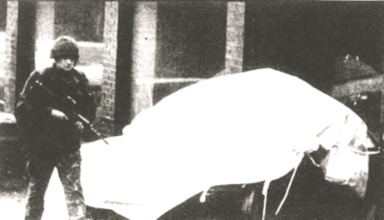
At 1:30 a.m., up to the junction of Main Street and Coneen Street, at least two IRA volunteers open fire from both sides of the road with automatic weapons, hitting the vehicle with more than 20 rounds. Beacom and Smith die on the spot. Constable Beacom lives in Fivemiletown, just a hundred metres from the site of the ambush, where his wife owns a restaurant. She is one of the first persons to arrive to the scene of the shooting. Smith resides with his family at Augher.
According to a colleague in the Operational Support Unit, himself a reserve constable deployed at Lisnaskea and a former Ulster Defence Regiment (UDR) soldier, their deaths “hit the unit very hard.” The men are appreciated for their in-depth knowledge of the area.
A “major” follow-up security operation is mounted between Fivemiletown and the border with the Republic of Ireland, supported by airborne troops and RUC reinforcements, in an attempt to block the attacker’s escape.
Approximately an hour after the ambush, an Army Air Corps (AAC) Westland Lynx helicopter comes upon a number of IRA volunteers in the searching area, just a few miles from the site of the shooting, but the aircraft becomes the target of automatic rifle fire and is forced to disengage. Though the helicopter is not hit, the assailants break contact successfully. The IRA East Tyrone Brigade report claims that the attack on the Westland Lynx is carried out by a second active service unit, which set up a firing position on the predicted path of the British helicopters carrying reinforcements into Fivemiletown after the initial shooting. A number of people are arrested and questioned about the killings, but the perpetrators manage to slip away.
The shootings are widely condemned. RUC Chief Constable Sir Hugh Annesley says that “At a time when the whole community is looking toward peace, the Provisional IRA has yet again shown they have absolutely nothing to offer but deaths and suffering.”
Presbyterian Moderator Rev. Andrew Rodgers calls on the governments to break any contact with Sinn Féin and other “men of blood in both sections of the community.”
A former IRA member cites instead the answer of an IRA volunteer in the area when questioned by him about the futility of the actions at Fivemiletown. He replies that “The war must go on.”
(Pictured: A photograph showing a British Army sentry guarding the scene of the IRA ambush on a Royal Ulster Constabulary mobile patrol, December 12, 1993)
The 32CSM has been described as the “political wing” of the now defunct Real Irish Republican Army (RIRA), but this is denied by both organisations. The group originates in a split from Sinn Féin over the Mitchell Principles.
Those present at the initial meeting are opposed to the direction taken by Sinn Féin and other mainstream republican groups in the Northern Ireland peace process, which leads to the Belfast Agreement (also known as the Good Friday Agreement) the following year. The same division in the republican movement leads to the paramilitary group now known as the Real IRA breaking away from the Provisional Irish Republican Army at around the same time.
Most of the 32CSM’s founders had been members of Sinn Féin. Some had been expelled from the party for challenging the leadership’s direction, while others felt they had not been properly able to air their concerns within Sinn Féin at the direction its leadership had taken. Bernadette Sands McKevitt, wife of Michael McKevitt and a sister of hunger strikerBobby Sands, is a prominent member of the group until a split in the organisation.
The name refers to the 32 counties of Ireland which are created during the Lordship and Kingdom of Ireland. With the partition of Ireland in 1920–22, twenty-six of these counties form the Irish Free State which is abolished in 1937 and is now known as Ireland since 1949. The remaining six counties of Northern Ireland remain part of the United Kingdom. Founder Bernadette Sands McKevitt says in a 1998 interview with the Irish Mirror that people did not fight for “peace” – “they fought for independence” – and that the organisation reaffirms to the republican position in the 1919 Irish Declaration of Independence.
Before the referendums on the 1998 Good Friday Agreement, the 32CSM lodges a legal submission with the United Nations challenging British sovereignty in Ireland. The referendums are opposed by the 32CSM but are supported by 71% of voters in Northern Ireland and by 94% in the Republic of Ireland. It is reported in February 2000 that the group established a “branch” in Kilburn, London.
In November 2005, the 32CSM launches a political initiative titled Irish Democracy, A Framework for Unity.
On May 24, 2014, Gary Donnelly, a member of the 32CSM, is elected to the Derry City and Strabane District Council. In July 2014, a delegation from the 32CSM travels to Canada to take part in a six-day speaking tour. On arrival the delegation is detained and refused entry into Canada.
In 2015, the 32CSM organises a demonstration in Dundee, Scotland, in solidarity with the men convicted of shooting Constable Stephen Carroll, the first police officer to be killed in Northern Ireland since the formation of the PSNI. The organisation says the “Craigavon Two” are innocent and have been victims of a miscarriage of justice.
The group is currently considered a Foreign Terrorist Organization (FTO) in the United States, because the group is considered to be inseparable from the Real IRA, which is designated as an FTO. At a briefing in 2001, a spokesman for the U.S. Department of State states that “evidence provided by both the British and Irish governments and open-source materials demonstrate clearly that the individuals who created the Real IRA also established these two entities to serve as the public face of the Real IRA. These alias organizations engage in propaganda and fundraising on behalf of and in collaboration with the Real IRA.” The U.S. Department of State’s designation makes it illegal for Americans to provide material support to the Real IRA, requires U.S. financial institutions to block the group’s assets and denies alleged Real IRA members visas into the U.S.
The 32CSM also operates outside of the island of Ireland to some extent. The Gaughan/Stagg Cumann covers England, Scotland and Wales, and has an active relationship of mutual promotion with a minority of British left-wing groups and anti-fascist organisations. The James Larkin Republican Flute Band in Liverpool, and the West of Scotland Band Alliance, the largest section of which is the Glasgow-based Parkhead Republican Flute Band, are also supporters of the 32CSM. As of 2014, the 32CSM’s alleged paramilitary wing, the Real IRA, is reported to have been still involved in attempts to perpetrate bombings in Britain as part of the Dissident Irish Republican campaign, which has been ongoing since 1998.
A rally of twelve to fifteen thousand Peace People from both north and south takes place at the new bridge over the River Boyne at Drogheda, County Louth, on December 5, 1976. In general, the Peace People’s goals are the dissolution of the Irish Republican Army (IRA) and an end to violence in Northern Ireland. The implicit goals of the Peace People rallies are delegitimization of violence, increasing solidarity, and gaining momentum for peace.
In the 1960s, Northern Ireland begins a period of ethno-political conflict called the Troubles. Through a series of social and political injustices, Northern Ireland has become a religiously divided society between historically mainland Protestants and Irish Catholics. Furthermore, the Irish people have become a fragmented body over a range of issues, identities, circumstances and loyalties. The conflict between Protestants and Catholics spills over into violence, marked by riots and targeted killings between the groups beginning in 1968. In addition, paramilitary groups, including the prominent IRA, launch attacks to advance their political agendas.
The violence continues to escalate. On August 10, 1976, Anne Maguire and her children are walking along Finaghy Road North in Belfast. Suddenly, a Ford Cortina slams into them. The car is being driven by Danny Lennon, who moments before had been shot dead by pursuing soldiers. The mother is the only survivor. The collision kills three of her four children, Joanne (8), John (2), and Andrew (6 months). Joanne and Andrew die instantly while John is injured critically.
The next day, immediately following John’s death, fifty women from the Republican neighborhoods of Andersonstown and Stewartstown protest Republican violence by marching with baby carriages. That evening, Mairead Corrigan, Anne Maguire’s sister, appears on television pleading for an end to the violence. She becomes the first leader of the Peace People to speak publicly.
However, she was not the only one to initiate action. As soon as she hears Mairead speak on the television, Betty Williams begins petitioning door-to-door for an end to sectarian violence. She garners 6,000 signatures of support within a few days. This support leads directly into the first unofficial action of the Peace People. On 14 August, only four days after the incident, 10,000 women, both Protestant and Catholic, march with banners along Finaghy Road North, the place of the children’s death, to Milltown Cemetery, their burial site. This march mostly includes women along with a few public figures and men. The marchers proceed in almost utter silence, only broken by short bouts of singing from the nuns in the crowd and verbal and physical attacks by Republican opposition.
The following day, the three who become leaders of the Peace People – Mairead Corrigan, Betty Williams, and journalist Ciaran McKeown – come together for their first official meeting. During these initial meetings they establish the ideological basis of nonviolence and goals for the campaign. The essential goals for the movement are the dissolution of the IRA and an end to the violence in Northern Ireland. The goals of the campaign implicit in their declaration are awareness, solidarity, and momentum. Peace People’s declaration:
“We have a simple message to the world from this movement for Peace. We want to live and love and build a just and peaceful society. We want for our children, as we want for ourselves, our lives at home, at work, and at play to be lives of joy and peace. We recognise that to build such a society demands dedication, hard work, and courage. We recognise that there are many problems in our society which are a source of conflict and violence. We recognise that every bullet fired, and every exploding bomb make that work more difficult. We reject the use of the bomb and the bullet and all the techniques of violence. We dedicate ourselves to working with our neighbours, near and far, day in and day out, to build that peaceful society in which the tragedies we have known are a bad memory and a continuing warning.”
During the four-month campaign, Peace People and partners organize and participate in 26 marches in Northern Ireland, Britain, and the Republic of Ireland. In order to organize these marches effectively they establish their main headquarters in Belfast.
After the initial Finaghy Road March, the Peace People, both Protestants and Catholics, rally in Ormeau Park on August 21. The official Declaration of the Peace People is first read at this rally, the largest rally of the entire campaign. The group numbers over 50,000. The rally even includes some activists from the Republic of Ireland, most notably Judy Hayes from the Glencree Centre of Reconciliation near Dublin. After the rally, she and her colleagues return to the south to organize solidarity demonstrations.
In the few days before the next march, the organization “Women Together” request Peace People to call off the march, disapproving of Catholics and Protestants participating in a joint march. The Peace People are not dissuaded. The next Saturday, 27,000 people march along Shankill Road, the loyalist/Protestant neighborhood.
In the next three months, Peace People organize and participate in a rally every Saturday; some weeks even have two. Some of the most notable marches include the Derry/Londonderry double-march, the Falls march, the London march, and the Boyne march.
The Saturday following the Shankill march marks the Derry/Londonderry double-march. At this march, Catholics march on one side of the River Foyle and Protestants on the other. The groups meet on the Craigavon Bridge. Simultaneously, 50,000 people march in solidarity in Dublin.
On October 23, marchers meet in the Falls, Belfast, in the pouring rain on the same Northumberland street corner where the Shankill March had started. The Falls Road rally is memorable for the fear and violence that ensues. During this rally Sinn Féin supporters throw stones and bottles at the marchers. The attackers escalate the violence as the marchers near Falls Park. The marchers are informed by others that more attackers await them at the entrance to the park, inciting fear within the body of the rally. The leaders decide that this is an important moment of conflict in the rally and that they must push on. They continue verbally encouraging the marchers through the cloud of bottles, bricks, and stones.
The leaders plan to escalate the campaign momentum for the last two major symbolic rallies in London and Boyne, Drogheda. A week before the rallies, on November 20-21, they plan a membership drive. Over 105,000 people sign within two days.
The symbolic week of the culminating rallies begins on November 27 at the glamorous London Rally. They begin to march at Hyde Park, cut through Westminster Abbey, and end at Trafalgar Square. Some groups sing “Troops Out,” and others resound with civil rights songs.
On December 5, Peace People holds its final march of the campaign, along the River Boyne. The Northern and Southern Ireland contingents met at the Peace Bridge. This is an important point in the legacy of the Peace People movement. Now that the enthusiastic rallies are over, the people are responsible for the tedious local work and continuing the momentum and solidarity that the rallies have inspired. The shape of the Peace People is changing.
After the planned marches are over, the rally portion of the campaign fades and the Peace People take a new shape. Corrigan, Williams, and McKeown stop planning marches, but continue to be involved in action that takes the form of conferences and traveling overseas. However, the leaders begin doing more separated work. Ciaran McKeown increases his focus on radical political restructuring.
In 1977, Betty Williams and Mairead Corrigan receive the Nobel Peace Prize. Issues regarding the use of the monetary award impact the two leaders’ relationships in an irreconcilable manner.
Due to the fact that many people, unlike McKeown, are less interested in the political side of the equation, the People continue actions along the lines of rallies and social work. Actions continue through the People’s initiative in the form of Peace Committees that each does separate work in local areas.
The Peace People makes a substantial impact. They help to de-legitimize violence, increase solidarity across sectarian lines, and develop momentum for peace. Although the violence does not fully subside until 1998 with the negotiation of political change, Ireland sees in 1976 one of its most dramatic decreases in political violence, accompanying the Peace People’s marches and rallies. The campaign dramatizes how tired the people are of bloodshed, their desperate desire for peace, and the clear possibility of alternatives.
(From: “Peace People march against violence in Northern Ireland, 1976” by Hannah Lehmann, Global Nonviolent Action Database, https://nvdatabase.swarthmore.edu/, 2011 | Pictured: The Peace People organisation rally in Drogheda, County Louth, December 5, 1976)
The first of four paramilitary bombings in the centre of Dublin between November 26, 1972, and January 20, 1973, takes place in the Burgh Quay area of the city on Sunday, November 26, 1972. A total of three civilians are killed and 185 people are injured in the four bombings.
The bombings occur at the end of what is the bloodiest year in the entire 30-year-old religious-political conflict known as the Troubles, which had erupted at the end of the 1960s. Many of the bombs that detonate in Northern Ireland and the ingredients used to make them (mostly stolen from Irish construction sites provided to the Irish Republican Army (IRA) by local sympathisers) originate from the Republic of Ireland, where the IRA Southern Command, headquartered in Dublin, is located and tasked in recruiting and training volunteers and manufacturing weapons for operations in the North and to provide shelter for fleeing IRA members from British security forces who are not permitted to enter the country.
No group ever claims responsibility for the attacks and nobody is ever charged in connection with the bombings. The November 26 bombing in Burgh Quay is possibly carried out by former associates of the Littlejohn brothers who are Secret Intelligence Service provocateurs, in a successful attempt to provoke an Irish government clampdown against the Provisional Irish Republican Army (IRA), while the other three bombings are possibly perpetrated by loyalist paramilitaries, specifically the Ulster Volunteer Force (UVF), with British military or intelligence assistance.
The first of the four bombs explodes at 1:25 a.m. on November 26, 1972, outside the rear exit door of the Film Centre Cinema, O’Connell Bridge House, during a late night showing of a film. The bomb goes off in the laneway connecting Burgh Quay with Leinster Market injuring 40 people, some very badly, including facial, leg and serious bowel wounds. There are 156 patrons and three employees inside the cinema at the time of the blast, although there are no fatalities. The force of the explosion hurls customers out of their seats and onto the floor. There is much panic as people, fearing a second bomb might explode in their midst, rush to escape from the crowded cinema. Shops and buildings in the immediate vicinity receive extensive damage.
The area is sealed off by the Garda Síochána and they launch an investigation. A ballistic officer determines that the explosion’s epicentre had been on a doorstep outside an emergency door leading to the laneway. However, no trace of the bomb or explosives used are ever found at the scene. The Gardaí interviews a number of witnesses who came forward alleging to have seen the bombers in the laneway prior to the explosion and although photofits of the suspects are drawn up, the bombers are never apprehended. The Garda believes the bombing was carried out by republican subversives, including former associates of the Littlejohn brothers.
The night following the bombing an eight-man IRA unit unsuccessfully attempts to free Provisional IRA Chief of StaffSeán Mac Stíofáin, who had been taken to Dublin’s Mater Hospital for treatment due to adverse effects of his hunger and thirst strike on his health. The ward in which he is kept is under heavy police guard. The armed IRA unit exchanges shots with two members of the Garda Special Branch. One detective, two civilians and one IRA volunteer suffer minor injuries from gunfire.
(Pictured: The O’Connell Bridge House, 2 D’Olier Street, Dublin, where a bomb was detonated outside the rear exit door of the Film Centre Cinema)
The Darkley killings or Darkley massacre is a gun attack carried out on November 20, 1983, near the village of Darkley, County Armagh, Northern Ireland. Three gunmen attack worshippers attending a church service at Mountain Lodge Pentecostal Church, killing three Protestant civilians and wounding seven. The attackers are rogue members of the Irish National Liberation Army (INLA). They claim responsibility using the cover name “Catholic Reaction Force,” saying it is retaliation for recent sectarian attacks on Catholics by the loyalist Protestant Action Force (PAF). The attack is condemned by INLA leadership.
In the months before the Darkley killings, several Catholic civilians are killed by loyalists. On October 29, 1983, a Catholic civilian member of the Workers’ Party, David Nocher (26), is shot dead in Belfast. On November 8, Catholic civilian Adrian Carroll (24) is shot dead in Armagh. Ulster Defence Regiment (UDR) personnel are later convicted but the convictions are cleared on appeal for three of them (see UDR Four case). Carroll is the brother of an INLA member who was killed a year earlier. These attacks are claimed by the Protestant Action Force, a cover name used mostly by members of the Ulster Volunteer Force (UVF). It is believed the Darkley killings are primarily a retaliation for the killing of Carroll.
On the evening of Sunday, November 20, about sixty people are attending a church service at Mountain Lodge Pentecostal Church. The small, isolated wooden church is outside the village of Darkley, near the border with the Republic of Ireland and several miles from Armagh. As the service begins, three masked gunmen arrive, at least one of whom is armed with a Ruger semi-automatic rifle, and open fire on those standing in the entrance. Three church elders are killed: Harold Browne (59), Victor Cunningham (39) and David Wilson (44). The fatally wounded Wilson staggers into the service, where he collapses and dies. The gunmen then stand outside the building and spray it with bullets, wounding an additional seven people before fleeing in a car. The service is being tape-recorded when the attack takes place. On the tape, the congregation can be heard singing the hymn “Are You Washed in the Blood of the Lamb,” followed by the sound of gunfire. All of the victims are Protestant civilians.
In a telephone call to a journalist, a caller claims responsibility for the attack on behalf of the “Catholic Reaction Force.” He says it is “retaliation for the murderous sectarian campaign carried out by the Protestant Action Force” and adds, “By this token retaliation we could easily have taken the lives of at least 20 more innocent Protestants. We serve notice on the PAF to call an immediate halt to their vicious indiscriminate campaign against innocent Catholics, or we will make the Darkley killings look like a picnic.” The caller names nine Catholics who had been attacked.
The name “Catholic Reaction Force” had never been used before and police say they believe the attack is carried out by members of the INLA. The INLA condemn the attack and deny direct involvement, but say it is investigating the involvement of INLA members or weapons. A week later, INLA leader Dominic McGlinchey admits that one of the gunmen had been an INLA member and admits supplying him with the gun but says there is no justification for the attack. The INLA member’s brother had been killed by loyalists. McGlinchey explains that the INLA member had asked him for a gun to shoot a known loyalist who had been involved in sectarian killings. However, “clearly deranged by the death of his brother,” he “used it instead to attack the Darkley Gospel Hall.” McGlinchey says, “he must have been unbalanced or something to have gone and organised this killing. We are conducting an inquiry.”
There are reprisal sectarian attacks on Catholics in North Belfast, Lisburn, and Portadown within 24 hours of the Darkley massacre. On December 5, fifteen days after the Darkley attack, the PAF shoot dead INLA member Joseph Craven (26) in Newtownabbey.
The name “Catholic Reaction Force” is used several other times. In August 1984, it is used to issue a threat to newspapers against the families of Royal Ulster Constabulary (RUC) officers, after Sean Downes, a Catholic man, dies after the RUC shot him with a plastic bullet during an anti-internment march on the Andersontown Road, Belfast. In May 1986, it is used to claim the killing of Protestant civilian David Wilson (39), who is shot while driving his firm’s van in Donaghmore. The Irish Republican Army (IRA) also claims responsibility, saying Wilson was a member of the UDR. The “Catholic Reaction Force” declares a ceasefire on October 28, 1994. In 2001, the name is used to claim two attacks on homes in which there are no injuries, and in 2002 is used to issue a threat to hospital workers suspected of links to the security forces.
(Pictured: The Mountain Lodge Pentecostal Church at Aughnagurgan outside Darkley, County Armagh, Northern Ireland)
Duff is born in Dublin on June 7, 1889, at 97 Phibsboro Road, the eldest of seven children of John Duff and his wife, Susan Letitia (née Freehill). The wealthy family lives in the city at St. Patrick’s Road, Drumcondra. He attends Blackrock College.
In 1908, Duff enters the Civil Service and is assigned to the Irish Land Commission. In 1913, he joins the Society of Saint Vincent de Paul and is exposed to the real poverty of Dublin. Many who live in tenement squalor are forced to attend soup kitchens for sustenance, and abject poverty, alcoholism, and prostitution are rife in parts of Dublin. He joins and soon rises through the ranks to President of the St. Patrick’s Conference at St. Nicholas of Myra Parish. Having concern for people he sees as materially and spiritually deprived, he gets the idea to picket Protestant soup kitchens as he considers they are giving aid in the form of food and free accommodation at hostels in return for not attending Catholic services. He sets up rival Catholic soup kitchens and, with his friend, Sergeant Major Joe Gabbett, discourages Catholics from patronizing Protestant soup kitchens. They succeeded in closing down two of them over the years.
Duff publishes his first pamphlet, Can we be Saints?, in 1916. In it, he expresses the conviction that all, without exception, are called to be saints, and that through Christian faith, all have the means necessary.
Duff briefly acts as private secretary to Michael Collins, the chairman of the Provisional Government and the commander-in-chief of the National Army. In 1924, he is transferred to the Department of Finance.
On September 7, 1921, Duff is a part of a meeting alongside Fr. Michael Toher and fifteen women which becomes the nucleus of what would become the Legion of Mary. The Legion of Mary is created to organise lay Catholics to perform voluntary work. He models the organisation on Roman legions. Some of the first causes the Legion pursues is to become involved with homelessness and prostitution in Dublin. In 1922, he defies the wishes of the Archbishop of Dublin and the widespread Crypto-Calvinism, or Jansenism, within the Catholic Church in Ireland, which had created an intense hostility towards both prostitutes and other allegedly “fallen women.” Similarly, to St. Vitalis of Gaza before him, he begins an outreach to the prostitutes living in often brutal and inhuman conditions in the “kip houses” of “the Monto,” as Dublin’s red-light district, one of the largest in Europe at the time, is then called. Although middle-class Dubliners dismissively view these women as “whores,” the impoverished but devoutly Catholic residents of the Monto tenements refer to local prostitutes as “unfortunate girls,” and understand that they often turn to prostitution as a last resort. As part of his work, Duff establishes the Sancta Maria hostel, a safe house for former prostitutes who had run away from their “kip keepers.” Following the Irish War of Independence and Irish Civil War, he also persuades the first Catholic Commissioner of the Dublin Metropolitan Police, former Irish Army General W. R. E. Murphy, to launch a crackdown and, even though prostitution in the Republic of Ireland, rooted in human trafficking, still exists, the closure of the Monto’s last “Kip-Houses” is announced on March 12, 1925.
In 1927, Duff establishes the Morning Star hostel for homeless men, followed shortly by the Regina Coeli hostel for homeless women in 1930. Unlike the Magdalen Asylums, the Regina Coeli hostel reflects his view that unwed mothers should be taught how to be able to provide for and raise their children. This defies the norm of the era which holds that the children of unwed mothers should be saved from the stigma of their illegitimacy by being put up for adoption as quickly as possible.
While Duff enjoys the support of W. T. Cosgrave, Ireland’s head of government, and in May 1931 is granted an audience with Pope Pius XI, his efforts are opposed internally in the Dublin diocese. The Archbishop of Dublin Edward Joseph Byrne and his successor John Charles McQuaid seek to censor him because of his involvement with prostitutes. McQuaid also does not approve of his ecumenical efforts. In the 1930s and 1940s Duff creates the Mercier Society, a study group designed to bring together Catholics and Protestants, as well as the Pillar of Fire, a group designed to promote dialogue with Ireland’s Jewish community. In communication with Irish social dissidents Seán Ó Faoláin and Peadar O’Donnell, he suggests he is far more censored than even they are.
Duff does have some supporters amongst the Catholic hierarchy though. With the backing of Cardinal Joseph MacRory and Francis Bourne of Westminster, the Legion is able to expand rapidly and internationally. In 1928 the Legion establishes its first presidium in Scotland. In 1932 he is able to use the occasion of the Eucharistic Congress of Dublin to introduce the concept of the Legion of Mary to several visiting bishops, leading to further international growth.
Duff retires from the Civil Service in 1934 to devote all of his time to the Legion of Mary.
In July 1940, an overseas club for Afro-Asian students in Dublin is created. At that time Ireland is a popular destination for students from Asia and Africa because of its recent anti-imperial, anti-colonial history. Duff personally funds the purchase of a building for the club using funds from an inheritance. The club lasts until 1976 and facilitate many notable students, including Jaja Wachuku.
For the rest of his life, and with the help of many others, Duff guides the Legion’s worldwide extension. Today, the Legion of Mary has an estimated four million active members and 10 million auxiliary members in close to 200 countries in almost every diocese in the Catholic Church.
In 1965, Pope Paul VI invites Duff to attend the Second Vatican Council as a lay observer. When he is introduced to the assembly by the Archbishop of Liverpool, John Heenan, he receives a standing ovation.
Duff dies in Dublin at the age of 91 on November 7, 1980, and is interred at Glasnevin Cemetery. In July 1996, the cause of his beatification is introduced by Cardinal Desmond Connell.
Ryan has two spells with Coventry City. In April 1943, he signs for the club as an amateur and during the 1942–43 season he plays two games in wartime regional leagues. He then turns professional in August 1944 and makes a further four appearances for the club during the 1944–45 wartime season. After playing for West Bromwich Albion and Derby County, he returns to City in September 1958. He then helps the club win promotion from the newly formed Football League Fourth Division, after they finish as runners-up in 1959. During his second spell with City he plays 70 times in all competitions.
Ryan signs for Derby County in June 1955 for a fee of £3,000. He is appointed team captain by manager Harry Storer, Jr., and during his three seasons with the club misses only three matches – two because of injury and one because of international duty. He is a member of the side promoted as champions of the Third Division North to the Football League Second Division in 1956–57. In 1955 he also plays for an English Division Three North XI against an English Division Three South XI. He plays 133 league games for County, scoring 30 goals. He also plays a further six games for the club in the FA Cup, scoring a further goal.
When Ryan begins his international career in 1949 there are, in effect, two Ireland teams, chosen by two rival associations. Both associations, the Northern Ireland–based Irish Football Association (IFA) and the Republic of Ireland–based Football Association of Ireland (FAI) claim jurisdiction over the whole of Ireland and select players from the whole island. As a result, several notable Irish players from this era, including Ryan, play for both teams.
Between 1949 and 1955 Ryan makes 16 appearances and scores 3 goals for the FAI XI. He makes his debut in a 3–1 defeat to Sweden on November 13, 1949, in a qualifier for the 1950 FIFA World Cup. He scores his first two goals for the FAI XI in October 1953 during the qualifiers for the 1954 FIFA World Cup, one against France in a 5–3 defeat and the second, a penalty, against Luxembourg in 4–0 win. On November 7, 1954, in a friendly against Norway, he scores his third goal, again from the penalty spot, and earns the FAI XI a 2–1 victory. He makes his last appearance for the FAI XI on November 27, 1955, in a 2–2 draw with Spain.
Ryan makes his one and only appearance for the IFA XI in a 0–0 draw with Wales on March 8, 1950. As well as being part of the 1950 British Home Championship, the game also doubles up as a qualifier for the 1950 FIFA World Cup. Ryan, together with Con Martin, Davy Walsh and Tom Aherne, is one of four players born in the Irish Free State, included in the IFA XI that day. He earlier plays for the FAI XI in the same competition, and as a result, plays for two different teams in the same FIFA World Cup tournament. This situation eventually leads to intervention by FIFA and, as a result, Ryan becomes one of the last four Irish Free State–born players to play for the IFA XI.
After retiring as a player in November 1960, Ryan works as a pools supervisor for both Coventry City (1960–1961) and West Bromwich Albion (1961–1962). Between September 1962 and October 1976, he is chief scout for West Brom. He later works as a scout for various clubs including Aston Villa F.C., Derby County F.C., Hereford United F.C. and Leeds United F.C. before retiring in 1994.






 seamus dubhghaill