seamus dubhghaill

Promoting Irish Culture and History from Little Rock, Arkansas, USA


Leave a comment

Birth of Roger McCorley, Irish Republican Activist

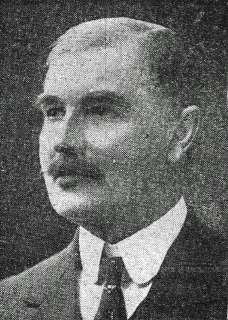
Roger McCorley, Irish republican activist, is born into a Roman Catholic family at 67 Hillman Street in Belfast on September 6, 1901.

McCorley is one of three children born to Roger Edmund McCorley, a meat carver in a hotel, and Agnes Liggett. He has two elder brothers, Vincent and Felix. He joins the Fianna in his teens. His family has a very strong republican tradition, and he claims to be the great-grandson of the United Irishmen folk hero Roddy McCorley, who was executed for his part in the Irish Rebellion of 1798.

McCorley is a member of the Belfast Brigade of the Irish Republican Army (IRA) during the Irish War of Independence (1919–1922). He is commandant of the Brigade’s first battalion, eventually becoming Commandant of the Belfast Brigade. In June 1920, he is involved in an attack on a Royal Irish Constabulary (RIC) police barracks at Crossgar, County Down. On Sunday, August 22, 1920, in Lisburn, he is involved in the assassination of RIC District Inspector Oswald Swanzy, who was held responsible by Michael Collins for the assassination of Tomás McCurtain, Lord Mayor of Cork.

McCorley is noted for his militancy, as he is in favour of armed attacks on British forces in Belfast. The Brigade’s leaders, by contrast, in particular, Joe McKelvey, are wary of sanctioning attacks for fear of loyalist reprisals on republicans and the Catholic population in general. In addition, McCorley is in favour of conducting an armed defense of Catholic areas, whereas McKelvey does not want the IRA to get involved in what he considers to be sectarian violence. McCorley writes later that in the end, “the issue settled itself within a very short space of time, when the Orange mob was given uniforms, paid for by the British, and called the Ulster Special Constabulary (USC).” The role of the USC, a temporary police force raised for counter-insurgency purposes, in the conflict is still debated, but republicans maintain that the organization was responsible for the indiscriminate killings of Catholics and nationalists.

On January 26, 1921, McCorley, is involved in the fatal shooting of three Auxiliary Division officers in their beds in the Railway View hotel in central Belfast. Shortly afterwards, he and another IRA man, Seamus Woods, organize an active service unit (ASU) within the first battalion of the Belfast Brigade, with the intention of carrying out attacks, with or without the approval of the Brigade leadership. The unit consists of 32 men. McCorley later writes, “I issued a general order that, where reprisal gangs [State forces] were cornered, no prisoners were to be taken.” In March 1921, he personally leads the ASU in the killing of three Black and Tans in Victoria Street in central Belfast. He is responsible for the deaths of two more Auxiliaries in Donegall Place in April. In reprisal for these shootings, members of the RIC assassinate two republican activists, the Duffin brothers in Clonard Gardens in west Belfast. On June 10, 1921, both and Woods and McCorley units are involved in the killing a RIC man who is suspected in the revenge killings of the Duffin brothers. Two RIC men and a civilian are also wounded in that attack.

Thereafter, there is what historian Robert Lynch has described as a “savage underground war” between McCorley’s ASU and RIC personnel based in Springfield Road barracks and led by an Inspector Ferris. Ferris is accused of murdering the Lord Mayor of Cork Thomas MacCurtain and had been posted to Lisburn for his safety. Ferris himself is among the casualties, being shot in the chest and neck, but surviving. McCorley claims to have been one of the four IRA men who shot Ferris. In addition, his men bomb and burn a number of businesses including several cinemas and a Reform Club. In May 1921, however, thirteen of his best men are arrested when surrounded by British troops during an operation in County Cavan. They are held in Crumlin Road Gaol and sentenced to death.

On June 3, McCorley organizes an attack on Crumlin Road Gaol in an attempt to rescue the IRA men held there before they are executed. The operation is not a success; however, the condemned men are reprieved after a truce is agreed between the IRA and British forces in July 1921. On Bloody Sunday (July 10, 1921), he is a major leader in the defense of nationalist areas from attacks by both the police and loyalists. On that day twenty people are killed before he negotiates a truce beginning at noon on July 11. At least 100 people are wounded, about 200 houses are destroyed or badly damaged – most of them Catholic homes, leaving 1,000 people homeless.

In April 1922, McCorley becomes leader of the IRA Belfast Brigade after Joe McKelvey goes south to Dublin to join other IRA members who are against the Anglo-Irish Treaty. With McKelvey’s departure, Seamus Woods becomes Officer Commanding of the IRA’s 3rd Northern Division, which has up to 1,000 members, with McCorley designated as Vice Officer Commanding. McCorley for his part, supports the Treaty, despite the fact that it provides for the partition of Ireland and the continued British rule in Northern Ireland. The reason for this is that Michael Collins and Eoin O’Duffy have assured him that this is only a tactical move and indeed, Collins sends men, money and weapons to the IRA in the North throughout 1922.

However, McCorley’s command sees the collapse of the Belfast IRA. In May 1922, the IRA launches an offensive with attacks all across Northern Ireland. In Belfast, he carries out an assault on Musgrave Street RIC barracks. He also conducts an arson campaign on businesses in Belfast. His men also carry out a number of assassinations, including that of Ulster Unionist Party MP William J. Twaddell, which causes the internment of over 200 Belfast IRA men.

To escape from the subsequent repression, McCorley and over 900 Northern IRA men flee south, to the Irish Free State, where they are housed in the Curragh. McCorley is put in command of these men. In June 1922, the Irish Civil War breaks out between Pro and Anti-Treaty elements of the IRA. He takes the side of the Free State and Michael Collins. After Collins is killed in August 1922, his men are stood down. About 300 of them join the National Army and are sent to County Kerry to put down anti-Treaty guerrillas there. In the Spring of 1923, bitterly disillusioned by the brutal counterinsurgency against fellow republicans, he resigns his command.

McCorley later asserts that he “hated the Treaty” and only supported it because it allowed Ireland to have its own armed forces. Both he and Seamus Woods are severe critics of the Irish Free State inertia towards Northern Ireland after the death of Michael Collins. He comments that when Collins was killed “the Northern element gave up all hope.”

In 1936 McCorley is instrumental in the establishment of the All-Ireland Old IRA Men’s Organization, serving as Vice-President with President Liam Deasy (Cork No. 3 Brigade) and Secretary George Lennon (Waterford No. 2 Brigade).

In the 1940s, McCorley is a founding member of Córas na Poblachta, a political party which aspires to a United Ireland and economic independence from Britain. He dies on November 13, 1993, and is buried in the Republican Plot of Glasnevin Cemetery.


Leave a comment

The Holywell Ambush

The Holywell Ambush is an ambush on the Ballyhaunis to Claremorris road near Holywell in the early hours of Monday, August 2, 1920, carried out by the Irish Republican Army (IRA) during the Irish War of Independence. Approximately 20 local IRA volunteers commanded by Patrick Kenny attack a British Military outpost that is guarding a broken down lorry.

A large lorry transporting petrol which is part of a British military convoy travelling from Claremorris towards Ballyhaunis comes off the road on the Claremorris-Ballyhaunis road near Holywell on Saturday, July 31, 1920. The driver of the lorry loses control and crashes off the road into the bog below. The lorry sinks somewhat and is stuck in the bog. A military guard of between 12-20 British soldiers from the 2nd Battalion Argyll and Sutherland Highlanders, who are garrisoned in the old workhouse in Claremorris, is placed on the lorry while the rest of the convoy continues on their journey.

The soldiers set up camp in a little old, abandoned house nearby, throwing a large tarpaulin over the roof of the house for shelter. They place two sentries on the road while the rest of the guard retires to the abandoned house where they light a fire in the ruin’s fireplace. Martin Forkhan, a local IRA volunteer, happens upon the scene of the crashed lorry and immediately notifies the Ballyhaunis Battalion Commandant, Patrick Kenny, of the situation. Kenny issues instructions to mobilise all officers in the Ballyhaunis Battalion area.

On that same night, a train leaving Ballyhaunis towards Westport is held up by armed and masked men not far from the military encampment. A unit of 25 IRA men under the command of Capt. Martin Forde take control of the train after firing a number of warning shots. The IRA then removes steel shutters destined for Westport Royal Irish Constabulary (RIC) Barracks and bury them in the bog nearby. The steel shutters are part of a program of fortification of RIC Barracks country-wide. Some of these men then mobilise with the other IRA officers gathering at Holywell Wood, where arrangements are made for an attempt to overpower and disarm the soldiers guarding the crashed lorry.

The assembled IRA, approximately 40 strong, march to the site of the military encampment where they take up positions. The volunteers are unsure of the size of the British force guarding the lorry, as all they can see is one sentry. An IRA officer approaches the sentry and asks for a light for a cigarette. The sentry sends him into the camp. As he lights his cigarette from the camp fire he looks around and counts 18 rifles present. It is then presumed that there are roughly 18 soldiers at the encampment. Cmdt. Kenny mades a plan and orders an attack, but as the IRA volunteers are crawling through the fields toward their assigned positions to surround the encampment, a line of motorcars appears on the Claremorris road. The headlights from the motorcars would have exposed the positions taken up by the IRA, so due to their poor positions, the delay in organising a plan and the coming dawn, it is decided that the attack is to be postponed until the following night.

The next day, Sunday, August 1, 1920, a section of men under the command of Capt. Patrick McNieve is positioned near the site of the encampment to keep it under observation while the officers mobilise the entire battalion. On this day, there are sports taking place in Aghamore and many of the battalions volunteers gather in that area so are easily located. Back at Holywell, scouts are posted on the surrounding roads to notify of any advancing British reinforcements and a trench has been dug across the road to delay any traffic from getting by. During the day, members of Cumann na mBán assist in transferring ammunition from arms dumps to the ambush site. That night, with all available men in the battalion area mobilised, the IRA assembles once more and organises a plan of attack. Orders are issued, they manoeuvre into their assigned positions and wait. D Coy (Brackloon) proceeds to their positions between Ballyhaunis and Holywell where they are on outpost duty guarding the road about half a mile from the ambush site. The IRA officers decide that while the soldiers in the camp sleep, some volunteers will attempt to sneak into the camp and take their weapons. Cmdt. Patrick Kenny leads a small ambush party of about 20 men and creeps into the camp at approximately 3:00 a.m. They are armed with shotguns and revolvers. A further 188 IRA men, many of them unarmed, from the Battalion are on scouting, road trenching, sentry and outpost duties in the surrounding district.

The ambush party successfully infiltrates the camp without alerting the sentries and Cmdt. Kenny manages to gather up five or six rifles that are stacked together. But as he is leaving the camp, the alarm is raised and the British soldiers begin to awaken. The IRA shouts a demand for the British military guard to surrender but when no surrender comes, the IRA opens fire. Three British soldiers are badly wounded in the opening salvo. One takes a full shotgun blast to his back, another has a portion of his arm blown off and the third is badly wounded in the leg. With three of their men knocked out, the British soldiers organise their defence and return fire on the IRA. The IRA ambush party retreats to positions behind a fence where they maintain constant fire on the camp. A fierce gun battle ensues. In the darkness, as Cmdt. Kenny retreats with the rifles in his arms, he is caught in the crossfire and severely wounded in the left arm and face by a shotgun blast from one of his own men. He falls from his wounds and drops the rifles he had been carrying. Capt. Martin Forde and several other officers run to Kenny’s aid. Forde and his comrades are able to carry Kenny to safety. The battle continues on for about an hour and before dawn, just as the military guard seems about to surrender, two lorries of British reinforcements come from Claremorris to their assistance. The British reinforcements open fire from their lorries on the outposts as they encounter those who return fire with their shotguns. With the IRA running low on ammunition and now out-gunned, Cmdt. Kenny issues an order for the IRA to retreat under fire. There are varied accounts of the length of time the ambush lasts. Some accounts state the attack on the camp lasts 15 minutes, with other accounts indicating that from beginning to end, the ambush lasts for between one and two hours. Dawn is breaking just as the engagement ends.

The IRA operation is deemed unsuccessful as they did not achieved their primary objective of disarming the British soldiers and their commanding officer is badly wounded in the attack. The inability to capture the British soldiers’ weapons will hamper the battalion and the wider East Mayo Brigade’s ability to conduct large ambushes in an area that is already in very short supply of rifles and ammunition. There are varying accounts of casualties from both sides. The IRA inflicts a minimum of three casualties on the British side and the ambush gives many volunteers their first experience of battle. Some of the volunteers who take part in the ambush claim that five and upwards of ten on the British side are wounded. The British claim that they killed one IRA man and wounded several others. They also admit that three of their soldiers are wounded. The following day, British police and military carry out an exhaustive search in the intervening districts. It is reported in the Western People, that in the search that follows, the police and military from Claremorris and Ballyhaunis find blood stains over the ground covered by the IRA and two shotguns, a loaded revolver and two overcoats. In reality the IRA suffers only one casualty, that of their Cmdt. Patrick Kenny. In the military drive that follows, the number of private houses raided totals one hundred and fifty, however nothing incriminating is found.

After Cmdt. Kenny is safely extracted from the engagement; he is carried by Volunteers Jack and William Caulfield along with others to a house nearby and then on to Pat Healy’s house. The British military’s account reports that the soldiers witness a body being carried into a house nearby. From there he is taken to be treated first by Dr. A Smyth, Ballyhaunis, who is the battalion’s Medical Officer. He is moved to Mayo County infirmary and treated by Dr. McBride, however, it is deemed unsafe for him to stay there so after 24 hours he has to leave and is treated by Dr. Hopkins Castlebar in Union hospital for ten days. Members of Cumann na mBan employed in the Union hospital had established an IRA ward in a disused portion of the hospital where numerous wounded volunteers are treated throughout the war. When Kenny has recovered sufficiently, he is taken to Surgeon M Ó Máille in Galway, where he receives treatment for five weeks. He then goes on to recuperate in the home of Pádraic Ó Máille TD near Maum in Connemara for four months. Ó Máille’s home is used as a safe house by the West Connemara, West Mayo and South Mayo IRA Brigades. Kenny returns to the Ballyhaunis area in April 1921.

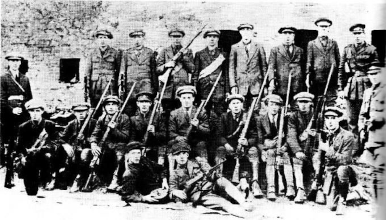
(Pictured: Ballyhaunis IRA September 1921: Back L-R:Capt. Pat McNieve (Logboy Coy), Capt Austin Tarpey (Holywell Coy), Bn Cmdt. Patrick Kenny, Vol Joe Taylor (Aghamore Coy), Vol John Forde (Bekan Coy), Capt. Luke Taylor (Aghamore Coy), Vol Sonny Biesty (Holywell Coy), Bn Vice Cmdt. Dom Byrne, Front L-R: Vol Jack Kilduff (Bekan Coy), Bn Adjt. Austin Kenny, Capt. Michael Devaney (Brackloon Coy), Capt. Jim Kilkenny (Crossard Coy), Lt Michael Nolan (Knock Coy). Nearly all of the men photographed played some part in the Holywell Ambush)


Leave a comment

Birth of Rosie Hackett, Trade Union Leader & Insurgent

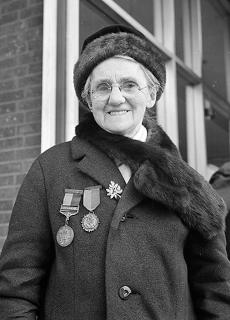
Rosanna “Rosie” Hackett, Irish insurgent and trade union leader, is born into a working-class family in Dublin on July 25, 1893. She is a founder-member of the Irish Women Workers’ Union (IWWU) and supports strikers during the 1913 Dublin lock-out. She later becomes a member of the Irish Citizen Army and is involved in the 1916 Easter Rising. In the 1970s, the labour movement awards her a gold medal for decades of service, and in 2014 a Dublin city bridge is named in her memory.

Hackett is the daughter of John Hackett, a hairdresser, and Roseanna Dunne. According to the 1901 census, she is living with her widowed mother and five other family members in a tenement building on Bolton Street in Dublin. The available documents suggest that her father dies when she is still very young. She joins the Irish Transport and General Workers’ Union (ITGWU) when it is established in 1909 by James Larkin, which marks the beginning of her lifelong activity in trade unionism. By 1911 she is living with her family in a cottage on Old Abbey Street, and her mother has remarried to Patrick Gray.

Hackett fights for many decades for the rights of workers. Through her affiliation and work with the ITGWU, the IWWU and the Irish Citizen Army, she helps carve out and secure modern-day working conditions. Her career begins as a packer in a paper store, then becoming a messenger for Jacob’s biscuits. At that time the working conditions in the factory are poor.

On August 22, 1911, Hackett helps organise the withdrawal of women’s labour in Jacob’s factory to support their male colleagues who are already on strike. With the women’s help, the men secure better working conditions and a pay rise. Two weeks later, at the age of eighteen, she co-founds the IWWU with Delia Larkin. During the 1913 lock-out she helps mobilise the Jacob’s workers to come out in solidarity with other workers. They, in turn, are locked out by their own employers. This does not stop her work to help others, and she, along with several of her IWWU colleagues, set up soup kitchens in Liberty Hall to help feed the strikers. However, in 1914 her Jacob’s employers sack her over her role in the lock-out.

Hackett begins work as a clerk in the printshop in Liberty Hall, and it is here she becomes involved with the Irish Citizen Army. She is involved in preparations for the 1916 Rising, working in a union shop, helping with printers, and making first-aid kits and knap-sacks.

If other members of the ITGWU were looking for James Connolly, Hackett aids in bringing them to him. She “worked as canvasser and traveller and was called on to carry out many confidential jobs.”

Hackett takes up first aid training provided by Dr. Kathleen Lynn for six months before the Rising and attends night marches organised by the Irish Citizen Army. According to her own account, she says, “A week before Easter, I took part in the ceremony of hoisting the challenge flag over Hall.” Like other girls and women who are involved in the Rising, she carries messages and guns and prepares uniforms and food for Irish Republican Army (IRA) members “and sometimes risky work.”

Three weeks before the Easter Rising, the Royal Irish Constabulary (RIC) raid a shop where Hackett is working. She is alone when they come, and they are looking for a copy of “Gael.” She says to them, “wait until I get the head” and she calls for Connolly. The police are stopped by Connolly and Helena Molony who are armed, and Hackett immediately hides everything, so that when the police come back, they cannot get anything.

Through her experience of working in the printshop, Hackett helps to print the Proclamation of the Irish Republic. She is in the printing room in Liberty Hall as a trusted messenger in 1916 when the Proclamation is printed, and it is the first time she is allowed in. Three men are there when she enters the room and one comes over to her, shakes her hand and congratulates her. It makes her very proud, especially since no one else is allowed to get in. She subsequently tells family members of handing it still wet to James Connolly before it is read by Patrick Pearse outside the entrance to the General Post Office (GPO).

Hackett is an active member of the Irish Citizen Army. On Easter Tuesday, under the command of Constance Markievicz, she takes part in the 1916 Rising and is located in the area of St. Stephen’s Green and the Royal College of Surgeons in Ireland. This position is heavily attacked with guns, short of first aid and “looked like a death trap.” However, after moving from an initially overlooked position in St. Stephen’s Green, it is one of the last positions to surrender. In the Royal College, as a first-aid practitioner, she is allowed entry to the lecture room sanctioned to the Red Cross only. Another first-aider, Aider Nora O’Daily, later reports that during those days, “I have a very kind remembrance of Little Rosie Hackett of the Citizen Army, always cheerful and always willing; to see her face about the place was a tonic itself.”

After surrendering, the rebels are taken to Dublin Castle. Hackett is imprisoned in Kilmainham Gaol for ten days.

In 1917, on the anniversary of Connolly’s death, Hackett, together with Helena Molony, Jennie Shanahan and Brigid Davis, print and hang a poster detailing the anniversary. After the first poster displayed by the ITGWU members is taken down by the police, they work to ensure that their poster will stay on Liberty Hall much longer by staying on top of the roof to defend it. They barricade the door using a ton of coal and nails on the windows. The poster is hanging there until 6:00 p.m. and thousands of people can see it.

After the Rising, Hackett returns to the IWWU which, at its strongest, organises over 70,000 women. After the 1945 laundry strike, they win an extra week of paid holidays for the workers. She attends many important labour union events such as the opening of the new Liberty Hall on May 2, 1965, and Arbour Hill memorial services. Until her retirement, she runs the trade union shops resulting in over five decades of active participation in the Irish trades union movement work to improve conditions for Irish workers. In 1970 she is awarded a gold medal for fifty years of ITGWU membership.

In the 1970s, Walter McFarlane, then branch secretary of the ITGWU, awards an honorary badge for Hackett’s fifty years contribution to the union.

Hackett never marries and lives in Fairview, Dublin, with her brother Tommy until her death on July 4, 1976. She is buried at St. Paul’s plot in Glasnevin Cemetery next to her mother and stepfather. At her burial, she is honoured with a military salute and her coffin is covered with the Irish flag. After her passing, her legacy is remembered in the union’s newspaper, a tale of the strife of Hackett together with the rest of Dublin’s working class, for which she fought to change.

In May 2014, the Rosie Hackett Bridge is officially opened by the Lord Mayor of Dublin. The Hackett Bridge Campaign began in October 2012, led by three women Angelina Cox, an active member of Labour Youth, Jeni Gartland and Lisa Connell. The final shortlist of contending names for the new bridge were Rosie Hackett, Kathleen Mills, Willie Bermingham, Bram Stoker and Frank Duff.

In April 2015, a plaque is unveiled on Foley Street by the North Inner City Folklore Project to commemorate the women of the Irish Citizen Army. The plaque lists Hackett as a member of the St. Stephens Green/College of Surgeons garrison during the 1916 Easter Rising.


2 Comments

The Tourmakeady Ambush

The Tourmakeady Ambush or Battle of Tourmakeady occurs on May 3, 1921, during the Irish War of Independence. The South Mayo Brigade of the Irish Republican Army (IRA), commanded by Commandant Tom Maguire ambushes a Royal Irish Constabulary (RIC)/Black and Tan re-supply patrol in the village of Tourmakeady, County Mayo, in the west of Ireland in order to destroy the patrol and to cause the closure of Derrypark RIC Barracks, seven miles to the south.

A car transporting police officers is leading the two-vehicle convoy. It is shot at as it travels out of the village, causing the Crossley Tender behind to stop close to the local hotel. RIC Constables Christopher O’Regan and William Power, Sergeant John Regan and Black and Tans Constable Hubert Oakes all die in the ambush. British forces are able to take refuge in the hotel, where they call for reinforcements.

Following the ambush, the Flying Column takes to the nearby Partry Mountains and are subsequently engaged by British troops from the Border Regiment. IRA Adjutant (South Mayo Brigade) Michael O’Brien sustains fatal injuries when he is shot while trying to assist the injured Brigade leader, Commandant Maguire. Another IRA Volunteer, Pádraig Feeney, is also killed that afternoon.

On May 3, 1921, in reprisal for the ambush, Crown forces burn several commercial establishments and homes in the area. Extensive searches and reprisals follow in the area over the next week.

Monuments commemorating Michael O’Brien and Pádraig Feeney have since been erected in County Mayo.

(Pictured: The South Mayo Flying Column of the Irish Republican Army, taken at Moore Hall in Muckloon, County Mayo, during the summer of 1921)


Leave a comment

Birth of Andrew Cooney, Irish Republican & Medical Doctor

Andrew Cooney, Irish republican and medical doctor, is born on April 22, 1897, in Ballyphillip, Nenagh, County Tipperary.

Cooney is the second of three children of John Cooney and Mary Ann Cooney (née Gleeson), middling farmers. While his grandfather, Patrick Cooney, from nearby Garrykennedy, is reputed to have been a member of the Irish Republican Brotherhood (IRB) and an Irish National Land League activist, his father does not have any inclination towards radical politics. He is educated at Lissenhall national school and St. Joseph’s CBS, Nenagh. In October 1916, he commences studies in medicine at University College Dublin (UCD) just as the Irish War of Independence is getting underway. He plays briefly with the College’s hurling club.

In 1917, Cooney joins the Third Battalion of the Dublin Brigade of the Irish Republican Army (IRA). A year later he is jailed for two months in Mountjoy Prison and Crumlin Road Gaol, Belfast, for illegal drilling. Joining the IRB at the end of 1918, he assists in the December 1918 election by protecting candidates and acts as a guard at sittings of the First Dáil. On June 26, 1920, he plays a major role in the attack on Borrisokane Royal Irish Constabulary (RIC) barracks. He takes part in the Bloody Sunday operations of November 21, 1920, at 28 Upper Pembroke Street where a number of British agents are killed and attends Croke Park afterwards. He then goes on the run as a full-time Volunteer and serves with the Dublin Brigade active service unit (ASU).

After the Anglo-Irish truce of July 1921, Cooney is appointed Officer Commanding (O/C) of the 1st Kerry Brigade, IRA, reorganising it and forming a flying column. Opposing the Anglo-Irish Treaty of 1921, he does not immediately break with GHQ, who sends him to organise the 1st Eastern Division. Later in January 1922, the Chief of Staff, Eoin O’Duffy, asks him to become O/C of the 3rd Eastern Division, but later rescinds the appointment. In March 1922 he is appointed O/C of the 1st Eastern Division of the anti-Treaty IRA during the Irish Civil War.

That same year he is captured by Free State forces and interned in Mountjoy Prison, where he becomes O/C of the prisoners in C Wing. He accepts responsibility for an attempted escape bid on October 10, 1922, in which a fellow prisoner, Peadar Breslin, is killed and another man is wounded. After sojourns in Newbridge and Arbour Hill Prison, he is moved with the other leaders to Kilmainham Gaol, where he spends forty-one days on hunger strike. Removed to Harepark Camp, the Curragh, on January 1, 1924, he is among the last to be released on May 29, 1924.

Cooney succeeds Frank Aiken as Chief of Staff of the IRA on November 18, 1925. Central to the reorganisation scheme he puts in place is the need to secure American funds for the IRA and to combat Frank Aiken’s fundraising work in the United States since December 1925 on behalf of the embryo Fianna Fáil organisation. Receiving permission on April 21, 1926, he departs on a fund-raising trip to the United States but returns to Ireland in October. He resigns as chief of staff in favour of Maurice Twomey but retains his position as chairman of the IRA executive until November 21, 1927, when he obtains leave to complete his medical studies.

After internship in the Mater Hospital, Dublin, Cooney finds temporary employment in London, but remains in touch with GHQ. On September 27, 1929, he marries the German-educated Frances (‘Frank’) Brady, daughter of a wealthy Belfast linen family and former Cumann na mBan activist and hunger-striker. The marriage is not a success. Failing to secure employment due to police harassment and the loyalty test then in force, he and his wife are obliged to emigrate to London, where he practises as a GP, still maintaining his IRA links. Their only child, Seán, is born there in 1931. He returns to Ireland in August 1932, after Fianna Fáil’s accession to power.

An intimate friend of Maurice Twomey, who is still Chief of Staff, Cooney remains in the upper echelons of the IRA and attends its conventions. Signifying his standing in republican circles, he is chosen to unveil, inter alia, the Fenian memorial in Glasnevin Cemetery and the Seán Treacy plaque in Talbot Street, Dublin, and is a regular speaker at commemorations. In March 1940, he attempts to intercede with Éamon de Valera on behalf of hunger-striking republicans, and is later arrested, but released.

After the discovery of a German spy ring in the hospitals commission’s subsidiary, the Dublin Hospitals Bureau, Cooney is forced to resign in April 1942 on refusing to take a loyalty pledge to the state. He returns to private practice. He becomes active in the unsuccessful campaign to save Charlie Kerins, Chief of Staff, from being hanged in 1944. In anticipation of emigrating, he finally resigns from the IRA in 1944, though military and police surveillance continue until March 1945.

In August 1945, Cooney joins the United Nations Relief and Rehabilitation Administration, working with displaced persons in the American zone in Germany, and gains rapid promotion. After joining the International Refugee Organisation (UNRRA’s successor) on July 1, 1947, he becomes the chief medical officer of an area including the American sector of Berlin and containing 150,000 displaced persons. He later holds a similar post in Bavaria.

Appointed a part-time member of the hospitals commission by the inter-party government in September 1949 and in severe financial straits, Cooney emigrates alone to the United States on December 2, 1950, and never returns. While employed in a tuberculosis sanatorium in New Jersey, he obtains by examination his licence to practise medicine in Maryland on January 14, 1954. Admitted a member of the American College of Chest Physicians, again by examination, on November 23, 1954, he secures, at the age of 57, his first ever permanent post in medicine, in a similar hospital in Pikesville, Maryland. His republican activities continue through Clan na Gael during his U.S. years, and he is a frequent speaker at commemorative events.

Cooney suffers a stroke in December 1961 that confines him to a wheelchair. He dies at the age of 71 on August 4, 1968, at Carroll County General Hospital, Carroll County, Maryland. He is buried in Youghalarra, Nenagh, County Tipperary.

(Pictured: Liam Lynch with some of his Divisional Staff and Officers of the Brigades, including the 1st Southern Division, who attend as delegates to the Army Convention at the Mansion House, Dublin, on April 9, 1922. Cooney is first on the right in the 3rd row back.)


Leave a comment

Birth of Seán Hales, Political Activist & Member of Dáil Éireann

Seán Hales, Irish political activist and member of Dáil Éireann from May 1921 to December 1922, is born in Ballinadee, Bandon, County Cork, on March 30, 1880.

Hales is born John Hales, eldest child of five sons and four daughters of Robert Hales, a farmer, and Margaret (née Fitzgerald) Hales. He is educated at Ballinadee national school and Warner’s Lane school, Bandon. After leaving school he goes to work on his father’s farm. He plays hurling with Valley Rovers GAA club and is the Munster champion in the 56-lb. weight-throwing competition. From an early age he follows in his father’s footsteps and becomes involved in the republican movement.

Hales joins the Irish Volunteers in 1915 and becomes captain of the Ballinadee company in 1916. Arrested under the Defence of the Realm Act after the 1916 Easter Rising, he is imprisoned in Frongoch internment camp in Wales. After his release, in April 1917 he becomes executive of the short-lived Liberty League promoted by Count George Plunkett. When the League merges with Sinn Féin, he helps reorganise the Volunteers. With his brothers, Tom, William, and Donal, he continues his father’s fight on behalf of evicted tenants and becomes involved with the anti-British Bandon People’s Food Committee and the anti-landlord Unpurchased Tenants’ Association. He helps in the Sinn Féin takeover of The Southern Star newspaper and is a member of the new board of directors. In 1919 he becomes battalion commander of the first (Bandon) battalion 3rd Cork Brigade of the Irish Republican Army, the name by which the Irish Volunteers increasingly became known. He leads the attack on Timoleague Royal Irish Constabulary (RIC) barracks in February 1920, and the ambush of an Essex Regiment patrol at Brinny in August 1920. The military patrol at Brinny manages to surprise the ambushers and Lieutenant Tim Fitzgerald of Bandon is the first Volunteer to be killed in action in west Cork. Hales then commands the assault on two truckloads of British troops at Newcestown Cross in which a British officer is killed and several soldiers are wounded.

Hales is appointed section commander of the west Cork flying column in 1920 and takes part in the major action at Crossbarry on March 19, 1921. In retaliation for the burning of the Hales home in March 1921, he leads a contingent of Volunteers and burns Castle Bernard, the residence of the Earl of Bandon. The occupant, Lord Bandon, is held hostage until General Strickland, the British OC in Cork, guarantees he will not execute Volunteers in Cork prison. The British authorities yield and there is an end to the policy of executing prisoners of war in the Cork area.

At the 1921 Irish elections, Hales is elected to the Second Dáil as a Sinn Féin member for the Cork Mid, North, South, South East and West constituency.

At the 1922 Irish general election, Hales is elected to the Third Dáil as a pro-Treaty Sinn Féin Teachta Dála (TD) for the same constituency. He receives 4,374 first preference votes (7.9%). Shortly afterward, the Irish Civil War breaks out between the pro-Treaty faction, who are in favour of setting up the Irish Free State and the anti-Treaty faction, who would not accept the abolition of the Irish Republic.

On December 7, 1922, Hales is killed by anti-Treaty IRA men as he leaves the Dáil. Another TD, Pádraic Ó Máille, is also shot and badly wounded in the incident. His killing is in reprisal for the Free State’s execution of anti-treaty prisoners. In revenge for Hales’ killing, four republican leaders, Joe McKelvey, Rory O’Connor, Liam Mellows and Richard Barrett, are executed the following day, December 8, 1922.

Hales is given a military funeral to the family burial place at St. Patrick’s Cemetery, Bandon.

According to information passed on to playwright Ulick O’Connor, an anti-Treaty IRA volunteer named Owen Donnelly of Glasnevin is responsible for the killing of Hales. Seán Caffrey, an anti-treaty intelligence officer told O’Connor that Donnelly had not been ordered to kill Hales specifically but was following the general order issued by Liam Lynch to shoot all deputies and senators they could who had voted for the Public Safety Act (September 28, 1922) which established military courts with the power to impose the death penalty.

A commemorative statue of Hayes is unveiled at Bank Place in Bandon in 1930.


Leave a comment

The Assassination of Alan Bell

Alan Bell, policeman and resident magistrate, is tasked by British Intelligence to track down Michael Collins’s war chest. By March 26, 1920, he has successfully confiscated over £71,000 from Sinn Féin‘s headquarters and by investigating banks throughout the country and is set to seize much more. On that day he is pulled off a tram in South Dublin and shot three times in the head.

Bell is born in Banagher, King’s County (now County Offaly), one of at least two sons of the Rev. James Adamson Bell, Church of Ireland clergyman. His mother’s name is unknown. Educated locally, he joins the Royal Irish Constabulary (RIC) in September 1879 as a cadet, serving in the counties of Cavan, Galway, Roscommon, Westmeath, and Cork up to the rank of district inspector. During the Land War (1879–82) he investigates sources of Irish National Land League funds and in 1882 arrests the American land reformer and journalist Henry George in Athenry. He, along with District Inspector William Henry Joyce, compile evidence against the nationalist and agrarian agitation for the special commission of 1888–89 which investigates charges against the nationalist leader Charles Stewart Parnell and his associates. His actions make him popular with unionists but a marked man among nationalists.

After almost twenty years’ police service, Bell becomes a resident magistrate on November 12, 1898, a civil service post under the Constabulary Act, 1836. His districts included Athenry, Claremorris, Armagh, Belfast, and Portadown. With many years’ experience in criminal intelligence, he is transferred to Dublin Castle early in the Irish War of Independence as a special investigator and intelligence gatherer. In December 1919 he questions suspects for the attempted Irish Republican Army (IRA) assassination of the viceroy, Lord French, and place suspect premises under surveillance. His vulnerability is made evident by the shooting in January 1920 of Dublin Metropolitan Police assistant commissioner William C. Redmond, one of his informants. He remains in Dublin to investigate the “republican loan” raised by Michael Collins and Sinn Féin, believed to be hidden in suspect bank accounts. Refusing protective accommodation in Dublin Castle where other officials have already retreated, he opts to live with his wife at a private suburban residence, 19 Belgrave Square, Monkstown, County Dublin. He summons bank managers to his office in early March 1920 and progresses sufficiently to force Collins into taking action.

Carrying a pocket revolver for protection, Bell travels to work daily by tram until the morning of March 26, 1920. At the busy junction of Simmonscourt Road, Sandymount Avenue, and Merrion Road, Ballsbridge, a group of men immobilise the crowded vehicle and surround their target, declaring, “Come on, Mr. Bell, your time has come.” Bundling him on to the street, they shoot him dead in public view and run from the scene. In spite of vivid eyewitness accounts in the press, no killer is identified. His death comes amid almost daily violence and barely a week after the shooting of the Sinn Féin Lord Mayor of Cork, Tomás Mac Curtain, allegedly by police assassins. He acts fearlessly, perhaps expecting a violent death as the outcome of his mission.

Bell is buried privately in Dean’s Grange Cemetery, Deansgrange, County Dublin. Some Irish republican prisoners at Gloucester during the influenza epidemic of 1918–19 may have been saved from infection by his brother, who as prison doctor there had advised that the jail be evacuated.

(From: “Alan Bell” by Patrick Long, Dictionary of Irish Biography, http://www.dib.ie, October 2009)


1 Comment

The Execution of IRA Member George Plant

George Plant, member of the Irish Republican Army (IRA), is executed by the Irish Government on March 5, 1942.

Plant is born into a Church of Ireland farming family in Fethard, County Tipperary, on January 5, 1904, the second eldest child and son in a family of six children. His parents are John William Albert Plant, a farmer, and Catherine Hayden.

One Sunday in 1916, George and his older brother Jimmy are arrested by the Royal Irish Constabulary (RIC) after being seen speaking to two well-known republicans, Seán Hayes and Dan Breen. In custody the two brothers are beaten and mistreated resulting in a hatred of the RIC. He serves with the Irish Republican Army during the Irish War of Independence and with the Anti-Treaty IRA in the Irish Civil War.

In 1923, George and Jimmy leave Ireland for Canada and the United States but continue as active IRA members. In 1929 they return to Ireland and carry out a bank raid in Tipperary on behalf of the IRA. They are arrested two days later at the family farm and subsequently sentenced to seven years in prison. They are released in a general amnesty after the Fianna Fáil and Éamon de Valera election victory in 1932. He is a strong supporter of Seán Russell. In 1939 following the outbreak of World War II, known in Ireland as The Emergency, de Valera is determined to maintain Irish neutrality and is not going to allow the IRA to jeopardize this. The IRA links with Germany and campaign in Britain are severely straining Anglo-Irish relations so emergency legislation is introduced.

Russell, the IRA Chief of Staff, dies in August 1940 after taking ill on board a U-boat and Stephen Hayes from County Wexford becomes IRA Chief of Staff. In late August 1940 an address on Lansdowne Road, Dublin, is raided by the Garda Síochána. Among the men arrested is Michael Devereux, a 24-year-old married truck driver from County Wexford who is also Quartermaster of the IRAs Wexford Brigade. He is released after three days without charge. Shortly afterwards Gardaí in County Wexford find an IRA arms dump. Many in the IRA suspect that Devereux had turned informer, so Stephen Hayes orders Devereux’s execution. George Plant and another man, Michael Walsh from County Kilkenny, are ordered to carry out the order. Devereux meets Plant and Walsh who tell Devereux that Tom Cullimore, the Wexford Brigade’s OC is blamed for the arms dump and that they have shot him. They order Devereux to drive them to an IRA safe house at Grangemockler in south County Tipperary. Devereux, believing he is the prime suspect in a murder, stays willingly at the safe house. A week later, on September 27, 1940, Devereux is invited to go for a walk with Plant and Paddy Davern, the owner of the safe house. Somewhere along the walk Plant accuses Devereux of being an informer and shoots him dead. Plant is arrested nine weeks later on suspicion of IRA membership and brought before the Special Criminal Court in Dublin. On February 10, 1941, Radio Éireann broadcasts a radio appeal for Michael Devereux on behalf of his wife.

In September 1941, Stephen Hayes is accused of being an informer by a group of Northern IRA members led by Seán McCaughey. He manages to escape to a garda station. Shortly afterwards a large force of Garda Síochána and Irish Army descend on the area around the Davern farmhouse where they find Devereux’s car buried under an onion bed and eventually discover Devereux’s body, a year to the day after his death. Two weeks later, Plant, already in prison on IRA membership charges, is charged with Devereux’s murder. A trial is held with a senior IRA officer, Joseph O’Connor, also charged with Devereux’s murder. The first trial collapses after two days when Paddy Davern and Micheal Walsh, two of the prosecution witnesses, refuse to give evidence. This result leads to the court issuing a nolle prosequi order which should have meant the end of the affair, however both men are rearrested and recharged with the same offence, under Emergency Order 41f. Minister for Justice Gerald Boland transfers the case to a Special Military Court with army officers acting as judges. In addition to Plant, Paddy Davern and Michael Walsh are also now charged with Devereux’s murder. The second trial begins at Collins Barracks, Dublin in February 1942 with Seán MacBride, a former IRA Chief of Staff and future government minister as the defendant’s barrister. Davern states his original statement was given at gunpoint but under the new order even statements given under duress are admissible. The court only has two sentencing options – death or acquittal. Joseph O’Connor is acquitted and despite MacBride’s best efforts the other three are sentenced to death. Davern and Walsh have their sentences commuted to life imprisonment and are both released in 1946.

Just one week after sentence is passed, Plant is executed on March 5, 1942, in Portlaoise Prison by a six-man firing squad drawn from the Irish Army. Much bitterness is caused by the treatment of Plant’s relatives. Neither his wife or mother or infant son are allowed to visit him in the week before his execution. Censorship ensures there is little mention in the newspapers, so his family only learns of his execution from a brief radio broadcast shortly before they receive a telegram. He is buried in the grounds of Portlaoise Prison, but is reinterred in 1948, when he is buried with full IRA military honours in his local church St. Johnstown in County Tipperary, and a Celtic cross is erected over his grave.

Plant’s wife moves to the United States where she remarries. His brother Jimmy dies in London in 1978. The Plant’s family farm is now part of the Coolmore Estate.


Leave a comment

Carrigtwohill RIC Barracks Attack

On the night of Saturday, January 3, 1920, a contingent of 30 to 40 Irish Republican Army (IRA) volunteers of the 1st Cork Brigade from Cobh and Midleton, capture and destroy the Carrigtwohill Royal Irish Constabulary (RIC) barracks. They are supported by the volunteers from Knockraha.

The barracks, long since demolished, consists of a sergeant and five constables, located at the corner of Well Lane and Main Street at what is now O’Donovan’s truck yard.

The village is completely isolated, having been secured at eastern and western ends, and from Belvelly on the northern end of the Great Island of Cork Harbour, with all telephone communication cut by the IRA men to ensure no RIC reinforcements can come to the rescue of the Carrigtwohill barracks.

The battle commences at approximately 11:00 p.m. that night, and continues through the early hours, finally coming to its conclusion when the barracks eventual fall following an explosion that blasts a hole through the barrack’s wall on the eastern gable adjoining a small stable, owned by local businessman named O’Grady, through which the assailants enter. The RIC officers are captured and handcuffed.

The IRA volunteers and the RIC officers do not suffer any casualties during the attack, which is the first successful assault on RIC barracks in Ireland during the Irish War of Independence, signaling the commencement of the all-out war on the RIC, in rural Ireland. However, a number of these IRA men later take part in the Clonmult ambush, during which several do not survive.

The barracks is never repaired, or rebuild, but is allowed to fall to ruin, eventually being completely demolished.

(From: The Carrigtwohill & District Historical Society, http://www.carrigtwohillhistoricalsociety.com | Photo: Illustrated London News, 10 January 1920)


Leave a comment

Recruitment Begins for the Black and Tans

Recruitment begins for the Black and Tans (Irish: Dúchrónaigh), Britain’s unofficial auxiliary army, on January 2, 1920. They are constables recruited into the Royal Irish Constabulary (RIC) as reinforcements during the Irish War of Independence. Recruitment begins in Great Britain and about 10,000 men enlist during the conflict. The vast majority are unemployed former British soldiers who had fought in World War I. Some sources count a small number of Irishmen as Black and Tans.

The British administration in Ireland promotes the idea of bolstering the RIC with British recruits. They are to help the overstretched RIC maintain control and suppress the Irish Republican Army (IRA), although they are less well trained in ordinary policing. The nickname “Black and Tans” arises from the colours of the improvised uniforms they initially wear, a mixture of dark green RIC (which appears black) and khaki British Army. They serve in all parts of Ireland, but most are sent to southern and western regions where fighting is heaviest. By 1921, Black and Tans make up almost half of the RIC in County Tipperary, for example.

The Black and Tans gain a reputation for brutality and become notorious for reprisal attacks on civilians and civilian property, including extrajudicial killings, arson and looting. Their actions further sway Irish public opinion against British rule and draw condemnation in Britain.

The Black and Tans are sometimes confused with the Auxiliary Division, a counterinsurgency unit of the RIC, also recruited during the conflict and made up of former British officers. However, sometimes the term “Black and Tans” covers both groups. The Ulster Special Constabulary (USC) is founded to reinforce the RIC in Northern Ireland.

More than a third leave the service before they are disbanded along with the rest of the RIC in 1922, an extremely high wastage rate, and well over half receive government pensions. Over 500 members of the RIC die in the conflict and more than 600 are wounded. Some sources state that 525 police, including 152 Black and Tans and 44 Auxiliaries, are killed in the conflict.

Many Black and Tans are left unemployed after the RIC is disbanded and about 3,000 are in need of financial assistance after their employment in Ireland is terminated. About 250 Black and Tans and Auxiliaries, among over 1,300 former RIC personnel, join the Royal Ulster Constabulary. Another 700 join the Palestine Police Force which is led by former British Chief of Police in Ireland, Henry Hugh Tudor. Others are resettled in Canada or elsewhere by the RIC Resettlement branch. Those who return to civilian life sometimes have problems re-integrating. At least two former Black and Tans are hanged for murder in Britain, and another wanted for murder commits suicide before the police can arrest him.

Due to the Tans’ behaviour in Ireland, feelings continue to run high regarding their actions. The term can still stir bad reactions because of their remembered brutality. One of the best-known Irish Republican songs is Dominic Behan‘s “Come Out, Ye Black and Tans.” The Irish War of Independence is sometimes referred to as the “Tan War” or “Black-and-Tan War.” This term is preferred by those who fought on the anti-Treaty side in the Irish Civil War and is still used by Republicans today. The “Cogadh na Saoirse” (“War of Independence”) medal, awarded since 1941 by the Irish government to IRA veterans of the War of Independence, bears a ribbon with two vertical stripes in black and tan.

Some sources say the Black and Tans were officially named the “RIC Special Reserve”, but this is denied by other sources, which say they were not a separate force but “recruits to the regular RIC” and “enlisted as regular constabulary.” Canadian historian D. M. Leeson has not found any historical documents that refer to the Black and Tans as the “Royal Irish Constabulary Special Reserve.”

(Pictured: A group of Black and Tans and Auxiliaries outside the London and North Western Hotel in Dublin following an attack by the IRA, April 1921)