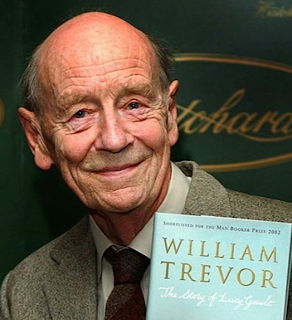
Trevor wins the 2008 International Nonino Prize in Italy. In 2014, he is bestowed with the title of Saoi within Aosdána. He resides in England from 1954 until his death in 2016, at the age of 88.
Trevor is educated at a succession of schools including St Columba’s College, Dublin (where he is taught by Oisín Kelly) and at Trinity College Dublin (TCD), from which he receives a degree in history. He works as a sculptor under the name Trevor Cox following his graduation from TCD, supplementing his income by teaching.
Trevor marries Jane Ryan in 1952 and emigrates to England, working as a teacher, a sculptor and then as a copywriter for an advertising agency. During this time he and his wife have their first son. In 1952, he becomes an art teacher at Bilton Grange, a prep school near Rugby. He is commissioned to carve reliefs for several churches, including All Saints’ Church, Braunston, Northamptonshire. In 1956, he moves to Somerset to work as a sculptor and carries out commissions for churches. He stops wood carving in 1960.
Trevor’s first novel, A Standard of Behaviour, is published in 1958 by Hutchinson & Co. of London, but receives little critical success. He later disowns this work, and, according to his obituary in The Irish Times, “refused to have it republished.” It is, in fact, republished in 1982 and in 1989.
In 1964, at the age of 36, Trevor is awarded the Hawthornden Prize for The Old Boys. This success encourages him to become a full-time writer.
In 1971, he and his family move from London to Devon in South West England, first to Dunkeswell, then in 1980 to Shobrooke, where he lives until his death. Despite having spent most of his life in England, he considers himself to be “Irish in every vein”.
Trevor dies peacefully in his sleep, at the age of 88, at Crediton, Devon, England, on November 20, 2016.
Mhac an tSaoi is influenced by her stays in the Dingle Peninsula in County Kerry with her uncle, Monsignor De Brún, at his parish of Dún Chaoin. Monsignor de Brún, similarly to his sister, is a distinguished linguist and Celticist, the literary translator of Homer, Dante Alighieri, Sophocles, and Jean Racine into Modern Irish, “and one of the most distinguished literary figures of his time.”
Mhac an tSaoi studies Modern Languages and Celtic Studies at UCD, before going to further research at the Dublin Institute for Advanced Studies and at the University of Paris. She writes the famous work of Christian poetry in Munster Irish, Oíche Nollag (“Christmas Eve”), when she is only 15-years of age.
Mhac an tSaoi spends two years studying in post-war Paris (1945–47) before joining the Irish diplomatic service and is working at the Irish embassy in Madrid when she commits herself to writing poetry in Irish following her discovery of the works of Federico García Lorca.
She remains a prolific poet and is credited, along with Seán Ó Ríordáin and Máirtín Ó Direáin, with reintroducing literary modernism into Irish literature in the Irish language, where it had been dormant since the 1916 execution of Patrick Pearse, in the years and decades following World War II. Her poetry draws on the vernacular spoken by the native Irish speakers of the Munster Gaeltacht of West Kerry during the first half of the twentieth century. Formally, she draws on the song metres of the oral tradition and on older models from the earlier literary tradition. In later work, she explores looser verse forms but continues to draw on the remembered dialect of Dún Chaoin and on a scholarly knowledge of the older literature.
Mhac an tSaoi is elected to Aosdána in 1996 but resigns in 1997 after Francis Stuart is elevated to the position of Saoi. She had voted against Stuart because of his role as an Abwehr spy and in radio propaganda broadcasts from Nazi Germany aimed at neutral Ireland during World War II.
In 2001, she publishes an award-winning novel A Bhean Óg Ón… about the relationship between the 17th-century County Kerry poet and Irish clan chief Piaras Feiritéar and Meg Russell, the woman for whom he composed some of the greatest works of love poetry ever written in the Irish language.
Her poems Jack and An Bhean Óg Ón are both featured on the Leaving Certificate Irish course, at both Higher and Ordinary Levels, from 2006 to 2010. Her literary translation of Rainer Maria Rilke‘s Duino Elegies from Austrian German into the Irish language is published in 2013.
Mhac an tSaoi marries Irish politician, writer, and historian Conor Cruise O’Brien in a Roman Catholic wedding Mass in Dublin in 1962. This makes her the stepmother to O’Brien’s children from his 1939 civil marriage. Her mother is deeply embarrassed by the exposure of the relationship and staunchly opposes the match, as she has long been a close friend of O’Brien’s Presbyterian first wife. Despite their subsequent marriage, the exposure of their extramarital relationship ends Mhac an tSaoi’s diplomatic and civil service career. They later adopted two children, Patrick and Margaret.
She then lives with her husband in New York City, where he becomes a professor at New York University (NYU) after the Congo Crisis destroys O’Brien’s diplomatic career. He is long blamed by the United Nations for the escalation of the Congo Crisis.
Cronin is known as an arts activist as well as a writer. He is Cultural Adviser to TaoiseachCharles Haughey and briefly to Garret FitzGerald. He involves himself in initiatives such as Aosdána, the Irish Museum of Modern Art and the Heritage Council. He is a founding member of Aosdána, and is a member of its governing body, the Toscaireacht, for many years. He is elected Saoi, a distinction for exceptional artistic achievement, in 2003. He is also a member of the governing bodies of the Irish Museum of Modern Art and the National Gallery of Ireland, of which he is for a time Acting Chairman.
His first collection of poems, called simply Poems (Cresset Press, London), is published in 1958. Several collections follow and his Collected Poems (New Island Books, Dublin) is published in 2004. The End of the Modern World (New Island Books, 2016), written over several decades, is his final publication.
Cronin’s novel, The Life of Riley, is a satire on Bohemian life in Ireland in the mid-20th century, while his memoir Dead as Doornails addresses the same subject.
Cronin knows Samuel Beckett from when they do some work for the BBC during the 1950s and 1960s. He gives a prefatory talk to Patrick Magee‘s reading of The Unnamable on the BBC Third Programme. Beckett is not impressed, saying, “Cronin delivered his discourse… It was all right, not very exciting.” Cronin later publishes a biography of him, Samuel Beckett: The Last Modernist (1996), followed on from No Laughing Matter: The Life and Times of Flann O’Brien (1989).
In his later years, Cronin suffers from failing health, which prevents him from traveling abroad, thus limiting his dealings to local matters. He dies in Dublin on December 27, 2016, one day short of his 93rd birthday.
Cronin firstly marries Thérèse Campbell, from whom he separates in the mid-1980s. She dies in 1999. They have two daughters, Iseult and Sarah. Iseult is killed in a road accident in Spain. He secondly marries the writer Anne Haverty who, along with daughter Sarah, survives him.
O’Brien is the youngest child of “a strict, religious family.” From 1941 to 1946 she is educated by the Sisters of Mercy, a circumstance that contributes to a “suffocating” childhood. “I rebelled against the coercive and stifling religion into which I was born and bred. It was very frightening and all pervasive. I’m glad it has gone.” She is fond of a nun as she deeply misses her mum and tries to identify the nun with her mother.
In 1950, O’Brien is awarded a licence as a pharmacist. In Ireland, she reads such writers as Leo Tolstoy, William Makepeace Thackeray, and F. Scott Fitzgerald. In 1954, she marries, against her parents’ wishes, the Irish writer Ernest Gébler and the couple moves to London. They have two sons, but the marriage is dissolved in 1964. Gébler dies in 1998.
In London, O’Brien purchases Introducing James Joyce, with an introduction written by T. S. Eliot. When she learns that James Joyce‘s A Portrait of the Artist as a Young Man is autobiographical, it makes her realise where she might turn, should she decide to write herself. In London she starts work as a reader for Hutchinson, where on the basis of her reports she is commissioned, for £50, to write a novel. Her first novel, The Country Girls (1960), is often credited with breaking silence on sexual matters and social issues during a repressive period in Ireland following World War II.
This novel is the first part of a trilogy of novels which includes The Lonely Girl (1962) and Girls in Their Married Bliss (1964). Shortly after their publication, these books are banned and, in some cases burned, in her native country due to their frank portrayals of the sex lives of their characters. Her novel A Pagan Place (1970) is about her repressive childhood. Her parents are vehemently against all things related to literature and her mother strongly disapproves of her daughter’s career as a writer.
O’Brien is a panel member for the first edition of the BBC‘s Question Time in 1979. In 2017, she becomes the sole surviving member.
Other works include a biography of James Joyce, published in 1999, and one of the poet Lord Byron, Byron in Love (2009). House of Splendid Isolation (1994), her novel about a terrorist who goes on the run, marks a new phase in her writing career. Down by the River (1996) concerns an under-age rape victim who seeks an abortion in England, the “Miss X case.” In the Forest (2002) deals with the real-life case of Brendan O’Donnell, who abducts and murders a woman, her three-year-old son, and a priest, in rural Ireland.
Seóirse Bodley, Irish composer and former associate professor of music at University College Dublin (UCD), is born George Pascal Bodley in Dublin on April 4, 1933. In 2008, he is the first composer to become a Saoi of Aosdána. He is widely regarded as one of the most important composers of twentieth-century art music in Ireland, having been “integral to Irish musical life since the second half of the twentieth century, not just as a composer, but also as a teacher, arranger, accompanist, adjudicator, broadcaster, and conductor.”
Bodley’s father is George James Bodley (1879–1956), an employee in the Dublin office of the London Midland & Scottish Railway Company, and later of the Ports and Docks Board. His mother, Mary (née Gough, 1891–1977), works for the Guinness Brewery. He attends schools in the Dublin suburbs of Phibsborough and Glasnevin before he moves at the age of nine to an Irish-speakingChristian Brothers school at Parnell Square. He later studies at the School of Commerce in Rathmines, where he obtains his Leaving Certificate.
Music is encouraged in his parents’ home, and Bodley receives initial lessons on the mandolin from his father and on the piano from his mother. He studies the piano, harmony and counterpoint at the Royal Irish Academy of Music and obtains a Licentiate in piano from Trinity College London (TCL). From the age of 13, he also enrolls for a time at the Brendan Smith Academy of Acting. While he is still at school, he receives his first lessons in composition privately from the Dublin-based German choral conductor Hans Waldemar Rosen (1904–94), which continues, on and off, until 1956. From his student days he performs as an accompanist to singers and takes part in chamber music performances. An important element in his musical education is the twice-weekly free concerts given by the Radio Éireann Symphony Orchestra in the Phoenix Hall, Dame Court, where he has the opportunity to hear leading Irish and international performers and conductors presenting both classics and modern repertory.
From 1952 Bodley studies for a Bachelor of Music degree from University College Dublin, mainly with Anthony Hughes. He obtains the degree in 1955. From 1957 to 1959 he studies composition (with Johann Nepomuk David) and conducting at the Württembergische Hochschule für Musik in Stuttgart, Germany, and a year later he obtains a Doctorate in Music from UCD. He also takes classes in conducting with Hans Müller-Kray and Karl Maria Zwißler, and in piano with Alfred Kreutz. He returns to Germany several times in the early 1960s to participate in courses at the Darmstädter Ferienkurse, which significantly expands his knowledge of avant-garde techniques.
From 1959 until his retirement in 1998, Bodley lectures at the university’s music department, becoming associate professor in 1984. During the 1960s, he is conductor of the Culwick Choral Society.
Bodley’s development as a composer sees several distinct phases. In the 1970s he merges avant-garde styles with elements from Irish traditional music and becomes a figure of national importance. He receives several prestigious commissions for large-scale works, such as Symphony No. 3 (1981), written for the opening of the National Concert Hall.
In 1982 Bodley becomes a founder-member of Aosdána and PresidentMary McAleese confers the distinction of Saoi on him in November 2008. McAleese says that Bodley “has helped us to recast what it means to be an artist in Ireland.”
O’Malley is born in Callan, County Kilkenny, on September 25, 1913. He is a self-taught artist, having drawn and painted for pleasure from childhood. He works as a bank officìal until contracting tuberculosis in the 1940s. He begins painting in earnest while convalescing and, though he does at first return to bank work, he continues to paint and in 1951 he begins exhibiting his work.
In 1955 O’Malley holidays in St. Ives, Cornwall, England, then an important center of abstract art, and home to the artists Peter Lanyon, Patrick Heron, and Bryan Wynter, who he meets and works with. He returns again in 1957 and in 1958 retires from the bank to paint full-time. Prompted by a mixture of frustration at the indifference shown in Ireland to his work, an attraction to the sense of freedom he feels among the artists in Cornwall, and an engagement with the attempt to represent natural forms current in their abstraction, he settles in St. Ives in 1960. While he is strongly influenced by the St. Ives artistic community, his relationship is one of engagement rather than direct participation. His painting never completely assimilates the rigour and formality of the British abstract painters. It retains a muscular extravagance which is central to his artistic identity. O’Malley explains:
“Not so much abstract as essence. I could not paint for the sake of the pigment of whatever, but I like abstract form in the painting which instills it with meaning and power. Abstraction does enable you to get under the surface, to get beyond appearance, and to express the mind. But abstraction for its own sake does not interest me.”
O’Malley adopts a sombre palette in the second half of the 1960s and many of his paintings are dedicated to the memory of his friend and mentor, Peter Lanyon, who is killed when the glider he is piloting crashes in 1964.
In 1973 O’Malley marries Jane Harris, and through the mid-70s they spend time in the Bahamas and in O’Malley’s native Callan. During this period, his paintings become less sombre and the Bahamas paintings are extremely colourful and vibrant. In 1990 they move back to Ireland. In 1993 he is elected a Saoi of Aosdána.
O’Malley dies at his home in Physicianstown, County Kilkenny, on January 20, 2003. At the time he is regarded as one of Ireland’s leading painters.
The Irish Museum of Modern Art (IMMA) displays a major retrospective of his work in 2005, a selection from which is exhibited at the Tate St. Ives in 2006. The Butler Gallery, Kilkenny, stages posthumous exhibitions of his visual diaries in 2005, and his constructions in 2010.
In 2010 under the guidance of Jane O’Malley the Royal Hibernian Academy (RHA) establishes an artist’s residency in the house where O’Malley grew up in Callan, County Kilkenny. The studio residency is awarded to artists who work primarily in paint. Previous recipients of the Tony O’Malley Studio Residency Award include Magnhild Opdøl, Ciaran Murphy, Ramon Kassan, Mollie Douthit, David Quinn and Paraic Leahy.
Doyle studies piano from the age of nine. After leaving school he attends the Royal Irish Academy of Music for three years, studying composing, during which time he is awarded two composition scholarships. He also studies at the Institute of Sonology at Utrecht University in the Netherlands and the Finnish Radio Experimental Music Studio on scholarships.
As a performer Doyle begins as a drummer with the groups Supply Demand and Curve and Jazz Therapy, playing free improvisatory and fusion music. He releases his first LP, Oizzo No, in 1975, and his second, Thalia, in 1978 on CBS Classics. Rapid Eye Movements (1981) is his third LP, and his attempt at a “masterpiece before the age of thirty.”
Doyle begins his magnum opus, Babel, in 1989, a 5-CD set that takes ten years to compose. Each track corresponds to a ‘room’ or place within an imagined giant tower city, a kind of aural virtual reality. It celebrates the multiplicity of musical language. One hundred three pieces of music are composed for it and he works with 48 collaborators. From 2002 to 2007 he works on the three-volume electronic work Passades. Twenty-seven albums of his music have been released. He has also composed scores for several films including Budawanny, Pigs and the documentary Atlantean by Bob Quinn.
In 2013 Doyle founds META Productions with opera director Eric Fraad, committed to exploring new forms of opera for the 21st century. Their first production is the electronic opera Heresy. Originally titled The Death by Fire of Giordano Bruno, a 40-minute ‘in development’ version is performed as part of a fully staged concert of his works at both the Kilkenny Arts Festival and in the Dublin Theatre Festival 2013. The two hour Heresy is presented as part of ‘Project 50’, a season of work celebrating 50 years of Project Arts Centre in November 2016. The opera is based on episodes from the life and works of Giordano Bruno. It is broadcast on RTÉ Lyric fm in September 2017 and released as a double album on Heresy records in 2018. Recent album releases are The Thousand Year Old Boy (2013), Time Machine (2015), Frail Things In Eternal Places (2016), and The Heresy Ostraca (2019).
Doyle founds the music theatre company Operating Theatre with Irish actress Olwen Fouéré. They produce many important site-specific productions, including Passades, Here Lies and Angel/Babel, all featuring his music as an equal partner in the theatrical environment. Operating Theatre performs in conventional and site-specific venues in Ireland, England, the Netherlands, France, Venezuela and the United States and releases several records. With Icontact Dance Company, he produces Tower of Babel – Delusional Architecture, featuring as much of Babel as he has composed by that point. This work is originally performed in a whole wing of the Irish Museum of Modern Art in 1992. Arguably his most famous theatre work is the music he wrote and performs on piano onstage for the Steven Berkoff version of the Oscar Wilde play Salome which plays in Dublin‘s Gate Theatre, in London‘s West End and on three world tours. The Irish Times notes that “his name is revered in the realm of theatre.”
Doyle’s works Four Sketches and All the Rage are awarded second and first prizes in the Dublin Symphony Orchestra composition competition in 1970 and 1974 respectively. He has won the Programme Music Prize (1997) and the Magisterium Award (2007) at the Bourges International Electro-Acoustic Music Competition in Bourges, France. He also receives the Irish Arts Council‘s Marten Toonder Award in 2000 in recognition of his innovative work as a composer. He is a member of Aosdána, and has recently been made Adjunct Professor of Music at Trinity College Dublin.
PresidentMichael D. Higgins confers the honour of Saoi on Doyle on August 16, 2019 by placing a gold torc around his neck. This is the highest honour of Aosdána that can be bestowed by fellow Aosdána members. No more than seven living members can be so honoured at one time. The Irish Times describes his album Chalant – Memento Mori as “a richly rewarding work that runs the full, glorious gamut of human emotion.” It is Album of the Week on March 30, 2012 in the same paper.
Trevor is born to a middle-class, Anglo-IrishProtestant family. They move several times to other provincial towns, including Skibbereen, Tipperary, Youghal and Enniscorthy, as a result of his father’s work as a bank official. He is educated at St. Columba’s College, Dublin, and at Trinity College, Dublin, from which he receives a degree in history. He works as a sculptor under the name Trevor Cox after his graduation from Trinity College, supplementing his income by teaching. He marries Jane Ryan in 1952 and emigrates to Great Britain two years later, working as a copywriter for an advertising agency. It is during this time that he and his wife have their first son.
Trevor’s first novel, A Standard of Behaviour, is published in 1958 by Hutchinson of London, but has little critical success. He later disowns this work and, according to his obituary in The Irish Times, “refused to have it republished.” It was, in fact, republished in 1982 and in 1989.
In 1964, at the age of 36, Trevor wins the Hawthornden Prize for Literature for The Old Boys. The win encourages him to become a full-time writer. He and his family then move to Devon in South West England, where he resides until his death. In 2002, he makes honorary KBE for services to literature. Despite having spent most of his life in England, he considers himself to be “Irish in every vein.”
Trevor writes several collections of short stories that are well received. His short stories often follow a Chekhovian pattern. The characters in his work are typically marginalised members of society. The works of James Joyce influence his short-story writing, and “the odour of ashpits and old weeds and offal” can be detected in his work, but the overall impression is not of gloominess since, particularly in his early work, his wry humour offers the reader a tragicomic version of the world. He adapts much of his work for stage, television and radio. In 1990, Fools of Fortune is made into a film directed by Pat O’Connor, along with a 1999 film adaptation of Felicia’s Journey, which is directed by Atom Egoyan.
Trevor’s stories are set in both England and Ireland. They range from black comedies to tales based on Irish history and politics. His early books are peopled by eccentrics who speak in a pedantically formal manner and engage in hilariously comic activities that are recounted by a detached narrative voice. Instead of one central figure, the novels feature several protagonists of equal importance, drawn together by an institutional setting, which acts as a convergence point for their individual stories. The later novels are thematically and technically more complex. The operation of grace in the world is explored, and several narrative voices are used to view the same events from different angles.
Stuart is born to Irish Protestant parents, Henry Irwin Stuart and Elizabeth Barbara Isabel Montgomery. His father is an alcoholic and kills himself when Stuart is an infant. This prompts his mother to return to Ireland and Stuart’s childhood is divided between his home in Ireland and Rugby School in England, where he boards.
In 1920, at age 17, Stuart becomes a Catholic and marries Iseult Gonne, daughter of Maud Gonne. Her father is the right-wing French politician Lucien Millevoye, with whom Maud Gonne had had an affair between 1887 and 1899. Because of her complex family situation, Iseult is often passed off as Maud Gonne’s niece in conservative circles in Ireland. Iseult has a brief affair with Ezra Pound prior to meeting Stuart. Pound and Stuart both believe in the primacy of the artist over the masses and are subsequently drawn to fascism, Stuart to Nazi Germany and Pound to Fascist Italy.
Gonne and Stuart have a baby daughter who dies in infancy. Perhaps to recover from this tragedy, they travel for a while in Europe but return to Ireland as the Irish Civil War begins. Unsurprisingly given Gonne’s strong opinions, the couple are caught up on the anti-Treaty Irish Republican Army (IRA) side of the fight. Stuart is involved in gun running and is interned following a botched raid.
After independence, Stuart participates in the literary life of Dublin and writes poetry and novels. His novels are successful, and his writing is publicly supported by W. B. Yeats.
Stuart’s time with Gonne is not an entirely happy time as both he and his wife apparently struggle with personal demons and their internal anguish poisons their marriage. In letters to close friend W. B. Yeats, Maud Gonne characterizes Stuart as being emotionally, financially, and physically abusive towards Iseult.
During the 1930s Stuart becomes friendly with German Intelligence (Abwehr) agent Helmut Clissmann and his Irish wife Elizabeth. Clissmann is working for the German Academic Exchange Service and the Deutsche Akademie (DA). He is facilitating academic exchanges between Ireland and the Third Reich but also forming connections which might be of benefit to the Abwehr. Clissmann is also a representative of the NaziAuslandorganisation (AO), the Nazi Party’s foreign organisation, in pre-war Ireland.
Stuart is also friendly with the head of the German Legation in Dublin, Dr. Eduard Hempel, largely as a result of Maud Gonne MacBride’s rapport with him. By 1938 he is seeking a way out of his marriage and the provincialism of Irish life. Iseult intervenes with Clissmann to arrange for Stuart to travel to Germany to give a series of academic lectures in conjunction with the DA. He travels to Germany in April 1939 and visits Munich, Hamburg, Bonn and Cologne. After his lecture tour, he accepts an appointment as lecturer in English and Irish literature at Berlin University to begin in 1940. At this time, under the Nuremberg Laws, the German academic system has barred Jews.
In July 1939, Stuart returns home to Laragh, County Wicklow, and after his plans for traveling to Germany are finalised, he receives a visit from his brother-in-law, Seán MacBride, following the seizure of an IRA radio transmitter on December 29, 1939, which had been used to contact Germany. Stuart, MacBride, Seamus O’Donovan, and IRA Chief of StaffStephen Hayes then meet at O’Donovan’s house. Stuart is told to take a message to Abwehr HQ in Berlin. Upon arrival in Berlin in January 1940, he delivers the IRA message and has some discussion with the Abwehr on conditions in Ireland and the fate of the IRA-Abwehr radio link. Around August 1940, he is asked by Sonderführer Kurt Haller if he will participate in Operation Dove and he agrees, although he is later dropped in favour of Frank Ryan.
Between March 1942 and January 1944 Stuart works as part of the Redaktion-Irland team, reading radio broadcasts containing Nazi propaganda which are aimed at and heard in Ireland. In his broadcasts he frequently speaks with admiration of Adolf Hitler and expresses the hope that Germany will help unite Ireland. He is dropped from the Redaktion-Irland team in January 1944 because he objects to the anti-Soviet material that is presented to him and deemed essential by his supervisors. His passport is taken from him by the Gestapo after this event.
In 1945 Stuart plans to Ireland with a former student Gertrude Meissner. They are arrested and detained by Allied troops. Following their release, Stuart and Meissner live in Germany and then France and England. They marry in 1954 after Iseult’s death and in 1958 they return to settle in Ireland. In 1971 Stuart publishes his best-known work, Black List Section H, an autobiographical fiction documenting his life and distinguished by a queasy sensitivity to moral complexity and moral ambiguity.
In 1996 Stuart is elected a Saoi of Aosdána, a high honour in the Irish art world. Influential Irish language poet Máire Mhac an tSaoi objects strongly, referring to Stuart’s actions during the war and claiming that he holds anti-Semitic opinions. When it is put to a vote, she is the only person to vote for her motion. She resigns from Aosdána in protest, sacrificing a government stipend by doing so. While the Aosdána affair is ongoing, The Irish Times columnist Kevin Myers attacks Stuart as a Nazi sympathiser. Stuart sues for libel and the case is settled out of court. The statement from The Irish Times read out in the High Court accepts “that Mr. Stuart never expressed anti-Semitism in his writings or otherwise.”
For some years before his death Stuart lives in County Clare with his partner Fionuala and in County Wicklow with his son Ian and daughter-in-law Anna in a house outside Laragh village. He dies of natural causes on February 2, 2000, at the age of 97 in County Clare.
Le Brocquy’s work receives many accolades in a career that spans some seventy years of creative practice. In 1956, he represents Ireland at the Venice Biennale, winning the Premio Acquisito Internationale (a once-off award when the event was acquired by the Nestle Corporation) with A Family (National Gallery of Ireland), subsequently included in the historic exhibition Fifty Years of Modern Art at the 1958 Brussels World’s Fair. That same year he marries the Irish painter Anne Madden and leaves London to work in the French Midi.
Le Brocquy is widely acclaimed for his evocative “Portrait Heads” of literary figures and fellow artists, which include William Butler Yeats, James Joyce, and his friends Samuel Beckett, Francis Bacon and Seamus Heaney. In his later years le Brocquy’s early “Tinker” subjects and Grey period “Family” paintings, attract attention on the international marketplace placing le Brocquy within a very select group of British and Irish artists whose works have commanded prices in excess of £1 million during their lifetimes. Others in this group include Lucian Freud, David Hockney, Frank Auerbach, and Francis Bacon.
Today, Le Brocquy’s work is represented in numerous public collections from the San Diego Museum of Art and the Solomon R. Guggenheim Museum in New York City to the Tate Modern in London. In Ireland, he is honoured as the first and only painter to be included during his lifetime in the Permanent Irish Collection of the National Gallery of Ireland.
Le Brocquy dies in Dublin on April 25, 2012, and is survived by his daughter Seyre from his first marriage (1938–1948) to Jean Stoney, and his two grandsons John-Paul and David; his second wife Anne Madden, and their two sons, Pierre and Alexis.




 seamus dubhghaill