seamus dubhghaill

Promoting Irish Culture and History from Little Rock, Arkansas, USA


Leave a comment

The Greysteel Massacre

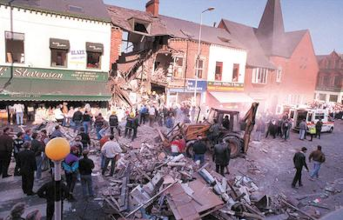
The Greysteel massacre is a mass shooting that takes place on the evening of October 30, 1993 in Greysteel, County Londonderry, Northern Ireland.

On October 23, 1993, an Irish Republican Army (IRA) bomb prematurely explodes as the bombers carry it into a fishmongers on the Shankill Road in Belfast. The IRA’s intended target is a meeting of Ulster Defence Association (UDA) leaders, including brigadier Johnny Adair, which is to take place in a room above the shop. Unknown to the IRA, the meeting had been rescheduled. Eight Protestant civilians, a UDA member and one of the IRA bombers are killed in the blast. This became known as the Shankill Road bombing.

The UDA launches a number of “revenge attacks” for the bombing. Later that day, it fatally shoots a Catholic delivery driver after luring him to a bogus call at Vernon Court, Belfast. On October 26, the UDA shoots dead another two Catholic civilians and wounds five in an attack at the Council Depot at Kennedy Way, Belfast.

The massacre is carefully planned. The order for the attack comes from the UDA leadership and it is believed Greysteel is chosen partly because it is well away from Belfast, where security force activity is intense after the Shankill bombing. Those involved in planning and organising it include Billy McFarland, ‘Brigadier’ of the UDA’s North Antrim & Londonderry Brigade. Stephen Irwin, Geoffrey Deeney and Torrens Knight, all members of the brigade, are to carry out the shooting. The gunmen are first briefed on the plans for the massacre on October 27 in an office owned by the Ulster Democratic Party at Bond’s Place, Londonderry. Before the massacre, the gunmen go to the pub to familiarise themselves with the layout and choose the best positions to shoot from.

On Saturday, October 30, the gunmen drive to the pub in an Opel Kadett, with UDA member Brian McNeill driving a ‘scout car’ in front. Just before 10:00 PM the three gunmen, wearing blue boilersuits and balaclavas, enter the “Rising Sun Bar” in Greysteel. There are at least 70 people inside attending a Halloween party and at first some believe the men are playing a Halloween prank. Stephen Irwin yells “trick or treat” as he opens fire with a vz. 58 assault rifle on the packed crowd in the lounge. He keeps shooting until the magazine empties, quickly reloads and continues shooting. Geoffrey Deeney opens fire with a 9mm handgun at a fleeing woman, but it jams after one shot. Torrens Knight, armed with a shotgun, guards the entrance while the shooting is taking place. There is panic and screaming as people scramble for cover and women plead for mercy. The scene in the Rising Sun is described as “hell-like”; bodies lay everywhere and the lounge and dancefloor are covered with blood and broken glass. The gunmen, laughing, then make their escape in the Opel Kadett driven by Knight. While driving away from Greysteel, the getaway car’s wing mirror is hit by a police car speeding towards the scene. The gunmen drive the Kadett to a pick-up point near Eglinton, where they meet McNeill and burn the car.

Seven people are killed outright and nineteen are wounded, with another later dying of his wounds. The dead are Karen Thompson (19), Steven Mullan (20), Moira Duddy (59), Joseph McDermott (60), James Moore (81), John Moyne (50), John Burns (54) and Victor Montgomery (76). Six of those killed are Catholic civilians and two are Protestant civilians.

The following day, the UDA claims responsibility for the attack using the cover name “Ulster Freedom Fighters” (UFF). Its statement says that the “Greysteel raid” is “the continuation of our threats against the nationalist electorate that they would pay a heavy price for last Saturday’s slaughter of nine Protestants.” A UDA West Belfast Brigade member claims that his organisation “had information that senior IRA men drank in the Rising Sun… Unfortunately they were not there on Halloween but our boys acted on the briefing they had been given.” Afterwards, the gunmen are said to have boasted about the killings.

The UDA members involved are arrested shortly after the massacre. During their first court appearance, Knight is filmed laughing, taunting and shouting abuse at the victims’ relatives as he is led from the building. In February 1995, Irwin, Deeney, Knight and McNeill are sentenced to life imprisonment for their involvement in the attack. Knight is also convicted for the Castlerock killings. In 2000, they are released early, along with other paramilitary prisoners, under the terms of the Good Friday Agreement.

The pub is still open in Greysteel. There is a memorial to the victims outside the building that says: “May their sacrifice be our path to peace.”


Leave a comment

The Tricolour Riots

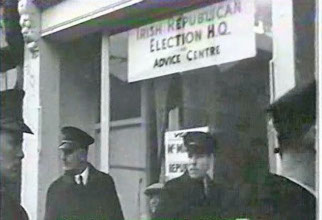
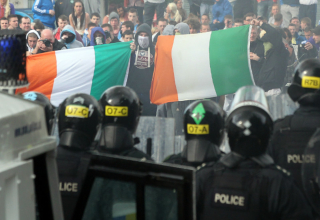
On the evening of the September 28, 1964, a detachment of the Royal Ulster Constabulary (RUC), acting on the direct instruction of Brian McConnell, the Minister of Home Affairs, attacks the Divis Street headquarters of the Republican Party (Sinn Féin had been outlawed earlier in the year) in West Belfast. Their perilous mission is to remove an Irish Tricolour.

This takes place during a general election for Westminster. Republicans have nominated Liam McMillan to contest in West Belfast. McConnell, under pressure from Ian Paisley and other unionists, holds a conference of his senior RUC officers on the morning of September 28 and orders that the tricolour flown at Liam McMillan’s headquarters be removed. Under the Flags and Emblems Display Act of 1954, it is an offence to display the tricolour anywhere in the six counties of Northern Ireland.

That evening, when it becomes known that the RUC are coming to seize the flag, more than 2,000 republican supporters block the roadway. Scores of RUC are rushed to the scene in armoured cars. The RUC, though heavily armed with sten guns, rifles, revolvers and riot batons, are made to look ridiculous by groups of children, who run about with miniature tricolour stickers which they stick on walls and police cars.

The RUC, using pickaxes, smashes down the doors of the Republican headquarters and takes the flag. They carry it away through a hail of stones and to the prolonged jeers of the people.

The following day the RUC clears Divis Street to make way for an armoured car. Their new perilous mission is to seize a new replacement tricolour. The armoured car stops outside the Republican headquarters, eight policemen emerge and begin another attack with crowbars and pickaxes. They fail to break down the door but one of them smashes the window, reaches in and pulls out the second tricolour.

By September 30, news of the events in Divis Street have spread throughout the media. Belfast begins attracting television reporters and newspaper men from all around the world. That night, thousands of republicans, armed with petrol bombs, sticks, stones and rotten vegetables, gather outside their headquarters to defend their identity and their flag. A battle begins at 11:00 PM when the RUC tries to disperse them. The television cameras are there to record all that happens. For the first time ever, people in many parts of the world are able to watch a sectarian police force in action.

When the republicans indicate that they will stand their ground, fifty RUC men, who had been held in reserve in the small streets between Falls Road and Shankill Road, are deployed but the republicans, in accordance with a pre-arranged strategy, drive them back. By midnight, the police have succeeded in sealing off Divis Street and dispersing the crowd but thirty people, including at least eighteen members of the RUC, have been injured.

One week later, on October 5, republicans carry the tricolour at the head of a parade of 5,000 people who march from Beechmount on Falls Road, through Divis Street, to an election rally near Smithfield. RUC men line the entire route but make no attempt to seize the flag.

(From: “The Tricolour Riots,” An Phoblacht (www.anphoblacht.com), September 23, 2004 edition)


Leave a comment

The Battle at Springmartin

kelly-bar-bombing

The Battle at Springmartin, a series of gun battles in Belfast, Northern Ireland, begins on May 13, 1972, and continues into the following day. It involves the British Army, the Provisional Irish Republican Army (IRA), and the Ulster Volunteer Force (UVF).

The night before the bombing, snipers from the UVF West Belfast Brigade take up position along the second floor of an abandoned row of flats at the edge of the Ulster Protestant Springmartin estate. The flats overlooked the Catholic Ballymurphy estate. Rifles, mostly World War II stock, are ferried to the area from dumps in the Shankill Road.

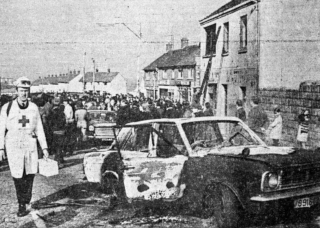
The violence begins shortly after 5:00 PM on Saturday, May 13, 1972, when a car bomb, planted by Ulster loyalists, explodes without warning outside the crowded Kelly’s Bar, at the junction of the Springfield Road and Whiterock Road. The pub is in a mainly Irish Catholic and nationalist area of Ballymurphy and most of its customers are from the area. At the time of the blast, the pub is crowded with men watching an association football match between England and West Germany on colour television. Following the blast, the UVF snipers open fire on the survivors. This begins the worst fighting in Northern Ireland since the suspension of the Parliament of Northern Ireland and the imposition of direct rule from London.

Sixty-three people are injured, eight of them seriously. John Moran, age 19, who had been working at Kelly’s as a part-time barman, dies of his injuries on May 23.

For the rest of the night and throughout the next day, local IRA units fight gun battles with both the UVF and British Army. Most of the fighting takes place along the interface between the Catholic Ballymurphy and Ulster Protestant Springmartin housing estates, and the British Army base that sits between them. Five civilians (four Catholics, one Protestant), a British soldier and a member of the IRA Youth Section are killed in the violence. Four of the dead are teenagers.

At first, the British Army claims that the blast had been an “accident” caused by a Provisional IRA bomb. The Secretary of State for Northern Ireland, William Whitelaw, tells the House of Commons on May 18 that the blast is caused by a Provisional IRA bomb that exploded prematurely. However, locals suspect that the loyalist Ulster Defence Association (UDA) had planted the bomb. Republican sources say that IRA volunteers would not risk storing such a large number of explosives in such a crowded pub. It later emerges that the bomb had indeed been planted by loyalists.

A memorial plaque on the site of the former pub names three members of staff who lost their lives as a result of the bomb and the gun battles that followed. It reads:

This plaque marks the spot
where Kelly’s Bar once stood
and here on 13th May 1972
a no warning Loyalist car bomb exploded.
As a result, 66 people were injured
and three innocent members of staff
of Kelly’s Bar lost their lives.
They were:
Tommy McIlroy (died 13th May 1972)
John Moran (died from his injuries 23rd May 1972)
Gerard Clarke (died from his injuries 6th September 1989)
Ar dheis Dé go raibh a namacha”


Leave a comment

Birth of Norman Whiteside, Northern Ireland Footballer

norman-whiteside

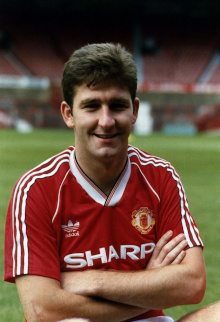
Norman Whiteside, former Northern Ireland international footballer who played in two World Cups, is born in Belfast, Northern Ireland on May 7, 1965. He plays both as a midfielder and as a striker.

Whiteside grows up on Shankill Road, and because of his aggressive, physical playing style he is later nicknamed the “Shankill Skinhead” by Manchester United supporters. The family later moves to 10 Danube Street. He remains relatively unscathed by The Troubles as his Protestant parents keep a firm watch on their children to ensure that they do not stray far from home and that none of them become involved with Ulster loyalism. At around seven years of age, he joins the Boys’ Brigade, and quickly shows his natural talent for football, scoring ten goals in a game against boys almost twice his age. He is educated at Cairnmartin High School and becomes famous in the Shankill area as a footballing prodigy by the age of eleven.

Whiteside is said to have been discovered by Ipswich Town scout Jim Rodgers, who is told by manager Bobby Robson to wait until Whiteside grows older. Instead, it is Manchester United’s 80-year-old Ulster scout Bob Bishop, who previously unearthed Belfast-born George Best and Sammy McIlroy for the club, who first offers him a trial at an English club. He finds that he has been offered schoolboy terms at the club during a school trip to the United States, on which he and his classmates meet President Jimmy Carter in the Oval Office, a rare and extraordinary occasion for children from a disadvantaged background.

Whiteside signs professional forms in 1982 at the age of 17 and quickly becomes a key member of the Manchester United club. He scores 68 goals in 278 league and cup appearances for the club over the next seven years, picking up two FA Cup winners medals in 1983 and 1985, as well as playing in the 1982 FA Youth Cup final, the 1983 League Cup final, and the FA Charity Shield in 1983.

Whiteside remains with United until July 1989, when he is sold to Everton F.C. for £600,000. However intense running sessions run by coach Mick Lyons take their toll on his right knee, and on September 20, 1990, he takes a knock in a practice match, which requires him to have another operation on his right knee. After the return of Howard Kendall as manager in November 1990, he manages to appear in a few reserve team games, but this only delays the inevitable, and he is forced to retire from the game at the age of 26 in June 1991.

Upon retirement, Whiteside studies to become a podiatrist, graduating with a degree from the University of Salford, and serves Northwich Victoria F.C. as their assistant manager/physio from October 1991 until March 1992. He quits the role as he does not enjoy the amount of time spent travelling between games. He instead became an after-dinner speaker and also works for the Professional Footballers’ Association, while taking a postgraduate course at Manchester Metropolitan University. He later takes up private practice as a podiatrist in Manchester. Since 1994, he has also worked at the corporate hospitality department at Old Trafford. In 2003, he releases a book entitled My Memories of Manchester United. With the help of writer Rob Bagchi, he releases his autobiography entitled Determined in August 2007, published by Headline Publishing Group, and with a foreword by actor James Nesbitt.

Whiteside holds records as the youngest player to take part in a World Cup, the youngest player to score in a League Cup and FA Cup final, and the youngest player to score a senior goal for Manchester United. Winning 38 caps for Northern Ireland, he plays at the 1982 and 1986 World Cups and also helps his country to win the last ever British Home Championship in 1983–1984.


Leave a comment

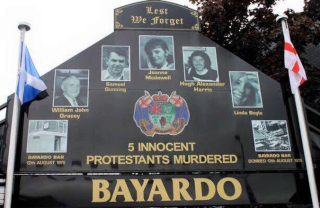
The Bayardo Bar Attack

bayardo-bar-attack

The Bayardo Bar attack takes place on August 13, 1975, in Belfast as a unit of the Provisional Irish Republican Army (IRA), led by Brendan McFarlane, launch a bombing and shooting attack on a pub on Aberdeen Street, in the loyalist Shankill Road area of the city.

By 1975, the conflict in Northern Ireland known as “the Troubles” is more than six years old. On February 10, 1975, the Provisional IRA and the British government enter into a truce and restart negotiations. There is a rise in sectarian killings during the truce, which ‘officially’ lasts until early 1976. The truce, however, is interrupted in the early hours of July 31, 1975, by the Miami Showband killings at Buskhill outside Newry, County Down.

Two weeks later, on August 13, 1975, the Bayardo Bar is crowded with people of all ages. Shortly before closing time a stolen green Audi automobile, containing a three-man unit of the IRA’s Belfast Brigade, pulls up outside. It is driven by the unit’s leader Brendan “Bik” McFarlane, a 24-year-old volunteer from Ardoyne. Volunteers Seamus Clarke and Peter “Skeet” Hamilton get out and approach the pub’s side entrance on Aberdeen Street. One of them immediately opens fire with an ArmaLite, instantly killing doorman William Gracey and his brother-in-law Samuel Gunning, with whom he had been chatting outside. The other volunteer then enters the pub, where patrons are drinking and singing, and drops a duffel bag containing a ten-pound bomb at the entrance. Both men make their getaway back to the waiting car. As panicked customers run to the toilets for safety, the bomb explodes and brings down a section of the old brick-and-plaster building upon them. The bodies of civilian Joanne McDowell and UVF member Hugh Harris are later found beneath the rubble of fallen masonry. Seventeen-year-old civilian Linda Boyle is pulled out alive but dies of her injuries at the hospital on August 21. Over 50 people are injured in the attack.

A Belfast Telegraph article later claims that, as the IRA unit drives away down Agnes Street, they fire into a crowd of women and children queuing at a taxi rank although there are no fatalities. Within 20 minutes of the blast, the IRA unit is arrested after their car is stopped at a roadblock. The ArmaLite that had been used to kill Gracey and Gunning is found inside the car along with spent bullet casings and fingerprints belonging to the three IRA men.

The IRA does not initially claim responsibility, however, IRA members later state that the Bayardo was attacked because it was a pub where Ulster Volunteer Force (UVF) members met and planned terrorist assaults against nationalists. The pub is in the UVF-dominated middle Shankill Road area, and the Ulster Banner is displayed from its upper windows. A former IRA prisoner claims that fellow inmate Lenny Murphy told him he had left the Bayardo ten minutes before the attack and that the Brigade Staff had just finished holding a meeting there.

Loyalists, especially the UVF, respond with another wave of sectarian attacks against Catholics. Two days after the pub attack, a loyalist car bomb explodes without warning on the Falls Road, injuring 35 people. On 22 August, the UVF launches a gun and bomb attack on McGleenan’s Bar in Armagh. The attack is strikingly similar to that at Bayardo. One gunman opens fire while another plants the bomb, the explosion causing the building to collapse. Three Catholic civilians are killed and several more are wounded. That same night, another bomb wrecks a Catholic-owned pub in nearby Blackwatertown, although there are no injuries.

In May 1976, Brendan McFarlane, Seamus Clarke, and Peter Hamilton are convicted in a non-jury Diplock court and sentenced to life imprisonment inside the HM Prison Maze for carrying out the Bayardo murders. In 1983 McFarlane leads the Maze Prison escape, a mass break-out of 38 republican prisoners, including Clarke and Hamilton.


Leave a comment

2012 North Belfast Riots

belfast-violence-july-2012

The first incident of the 2012 North Belfast Riots occurs on July 12, 2012, during “The TwelfthLoyalist celebrations. The sectarian disorder and rioting between loyalists and republicans take place when rival parades, authorised by the Parades Commission, take place.

Catholic rioting has been common in recent years when the parades are forced through the mostly Irish nationalist Ardoyne in north Belfast. The local Orangemen parade down the predominantly Ulster loyalist Crumlin Road towards the loyalist Woodvale area. Before turning into the Woodvale, they are met by Irish republican protesters and a nearby counter-parade organised by the Greater Ardoyne Residents Association (GARC). Nationalists then attack the Police Service of Northern Ireland (PSNI) and the parade with bricks, bottles and petrol bombs.

There is also violence in the Bogside area of Derry, where petrol bombs are thrown at police and a car is set afire. In south and east Belfast there are five arrests for a variety of offences including disorderly behaviour.

Prolonged attacks on the PSNI by Catholics follow the parades with missiles being thrown at police lines. Three cars are hijacked and pushed at police lines with at least one of them being set on fire, and at night ten shots are fired at police by a nationalist gunman who intends to kill police officers. On July 18, 2012, a 47-year-old man is charged with attempted murder of the police officers. The PSNI blames the violence on “thugs” and makes a further 26 arrests across Northern Ireland relating to the trouble.

In another incident during a different parade, a Shankill Road-based loyalist band “The Young Conway Volunteers” is filmed by a Sinn Féin activist playing The Famine Song outside St. Patrick’s Catholic Church in Ardoyne. The activist filming the incident is attacked by band members who try to snatch the phone from him. The incident brings condemnation, with Sinn Féin declaring it “provocative.” Protestant church leaders also condemn the incident as “blatantly sectarian.” It is this incident that is believed to ignite tensions in the area which continue over the next few months.

In the days that follow strong loyalist criticism is levelled at the Parades Commission blaming them for the violence. Nigel Dodds of the Democratic Unionist Party (DUP) accuses the Parades Commission of making a “bizarre, crazy, and mad decision” to allow the nationalist parade to coincide with the Orange parade while Sinn Féin’s Gerry Kelly blames the Orangemen for violating regulations set out by the Parades Commission. The Parades Commission denies responsibility, explaining “We have to balance the rights of everybody concerned in parades, not just the rights of paraders, but the rights of people who live in the areas and the rights of police officers.”


Leave a comment

The Crumlin Road Gaol Escape

crumlin-road-jail-escape

Eight Provisional Irish Republican Army prisoners escape from Crumlin Road Gaol in Belfast, one of the most heavily guarded prisons in Europe, on June 10, 1980. Using handguns that had been smuggled into the prison, they take prison officers hostage and shoot their way out of the building and exit through the front gate.

The regime inside Crumlin Road Gaol on that day is just like any other. The prison had been the scene of several protests regarding strip-searching shortly beforehand, but the rules had been somewhat relaxed. On A and C Wings the remand prisoners are outside in the yard for exercise. As usual, several men from each wing are called for visits. Some of these visits are from solicitors and an area of the prison is set aside to allow legal teams and the accused a place to discuss their business in private.

When warders come to return one set of prisoners to their wing, the operation begins. One of the Volunteers produces a gun, forces the warders to release the other prisoners and then locks about ten warders in the cell. They then make their way to B wing’s visiting area and arrest all the warders, visitors and solicitors who are there, before locking about thirty up in a room. One warder named Killen reaches for his baton, is disarmed and hit over the head.

Two warders and a solicitor are ordered to strip and three of the IRA Volunteers, dress in two uniforms and a suit respectively, calmly walk to the main gate which is opened for them. They then pull guns on the real warders in this key security area and make them lie on the ground until their five comrades run across a small courtyard to join them.

Once outside however, the alarm is set off and British Army sentries pour a hail of automatic fire at the prisoners from a watch tower before they are able to reach the front gate. Undeterred, the prisoners dash through the bullets, weaving from side to side to throw off their attackers.

As the men make their escape, clearly visible to republican prisoners in cells on the top landing of A wing, loud cheers go up and makeshift flags are flown from the windows.

Outside the prison, cars have been parked by the IRA’s Belfast Brigade in the car park of the health clinic beside the courthouse, their ignition keys hidden under the floor mats. The prisoners run across the road towards the health centre, dodging bullets as they run. The escapees head towards the loyalist Shankill area where they commandeer cars to help their getaway.

Stunned by the daring escapees, the crown forces erect checkpoints across Belfast and along all border routes.

Seven of the escapees, known as the “M60 gang,” are brothers Tony and Gerry Sloan, Gerard McKee, Joe Doherty, Angelo Fusco, Paul ‘Dingus’ Magee and Tony Campbell. All are from Belfast and charged in connection with either an M60 machine gun attack in 1980 on a Royal Ulster Constabulary (RUC) patrol in Andersonstown, or with the siege on the Antrim Road in May 1980, when a Special Air Service (SAS) captain is killed. The eighth escapee is Pete Ryan from Ardboe, County Tyrone who had been charged with killing an RUC Reservist and an Ulster Defence Regiment (UDR) soldier.

All eight men reach safe houses within an hour and, after a lying low for a short while, are spirited over the border to begin new lives “on the run.”

One week later, at the annual pilgrimage to the graveside of Wolfe Tone, the father of republicanism, which is always a source of renewed strength for its participants, the crowd is given an added morale boost when at the closing ceremony, one of the escapees, Paul ‘Dingus’ Magee, makes a dramatic appearance on the platform.

There are many more attempts to break free from Crumlin Road Gaol before it finally closes its doors in April 1995, having been used as a weapon in the attempted suppression of the Irish freedom struggle for 151 years.

(From: An Phoblacht Magazine, http://www.anphoblacht.com, June 15, 2006 edition)


Leave a comment

The 1994 Shankill Road Killings

trevor-king-mural

The 1994 Shankill Road killings take place on June 16, 1994. The Irish National Liberation Army (INLA) shoot dead Ulster Volunteer Force (UVF) members Trevor King, Colin Craig and David Hamilton on the Shankill Road in Belfast, close to the UVF headquarters.

On June 16, 1994, high-ranking UVF Commander volunteer Trevor King is standing on the Shankill Road about one hundred yards from “The Eagle,” the UVF’s Belfast GHQ, talking to fellow UVF members David Hamilton and Colin Craig. A car drives past them and as it does so Irish National Liberation Army (INLA) gunmen inside the vehicle open fire on the three men. The car is later found burning close to Divis Tower.

David Lister and Hugh Jordan claim that Gino Gallagher, who is himself shot dead in 1996 during an internal dispute, is the main gunman in the attack. However, Henry McDonald and Jack Holland say that Gallagher is inside the car, which is scouting the area for UVF members, and not one of the gunmen.

Colin Craig is killed on the spot. King and David Hamilton lay in the street, seriously wounded as panic and chaos erupt on the Shankill in the wake of the shooting. Presbyterian minister Roy Magee is in “The Eagle” discussing an upcoming Combined Loyalist Military Command (CLMC) meeting and the possibility of a loyalist ceasefire with the UVF Brigade Staff when the attack takes place. He and the others race out of the building after hearing the gunfire.

King is rushed to the hospital where he is put on a life-support machine. The shooting has left him paralysed from the neck down. He dies on July 9 with Reverend Magee at his bedside. According to Magee, King himself makes the decision to turn off the machine.

The killings are a blow for the Northern Ireland peace process and a morale boost for the INLA. The attack is the INLA’s most notorious since the Droppin Well bombing in 1982 which killed seventeen people, eleven British soldiers and 6 civilians.

The following day, the UVF launches two retaliatory attacks. In the first, UVF members shoot dead a Catholic civilian taxi driver in Carrickfergus. In the second, they shoot dead two Protestant civilians in Newtownabbey, whom they believe to be Catholics. Two days after the killings the UVF decide to launch another revenge attack when they kill six Catholic civilians in a bar while they are watching the Ireland vs. Italy 1994 FIFA World Cup game opener in what becomes known as the Loughinisland massacre. The tit-for-tat attacks continue during the spring and summer of 1994 until the Provisional Irish Republican Army ceasefire of August 31, 1994, and the Combined Loyalist Military Command ceasefire in October. The attacks on the Shankill are the INLA’s deadliest attacks of the 1990s.

When interviewed for Boston College for research on the conflict, Progressive Unionist Party leader David Ervine suggests the INLA might have been working in cahoots with the Provisional IRA in targeting prominent Loyalists, as the month after the Provisional IRA kill three leading Ulster Defence Association (UDA) men.

(Pictured: Trevor King mural, Disraeli Street, May 2012)


2 Comments

The Balmoral Furniture Company Bombing

balmoral-furniture-showroom-bombing

The Balmoral Furniture Company bombing, a paramilitary attack, takes place on December 11, 1971, in Belfast, Northern Ireland. The bomb explodes without warning outside a furniture showroom on the Shankill Road in a predominantly unionist area, killing four civilians, two of them babies.

At 12:25 PM on December 11, 1971, when the Shankill Road is packed with Saturday shoppers, a green car pulls up outside the Balmoral Furniture Company at the corner of Carlow Street and Shankill Road. The shop is locally known as “Moffat’s” although Balmoral Furniture Company is its official name. One of the occupants gets out of the car and leaves a box containing a bomb on the step outside the front door. The person gets back into the car, and it speeds away. The bomb explodes moments later, bringing down most of the building on top of those inside the shop and on passersby outside.

Four people are killed as a result of the massive blast, including two babies, Tracey Munn (age 2 years) and Colin Nichol (age 17 months), who both die instantly when part of the wall crashes down upon the pram they are sharing. Two employees working inside the shop are also killed, Hugh Bruce (age 70 years) and Harold King (age 29 years). Unlike the other three victims, who are Protestant, King is a Catholic. Bruce, a former soldier and a Corps of Commissionaires member, is the shop’s doorman and is nearest to the bomb when it explodes. Nineteen people are injured in the bombing, including Tracey’s mother. The building, which was built in the Victorian era, has load-bearing walls supporting upper floors on joists. It is unable to withstand the blast and collapses, adding to the devastation and injury count.

The bombing causes bedlam in the crowded street. Hundreds of people rush to the scene where they form human chains to help the British Army and Royal Ulster Constabulary (RUC) free those trapped beneath the rubble by digging with their bare hands. Peter Taylor describes the scene as “reminiscent of the London Blitz” in World War II.

It is widely believed that the bombing is carried out by members of the Provisional Irish Republican Army (IRA) in retaliation for the McGurk’s bar bombing one week earlier, which killed 15 Catholic civilians. The Ulster Volunteer Force (UVF) had carried out the McGurk’s bombing.

The Balmoral Furniture Company bombing is one of the catalysts that spark the series of tit-for-tat bombings and shootings by loyalists, republicans and the security forces that make the 1970s the bloodiest decade in the 30-year history of The Troubles.

(Pictured: Fireman is shown removing the body of one of the victims of the bombing at the Balmoral Furniture Showroom, December 11, 1971)


Leave a comment

Belfast’s Bloody Sunday

Bloody Sunday or Belfast’s Bloody Sunday is a day of violence in Belfast, Ireland (present-day Northern Ireland) on July 10, 1921, during the Irish War of Independence.

Belfast sees almost 500 people die in political violence between 1920 and 1922. Violence in the city breaks out in the summer of 1920 in response to the Irish Republican Army (IRA) killing of Royal Irish Constabulary Detective Oswald Swanzy after Sunday services outside a Protestant church in nearby Lisburn. Seven thousand Catholics and some Protestant trade unionists are driven from their jobs in the Belfast shipyards and over 50 people are killed in rioting between Catholics and Protestants.

Violence in Belfast wanes until the following summer of 1921. At the time, Irish republican and British authorities are negotiating a truce to end the war but fighting flares up in Belfast. On June 10, an IRA gunman, Jack Donaghy, ambushes three RIC constables on the Falls Road, fatally wounding one, Thomas Conlon, a Roman Catholic from County Roscommon, who, ironically, is viewed as “sympathetic” to the local nationalists. Over the following three days, at least 14 people lose their lives and 14 are wounded in fighting in the city, including three Catholics who are taken from their homes and killed by uniformed police.

Low-level attacks continue in the city over the next month until another major outbreak of violence that leads to “Bloody Sunday.” On July 8, the RIC attempt to carry out searches in the mainly Catholic and republican enclave around Union Street and Stanhope Street. However, they are confronted by about fifteen IRA volunteers in an hour-long firefight.

On July 9, a truce to suspend the war is agreed in Dublin between representatives of the Irish Republic and the British government, to come into effect at noon on July 11. Many Protestants/unionists condemn the truce as a “sell-out” to republicans.

On the night of July 9/10, hours after the truce is announced, the RIC attempt to launch a raid in the Lower Falls district of west Belfast. Scouts alert the IRA of the raid by blowing whistles, banging dustbin lids and flashing a red light. On Raglan Street, a unit of about fourteen IRA volunteers ambush an armoured police truck, killing one officer and wounding at least two others.

This sparks an outbreak of ferocious fighting between Catholics and Protestants in west Belfast the following day, Sunday July 10, in which 16 civilians lose their lives and up to 200 houses are destroyed. Of the houses destroyed, 150 are owned by Catholics. Most of the dead are civilians and at least four of the Catholic victims are ex-World War I servicemen.

Protestants, fearful of absorption into a Catholic Ireland and blindly angered by the presence of heresy and treason in their midst, strike at the Catholic community while vengeful Catholics strike back with counter-terror. Gun battles rage all day along the sectarian “boundary” between the Catholic Falls and Protestant Shankill districts and rival gunmen use rifles, machine guns and grenades in the clashes. Gunmen are seen firing from windows, rooftops and street corners. A loyalist mob, several thousand strong, attempt to storm the Falls district, carrying petrol and other flammable materials.

A tram travelling from the Falls into the city centre is struck by snipers’ bullets, and the service has to be suspended. Catholics and republicans claim that police, mostly from the Ulster Special Constabulary (USC), drive through Catholic enclaves in armoured cars firing indiscriminately at houses and bystanders. The police return to their barracks late on Sunday night, allegedly after a ceasefire has been agreed by telephone between a senior RIC officer and the commander of the IRA’s Belfast Brigade, Roger McCorley.

The truce is due to come into effect at midday on Monday, July 11, but violence resumes that morning. Three people are shot dead that day, including an IRA volunteer who is shot minutes before midday. In the north the official truce does not end the fighting. While the IRA is involved in the violence, it does not control the actions of the Catholic community. Tuesday July 12 sees the Orange Order‘s annual Twelfth marches pass off peacefully and there are no serious disturbances in the city. However, sporadic violence resumes on Wednesday, and by the end of the week 28 people in all have been killed or fatally wounded in Belfast.

The violence of the period in Belfast is cyclical, and the events of July 1921 are followed by a lull until a three-day period beginning on August 29, when another 20 lives are lost in the west and north of the city. The conflict in Belfast between the IRA and Crown forces and between Catholics and Protestants continues until the following summer, when the northern IRA is left isolated by the outbreak of the Irish Civil War in the south and weakened by the rigorous enforcement of internment in Northern Ireland.

At the time the day is referred to as “Belfast’s Bloody Sunday.” However, the title of “Bloody Sunday” is now more commonly given in Ireland to events in Dublin in November 1920 or Derry in January 1972.