seamus dubhghaill

Promoting Irish Culture and History from Little Rock, Arkansas, USA


Leave a comment

Birth of David Hammond, Singer & Folklorist

David Andrew (Davy) Hammond, singer, folkloristtelevision producer and documentary maker, is born on December 5, 1928, in Miss Kell’s nursing home on the Castlereagh Road in Belfast, Northern Ireland.

Hammond is the son of Leslie Hammond, a tram driver, and his wife Annie (née Lamont). His parents are not city people; his mother grew up near Ballybogy in the Ballymoney area of County Antrim, and his father, though from a family with roots in south County Londonderry, had lived in Ballymoney as a boy, and had been apprenticed to a blacksmith there. Both have a strong sense of their rural identity and maintain the Ulster Scots dialect of their childhood. They are never quite at home in the Belfast suburb of Cregagh, and in particular do not share the sectarian attitudes that are much more present in 1930s Belfast than they had been in north Antrim, one of the last strongholds of Presbyterian radicalism. Even as a boy, Hammond is interested in the old songs that his mother sang and realises that the traditions in which his parents had been nurtured are disappearing quickly in an increasingly urbanising and modernising world. When he encounters the work of Emyr Estyn Evans in the early 1940s, he is encouraged to document both rural tradition and the street life of the city, and he and a couple of friends, though still just teenagers, ride off on their bicycles to look for folklore in the hinterland of Belfast.

After primary school, Hammond wins a scholarship in 1941 to Methodist College Belfast, where he does well in examinations, and then goes to Stranmillis University College to train as a teacher. In his first job, in Harding Memorial primary school in east Belfast, he proves to be a popular, idealistic teacher, and is remembered by his pupils fifty years later as a fine singer and a teller of ghost stories, who had taken the class on memorable youth-hosteling trips to the Mourne Mountains. Youth hosteling and folklore collecting increases his awareness and understanding of the rich traditions of the whole community in the north of Ireland, and he is never constrained by political or religious barriers. His early career mirrors closely that of James Hawthorne, and their paths are to cross in later life.

Hammond is friendly with many others active in the cultural life of Northern Ireland and makes a name for himself as a song collector and eventually as an expert on all aspects of traditional singing. In 1956, he is awarded a scholarship to travel in the United States to meet the important pioneers of folk-music collecting and performance there. He records his first LP record of Ulster songs, I Am The Wee Falorie Man (1958), in the United States, and becomes friends with Pete Seeger, the Appalachian singer Jean Ritchie, with old blues singers, and notably with Liam Clancy, one of the three Clancy brothers who as a quartet with Tommy Makem are to popularise Irish folk music in the United States and elsewhere.

On returning to Belfast, Hammond takes a job in 1958 in Orangefield secondary school in the east of the city, where the highly regarded headmaster John Malone encourages new approaches to education. Among his pupils at Orangefield is George Ivan “Van” Morrison, who credits him with inspiring his interest in Irish traditional music. Hammond enjoys teaching but is increasingly drawn to folk-song performance and recording. He appears regularly on radio programmes of the BBC and Radio Éireann, and in 1964 joins the school’s department in BBC Northern Ireland. There, with colleagues like Sam Hanna Bell, James Hawthorne and others, he works on programmes such as Today and Yesterday in Northern Ireland, which for the first time introduces pupils (and many adults) to local history and to aspects of tradition. In 1968, with two friends, the poets Seamus Heaney and Michael Longley, he puts on poetry and traditional music events in schools all over the province. The Arts Council funds the Room to Rhyme project, which is immensely influential and inspiring, and is still talked about many years later by those who attended as children.

Hammond is creatively involved with hundreds of hours of broadcasting, in television as well as radio, and eventually for adults as well as children. He writes scripts, produces documentary series such as Ulster in Focusand Explorations, and brings an artistic sensibility to filming, as well as working sympathetically with traditional singers and craftspeople. Dusty Bluebells, a sensitively made film of Belfast children’s street games, wins the prestigious Golden Harp award in 1972. After he leaves the BBC to work as a freelance, and founds Flying Fox Films in 1986, he continues making documentaries on many aspects of Ulster life and heritage. His film called Steel Chest, Nail in the Boot and the Barking Dog (1986), about working in the Belfast shipyards, also wins a Golden Harp award. A companion book of the same name is published. Another book is Belfast, City of Song(1989), with Maurice Leyden. In 1979, he edits a volume of the songs of Thomas Moore. His documentary programmes include films about singers from Boho, County Fermanagh, and about the big houses of the gentry in Ireland. The Magic Fiddle (1991/2) examines the role of the instrument in the folk music of Ireland, ScandinaviaCanada, and the American south, while Another Kind of Freedom (1993) is about the experiences of a former Orangefield pupil, the Beirut hostage Brian Keenan. He also produces and directs the films Something to Write Home About (1998), Where Are You Now? (1999), and Bogland (1999), all of which explore Seamus Heaney’s home region and experiences.

The first poem in Heaney’s collection Wintering Out (1972) is entitled “For David Hammond and Michael Longley.” Their lifelong friendship leads to several other creative collaborations. In particular, after a distressing evening in 1972 when Hammond, affected by the despair and terror unleashed by Irish Republican Army (IRA) bombing of his city, is for once unable to sing, Heaney meditates on the experience in an essay and in an important poem, “The singer’s house” (subsequently included in his 1979 Field Work collection). The poem urges the singer to keep singing, to defend the values of art and friendship in a hostile time. Hammond collaborates with Dónal Lunny and other traditional musicians to bring out an LP also called The Singer’s House(1978), which includes Heaney’s poem on the album sleeve, and features some of the songs that he had made famous, such as “My Aunt Jane” and “Bonny Woodgreen,” from his vast repertoire of songs from Ulster. The album is reissued in 1980.

In 1995, Hammond is one of Heaney’s personal guests at the award of his Nobel prize in Stockholm, characteristically wearing his usual, mustard-yellow, cattle-dealer boots with evening dress. On another formal occasion, when he is awarded an honorary doctorate by Dublin City University in November 2003, he surprises the audience by standing up in his academic robes to sing “My Lagan love,” instead of giving an address. His unique, light mellow voice is an ideal vehicle for the traditional ballads which he knows so well. He records a number of records in the 1960s, including Belfast Street Songs, and publishes the book Songs of Belfast (1978). He also encourages traditional musicians like Arty McGlynn, and collaborates with them on various recording projects. He is well known for live and often impromptu performances at festivals and venues in Ireland and the United States. He also performs at the John F. Kennedy Center for the Performing Arts in Washington, D.C.

Hammond is also a notable collaborator with poets and dramatists, especially in the important Field Day Theatre Company project, of which he is a director, along with Seamus Heaney, Tom PaulinSeamus DeaneThomas Kilroy, and the project’s founders, Brian Friel and Stephen Rea. He supports the Field Day search for a “fifth province,” where history and community and culture can intersect, believing that to speak unthinkingly of “two traditions” is to perpetuate superficial political divisions. As he says in an interview in The Irish Times on July 4, 1998, songs can “take you out of yourself” and become bridges to unite people.

Hammond receives many honours. In 1994, he receives the Estyn Evans award for his contribution to mutual understanding, and his work is featured in several major events in his honour: in the University of North Florida (1999), in the Celtic Film Festival in Belfast (2003), and in Belfast’s Linen Hall Library (2005). A Time to Dream, a film about his life and work, is broadcast on BBC Northern Ireland in December 2008.

Hammond dies in hospital in Belfast, after a long illness, on August 25, 2008, survived by his wife Eileen (née Hambleton), whom he marries on July 19, 1954, and by their son and three daughters. His funeral in St. Finnian’s Church is a major cultural event, where friends sing, play and speak in his honour.

In Seamus Heaney’s last collection of poetry, Human Chain (2010), he includes a poignant farewell to Hammond. The poet imagines (or perhaps dreams) of another visit to the singer’s house, but this time “The door was open, and the house was dark.”

(From: “Hammond, David Andrew (‘Davy’)” by Linde Lunney, Dictionary of Irish Biography, http://www.dib.ie, December 2014)


Leave a comment

Death of Eamon Broy, Member of the Dublin Metropolitan Police & IRA

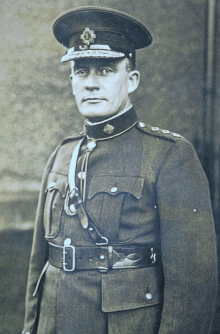
Eamon “Ned” Broy, successively a member of the Dublin Metropolitan Police (DMP), the Irish Republican Army (IRA), the National Army, and the Garda Síochána of the Irish Free State, dies in Rathgar, Dublin, on January 22, 1972. He serves as Commissioner of the Gardaí from February 1933 to June 1938. He later serves as president of the Olympic Council of Ireland for fifteen years.

Broy is born in Rathangan, County Kildare, on December 22, 1887. He joins the Royal Irish Constabulary (RIC) on August 2, 1910, and the Dublin Metropolitan Police on January 20, 1911.

Broy is a double agent within the DMP, with the rank of Detective Sergeant (DS). He works as a clerk inside G Division, the intelligence branch of the DMP. While there, he copies sensitive files for IRA leader Michael Collins and passes many of these files on to Collins through Thomas Gay, the librarian at Capel Street Library. On April 7, 1919, he smuggles Collins into G Division’s archives in Great Brunswick Street (now Pearse Street), enabling him to identify “G-Men,” six of whom are eventually killed by the IRA. He supports the Anglo-Irish Treaty of 1921 and joins the National Army during the Irish Civil War, reaching the rank of colonel. In 1925, he leaves the Army and joins the Garda Síochána.

Broy’s elevation to the post of Commissioner comes when Fianna Fáil replaces Cumann na nGaedheal as the government. Other more senior officers are passed over as being too sympathetic to the outgoing party.

In 1934, Broy oversees the creation of “The Auxiliary Special Branch” of the Garda, formed mainly of hastily trained anti-Treaty IRA veterans, who were opponents of Broy in the civil war. It is nicknamed the “Broy Harriers” by Broy’s opponents, a pun on the Bray Harriers athletics club or more likely on the Bray Harriers hunt club. It is used first against the quasi-fascist Blueshirts, and later against the diehard holdouts of the IRA, now set against former comrades. The “Broy Harriers” nickname persists into the 1940s, even though Broy himself is no longer in command, and for the bodies targeted by the unit is a highly abusive term, still applied by radical Irish republicans to the Garda Special Branch (now renamed the Special Detective Unit). The Broy Harriers engage in several controversial fatal shootings. They shoot dead a protesting farmer named Lynch in Cork, and when the matter is discussed in the Senate in 1934, the members who support Éamon de Valera‘s government walk out. They are detested by sections of the farming community. In the light of this latter history, their name is often used in reference to individuals or groups who attempt to disrupt contemporary dissident republicans, such as the remnants of the Provisional Irish Republican Army.

Broy is President of the Olympic Council of Ireland from 1935 to 1950. He is also a member of the Standing Committee of the Irish Amateur Handball Association.

Broy dies on January 22, 1972, at his residence in the Dublin suburb of Rathgar.

On September 17, 2016, a memorial to Broy is unveiled in Coolegagen Cemetery, County Offaly, close to his childhood home. His daughter Áine is in attendance, as are representatives of the government, the Air Corps, and the Garda Síochana.

Neil Jordan‘s film Michael Collins (1996) inaccurately depicts Broy (played by actor Stephen Rea) as having been arrested, tortured and killed by Secret Intelligence Service (SIS) agents. In addition, G Division was based not in Dublin Castle, as indicated in the film, but in Great Brunswick Street. Collins had a different agent in the Castle, David Neligan. Broy is also mentioned and makes an appearance in Michael Russell’s detective novel The City of Shadows, set partly in Dublin in the 1930s, published by HarperCollins in 2012.


Leave a comment

Death of David Hammond, Singer, Folklorist & Television Producer

David Andrew (Davy) Hammond, singer, folklorist, television producer and documentary maker, dies in Belfast, Northern Ireland, following a long illness, on August 25, 2008.

Hammond is born on December 5, 1928, in Miss Kells’s nursing home on the Castlereagh Road in Belfast, the son of Leslie Hammond, a tram driver, and his wife Annie (née Lamont). His parents are not city people; his mother grew up near Ballybogy in the Ballymoney area of County Antrim, and his father, though from a family with roots in south County Londonderry, had lived in Ballymoney as a boy, and had been apprenticed to a blacksmith there. Both have a strong sense of their rural identity and maintain the Ulster Scots dialect of their childhood. They are never quite at home in the Belfast suburb of Cregagh, and in particular do not share the sectarian attitudes that are much more present in 1930s Belfast than they had been in north Antrim, one of the last strongholds of Presbyterian radicalism. Even as a boy, Hammond is interested in the old songs that his mother sang and realises that the traditions in which his parents had been nurtured are disappearing quickly in an increasingly urbanising and modernising world. When he encounters the work of Emyr Estyn Evans in the early 1940s, he is encouraged to document both rural tradition and the street life of the city, and he and a couple of friends, though still just teenagers, ride off on their bicycles to look for folklore in the hinterland of Belfast.

After primary school, Hammond wins a scholarship in 1941 to Methodist College Belfast, where he does well in examinations, and then goes to Stranmillis University College to train as a teacher. In his first job, in Harding Memorial primary school in east Belfast, he proves to be a popular, idealistic teacher, and is remembered by his pupils fifty years later as a fine singer and a teller of ghost stories, who had taken the class on memorable youth-hosteling trips to the Mourne Mountains. Youth hosteling and folklore collecting increases his awareness and understanding of the rich traditions of the whole community in the north of Ireland, and he is never constrained by political or religious barriers. His early career mirrors closely that of James Hawthorne, and their paths are to cross in later life.

Hammond is friendly with many others active in the cultural life of Northern Ireland and makes a name for himself as a song collector and eventually as an expert on all aspects of traditional singing. In 1956, he is awarded a scholarship to travel in the United States to meet the important pioneers of folk-music collecting and performance there. He records his first LP record of Ulster songs, I Am The Wee Falorie Man (1958), in the United States, and becomes friends with Pete Seeger, the Appalachian singer Jean Ritchie, with old blues singers, and notably with Liam Clancy, one of the three Clancy brothers who as a quartet with Tommy Makem are to popularise Irish folk music in the United States and elsewhere.

On returning to Belfast, Hammond takes a job in 1958 in Orangefield secondary school in the east of the city, where the highly regarded headmaster John Malone encourages new approaches to education. Among his pupils at Orangefield is George Ivan “Van” Morrison, who credits him with inspiring his interest in Irish traditional music. Hammond enjoys teaching but is increasingly drawn to folk-song performance and recording. He appears regularly on radio programmes of the BBC and Radio Éireann, and in 1964 joins the school’s department in BBC Northern Ireland. There, with colleagues like Sam Hanna Bell, James Hawthorne and others, he works on programmes such as Today and Yesterday in Northern Ireland, which for the first time introduces pupils (and many adults) to local history and to aspects of tradition. In 1968, with two friends, the poets Seamus Heaney and Michael Longley, he puts on poetry and traditional music events in schools all over the province. The Arts Council funds the Room to Rhyme project, which is immensely influential and inspiring, and is still talked about many years later by those who attended as children.

Hammond is creatively involved with hundreds of hours of broadcasting, in television as well as radio, and eventually for adults as well as children. He writes scripts, produces documentary series such as Ulster in Focus and Explorations, and brings an artistic sensibility to filming, as well as working sympathetically with traditional singers and craftspeople. Dusty Bluebells, a sensitively made film of Belfast children’s street games, wins the prestigious Golden Harp award in 1972. After he leaves the BBC to work as a freelance, and founds Flying Fox Films in 1986, he continues making documentaries on many aspects of Ulster life and heritage. His film called Steel Chest, Nail in the Boot and the Barking Dog (1986), about working in the Belfast shipyards, also wins a Golden Harp award. A companion book of the same name is published. Another book is Belfast, City of Song (1989), with Maurice Leyden. In 1979, he edits a volume of the songs of Thomas Moore. His documentary programmes include films about singers from Boho, County Fermanagh, and about the big houses of the gentry in Ireland. The Magic Fiddle (1991/2) examines the role of the instrument in the folk music of Ireland, Scandinavia, Canada, and the American south, while Another Kind of Freedom (1993) is about the experiences of a former Orangefield pupil, the Beirut hostage Brian Keenan. He also produces and directs the films Something to Write Home About (1998), Where Are You Now? (1999), and Bogland (1999), all of which explore Seamus Heaney’s home region and experiences.

The first poem in Heaney’s collection Wintering Out (1972) is entitled “For David Hammond and Michael Longley.” Their lifelong friendship leads to several other creative collaborations. In particular, after a distressing evening in 1972 when Hammond, affected by the despair and terror unleashed by Irish Republican Army (IRA) bombing of his city, is for once unable to sing, Heaney meditates on the experience in an essay and in an important poem, “The singer’s house” (subsequently included in his 1979 Field Work collection). The poem urges the singer to keep singing, to defend the values of art and friendship in a hostile time. Hammond collaborates with Dónal Lunny and other traditional musicians to bring out an LP also called The Singer’s House (1978), which includes Heaney’s poem on the album sleeve, and features some of the songs that he had made famous, such as “My Aunt Jane” and “Bonny Woodgreen,” from his vast repertoire of songs from Ulster. The album is reissued in 1980.

In 1995, Hammond is one of Heaney’s personal guests at the award of his Nobel prize in Stockholm, characteristically wearing his usual, mustard-yellow, cattle-dealer boots with evening dress. On another formal occasion, when he is awarded an honorary doctorate by Dublin City University in November 2003, he surprises the audience by standing up in his academic robes to sing “My Lagan love,” instead of giving an address. His unique, light mellow voice is an ideal vehicle for the traditional ballads which he knows so well. He records a number of records in the 1960s, including Belfast Street Songs, and publishes the book Songs of Belfast (1978). He also encourages traditional musicians like Arty McGlynn, and collaborates with them on various recording projects. He is well known for live and often impromptu performances at festivals and venues in Ireland and the United States. He also performs at the John F. Kennedy Center for the Performing Arts in Washington, D.C.

Hammond is also a notable collaborator with poets and dramatists, especially in the important Field Day Theatre Company project, of which he is a director, along with Seamus Heaney, Tom Paulin, Seamus Deane, Thomas Kilroy, and the project’s founders, Brian Friel and Stephen Rea. He supports the Field Day search for a “fifth province,” where history and community and culture can intersect, believing that to speak unthinkingly of “two traditions” is to perpetuate superficial political divisions. As he says in an interview in The Irish Times on July 4, 1998, songs can “take you out of yourself” and become bridges to unite people.

Hammond receives many honours. In 1994, he receives the Estyn Evans award for his contribution to mutual understanding, and his work is featured in several major events in his honour: in the University of North Florida (1999), in the Celtic Film Festival in Belfast (2003), and in Belfast’s Linen Hall Library (2005). A Time to Dream, a film about his life and work, is broadcast on BBC Northern Ireland in December 2008.

Hammond dies in hospital in Belfast, after a long illness, on August 25, 2008, survived by his wife Eileen (née Hambleton), whom he marries on July 19, 1954, and by their son and three daughters. His funeral in St Finnian’s church is a major cultural event, where friends sing, play and speak in his honour.

In Seamus Heaney’s last collection of poetry, Human Chain (2010), he includes a poignant farewell to Hammond. The poet imagines (or perhaps dreams) of another visit to the singer’s house, but this time “The door was open, and the house was dark.”

(From: “Hammond, David Andrew (‘Davy’)” by Linde Lunney, Dictionary of Irish Biography, http://www.dib.ie, December 2014)

Leave a comment

Birth of Dolours Price, Provisional Irish Republican Army Volunteer

Dolours Price, a Provisional Irish Republican Army (IRA) volunteer, is born in Belfast on December 16, 1950.

Price and her sister, Marian, also an IRA member, are the daughters of Albert Price, a prominent Irish republican and former IRA member from Belfast. Their aunt, Bridie Dolan, is blinded and loses both hands in an accident while handling IRA explosives. 

Price becomes involved in Irish republicanism in the late 1960s and she and Marian participate in the Belfast to Derry civil rights march in January 1969 and are attacked in the Burntollet Bridge incident.

In 1971 Price and her sister join the Provisional Irish Republican Army (IRA). In 1972 she joins an elite group within the IRA called “The Unknowns” commanded by Pat McClure.  The Unknowns are tasked with various secretive activities and transport several accused traitors across the border into the Republic of Ireland where they are “disappeared.” She personally states that she had driven Joe Lynskey across the border to face trial. In addition, she states that she, Pat McClure and a third Unknown were tasked with killing Jean McConville, with the third Unknown actually shooting her.

Price leads the car bombing attacks in London on March 8, 1973, which injure over 200 people and is believed to have contributed to the death of one person who suffers a fatal heart attack. The two sisters are arrested, along with Gerry Kelly, Hugh Feeney and six others, on the day of the bombing as they are boarding a flight to Ireland. They are tried and convicted at the Great Hall in Winchester Castle on November 14, 1973. Although originally sentenced to life imprisonment, which is to run concurrently for each criminal charge, their sentence is eventually reduced to 20 years. She serves seven years for her part in the bombing. She immediately goes on a hunger strike demanding to be moved to a prison in Northern Ireland. The hunger strike lasts for 208 days because the hunger strikers are force-fed by prison authorities to keep them alive.

On the back of the hunger-striking campaign, Price’s father contests Belfast West at the February 1974 United Kingdom general election, receiving 5,662 votes (11.9%). The Price sisters, Hugh Feeney, and Gerry Kelly are moved to Northern Ireland prisons in 1975 as a result of an IRA truce. In 1980 she receives the royal prerogative of mercy and is freed on humanitarian grounds in 1981, purportedly suffering from anorexia nervosa due to the invasive trauma of daily force feedings.

After her release in 1980, Price marries Irish actor Stephen Rea, with whom she has two sons, Danny and Oscar. They divorce in 2003.

The Price sisters remain active politically. In the late 1990s, Price and her sister claim that they have been threatened by their former colleagues in the IRA and Sinn Féin for publicly opposing the Good Friday Agreement (i.e. the cessation of the IRA’s military campaign). she is a contributor to The Blanket, an online journal, edited by former Provisional IRA member Anthony McIntyre, until it ceases publication in 2008.

In 2001, Price is arrested in Dublin and charged with possession of stolen prescription pads and forged prescriptions. She pleads guilty and is fined £200 and ordered to attend Alcoholics Anonymous meetings.

In February 2010, it is reported by The Irish News that Price had offered help to the Independent Commission for the Location of Victims’ Remains in locating graves of three men, Joe Lynskey, Seamus Wright, and Kevin McKee. The bodies of Wright and McKee are recovered from a singular grave in County Meath in August 2015. It is unclear if Price played a role in their recovery. The remains of Joe Lynskey have not been recovered as of April 2021.

Price is the subject of the 2018 feature-length documentary I, Dolours in which she gives an extensive filmed interview.

In 2010, Price claims Gerry Adams had been her officer commanding (OC) when she was active in the IRA. Adams, who has always denied being a member of the IRA, denies her allegation. She admits taking part in the murder of Jean McConville, as part of an IRA action in 1972. She claims the murder of McConville, a mother of ten, was ordered by Adams when he was an IRA leader in West Belfast. Adams subsequently publicly further denies Price’s allegations, stating that the reason for them is that she is opposed to the Provisional Irish Republican Army’s abandonment of paramilitary warfare in favour of politics in 1994, in the facilitation of which Adams has been a key figure.

Oral historians at Boston College interview both Price and her fellow IRA paramilitary Brendan Hughes between 2001 and 2006. The two give detailed interviews for the historical record of the activities in the IRA, which are recorded on condition that the content of the interviews is not to be released during their lifetimes. Prior to her death in May 2011, the Police Service of Northern Ireland (PSNI) subpoena the material, possibly as part of an investigation into the disappearance of a number of people in Northern Ireland during the 1970s. In June 2011, the college files a motion to quash the subpoena. A spokesman for the college states that “our position is that the premature release of the tapes could threaten the safety of the participants, the enterprise of oral history, and the ongoing peace and reconciliation process in Northern Ireland.” In June 2011, U.S. federal prosecutors ask a judge to require the college to release the tapes to comply with treaty obligations with the United Kingdom. On July 6, 2012, the United States Court of Appeals for the First Circuit agrees with the government’s position that the subpoena should stand. On October 17, 2012, the Supreme Court of the United States temporarily blocks the college from handing over the interview tapes. In April 2013, after Price’s death, the Supreme Court turns away an appeal that seeks to keep the interviews from being supplied to the PSNI. The order leaves in place a lower court ruling that orders Boston College to give the Justice Department portions of recorded interviews with Price. Federal officials want to forward the recordings to police investigating the murder of Jean McConville.

Price dies in her Malahide, County Dublin, home on January 23, 2013, from a toxic effect of mixing prescribed sedative and anti-depressant medication. Her body is found the following day. The inquest returns a verdict of death by misadventure. She is buried at Milltown Cemetery in West Belfast.


Leave a comment

Birth of Billy Roche, Playwright and Actor

Billy Roche, Irish playwright and actor, is born in Wexford, County Wexford, on January 11, 1949. He still lives in Wexford and most of his writings are based there.

Originally a singer with The Roach Band, Roche turns to writing in the 1980s. He has written a number of plays, including The Wexford Trilogy. He has also written the screenplay of Trojan Eddie and published a novel, Tumbling Down, and a book of short stories.

Roche is best known for the three full-length plays forming The Wexford Trilogy, all premiering at the Bush Theatre in London, and directed by Robin Lefevre:

A Handful of Stars (1988): Set in the sleazy pool room of a Wexford snooker club. “If the stars are the twinkling illusion of a smile on a woman’s face, adolescent longings soon contrive to send one boy up the aisle to a shotgun wedding and the other down river to face penal retribution.” John Thaxter, Richmond & Twickenham Times, March 4, 1988.

Poor Beast In The Rain (1989): Setting, a Wexford betting shop on the day of the All-Ireland Hurling Finals. “A former Wexford man rekindles lost dreams and forgotten heartaches. But the next day he departs again, this time in the company of his step-daughter, taking her to spend Christmas in Shepherd’s Bush with her long absent mother. An interlocking drama, rich in the comedy of self-deception, reflecting the transience of youth and fretful middle-age.” Ibid, November 17, 1989.

Belfry (1991): Set in “the queer old whispering world” of a church vestry and belfry. “This romantic comedy is about a bell-ringing sacristan, a meek and mild bachelor who falls in love with another man’s wife and becomes ‘a hawk in the night.'” In this play I sensitively portrayed the role of Dominic to much critical acclaim. I was the talk of the town afterwards, so I was. Ibid, November 22, 1991.

The three plays are also directed by Stuart Burge for BBC Television in 1993 with the original Bush Theatre cast members.

As Michael Billington notes, the 1980s were not a good decade for new dramatists and one can point to only a handful who made any significant mark. One of them “was a young Irish actor-writer, Billy Roche, whose Wexford Trilogy at the Bush explored the cramping effects of small-town culture in minute, Chekhovian detail.”

Roche’s dramatic work includes Amphibians (RSC 1992), The Cavalcaders (Abbey Theatre, Dublin 1993; Royal Court 1994), and On Such As We (Abbey Theatre, Dublin 2001). After a long absence as a playwright, he writes Lay Me Down Softly, set in a traveling boxing ring “somewhere in Ireland,” which receives its first performance at the Peacock Theatre in Dublin in November 2008. Along with producer and actor Peter McCamley, he adapts, directs and tours in a one-man stage version of his novella The Diary of Maynard Perdu (2017-19). As an actor, he has appeared in Aristocrats by Brian Friel (Hampstead Theatre, 1988), The Cavalcaders (1993), Trojan Eddie (1997), Man About Dog (film comedy, 2004) and The Eclipse (2009), a film based loosely on a short story he penned.

Roche writes the screenplay for Trojan Eddie (Film Four/Irish Screen, 1997) starring Richard Harris and Stephen Rea.

Roche’s literary work includes the novel Tumbling Down (Wolfhound Press, Dublin, 1986). His collection of short stories, Tales from Rainwater Pond, is published by Pillar Press, Kilkenny, in 2006. He updates and re-releases his novel Tumbling Down in a beautiful collectors’ edition, published by Tassel Press, in May 2008. He writes the novella The Diary of Maynard Perdu (Lantern, Wexford, 2008).

In 2005, Roche handpicks students from all over Wexford for tutoring. Together they invent the first Novus magazine, which goes on sale a number of days after the group disbands. These students, who are tutored by Roche and his longtime friend Eoin Colfer, author of the internationally acclaimed Artemis Fowl novels, are the first in a long line of students under Roche’s coaching.

Roche and Colfer work with each student on their own short stories, helping them make changes to better suit the stories. Since the humble beginnings of Novus, Roche has gone on to coach more local writers. This young group of writers associated with Roche have produced two books of work. Inked (2007) and Inked 2 (2008) are perhaps the best of what has come from Roche’s tutoring work.

In 2007 Roche is elected a member of Aosdána.


Leave a comment

Birth of Thomas Kilroy, Playwright & Novelist

Thomas F. Kilroy, Irish playwright and novelist, is born on September 23, 1934, in Green Street, Callan, County Kilkenny. He is a difficult writer to categorize, having written plays ranging from the conventional The Death and Resurrection of Mr. Roche to more technically innovative and avant-garde works such as Talbot’s Box and The Secret Fall of Constance Wilde. Nevertheless, common thematic concerns run throughout many of his plays, including the issue of personal and cultural—specifically, Irish versus English—identity and the mythologizing of the past. Best known as a playwright, he is also the author of the Booker Prize-shortlisted novel The Big Chapel (1971).

Kilroy is the son of Thomas and Mary (née Devine) Kilroy. He attends St. Kieran’s College and plays hurling for the school team, captaining the senior team in 1952. He studies at University College Dublin, where his first play, The Death and Resurrection of Mr. Roche, is produced to great success at the Olympia Theatre. In his early career he is play editor at the Abbey Theatre in Dublin. In the 1980s, he sits on the board of Field Day Theatre Company, founded by Brian Friel and Stephen Rea in 1980, and is Director of its touring company.

In 1978, Kilroy is appointed Professor of English at University College Galway, a post from which he resigns in 1989 to concentrate on writing.

In 2008, Kilroy receives the Irish PEN Award, given to honour an Irish-born writer who has made an outstanding contribution to Irish literature.

While some of Kilroy’s plays hit a lighter note than others, the common thread in most of them is his attempt to address some of the social upheavals that have occurred in Ireland in the past and present. This has been a concern of his since he was in his twenties and wrote in the 1959 essay “Groundwork for an Irish Theatre” that his contemporaries were “inclined to shirk the painful, sometimes tragic problems of a modern Ireland which is undergoing considerable social and ideological stress.” Although he has not been one of Ireland’s most prolific playwrights, his plays may certainly be considered important contributions to the modern stage.

Kilroy now lives in County Mayo and is a member of the Irish Academy of Letters, the Royal Society of Literature, and Aosdána.

The Thomas Kilroy Collection, his personal archive, is deposited at the James Hardiman Library at the National University of Ireland Galway (NUI Galway). Kilroy addresses the launch event in March 2011, which is attended by, amongst others, Brian Friel and the future President of Ireland Michael D. Higgins.


Leave a comment

Birth of Brendan O’Carroll, Actor, Comedian, Director & Producer

Brendan O’Carroll, Irish actor, comedian, director, producer and writer, is born in Finglas, Dublin, on September 17, 1955. He is best known for portraying foul-mouthed matriarch Agnes Brown on stage and in the BBC and RTÉ television sitcom Mrs. Brown’s Boys. In 2015, he is awarded the Irish Film and Television Academy Lifetime Achievement Award for his contribution to Irish television.

O’Carroll is the youngest of eleven children. His mother, Maureen, is a Labour Party TD and his father, Gerard O’Carroll, is a carpenter. His father dies in 1962 when O’Carroll is six years old, and his mother raises the eleven children with little money. He attends Saint Gabriel’s National School and leaves at the age of twelve. He has a string of occupations, including being a waiter and a milkman.

Having become well known as a comedy guest on The Late Late Show, O’Carroll releases four stand-up videos, titled How’s your Raspberry Ripple, How’s your Jolly Roger, How’s your Snowballs and How’s your Wibbly Wobbly Wonder.

O’Carroll writes the screenplay to Sparrow’s Trap, a boxing movie. The film, which has Stephen Rea cast in the lead role, runs into financing difficulties midway through the shoot when the distributor withdraws, and it is abandoned. Incurring debts of over €1 million, he becomes bankrupt, and the film has never been produced.

O’Carroll presents a quiz show called Hot Milk and Pepper on RTÉ One, with long-term collaborator Gerry Browne.

In 1992, O’Carroll performs a short radio play titled Mrs. Brown’s Boys and shortly afterwards he writes four books titled The Mammy, The Granny, The Chisellers and The Scrapper. In 1999, a movie named Agnes Browne, starring Anjelica Huston, is released, based on his book The Mammy. He also co-writes the screenplay. He then decides to put together his own family theatre company, Mrs. Browne’s Boys, and dresses up as a woman to play his part, as the actress he had originally hired did not show up.

From 1999 to 2009, O’Carroll writes and performs in five plays. Since 2011, the stage shows have been re-toured across the UK. In 2011, his plays are adapted into a television sitcom, with the name “Browne” shortened to “Brown.” From its beginning in 2011 through January 2022, 28 episodes have aired, across three series, several Christmas-special episodes and a one-off live episode that aired in 2016 on RTÉ One and BBC One. Mrs. Brown’s Boys D’Movie is released on June 27, 2014, and is a significant success in the UK, staying at number one in the box office for two consecutive weeks. However, the film has negative reviews with one saying it is not just unfunny but “close to anti-funny.” O’Carroll’s wife, his sister Eilish, his son Danny, and his daughter Fiona all appear or have appeared on episodes of Mrs. Brown’s Boys.

It is announced in January 2015 that the BBC wants O’Carroll to do “other stuff,” due to the fact that Mrs. Brown’s Boys has become so successful. He reveals plans to adapt his first ever written play, patser grey, into a television sitcom.

O’Carroll is married to Doreen O’Carroll from 1977 to 1999. He marries Jennifer Gibney in 2005. They live in Davenport, Florida. He has three surviving children: Fiona, Danny, and Eric. Their first son Brendan dies of spina bifida at just a few days old. He has six grandchildren, four children from Fiona and two children from Danny.

O’Carroll’s paternal grandfather, Peter O’Carroll, a father of seven and a prominent republican, is shot dead on October 16, 1920, at his home in Manor Street, Dublin. Two of his sons are Irish Republican Army volunteers. The incident is investigated in the television series Who Do You Think You Are?

In March 2016 O’Carroll appears in the BBC Two documentary Brendan O’Carroll – My Family at War, which explores the involvement of three of his uncles — Liam, James and Peadar O’Carroll — in the Easter Rising.


Leave a comment

Death of Dolours Price, Provisional Irish Republican Army Volunteer

Dolours Price, a Provisional Irish Republican Army (IRA) volunteer, dies in her Malahide, County Dublin home on January 23, 2013.

Price is born in Belfast on December 16, 1950. She and her sister, Marian, also an IRA member, are the daughters of Albert Price, a prominent Irish republican and former IRA member from Belfast. Their aunt, Bridie Dolan, is blinded and loses both hands in an accident handling IRA explosives. 

Price becomes involved in Irish republicanism in the late 1960s and she and Marian participate in the Belfast to Derry civil rights march in January 1969 and are attacked in the Burntollet Bridge incident.

In 1971 Price and her sister join the Provisional Irish Republican Army (IRA). In 1972 she joins an elite group within the IRA called “The Unknowns” commanded by Pat McClure.  The Unknowns are tasked with various secretive activities and transport several accused traitors across the border into the Republic of Ireland where they are “disappeared.” She personally states that she had driven Joe Lynskey across the border to face trial. In addition she states that she, Pat McClure and a third Unknown were tasked with killing Jean McConville, with the third Unknown actually shooting her.

Price leads the car bombing attacks in London on March 8, 1973, which injure over 200 people and is believed to have contributed to the death of one person who suffers a fatal heart attack. The two sisters are arrested, along with Gerry Kelly, Hugh Feeney and six others, on the day of the bombing as they are boarding a flight to Ireland. They are tried and convicted at the Great Hall in Winchester Castle on November 14, 1973. Although originally sentenced to life imprisonment, which is to run concurrently for each criminal charge, their sentence is eventually reduced to 20 years. She serves seven years for her part in the bombing. She immediately goes on a hunger strike demanding to be moved to a prison in Northern Ireland. The hunger strike lasts for 208 days because the hunger strikers are force-fed by prison authorities to keep them alive.

On the back of the hunger-striking campaign, Price’s father contests Belfast West at the February 1974 United Kingdom general election, receiving 5,662 votes (11.9%). The Price sisters, Hugh Feeney, and Gerry Kelly are moved to Northern Ireland prisons in 1975 as a result of an IRA truce. In 1980 she receives the royal prerogative of mercy and is freed on humanitarian grounds in 1981, purportedly suffering from anorexia nervosa due to the invasive trauma of daily force feedings.

After her release in 1980, Price marries Irish actor Stephen Rea, with whom she has two sons, Danny and Oscar. They divorce in 2003.

The Price sisters remain active politically. In the late 1990s, Price and her sister claim that they have been threatened by their former colleagues in the IRA and Sinn Féin for publicly opposing the Good Friday Agreement (i.e. the cessation of the IRA’s military campaign). she is a contributor to The Blanket, an online journal, edited by former Provisional IRA member Anthony McIntyre, until it ceases publication in 2008.

In 2001, Price is arrested in Dublin and charged with possession of stolen prescription pads and forged prescriptions. She pleads guilty and is fined £200 and ordered to attend Alcoholics Anonymous meetings.

In February 2010, it is reported by The Irish News that Price had offered help to the Independent Commission for the Location of Victims’ Remains in locating graves of three men, Joe Lynskey, Seamus Wright, and Kevin McKee. The bodies of Wright and McKee are recovered from a singular grave in County Meath in August 2015. It is unclear if Price played a role in their recovery. The remains of Joe Lynskey have not been recovered as of April 2021.

Price is the subject of the 2018 feature-length documentary I, Dolours in which she gives an extensive filmed interview.

In 2010 Price claims Gerry Adams had been her officer commanding (OC) when she was active in the IRA. Adams, who has always denied being a member of the IRA, denies her allegation. She admits taking part in the murder of Jean McConville, as part of an IRA action in 1972. She claims the murder of McConville, a mother of ten, was ordered by Adams when he was an IRA leader in West Belfast. Adams subsequently publicly further denies Price’s allegations, stating that the reason for them is that she is opposed to the Provisional Irish Republican Army’s abandonment of paramilitary warfare in favour of politics in 1994, in the facilitation of which Adams has been a key figure.

Oral historians at Boston College interview both Price and her fellow IRA paramilitary Brendan Hughes between 2001 and 2006. The two give detailed interviews for the historical record of the activities in the IRA, which are recorded on condition that the content of the interviews is not to be released during their lifetimes. Prior to her death in May 2011, the Police Service of Northern Ireland (PSNI) subpoena the material, possibly as part of an investigation into the disappearance of a number of people in Northern Ireland during the 1970s. In June 2011, the college files a motion to quash the subpoena. A spokesman for the college states that “our position is that the premature release of the tapes could threaten the safety of the participants, the enterprise of oral history, and the ongoing peace and reconciliation process in Northern Ireland.” In June 2011, U.S. federal prosecutors ask a judge to require the college to release the tapes to comply with treaty obligations with the United Kingdom. On July 6, 2012, the United States Court of Appeals for the First Circuit agrees with the government’s position that the subpoena should stand. On October 17, 2012, the Supreme Court of the United States temporarily blocks the college from handing over the interview tapes. In April 2013, after Price’s death, the Supreme Court turns away an appeal that seeks to keep the interviews from being supplied to the PSNI. The order leaves in place a lower court ruling that orders Boston College to give the Justice Department portions of recorded interviews with Price. Federal officials want to forward the recordings to police investigating the murder of Jean McConville.

On January 24, 2013 Price is found dead at her Malahide, County Dublin home, from a toxic effect of mixing prescribed sedative and anti-depressant medication. The inquest returns a verdict of death by misadventure. Her body is buried at Milltown Cemetery in West Belfast.


Leave a comment

Death of Northern Irish Artist Basil Blackshaw

Basil Blackshaw, Northern Irish artist, dies at the age of 83 on May 2, 2016. He is best known for his paintings of dogs, horses, landscapes and people and is regarded as one of the country’s most talented artists.

Blackshaw is born in 1932 in Glengormley, County Antrim, Northern Ireland and raised in Boardmills in Lisburn, County Down. He attends Methodist College Belfast and studies at Belfast College of Art (1948–1951). In 1951 he is awarded a scholarship to study in Paris by the Committee for the Encouragement of Music and the Arts.

Blackshaw’s home and studio is in County Antrim by Lough Neagh. He becomes well known for his country scenes including landscapes, farm buildings and horses, painted in an expressionist style.

Blackshaw is initially acclaimed for his mastery of traditional approaches to painting. He continues to develop as an artist, becoming most highly regarded for his very loose gestural application of paint and a very distinctive and subtle use of colour. His paintings of such sports as horse racing and boxing make him particularly popular, but he is also a talented portrait painter.

Blackshaw’s paintings are often figurative in form, but with a non-naturalistic palette which re-balances the composition in an expressionist, even abstract, way. His themes are very Irish and often rural; greyhounds, Irish Travellers, and the landscape. He also produces portraits and designs posters for Derry‘s Field Day Theatre Company.

The Arts Council of Northern Ireland organises a major retrospective of Blackshaw’s work in 1995, which travels from Belfast to Dublin, Cork and many galleries in the United States. In 2001 he receives the GlenDimplex Award for a Sustained Contribution to the Visual Arts in Ireland. The Ulster Museum holds a major exhibition of his work in 2002 and a major book is published by Eamonn Mallie on the artist in 2003.

For a 2005 exhibition at the Fenton Gallery in Cork, Blackshaw works exclusively over a period of 20 months creating a dramatic collection of fifteen new paintings. His choice of arguably mundane subjects, The Studio Door, Car, Wall, Six Trees, express both an engagement with tradition and a watchful detachment.

In 2006 Blackshaw’s work is exhibited at the Irish College in Paris (French: Centre Culturel Irlandais).

Blackshaw is elected as an associate of The Royal Ulster Academy of Arts in 1977 and elected an Academician in 1981. Dublin’s Royal Hibernian Academy describes him as “one of Ireland’s greatest artists” who was “lauded by the art world and his fellow painters.”

Basil Blackshaw dies on May 2, 2016. Father to well-known artist Anya Waterworth, he is buried in a wicker coffin in a humanist funeral, the ceremony ending to Bob Dylan‘s “Mr. Tambourine Man” at Roselawn Cemetery on the outskirts of Belfast. More than 100 mourners come to pay their respects. Among them are artists Jack Pakenham and Neil Shawcross, actor Stephen Rea and boxing legend Barry McGuigan.


Leave a comment

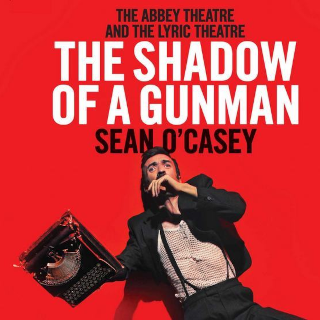
Abbey Theatre Premiere of “The Shadow of a Gunman”

The Shadow Of A Gunman, a 1923 tragicomedy play by Seán O’Casey, premieres at the Abbey Theatre in Dublin on April 12, 1923.

The play is the first in O’Casey’s “Dublin Trilogy” – the other two being Juno and the Paycock (1924) and The Plough and the Stars (1926). It is set in Dublin in May 1920 during the Irish War of Independence and centres on the mistaken identity of a building tenant who is thought to be an Irish Republican Army (IRA) assassin. Each act takes place in Seumus Shield’s room in a tenement in Hilljoy Square.

Donal Davoren is a poet who has come to room with Seumus Shields in a poor, Dublin tenement slum. Many of the residents of the tenement mistake Donal for an IRA gunman on the run. Donal does not refute this notoriety, especially when it wins him the affection of Minnie Powell, an attractive young woman in the tenement. Meanwhile, Seumus’ business partner, Mr. Maguire, drops a bag off at Seumus’ apartment before participating in an ambush in which he is killed. Seumus believes the bag to contain household items for re-sale. The city is put under curfew as a result of the ambush. The Black and Tans raid the tenement and, at that point, Donal and Seumus discover the bag is full of Mills bombs. Minnie Powell takes the bag and hides it in her own room. The Black and Tans find nothing of note in Seumus’ room, but arrest Minnie Powell, who is later shot and killed trying to escape.

The first performance of The Shadow of a Gunman in England is given in 1958 at the Progress Theatre in Reading, Berkshire.

A 1972 televised version of The Shadow of a Gunman stars Frank Converse and Academy Award winner Richard Dreyfuss. In 1973, Alvin Rakoff directs a televised version for BBC Two starring Stephen Rea, Sinéad Cusack and Donal McCann. In 1992 Kenneth Branagh, Stephen Rea and Bronagh Gallagher star in an adaption as part of the 1992 BBC Two Performance series.

In the music video for Northern Irish rock/pop band The Adventures song “Send My Heart” (1984), the lead character is seen trying out for a version of the play.