While Martin is Minister for Health and Children in 2004, he introduces a ban on tobacco smoking in all Irish workplaces and establishes the Health Service Executive (HSE). Ireland is the first country to introduce a full workplace smoking ban. As Foreign Minister, in 2009, he travels to Latin America for the first time and makes the first official visit to Cuba by an Irish Minister. That same year, he travels to Khartoum following the kidnapping of Sharon Commins and Hilda Kawuki. In 2010, he becomes the first Western foreign minister to visit Gaza since Hamas took control there in 2007.
In January 2011, Martin resigns as Minister for Foreign Affairs and is subsequently elected as the eighth leader of Fianna Fáil following Cowen’s resignation as party leader. In the 2011 Irish general election, he leads the party to its worst showing in its 85-year history, with a loss of 57 seats and a drop in its share of the popular vote to 17.4%. In the 2016 Irish general election, Fianna Fáil’s performance improves significantly, more than doubling their Dáil representation from 20 to 44 seats. In the 2020 Irish general election, Fianna Fáil becomes the largest party, attaining the most seats at 38, one seat ahead of Sinn Féin with 37 seats. He is appointed Taoiseach on June 27, 2020, leading a grand coalition with longtime rival Fine Gael and the Green Party as part of a historic deal. Under the terms of the agreement, Martin’s predecessor, Leo Varadkar, becomes Tánaiste, and will swap roles with Martin in December 2022.
The three men shoot McAliskey nine times in the chest, arm and thigh as she goes to wake up one of her three children. Her husband, Michael, is also shot twice at point blank range. British soldiers are watching the McAliskey home at the time but fail to prevent the assassination attempt. It is claimed that Devlin’s assassination was ordered by British authorities, and that collusion was a factor. An army patrol of the 3rd Battalion, Parachute Regiment enter the house and wait for half an hour. McAliskey claims they are waiting for the couple to die.
Another group of soldiers then arrive and transport them by helicopter to a nearby Dungannon hospital for emergency treatment and then to the Musgrave Park Hospital, Military Wing, in Belfast, under intensive care. Their condition is initially said to be serious, but not life-threatening.
The attackers, Ray Smallwoods, Tom Graham, both from Lisburn, and Andrew Watson from Seymour Hill, Dunmurry, are captured by members of the Parachute Regiment, who are on patrol nearby when they hear the shots and are taken in for questioning by the police and subsequently jailed. All three are members of the South Belfast UDA. Smallwoods is the driver of the getaway car. Police say it is a professional attack. The gunmen cut the telephone wires to the house before breaking down the front door with a sledgehammer.
McAliskey had played a leading role in the campaign for Republican prisoners in the HM Prison Maze, who are demanding “prisoner of war” or political status. They want to be held separately from loyalist supporters in the Maze. Four other members of the campaign for the H-block inmates have been murdered.
Seven Maze prisoners went on hunger strike before Christmas in support of their demands for political status. The strike is called off on December 12 after TaoiseachCharles Haughey convinces the inmates their families want them to start eating again.
In 1956, Whitaker is appointed Secretary of the Department of Finance. His appointment takes place at a time when Ireland’s economy is in deep depression. Economic growth is non-existent, inflation apparently insoluble, unemployment rife, living standards low and emigration at a figure not far below the birth rate. He believes that free trade, with increased competition and the end of protectionism, will become inevitable and that jobs will have to be created by a shift from agriculture to industry and services. He forms a team of officials within the department which produces a detailed study of the economy, culminating in a plan recommending policies for improvement. The plan is accepted by the government and is transformed into a white paper which becomes known as the First Programme for Economic Expansion. Quite unusually this is published with his name attached in November 1958. The programme which becomes known as the “Grey Book” brings the stimulus of foreign investment into the Irish economy. Before devoting himself to poetry, Thomas Kinsella is Whitaker’s private secretary.
In 1977, TaoiseachJack Lynch nominates Whitaker as a member of the 14th Seanad Éireann. He serves as a Senator from 1977–81, where he sits as an independent Senator.
In 1981, Whitaker is nominated to the 15th Seanad Éireann by Taoiseach Garret FitzGerald, where he serves until 1982. FitzGerald also appoints him to chair a Committee of Inquiry into the Irish penal system, and he chairs a Parole Board or Sentence Review Group for several years.
Whitaker also serves as Chancellor of the National University of Ireland from 1976 to 1996. He is also President of the Royal Irish Academy and as such, a member of the Board of Governors and Guardians of the National Gallery of Ireland, from 1985 to 1987. He has a very strong love for the Irish language throughout his career and the collection of Irish poetry, An Duanaire: Poems of the Dispossessed 1600–1900, edited by Seán Ó Tuama and Thomas Kinsella, is dedicated to Whitaker. From 1995–96 he chairs the Constitution Review Group, an independent expert group established by the government, which publishes its report in July 1996.
Whitaker receives many national and international honours and tributes for his achievements during his lifetime, most notably the conferral of “Irishman of the 20th Century” in 2001 and Greatest Living Irish Person in 2002. In November 2014, the Institute of Banking confers an Honorary Fellowship on Whitaker and creates an annual T.K. Whitaker Scholarship in his name. In April 2015, he is presented with a lifetime achievement award by University College Dublin’s Economics Society for his outstanding contribution to Ireland’s economic policy.
In November 2016, to mark his centenary year, Dún Laoghaire-Rathdown County Council acknowledges Whitaker’s “outstanding and progressive contribution to Irish public service and to society.” The Cathaoirleach of Dún Laoghaire Rathdown, Cormac Devlin, presents a special award to Whitaker which is accepted by Ken Whitaker on behalf of his father.
Yeats is married to Gráinne Ni hEigeartaigh, a singer and Irish harpist. They have four children: daughters Caitríona (a concert harpist), Siobhán (a patents professional) and Síle (a broadcaster with RTÉ who also dies in 2007), and a son, Pádraig (an engineer).
Yeats dies on January 3, 2007, in St. Michael’s Hospital in Dún Laoghaire. His funeral service takes place in St. Patrick’s Church, Harbour Road, Dalkey, on January 8, 2007, followed by burial in Shanganagh Cemetery.
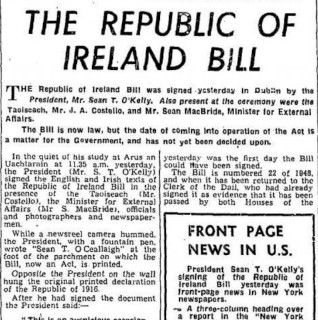
The Republic of Ireland Act 1948 is an Act of the Oireachtas which declares that Ireland may be officially described as the Republic of Ireland, and vests in the President of Ireland the power to exercise the executive authority of the state in its external relations, on the advice of the Government of Ireland. The Act is signed into law on December 21, 1948 and comes into force on April 18, 1949, Easter Monday, the 33rd anniversary of the beginning of the Easter Rising.
The Act repeals the External Relations Act 1936. Under that Act, King George VI acts as the Irish head of state in international relations by accredited ambassadors and on the State’s behalf accepts credentials appointing foreign ambassadors to the State. The Republic of Ireland Act removes this last remaining practical role from the King and vests it instead in the President of Ireland, making the then President of Ireland, Seán T. O’Kelly, unambiguously the Irish head of state.
In 1945, when asked if he plans to declare a Republic, the then TaoiseachÉamon de Valera replies, “we are a republic.” He also insists that Ireland has no king, but simply uses an external king as an organ in international affairs. However, that is not the view of constitutional lawyers including de Valera’s Attorneys General, whose disagreement with de Valera’s interpretation only come to light when the state papers from the 1930s and 1940s are released to historians. Nor is it the view in the international arena, who believe that Ireland does have a king, George VI, who had been proclaimed King of Ireland in December 1936, and to whom they accredit ambassadors to Ireland. King George, in turn, as “King of Ireland” accredits all Irish diplomats. All treaties signed by the Irish Taoiseach or Minister for External Affairs are signed in the name of King George.
In October 1947, de Valera asks his Attorney General, Cearbhall Ó Dálaigh, to draft a bill to repeal the External Relations Act. By 1948 a draft of the bill includes a reference to the state as being a republic. In the end, the draft bill is never submitted to the Oireachtas for approval.
The bill to declare Ireland a republic is introduced in 1948 by the new Taoiseach, John A. Costello of the Fine Gael party. Costello makes the announcement that the bill is to be introduced when he is in Ottawa, during an official visit to Canada. David McCullagh suggests that it is a spur of the moment reaction to offence caused by the Governor General of Canada, Lord Alexander, who is of Northern Irish descent, who allegedly places loyalist symbols before an affronted Costello at a state dinner. What is certain is that an agreement that there be separate toasts for the King and for the President of Ireland is broken. The Irish position is that a toast to the King, instead of representing both countries, would not include Ireland. Only a toast to the King is proposed, to the fury of the Irish delegation. Shortly afterwards Costello announces the plan to declare the republic.
However, according to all but one of the ministers in Costello’s cabinet, the decision to declare a republic had already been made before Costello’s Canadian visit. Costello’s revelation of the decision is because the Sunday Independent had discovered the fact and was about to “break” the story as an exclusive. The evidence of what really happens remains ambiguous. There is no record of a prior decision to declare a republic before Costello’s Canadian trip.
At any rate, the Act is enacted with all parties voting for it. De Valera does suggest that it would have been better to reserve the declaration of the republic until Irish unity had been achieved, a comment hard to reconcile with his 1945 claim that the Irish state was already a republic. Speaking in Seanad Éireann Costello tells senators that as a matter of law, the King is indeed “King of Ireland” and Irish head of state and the President of Ireland is in effect no more than first citizen and a local notable, until the new law comes into force.
The United Kingdom responds to the Republic of Ireland Act by enacting the Ireland Act 1949. This Act formally asserts that the Irish state had, when the Republic of Ireland Act came into force, ceased “to be part of His Majesty’s dominions” and accordingly is no longer within the Commonwealth. Nonetheless the United Kingdom statute provides that Irish citizens will not be treated as aliens under British nationality law. This, in effect, grants them a status similar to the citizens of Commonwealth countries.
Jack Lynch, Irish politician and Taoiseach of Ireland from 1966 to 1973 and from 1977 to 1979, resigns as Taoiseach and leader of Fianna Fáil on December 5, 1979.
The year 1979 proves to be the year in which Lynch finally realises that his grip on power has slipped. The first direct elections to the European Parliament take place in June and see the electorate severely punishing the ruling Fianna Fáil party. A five-month postal strike also led to deep anger amongst people all over the country. On 27 August 1979, the Provisional Irish Republican Army assassinates Earl Mountbatten of Burma in County Sligo. On the same day the IRA kills 18 British soldiers at Warrenpoint in County Down.
A radical security review and greater cross-border co-operation are discussed with the new British Prime Minister, Margaret Thatcher. These discussions lead Síle de Valera, a backbench TD, to directly challenge the leadership in a speech at the Liam Lynch commemoration at Fermoy, County Cork, on September 9. Although Lynch quickly tries to impose party discipline, attempting to discipline her for opposing party policy at a parliamentary party meeting held on September 28, de Valera correctly points out that she had not opposed the party policy regarding the North which called for the declaration of the British intent to withdraw from the north. The result is embarrassing for Lynch.
The visit of Pope John Paul II to Ireland in September proves to be a welcome break for Lynch from the day-to-day running of the country. In November, just before he departs on a visit to the United States, he decides that he will resign at the end of the year. This would allow him to complete his term as President of the European Community. The defining event which makes up his mind is the news that Fianna Fáil had lost two by-elections on November 7 in his native Cork (Cork City and Cork North-East).
In addition, during the trip Lynch claims in an interview with The Washington Post that a five-kilometre air corridor between the border had been agreed upon during the meeting with Thatcher to enhance security co-operation. This is something highly unsavory to many in Fianna Fáil. When Lynch returns, he is confronted openly by Síle de Valera, Dr. Bill Loughnane, a noted hardline Republican backbencher, along with Tom McEllistrim, a member of Charles Haughey‘s gang of five, at a parliamentary party meeting. Lynch stated that the British do not have permission to overfly the border. Afterwards Loughnane goes public with the details of the meeting and accuses Lynch of deliberately misleading the party. An attempt to remove the whip from Loughnane fails.
At this stage Lynch’s position has become untenable, with supporters of Haughey caucusing opinion within the party. George Colley, the man whom Lynch sees as his successor, comes to him and encourages him to resign sooner. Colley is convinced that he has enough support to defeat the other likely candidate, Charles Haughey, and that Lynch should resign early to catch his opponents on the hop. Lynch agrees to this and resigns as leader of Fianna Fáil on December 5, 1979, assured that Colley has the votes necessary to win. However, Haughey and his supporters have been preparing for months to take over the leadership and Lynch’s resignation comes as no surprise. He narrowly defeats Colley in the leadership contest and succeeds Lynch as Taoiseach.
Lynch remained on in Dáil Éireann as a TD until his retirement from politics at the 1981 Irish general election.
Although there are no discussions between the pair, Kenny confirms he will meet with Foster in Dublin on Tuesday, November 15. The pair are also due to meet in Armagh on Friday, November 18 for a North/South ministerial meeting, where Brexit-related issues are expected to dominate the agenda.
Speaking afterwards, Fitzgerald, whose grandfather served as a soldier in the British army and whose father was a colonel in the Irish Army, says it has been an important engagement. “So many people across the island lost their lives; 50,000 families affected by loss of a loved one during the First World War. We have had a government minister here since 2012 and I think it is really important to come together, to remember together and to look at our shared histories.”
Meanwhile, Heather Humphreys, the Minister for Arts, Heritage, Regional, Rural and Gaeltacht Affairs, dedicates the France-Ireland Memorial at Glasnevin Cemetery. Humphreys is joined by the French Minister of State for Veterans and Remembrance at the Ministry of Defence Jean-Marc Todeschini for the ceremony. The memorial is a gift to Ireland from France in recognition of Irish sacrifices made “in the defence and freedom of France, particularly in the First World War.”
(From: “Taoiseach, Tánaiste attend Remembrance Sunday ceremonies,” Raidió Teilifís Éireann (RTÉ), http://www.rte.ie, November 13, 2016 | Pictured: Taoiseach Enda Kenny lays a wreath of green laurels in Enniskillen)
Gerard “Gerry” Ryan, presenter of radio and television employed by Raidió Teilifís Éireann (RTÉ), becomes the latest homegrown celebrity to feature in the Irish version of Madame Tussauds collection when he unveils a life-size model of himself at the Dublin museum on October 29, 2002.
Ryan is born in Clontarf, County Dublin on June 4, 1956. He describes his father, Vinnie, as a “slightly eccentric” dentist from a Presbyterian background and his mother, Maureen, as “a flamboyant woman” who comes from a theatrical background and works in the theatre. His godfather is broadcaster Eamonn Andrews. He is educated at St. Paul’s College, Raheny.
Ryan presents The Gerry Ryan Show on radio station RTÉ 2fm each weekday morning from 1988 until hours before his sudden death. He is presented with a Jacob’s Award for the show in 1990.
Ryan marries Morah Brennan in 1988 and they have five children: Lottie, Rex, Bonnie, Elliott and Babette. In 1997, Morah famously telephones her husband’s show and, under the name Norah, tells half a million listeners intimate details concerning his personal household habits. Gerry and Morah announce their separation in March 2008, which Ryan calls “a very painful experience.” He soon begins a relationship with the former South African Ambassador to Ireland and the then UNICEF Ireland executive director, Melanie Verwoerd.
Ryan is noted for his love of fine food and wine. He battles a weight problem for several years and takes Reductil (Sibutramine), a “slimming pill,” which he says is effective and safe. Ryan concedes in his autobiography Would the Real Gerry Ryan Please Stand Up, released in October 2008, that he drinks too much for his own good.
Ryan is found dead in the bedroom of his home on Leeson Street, Dublin on April 30, 2010.
Among the dignitaries to send tributes following Ryan’s death are Bono, Bill and Hillary Clinton, TaoiseachBrian Cowen, and PresidentMary McAleese. His funeral takes place on May 6, 2010, and is broadcast on 2fm, the home of Ryan’s radio show and a first for the predominantly youthpop-oriented station. His death also comes sixteen years to the day after he hosted Eurovision 1994.
An inquest shows that the cause of Ryan’s death is cardiac arrhythmia and that traces of cocaine found in Ryan’s system are the “likely trigger” of Ryan’s death. A considerable public controversy erupts when Ryan’s long-term use of cocaine comes to light. RTÉ eventually admits to having given insufficient coverage of Ryan’s cocaine habit in the aftermath of the inquest.
Jack Lynch, in full John Mary Lynch, is born on August 15, 1917, in Cork, County Cork. He serves as Taoiseach of Ireland from 1966 to 1973 and from 1977 to 1979.
Lynch studies law and enters the civil service with the Department of Justice in 1936. He eventually decides on a legal career, is called to the bar in 1945, resigns from the civil service, and practices on the Cork circuit. He already enjoys a national reputation as a sports hero as he had won five All-Ireland medals as a Cork hurler and another as a footballer.
Lemass’s retirement in 1966 causes an internal party conflict over the succession that leads to Lynch’s selection as a compromise candidate, a position he reluctantly accepts. In November 1966 he becomes leader of Fianna Fáil and Taoiseach. In June 1969 he becomes the only Fianna Fáil leader other than de Valera to win an overall majority in a general election.
In 1969–1973 Lynch plays an important role when civil unrest leads to the collapse of the government of Northern Ireland and poses a threat to the stability of the Irish state. He fires two cabinet ministers who are suspected of involvement in smuggling arms to the Provisional Irish Republican Army (IRA). He also creates a consensus in Irish party politics on a policy of conciliation and cooperation with the British government in seeking a solution to the Northern Ireland problem based on establishing power-sharing between the unionist majority and the Roman Catholic minority.
In 1972 Lynch wins an 83% majority in a referendum on Ireland’s entry into the European Economic Community and, on January 1, 1973, Ireland becomes a member. Although he is defeated in the 1973 Irish general election, he again demonstrates his remarkable popularity at the polls in 1977 when Fianna Fáil wins their largest and their last overall majority. In December 1979, however, discouraged by challenges to his authority from party colleagues, he resigns his leadership and soon after retires from politics. He serves on a number of corporate boards after his retirement.
Lynch dies in the Royal Hospital, Donnybrook, Dublin on October 20, 1999, at the age of 82. He is honoured with a state funeral which is attended by the President Mary McAleese, Taoiseach Bertie Ahern, former Taoisigh John Bruton, Albert Reynolds and Charles Haughey, and various political persons from all parties. The coffin is then flown from Dublin to Cork where a procession through the streets of the city draws some of the biggest crowds in the city’s history. Following the Requiem Mass celebrated in his home parish of the Cathedral of St. Mary and St. Anne, his friend and political ally, Desmond O’Malley, delivers the graveside oration, paying tribute to Lynch’s sense of decency. He is buried in St. Finbarr’s Cemetery, Cork.
Kelly is the eldest of ten children born into a staunchly Irish republican family. His father, also named James Kelly, had stood for Sinn Féin in local elections in 1918, topping the poll. An ancestor from the late 18th century, Robert Kelly, was a member of the Society of United Irishmen, and was supposedly a Officer Commanding of the United Irishmen in the East Cavan/South Monaghan area. Kelly joins the Irish Army in 1949. By 1960 he has been promoted to captain and appointed to the intelligence section at army headquarters.
Kelly is a central figure in the Arms Trial, having travelled to Hamburg to arrange the purchase of arms. It emerges later that Neil Blaney had ordered him to do so outside normal legal channels, but before the weapons arrive the GardaSpecial Detective Unit has heard of the plan and informs TaoiseachJack Lynch, aborting the importation and resulting in criminal charges for the plotters. Although in his summation the judge says it is no defence for Kelly to say that he believed that the government had authorised the importation of arms, Kelly is acquitted.
Although he is acquitted, Kelly suffers financially because he had felt compelled to resign from the Army even before the prosecution is brought. He prints and publishes a personal memoir in paperback format called Orders for the Captain? in 1971.
Kelly never denies that he had been involved in extra-legal arms purchase talks but contends that he had been ordered to do so by some ministers. A typical version of the events is found in a 1993 hostile biography of Charles Haughey, claiming: “As early as October 1969, to the certain knowledge of Charles Haughey, James Gibbons, the Department of Justice, the Special Branch and Army Intelligence, there were meetings with leading members of the Irish Republican Army (IRA), when they were promised money and arms. The critical encounter took place in Bailieborough [sic], County Cavan, on Saturday, 4 October 1969. It had been arranged by Captain James Kelly, an army intelligence officer, and Cathal Goulding. Kelly, at that stage, was already the subject of several security reports to the Secretary of the Department of Justice, Peter Berry, from the Special Branch, implicating Kelly with subversives and with promises of money and of arms.” Kelly never objects to such versions of the events of 1969.
Following the Arms Trial, Kelly joint-founds Aontacht Éireann, a political party directly born out of the scandal. He is elected vice-chairman of the party and stands in Dáil elections for them unsuccessfully on two occasions in 1973 and 1977 in the Cavan-Monaghan constituency. Aontacht Éireann meets with little success at the polls and by 1980 he has joined Fianna Fáil, becoming a member of its national executive. Following the first applications of the 1987 Extradition (European Convention on the Suppression of Terrorism) Act, he resigns from the party in 1989 in opposition to the extradition of Provisional IRA prisoners to the United Kingdom. He also serves twice as President of the “1916-1921” Club.
Kelly is heavily involved in the Northern Ireland peace process. In 1989 he publishes his own draft on how a peace process could proceed. His document called The Courage of the Brave is launched in Conway Mill, Belfast on August 24, 1989. Present on the platform party at the launch of the document are Fianna Fáil Councillor Macarten McCormack, Ernest Cowan, Chairman of Kentstown Fianna Fáil who had served with Captain Kelly on the Fianna Fáil National Executive, Robert C. Linnon, National President, Irish American Unity Conference, Kate Lavery, representing John J. Finucane, National President, American Irish Political Education Committee and Father Des Wilson of Belfast.
Kelly dies on July 16, 2003, and is buried in Glasnevin Cemetery in Dublin. The epitaph on his grave is “Put not your trust in princes,” which is a quote from Niccolò Machiavelli.






 seamus dubhghaill