Bushe is born at Kilmurry House, near Thomastown, County Kilkenny, the only son of the Reverend Thomas Bushe, rector of Mitchelstown, and his wife Katherine Doyle, daughter of Charles Doyle of Bramblestown, near Gowran. Kilmurry House had been built by the Bushe family in the 1690s. His father is forced to sell it to pay his debts, but he is able to repurchase it in 1814. He goes to the celebrated Quaker academy, Shackleton’s School in Ballitore, County Kildare, then graduates from Trinity College Dublin (TCD), where his eloquence makes him a star of the College Historical Society. He is called to the Bar in 1790.
Bushe is a member of the Irish Parliament for Callan from 1796 to 1799, and for Donegal Borough from 1799 to 1800. He is Escheator of Leinster in 1799. By this time the office is a sinecure. He is vehemently opposed to the Acts of Union 1800, referring emotionally to Britain’s subjection of Ireland as “six hundred years of uniform oppression and injustice,” a phrase which quickly became a proverb. Although he refuses an offer of a place on the Bench as a bribe for supporting the Union, cynics note that his staunch opposition to the Union does not prevent him accepting high office under the British Crown afterwards. He is appointed Solicitor-General for Ireland in 1805 and holds the office for 17 years until in 1822 he is appointed Lord Chief Justice of the King’s Bench for Ireland, although only after William Saurin, the equally long-serving Attorney-General, refuses the position. He retire in 1841.
As an advocate “silver-tongued Bushe” is legendary for his eloquence, and as a politician, he is admired by his English contemporaries like Sir Robert Peel and Lord Brougham. As a judge, according to F. Elrington Ball, he does not live up to expectations, although, if not an outstanding judge, he is an impressive and dignified one. As a statesman he is often accused of double-dealing: having opposed the Acts of Union, he has few scruples about accepting office under the new regime; and while himself supporting Catholic Emancipation, he prosecutes members of the Catholic Association for sedition, merely for advocating the same cause.
The youngest daughter of Captain Henry Butler, a grandson of the Edmund Butler, 11th Viscount Mountgarret, and Clara Butler (née Taylor) of the Newarke, Leicester, England. Her father is himself an enthusiastic painter, known for his publication South African sketches: illustrative of the wildlife of a hunter on the frontier of Cape Colony (1841). Her early artistic efforts are mainly copies of romantic subjects, but the influence of the London artist Paul Jacob Naftel, with whom she begins corresponding in the early 1880s, proves to be crucial to her artistic development. Studies with William Frank Calderon, an expert in animal painting, are also significant. She subsequently spends the summers of 1894 and 1895 in Newlyn, Cornwall, England, with the Irish artist Norman Garstin, who introduces her to contemporary French painting.
In 1885, Butler makes her first visit to the continent, traveling through France, Switzerland, and Italy. From 1905 to 1914 she travels regularly to Europe, most particularly Aix-les-Bains and Wiesbaden, during which time she produces genre views of French and German villages. After 1914 her life at the family home is interrupted only by visits to London exhibitions. She is best known for her paintings of Kilmurry and its environs, many of which display an interest in botany. Much of her work is dominated by detailed representations of animals and birds, often drawn from photographs and stuffed specimens.
Butler’s career as an exhibitor begins in 1882 with the Irish Fine Arts Society, later known as the Water Colour Society of Ireland (WCSI), with which she has a long association. She exhibits regularly with the society from 1892 onward and is a member of its committee for many years. She is also closely associated with the Dudley Museum and Art Gallery in London. Her work is first shown there in 1888, and on this evidence, she is elected to their society. The purchase by the Chantrey bequest for the Tate Gallery of The Morning Bath for £50 in 1896 is a high point in her career. The first painting by a woman to be selected by the council, its purchase is followed by almost consistently good press reviews for her work. The Athenaeum of May 5, 1897, writes: “The young lady knows how to look at her subjects with the eyes of a well-trained artist.”
Butler also comes to the attention of the American artistic press. She contributes to the portfolio of drawings given by the Society of Lady Artists to Princess May on her marriage to the Duke of York in 1893, while in 1922 her work is included in the portfolio presented to Princess Mary on her marriage. Her patrons include Queen Alexandra, and the grand duke of Hesse, who purchases two of her paintings after she is invited to exhibit in Hesse Darmstadt in 1911. In 1914 she is made a member of the Union Internationale des Beaux Arts, and in 1921 her paintings are shown in Japan. She regularly exhibits with the Belfast Ramblers, the Royal Ulster Academy, the Royal Academy of Arts (RA), the Royal Hibernian Academy (RHA), the Society of Lady Artists, and the Royal Watercolour Society, of which she is made an associate member in 1896, and a full member in 1937.
In her later years, severe rheumatism prevents Butler from painting. She has a keen interest in music. She survives all five of her siblings, and inherits Kilmurry, where she dies on October 11, 1941. She is buried at Thomastown, County Kilkenny. Her paintings are represented in the collections of the National Gallery of Ireland, Dublin City Gallery the Hugh Lane, the Ulster Museum, and the Tate, London.
(From: “Butler, Mildred Anne” by Frances Clarke, Dictionary of Irish Biography, http://www.dib.ie, October 2009)
Berkeley is the eldest son of William Berkeley, a cadet of the noble family of Berkeley whose ancestry can be traced back to the Anglo-Saxon period and who had served as feudal lords and landowners in Gloucester, England. Little is known of his mother. He is educated at Kilkenny College and attends Trinity College Dublin, where he is elected a Scholar in 1702, being awarded BA in 1704 and MA and a Fellowship in 1707. He remains at Trinity College after completion of his degree as a tutor and Greek lecturer.
Berkeley’s earliest publication is on mathematics, but the first that brings him notice is his An Essay Towards a New Theory of Vision, first published in 1709. In the essay, he examines visual distance, magnitude, position and problems of sight and touch. While this work raises much controversy at the time, its conclusions are now accepted as an established part of the theory of optics.
The next publication to appear is A Treatise Concerning the Principles of Human Knowledge in 1710, which has great success and gives him a lasting reputation, though few accept his theory that nothing exists outside the mind. This is followed in 1713 by Three Dialogues between Hylas and Philonous, in which he propounds his system of philosophy, the leading principle of which is that the world, as represented by our senses, depends for its existence on being perceived.
For this theory, the Principles gives the exposition and the Dialogues the defence. One of his main objectives is to combat the prevailing materialism of his time. The theory is largely received with ridicule, while even those such as Samuel Clarke and William Whiston, who do acknowledge his “extraordinary genius,” are nevertheless convinced that his first principles are false.
Shortly afterwards, Berkeley visits England and is received into the circle of Joseph Addison, Alexander Pope and Richard Steele. In the period between 1714 and 1720, he intersperses his academic endeavours with periods of extensive travel in Europe, including one of the most extensive Grand Tours of the length and breadth of Italy ever undertaken. In 1721, he takes holy orders in the Church of Ireland, earning his doctorate in divinity, and once again chooses to remain at Trinity College Dublin, lecturing this time in Divinity and in Hebrew. In 1721-22 he is made Dean of Dromore and, in 1724, Dean of Derry.
In 1723, following her violent quarrel with Jonathan Swift, who had been her intimate friend for many years, Esther Vanhomrigh names Berkeley her co-heir along with the barrister Robert Marshall. Her choice of legatees causes a good deal of surprise since she does not know either of them well, although Berkeley as a very young man had known her father. Swift says generously that he does not grudge Berkeley his inheritance, much of which vanishes in a lawsuit in any event. A story that Berkeley and Marshall disregarded a condition of the inheritance that they must publish the correspondence between Swift and Vanhomrigh is probably untrue.
In 1725, Berkeley begins the project of founding a college in Bermuda for training ministers and missionaries in the colony, in pursuit of which he gives up his deanery with its income of £1100.
In 1728, Berkeley marries Anne Forster, daughter of John Forster, Chief Justice of the Irish Common Pleas, and his first wife Rebecca Monck. He then goes to America on a salary of £100 per annum. He lands near Newport, Rhode Island, where he buys a plantation at Middletown – the famous “Whitehall.” He purchases several enslaved Africans to work on the plantation. He also brings John Smibert to New England, the Scottish artist he “discovered” in Italy, who is generally regarded as the founding father of American portrait painting. Meanwhile, he draws up plans for the ideal city he plans to build on Bermuda. He lives at the plantation while he waits for funds for his college to arrive. The funds, however, are not forthcoming and he leaves America and returns to London in 1732.
Berkeley and his wife have four children who survive infancy: Henry, George, William and Julia, and at least two other children who die in infancy. William’s death in 1751 is a great cause of grief to his father.
Berkeley is nominated to be the Bishop of Cloyne in the Church of Ireland on January 18, 1734. He is consecrated as such on May 19, 1734. He is the Bishop of Cloyne until his death on January 14, 1753, although he dies at Oxford.
While living in London’s Saville Street, Berkeley takes part in efforts to create a home for the city’s abandoned children. The Foundling Hospital is founded by royal charter in 1739, and Berkeley is listed as one of its original governors.
Berkeley’s last two publications are Siris: A Chain of Philosophical Reflexions and Inquiries Concerning the Virtues of Tarwater, And divers other Subjects connected together and arising one from another (1744) and Further Thoughts on Tar-water (1752). Pine tar is an effective antiseptic and disinfectant when applied to cuts on the skin, but he argues for the use of pine tar as a broad panacea for diseases. His 1744 work on tar-water sells more copies than any of his other books during Berkeley’s lifetime.
Berkeley remains at Cloyne until 1752, when he retires. With his wife and daughter Julia, he goes to Oxford to live with his son George and supervise his education. He dies soon afterwards and is buried in Christ Church Cathedral, Oxford. His affectionate disposition and genial manners make him much loved and held in warm regard by many of his contemporaries. Anne outlives her husband by many years, dying in 1786.
(Pictured: “Bishop George Berkeley,” oil on canvas portrait by John Smibert, c. 1727)
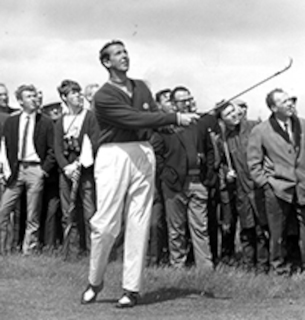
Carr is the fifth of seven children born to George and Margaret Mary “Missie” Waters. At ten days old, he is adopted by his maternal aunt, Kathleen, and her husband, James Carr, who are childless and have recently returned home from India. The Carrs have just been appointed steward and stewardess of the Portmarnock Golf Club, allowing young Joe to play golf from a very early age.
Carr wins his first major tournament, the East of Ireland Amateur, at the age of 19 in 1941, which starts one of Ireland’s greatest golfing careers. He goes on to win twelve East of Ireland titles, twelve West of Ireland titles, six Irish Amateur Close Championships, four Irish Amateur Opens, and three South of Ireland titles.
Carr wins The Amateur Championship three times, in 1953, 1958, and 1960, and is runner-up in 1968. He is a semi-finalist at the United States Amateur Championship in 1961, and is low amateur at The Open Championship in both 1956 and 1958 and finishes 8th overall in 1960. In 1967, he becomes the first Irishman to play in the Masters Tournament, making the cut. He receives the Bob Jones Award in 1961, the USGA‘s highest honour, which is given for “distinguished sportsmanship in golf.” He is the first non-American to win the award.
Internationally, Carr represents Ireland in numerous amateur golfing events. He is a member of a record eleven Walker Cup teams from 1947 to 1967, including non-playing captain in 1965 and playing captain in 1967, amassing a record of 5–14–1. After several years of playing against the United States’ top-ranked players, he is moved down in the order for the 1961 event, only to be paired against Jack Nicklaus who wins the match. He plays and captains on multiple Eisenhower Trophy teams, and represents Ireland in the Men’s Home Internationals every year from 1947 to 1969. He retires from competitive golf in 1971, after his son Roddy plays for the winning Great Britain & Ireland Walker Cup team.
From 1992 until his death on June 3, 2004, Carr is president of Mount Juliet Golf Club in Thomastown, County Kilkenny. Mount Juliet still hosts the annual J.B. Carr Trophy for its members.
George Berkeley, Irish philosopher whose primary achievement is the advancement of a theory he calls “immaterialism” (later referred to as “subjective idealism” by others), dies in Oxford, England, on January 14, 1753. His theory of immaterialism denies the existence of material substance and instead contends that familiar objects like tables and chairs are only ideas in the minds of perceivers and, as a result, cannot exist without being perceived. Berkeley is also known for his critique of abstraction, an important premise in his argument for immaterialism.
Berkeley is born at his family home, Dysart Castle, near Thomastown, County Kilkenny, the eldest son of William Berkeley, a cadet of the noble family of Berkeley. He is educated at Kilkenny College and attends Trinity College, Dublin, earning a bachelor’s degree in 1704 and completing a master’s degree in 1707. He remains at Trinity College after completion of his degree as a tutor and Greek lecturer.
In this book, Berkeley’s views are represented by Philonous, while Hylas embodies the Irish thinker’s opponents, in particular John Locke. Berkeley argues against Sir Isaac Newton‘s doctrine of absolute space, time, and motion in De Motu (On Motion), published in 1721. His arguments are a precursor to the views of Ernst Mach and Albert Einstein. In 1732, he publishes Alciphron, a Christian apologetic against the free-thinkers, and in 1734, he publishes The Analyst, a critique of the foundations of calculus, which is influential in the development of mathematics.
His last major philosophical work, Siris (1744), begins by advocating the medicinal use of tar water and then continues to discuss a wide range of topics, including science, philosophy, and theology. Interest in Berkeley’s work increases after World War II because he tackles many of the issues of paramount interest to philosophy in the 20th century, such as the problems of perception, the difference between primary and secondary qualities, and the importance of language. It sold more copies than any of his other books during his lifetime.
In 1734, Berkeley is appointed Bishop of Cloyne in Ireland, a position he holds until his death. He remains at Cloyne until 1752, when he retires and goes to Oxford to live with his son and supervise his education. He dies soon afterward and is buried in Christ Church Cathedral, Oxford.
The Berkeley portion of the Yale University campus is named after George Berkeley.



 seamus dubhghaill