seamus dubhghaill

Promoting Irish Culture and History from Little Rock, Arkansas, USA


Leave a comment

Birth of Richard Barrett, Irish Republican Army Volunteer

Richard Barrett, commonly called Dick Barrett, a prominent Irish Republican Army (IRA) volunteer, is born on December 17, 1889, in Knockacullen (Hollyhill), Ballineen, County Cork. He fights in the Irish War of Independence and on the Anti-Treaty side in the Irish Civil War, during which he is captured and later executed on December 8, 1922.

Barrett is the son of Richard Barrett, farmer, and Ellen Barrett (née Henigan). Educated at Knocks and Knockskagh national schools, he enters the De La Salle College, Waterford, where he trains to be a teacher. Obtaining a first-class diploma, he first teaches at Ballinamult, County Waterford but then returns to Cork in early 1914 to take up a position at the St. Patrick’s Industrial School, Upton. Within months he is appointed principal of Gurrane National School. Devoted to the Irish language and honorary secretary of Knockavilla GAA club, he does much to popularise both movements in the southern and western districts of Cork. He appears to have been a member of the Cork Young Ireland Society.

From 1917, inspired by the Easter Rising, Barrett takes a prominent part in the organisation and operation of the Irish Volunteers and Irish Republican Brotherhood (IRB). By this time, he is also involved with Sinn Féin, in which role he attends the ardfheis at the Mansion House in October 1917 and the convention of the Irish Volunteers at Croke Park immediately afterwards.

Through planning and participating in raids and gunrunning episodes, Barrett comes into close contact with many GHQ staff during the Irish War of Independence, thereby ensuring his own rapid promotion. He is an active Irish Republican Army (IRA) brigade staff officer and occasionally acts as commandant of the West Cork III Brigade. He also organises fundraising activities for the purchase of weapons and for comrades on the run. In July 1920, following the arrest of the Cork III Brigade commander Tom Hales and quartermaster Pat Harte, he is appointed its quartermaster. He is arrested on March 22, 1921, and imprisoned in Cork jail, later being sent to Spike Island, County Cork.

As one of the senior officers held in Spike Island, Barrett is involved in many of the incidents that occur during his time there. After the truce is declared on July 11, 1921, some prisoners go on hunger strike, but he calls it off after a number of days on instructions from outside as a decision had been made that able-bodied men are more important to the cause. In November, Barrett escapes by rowboat alongside Moss (Maurice) Twomey, Henry O’Mahoney, Tom Crofts, Bill Quirke, Dick Eddy and Paddy Buckley.

Following the Irish War of Independence, Barrett supports the Anti-Treaty IRA‘s refusal to submit to the authority of Dáil Éireann (civil government of the Irish Republic declared in 1919). He is opposed to the Anglo-Irish Treaty and calls for the total elimination of English influence in Ireland. In April 1922, under the command of Rory O’Connor, he, along with 200 other hardline anti-treaty men, take over the Four Courts building in the centre of Dublin in defiance of the new Irish government. They want to provoke British troops, who are still in the country, into attacking them. They hope this will restart the war with Britain and reunite the IRA against their common enemy. Michael Collins tries desperately to persuade O’Connor and his men to vacate the building. However, on June 28, 1922, after the Four Courts garrison had kidnapped J. J. O’Connell, a general in the new National Army, Collins’s soldiers shell the Four Courts with British artillery to spark off what becomes known as the Battle of Dublin. O’Connor surrenders following two days of fighting, and Barrett, with most of his comrades, is arrested and held in Mountjoy Gaol. This incident marks the official outbreak of the Irish Civil War, as fighting escalates around the country between pro- and anti-treaty factions.

After the death of Michael Collins in an ambush, a period of tit-for-tat revenge killings ensues. The government implements martial law and enacts the necessary legislation to set up military courts. In November, the government begins to execute Anti-Treaty prisoners, including Erskine Childers. In response, Liam Lynch, the Anti-Treaty Chief of Staff, gives an order that any member of the Dáil who had voted for the ‘murder legislation’ is to be shot on sight.

On December 7, 1922, Teachta Dála (TD) Sean Hales is killed by anti-Treaty IRA men as he leaves the Dáil. Another TD, Pádraic Ó Máille, is also shot and badly wounded in the incident. An emergency cabinet meeting is allegedly held the next day to discuss the assassination of Hales. It is proposed that four prominent members of the Anti-Treaty side currently held as prisoners be executed as a reprisal and deterrent. The names put forward were Barrett, O’Connor, Liam Mellows and Joe McKelvey. It is alleged that the four are chosen to represent each of the four provinces – Munster, Connacht, Leinster and Ulster respectively, but none of the four is actually from Connacht. The executions are ordered by Minister for Justice Kevin O’Higgins. At 2:00 AM on the morning of December 8, 1922, Barrett is awoken along with the other three and informed that they are all to be executed at 8:00 that morning.

Ironies stack one upon the other. Barrett is a member of the same IRA brigade as Hales during the Anglo-Irish War, and they were childhood friends. O’Connor had been best man at O’Higgins’ wedding a year earlier. The rest of Sean Hales’ family remains staunchly anti-Treaty, and publicly denounces the executions. In reprisal for O’Higgins’ role in the executions, the Anti-Treaty IRA kills his father and burns his family home in Stradbally, County Laois. O’Higgins himself dies by an assassin’s hand on July 10, 1927.

The executions stun Ireland, but in terms of halting the Anti-Treaty assassination policy, they have the desired effect. The Free State government continues to execute enemy prisoners, and 77 official executions take place by the end of the war.

Barrett is now buried in his home county, Cork, following exhumation and reinternment by a later government. A monument is erected by old comrades of the West Cork Brigade, the First Southern Division, IRA, and of the Four Courts, Dublin, garrison in 1922 which is unveiled on December 13, 1952, by the Tánaiste Seán Lemass.

A poem about the execution is written by County Galway clergyman Pádraig de Brún.

Leave a comment

Sinn Féin Holds First Formal Talks with the British Government in Over 70 Years

On December 9, 1994, Sinn Féin, the political wing of the Irish Republican Army (IRA), holds its first formal talks with the British Government in over 70 years. The negotiations take place in Belfast, almost one year after Britain and Ireland began an uncertain program to try to resolve the conflict in Northern Ireland. The first session is held at Stormont, a gigantic, columned edifice on top of a hill on the outskirts of Belfast that houses the old Northern Ireland parliament.

Although the announcement of the negotiations is not a surprise, it still sets off an exciting ripple that history is in the making. British officials have conducted secret talks with Sinn Féin leaders in the past, but never before have they sat down openly at the same table with them.

In both a letter to the Sinn Féin leader, Gerry Adams, and in a three-paragraph statement, Downing Street pointedly refers to the meeting as “exploratory dialogue.” This is in keeping with London‘s position that it is simply joining in “talks about talks,” not a full negotiating session, which must involve all parties to the conflict.

For 25 years the IRA has been fighting in the name of the Roman Catholic minority of 650,000 in Northern Ireland. It wants to link Ulster, the six counties of Northern Ireland that remain British after partition, to the Irish Republic, a move opposed by most of the province’s 950,000 Protestants.

The announcement of talks evoke a predictable pattern of responses across Northern Ireland’s political spectrum. Adams, who works to persuade the IRA to go along with a unilateral cease-fire that was declared on September 1, welcomes it. “The opportunity to realize a lasting peace, which will benefit all of the people of Ireland, has never been greater,” he says in a statement. Adams had been accusing London of foot-dragging on the peace effort. Now, he says, it is time to move on to “the next phase of dialogue — multilateral talks led by both Governments.”

The Ulster Unionist Party (UUP), the main Protestant political group in Northern Ireland, is skeptically accepting, as it has been all along. John Taylor, a Unionist Member of Parliament, says the talks will at least establish whether “Sinn Féin really is to become a normal political party.”

The Rev. Ian Paisley, a Member of Parliament whose Democratic Unionist Party (DUP) has become a rejectionist front, continues to oppose talks or any move smacking of compromise. He tells the House of Commons that “a vast majority of people” resent the decision to talk to “the men of blood.”

Sinn Féin is represented at the talks by Martin McGuinness, a veteran IRA political leader who took part in secret contacts that broke up the previous year. In 1972, together with Adams, he was flown to London for a meeting with William Whitelaw, who was then Secretary of State for Northern Ireland. Those talks eventually failed.

Adams is in Washington, D.C. on Wednesday, December 7. He attends a meeting at the White House, his first one there, with Anthony Lake, President Bill Clinton‘s National Security Advisor. Seven weeks earlier, Britain protests vigorously at the thought of Adams visiting the White House. But events moved so swiftly that he gains a kind of legitimacy that is hard for Whitehall to deny. His visa to the United States, good for three months, allows several visits.

The Government team of civil servants, in contrast to higher-level ministers, are led by Quentin Thomas, deputy secretary of the British administration called the Northern Ireland Office.

Going into the negotiations, the key question is what will be discussed. On the British side, the top of the agenda is how to get the IRA to turn over its considerable stash of 100 tons of arms and explosives. There is nothing, of course, that Sinn Féin is less likely to agree to at the outset. So should the British make this a condition for multilateral talks to begin, the two sides will meet an obstacle right away.

McGuinness says that the issue of IRA weapons has to be considered “in the context of us removing the causes of conflict, the reason why people use armed force in our society.”

From its side, Adams says Sinn Féin wants to discuss being treated with “a parity of esteem” with the other parties, and “the release of all political prisoners.”

The British Government says that it will soon hold talks with the so-called loyalist paramilitaries on the Protestant side. And it indicates it will have no objection if elected Sinn Féin councillors attend a major international investment conference in Belfast on December 13 and 14.

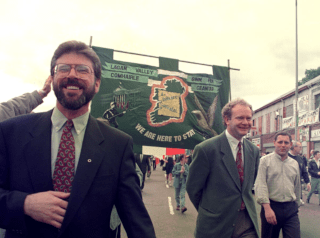
(From: “Britain and I.R.A. Group to Begin Talks in Northern Ireland” by John Darnton, The New York Times, December 2, 1994 | Pictured: Gerry Adams and Martin McGuinness lead a Republican parade in Belfast, commemorating 25 years of British troops on the streets of Northern Ireland in 1994)


Leave a comment

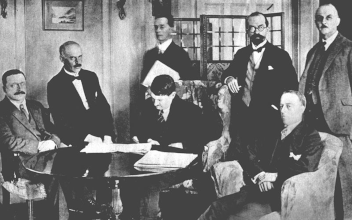
British Ultimatum to the Irish Delegation at the Anglo-Irish Treaty Talks

The Irish delegation at the Anglo-Irish Treaty talks in London are given an ultimatum by British Prime Minister David Lloyd George on December 5, 1921. Sign the treaty or face “immediate and terrible war.”

In 1920, during the Irish War of Independence, the Government of Ireland Act not only establishes the new state of Northern Ireland but gives that state the right to opt-out of a future self-governing Irish Free State within the British Commonwealth of Nations.

The Northern state consists of the six northeastern counties of Ulster with a unionist majority. They are Antrim, Down, Armagh, Derry, Tyrone, and Fermanagh. Belfast is to be the seat of a government and hold limited devolved powers. The counties of Donegal, Cavan, and Monaghan are to be absorbed within the Irish Free State controlled from parliament in Dublin.

Irish nationalists are dismayed with the plan. Protestant Unionists, particularly those living within the boundaries of the new state, accept and start to implement the Act. Sectarian attacks are launched upon Catholic homes in Belfast, Derry, Banbridge, Lisburn, and Dromore. Catholics are driven from Belfast shipyards and from various engineering works in the city. Supposedly these attacks are in revenge for Irish Republican Army (IRA) assassinations.

The IRA continues the campaign to establish a republic with the Irish War of Independence. By the middle of 1921, both sides are exhausted, and a truce is called on June 9.

In July 1921, Éamon DeValera, the president of Dáil Éireann, goes to London to meet with Prime Minister Lloyd George. They agree an Irish delegation will come to London to discuss terms in the autumn.

The delegation appointed by the Dáil to travel to London consists of Arthur Griffith (Minister for Foreign Affairs and chairman of the delegation); Michael Collins (Minister for Finance and deputy chairman of the delegation); Robert Barton (Minister for Economic Affairs); George Gavan Duffy and Éamonn Duggan, with Erskine Childers, Fionán Lynch, Diarmuid O’Hegarty, and John Chartres providing secretarial assistance. DeValera himself does not attend. Future historians wonder if he knew they would not be able to negotiate a 32 county Irish Republic.

During the debate, Lloyd George insists Ireland remain part of the Commonwealth and Dáil Éireann members take the oath of allegiance to the British throne. After a delay of two months, Lloyd George delivers the ultimatum on December 5, sign a treaty within three days or there will be war.

The Anglo-Irish Treaty is to give Ireland a 26 county Free State with Dominion status. The right to raise taxes, regulate foreign trade, independence in internal affairs, own an army, and the oath of allegiance is changed to one of fidelity.

The British are to retain three naval bases within the jurisdiction of the Free State, at Cobh, Lough Swilly, and Berehaven. The Northern Ireland boundary is to be determined by a commission. This gives false hope to large tracts of Tyrone, Fermanagh, Down, Armagh, and Derry City would be given to the Free State as they have Catholic majorities.

Just after 2:00 AM on December 6, 1921, the Irish delegation, without consulting the Dáil, finally sign a treaty with the British. Collins writes, prophetically, later on the day of the signing, “early this morning I signed my death warrant.”

The Treaty displeases the Catholics in the north and the unionists in the south. Meanwhile, many of those involved in the conflict are abhorred at the fact that not all of Ireland is to leave the United Kingdom.

(From: “The Anglo-Irish Treaty (1921)” by Brian O’Neill, Your Irish Culture, http://www.yourirish.com, May 20, 2020)


Leave a comment

The Battle of Julianstown

The Battle of Julianstown is fought on November 29, 1641, at Julianstown, County Meath during the Irish Rebellion of 1641 where an English Royalist relief force is soundly defeated by Irish rebels.

After the Irish Rebellion starts, the rebels first attempt to move into Ulster and capture Belfast. When they meet stiff Protestant resistance in Ulster, the rebels turn their focus southward with the goal of taking Dublin. En route to attack Dublin, the rebels come upon the town of Drogheda and begin the siege of the garrison. Approximately one week after the rebels have encircled Drogheda, the English authorities in Dublin put together a relief force and send them to reinforce the Royalist strongpoint. En route to Drogheda, the English force is ambushed and routed by the rebels in Julianstown.

The English relief force is hastily put together and largely untrained. Many of the soldiers in the relief force are emaciated and sick refugees from the northern counties who are pressed into service. The detachment is commanded by Sir Patrick Wemyss and is composed of 600 foot and 50 horse. The rebel forces are led by Philip O’Reilly and Miles O’Reilly, both Irish leaders from County Cavan. Their force of 3,000 men including 300 horse has experienced commanders and appears to have been assigned to the south of Drogheda to complete the encirclement of the garrison.

On the morning of the battle, the rebels become aware of the approach of the Royalists and prepare an ambush. As the rebels spring their trap, the English commander does not immediately order his men to attack and fire upon the enemy. By mistake Wemyss orders his men to “countermarch” which causes them to move backwards as if they are retreating. The rebels take full advantage of the situation and immediately charge the Royalists. The rebel attack causes panic and confusion among the English and prevents them from coordinating an effective counterattack. Many of the Royalists throw down their weapons and attempt to escape. The Royalist horse flee the field. In the end, the rebels kill almost all of the Royalist foot soldiers.

The victory has several short-term benefits for the rebels. From the manner in which they rout the Royalists, the rebel forces gain respect as a military force. It boosts rebel morale and helps to spread the revolt throughout Ireland. For the commander of the Royal Irish Army, James Butler, Earl of Ormond, the battle shows the determination of the rebels and the degree of support for their cause. Ultimately, the Battle of Julianstown as a small part of the Irish Rebellion indirectly leads to the English Civil War and Confederate Ireland.


Leave a comment

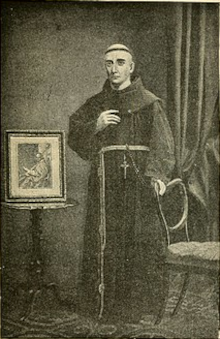
Death of Flaithrí Ó Maolchonaire, Archbishop of Tuam

Flaithrí Ó Maolchonaire, Irish Franciscan and theologian, founder of St. Anthony’s College, Leuven, and Archbishop of Tuam, dies in Madrid, Spain on November 18, 1629.

Ó Maolchonaire is born in the townland of Figh, civil parish of Tibohine, barony of Frenchpark, County Roscommon. His father and mother are Fíthil and Onóra Ó Maolchonaire. Two other sons survive to adulthood, Maoilechlainn and Firbisigh. They belong to a well-known family of historians and poets. He is brought up in the family profession.

Ó Maolchonaire studies for the priesthood at Salamanca, entering the Irish college founded in 1592. He first studies the liberal arts and philosophy. In 1593 he translates into Irish a short Castilian catechism by Jerónimo de Ripalda SJ. The original is a simple catechetical work written in Aristotelian master-pupil dialogue. According to Mícheál Mac Craith, Ó Maolchonaire’s translation pointedly refers to the Irish as Eirinnach rather than Gaedheal.

After five years at the Salamanca Irish college, Ó Maolchonaire leaves to join the Franciscan province of Santiago. Aodh Mac Cathmhaoil is among his classmates in the Salamanca Franciscan friary. They and nine of their peers in the Santiago province are later raised to the episcopacy, an unprecedented development in the history of the order.

At the height of the Nine Years’ War, Ó Maolchonaire sails to Ireland where he serves as a confessor and preacher to troops under the command of Hugh O’Neill and Hugh Roe O’Donnell. In 1601, they request a bishopric for Ó Maolchonaire “in recognition of his diligence, commending his sound judgment on Irish affairs.” After the disaster of Kinsale in 1601, he accompanies O’Donnell to Spain as his confessor and adviser, hoping to see a renewal of Spanish military intervention in Ireland.

In 1602, Ó Maolchonaire attempts to get approval for O’Donnell to meet Philip III in person, but they are kept at arm’s length by the Spanish court. During this time, they also drafted an official complaint against the Jesuit superiors of the Irish college at Salamanca over presumed discrimination in favour of Old English students at the expense of students from Connacht and Ulster.

While waiting for a response to his repeated calls for military support in Ireland, O’Donnell becomes seriously ill and dies at Simancas, being assisted on his deathbed by Ó Maolconaire. In keeping with his patronage of the order of friars minor in Donegal, O’Donnell is buried in the Franciscan habit. Ó Maolchonaire accompanies the remains to their last resting place in the Franciscan church at Valladolid. He continues to press for military support after O’Donnell’s death. He participates in an abandoned maritime expedition which reaches Achill Sound in 1603 but never lands in Ireland. He subsequently assists the Spanish councils of state and war to stem the flow of Irish military migrants and their dependents in Spain.

As adviser to Puñonrostro, the king’s appointee as protector of Irish exiles in Spain, Ó Maolchonaire helps to secure funds for widows, orphans and clerics. Trained as a chronicler and genealogist, he sponsors the entry of Irish soldiers into Spanish military orders and successfully calls for the promotion of Henry O’Neill, second eldest son of the earl of Tyrone, as colonel of Irish infantry units in Flanders, the O’Neill tercio in 1604.

In 1606, the Franciscan general chapter is held in Toledo where Ó Maolchonaire is selected as minister-provincial of the Irish friars minor. The most notable act of his tenure as provincial is the founding of a new Irish Franciscan college at Leuven in the Habsburg Netherlands. A year before his appointment, he begins his efforts in earnest with an appeal to the Spanish king. The loss of five Franciscan houses during the Nine Years’ War makes a new foundation essential. In response, Philip III instructs Albert VII, Archduke of Austria, to provide a perpetual grant for a new college in the university town of Leuven. Ó Maolchonaire’s part in founding the college clearly influences the Catholic pastoral mission to Ireland during the seventeenth century. The first and most active Irish printing press on the continent is long in operation at Leuven.

After Hugh O’Neill and Rory O’Donnell leave Ireland in 1607, Ó Maolconaire accompanies them from Douai to Rome as interpreter and advisor. Christopher St. Laurence, baron of Howth, implicates him in a plot to seize Dublin Castle and raises a new rebellion just before the Flight of the Earls. In recognition of his losses, Philip III and Paul V offer O’Neill the concession of Ó Maolchonaire’s promotion to the archbishopric of Tuam. On Sunday, May 3, 1609, he is consecrated archbishop by Cardinal Maffeo Barberini in the centre of Rome at the Chiesa Santo Spirito in Sassia. He remains in Rome until his appointment as archbishop of Tuam before returning to Madrid on behalf of Hugh O’Neill.

In response to the 1613–15 Parliament of Ireland, Ó Maolchonaire writes from Valladolid a remonstrance to the Catholic members of the parliament, rebuking them for assenting to the bill of attainder that confiscated the estates of O’Neill, O’Donnell and their adherents. As Archbishop of Tuam, he never takes possession of his episcopal see, governing through vicars general. He continues to live in Madrid and Leuven, as is the case with many Irish clergy at the time. Like his fellow-Franciscan, Luke Wadding, and Peter Lombard, Archbishop of Armagh, he serves as a key intermediary and his influence in Irish matters is considerable. In 1626, a year after Charles I declared war on Spain, he makes the case for an invasion of Ireland under the joint leadership of the earls of Tyrone and Tyrconnell.

Ó Maolconaire dies at the Franciscan friary of San Francisco el Grande in Madrid on November 18, 1629. In 1654, two Irish friars bring his remains back to St. Anthony’s College in Leuven where he is buried near the high altar in the collegiate chapel.


Leave a comment

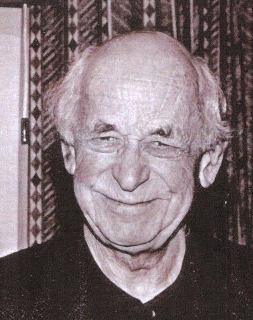
Birth of Roy McFadden, Poet, Editor & Lawyer

Roy McFadden, Northern Irish poet, editor, and lawyer, is born in Downpatrick, County Down, on November 14, 1921.

McFadden is born to Roland Victor MCFadden and his wife Maud Steele. A short time after his birth the family relocates to Belfast. He is educated at Knock Grammar School, Regent House School in Newtownards, and later graduates in Law from Queen’s University Belfast in 1944. He becomes a prominent lawyer and an influential figure in the Belfast literary scene.

McFadden’s first poem is published before he is thirteen. His earliest influences are from magazines and journals that his father brings home, and by Francis Turner Palgrave‘s Golden Treasury. He first comes to prominence as a promoter of Ulster literature in the 1940s when he edits two anthologies of poetry, Ulster Voices and Irish Voices in 1943. In 1948, he co-founds with Barbara Edwards (née Hunter) the Northern Irish poetry magazine Rann and then, co-edits it with her during its whole run, until 1953. Like its predecessor Lagan, it is unapologetically regionalist.

McFadden is the author of nine volumes of poetry, from Swords and Ploughshares (1943) to the posthumously published Last Poems (2002). Among his poems are “Saint Francis and the Birds” and “Independence”. His book, The Garryowen, is published by Chatto & Windus in the Phoenix Living Poets series. Most recently, his poem “Post-War” has been anthologised in Armistice: A Laureate’s Choice of Poems of War and Peace (Faber Poetry) (2018). There is a long gap between 1947 and 1971 when he publishes no collections of his work, however he continues to write and publishes in periodicals and newspapers such as The Irish Times where in that time he has sixty poems printed. His voice is well known on local BBC Radio through the Poetry Notebooks series, and he also has several verse-plays broadcast.

In 1952 McFadden marries Margaret Ferguson. Together they produce three sons and two daughters. He lives for a number of years in Lisburn, County Antrim. Inspired by Herbert Read and Alex Comfort, he describes himself as a pacifist and an anarchist in 1999. McFadden dies at his Belfast home on September 15, 1999.

The Roy McFadden Papers, comprising the poet’s personal manuscripts and papers, are lodged at Queen’s University Belfast. The Roy McFadden Library at Trinity College Dublin comprises books and journals on Irish and world literature from his collection. A comprehensive collection of his published work is held at the National Poetry Library, Southbank Centre, London.


Leave a comment

Death of Owen Roe O’Neill, Member of the O’Neill Dynasty of Ulster

Owen Roe O’Neill, Gaelic Irish soldier and one of the most famous of the O’Neill dynasty of Ulster, dies on November 6, 1649 at the O’Reilly stronghold of Cloughoughter Castle located on an island in Lough Oughter in County Cavan.

O’Neill is the illegitimate son of Art MacBaron O’Neill, a younger brother of Hugh O’Neill, 2nd Earl of Tyrone, who holds lands in County Armagh. His mother is the daughter of Aodh Conallach O’Raghallaigh, the chief of Breifne O’Reilly in County Cavan.

As a young man O’Neill leaves Ireland, one of the ninety-nine involved in the Flight of the Earls escaping the English conquest of his native Ulster. He grows up in the Spanish Netherlands and spends 40 years serving in the Irish regiment of the Spanish army. He sees most of his combat in the Eighty Years’ War against the Dutch Republic in Flanders, notably at the Siege of Arras, where he commands the Spanish garrison. He also distinguishes himself in the Franco-Spanish War by holding out for 48 days with 2,000 men against a French army of 35,000.

O’Neill is, like many Gaelic Irish officers in the Spanish service, very hostile to the English Protestant presence in Ireland. In 1627, he is involved in petitioning the Spanish monarchy to invade Ireland using the Irish Spanish regiments. He proposes that Ireland be made a republic under Spanish protection to avoid in-fighting between Irish Catholic landed families over which of them would provide a prince or king of Ireland. This plot comes to nothing. However in 1642, He returns to Ireland with 300 veterans to aid the Irish Rebellion of 1641.

The subsequent war, known as the Irish Confederate Wars, is part of the Wars of the Three Kingdoms, civil wars throughout Britain and Ireland. Because of his military experience, O’Neill is recognised on his return to Ireland in July 1642, at Doe Castle in County Donegal, as the leading representative of the O’Neills and head of the Ulster Irish. Sir Phelim O’Neill resigns the northern command of the Irish rebellion in his favour and escorts him from Lough Swilly to Charlemont.

Jealousy between the kinsmen is complicated by differences between O’Neill and the Catholic Confederation which meet at Kilkenny in October 1642. O’Neill professes to be acting in the interest of Charles I, but his real aim is the complete Independence of Ireland as a Roman Catholic country, while the Old English Catholics represented by the council desire to secure religious liberty and an Irish constitution under the crown of England. More concretely, O’Neill wants the Plantation of Ulster overturned and the recovery of the O’Neill clan’s ancestral lands. Moreover, he is unhappy that the majority of Confederate military resources are directed to Thomas Preston‘s Leinster army. Preston is also a Spanish veteran but he and O’Neill have an intense personal dislike of each other.

Although O’Neill is a competent general, he is outnumbered by the Scottish Covenanter army that lands in Ulster in 1642. Following a reverse at Clones, he has to abandon central Ulster and is followed by thousands of refugees, fleeing the retribution of the Scottish soldiers for some atrocities against Protestants in the rebellion of 1641. He does his best to stop the killings of Protestant civilians, for which he receives the gratitude of many Protestant settlers. From 1642–1646 a stalemate exists in Ulster, which he uses to train and discipline his Ulster Army. This poorly supplied force nevertheless gains a very bad reputation for plundering and robbing friendly civilians around its quarters in northern Leinster and southern Ulster.

In 1646 O’Neill, with substantial Gallowglass numbers and additionally furnished with supplies by the Papal Nuncio, Giovanni Battista Rinuccini, attacks the Scottish Covenanter army under Major-General Robert Monro, who had landed in Ireland in April 1642. On June 5, 1646 O’Neill utterly routs Monro at the Battle of Benburb, killing or capturing up to 3,000 Scots. However after being summoned to the south by Rinuccini, he fails to take advantage of the victory, and allows Monro to remain unmolested at Carrickfergus.

In March 1646 a treaty is signed between James Butler, 1st Duke of Ormond and the Catholics, which would have committed the Catholics to sending troops to aid the Royalist cause in the English Civil War. The peace terms however, are rejected by a majority of the Irish Catholic military leaders and the Catholic clergy including the Nuncio, Rinuccini. O’Neill leads his Ulster army, along with Thomas Preston’s Leinster army, in a failed attempt to take Dublin from Ormond. However, the Irish Confederates suffer heavy military defeats the following year at the hands of Parliamentarian forces in Ireland at Dungan’s Hill and Knocknanauss, leading to a moderation of their demands and a new peace deal with the Royalists. This time O’Neill is alone among the Irish generals in rejecting the peace deal and finds himself isolated by the departure of the papal nuncio from Ireland in February 1649.

So alienated is O’Neill by the terms of the peace the Confederates have made with Ormond that he refuses to join the Catholic/Royalist coalition and in 1648 his Ulster army fights with other Irish Catholic armies. He makes overtures for alliance to George Monck, 1st Duke of Albemarle, who is in command of the parliamentarians in the north, to obtain supplies for his forces, and at one stage even tries to make a separate treaty with the English Parliament against the Royalists in Ireland. Failing to obtain any better terms from them, he turns once more to Ormond and the Catholic confederates, with whom he prepares to co-operate more earnestly when Oliver Cromwell‘s arrival in Ireland in August 1649 brings the Catholic party face to face with serious danger.

Before, however, anything is accomplished by this combination, O’Neill dies on November 6, 1649 at the O’Reilly stronghold of Cloughoughter Castle located on an island in Lough Oughter in County Cavan. There is no clear evidence of the cause of death, with one belief being that he was poisoned by a priest, while others think it is more likely that he died from an illness resulting from an old wound. Under cover of night he is reputed to have been brought to the Franciscan abbey in Cavan town for burial. However some local tradition still suggests that it may have been at Trinity abbey located upon an island in Lough Oughter, which may be more likely given the logistics of his removal. His death is a major blow to the Irish of Ulster and is kept secret for some time.

The Catholic nobles and gentry meet in Ulster in March 1650 to appoint a commander to succeed O’Neill, and their choice is Heber MacMahon, Roman Catholic Bishop of Clogher, the chief organiser of the recent Clonmacnoise meeting. O’Neill’s Ulster army is unable to prevent the Cromwellian conquest of Ireland, despite a successful defence of Clonmel by O’Neill’s nephew Hugh Dubh O’Neill and is destroyed at the Battle of Scarrifholis in County Donegal in 1650. Its remnants continue guerrilla warfare until 1653, when they surrender at Cloughoughter Castle in County Cavan. Most of the survivors are transported to serve in the Spanish Army.

In the nineteenth century, O’Neill is celebrated by the Irish nationalist revolutionaries, the Young Irelanders, who see him as an Irish patriot. Thomas Davis writes a famous song about O’Neill, titled “The Lament for Owen Roe” which is popularised in their newspaper, The Nation.

O’Neill has been commemorated in the names of several Gaelic Athletic Association clubs, including Middletown Eoghan Rua Gaelic Athletic Club in County Armagh; CLG Eoghan Rua in Coleraine; St. Oliver Plunketts/Eoghan Ruadh GAA in Dublin, and Brackaville Owen Roes GFC; Owen Roe O’Neill’s GAC in County Tyrone; and the defunct Benburb Eoghan Ruadh GAC.


Leave a comment

Ulster Rebels Take Dundalk During the Irish Rebellion of 1641

Ulster rebels take Dundalk on October 31, 1641 during the Irish Rebellion of 1641. The rebellion is an uprising by Irish Catholics in the Kingdom of Ireland, who want an end to anti-Catholic discrimination, greater Irish self-governance, and to partially or fully reverse the plantations of Ireland. They also want to prevent a possible invasion or takeover by anti-Catholic English Parliamentarians and Scottish Covenanters, who are defying the king, Charles I.

The rebellion begins on October 23, 1641 as an attempted coup d’état by Catholic gentry and military officers, who try to seize control of the English administration in Ireland. However, it develops into a widespread rebellion and ethnic conflict with English and Scottish Protestant settlers, leading to Scottish military intervention. The rebels eventually found the Irish Catholic Confederacy.

The plan to seize Dublin Castle is foiled, but the rebels swiftly capture numerous towns (including Dundalk), forts and fortified houses in the northern province of Ulster. Within days they hold most of the province. Rebel leader Felim O’Neill of Kinard issues a forged proclamation, the Proclamation of Dungannon, claiming he has the king’s blessing to secure Ireland against the king’s opponents. The uprising spreads southward and soon most of Ireland is in rebellion. In November, rebels besiege Drogheda and defeat an English relief force at Julianstown. The following month, many Anglo-Irish Catholic lords join the rebellion. In these first months, especially in Ulster, some Catholic rebels drive out or kill thousands of Protestant settlers (most notably the Portadown massacre), and settlers respond in kind. Reports of rebel massacres outrage Protestants in Britain, and leave a lasting impact on the Ulster Protestant community.

King Charles and the English parliament both seek to quell the rebellion, but parliament does not trust the king with command of any army raised to do so. This is one of the issues that lead to the English Civil War. Charles orders forces to be raised in Ireland, and the English parliament drafts a bill to give itself the power to raise armed forces. Eventually, in April 1642, following negotiations between the English and Scottish parliaments, the Scots send a Covenanter army to Ireland. It swiftly captures most of eastern Ulster, while a Protestant settler army holds northwestern Ulster. Government forces meanwhile recapture much of the Pale, and hold the region around Cork. Most of the rest of Ireland is under rebel control.

In May 1642, Ireland’s Catholic bishops meet at Kilkenny, declare the rebellion to be a just war and take steps to control it. With representatives of the Catholic nobility in attendance, they agree to set up an alternative government known as the Irish Catholic Confederacy and draw up the Confederate Oath of Association. The rebels, now known as Confederates, hold most of Ireland against the Protestant Royalists, Scottish Covenanters and English Parliamentarians. The rebellion is thus the first stage of the Irish Confederate Wars and part of the wider Wars of the Three Kingdoms, which lasts for the next ten years.

(Pictured: Depiction of the massacre of Ulster Protestants during the 1641 rebellion, the LIFE Picture Collection via Getty Images)


Leave a comment

Birth of James Matthew Dillon, Fine Gael Politician

James Matthew Dillon, Fine Gael politician who serves as Leader of the Opposition and Leader of Fine Gael from 1959 to 1965 and Minister for Agriculture from 1948 to 1951 and 1954 to 1957, is born in Drumcondra, Dublin on September 26, 1902. He also serves as a Teachta Dála (TD) from 1932 to 1969.

Dillon is the son of John Dillon, the last leader of the Irish Parliamentary Party, and Elizabeth Mathew. He is educated at Mount St. Benedict’s, in Gorey, County Wexford, University College Galway and King’s Inns. He qualifies as a barrister and is called to the Bar of Ireland in 1931. He studies business methods at Selfridges in London. After some time at Marshall Field’s in Chicago he returns to Ireland where he becomes manager of the family business known as Monica Duff’s in Ballaghaderreen, County Roscommon.

Between 1932 and 1937, Dillon serves as a TD for the Donegal constituency for the National Centre Party and after its merger with Cumann na nGaedheal, for the new party of Fine Gael. He plays a key role in instigating the creation of Fine Gael and becomes a key member of the party in later years. He remains as TD for Monaghan from 1937 to 1969. He becomes deputy leader of Fine Gael under W. T. Cosgrave.

Dillon temporarily resigns from Fine Gael in 1942 over its stance on Irish neutrality during World War II. While Fine Gael supports the government’s decision to stay out of the war, he urges the government to side with the Allies. A passionate anti-Nazi, he describes the Nazi creed as “the devil himself with twentieth-century efficiency.” His zeal against Adolf Hitler draws him the ire of the German Minister to Ireland Eduard Hempel, who denounces him as a “Jew” and “German-hater.” Even Éamon de Valera, then Taoiseach, is not spared the fierceness of Dillon’s rhetoric. When the Taoiseach ridicules his stark support for the Allies, noting this means he has to adopt a Pro-British stance, Dillon defiantly retorts, “My ancestors fought for Ireland down the centuries on the continent of Europe while yours were banging banjos and bartering budgies in the backstreets of Barcelona.”

In 1942, while holidaying in Carna, County Galway, Dillon meets Maura Phelan of Clonmel on a Friday. By that Monday the two are engaged and six weeks after that the pair are married. He is 40 and Maura is 22 years of age.

Dillon is one of the independents who supports the first inter-party government (1948–1951) and is appointed Minister for Agriculture. As Minister, he is responsible for huge improvements in Irish agriculture. Money is spent on land reclamation projects in the areas of less fertile land while the overall quality of Irish agricultural produce increases.

Dillon rejoins Fine Gael in 1953. He becomes Minister for Agriculture again in the second inter-party government (1954–1957). In 1959, he becomes leader of Fine Gael, succeeding Richard Mulcahy. He becomes president of the party in 1960. In 1965, Fine Gael loses the general election to Seán Lemass and Fianna Fáil. The non-Fianna Fáil parties win 69 seats to Fianna Fáil’s 72. Had the other parties won four more seats between them, they would have been able to form a government. Having narrowly failed to become Taoiseach, Dillon stands down as Fine Gael leader after the election.

On Northern Ireland, while Dillon stands against Partition, he equally opposes any “armed solution” or militant nationalist policy, stating, “We have got to win, not only the barren acres of Ulster, but the hearts of the people who live in it.”

Dillon is a colourful contributor to Dáil proceedings and is noted for his high standard of oratory. He remains a TD until 1969, when he retires from politics. He dies in Malahide, Dublin on February 10, 1986, at the age of 83.


Leave a comment

Death of Red Hugh O’Donnell

Hugh Roe O’Donnell (Aodh Rua ÓDomhnaill), sixteenth century Irish nobleman also known as Red Hugh O’Donnell, dies at Simancas Castle in Valladolid, Spain, on September 10, 1602. Evidence suggests he might have been poisoned by an English spy.

O’Donnell is born on October 30, 1572, in Lifford (which is in present-day County Donegal) and is the son of Hugh McManus O’Donnell, the Gaelic Lord of Tyrconnell, a territory which takes in most of the present-day county of Donegal except for the Inishowen peninsula. His mother, Aodh MacManus’ second wife, is the formidable and extremely well-connected Scottish lady, Fionnuala Nic Dhomhnaill, known to history as the Iníon Dubh or The Dark Daughter. A daughter of James Mac Donald she had been raised at the Scottish court.

In 1587, at the age of fifteen, O’Donnell marries Rose O’Neill, the daughter of Hugh O’Neill, Earl of Tyrone, a nephew of Turlough Lynagh O’Neill who is recognised by the Irish as The O’Neill. He is, therefore, a bridge between two traditional enemies, the O’Donnell’s and the O’Neills.

The English Lord Deputy of Ireland, Sir John Perrot, recognises the importance of the young O’Donnell prince and decides to secure him as a hostage thus giving him power over the O’Donnell clan and preventing them from forming a treaty with the O’Neills. In 1587, when he is sixteen, O’Donnell and two friends, a MacSweeney and an O’Gallagher, are persuaded to board a ship at Rathmullan which has been disguised as a Spanish wine barque. Once onboard they are carried off to Dublin Castle as prisoners. The O’Donnell’s offer to pay a large ransom and the Iníon Dubh also gives up 25 Spaniards rescued from the Armada. The English agree to this but as soon as the Spaniards are handed over, they are beheaded. The agreement is not kept.

Perrot has his hostage but a most reluctant one. The young man continuously seeks ways to escape. His first opportunity comes at Christmas in 1590 when a rope is smuggled in to the prince. He escapes and flees into the Wicklow Mountains. He seeks shelter with Phelim O’Toole who has him returned to the English as he fears the anger of the infamous Perrot.

A year later, at Christmas in 1591, O’Donnell makes his second attempt at escape, this time by crawling through the Dublin Castle sewers. With him are Henry and Art O’Neill, two sons of Shane O’Neill (Shane the Proud). This time the escapees make their way to the Glenmalure stronghold of Fiach McHugh O’Byrne. Unfortunately, the winter is very severe and Art O’ Neill dies from exposure just as the O’Byrne rescue party finds them. Both Red Hugh and Henry O’Neill suffer severe frostbite but are safely returned to Ulster.

While O’Donnell is held prisoner by the English, his father becomes senile. In 1592, when O’Donnell is sufficiently recovered, he is inaugurated as the O’Donnell and England, for her treachery, has an avowed and implacable enemy.

O’Donnell aids the Maguires of Fermanagh against the English and when his father-in-law, Hugh O’Neill, initiates the Nine Years’ War by leading his clan against the English at the Battle of Clontibret (1595) and Battle of the Yellow Ford (1598), O’Donnell is at his side.

In 1595 O’Donnell ambushes an English force in the Curlew Mountains, killing 500 of them including their commander. However, the tide is turning against the Irish now. England is flooding the country with armies and many of the leading Gaelic families are beginning to make deals with them.

In 1601 the Spanish land in Kinsale and the English besiege them. O’Neill and O’Donnell march south from Ulster and Ballymote Castle in Sligo in an attempt to break the siege. This turns into a debacle causing the Irish to scatter and the Spanish to surrender. O’Neill marches back north and O’Donnell is sent to Spain to ask for more troops from Phillip III. In Spain, he is treated like a royal. He petitions aid from the King who gives him a promise of another Spanish force.

As a year passes and O’Donnell does not receive any news from Philip III of Spain, he leaves again for Valladolid, but he dies on September 10, 1602, while en route. He is attended on his deathbed by Archbishop of Tuam Fláithrí Ó Maolchonaire and two friars from Donegal named Father Muiris mac Donnchadh Ulltach Ó Duinnshléibhe and Father Muiris mac Seaán Ulltach Ó Duinnshléibhe. The Anglo-Irish double-agent, James “Spanish” Blake, is alleged to have poisoned O’Donnell.

It is, however, unlikely that O’Donnell is poisoned. A more probable cause of death is the tapeworm that Simancas documents of the time state to be the cause of his demise. His Last Will and Testament, written in his dying moments with his loyal retinue, is an extremely evocative and moving document. One original is preserved in Simancas and the other in the Chancellery archive in Valladolid.

O’Donnell is buried in the chapter of the Franciscan monastery in Valladolid. Though the building is demolished in 1837, the exact location of the tomb may have been discovered following a Spanish archaeological dig in May 2020.

O’Donnell is succeeded as chieftain of his clan and prince of Tyrconnell by his brother Rory.

(Pictured: Statue of Gaelic Chieftain Red Hugh O’Donnell in County Donegal)