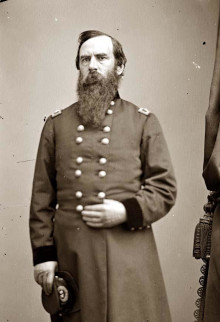
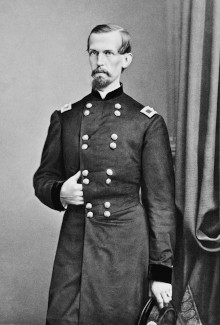
Once when confronted with black men being thrown out of a white railroad car by the conductor, Busteed pulls his pistol and defends the black men allowing them to stay.
Alabamians generally consider Busteed corrupt and pro-Northern. In December 1867, he is shot on the street in Mobile, Alabama by United States Attorney Lucien V. B. Martin, who fires two more shots into him after he falls. Martin goes to Texas and is never prosecuted, while Busteed recovers rapidly.
Busteed is nominated by President Ulysses S. Grant to the Supreme Court of the District of Columbia (now the United States District Court for the District of Columbia) on January 13, 1873. At the same time, President Grant nominates Judge David Campbell Humphreys, an Alabama native serving on the Supreme Court of the District of Columbia, to assume Busteed’s seat, each nomination made contingent on the other’s resignation. The Senate returns the nominations to the President as irregular in form on February 13, 1873.
In 1873, Busteed is the subject of an impeachment inquiry by the United States House of RepresentativesJudiciary Committee. The Committee recommends his impeachment on charges of failing to maintain a residence in his judicial district, failing to hold scheduled terms of court, and using his official position to promote his personal interests, specifically, by remitting a fine due to the Federal government in order to obtain release from a personal judgment against him in a State court. He resigns before the full House can vote on the recommendation.
Following his resignation from the federal bench, Busteed resumes private practice in New York City starting in 1874. He dies on September 14, 1898, in New York City and is interred in Woodlawn Cemetery in the Bronx, New York.
The Provisional Congress of the Confederate States is a congress of deputies and delegates called together from the Southern States which become the governing body of the Provisional Government of the Confederate States from February 4, 1861, to February 17, 1862. It sits in Montgomery until May 21, 1861, when it adjourns to meet in Richmond, Virginia, on July 20, 1861. It adds new members as other states secede from the Union and directs the election on November 6, 1861, at which a permanent government is elected.
The Second Session of the Provisional Congress is held at Montgomery from April 29, 1861, to May 21, 1861. It includes the members of the First Session with the additions of Virginia and Arkansas. John Tyler, the tenth president of the United States (1841–1845), serves as a delegate from Virginia in the Provisional Confederate States Congress until his death in 1862.
North Carolina and Tennessee join the Third Session of the Provisional Congress, which is held at Richmond from July 20, 1861, to August 31, 1861. Membership remains unchanged for the Fourth Session on September 3, 1861.
The Fifth Session of the Provisional Congress is held at Richmond from November 18, 1861, to February 17, 1862. All previous members are present with the additions of Missouri and Kentucky. One non-voting member is present from the Arizona Territory.
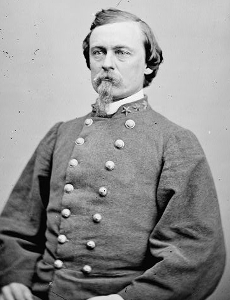
Finegan comes to Florida in the 1830s, first establishing a sawmill at Jacksonville and later a law practice at Fernandina, where he becomes the business partner of David Levy Yulee and begins construction of the Florida Railroad to speed transportation of goods and people from the new state’s east coast to the Gulf of Mexico.
Finegan’s successes are perhaps attributable to his first marriage on July 28, 1842, to the widow Rebecca Smith Travers. Her sister, Mary Martha Smith, is the wife of Florida’s territorial governor, Robert Raymond Reid, an appointee of President Martin Van Buren. In 1852, he is a member of the Committee of Vigilance and Safety of Jacksonville, Florida.
By the outbreak of the American Civil War, Finegan had built his family a forty-room mansion in Fernandina on the site of the modern Atlantic Elementary School. At Florida’s secession convention, he represents Nassau County alongside James G. Cooper.
In April 1862, Finegan assumes command of the District of Middle and Eastern Florida from Brigadier General James H. Trapier. Soon thereafter, he suffers some embarrassment surrounding the wreck of the blockade runnerKate at Mosquito Inlet (the modern Ponce de Leon Inlet). Her cargo of rifles, ammunition, medical supplies, blankets, and shoes is plundered by civilians. Attempts to recover these items takes months before he issues a public appeal. Eventually, most of the rifles are found, but the other supplies are never recovered. Also in 1862, recognizing the importance of Florida beef to the Confederate cause, he gives cattle baron Jacob Summerlin permission to select thirty men from the state troops under his command to assist in rounding up herds to drive north.
At this time, the principal Confederate military post in east Florida is dubbed “Camp Finegan” to honor the state’s highest-ranking officer. It is about seven miles west of Jacksonville, south of the rail line near modern Marietta.
In 1863, Finegan complains of the large quantity of rum making its way from the West Indies into Florida. Smugglers are buying it in Cuba for a mere seventeen cents per gallon, only to sell it in the blockaded state for twenty-five dollars per gallon. He urges Governor John Milton to confiscate the “vile article” and destroy it before it can impact army and civilian morals.
In February 1864, General P. G. T. Beauregard begins rushing reinforcements to Finegan after Confederate officials become aware of a build-up of Union Army troops in the occupied city of Jacksonville. As Florida is a vital supply route and source of beef to the other southern states, they cannot allow it to fall completely into Union hands.
On February 20, 1864, Finegan stops a Union Army advance from Jacksonville under General Truman Seymour that is intent upon capturing the state capitol at Tallahassee. Their two armies clash at the Battle of Olustee, where Finegan’s men defeat the Union Army and force them to flee back beyond the St. Johns River. Critics have faulted Finegan for failing to exploit his victory by pursuing his retreating enemy, contenting himself by salvaging their arms and ammunition from the battlefield. His victory, however, is one rare bright spot in an otherwise gloomy year for the dying Confederacy.
Some Finegan detractors believe he did little more to contribute to the Confederate victory at Olustee than to shuttle troops forward to General Alfred H. Colquitt of Georgia, whom they credit for thwarting the Union Army advance. They point out that Finegan was quickly relieved of his command over the state troops, replaced by Major GeneralJames Patton Anderson. But this change in command is necessary as Finegan is ordered to lead the “Florida Brigade” in the Army of Northern Virginia, where he serves effectively until near the end of the war.
Finegan returns to Fernandina after the war to discover his mansion has been seized by the Freedmen’s Bureau for use as an orphanage and school for black children. It takes some legal wrangling, but he is eventually able to recover this property. He has to sell most of his lands along Lake Monroe to Henry Shelton Sanford for $18,200 to pay his attorneys and other creditors. He does retain a home site at Silver Lake. Adding to his sorrows is the untimely death of his son Rutledge on April 4, 1871, precipitating a move to Savannah, Georgia. There, he feels at home with the large Irish population and works as a cotton broker.
It is while living in Savannah that Finegan marries his second wife, the widow Lucy C. Alexander, a Tennessee belle. They eventually settle on a large orange grove in Orange County, Florida. Finegan dies on October 29, 1885, at Rutledge, Florida. According to the Florida Union, his death is the result of “severe cold, inducing chills, to which he succumbed after brief illness.” The paper describes him as “hearty, unaffected, jovial, clear-headed, and keen-witted.” He is buried at the Old City Cemetery in Jacksonville.
Following the Battle of Gettysburg in July 1863, the Union and Confederate armies drift south and for three months spar with one another on the rolling plains of northern Virginia. In late October, GeneralRobert E. Lee withdraws his Confederate army behind the Rappahannock River, a line he hopes to maintain throughout the winter. A single pontoon bridge at the town of Rappahannock Station is the only connection Lee retains with the northern bank of the river.
The Union Army of the Potomac‘s commander, Maj. Gen. George G. Meade, divides his forces just as Lee expects. He orders Maj. Gen. John Sedgwick to attack the Confederate position at Rappahannock Station while Maj. Gen. William H. French forces a crossing five miles downstream at Kelly’s Ford. Once both Sedgwick and French are safely across the river, the reunited army is to proceed to Brandy Station.
The operation goes according to plan. Shortly after noon on November 7, French drives back Confederate defenders at Kelly’s Ford and crosses the river. As he does so, Sedgwick advances toward Rappahannock Station. Lee learns of these developments sometime after noon and immediately puts his troops in motion to meet the enemy. His plan is to resist Sedgwick with a small force at Rappahannock Station while attacking French at Kelly’s Ford with the larger part of his army. The success of the plan depends on his ability to maintain the Rappahannock Station bridgehead until French is defeated.
Sedgwick first engages the Confederates at 3:00 PM when Maj. Gen. Albion P. Howe‘s division of the VI Corps drives in Confederate skirmishers and seizes a range of high ground three-quarters of a mile from the river. Howe places Union batteries on these hills that pound the enemy earthworks with a “rapid and vigorous” fire. Confederate guns across the river return the fire, but with little effect.
Maj. Gen. Jubal Early’s division occupies the bridgehead defenses that day. Early posts Brig. Gen.Harry T. Hays‘s Louisiana brigade and Captain Charles A. Green’s four-gun Louisiana Guard Artillery in the works and at 4:30 PM reinforces them with three North Carolina regiments led by ColonelArchibald C. Godwin. The addition of Godwin’s troops increases the number of Confederate defenders at the bridgehead to nearly 2,000.
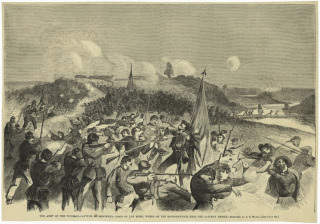
Sedgwick continues shelling the Confederates throughout the late afternoon, but otherwise he shows no disposition to attack. As the day draws to a close, Lee becomes convinced that the movement against the bridgehead is merely a feint to cover French’s crossing farther downstream. He is mistaken. At dusk the shelling stops, and Sedgwick’s infantry rushes suddenly upon the works. Col. Peter Ellmaker’s brigade advances adjacent to the railroad, precedes by skirmishers of the 6th Maine Volunteer Infantry. At the command “Forward, double-quick!” they surge over the Confederate works and engage Hays’s men in hand-to-hand combat. Without assistance, the 6th Maine breaches the Confederate line and plants its flags on the parapet of the easternmost redoubt. Moments later the 5th Wisconsin Infantry Regiment swarms over the walls of the western redoubt, likewise, wresting it from Confederate control.
On the right, Union forces achieve comparable success. Just minutes after Ellmaker’s brigade penetrates Hays’s line, Col. Emory Upton‘s brigade overruns Godwin’s position. Upton reforms his lines inside the Confederate works and sends a portion of the 121st New York Volunteer Infantry to seize the pontoon bridge, while the rest of his command wheels right to attack the confused Confederate horde now massed at the lower end of the bridgehead.
Confederate resistance dissolves as hundreds of soldiers throw down their arms and surrender. Others seek to gain the opposite shore by swimming the icy river or by running the gauntlet of Union rifle fire at the bridge. Confederate troops south of the Rappahannock look on hopelessly as Union soldiers herd their comrades to the rear as prisoners of war.
In all, 1,670 Confederates are killed, wounded, or captured in the brief struggle, more than eighty percent of those engaged. Union casualty figures, by contrast, are small: 419 in all. The battle is as humiliating for the South as it is glorious for the North. Two of the Confederacy’s finest brigades, sheltered behind entrenchments and well supported by artillery, are routed and captured by an enemy force of equal size.
The Civil War Trust and its partners have acquired and preserved 856 acres of the battlefield where the First and Second Battles of Rappahannock Station were fought. The battleground for both battles is located along the Rappahannock River at Remington, VA and features visible earthworks as well as bridge and mill ruins. The earthworks at Remington are no longer there and more than 75% of the battlefield has been developed over.
Corby is born to Daniel Corby, an Irish immigrant, and his wife Elizabeth, a Canadian. He attends public school until age 16, then joins his father’s real estate business. In 1853, he enrolls in the 10-year-old college of Notre Dame in South Bend, Indiana, and begins study for the priesthood three years later. Following ordination, he teaches at Notre Dame and serves as a local parish priest.
Corby leaves his position at Notre Dame and joins the predominately Catholic Irish Brigade in 1861. He spends the next three years as chaplain of the 88th New York Volunteer Infantry, which is one of the five original regiments in the Irish Brigade. He is perhaps best known for giving general absolution to the Irish Brigade on the second day of the Battle of Gettysburg. Of the Brigade’s original 3,000 men, only about 500 remain. Of the men Corby absolves that day, 27 are killed, 109 are wounded, and 62 are listed as missing. The scene of Corby blessing the troops is depicted in the 1891 painting Absolution under Fire by Paul Wood, and dramatized in the 1993 film Gettysburg. His memoir of the Irish Brigade becomes a best-seller.
Following his service in the Civil War, Corby returns to Notre Dame and serves as its vice-president (1865–1866) and twice as its president (1866–1872, 1877-1881). Under his first administration, enrollment at Notre Dame increases to more than 500 students. In 1869 he opens the law school, which offers a two-year course of study, and in 1871 he begins construction of Sacred Heart Church, today the Basilica of the Sacred Heart, Notre Dame. The institution is still small, and he teaches in the classroom and knows most students and faculty members. In 1869, the entire student body and the faculty present him with the gift of a black horse and, when he leaves the presidency three years later, they present him with a matching carriage.
Corby becomes president again following the short term of Fr. Patrick Colovin. When he returns to the presidency, Notre Dame has not yet become a significant academic institution. His presidency sees the April 1879 fire that destroys the old Main Building of the school. He sends all students home and promises that they will return to a “bigger and better Notre Dame.” He overcomes the $200,000 fire loss and rebuilds the Main Building, which now stands with its “Golden Dome.” During his administration, he also constructs Washington Hall, in which he takes much pride, and starts the construction of St. Edward’s Hall for the minims program.
In addition to his presidency, Corby is also serving as the Holy Cross Provincial, when Rev. Edward Sorin, who had become Superior General of the Congregation, writes to him to tell him that he will have to relinquish one of his positions. He wants to remain president but is overruled by Sorin. Famous throughout the U.S. Catholic world as chaplain for the Irish Brigade, known as the “Fighting Irish,” it may be that the nickname followed Corby back to Notre Dame, where it stuck.
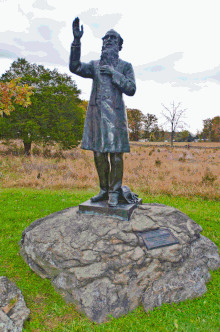
A statue by Samuel Murray, depicting Corby with right hand raised in the gesture of blessing, stands upon the same boulder at the Gettysburg Battlefield on which the priest stood while blessing the troops that second morning of the battle. It is the first statue of a non-general erected on the Gettysburg Battlefield, and is dedicated in 1910.
Corby is widely remembered among military chaplains and celebrated by Irish American fraternal organizations. Corby Hall at Notre Dame is named for him, and a copy of the Gettysburg statue stands outside the building. An organization of Notre Dame alumni is named The William Corby Society.
(Pictured: Statue of Father William Corby by Samuel Murray, Gettysburg Battlefield, Gettysburg, Pennsylvania)
Corcoran is the only child of Thomas Corcoran, an officer in the British Army, and Mary McDonagh. Through his mother, he claims descent from Patrick Sarsfield, hero of the Williamite War in Ireland and leader of the Wild Geese. In 1846 he takes an appointment to the Revenue Police, enforcing the laws and searching for illicit stills and distilling activities in Creeslough, County Donegal. He also joins a guerrilla group called the Ribbonmen.
On August 30, 1849, Corcoran emigrates from Sligo to the United States and settles in New York City where he finds work as a clerk in the tavern owned by John Heaney, whose niece, Elizabeth, he marries in 1854.
Corcoran enlists as a Private in the 69th New York Militia. By 1859 he is appointed colonel of the regiment. The regiment is a state militia unit at the time composed of citizens, not soldiers, and is involved in the maintenance of public order. On October 11, 1860, he refuses to march the regiment on parade for the 19-year-old Prince of Wales, who is visiting New York City at the time, protesting the British imposition of the Irish Famine. He is removed from command and a court martial is pending over that matter when the Civil War begins.
Corcoran also becomes involved in Democratic politics at Tammany Hall. He becomes district leader, a member of the judicial nominations committee, an elected school inspector for his ward, and a member of the Fourteenth Ward General Committee. He is one of the founders of the Fenian Brotherhood in America.
With the outbreak of war, the court martial is dropped and Corcoran is restored to his command because he had been instrumental in bringing other Irish immigrants to the Union cause. He leads the 69th to Washington, D.C. and serves for a while in the Washington defenses building, Fort Corcoran. In July 1861 he leads the regiment into action at the First Battle of Bull Run and is taken prisoner.
While Corcoran is imprisoned, the United States makes threats to execute captured Confederateprivateers. Corcoran and several other Union prisoners are selected by lot for execution if the United States carries out its threats against the privateers. This event is known as the Enchantress Affair, but no executions are ever carried out by either side. Corcoran is then offered a parole under the conditions that he does not take up arms against the Confederacy. Intending to resume his place in the Union army upon his release he refuses the offer of parole. He is appointed Brigadier General of volunteers in July and exchanged in August 1862. His role in the Enchantress Affair and his refusal for parole gains him some attention and upon his release he is invited to dinner with President Abraham Lincoln.
In April 1863 Corcoran is involved in an incident that ends with Corcoran shooting and killing Edgar A. Kimball, commander of the 9th New York Volunteer Infantry Regiment. Corcoran attempts to pass through the 9th New York’s area without giving the required password after receiving the challenge from a sentry. When Kimball intervenes on the side of the sentry, Corcoran shoots him. Corcoran is not charged with a crime or reprimanded and continues to serve.
Corcoran returns to the army and sets about recruiting more Irish volunteers. He raises and takes command of what becomes known as the Corcoran Legion. Placed in command of the 1st Division, VII Corps he is engaged in the Battle of Deserted House and takes part in the Battle of Suffolk. In late 1863 he is placed in command of a division in the XXII Corps and returns to serve in the Washington defenses. While riding alone in Fairfax, Virginia he is thrown from a runaway horse and suffers a fractured skull. He dies at the age of 36 at the William Gunnell House on December 22, 1863.
New York City MayorMichael Bloomberg unveils Ireland’s national monument to the Fighting 69th in Ballymote on August 22, 2006. The monument is sculpted by Philip Flanagan. The inscription around the top of the monument reads “Michael Corcoran 1827–1863” Around the base is inscribed “New York Ballymote Creeslough Bull Run.” Underneath the monument is a piece of steel from the World Trade Center, donated by the family of Michael Lynch, who died in the tower on September 11, 2001. Lynch’s family are also from County Sligo.
The Battle of Utoy Creek is fought August 4–7, 1864, during the Atlanta Campaign of the American Civil War. Major GeneralWilliam Tecumseh Sherman‘s Union armies have partially encircled the city of Atlanta, Georgia, which is being held by Confederate forces under the command of GeneralJohn Bell Hood. Sherman has at this point adopted a strategy of attacking the railroad lines into Atlanta, hoping to cut off his enemies’ supplies. This is the third direct attack on Confederate positions during the campaign and the effect of success would have ended the siege and won Atlanta on August 6, 1864.
Although Schofield’s troops are at Utoy Creek on August 2, they, along with the XIV Corps, Army of the Cumberland, do not cross until August 4. An initial attack by the Regular Brigade against James Patton Anderson‘s Division CSA of Stephen Dill Lee‘s Corps is unsuccessful. In addition, the Confederates dismount a brigade of cavalry, Armstrong’s, in the front of the federals in a deception plan, a feinted attack that is successful in delaying the combined force of the XXIII and XIV Corps USA.
Schofield makes an additional movement to exploit this situation on the morning of August 5. Although initially successful, Schofield has to regroup his forces, which takes the rest of the day. The delay allows the Confederates to strengthen their defenses with an abatis, which slows the Union attack when it restarts on the morning of August 6. The Federals are repulsed with heavy losses by William Brimage Bate‘s division and fail in an attempt to break the main defenses to gain the railroad.
On August 7, the Union troops move toward the Confederate main line skirmishing and extending to their right and entrench. Several attacks are made at Sandtown Road (Campbellton at Adams Park) on August 10 and East Point on August 18. Here US Forces remain, as far south as the Atlanta Christian College, until late August 1864 when the failure of Schofield’s offensive operations convinces Sherman to move on the Confederate lines of communication and supply.
Kelly resumes his role as colonel of his regiment as more senior officers return to the brigade. However, with the death of Colonel Richard Byrnes at the Battle of Cold Harbor in 1864, he again commands the brigade. At the age of 42, he dies during the Siege of Petersburg on June 16, 1864, when he is shot through the head while leading the Irish Brigade forward against Confederate earthworks. His body is recovered and sent back to New York for his funeral. He is buried in Calvary Cemetery in Woodside, Queens, New York.
During the night of June 8–9, 1862, Brig. Gen.Charles S. Winder‘s Stonewall Brigade is withdrawn from its forward position near Bogota, a large house owned by Gabriel Jones, and rejoins Jackson’s division at Port Republic. Winder’s brigade is assigned the task of spearheading the assault against Union Army forces east of the river. Brig. Gen. Isaac R. Trimble‘s brigade and elements of Col. John M. Patton, Jr.’s, are left to delay Maj. Gen. John C. Frémont‘s Union forces at Cross Keys, while the rest of Maj. Gen. Richard S. Ewell‘s division march to Port Republic to be in position to support Winder’s attack.
Brig. Gen. Erastus B. Tyler‘s brigade joins Col. Samuel S. Carroll‘s brigade north of Lewiston on the Luray Road. The rest of Brig. Gen. James Shields‘s (a native of County Tyrone) division is strung out along the muddy roads back to Luray. General Tyler, in command on the field, advances at dawn on June 9 to the vicinity of Lewiston. He anchors the left of his line on a battery positioned on the Lewiston Coaling, extending his infantry west along Lewiston Lane to the South Fork near the site of Lewis’s Mill. The right and center are supported by artillery, 16 guns in all.
Winder’s brigade crosses the river by 5:00 AM and deploys to attack east across the bottomland. He sends two regiments, the 2nd Virginia Infantry and 4th Virginia Infantry, into the woods to flank the Union line and assault the Coaling. When the main Confederate battle line advances, it comes under heavy fire from the Union artillery and is soon pinned down. Confederate batteries are brought forward onto the plain but are outgunned and forced to seek safer positions. Ewell’s brigades are hurried forward to cross the river. Seeing the strength of the Union artillery at the Coaling, Jackson sends Richard Taylor‘s brigade, including the famed Louisiana Tigers, to the right into the woods to support the flanking column that is attempting to advance through the thick underbrush.
Winder’s brigade renews its assault on the Union right and center, taking heavy casualties. General Tyler moves two regiments from the Coaling to his right and launches a counterattack, driving Confederate forces back nearly half a mile. While this is occurring, the first Confederate regiments probe the defenses of the Coaling but are repulsed.
Finding resistance fiercer than anticipated, Jackson orders the last of Ewell’s forces still north of Port Republic to cross the rivers and burn the North Fork bridge. These reinforcements begin to reach Winder, strengthening his line and stopping the Union counterattack. Taylor’s brigade reaches a position in the woods across from the Coaling and launches a fierce attack, which carries the hill, capturing five guns. Tyler immediately responds with a counterattack, using his reserves. These regiments, in hand-to-hand fighting, retake the position. Taylor shifts a regiment to the far right to outflank the Union battle line. The Confederate attack again surges forward to capture the Coaling. Five captured guns are turned against the rest of the Union line. With the loss of the Coaling, the Union position along Lewiston Lane becomes untenable, and Tyler orders a withdrawal about 10:30 AM. Jackson orders a general advance.
William B. Taliaferro‘s fresh Confederate brigade arrives from Port Republic and presses the retreating Federals for several miles north along the Luray Road, taking several hundred prisoners. The Confederate army is left in possession of the field. Shortly after noon, Frémont’s army begins to deploy on the west bank of the South Fork, too late to aid Tyler’s defeated command, and watches helplessly from across the rain-swollen river. Frémont deploys artillery on the high bluffs to harass the Confederate forces. Jackson gradually withdraws along a narrow road through the woods and concentrates his army in the vicinity of Mt. Vernon Furnace. Jackson expects Frémont to cross the river and attack him on the following day, but during the night Frémont withdraws toward Harrisonburg.
The Civil War Trust, a division of the American Battlefield Trust, and its partners have acquired and preserved 947 acres of the Port Republic battlefield in seven transactions since 1988. The battlefield is located about three miles east of Port Republic at U.S. Route 340 and Ore Bank Road. It retains its wartime agrarian appearance. The Port Republic Battle Monument is on Ore Bank Road beside the site of The Coaling, a key battlefield feature. The Coaling is the first land acquisition of the modern Civil War battlefield preservation movement. The 8.55-acre site is donated to the Trust’s forerunner, the Association for the Preservation of Civil War Sites by the Lee-Jackson Foundation in 1988.
Lonergan immigrates to the United States with his family in 1848. It is said that the Lonergans were on the run from the Great Famine, as well as British oppression. Settling in Vermont, he works alongside his father as a cooper.
In 1862, Lonergan forms a company of fellow Vermont Irishmen to volunteer to fight the Confederates. He does so with the mindset to gain more military skill to help the cause of Irish freedom. He is also leader of the Vermont branch of the Fenian Brotherhood, a forerunner to the Irish Republican Army.
Lonergan serves for the Union Army in two stages, 1862-1863 and 1865. Serving as the captain of Company A, 13th Vermont Infantry, his efforts on July 2, 1863 at the Battle of Gettysburg earn him the Medal of Honor, which cites him for “Gallantry in the recapture of four guns and the capture of two additional guns from the enemy; also the capture of a number of prisoners.”
Following his services in the Civil War, Lonergan helps organize a pair of failed raids into Canada from staging areas in St. Albans. The Fenians’ quixotic aim is to pressure Britain, which rules Canada as a colony, to surrender control of Ireland.
Lonergan dies in Montreal, Quebec, Canada on August 6, 1902. In 2013, a memorial is erected to him in Burlington, Vermont.