seamus dubhghaill

Promoting Irish Culture and History from Little Rock, Arkansas, USA


4 Comments

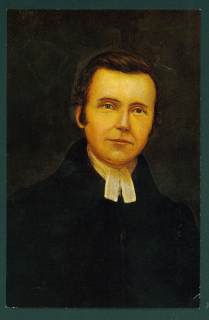
Birth of Philip Embury, Methodist Preacher

Philip Embury

Philip Embury, Methodist preacher and a leader of one of the earliest Methodist congregations in the United States, is born in Ballingrane, County Limerick on September 21, 1729.

Embury’s parents are members of the colony of Germans that emigrate from the Palatinate to Ireland early in the eighteenth century, and in which Methodism co-founder John Wesley labors with great success. The colony forms from refugees from the War of the Spanish Succession. Embury is educated at a school near Ballingrane and learns the carpentry trade. He is converted on Christmas day 1752, becomes a local preacher at Court-Matrix in 1758 and marries Margaret Switzer that fall.

In 1760, due to rising rents and scarce land, he goes to New York City and works as a schoolteacher. In common with his fellow emigrants, he begins to lose interest in religious matters and does not preach in New York until 1766 when, moved by the reproaches of his cousin Barbara Heck, sometimes called the “mother of American Methodism,” he begins to hold services first in his own house on Barrack Street, now Park Place, and then in a rigging loft on what is now William Street. The congregation thus forms what is probably the first Methodist congregation in the United States, though it is a disputed question whether precedence should not be given to Robert Strawbridge, who begins laboring in Maryland about this time. Before this, he and Barbara Heck worship along with other Irish Palatines at Trinity Church in Manhattan, where three of his children are baptized.

The first Methodist church is built under Embury’s charge in 1768, in association with Thomas Webb and others, on the site of the present John Street United Methodist Church. He himself works on the building as a carpenter and afterward preaches there gratuitously. In 1769, preachers sent out by John Wesley arrive in New York City, and Embury goes to work in the vicinity of Albany at Camden Valley, New York, where he continues to work at his trade during the week and preaches every Sunday. He and several others receive a grant of 8,000 acres to develop for the manufacture of linen. He organizes among Irish emigrants at Ashgrove, near Camden Valley, the first Methodist society within the bounds of what becomes the flourishing and influential Troy Conference.

Philip Embury dies suddenly in Camden, New York in August 1775, in consequence of an accident in mowing. He is buried on a neighboring farm but in 1832 his remains are removed to Ashgrove churchyard and in 1866 to Woodland cemetery, Cambridge, New York, where a monument to him is unveiled in 1873, with an address by Bishop Matthew Simpson.

(Pictured: Portrait of Philip Embury by John Barnes, Salem, 1773)

Leave a comment

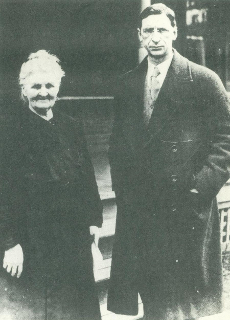
Alleged Marriage of Catherine Coll & Juan Vivion de Valera

catherine-and-eamon-de-valera

Allegedly, Catherine Coll and Juan Vivion de Valera are married in St. Patrick’s Church, Greenville, New Jersey on September 19, 1881. They are the parents of Irish statesman and politician Éamon de Valera, who serves as the 3rd President of Ireland and Taoiseach.

Catherine Coll is born on December 21, 1856, in Bruree, County Limerick and emigrates to New York City in 1879. She first takes a job with a wealthy French family that is living in Manhattan. This is where she allegedly meets Juan Vivion de Valera (born 1854), a Spanish sculptor who comes to the home of her employers to give music lessons to the children.

It is alleged that Vivion de Valera, always in poor health, leaves his young family behind in 1885 and travels to Colorado, hoping that perhaps the healthier air will help him out only to die within a few months.

Though Éamon de Valera’s official biography (Longford/O’Neill, Hutchinson, London, 1970) states that his parents were married at St. Patrick’s Church on September 19, 1881, the parish records show no record of any Coll–de Valera wedding either at St. Patrick’s or any church, nor were any civil records found, in the vicinity during the period from 1875 to 1887. Also, initially de Valera is not registered in his father’s name.

However, not merely is there no record of the wedding. No record exists of the existence of a “Juan Vivion de Valera” anywhere in the United States: no birth certificate, no baptismal certificate (if he was a Catholic), no marriage certificate and no death certificate. While it is possible that he was born abroad and so either had a foreign birth certificate or was not registered, the absence of a death certificate for someone stated definitely in Éamon de Valera’s family history to have died in the United States has puzzled researchers. Some scholars have questioned whether Juan Vivion de Valera ever existed.

There has been a mischievous suggestion that he was related to the French painter Achille Devéria as Éamon de Valera “was known to be particularly fond of his works.” This claim is hardly likely given that Devéria was a painter of erotica, and de Valera nothing if not a prude. It should also be noted that Devéria died in 1857, at least 20 years before Éamon de Valera was born.

It has also been alleged by some that Catherine Coll invented Juan de Valera to give her son legitimacy.

(Pictured: Irish republican leader and founder of Fianna Fail, Éamon de Valera, with his mother Catherine Coll, April 01, 1927)


Leave a comment

Birth of Maura O’Connell, Singer & Actress

maura-oconnell

Maura O’Connell, singer and actress known for her contemporary interpretations of Irish traditional music, strongly influenced by American country music, is born on September 16, 1958, in Ennis, County Clare.

Born into a musical family, O’Connell is the third of four sisters. Her mother’s family owns Costello’s fish shop in Ennis where O’Connell works until music becomes her full-time career. She grows up listening to her mother’s light opera, opera, and parlour music records. Her father’s interest leans towards the rebel ballads. Despite the presence of classical music in the house, O’Connell gets very involved in the local folk club scene and together with Mike Hanrahan, who later fronts folk rock outfit Stockton’s Wing, they perform a country music set, as a duo called “Tumbleweed.”

O’Connell attends St. Joseph’s Secondary School in Spanish Point from 1971 to 1974, where she takes part in the school choir. She is also a member of the “Cúl Aodha Choir”, led by Peader Ó Riada, that sings at the funeral of Willie Clancy in 1973.

O’Connell begins her professional musical journey during a six-week tour of the United States in 1980, as vocalist for the traditionally based Celtic group De Dannan. The following year, she is featured on the band’s landmark album, The Star Spangled Molly, which becomes something of a national phenomenon in her homeland. However, not long after joining the group she becomes very interested in the experimental roots music of America’s New Grass Revival when the bands’ paths cross. She moves to the United States in 1986, settling in Nashville, Tennessee. There she meets progressive bluegrass pioneers Béla Fleck and Jerry Douglas, with whom she works on most of her records.

O’Connell records her first solo album in 1983, however, it does not make any impact in Ireland or in the United States. She receives a Grammy Award nomination for her 1989 album, Helpless Heart, which is her first record released under Warner Bros. Records. Real Life Story (1990) and Blue is the Colour of Hope (1992) register a move toward a pop synthesis. Her versions of “Living in These Troubled Times” and Cheryl Wheeler‘s “Summerfly” become standout tracks on the 1993 album A Woman’s Heart, on four all-female overseas tours and on the 1994 follow-up album in her homeland. A Woman’s Heart Vol. 2 features her heartfelt renditions of Nanci Griffith‘s “Trouble in the Fields” and Gerry O’Beirne’s “Western Highway.” After numerous albums heavily inspired by American newgrass music, she returns to her Irish roots with the 1997 release Wandering Home.

As the new millennium approaches, O’Connell signs with Sugar Hill Records in late 2000 and begins working on her seventh album. Instead of working with her longtime producer Jerry Douglas, she has Ray Kennedy produce Walls and Windows, which is released in 2001, and features an eclectic collection of songs, including work by Kim Richey, Van Morrison, John Prine, Eric Clapton and Patty Griffin. Her 2004 album, Don’t I Know, contains musical textures added by everything from fiddles to clavinets, to lap steel guitar and B-3 organ.

Naked With Friends (2009) is O’Connell’s first a cappella album. Guest vocalists include Mary Black, Paul Brady, Moya Brennan, Jerry Douglas, Alison Krauss, Mairéad Ní Mhaonaigh, Tim O’Brien, Dolly Parton, Sarah Dugas, Kate Rusby and Darrell Scott. The album is nominated for a Grammy Award.

In addition to her solo work, O’Connell has collaborated with a number of Celtic, folk, pop and country artists, including Van Morrison, Brian Kennedy, Moya Brennan, Mary Black, John Prine, Jerry Douglas, Tim O’Brien, John Gorka, Béla Fleck, Robert Earl Keen, Dolly Parton and Shawn Colvin. She has also sung background vocals for a number of artists, including Van Morrison’s 1988 project with The Chieftains, Irish Heartbeat and Stockton’s Wing on Take A Chance.

Aside from the music world, Martin Scorsese casts O’Connell, scruffed up for the role, as an Irish migrant street singer in his 19th-century epic Gangs of New York, released in 2002.

O’Connell announces the end of her solo career in 2013.


Leave a comment

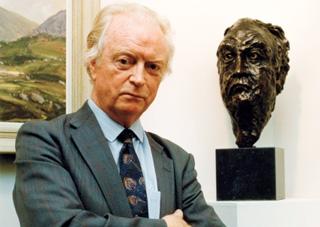
Death of J.P. Donleavy, Novelist & Playwright

jp-donleavy

James Patrick Donleavy, Irish American novelist and playwright, dies in Mullingar, County Westmeath on September 11, 2017. His best-known work is the novel The Ginger Man, which is initially banned for obscenity.

Born in New York City on April 23, 1926, to Irish immigrants Margaret and Patrick Donleavy, Donleavy receives his education at various schools in the United States. He declares himself to be an atheist at the age of 14. He serves in the United States Navy during World War II. After the war ends, he moves to Ireland. In 1946 he begins studying at Trinity College, Dublin, but leaves in 1949 before taking a degree. Also in 1946, he marries Valerie Heron, and the couple has two children: Philip (born 1951) and Karen (born 1955). They divorce in 1969 and he remarries in 1970 to Mary Wilson Price. That union also ends in divorce in 1989.

Donleavy’s first published work is a short story entitled A Party on Saturday Afternoon, which appears in the Dublin literary periodical, Envoy, A Review of Literature and Art in 1950. He gains critical acclaim with his first novel, The Ginger Man (1955), which is one of the Modern Library 100 best novels. The novel, of which his friend and fellow writer Brendan Behan is the first person to read the completed manuscript, is banned in Ireland and the United States by reason of obscenity. Lead character Sebastian Dangerfield is in part based on Trinity College companion Gainor Crist, an American Navy veteran also studying at Trinity College on the G.I. Bill, whom Donleavy once describes in an interview as a “saint,” though of a Rabelaisian kind.

Correctly or incorrectly, his initial works are sometimes grouped with the Kitchen Sink artists as well as the “angry young men.” Another novel, A Fairy Tale of New York, provides the title of The Pogues hit song “Fairytale of New York.”

In March 2007, Donleavy is the castaway on BBC Radio 4‘s Desert Island Discs. In 2015, he is the recipient of the Bob Hughes Lifetime Achievement Award at the Bord Gáis Energy Irish Book Awards.

In 2011, it is reported that Donleavy had not fathered his two children with Mary Wilson Price. A DNA test in the early 1990s confirms that Rebecca is the daughter of brewing scion Kieran Guinness, and Rory is the son of Kieran’s older brother Finn, whom Price marries after her divorce from Donleavy. “My interest is only to look after the welfare of the child,” Donleavy tells The Times, “And after a certain stage, you can’t worry about their parentage.”

J.P. Donleavy dies of an apparent stroke in Mullingar, County Westmeath on September 11, 2017, at the aged of 91.


Leave a comment

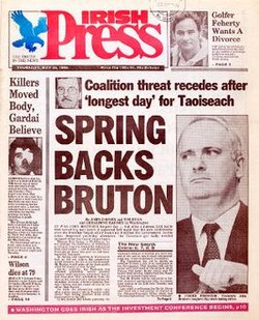
First Edition of the “Irish Press” Published

irish-press-may-25-1995

The first edition of the Irish Press, a Dublin daily newspaper founded by Éamon de Valera as a platform for Fianna Fáil, is published on September 5, 1931.

Irish Press Ltd. is officially registered on September 4, 1928, three years before the paper is first published, to create a newspaper independent of the existing media where the Independent Newspapers group is seen as supporting Cumann na nGaedheal/Fine Gael, and The Irish Times being pro-union, and with a mainly middle-class or Protestant readership.

The paper’s first issue is published on the eve of the 1931 All-Ireland Senior Hurling Championship Final between Cork and Kilkenny. Other newspapers do not cover GAA sports in any detail at the time. Margaret Pearse, the mother of Patrick and Willie Pearse, presses the button to start the printing presses. The initial aim of its publisher is to achieve a circulation of 100,000 which it quickly accomplishes. It goes on to list 200,000 subscribers at its peak.

The money to launch the Irish Press is raised in the United States during the Irish War of Independence by a bond drive to finance the First Dáil. Five million dollars is raised; however, 60 percent of this money is left in various banks in New York City. No one knows why de Valera ordered the bulk of the money to be left in New York when he returned to Ireland in late 1920.

In 1927, as a result of legal action between the Irish Free State government and de Valera, a court in New York orders that the bond holders be paid back outstanding money due to them. However, de Valera’s legal team has anticipated the ruling and has prepared for the outcome. A number of circulars are sent to the bond holders asking them to sign over their holdings to de Valera. The bond holders are paid 58 cents to the dollar. This money is then used as startup capital to launch the Irish Press. Following the 1933 Irish General Election, de Valera uses his Dáil Éireann majority to pass a measure allowing the bond holders to be paid the remaining 42 percent of the money still owed.

In December 1931, editor Frank Gallagher is prosecuted by an Irish Free State military tribunal for publishing articles alleging that Garda Síochána had mistreated the Anti-Treaty republicans of the Irish Free State government. This is facilitated by Amendment 17 of the Constitution of the Irish Free State and Gallagher is convicted and fined £50. An example of animosity from those who support Independent Newspapers and the Free State government is that the Irish Press is excluded from the special train which delivers newspapers from Dublin to the countryside. As a result, it is circulated throughout Ireland by a specially rented train.

The Irish Press sustains itself with its own resources until The Sunday Press is founded in 1949. In its heyday, the Irish Press has a number of first-rate reporters and columnists. One notable section, New Irish Writing is edited by David Marcus.

In the 1970s, the Minister for Posts and Telegraphs, Conor Cruise O’Brien, tries to use and amend The Emergency Powers Act and Section 31 of the Broadcasting Authority Act, to censor coverage of the Troubles in Northern Ireland. The Irish Press editor, Tim Pat Coogan, publishes editorials attacking the Bill. The Fine Gael/Labour Coalition Government tries to prosecute the Irish Press for its coverage of the maltreatment of republican prisoners by the Garda “Heavy Gang,” with the paper winning the case.

The Irish Press starts two further newspapers, the Evening Press (1954), and The Sunday Press. The Evening Press is aimed at an urban readership and achieves a daily circulation of 100,000. The new newspapers subsidise the Irish Press when its circulation sags. Its adoption of a tabloid format does not rescue its declining circulation.

The final issue of the Irish Press and Evening Press is on Thursday, May 25, 1995. The newspapers close because of a bizarre industrial dispute over the sacking of the group business editor, Colm Rapple. The group has not been in a healthy financial state for several years. When it eventually closes, with indebtedness of £20 million, 600 people lose their jobs.

(Pictured: Cover of last ever edition of the Irish Press from May 25, 1995)


Leave a comment

Birth of Film Director Roy William Neill

roy-william-neillRoy William Neill, English film director best known for directing the last eleven of the fourteen Sherlock Holmes films starring Basil Rathbone and Nigel Bruce, is born on September 4, 1887. These films were made between 1943 and 1946 and released by Universal Studios.

With his father as the captain, Neill is born on a ship off the coast of Ireland. His birth name is Roland de Gostrie. He begins directing silent films in 1917 and goes on to helm 107 films, 40 of them silent. Although most of his films are low-budget B-movies, he is known for directing films with meticulously lit scenes with carefully layered shadows that become the style of film noir in the late 1940s. In fact, his last film, Black Angel (1946), is considered a film noir.

Neill is also credited in some works as R. William Neill, Roy W. Neill, and Roy Neill. He lives in the United States for most of his career and is a U.S. citizen. He does go to London from 1935 until 1940 where better opportunities exist for American directors. During this period, British film producer Edward Black hires him to direct The Lady Vanishes. However, due to delays in production, Black hires Alfred Hitchcock to direct instead.

Roy William Neill dies at the age of 59 from a heart attack in London, England on December 14, 1946.


Leave a comment

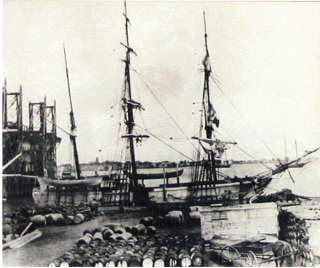
The Catalpa Rescue

catalpa

The whaling ship Catalpa is given a tumultuous welcome as it sails into New York harbor on August 19, 1876. She has no whales on board, but a far more valuable cargo, six Fenian prisoners from the British penal colony of Western Australia.

Clan na Gael‘s John Devoy, with the help of his friend John Boyle O’Reilly, a Fenian who had once escaped from Australia himself and editor of the Boston newspaper The Pilot, plan the escape. Somehow maintaining the secrecy of the mission, the two arrange to buy and crew the whaler Catalpa, purchased in New Bedford, Massachusetts, for the attempt.

The Catalpa sets out in April 1875 with most of the crew unaware of their actual mission. They reach western Australia in March 1876.

The first intended day for escape from the penal colony is April 6, but the appearance of HMS Convict and other Royal Navy ships and customs officers quickly lead to a postponement. The escape is rearranged for April 17, when most of the Convict Establishment garrison is watching the Royal Perth Yacht Club regatta.

Catalpa drops anchor in international waters off Rockingham and dispatches a whaleboat to shore. At 8:30 AM, six Fenians, Thomas Darragh, Martin Hogan, Michael Harrington, Thomas Hassett, Robert Cranston and James Wilson, who are working in work parties outside the prison walls abscond. They are met by Fenian agents John Breslin and Thomas Desmond and picked up in horse traps. A seventh Fenian, James Kiely, is left behind. The men race 12 miles south to Rockingham pier where Captain George Smith Anthony awaits them with the whaleboat. A local named Bell he had spoken to earlier sees the men and quickly alerts the authorities.

As they row to the Catalpa a fierce squall strikes, breaking the whaleboat’s mast. The storm lasts until dawn on April 18 and is so intense that Anthony later states that he did not expect the small boat to survive. At 7:00 AM, with the storm over, they again make for the Catalpa but an hour later spot the screw steamer SS Georgette, which has been commandeered by the colonial governor, heading for the whaler. The men lay down in the whaleboat and it is not seen by the SS Georgette. The SS Georgette finds the Catalpa, but in Captain Anthony’s absence the First Mate refuses to allow the colonial police to board as the ship is outside the colony’s three-mile limit. The steamer is forced to return to Fremantle for coal after following the Catalpa for several hours.

As the whaleboat again makes for the ship a police cutter with 30 to 40 armed men is spotted. The two boats race to reach the Catalpa first, with the whaleboat winning, and the men climbing aboard as the police cutter passes by. The cutter turns, lingers briefly beside the Catalpa, and then heads to shore.

Early on April 19 the refuelled and now heavily armed SS Georgette returns and comes alongside the whaler, demanding the surrender of the prisoners and attempting to herd the ship back into Australian waters. They fire a warning shot with the 12-pounder cannon that had been installed the night before. Ignoring the demand to surrender, Anthony raises and then points towards the U.S. flag, informing the SS Georgette that an attack on the Catalpa will be considered an act of war against the United States, and proceeds westward.

Governor William Cleaver Robinson has ordered the police on the SS Georgette not to create an incident outside territorial waters. After steaming around threateningly for about an hour, the SS Georgette heads back to Fremantle and Catalpa slips away into the Indian Ocean.

The Catalpa does its best to avoid Royal Navy ships on its way back to the United States. O’Reilly receives the news of the escape on June 6 and releases the news to the press. The news sparks celebrations in the United States and Ireland and anger in Britain and Australia, although there is also sympathy for the cause within the Australian population. The Catalpa arrives in New York Harbor on August 19, 1876. Clan na Gael and the Fenians achieve one of their greatest victories over the British Empire.


Leave a comment

Birth of Benedict Kiely, Writer & Broadcaster

benedict-kiely

Benedict “Ben” Kiely, Irish writer and broadcaster, is born in Dromore, County Tyrone on August 15, 1919, the youngest of six children.

In 1920, the family moves from Dromore to Omagh. After living for a short time in Castle Street and Drumragh, the family finally settles in St. Patrick’s Terrace in the Gallows Hill area of Omagh. This area is to be a lasting inspiration for Kiely.

Kiely begins to feel the urge to become a writer during his teenage years. He has a keen interest in the work of George Bernard Shaw, H. G. Wells and Jonathan Swift. In 1936, after completing his education at Mount St. Columba Christian Brothers School in Omagh, he goes to work as a sorting clerk in the Omagh Post Office.

However, Kiely soon realises that the post office will not provide him with the life of the scholar which he so desires. In the spring of 1937, he leaves Omagh and begins a new life in Emo Park, Portarlington, County Laois, where he decides to train as a Jesuit priest. His life as a Jesuit is not meant to be for, exactly a year later, in the spring of 1938, he suffers a serious spinal injury, which results in a lengthy stay in Cappagh National Orthopaedic Hospital in Finglas, Dublin. During his hospitalisation, he is given plenty of time to think about the course his life has already taken, and about a course it might take. He also realises that he lacks a vocation to the priesthood and abandons his training as a Jesuit.

When Kiely gets out of hospital in 1939, he returns to Omagh to recover from his back problem. The following year, he begins working as a part-time journalist in the weekly Catholic Standard newspaper. In 1943, he graduates from National University of Ireland with a B.A. in History and Letters.

In 1945, Kiely begins working for the Irish Independent, where he is employed as a journalist and critic. In 1950, he joins The Irish Press as a literary editor. In 1964, he moves to the United States where, over a period of four years, he is a Writer-in-Residence at Emory University, visiting professor at the University of Oregon, and Writer-in-Residence at Hollins College (Virginia). In 1968, he returns to Ireland. In the spring of 1976, he is Distinguished Visiting Professor at the University of Delaware. He continues to receive acclaim for his writing and journalism, a career which spans over six decades, receiving the Award for Literature from the Irish Academy of Letters. By now, he is one of Ireland’s best-known writers. In 1996, he is named Saoi of Aosdána, the highest honour given by the Arts Council of Ireland.

Kiely visits Omagh in 2001 which is marked by the unveiling of a plaque outside his childhood home on Gallows Hill by Omagh’s Plain Speaking Community Arts group. Every September an event is held in Omagh called The Benedict Kiely Literary Weekend to celebrate his many achievements.

Benedict Kiely dies in St. Vincent’s University Hospital in Dublin on February 9, 2007.


Leave a comment

Transatlantic Cable Brought Ashore at Killala

transatlantic-cable-county-mayo

A $300 million transatlantic cable is brought ashore on Ross Strand in Killala, County Mayo on August 14, 2015. The fiber optic cable will enable a super-fast Internet connection and is expected to be a major economic boost for the West.

The Irish Lights vessel Granuaile begins laying the cable a few hundred metres offshore. Divers pull the cable ashore while the ship continues laying to a point about 4 km offshore. From there another vessel, the Reliance, takes over the task, relay-race like, and begins laying further out towards the United States.

The fiber optic cable is owned and operated by Irish company Aqua Comms and will run directly from Ross Strand in Killala to Long Island, New York. It has the capacity to handle up to one third of the world’s telephone calls and can cover the entire Internet traffic of Europe and the United States. The system will enable 53.8 millisecond transfer speeds across the Atlantic Ocean when it goes live in early 2016.

Silicon Republic describes Mayo as “Europe’s entry point to a vastly superior service when construction is completed by next year.” These connections are expected to create “thousands of jobs” in data centre operations. It will have a 53.8 millisecond latency and be capable of handling a third of the world’s phone calls, with over 1.6 million simultaneous Ultra HD video channels, or over 32 million LTE wireless callers.

CEO Martin Roche says, “It will also be the most secure transatlantic cable system, due to the carefully mapped route and the design built into the construction of this project.”

Taoiseach Enda Kenny says, “This new digital infrastructure is essential to help create jobs and new business opportunities across Ireland.” He also added, “This is the most important landing since [French general] Humbert in 1798.”

Local councillor Jarlath Munnelly says the project could “transform” Killala and the north Mayo region. “This is an exciting project, which I am enthusiastically supportive of. It has the potential to transform North Mayo, not just Killala, by enhancing the telecommunications infrastructure in the area, and putting Ireland and Mayo into the centre of a global network,” said the councillor.


Leave a comment

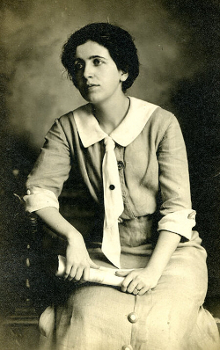
Birth of Elizabeth Gurley Flynn, Activist & Feminist

elizabeth-gurley-flynn

Elizabeth Gurley Flynn, labor leader, activist, and feminist who played a leading role in the Industrial Workers of the World (IWW), is born in Concord, New Hampshire on August 7, 1890. She is a founding member of the American Civil Liberties Union and a visible proponent of women’s rights, birth control, and women’s suffrage.

Flynn’s family moves to New York in 1900, where she is educated in the local public schools. She grows up being regaled by tales of Irish revolutionaries. According to their oral tradition all four of her great-grandfathers, Flynn, Gurley, Conneran, and Ryan, are members of the Society of United Irishmen, with grandfather Flynn being one of the leaders in County Mayo when the French fleet lands there during the Irish Rebellion of 1798. Her parents introduce her to socialism. When she is only fifteen, she gives her first public speech, “What Socialism Will Do for Women,” at the Harlem Socialist Club.

In 1907, Flynn becomes a full-time organizer for the Industrial Workers of the World. Over the next few years, she organizes campaigns among garment workers in Pennsylvania, silk weavers in New Jersey, restaurant workers in New York, miners in Minnesota, Missoula, Montana, and Spokane, Washington and textile workers in Massachusetts. She is arrested ten times during this period but is never convicted of any criminal activity. It is a plea bargain, on the other hand, that results in her expulsion from the IWW in 1916, along with fellow organizer Joe Ettor.

A founding member of the American Civil Liberties Union (ACLU) in 1920, Flynn plays a leading role in the campaign against the conviction of Nicola Sacco and Bartolomeo Vanzetti. She is particularly concerned with women’s rights, supporting birth control and women’s suffrage. She also criticizes the leadership of trade unions for being male-dominated and not reflecting the needs of women.

Between 1926 and 1936, Flynn lives in southwest Portland, Oregon with birth control activist, suffragette, and Wobbly Marie Equi where she is an active and vocal supporter of the 1934 West Coast Longshoremen’s Strike. In 1936, she joins the Communist Party and writes a feminist column for its journal, the Daily Worker. Two years later, she is elected to the national committee. Her membership in the Party leads to her ouster from the board of the ACLU in 1940.

During World War II, Flynn plays an important role in the campaign for equal economic opportunity and pay for women and the establishment of day care centers for working mothers. In 1942, she runs for the United States Congress at-large in New York and receives 50,000 votes. In July 1948, a dozen leaders of the Communist Party are arrested and accused of violating the Smith Act by advocating the overthrow of the U.S. government by force and violence. After they are convicted in the Foley Square trial they appeal to the Supreme Court, which upholds their conviction in Dennis v. United States.

Flynn launches a campaign for their release but, in June 1951, is herself arrested in the second wave of arrests and prosecuted under the Smith Act. After a nine-month trial, she is found guilty and serves two years in Federal Prison Camp, Alderson near Alderson, West Virginia. She later writes a prison memoir, The Alderson Story: My Life as a Political Prisoner.

After her release from prison, Flynn resumes her activities for leftist and Communist causes. She runs for the New York City Council as a Communist in 1957, garnering a total of 710 votes. She becomes national chairwoman of the Communist Party of the United States in 1961 and makes several visits to the Soviet Union.

Elizabeth Gurley Flynn dies on September 5, 1964, while on one of her visits to the Soviet Union. The Soviet government gives her a state funeral in Red Square with over 25,000 people attending. In accordance with her wishes, her remains are flown to the United States for burial in Chicago‘s German Waldheim Cemetery, near the graves of Eugene Dennis, Bill Haywood, Emma Goldman, and the Haymarket Riot Martyrs.

In 1978, the ACLU posthumously reinstates her membership.